

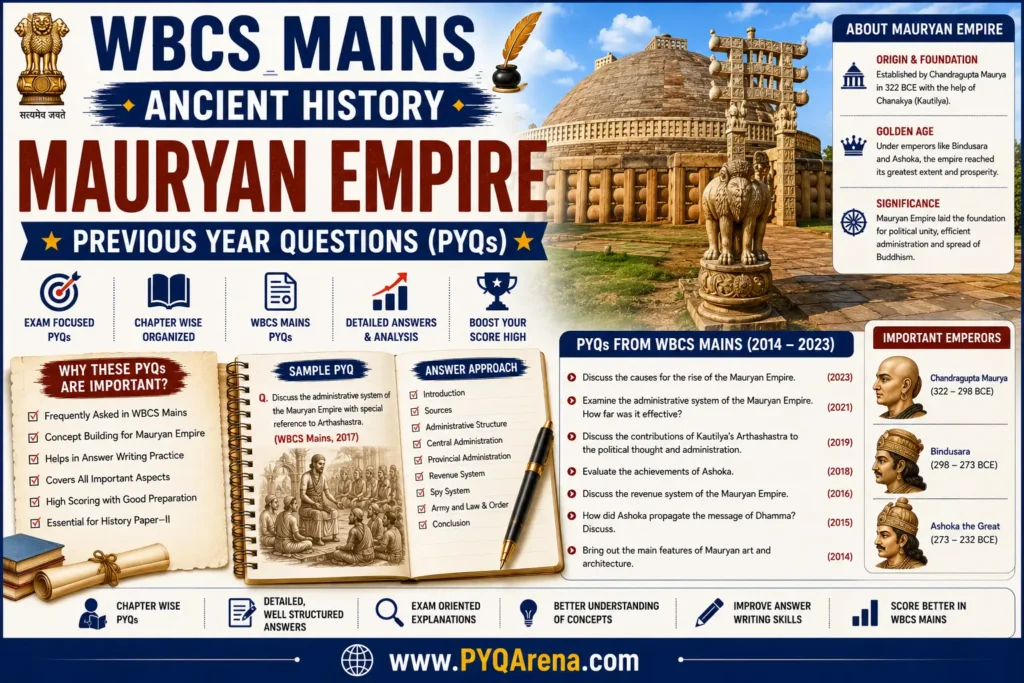
WBCS Mains Pre-Mauryan & Mauryan Empire Questions 2023
Q. During Alexander’s invasion who was the then ruler of Magadha?
(A) Dhanananda
(B) Chandragupta Maurya
(C) Puru
(D) Ambhi
Answer & Explanation
Correct Answer: (A) Dhanananda
Explanation
During Alexander’s invasion of India in 326 BCE, Dhanananda was the ruler of Magadha and the last ruler of the Nanda dynasty. Alexander did not invade Magadha because his exhausted army refused to advance beyond the Beas (Hyphasis) River. Greek accounts indicate that the enormous military strength of the Nanda kingdom also contributed to the soldiers’ reluctance to proceed further east.
Exam Facts
- Dhanananda → last ruler of the Nanda dynasty.
- Magadha was ruled by the Nanda dynasty when Alexander invaded northwestern India.
- Alexander entered India in 326 BCE and fought King Porus (Puru) in the Battle of the Hydaspes (Jhelum).
- Ambhi (Omphis) was the ruler of Taxila and allied himself with Alexander.
- Alexander’s army refused to cross the Beas (Hyphasis) River, forcing him to abandon his planned eastward advance.
- Chandragupta Maurya founded the Mauryan Empire shortly after Alexander’s withdrawal and eventually overthrew the Nanda dynasty.
- Dhanananda → Nanda dynasty; Chandragupta Maurya → Maurya dynasty; Puru → ruler of the Paurava kingdom; Ambhi → ruler of Taxila.
Q. Which Mahajanapada of 6th century BCE was an aristocratic-oligarchic republic (a confederacy of eight clans governed in accordance with republican principles)?
(A) Magadha
(B) Vajji
(C) Kashi
(D) Koshala
Answer & Explanation
Correct Answer: (B) Vajji
Explanation
Vajji (Vrijji) was an important republican Mahajanapada of the 6th century BCE. It was a confederacy of several clans, traditionally described as consisting of eight clans, with the Licchavis being the most prominent. Its political centre was Vaishali, and governance was based on an aristocratic-oligarchic republican system rather than hereditary monarchy.
Exam Facts
- Vajji → aristocratic-oligarchic republic/confederacy.
- Its principal centre was Vaishali, in present-day Bihar.
- The Licchavis were the most prominent clan within the Vajji confederacy.
- The Vajji confederacy is traditionally described as consisting of eight clans.
- Magadha, Kashi and Kosala were primarily monarchical Mahajanapadas.
- Ajatashatru, the ruler of Magadha, eventually defeated the Vajji confederacy after a prolonged conflict.
- The Mahaparinibbana Sutta describes the Vajjians as following established political practices, including frequent assemblies and collective decision-making.
- Vajji and Malla are important examples of republican or gana-sangha political traditions in ancient India.
Q. Which dynasty ruled over Magadha before Mauryan dynasty?
(A) Satavahana
(B) Sunga
(C) Nanda
(D) Kanva
Answer & Explanation
Correct Answer: (C) Nanda
Explanation
The Nanda dynasty ruled over Magadha immediately before the Mauryan dynasty. The last Nanda ruler, Dhanananda, was overthrown by Chandragupta Maurya with the assistance of Chanakya (Kautilya) around 321 BCE, leading to the establishment of the Mauryan Empire.
Exam Facts
- Nanda dynasty → immediately before Mauryan dynasty in Magadha.
- Dhanananda was the last ruler of the Nanda dynasty.
- Chandragupta Maurya overthrew the Nandas and established the Mauryan Empire.
- Mahapadma Nanda is traditionally regarded as the founder and most powerful early ruler of the Nanda dynasty.
- The Nandas are remembered for maintaining a large and powerful army.
- The Mauryan dynasty was founded by Chandragupta Maurya around 321 BCE.
- The Shunga dynasty succeeded the Mauryas, with Pushyamitra Shunga overthrowing the last Mauryan ruler Brihadratha.
- Satavahanas and Kanvas belonged to later periods and did not rule Magadha immediately before the Mauryas.
Q. Which was the Capital City of Magadha during the reign of Chandragupta Maurya?
(A) Amaravati
(B) Pataliputra
(C) Ujjain
(D) Kannauj
Answer & Explanation
Correct Answer: (B) Pataliputra
Explanation
Pataliputra was the capital of Magadha and the administrative centre of the Mauryan Empire during the reign of Chandragupta Maurya. Located near the confluence of major rivers in present-day Patna, Bihar, Pataliputra developed into one of the most important political centres of ancient India.
Exam Facts
- Chandragupta Maurya → Pataliputra as the capital.
- Pataliputra is identified with modern-day Patna, Bihar.
- Udayin, a ruler of the Haryanka dynasty, is traditionally credited with shifting the Magadhan capital from Rajagriha (Rajgir) to Pataliputra.
- Pataliputra became the political centre of the Mauryan Empire under Chandragupta Maurya.
- Megasthenes, the Greek ambassador to Chandragupta Maurya’s court, described Pataliputra as a large and well-organized city in his work Indica.
- Ujjain was an important Mauryan provincial centre, particularly in western India, but was not the imperial capital.
- Amaravati was an important centre of the Satavahana period, while Kannauj became prominent as a political centre much later.
Q. Who composed the ‘Artha Sastra’?
(A) Kautilya
(B) Barahamihira
(C) Aryabhatta
(D) Patanjali
Answer & Explanation
Correct Answer: (A) Kautilya
Explanation
The Arthashastra is traditionally attributed to Kautilya, also known as Chanakya or Vishnugupta. It is a comprehensive treatise on statecraft, administration, economics, diplomacy, law, taxation and military strategy. Kautilya is traditionally associated with the court of Chandragupta Maurya and played an important role in the establishment of the Mauryan Empire.
Exam Facts
- Arthashastra → Kautilya (Chanakya/Vishnugupta).
- It deals with politics, administration, taxation, economy, diplomacy, espionage and warfare.
- Kautilya is traditionally regarded as the chief adviser of Chandragupta Maurya.
- The work describes an extensive spy network and methods of maintaining political stability.
- The Saptanga theory of the state identifies seven elements of the state: Swamin, Amatya, Janapada, Durga, Kosa, Danda and Mitra.
- Aryabhata → Aryabhatiya, a major work on mathematics and astronomy.
- Varahamihira → Brihat Samhita and Brihat Jataka, important works on astronomy and astrology.
- Patanjali → Mahabhashya, a major Sanskrit grammatical commentary on Panini’s tradition.
WBCS Mains Pre-Mauryan & Mauryan Empire Questions 2022
Q. ‘Arthashastra’ was written by
(A) Chandragupta
(B) Bimbisara
(C) Kautilya
(D) None of the above
Answer & Explanation
Correct Answer: (C) Kautilya
Explanation
The Arthashastra is traditionally attributed to Kautilya, also known as Chanakya or Vishnugupta. It is an important ancient Indian treatise dealing with statecraft, administration, economics, taxation, diplomacy, espionage and warfare. Kautilya is traditionally regarded as the adviser and mentor of Chandragupta Maurya, the founder of the Mauryan Empire.
Exam Facts
- Arthashastra → Kautilya (Chanakya/Vishnugupta).
- Kautilya was traditionally the chief adviser of Chandragupta Maurya.
- The Arthashastra deals extensively with government, economy, taxation, law, diplomacy and military administration.
- Its Saptanga Theory describes seven elements of the state: Swamin, Amatya, Janapada, Durga, Kosa, Danda and Mitra.
- The Mandala Theory in the Arthashastra deals with inter-state relations and foreign policy.
- The text gives considerable importance to intelligence gathering and espionage as instruments of governance.
- Chandragupta Maurya founded the Mauryan Empire, while Bimbisara was an earlier ruler of the Haryanka dynasty of Magadha.
Q. Bimbisara was from the
(A) Gupta Dynasty
(B) Haryanka Dynasty
(C) Maurya Dynasty
(D) Khilji Dynasty
Answer & Explanation
Correct Answer: (B) Haryanka Dynasty
Explanation
Bimbisara was an important ruler of Magadha and is generally regarded as the founder or early consolidator of the Haryanka dynasty. He ruled during the 6th century BCE and significantly expanded Magadha through military conquests and diplomatic marriages. He was also a contemporary and patron of Gautama Buddha and Mahavira.
Exam Facts
- Bimbisara → Haryanka Dynasty.
- He ruled Magadha approximately from c. 543 to 492 BCE according to traditional chronology.
- He made Rajagriha (Rajgir) an important centre of the Magadhan kingdom.
- Bimbisara expanded Magadha through the conquest of Anga.
- He strengthened diplomatic relations through marriage alliances with neighbouring ruling families.
- He was a contemporary of Gautama Buddha and Mahavira and is mentioned in Buddhist and Jain traditions.
- Ajatashatru, his son, succeeded him and expanded Magadha further.
- The Haryanka dynasty was followed in Magadha by the Shishunaga dynasty, and later the Nanda dynasty.
Q. The Battle of Hydaspas was fought between
(A) Bimbisara and Ajatasatru
(B) Bimbisara and Porus
(C) Porus and Alexander
(D) None of the above
Answer & Explanation
Correct Answer: (C) Porus and Alexander
Explanation
The Battle of Hydaspes was fought in 326 BCE between Alexander the Great and King Porus (Puru) of the Paurava kingdom. The battle took place on the banks of the Hydaspes River (modern Jhelum River) in the northwestern Indian subcontinent. Although Alexander won the battle, he was impressed by Porus’s courage and allowed him to continue ruling his territory under Alexander’s authority.
Exam Facts
- Battle of Hydaspes → 326 BCE → Alexander vs Porus.
- Hydaspes River → modern Jhelum River.
- The battle was fought during Alexander’s Indian campaign.
- Porus was the ruler of the Paurava kingdom in the northwestern region.
- Alexander used a crossing operation during a stormy night to cross the river and surprise Porus.
- Porus fought with a large force that included war elephants, which posed a significant challenge to Alexander’s army.
- Alexander won the battle but treated Porus with respect and reportedly allowed him to retain his kingdom.
- After reaching the Beas River, Alexander’s troops refused to advance farther east, forcing him to turn back.
Q. The Maurya Emperor who propounded the concept of “Dhamma” had been
(A) Chandragupta
(B) Bindusara
(C) Ashoka
(D) None of the above
Answer & Explanation
Correct Answer: (C) Ashoka
Explanation
Ashoka, the third major ruler of the Mauryan Empire, propagated the concept of Dhamma after the Kalinga War. His Dhamma was a broad ethical and social code emphasizing non-violence, compassion, respect for elders, religious tolerance, kindness and welfare of living beings. It was not simply a synonym for Buddhism but a practical moral policy intended to promote social harmony.
Exam Facts
- Dhamma → propagated by Emperor Ashoka.
- Ashoka’s transformation was strongly influenced by the Kalinga War (c. 261 BCE) and its enormous human suffering.
- His Dhamma emphasized Ahimsa, compassion, tolerance, obedience to parents and respect for teachers and elders.
- Ashoka communicated his Dhamma through Rock Edicts and Pillar Edicts across his empire.
- He appointed special officers called Dhamma Mahamatras to promote the principles of Dhamma.
- Major Rock Edict XIII describes Ashoka’s remorse after the Kalinga War and his preference for Dhamma-vijaya (conquest through Dhamma).
- Ashoka supported Buddhism, but his Dhamma was broader than Buddhist doctrine and was intended for people of different religious traditions.
- Chandragupta Maurya founded the Mauryan Empire, while Bindusara succeeded him and ruled before Ashoka.
Q. The capital of the Magadhan Empire under Bimbisara was
(A) Girnar
(B) Girivraja
(C) Gauda
(D) Gujarat
Answer & Explanation
Correct Answer: (B) Girivraja
Explanation
The capital of Magadha under Bimbisara was Girivraja, also known as Rajagriha (Rajgir). It was a strategically located city surrounded by hills, providing natural protection to the Magadhan kingdom. Girivraja remained the capital of Magadha before the capital was shifted to Pataliputra.
Exam Facts
- Bimbisara → capital: Girivraja (Rajagriha/Rajgir).
- Girivraja literally means “surrounded by hills”, reflecting the city’s natural geographical setting.
- Rajagriha is identified with modern Rajgir in Bihar.
- Bimbisara was an important ruler of the Haryanka dynasty.
- Ajatashatru, Bimbisara’s successor, continued to use Rajagriha as an important centre.
- Udayin, a later Haryanka ruler, is traditionally credited with shifting the capital from Rajagriha to Pataliputra.
- Pataliputra later became the imperial capital under the Nandas and Mauryas.
- Girnar is in Gujarat and is associated with important inscriptions, including the Junagadh inscription.
Q. The first ruler of the Maurya Dynasty was
(A) Chandra Gupta Maurya
(B) Bimbisara
(C) Kanishka
(D) Megasthanes
Answer & Explanation
Correct Answer: (A) Chandra Gupta Maurya
Explanation
Chandragupta Maurya was the founder and first ruler of the Mauryan Dynasty. With the guidance of Kautilya (Chanakya), he overthrew the Nanda dynasty around 321 BCE and established the Mauryan Empire. He later expanded his empire across large parts of the Indian subcontinent.
Exam Facts
- Chandragupta Maurya → founder and first ruler of the Mauryan Empire.
- He established the Mauryan dynasty around 321 BCE after overthrowing Dhanananda, the last Nanda ruler.
- Kautilya (Chanakya) is traditionally regarded as his chief adviser and strategist.
- Chandragupta’s capital was Pataliputra.
- Megasthenes, the Greek ambassador, visited Chandragupta Maurya’s court and wrote about India in his work Indica.
- Chandragupta Maurya concluded a treaty with Seleucus I Nicator, a successor of Alexander, and received territories in the northwest in exchange for 500 war elephants, according to classical accounts.
- Chandragupta was succeeded by his son Bindusara, followed by his grandson Ashoka.
Q. The following was a Mahajanapada:
(A) Magadha
(B) Saurashtra
(C) Pragjyotishpur
(D) Sialkot
Answer & Explanation
Correct Answer: (A) Magadha
Explanation
Magadha was one of the Sixteen Mahajanapadas mentioned in early Buddhist and Jain literature. It emerged as one of the most powerful states in the 6th century BCE and eventually became the centre of major empires such as the Nanda and Mauryan Empires.
Exam Facts
- Magadha → one of the 16 Mahajanapadas.
- Its early capital was Rajagriha (Girivraja), and later Pataliputra became the capital.
- Important Magadhan dynasties included the Haryanka, Shishunaga and Nanda dynasties.
- Bimbisara and Ajatashatru were important rulers of the Haryanka dynasty.
- Magadha’s rise was aided by its fertile Gangetic plains, access to iron resources and strategic location.
- The Mauryan Empire was established from the Magadhan base by Chandragupta Maurya.
- The 16 Mahajanapadas are listed in Buddhist texts such as the Anguttara Nikaya.
- Saurashtra, Pragjyotishpur and Sialkot were important historical regions or settlements but are not included among the standard list of the Sixteen Mahajanapadas.
Q. The last ruler of the Maurya Dynasty was
(A) Ajatasatru
(B) Bimbisara
(C) Brihadratha
(D) Kakavarna
Answer & Explanation
Correct Answer: (C) Brihadratha
Explanation
Brihadratha was the last ruler of the Mauryan Dynasty. He ruled during the declining phase of the Mauryan Empire and was overthrown and killed by his military commander Pushyamitra Shunga around 185 BCE. This marked the end of the Mauryan dynasty and the beginning of the Shunga dynasty.
Exam Facts
- Brihadratha → last Mauryan ruler.
- He was overthrown and killed by Pushyamitra Shunga, his commander-in-chief.
- The Mauryan dynasty ended around 185 BCE.
- Pushyamitra Shunga → founder of the Shunga dynasty.
- Chandragupta Maurya → founder of the Mauryan Empire.
- Ashoka was the most famous Mauryan ruler and greatly expanded the empire.
- Ajatashatru and Bimbisara belonged to the Haryanka dynasty of Magadha, not the Mauryan dynasty.
- Kakavarna (Kalashoka) is generally associated with the Shishunaga dynasty.
Q. Who was known as “Beloved of the Gods”?
(A) Kalashoka
(B) Bimbisara
(C) Ajatasatru
(D) Ashoka
Answer & Explanation
Correct Answer: (D) Ashoka
Explanation
Emperor Ashoka used the title “Devanampiya Piyadasi”, commonly translated as “Beloved of the Gods, He Who Looks with Affection” or “Beloved of the Gods, of Gracious Appearance.” This title appears repeatedly in his rock and pillar edicts. The identification of Devanampiya Piyadasi with Ashoka was established through inscriptions and later historical evidence.
Exam Facts
- Ashoka → Devanampiya Piyadasi → “Beloved of the Gods.”
- Devanampiya means “Beloved of the Gods.”
- Piyadasi/Priyadarshi is generally interpreted as “one who looks with affection/gracious appearance.”
- Ashoka used this title in several of his Major and Minor Rock Edicts and Pillar Edicts.
- Major Rock Edict XIII records Ashoka’s remorse following the Kalinga War.
- Ashoka propagated his policy of Dhamma, emphasizing moral conduct, tolerance, compassion and welfare.
- Bimbisara and Ajatashatru were rulers of the Haryanka dynasty, while Kalashoka was associated with the Shishunaga dynasty.
WBCS Mains Pre-Mauryan & Mauryan Empire Questions 2021
Q. Which ruler of Magadha was called ‘Amitrochates’ (Amitraghata-Slayer of Enemies) in Greek records?
(A) Bimbisara
(B) Ajatashatru
(C) Bindusara
(D) Asoka
Answer & Explanation
Correct Answer: (C) Bindusara
Explanation
Bindusara, the second Mauryan emperor and son of Chandragupta Maurya, is identified with the Greek name Amitrochates (also rendered Amitraghata), meaning “Slayer of Enemies” or “Destroyer of Foes.” Greek writers, including Strabo, mention him in connection with the Mauryan Empire.
Exam Facts
- Bindusara succeeded Chandragupta Maurya and was the father of Ashoka.
- His reign is generally placed around 297–273 BCE.
- The Greek name Amitrochates is derived from the Sanskrit epithet Amitraghata/Amitraghata, meaning “slayer of enemies.”
- The Greek ambassador Deimachus was associated with Bindusara’s court at Pataliputra.
- Chandragupta Maurya was known to the Greeks as Sandrokottos.
- Ashoka is associated with the Greek name Piodasses/Piyadassi in some Greek accounts.
- Bindusara maintained and expanded the Mauryan Empire established by Chandragupta, extending Mauryan influence further into the Deccan.
WBCS Mains Pre-Mauryan & Mauryan Empire Questions 2020
Q. When and by whom were the Ashokan Inscriptions deciphered for the first time?
(A) 1787 – John Tower
(B) 1810 – Harry Smith
(C) 1825 – Charles Metcalfe
(D) 1837 – James Prinsep
Answer & Explanation
Correct Answer: (D) 1837 – James Prinsep
Explanation
The Ashokan inscriptions were deciphered in 1837 by James Prinsep, an English scholar and epigraphist. He successfully deciphered the Brahmi script, which enabled historians to read many of Emperor Ashoka’s inscriptions. Prinsep’s work was crucial in identifying the ruler referred to in the inscriptions as “Devanampiya Piyadassi” with Ashoka.
Exam Facts
- James Prinsep deciphered the Brahmi script in 1837.
- He also made significant progress in deciphering the Kharosthi script.
- Ashoka’s inscriptions were mainly written in Brahmi and Kharosthi scripts.
- Ashoka frequently used the titles Devanampiya (“Beloved of the Gods”) and Piyadassi/Priyadarshi (“He who looks with affection”).
- The decipherment of Brahmi helped establish the historical identity of Ashoka and greatly advanced the study of ancient Indian history.
- Most Ashokan inscriptions were written in Prakrit, while versions in other languages and scripts also existed in some regions.
- James Prinsep was associated with the Asiatic Society of Bengal and served as the editor of the society’s journal.
WBCS Mains Pre-Mauryan & Mauryan Empire Questions 2018
Q. The Kandahar Edict of Asoka was written in
(A) Aramaic
(B) Greek
(C) Brahmi
(D) Both Aramaic and Greek
Answer & Explanation
Correct Answer: (D) Both Aramaic and Greek
Explanation
The Kandahar Edict of Ashoka is a bilingual inscription written in Greek and Aramaic. It was discovered at Kandahar in present-day Afghanistan, reflecting the cultural and linguistic diversity of the northwestern part of the Mauryan Empire. The inscription is particularly important as evidence of Ashoka’s communication with populations familiar with Greek and Aramaic languages.
Exam Facts
- The Kandahar Edict was issued by Emperor Ashoka of the Mauryan Empire.
- It is written in both Greek and Aramaic, making it a significant bilingual inscription.
- It was found at Kandahar, Afghanistan, an important region of the ancient northwestern Mauryan Empire.
- Most of Ashoka’s inscriptions in the Indian subcontinent were written in Prakrit using the Brahmi script.
- In the northwest, Ashokan inscriptions were also written in Kharosthi script, reflecting regional linguistic traditions.
- The use of Greek and Aramaic at Kandahar demonstrates Ashoka’s efforts to communicate his Dhamma to diverse populations.
- The Kandahar inscription is an important source for understanding the extent and multicultural character of the Mauryan Empire.
WBCS Mains Pre-Mauryan & Mauryan Empire Questions 2017
Q. Rummindei pillar of Asoka is put up to mark Buddha’s
(A) Birth
(B) Enlightenment
(C) First Sermon
(D) Death
Answer & Explanation
Correct Answer: (A) Birth
Explanation
The Rummindei (Lumbini) Pillar Inscription of Ashoka marks the birthplace of Gautama Buddha. Ashoka visited Lumbini during his pilgrimage to Buddhist holy places and erected a pillar there to commemorate Buddha’s birth. The inscription states that “Here the Buddha was born.”
Exam Facts
- Rummindei is the ancient name associated with Lumbini, in present-day Nepal.
- The Rummindei Pillar Inscription was issued by Emperor Ashoka.
- It identifies Lumbini as the birthplace of Gautama Buddha.
- Ashoka exempted the people of Lumbini from certain taxes and reduced their revenue obligation after his visit.
- The inscription is important evidence for locating the historical birthplace of Buddha.
- Sarnath is associated with Buddha’s First Sermon (Dharmachakra Pravartana).
- Bodh Gaya is associated with Buddha’s Enlightenment.
- Kushinagara (Kushinagar) is associated with Buddha’s Mahaparinirvana (death).
Q. Which geographical region of India witnessed the maximum concentration of the Mahajanapadas in the 6th century BC?
(A) North India
(B) Godavari valley
(C) Malwa plateau
(D) North-West frontier of the subcontinent
Answer & Explanation
Correct Answer: (A) North India
Explanation
The maximum concentration of the Mahajanapadas in the 6th century BCE was in North India, particularly the Ganga-Yamuna Doab and the middle and lower Ganga plains. This region had fertile alluvial soil, abundant water resources, expanding agriculture, and growing towns, which supported the rise of large territorial states. Important Mahajanapadas such as Magadha, Kosala, Vatsa, and Vajji were located in this region.
Exam Facts
- There were 16 Mahajanapadas mentioned in early Buddhist and Jain literature.
- The greatest concentration of Mahajanapadas was in the Ganga valley and adjoining areas of North India.
- Major Mahajanapadas of the Ganga region included Magadha, Kosala, Vatsa, and Vajji.
- Magadha emerged as the most powerful Mahajanapada and eventually laid the foundation for the Mauryan Empire.
- The fertile Ganga plains facilitated agricultural surplus, population growth, urbanisation, and the development of powerful states.
- Anga was located in the eastern part of the Ganga region, with Champa as its important centre.
- Vatsa had its capital at Kaushambi, while Kosala had its capital at Shravasti.
- The Godavari valley and Malwa plateau were important regions in ancient Indian history but did not have the same concentration of the 16 Mahajanapadas.
Q. Who is the author of the Book “Asoka and Decline of the Mauryas”?
(A) D.N. Jha
(B) Romila Thapar
(C) R.S. Sharma
(D) A.L. Basham
Answer & Explanation
Correct Answer: (B) Romila Thapar
Explanation
The book Aśoka and the Decline of the Mauryas was written by Romila Thapar, one of India’s prominent ancient historians. First published in 1961, the work examines the reign of Ashoka, the nature of the Mauryan state, and the factors associated with the decline of the Mauryan Empire.
Exam Facts
- Aśoka and the Decline of the Mauryas was authored by Romila Thapar.
- The book was first published in 1961.
- Romila Thapar is a renowned historian specialising in ancient Indian history.
- The book critically examines Ashoka’s reign, Mauryan administration, economy, society, and the decline of the empire.
- D.N. Jha was known for works such as Ancient India: An Introductory Outline and Early India: A Concise History.
- R.S. Sharma wrote influential works including India’s Ancient Past and Indian Feudalism.
- A.L. Basham authored the famous The Wonder That Was India, a major work on ancient Indian civilisation.
WBCS Mains Pre-Mauryan & Mauryan Empire Questions 2016
Q. Name of which Indian ruler is inseparably associated with the first known International treaty made in Indian history?
(A) Mahapadma Nanda
(B) Chandragupta Maurya
(C) Bindusara
(D) Asoka
Answer & Explanation
Correct Answer: (B) Chandragupta Maurya
Explanation
Chandragupta Maurya is associated with the earliest known major international treaty in Indian history. After defeating or negotiating with Seleucus I Nicator, the Seleucid ruler and former general of Alexander, Chandragupta concluded a peace treaty around 305–303 BCE. Under the agreement, Seleucus ceded territories in the northwest to the Mauryan Empire, while Chandragupta is said to have provided 500 war elephants to Seleucus. The treaty was strengthened by a marriage alliance and diplomatic relations.
Exam Facts
- Chandragupta Maurya founded the Mauryan Empire around 321 BCE.
- Chandragupta’s conflict with Seleucus I Nicator took place around 305–303 BCE.
- The treaty resulted in the transfer of territories in the northwest, including areas corresponding to parts of Afghanistan and Pakistan, to the Mauryan Empire.
- Chandragupta reportedly gave 500 war elephants to Seleucus, which later proved valuable in Seleucus’s western campaigns.
- Megasthenes, the Greek ambassador, was sent to the court of Chandragupta Maurya at Pataliputra.
- Megasthenes wrote Indica, an important source for Mauryan India, though the original work is lost and survives through quotations by later writers.
- Bindusara, Chandragupta’s son, maintained diplomatic relations with the Hellenistic world.
- Ashoka is particularly associated with the spread of Dhamma and diplomatic/religious contacts beyond the Mauryan Empire, including with Hellenistic kingdoms.
Q. Name the historians who have rejected the idea of a marriage alliance between Chandragupta Maurya and Seleucus
(A) Vincent Smith
(B) H.C. Roychoudhury
(C) H.P. Shastri
(D) B.N. Mukherjee and Romila Thapar
Answer & Explanation
Correct Answer: (D) B.N. Mukherjee and Romila Thapar
Explanation
B.N. Mukherjee and Romila Thapar rejected the conventional interpretation that the treaty between Chandragupta Maurya and Seleucus I Nicator necessarily involved an actual marriage between the two royal families. They argued that the Greek term epigamia could refer to an officially recognized practice of intermarriage between Greeks and Indians, rather than necessarily indicating a dynastic marriage.
Exam Facts
- The treaty between Chandragupta Maurya and Seleucus I Nicator was concluded around 305–303 BCE.
- Seleucus ceded territories in the northwest to Chandragupta and received 500 war elephants in return.
- Greek sources such as Appian and Strabo mention a marriage-related arrangement, but its exact nature is debated by historians.
- Vincent Smith initially accepted the possibility of a marriage between Chandragupta and a daughter of Seleucus, although his later interpretation became more cautious and distinguished a general “matrimonial alliance” from an actual marriage.
- H.C. Raychaudhuri also followed Smith’s interpretation of a matrimonial alliance rather than specifically establishing that Seleucus’s daughter married Chandragupta.
- B.N. Mukherjee interpreted the arrangement as a convention recognizing intermarriage (epigamia) between Indians and Greeks rather than necessarily an actual royal marriage.
- Romila Thapar similarly treats the evidence cautiously and does not accept the traditional claim of a definite dynastic marriage as established fact.
Q. To whom was the Lomasa Rishi cave in the Barabar hills (near Gaya) donated by Asoka?
(A) Ajivika monks
(B) Jain monks
(C) Brahmanas
(D) Shri Lankan Buddhist monks
Answer & Explanation
Correct Answer: (A) Ajivika monks
Explanation
The Lomasa Rishi Cave in the Barabar Hills near Gaya, Bihar, is one of the famous rock-cut caves associated with the Mauryan period. It formed part of the caves donated by Ashoka to the Ajivikas, an ascetic sect contemporary with Buddhism and Jainism. The caves are renowned for their highly polished Mauryan rock-cut interiors.
Exam Facts
- The Barabar Hills are located near Gaya, Bihar.
- The caves date mainly to the Mauryan period, particularly the reign of Ashoka and his grandson Dasharatha.
- Ashoka donated caves in the Barabar Hills to the Ajivikas.
- The Ajivikas were an ascetic religious sect associated particularly with Makkhali Gosala.
- The Lomasa Rishi Cave is famous for its ornamental façade, featuring a chaitya-arch design and carved elephants.
- The Sudama Cave was also dedicated to the Ajivikas by Ashoka.
- The Barabar caves are among the earliest surviving examples of Indian rock-cut architecture.
- Their interiors display the characteristic highly polished Mauryan finish, often called the “Mauryan polish.”
- Dasharatha Maurya, Ashoka’s grandson, also donated caves to the Ajivikas in the nearby Nagarjuni Hills.
Q. Which Magadhan ruler launched final military assault on the Gana rajyas of Kasi-Kosal with the help of new weapons like rathamushala and mahasilakantaka?
(A) Bimbisara
(B) Ajatasatru
(C) Prasenjit
(D) Sisunaga
Answer & Explanation
Correct Answer: (B) Ajatasatru
Explanation
Ajatasatru, the powerful ruler of Magadha, is associated with the use of advanced military devices such as the Rathamusala (a chariot fitted with blades or weapons) and the Mahashilakantaka (a large stone-throwing engine) in his military campaigns. He fought against powerful neighbouring states and republics, helping Magadha emerge as the dominant power in northern India.
Exam Facts
- Ajatasatru was the son of Bimbisara and belonged to the Haryanka dynasty.
- He succeeded Bimbisara and ruled Magadha approximately during the 5th century BCE.
- Rathamusala is generally described as a chariot equipped with blades/weapons, designed to cause destruction among enemy forces.
- Mahashilakantaka was a war engine used for hurling large stones at enemy positions.
- Ajatasatru fought a major war against the Vajji confederacy, whose leading state was the Lichchhavis.
- He strengthened the military and strategic position of Magadha, contributing to its emergence as the leading power in North India.
- Bimbisara expanded Magadha largely through conquest, diplomacy, and matrimonial alliances.
- Sisunaga belonged to the Shishunaga dynasty, which succeeded the Haryanka dynasty.
- Prasenjit (Pasenadi) was the powerful ruler of Kosala and a contemporary of Bimbisara and Ajatasatru.
Q. Which of the following major rock edicts of Asoka are in Prakrit language and Kharosthi script?
(A) Manshera
(B) Shahbazgarhi
(C) Both (A) and (B)
(D) Dhauli
Answer & Explanation
Correct Answer: (C) Both (A) and (B)
Explanation
The Major Rock Edicts at Mansehra and Shahbazgarhi are written in Prakrit language using the Kharosthi script. Both sites are located in present-day Pakistan, in the northwestern region of the Mauryan Empire. Kharosthi was commonly used in this region and was written from right to left, unlike Brahmi, which was generally written from left to right.
Exam Facts
- Mansehra and Shahbazgarhi contain Ashoka’s Major Rock Edicts.
- Both inscriptions are written in Prakrit language and Kharosthi script.
- Kharosthi script was written from right to left.
- Kharosthi was mainly used in the northwestern part of the Indian subcontinent.
- The Shahbazgarhi Edicts are located in present-day Khyber Pakhtunkhwa, Pakistan.
- The Mansehra Edicts are also located in present-day Khyber Pakhtunkhwa, Pakistan.
- Dhauli, in present-day Odisha, has Ashokan inscriptions written in Prakrit using Brahmi script.
- The Dhauli and Jaugada inscriptions contain the Separate/Kalinga Edicts, which are particularly associated with Ashoka’s policy in Kalinga.
- Brahmi was the principal script used for Ashoka’s inscriptions across most of the Indian subcontinent, while Kharosthi was characteristic of the northwest.
Q. Which of the following was not a regional headquarters in the Maurya empire?
(A) Ujjaiyini
(B) Taxila
(C) Tosali
(D) Tambaparini
Answer & Explanation
Correct Answer: (D) Tambaparini
Explanation
Tambaparini was not a regional headquarters of the Mauryan Empire. The Mauryan Empire was divided into major administrative provinces, with important provincial centres such as Ujjayini (Ujjain), Taxila, Tosali, and Suvarnagiri. Tambaparini refers to Sri Lanka/Ceylon in ancient sources and was not a Mauryan provincial headquarters.
Exam Facts
- The Mauryan Empire had important provincial centres for administering its vast territory.
- Taxila was the major administrative centre of the northwestern province.
- Ujjayini (Ujjain) served as an important administrative centre in the western region.
- Tosali (Dhauli region) was an important administrative centre for Kalinga/eastern India.
- Suvarnagiri, generally identified with a region in present-day Karnataka, was an important centre in the southern province.
- Tambaparini/Tamraparni was an ancient name associated with Sri Lanka and is mentioned in Ashokan sources.
- Ashoka’s inscriptions refer to Tambapanni/Tamraparni among the regions beyond or outside the direct Mauryan administrative framework.
- The four commonly cited major provincial centres are Taxila, Ujjain, Tosali and Suvarnagiri.
Q. Which of the following were the most prominent monarchical mahajanapadas, during the age of the Buddha?
(A) Vajjis or Vrijis
(B) Kosal and Vatsa
(C) Avanti and Magadha
(D) All listed in (B) and (C)
Answer & Explanation
Correct Answer: (D) All listed in (B) and (C)
Explanation
During the 6th–5th centuries BCE, the age of the Buddha witnessed the rise of several powerful monarchical Mahajanapadas. Among the most prominent were Kosala, Vatsa, Avanti, and Magadha. The Vajjis, on the other hand, were a republican or gana-sangha confederacy, not a monarchy. Therefore, the correct answer is (D) All listed in (B) and (C).
Exam Facts
- The 16 Mahajanapadas are mainly known from early Buddhist and Jain texts.
- The four major monarchical powers during the Buddha’s age were Magadha, Kosala, Vatsa, and Avanti.
- Magadha had its early capital at Rajagriha (Rajgir) and later at Pataliputra.
- Kosala had its capital at Shravasti and was ruled by Prasenjit (Pasenadi) during the Buddha’s time.
- Vatsa had its capital at Kaushambi and was ruled by Udayana.
- Avanti was an important western Mahajanapada with Ujjayini (Ujjain) as its major centre; Pradyota was its prominent ruler.
- Vajji (Vrijji) was a gana-sangha/republican confederacy, with the Licchavis as its most prominent constituent.
- The Vajji confederacy had its headquarters at Vaishali.
- Among these four monarchies, Magadha ultimately emerged as the most powerful, paving the way for the Mauryan Empire.
Q. Who was the ruler of Taxila when Alexander’s army crossed the Indus in 326 BC?
(A) Porus (Puru)
(B) Ambhi
(C) Abhisara
(D) None of the above
Answer & Explanation
Correct Answer: (B) Ambhi
Explanation
Ambhi, also known as Omphis or Taxiles in Greek sources, was the ruler of Taxila when Alexander the Great invaded northwestern India in 326 BCE. Ambhi submitted to Alexander and offered him assistance, including troops and supplies, rather than fighting him. This alliance helped Alexander advance toward the territories ruled by Porus.
Exam Facts
- Ambhi was the ruler of Taxila during Alexander’s Indian campaign.
- Greek sources refer to Ambhi as Taxiles/Omphis.
- Ambhi accepted Alexander’s suzerainty and provided support to his army.
- Porus (Puru) was the ruler of the territory between the Jhelum (Hydaspes) and Chenab (Acesines) rivers.
- Alexander fought Porus in the Battle of Hydaspes (326 BCE).
- Despite being defeated, Porus impressed Alexander, who restored him to his kingdom and added territories to his domain.
- Abhisara was another ruler of a kingdom in the northwestern region who interacted with Alexander but was not the ruler of Taxila.
- Alexander crossed the Indus River in 326 BCE and entered the northwestern Indian subcontinent.
WBCS Mains Pre-Mauryan & Mauryan Empire Questions 2015
Q. ‘Just as for my children, I desire that they should enjoy all happiness and prosperity both in this world and the next. So for all men I desire the like happiness and prosperity’. This is stated in –
(A) Barabar Cave Inscriptions
(B) Minor Rock Edicts
(C) Tarai Pillars
(D) Kalinga Inscriptions
Answer & Explanation
Correct Answer: (D) Kalinga Inscriptions
Explanation
The statement reflects Ashoka’s paternalistic approach towards his subjects, in which he regarded all people as his children and wished for their welfare in both this life and the next. This idea is expressed in the Kalinga Edicts, particularly in the context of Ashoka’s instructions to his officers regarding the welfare and fair treatment of the people.
Exam Facts
- The Kalinga Edicts were issued after Ashoka’s conquest of Kalinga.
- They are found mainly at Dhauli (Odisha) and Jaugada (Odisha).
- Ashoka adopted a more pronounced policy of Dhamma and welfare after the Kalinga War.
- In the Kalinga Edicts, Ashoka instructed officials such as the Mahamatras to work for the welfare of the people.
- Ashoka expressed the idea that all his subjects were like his children, emphasizing paternal care and moral responsibility.
- The Barabar Cave inscriptions are primarily associated with Ashoka’s donations of caves to the Ajivikas.
- The Tarai (Terai) Pillars, especially the Lumbini/Rummindei inscription, are associated with important Buddhist sites and Ashoka’s pilgrimage.
- The Kalinga Edicts are particularly significant for understanding Ashoka’s post-Kalinga administrative and ethical policy.
Q. According to ‘Rajatarangini’ Ashoka’s favourite deity was
(A) Siva
(B) Vishnu
(C) Vasudeva
(D) Buddha
Answer & Explanation
Correct Answer: (A) Siva
Explanation
According to Kalhana’s Rajatarangini, Ashoka of Kashmir was a devotee of Lord Siva. Kalhana describes Ashoka as a ruler who initially followed the Brahmanical tradition and later became associated with Buddhism. The Ashoka mentioned in the Rajatarangini is traditionally identified with the Mauryan emperor Ashoka, though historians debate aspects of this identification.
Exam Facts
- Rajatarangini was written by Kalhana in the 12th century CE.
- The work is a historical chronicle of the kings of Kashmir.
- Rajatarangini literally means “River of Kings.”
- According to Kalhana, Ashoka was a devotee of Siva before his association with Buddhism.
- The Ashoka of the Rajatarangini is associated with the construction of Srinagari (Srinagar) and several Buddhist monuments in Kashmir.
- The Mauryan emperor Ashoka is historically famous for patronising Buddhism after the Kalinga War.
- Ashoka’s Dhamma was broader than Buddhism and emphasised ethical conduct, tolerance, compassion, and respect for different religious traditions.
Q. Kontakasodhanas of the Mauryan period were
(A) Royal treasuries
(B) Civil courts
(C) Criminal courts
(D) Police stations
Answer & Explanation
Correct Answer: (C) Criminal courts
Explanation
The Kantaka-shodhana courts were special criminal and administrative courts during the Mauryan period. The term Kantaka-shodhana literally means “removal of thorns”, referring to the elimination of threats to society and the state. These courts dealt with offences, economic crimes, and cases involving public order and protection of the state’s interests.
Exam Facts
- Kantaka-shodhana literally means “removal of thorns.”
- Kantaka-shodhana courts dealt primarily with criminal offences and matters affecting public order.
- They were an important part of the Mauryan judicial and administrative system.
- The Mauryan judicial system is described in detail in Kautilya’s Arthashastra.
- Dharmasthiya courts primarily dealt with civil disputes, such as property, contracts, marriage, and inheritance.
- Kantaka-shodhana courts focused more on criminal cases, economic offences, and offences against the state.
- The Mauryan state maintained an extensive administrative and intelligence network to protect law and order.
- The concept reflects the Mauryan state’s strong emphasis on maintaining social order and protecting economic and political interests.
Q. The hereditary soldiers of the Mauryan period were known as
(A) Bhritakas
(B) Maula
(C) Vardhaki
(D) Atavivala
Answer & Explanation
Correct Answer: (B) Maula
Explanation
The Maula were the hereditary or traditional soldiers of the Mauryan army. They were recruited from families with a long-standing military tradition and were considered a reliable component of the armed forces. Kautilya’s Arthashastra describes different categories of troops, including Maula, hired soldiers, guild troops, and tribal forces.
Exam Facts
- Maula referred to hereditary/native soldiers who traditionally served the king.
- They were regarded as among the most dependable troops because of their long-standing loyalty to the ruler.
- Kautilya’s Arthashastra provides information about the organisation and different categories of the Mauryan army.
- Bhritakas were generally hired or paid soldiers, recruited for military service.
- Atavivala refers to forest/tribal troops, who could be employed by the state in military campaigns.
- The Mauryan army consisted of different arms, including infantry, cavalry, chariots, and elephants.
- Megasthenes also provides information about the large and well-organised military establishment of the Mauryan state.
- The Mauryan military system was an important factor in maintaining the empire’s territorial control and administrative authority.
Q. Which of the following sources describe the Mauryas as belonging to the Sudra Varna?
(A) Puranas
(B) Jatakas
(C) Purvas
(D) European Classical Writers
Answer & Explanation
Correct Answer: (A) Puranas
Explanation
Some Puranic texts describe the Mauryas as belonging to the Sudra or lower social order. However, the social origin of the Mauryas is a debated historical issue, with different Buddhist, Jain, Brahmanical, and Greek sources providing different traditions about their ancestry.
Exam Facts
- The Puranas contain traditions that associate the Mauryas with a Sudra origin.
- Buddhist traditions, particularly the Mahavamsa and related traditions, associate the Mauryas with the Moriya clan.
- Jain traditions provide a different account of Chandragupta Maurya’s origins and his early life.
- Greek writers such as Megasthenes, Justin, and Plutarch provide valuable information about Chandragupta Maurya and the Mauryan Empire, but they do not provide the same Puranic classification of the Mauryas as Sudras.
- The question of the social origin of the Mauryas remains controversial among historians.
- Chandragupta Maurya founded the Mauryan Empire around 321 BCE after overthrowing the Nanda dynasty.
- The Mauryan dynasty ruled a large part of the Indian subcontinent, reaching its greatest extent under Ashoka.
Q. Which of the following statement is incorrect?
(A) Kautilya was Chandragupta’s guide and mentor
(B) Chandragupta was succeeded by his son Bindusara
(C) Chandragupta was known to the Greeks as ‘Amitrochates’, the destroyer of foes
(D) Chandragupta is said to have died of slow starvation in south India
Answer & Explanation
Correct Answer: (C) Chandragupta was known to the Greeks as ‘Amitrochates’, the destroyer of foes
Explanation
The incorrect statement is (C). Amitrochates (Amitraghata) was the Greek form of the name associated with Bindusara, the son and successor of Chandragupta Maurya. Chandragupta was known to Greek writers as Sandrokottos (or Androkottos).
According to Jain tradition, Chandragupta later renounced his throne, accompanied the Jain teacher Bhadrabahu to southern India, and died at Shravanabelagola through the practice of sallekhana (ritual fasting).
Exam Facts
- Chandragupta Maurya founded the Mauryan Empire around 321 BCE.
- Kautilya (Chanakya) is traditionally regarded as Chandragupta’s advisor, guide, and mentor.
- Chandragupta was succeeded by his son Bindusara.
- Greek writers called Chandragupta Sandrokottos/Androkottos.
- Bindusara was known in Greek sources as Amitrochates/Amitraghata, meaning “Slayer of Enemies.”
- Greek ambassador Megasthenes visited the court of Chandragupta Maurya at Pataliputra.
- Jain tradition states that Chandragupta went to Shravanabelagola in Karnataka with Bhadrabahu.
- Chandragupta is traditionally believed to have died through sallekhana, a Jain practice involving gradual fasting until death.
Q. Which one of the following has not been mentioned as ‘asineva’ in Ashokan inscriptions
(A) Greed and passion
(B) Cruelty and anger
(C) Pride and fury
(D) Envy and revenge
Answer & Explanation
Correct Answer: (D) Envy and revenge
Explanation
The term “Asinava” in Ashokan inscriptions refers to moral faults or evil tendencies that people should avoid. In Ashoka’s Rock Edict III, he mentions fierceness, cruelty, anger, pride, and envy as undesirable qualities. Therefore, the combination “envy and revenge” is not the correct pair mentioned as Asinava.
Exam Facts
- Asinava refers to moral faults, shortcomings, or sinful tendencies in Ashokan inscriptions.
- Ashoka urged his subjects to overcome negative qualities and cultivate Dhamma.
- Anger, pride, cruelty, and envy are among the undesirable qualities associated with Asinava.
- Ashoka’s Major Rock Edict III stresses moral behaviour, including respect for parents, generosity, and proper conduct.
- Ashoka’s Dhamma emphasised virtues such as compassion, self-control, respect for elders, and tolerance.
- The word Dhamma in Ashokan inscriptions refers broadly to an ethical code of conduct, rather than simply a sectarian religious doctrine.
- Ashoka’s inscriptions provide important evidence about the social and moral ideals promoted by the Mauryan state.
Q. Which one of the following sources states that Srinagar was built by Asoka?
(A) Kalahana’s Rajatarangini
(B) Divyavandana
(C) Taranatha’s History of Tibet
(D) Mahavamsa
Answer & Explanation
Correct Answer: (A) Kalhana’s Rajatarangini
Explanation
According to Kalhana’s Rajatarangini, Ashoka was responsible for founding or establishing Srinagari (Srinagar) in Kashmir. Kalhana describes Ashoka as a ruler of Kashmir and associates him with the construction of the city and several Buddhist establishments in the region. Rajatarangini, written centuries later, is therefore an important literary source for this tradition.
Exam Facts
- Rajatarangini was written by Kalhana in the 12th century CE.
- The title Rajatarangini means “River of Kings” and chronicles the rulers of Kashmir.
- According to Kalhana, Ashoka founded Srinagari, generally identified with Srinagar.
- Kalhana also associates Ashoka with the construction of numerous Buddhist monasteries and stupas in Kashmir.
- Divyavadana is a collection of Buddhist narratives and legends, including stories associated with Ashoka.
- Mahavamsa is a Sri Lankan Buddhist chronicle that provides important information about Ashoka, Buddhism, and the Mauryan period.
- Taranatha, a Tibetan Buddhist historian, wrote a history of Buddhism in Tibet and discussed Indian Buddhist traditions.
- Ashoka’s association with Kashmir and Buddhism is found in several later Buddhist and historical traditions, though the details vary between sources.
Q. Who among the following started the general use of stone for monuments?
(A) Chandra Gupta Maurya
(B) Bimbisara
(C) Bindusara
(D) Asoka
Answer & Explanation
Correct Answer: (A) Chandra Gupta Maurya
Explanation
Chandragupta Maurya is generally credited with initiating the widespread use of stone in monumental architecture in ancient India. Although stone had been used before the Mauryan period, it was during the Mauryan age that stone construction and especially highly polished stone became prominent on a large scale. The tradition reached its peak under Ashoka, particularly in pillars, stupas, and rock-cut architecture.
Exam Facts
- Chandragupta Maurya founded the Mauryan Empire around 321 BCE.
- The Mauryan period marks a major transition from predominantly wooden architecture to large-scale stone architecture.
- Ashoka greatly expanded the use of stone for pillars, stupas, rock edicts, and other monuments.
- Mauryan stonework is famous for its distinctive highly polished surface, commonly called Mauryan polish.
- The Ashokan pillars are among the finest examples of Mauryan stone craftsmanship.
- The Barabar Caves represent some of the earliest surviving examples of rock-cut architecture in India.
- Bimbisara belonged to the Haryanka dynasty and ruled Magadha before the Mauryan period.
- Bindusara succeeded Chandragupta Maurya and ruled between Chandragupta and Ashoka.
Q. Who among the following was not a Greek Ambassador staying at the Mauryan Court?
(A) Megasthenes
(B) Diodorus
(C) Deimachus
(D) Dionisius
Answer & Explanation
Correct Answer: (B) Diodorus
Explanation
Diodorus was not a Greek ambassador stationed at the Mauryan court. Megasthenes was the ambassador of Seleucus I Nicator to the court of Chandragupta Maurya at Pataliputra. Deimachus served as an ambassador at the court of Bindusara. Dionysius is also mentioned in ancient sources as a Greek ambassador who visited the Mauryan court, generally associated with the reign of Ashoka.
Exam Facts
- Megasthenes was sent by Seleucus I Nicator to the court of Chandragupta Maurya.
- Megasthenes wrote Indica, an important account of Mauryan India; the original work is lost and survives through quotations by later writers.
- Deimachus (Deimakhos) served as a Greek ambassador at the court of Bindusara.
- Dionysius is mentioned as a Greek ambassador associated with the Mauryan court, traditionally linked with the reign of Ashoka.
- Diodorus Siculus was a Greek historian, not a Mauryan court ambassador.
- Diodorus wrote Bibliotheca Historica, a major historical work covering events from the ancient world.
- Greek and Roman writers provide valuable information about the Mauryan Empire, especially through accounts derived from earlier sources such as Megasthenes.
WBCS Mains Pre-Mauryan & Mauryan Empire Questions 2014
Q. Name the class which is conspicuous by its absence from the list of seven classes given by Megasthenes
(A) Artisans
(B) Traders
(C) Cultivations
(D) Philosophers
Answer & Explanation
Correct Answer: (B) Traders
Explanation
Megasthenes, the Greek ambassador at the court of Chandragupta Maurya, divided Indian society into seven occupational groups/classes in his account Indica. These included philosophers, cultivators, herdsmen/hunters, artisans and traders, soldiers, overseers, and councillors/administrators. Therefore, among the given options, the question’s intended answer is (B) Traders, though it is worth noting that Megasthenes’ classification itself mentions artisans and traders together in some translations.
Exam Facts
- Megasthenes was the ambassador of Seleucus I Nicator to Chandragupta Maurya’s court.
- His account, Indica, is an important source for understanding Mauryan society and administration.
- Megasthenes described Indian society as consisting of seven groups/classes.
- The groups included philosophers, cultivators, herdsmen/hunters, artisans and traders, soldiers, overseers, and councillors/administrators.
- Cultivators formed a major occupational group and were primarily engaged in agriculture.
- Philosophers occupied a highly respected position in Megasthenes’ account.
- Megasthenes’ description should not be confused with the four-fold varna system of Brahmanas, Kshatriyas, Vaishyas, and Shudras.
- His account survives mainly through quotations and summaries by later writers such as Strabo, Arrian, and Diodorus.
Q. Rummindei pillar of Asoka is put up to mark Buddha’s
(A) Birth
(B) Enlightenment
(C) First Sermon
(D) Death
Answer & Explanation
Correct Answer: (A) Birth
Explanation
The Rummindei Pillar Inscription of Ashoka marks Lumbini as the birthplace of Gautama Buddha. Ashoka visited Lumbini during his pilgrimage to Buddhist holy places and erected the pillar to commemorate Buddha’s birth. The inscription specifically records that “the Buddha was born here.”
Exam Facts
- Rummindei is identified with Lumbini, located in present-day Nepal.
- The Rummindei Pillar was erected by Emperor Ashoka during his pilgrimage.
- The inscription identifies Lumbini as the birthplace of Gautama Buddha.
- Ashoka granted tax concessions to the people of Lumbini after visiting the site.
- Bodh Gaya is associated with Buddha’s Enlightenment.
- Sarnath is associated with Buddha’s First Sermon, known as the Dharmachakra Pravartana.
- Kushinagara (Kushinagar) is associated with Buddha’s Mahaparinirvana.
- The Rummindei inscription is an important epigraphic source for establishing the historical location of Buddha’s birthplace.
Q. Which of the following sources states that Srinagar was built by Asoka?
(A) Divyavadana
(B) Rajtarangini
(C) Taranath’s History of Tibet
(D) Mahavamsa
Answer & Explanation
Correct Answer: (B) Rajatarangini
Explanation
According to Kalhana’s Rajatarangini, Ashoka founded Srinagari, generally identified with present-day Srinagar in Kashmir. Kalhana also associates Ashoka with the construction of several Buddhist stupas and monasteries in Kashmir.
Exam Facts
- Rajatarangini was written by Kalhana in the 12th century CE.
- The word Rajatarangini means “River of Kings.”
- It is a historical chronicle dealing primarily with the history of Kashmir.
- According to Kalhana, Ashoka founded Srinagari (Srinagar) and promoted Buddhism in Kashmir.
- Divyavadana is a Sanskrit Buddhist text containing legends and stories related to several Buddhist figures, including Ashoka.
- Mahavamsa is a major Sri Lankan Buddhist chronicle and contains important accounts of Ashoka and the spread of Buddhism.
- Taranatha was a Tibetan Buddhist historian who wrote a history of Buddhism in India and Tibet.
- Ashoka’s association with Kashmir is also reflected in later Buddhist traditions, although details differ among sources.
Leave a Comment