

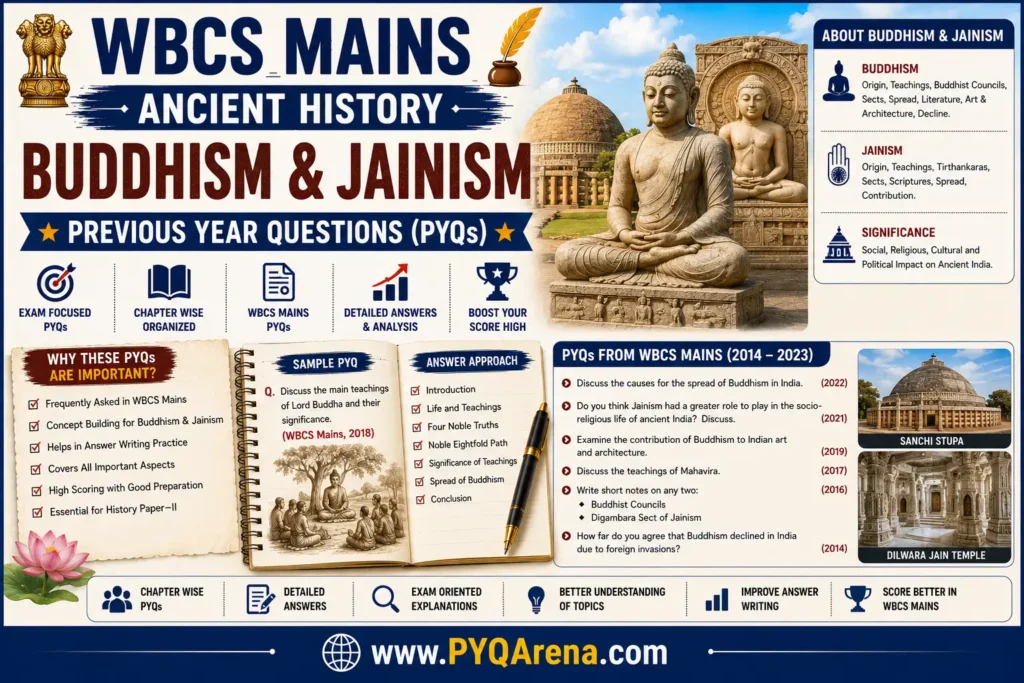
WBCS Mains Buddhism & Jainism Questions 2023
Q. Chandragupta Maurya was a follower of
(A) Jainism
(B) Buddhism
(C) Ajivika religion
(D) Saivism
Answer & Explanation
Correct Answer: (A) Jainism
Explanation
Chandragupta Maurya, the founder of the Mauryan Empire, is traditionally regarded as a follower of Jainism in his later life. According to Jain tradition, he renounced his throne and went to Shravanabelagola in Karnataka with the Jain teacher Bhadrabahu. He is believed to have spent his final years as a Jain ascetic and died through the practice of Sallekhana (religious fasting unto death).
Exam Facts
- Chandragupta Maurya → Jainism in his later life.
- He founded the Mauryan Empire around 321 BCE after overthrowing the Nanda dynasty.
- Chanakya (Kautilya) played a crucial role in helping Chandragupta establish the Mauryan Empire.
- According to Jain tradition, Chandragupta accompanied Bhadrabahu to Shravanabelagola in Karnataka.
- Shravanabelagola is an important centre of Jainism and is associated with the Chandragupta Basadi.
- Ashoka, Chandragupta’s grandson, initially followed traditional Brahmanical practices but later became a major patron of Buddhism.
- The Ajivika sect also received royal patronage during the Mauryan period, particularly from Ashoka and his grandson Dasharatha.
Q. Which ancient Indian ruler was the Chief Patron of the fourth Buddhist Council?
(A) Ashoka
(B) Kanishka
(C) Ajatashatru
(D) Samudragupta
Answer & Explanation
Correct Answer: (B) Kanishka
Explanation
Kanishka, the great ruler of the Kushan Empire, is traditionally regarded as the chief patron of the Fourth Buddhist Council. The council is generally associated with Kundalavana in Kashmir and is believed to have been held during Kanishka’s reign. It played an important role in the development of Mahayana Buddhism and the compilation and interpretation of Buddhist texts.
Exam Facts
- Fourth Buddhist Council → Kanishka is the key patronage association.
- The council is traditionally said to have been held at Kundalavana, Kashmir.
- It was presided over by Vasumitra, according to traditional accounts.
- Ashvaghosha is traditionally associated with the council and Kanishka’s court.
- The Fourth Buddhist Council is particularly associated with the Sanskritization of Buddhist literature and the growing importance of Mahayana Buddhism.
- Ashoka → Third Buddhist Council, held at Pataliputra, traditionally associated with Moggaliputta Tissa.
- Ajatashatru → First Buddhist Council, held at Rajagriha (Rajgir) after the death of the Buddha.
- Samudragupta was a Gupta ruler and was not associated with the Buddhist councils.
Q. Who composed the ‘Buddhacharita’?
(A) Asvaghosa
(B) Basumitra
(C) Nagasena
(D) None of the above
Answer & Explanation
Q. Who composed the ‘Buddhacharita’?
(A) Asvaghosa
(B) Basumitra
(C) Nagasena
(D) None of the above
Correct Answer: (A) Asvaghosa
Explanation
Ashvaghosha (Asvaghosa) composed the Buddhacharita, a famous Sanskrit epic biography of Gautama Buddha. He was a renowned Buddhist philosopher, poet and dramatist who is traditionally associated with the court of Kushan ruler Kanishka.
Exam Facts
- Buddhacharita → composed by Ashvaghosha.
- The Buddhacharita is an important Sanskrit biography of Gautama Buddha.
- Ashvaghosha is traditionally associated with the court of Kanishka.
- Ashvaghosha is also credited with the Sanskrit Buddhist work Saundarananda.
- Vasumitra is traditionally associated with presiding over the Fourth Buddhist Council under Kanishka.
- Nagasena is famous for his dialogue with Indo-Greek king Menander (Milinda) in the Milindapanho (Questions of Milinda).
- The Buddhacharita is important for understanding the life of Buddha and early Buddhist literary traditions.
Q. Who composed the ‘Milind Panho’?
(A) Vasumitra
(B) Nagasena
(C) Asvaghosa
(D) Dharmakirti
Answer & Explanation
Correct Answer: (B) Nagasena
Explanation
Milind Panho (Milindapañha) is a Buddhist text presented as a dialogue between King Menander (Milinda), the Indo-Greek ruler, and the Buddhist monk Nagasena. The text discusses important Buddhist philosophical concepts through questions and answers. Although Nagasena is the central figure in the dialogue, the work’s exact authorship is uncertain; it is traditionally associated with Nagasena.
Exam Facts
- Milind Panho → associated with Nagasena and King Menander (Milinda).
- Menander was an important Indo-Greek ruler who ruled parts of northwestern India.
- The dialogue covers subjects such as karma, rebirth, Nirvana, the nature of the self and Buddhist ethics.
- Nagasena is portrayed as a highly learned Buddhist monk who answers Menander’s philosophical questions.
- Ashvaghosha → Buddhacharita, a Sanskrit biography of Gautama Buddha.
- Vasumitra is traditionally associated with the Fourth Buddhist Council under Kanishka.
- Dharmakirti was a much later Buddhist philosopher and logician, associated with the 7th century CE.
WBCS Mains Buddhism & Jainism Questions 2022
Q. Gautam Buddha was from the following clans:
(A) Vajji
(B) Sakya
(C) Kushan
(D) Saka
Answer & Explanation
Correct Answer: (B) Sakya
Explanation
Gautama Buddha was born as Siddhartha Gautama into the Sakya (Shakya) clan. He was born at Lumbini, in present-day Nepal, and his father Suddhodana was associated with the ruling family of the Sakya clan. The Sakyas were a republican or oligarchic clan based around Kapilavastu.
Exam Facts
- Gautama Buddha → Sakya clan.
- Buddha’s personal name was Siddhartha Gautama.
- He was born at Lumbini in present-day Nepal.
- His father was Suddhodana, and his mother was Maya (Mahamaya).
- Kapilavastu was the principal settlement associated with the Sakya clan and Buddha’s early life.
- Buddha attained Enlightenment at Bodh Gaya, delivered his first sermon at Sarnath, and attained Mahaparinirvana at Kushinagar.
- Vajji was a powerful confederacy of republican clans, including the Licchavis, with its centre at Vaishali.
- Kushan and Saka were later ruling groups/dynasties and were not the clan of Gautama Buddha.
Q. The “Milinda Panho” was a
(A) Scripture
(B) Book on Philosophical discussion
(C) Artefact
(D) Cinema
Answer & Explanation
Correct Answer: (B) Book on Philosophical discussion
Explanation
The Milinda Panho (Milindapañha) is a Buddhist text presenting a philosophical dialogue between the Indo-Greek king Menander (Milinda) and the Buddhist monk Nagasena. Through a series of questions and answers, it discusses important Buddhist concepts such as karma, rebirth, Nirvana and the nature of the self.
Exam Facts
- Milinda Panho → philosophical dialogue between Menander and Nagasena.
- Milinda is the Pali name of the Indo-Greek king Menander.
- Nagasena is the Buddhist monk who answers the king’s questions.
- The text is written primarily in Pali and is an important work of Buddhist literature.
- The dialogue uses questions and analogies to explain complex Buddhist philosophical concepts.
- Menander ruled parts of northwestern India during the Indo-Greek period.
- Ashvaghosha → Buddhacharita, while Milindapanho → dialogue involving Nagasena and Menander.
Q. The “Three Jewels” are to be found in
(A) Vaishnavism
(B) Buddhism
(C) Judaism
(D) Jainism
Answer & Explanation
Correct Answer: (B) Buddhism
Explanation
The Three Jewels (Triratna) are the central objects of refuge in Buddhism. They are Buddha, Dhamma (Dharma) and Sangha. A Buddhist traditionally takes refuge in these three as the foundation of Buddhist faith and practice.
Exam Facts
- Three Jewels (Triratna) → Buddhism.
- The three jewels are Buddha, Dhamma (Dharma) and Sangha.
- Buddha → Gautama Buddha, the Enlightened One.
- Dhamma/Dharma → the teachings and principles taught by the Buddha.
- Sangha → the Buddhist monastic community.
- The traditional formula is “Buddham Sharanam Gacchami, Dhammam Sharanam Gacchami, Sangham Sharanam Gacchami.”
- In Jainism, the corresponding Three Jewels (Ratnatraya) are Right Faith, Right Knowledge and Right Conduct—an important distinction for exams.
Q. The Buddha gave his first sermon at
(A) Gaya
(B) Sarnath
(C) Peshawar
(D) Karnataka
Answer & Explanation
Correct Answer: (B) Sarnath
Explanation
Gautama Buddha delivered his first sermon at Sarnath, near Varanasi, after attaining enlightenment at Bodh Gaya. This first sermon is known as the Dhammachakkappavattana Sutta (Dharmachakra Pravartana), meaning “Setting the Wheel of Dharma in Motion.” He delivered it to his five former companions, marking the beginning of the Buddhist Sangha.
Exam Facts
- First Sermon of Buddha → Sarnath.
- Buddha’s first sermon is known as the Dharmachakra Pravartana or Dhammacakkappavattana.
- The sermon was delivered to the Five Ascetics (Panchavaggiya).
- The sermon explained the Four Noble Truths and the Noble Eightfold Path.
- Bodh Gaya → Enlightenment under the Bodhi tree.
- Sarnath → First Sermon and beginning of the Buddhist Sangha.
- Kushinagar → Mahaparinirvana (death) of Buddha.
- Lumbini → Birth of Gautama Buddha.
Q. The Eight-Fold path in Buddhism is known as
(A) Dharmachakrapravartana
(B) Ashtangik Marg
(C) Nirukta
(D) Vimukta
Answer & Explanation
Correct Answer: (B) Ashtangik Marg
Explanation
The Eight-Fold Path, known as the Ashtangika Marga (Noble Eightfold Path), is the Buddhist path leading towards the cessation of suffering and ultimately Nirvana. It forms the Fourth Noble Truth taught by Gautama Buddha.
Exam Facts
- Eight-Fold Path → Ashtangika Marga.
- It consists of Right View, Right Intention, Right Speech, Right Action, Right Livelihood, Right Effort, Right Mindfulness and Right Concentration.
- The Eightfold Path constitutes the Fourth Noble Truth.
- Dharmachakra Pravartana refers to Buddha’s first sermon at Sarnath, meaning “Setting the Wheel of Dharma in Motion.”
- The Four Noble Truths explain the nature of suffering, its cause, its cessation and the path leading to its cessation.
- The Buddhist path aims ultimately at Nirvana, the liberation from the cycle of suffering and rebirth.
- Nirukta is one of the Vedangas and deals primarily with etymology and the explanation of words, not Buddhist philosophy.
Q. The last Buddhist Council was held at
(A) Sarnath
(B) Kundalvan
(C) Saket
(D) Ceylon
Answer & Explanation
Explanation
The Fourth Buddhist Council is traditionally regarded as the last of the four major Buddhist Councils of ancient India. It was held at Kundalvan (Kundalavana) in Kashmir during the reign of the Kushan ruler Kanishka. The council is particularly associated with the development and consolidation of Mahayana Buddhism.
Exam Facts
- Fourth Buddhist Council → Kundalvan, Kashmir.
- It was held under the patronage of Kanishka, the great Kushan ruler.
- Vasumitra is traditionally said to have presided over the council.
- Ashvaghosha is also traditionally associated with the council and Kanishka’s court.
- The council is associated with the growing importance of Mahayana Buddhism.
- First Buddhist Council → Rajagriha (Rajgir), under the patronage of Ajatashatru.
- Second Buddhist Council → Vaishali, during the reign of Kalashoka.
- Third Buddhist Council → Pataliputra, under Ashoka, traditionally presided over by Moggaliputta Tissa.
- Ceylon (Sri Lanka) later became an important centre for Buddhist councils and the preservation of Theravada Buddhist literature, but it is not the answer to the traditional four-council sequence.
Q. The twenty third Tirthankara was
(A) Parshvanath
(B) Vardhaman Mahavira
(C) Gautam Buddha
(D) Ajatasatru
Answer & Explanation
Correct Answer: (A) Parshvanath
Explanation
Parshvanath (Parshva) was the 23rd Tirthankara of Jainism and is considered the immediate predecessor of Vardhaman Mahavira, the 24th Tirthankara. Parshvanath is traditionally believed to have lived about 250 years before Mahavira and emphasized four major vows: non-violence, truth, non-stealing and non-possession.
Exam Facts
- 23rd Tirthankara → Parshvanath.
- 24th and last Tirthankara → Vardhaman Mahavira.
- Parshvanath is traditionally associated with Varanasi as his birthplace.
- The four vows associated with Parshvanath were Ahimsa, Satya, Asteya and Aparigraha.
- Mahavira added Brahmacharya (celibacy) as the fifth major vow.
- Rishabhanatha (Adinatha) is regarded as the 1st Tirthankara.
- Tirthankara literally means a “ford-maker”, one who shows the path across the cycle of birth and death.
- Gautama Buddha was the founder of Buddhism and was not a Tirthankara.
WBCS Mains Buddhism & Jainism Questions 2020
Q. Which of the following statements is incorrect about the position of women during the age of Buddha?
(A) The position of women generally deteriorated.
(B) There were several instances of child marriages.
(C) Polygamy was gradually growing among the ruling classed.
(D) Education was denied to women.
Answer & Explanation
Correct Answer: (D) Education was denied to women.
Explanation
The statement that education was denied to women is incorrect. Although the overall social position of women generally declined in many sections of society during this period, women could receive education and participate in religious and intellectual life. The Buddhist tradition itself records learned women such as Khema, Uppalavanna and Dhammadinna. The establishment of the Bhikkhuni Sangha by the Buddha also provided women with an institutional path to religious life.
Exam Facts
- Women could receive education during the age of Buddha, although educational opportunities were not equal to those of men.
- The Buddha permitted women to enter the Buddhist monastic order (Bhikkhuni Sangha), traditionally associated with Mahapajapati Gotami, his foster mother and aunt.
- Dhammadinna was a renowned learned Buddhist nun whose teachings are recorded in Buddhist literature.
- Khema and Uppalavanna were among the prominent female disciples of the Buddha.
- Polygamy was practiced, particularly among members of the ruling and wealthy classes.
- The position of women was not uniform and varied according to social class, region and context.
- The Buddhist movement provided women with greater opportunities for religious participation and spiritual attainment than many contemporary social institutions.
Q. Who composed the Sanskrit kavya ‘Saundarananda’?
(A) Asvaghosa
(B) Kalidasa
(C) Nagarjuna
(D) Vishnu Sharma
Answer & Explanation
Correct Answer: (A) Asvaghosa
Explanation
Ashvaghosha (Asvaghosa) composed the Sanskrit Kavya Saundarananda. It is a Buddhist epic poem that narrates the story of Nanda, the Buddha’s half-brother, and describes his transformation from worldly attachment to the Buddhist path.
Exam Facts
- Saundarananda → Ashvaghosha.
- Ashvaghosha was a prominent Buddhist poet, philosopher and dramatist associated with the Kushan period.
- His other famous work is Buddhacharita, a Sanskrit biography of Gautama Buddha.
- Saundarananda focuses on Nanda’s spiritual transformation and attainment of liberation.
- Kalidasa is famous for works such as Abhijnanashakuntalam, Meghaduta and Raghuvamsha.
- Nagarjuna was a major Buddhist philosopher associated with the Madhyamaka school.
- Vishnu Sharma is traditionally credited with the composition of Panchatantra.
WBCS Mains Buddhism & Jainism Questions 2019
Q. Who was the propounder of the Ajivika Sect?
(A) Purana Kassapa
(B) Pakuddha Kaccayana
(C) Makkali Gosala
(D) Ajita Keshakambalin
Answer & Explanation
Correct Answer: (C) Makkali Gosala
Explanation
Makkali Gosala (Maskarin Gosala) was the principal founder and propounder of the Ajivika sect, a heterodox religious movement that flourished in ancient India around the same period as Buddhism and Jainism. The Ajivikas strongly emphasized Niyati (fate or determinism), believing that the course of life was predetermined.
Exam Facts
- Ajivika sect → Makkali Gosala.
- The central doctrine of the Ajivikas was Niyati, or the principle of strict determinism/fate.
- Ajivikas rejected the idea that individual effort could fundamentally alter the predetermined course of life.
- Makkali Gosala was a contemporary of Gautama Buddha and Mahavira.
- The Ajivika movement received royal patronage during the Mauryan period.
- Ashoka and his grandson Dasharatha are associated with patronage of the Ajivikas; Dasharatha dedicated caves at Barabar to them.
- Purana Kassapa, Pakuddha Kaccayana and Ajita Keshakambalin were other contemporary teachers associated with heterodox schools during the age of Buddha.
- The Barabar Caves in Bihar contain inscriptions recording donations to the Ajivikas.
WBCS Mains Buddhism & Jainism Questions 2017
Q. Both Lord Buddha and Mahavira died in the reign of
(A) Bimbisara
(B) Ajatasatru
(C) Udayin
(D) Dasratha
Answer & Explanation
Correct Answer: (B) Ajatasatru
Explanation
According to the traditional chronology, both Gautama Buddha and Mahavira died during the reign of Ajatashatru, the ruler of Magadha. Ajatashatru was the son of Bimbisara and played an important role in the political history of the 6th–5th century BCE.
Exam Facts
- Buddha → Mahaparinirvana at Kushinagar, traditionally dated to c. 483 BCE.
- Mahavira → Nirvana at Pavapuri, traditionally dated to c. 468 BCE.
- Both are traditionally placed within the reign of Ajatashatru.
- Ajatashatru was the son of Bimbisara, the ruler of Magadha.
- Ajatashatru is traditionally associated with the First Buddhist Council, held at Rajagriha (Rajgir) shortly after Buddha’s death.
- Bimbisara was a contemporary and supporter of both Buddha and Mahavira.
- Udayin, traditionally regarded as the successor of Ajatashatru, is associated with the establishment of Pataliputra as an important Magadhan centre.
Q. In the Buddhist context, which one refers to texts that are supposed to contain what the Buddha himself said?
(A) Sutta
(B) Vinaya
(C) Abhidhamma
(D) Milindapanha
Answer & Explanation
Correct Answer: (A) Sutta
Explanation
In Buddhist literature, Sutta (Sutra) refers to discourses or teachings traditionally attributed to Gautama Buddha. The Sutta Pitaka, one of the three divisions of the Tipitaka (Tripitaka), contains a large collection of these discourses and teachings.
Exam Facts
- Sutta → discourses/teachings attributed to the Buddha.
- Sutta Pitaka is one of the three major divisions of the Tripitaka.
- The three Pitakas are Vinaya Pitaka, Sutta Pitaka and Abhidhamma Pitaka.
- Vinaya Pitaka deals mainly with the rules and discipline of the Buddhist monastic community (Sangha).
- Abhidhamma Pitaka deals with systematic philosophical and psychological analysis of Buddhist teachings.
- Milindapanha records a philosophical dialogue between King Menander (Milinda) and the Buddhist monk Nagasena.
- The Sutta Pitaka includes important works such as the Digha Nikaya, Majjhima Nikaya, Samyutta Nikaya, Anguttara Nikaya and Khuddaka Nikaya.
Q. Which of the following is not a representative of the Buddhist art?
(A) Stupa
(B) Gopuram
(C) Vihara
(D) Chaitya
Answer & Explanation
Correct Answer: (B) Gopuram
Explanation
Gopuram is a monumental entrance tower primarily associated with Hindu temple architecture, particularly in South India. In contrast, Stupa, Vihara and Chaitya are important architectural forms associated with Buddhist religious architecture. Therefore, Gopuram is not a representative of Buddhist art.
Exam Facts
- Stupa → Buddhist architecture, originally associated with relics and commemorative worship.
- Chaitya → Buddhist prayer/worship hall, often containing a stupa at its end.
- Vihara → Buddhist monastery or residence for monks.
- Gopuram → monumental gateway tower, especially characteristic of South Indian Hindu temples.
- Sanchi Stupa in Madhya Pradesh is one of the most famous surviving examples of Buddhist stupa architecture.
- Karla Caves in Maharashtra contain a famous rock-cut Chaitya hall.
- Ajanta Caves contain both Chaitya halls and Viharas and are renowned for their Buddhist paintings and sculptures.
Q. Which one of the following events of Buddha’s life did not take place on a full moon day (Purnima)?
(A) Birth
(B) Death
(C) Enlightenment
(D) Renunciation
Answer & Explanation
Correct Answer: (D) Renunciation
Explanation
According to Buddhist tradition, the birth, enlightenment and Mahaparinirvana (death) of Gautama Buddha are associated with the full moon day of Vaishakha (Vesakha). This day is celebrated as Buddha Purnima or Vesak. However, Buddha’s Great Renunciation (Mahabhinishkramana) did not take place on a full moon day.
Exam Facts
- Birth of Buddha → Vaishakha Purnima.
- Enlightenment of Buddha → Vaishakha Purnima at Bodh Gaya.
- Mahaparinirvana (death) → Vaishakha Purnima at Kushinagar.
- These three events are traditionally known as the Triple Blessed Day in Buddhist tradition.
- Great Renunciation (Mahabhinishkramana) refers to Buddha leaving his princely life in search of the truth.
- Buddha was born at Lumbini, attained enlightenment at Bodh Gaya, delivered his first sermon at Sarnath, and attained Mahaparinirvana at Kushinagar.
- Buddha Purnima is observed on the full moon day of the Vaishakha month.
Q. Who was the propounder of the ‘Ajivaka’ sect?
(A) Purana Kassap
(B) Pakuddha Kaccayana
(C) Makkali Gosala
(D) Ajit Kesakambalin
Answer & Explanation
Correct Answer: (C) Makkali Gosala
Explanation
Makkali Gosala was the principal propounder and leader of the Ajivaka (Ajivika) sect, one of the major heterodox movements that emerged in ancient India during the same period as Buddhism and Jainism. The Ajivikas emphasized the doctrine of Niyati, or strict determinism, according to which the course of an individual’s life was largely predetermined.
Exam Facts
- Ajivaka/Ajivika sect → Makkali Gosala.
- The central doctrine of the Ajivikas was Niyati (fate/determinism).
- Makkali Gosala was a contemporary of Gautama Buddha and Mahavira.
- The Ajivikas rejected the idea that human effort alone could change the predetermined course of life.
- The sect received royal patronage during the Mauryan period.
- Ashoka and his grandson Dasharatha are associated with patronage of the Ajivikas.
- The Barabar Caves in Bihar contain inscriptions indicating that some caves were donated to the Ajivikas.
- Purana Kassapa, Pakuddha Kaccayana and Ajit Kesakambalin were also contemporary teachers associated with other heterodox schools, but Makkali Gosala was the principal figure of the Ajivika sect.
WBCS Mains Buddhism & Jainism Questions 2015
Q. The famous Jaina temples at Dilwara were built by
(A) Paramaras
(B) Chandellas
(C) Solankis
(D) Chauhans
Answer & Explanation
Correct Answer: (C) Solankis
Explanation
The famous Dilwara Jain Temples at Mount Abu, Rajasthan were constructed during the Solanki (Chaulukya) period. The temples are renowned for their exquisite marble architecture, intricate carvings and finely decorated ceilings and pillars. They were built mainly between the 11th and 13th centuries.
Exam Facts
- Dilwara Jain Temples → Mount Abu, Rajasthan.
- They were built mainly under the patronage of Solanki/Chaulukya rulers and their ministers.
- The earliest major temple, Vimal Vasahi, was built in 1031 CE by Vimal Shah, a minister of Solanki ruler Bhimadeva I.
- Luna Vasahi, dedicated to Lord Neminatha, was built in the 13th century by the brothers Vastupala and Tejapala.
- The temples are famous for their white marble and highly intricate ornamental carvings.
- The Dilwara complex contains temples dedicated to several Jain Tirthankaras.
- The Solankis (Chaulukyas) were an important ruling dynasty of Gujarat and parts of Rajasthan during the medieval period.
WBCS Mains Buddhism & Jainism Questions 2014
Q. The language of the Jaina religious text was
(A) Sanskrit
(B) Pali
(C) Prakrit
(D) Bengali
Answer & Explanation
Correct Answer: (C) Prakrit
Explanation
The earliest Jaina religious texts were primarily composed in Prakrit, especially Ardhamagadhi, a Middle Indo-Aryan language. The use of Prakrit made Jain teachings accessible to a wider section of society rather than restricting them to scholars familiar with Sanskrit.
Exam Facts
- Jaina canonical literature → primarily Prakrit.
- Ardhamagadhi Prakrit was an important language of the early Jain scriptures.
- The Jain canonical texts are collectively known as the Agamas.
- Pali is primarily associated with the Theravada Buddhist Canon (Tipitaka).
- Jainism later produced a substantial body of literature in Sanskrit, Shauraseni Prakrit, Apabhramsha and regional languages.
- Mahavira preached in the broader cultural and linguistic environment of Magadha and eastern India, where Middle Indo-Aryan languages were widely spoken.
- Sanskrit became increasingly important in later Jain philosophical and scholarly works, but it was not the principal language of the earliest Jain canonical tradition.
Q. Who wrote Milindapanha?
(A) Asvaghoshsa
(B) Nagarjuna
(C) Basumitra
(D) Nagasena
Answer & Explanation
Correct Answer: (D) Nagasena
Explanation
Milindapanha (Questions of Milinda) is a Buddhist philosophical text presented as a dialogue between King Milinda (Menander), the Indo-Greek ruler, and the Buddhist monk Nagasena. Although the text is traditionally associated with Nagasena, its exact authorship is uncertain. The work explores Buddhist ideas through a series of questions, answers and analogies.
Exam Facts
- Milindapanha → associated with Nagasena and King Menander (Milinda).
- Menander was an important Indo-Greek ruler of northwestern India.
- Nagasena is portrayed as the Buddhist monk who answers Menander’s philosophical questions.
- The text discusses karma, rebirth, Nirvana, the nature of the self and Buddhist ethics.
- Ashvaghosha → Buddhacharita and Saundarananda.
- Nagarjuna → Madhyamaka school of Mahayana Buddhism and the philosophy of Shunyavada (emptiness).
- Vasumitra is traditionally associated with presiding over the Fourth Buddhist Council under Kanishka.
Leave a Comment