

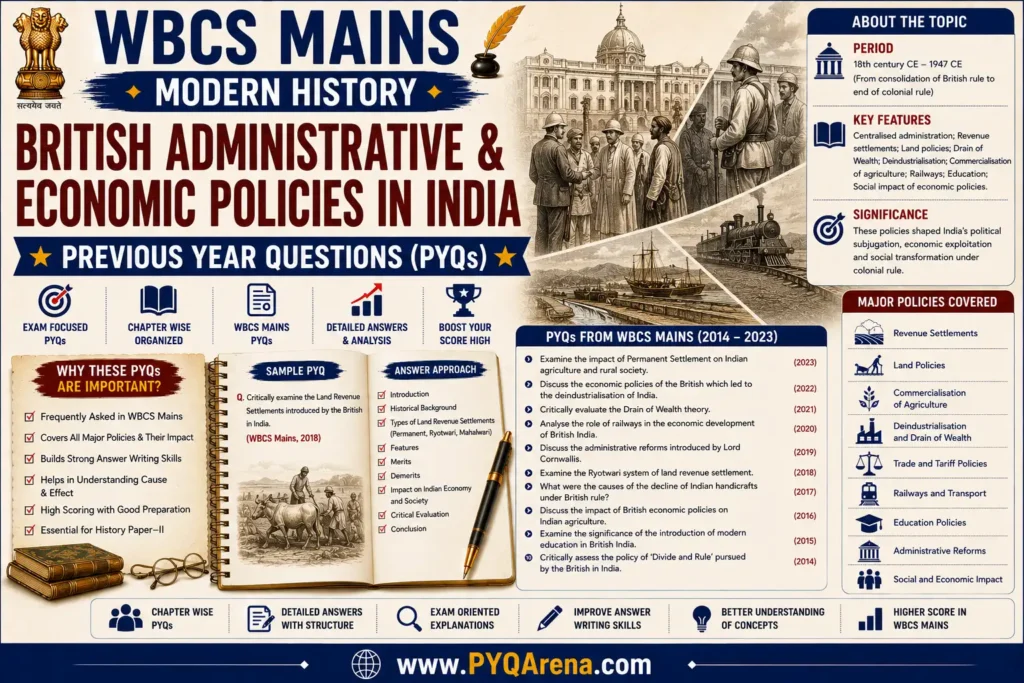
This compilation contains all multiple-choice questions from the West Bengal Civil Service (WBCS) Mains History examinations (2014-2023) that focus on the colonial land revenue systems (Permanent Settlement, Ryotwari, Mahalwari), the economic drain theory, the commercialization of agriculture, de-industrialization, and popular, peasant, and tribal uprisings (including Sannyasi-Fakir, Kuka, Wahabi, Santhal, Titu Mir, Indigo Revolt, Tebhaga, and Telangana movements).
WBCS Mains Economic Impact of British Rule & Popular Uprisings Questions 2023
Q. The Ryotwari System was first introduced in
(A) Bengal
(B) Delhi
(C) Madras
(D) Gujarat
Correct Answer: (C) Madras
Q. Who was associated with the ‘Sunset Law’?
(A) Lord Lytton
(B) Lord Ripon
(C) Lord William Bentinck
(D) Lord Cornwallis
Correct Answer: (D) Lord Cornwallis
Q. Who was the leader of Santhal Rebellion?
(A) Sindhu Murmu
(B) Jyotiba Phule
(C) Birsa Munda
(D) Visnucharan Biswas
Correct Answer: (A) Sindhu Murmu
Q. Who appointed the Amini Commission?
(A) Lord Cornwallis
(B) Lord Dalhousie
(C) Lord Warren Hastings
(D) Lord Minto
Correct Answer: (C) Lord Warren Hastings
WBCS Mains Economic Impact of British Rule & Popular Uprisings Questions 2022
Q. The Permanent Settlement was passed in the year
(A) 1803
(B) 1813
(C) 1793
(D) 1834
Correct Answer: (C) 1793
Q. The Hindoo Patriot was edited by
(A) Manmohan Ghosh
(B) Harish Chandra Mookherjee
(C) Debendranath Tagore
(D) Acharya Binoba Bhave
Correct Answer: (B) Harish Chandra Mookherjee
Q. Neel Darpan was written in the context of
(A) Sepoy Mutiny
(B) Deccan
(C) Indigo Revolt
(D) Ramosi Rebellion
Correct Answer: (C) Indigo Revolt
Q. Anandamath was written by
(A) Bankim Chandra Chattopadhyay
(B) Sarat Chandra Chattopadhyay
(C) Sarat Chandra Bose
(D) Dwijendralal Roy
Correct Answer: (A) Bankim Chandra Chattopadhyay
WBCS Mains Economic Impact of British Rule & Popular Uprisings Questions 2021
Q. What is the Ulgulan?
(A) Santhal uprising of 1840s and ’50s
(B) Kol uprising
(C) Munda uprising, 1899–1900
(D) None of the above
Correct Answer: (C) Munda uprising, 1899–1900
Q. Where among the following places was Permanent Settlement not introduced?
(A) Bengal
(B) Bihar
(C) Assam
(D) Punjab
Correct Answer: (C) Assam
Q. Which of the following settlements was a result of the Holt Mackenzie surveys of the 1820s?
(A) Taluqdari system
(B) Ryotwari system
(C) Anganwadi system
(D) Mahalwari system
Correct Answer: (D) Mahalwari system
Q. Which of the following statements is not true of the Permanent Settlement?
(A) The settlement was introduced initially as a decennial settlement
(B) It gave rise to a market in land
(C) It resulted in pauperisation of the peasantry
(D) None of the above
Correct Answer: (D) None of the above
Q. With the revenue settlement of which region was Mountstuart Elphinstone associated?
(A) Punjab
(B) Agra
(C) Bombay
(D) Awadh
Correct Answer: (C) Bombay
Q. When was the first Factory Act passed in India?
(A) 1881
(B) 1911
(C) 1921
(D) 1931
Correct Answer: (A) 1881
Q. In which session of the Congress was the movement provided with a peasant agenda?
(A) Calcutta
(B) Delhi
(C) Haripura
(D) Tripuri
Correct Answer: (C) Haripura
Q. Which party fought the 1937 elections in Bengal with the agenda of land reform?
(A) Congress
(B) Muslim League
(C) Kisan Sabha
(D) Krishak Praja Party
Correct Answer: (D) Krishak Praja Party
Q. In many of the peasant revolts, religion played an important role. Who was the leader of the Fakirs leading the Sannyasi-Fakir uprising? (Duplicate)
(A) Majnu Shah
(B) Tipu Shah
(C) Karim Shah
(D) Chirag Ali
Correct Answer: (A) Majnu Shah
Q. Titu Mir defeated ________, the Indigo Planter. (Duplicate)
(A) Okenelly
(B) Davis
(C) Thornton
(D) Alexander
Correct Answer: (B) Davis
Q. Sati Daha Bill was passed in the year
(A) 1830
(B) 1829
(C) 1831
(D) 1832
Correct Answer: (B) 1829
WBCS Mains Economic Impact of British Rule & Popular Uprisings Questions 2020
Q. The Kuka Movement was started in the mid nineteenth century in
(A) Western Punjab
(B) Maharashtra
(C) Bengal
(D) Madhya Pradesh
Correct Answer: (A) Western Punjab
Q. The Kuka Movement was started in the mid nineteenth century in (Duplicate Question)
(A) Western Punjab
(B) Maharashtra
(C) Bengal
(D) Madhya Pradesh
Correct Answer: (A) Western Punjab
Q. The Tebhaga Movement of 1946 is associated with which of the following states of India?
(A) Andhra Pradesh
(B) West Bengal
(C) Bihar
(D) Odisha
Correct Answer: (B) West Bengal
Q. The revolt of the Khasis against the British was led by
(A) Surendra Rai
(B) Utirot Sing
(C) Birsa Munda
(D) None of the above
Correct Answer: (B) Utirot Sing
Q. Which of the following is correctly matched?
(A) Rabindranath Tagore — Nil Darpan
(B) Dadabhai Naoroji — Indian Unrest
(C) Dinabandhu Mitra — Gora
(D) Ramesh Chandra Dutt — Economic History of India
Correct Answer: (D) Ramesh Chandra Dutt — Economic History of India
Q. Apart from the Quit India Movement, which started on 9th August 1942, what other sensational activity of the freedom fighters took place on that date in 1925?
(A) Salt Satyagraha
(B) Boycott of Simon Commission
(C) Champaran Satyagraha
(D) Kakori mail train robbery
Correct Answer: (D) Kakori mail train robbery
WBCS Mains Economic Impact of British Rule & Popular Uprisings Questions 2019
Q. A remarkable feature of the spread of landlordism was the growth of
(A) Aristocracy
(B) Capitalism
(C) Sub-infeudation
(D) Cultivation
Correct Answer: (C) Sub-infeudation
Q. The extension of the cultivation of indigo, cotton, opium, tea and coffee in India, besides benefitting the British planters, also benefited
(A) The Zamindars
(B) The small merchants
(C) Both (A) and (B)
(D) The Indian Bankers
Correct Answer: (C) Both (A) and (B)
Q. What was the primary reason for the failure of Mahalwari Settlement in checking the process of destruction of the village communities?
(A) It was introduced only as a temporary measure to be replaced ultimately by the Ryotwari system.
(B) Individual rights in the land were recognized and guaranteed by the state.
(C) There were several defects and lacunae in the implementation of the measure.
(D) It met with severe opposition from certain sections of the village community.
Correct Answer: (B) Individual rights in the land were recognized and guaranteed by the state.
Q. Which of the following consequences of the British rule did not affect the Muslim middle classes?
(A) The tyranny of the British Indigo Planters
(B) The disbandment of the Nawab’s forces
(C) The abolition of the rural police
(D) The resumptions of Imam’s lands which provided sustenance to the learned
Correct Answer: (A) The tyranny of the British Indigo Planters
Q. The tribal leader who was regarded as the Father of the World (Dharti Aba) was
(A) Buddha Bhagat
(B) Tilka Manjhi
(C) Birsa Munda
(D) Bonangi Pandu Paral
Correct Answer: (C) Birsa Munda
Q. Certain movements of the early twentieth century described as ‘Movements from below’ were
(A) Caste movements
(B) Revolutionary movements
(C) Peasant and tribal movements
(D) Socio-religious movements
Correct Answer: (C) Peasant and tribal movements
Q. When was the first Census carried out in India?
(A) 1851
(B) 1861
(C) 1871
(D) 1881
Correct Answer: (A) 1851
Q. Which prominent Indian nationalist leader found Gandhi’s definition of Swaraj in 1921 Ahmedabad session of the INC ‘delightfully vague’?
(A) Jawaharlal Nehru
(B) Subhas Bose
(C) M. A. Jinnah
(D) C. R. Das
Correct Answer: (A) Jawaharlal Nehru
Q. In the first session of the INC (1885), who represented the province of Bengal?
(A) W.C. Bonnerjea
(B) Surendranath Banerjee
(C) Sisir Kumar Ghosh
(D) R.B. Bose
Correct Answer: (A) W.C. Bonnerjea
Q. Under the Ryotwari system, after how many years could there be a reassessment of revenue demand?
(A) 10 years
(B) 20 years
(C) 30 years
(D) Never
Correct Answer: (C) 30 years
WBCS Mains Economic Impact of British Rule & Popular Uprisings Questions 2018
Q. Arrange the following armed resistance in the nineteenth century against the colonial rule in chronological order and choose the correct answer from the codes given below:
(i) Satara disturbance
(ii) Gadkari rebellion
(iii) Revolt of Rao Bharamal
(iv) Rebellion of Birabhadra Raju
(A) (i), (ii), (iii), (iv)
(B) (iv), (iii), (ii), (i)
(C) (iv), (ii), (i), (iii)
(D) (i), (iv), (iii), (ii)
Correct Answer: (B) (iv), (iii), (ii), (i)
Q. During the first century of British rule there were a series of ‘restorative rebellions’ started by disaffected local rulers. Arrange the following revolts in chronological order:
(i) Paik rebellion led by Jagabandhu
(ii) Poligar rebellion led by Kattabomman
(iii) Kittur uprising led by Queen Chennamma
(iv) Travancore revolt led by Velu Thampi
(A) (i), (ii), (iii), (iv)
(B) (ii), (iv), (i), (iii)
(C) (i), (iv), (ii), (iii)
(D) (ii), (i), (iv), (iii)
Correct Answer: (D) (ii), (iv), (i), (iii)
Q. Ho and Munda tribesmen were from
(A) Chotanagpur
(B) Araballi hills
(C) Sahayadri hills
(D) None of the above
Correct Answer: (A) Chotanagpur
Q. In many of the peasant revolt religion played an important role. Who among the following was the leader of the Fakirs leading the Sannyasi-Fakir uprising in Bengal?
(A) Tipu Shah
(B) Karim Shah
(C) Majnu Shah
(D) Golam Masum
Correct Answer: (C) Majnu Shah
Q. Match List I with List II and choose the correct answer from the codes given below:
List I:
(a) Pagalpanthi uprising
(b) Tariqah-i-Muhammadiya
(c) Faraizi movement
(d) Shah-i-Madar
List II:
(i) Chirag Ali
(ii) Haji Shariatullah
(iii) Karim Shah
(iv) Mir Nisar
(A) (a)-(ii), (b)-(i), (c)-(iv), (d)-(iii)
(B) (a)-(i), (b)-(iv), (c)-(ii), (d)-(iii)
(C) (a)-(ii), (b)-(iii), (c)-(iv), (d)-(i)
(D) (a)-(ii), (b)-(i), (c)-(iii), (d)-(iv)
Correct Answer: (B) (a)-(iii), (b)-(iv), (c)-(ii), (d)-(i)
Q. Some of the peasant rebellions were participated in exclusively by the tribal population. Arrange the following tribal movements chronologically:
(i) Gudem Rampa rebellion led by Alluri Sitaramaraju
(ii) Kol rebellion led by Buddha Bhagat
(iii) Hul rebellion led by Sidho and Kanho
(iv) Thadoe Kuki movement led by Jadonang and his niece Gaidinilu
(A) (ii), (iii), (i), (iv)
(B) (i), (iv), (ii), (iii)
(C) (i), (ii), (iii), (iv)
(D) (ii), (i), (iv), (iii)
Correct Answer: (A) (ii), (iii), (i), (iv)
Q. The first sign of revolt led by Titu Mir was a raid on zamindar ________.
(A) Ramram Chakraborty
(B) Kaliprasanna Mukhopadhyay
(C) Debnath Roy
(D) Krishnadeva Roy
Correct Answer: (D) Krishnadeva Roy
Q. Titu Mir defeated ________, the Indigo Planter.
(A) Okenelly
(B) Davis
(C) Thornton
(D) Alexander
Correct Answer: (B) Davis
Q. Which of the following conditions didn’t prompt the making of Mahalwari Settlement?
(A) To curb the refractory and oppressive nature of the Taluqdars.
(B) Need to maximise revenue.
(C) Protecting the rights of the present proprietors to ensure improvement of agriculture.
(D) Influence of the Ricardian theory of Rent.
Correct Answer: (D) Influence of the Ricardian theory of Rent
Q. Who among the following was the founder of Wahabi movement in India?
(A) Waliullah
(B) Shah Muhammad Hossein
(C) Muhammad Abdul Wahab
(D) Syed Ahmed of Rai Bareilly
Correct Answer: (D) Syed Ahmed of Rai Bareilly
Q. Who among the following was the leader of the Faraijis?
(A) Duddu Miyan
(B) Titu Mir
(C) Karim Shah
(D) Majnu Fakir
Correct Answer: (A) Duddu Miyan
Q. Tebhaga Movement was launched by Bengal Provincial Kisan Sabha to force implementation of the recommendations of ________ Commission through mass struggle.
(A) Fowler Commission
(B) Frazer Commission
(C) Sapru Commission
(D) Floud Commission
Correct Answer: (D) Floud Commission
WBCS Mains Economic Impact of British Rule & Popular Uprisings Questions 2017
Q. The ‘Drain Theory’ was first propounded by
(A) Womesh Chandra Bonerjee
(B) G. V. Joshi
(C) Dadabhai Naoroji
(D) Romesh Chandra Dutt
Correct Answer: (C) Dadabhai Naoroji
Q. The Landholders’ Association was founded in the year
(A) 1838
(B) 1851
(C) 1875
(D) 1876
Correct Answer: (A) 1838
Q. Who was the founder of Gramvarta Prakashika?
(A) Bhavani Charan
(B) Harish Chandra Mukhopadhyay
(C) Sisir Kumar Ghosh
(D) Harinath Majumder
Correct Answer: (D) Harinath Majumder
Q. What was the first all India movement launched by M. K. Gandhi?
(A) Rowlatt Satyagraha
(B) Khilafat Movement
(C) Non-Cooperation Movement
(D) Champaran Satyagraha
Correct Answer: (A) Rowlatt Satyagraha
Q. In which year the Indian Penal Code came into effect?
(A) 1860
(B) 1862
(C) 1865
(D) 1875
Correct Answer: (B) 1862
WBCS Mains Economic Impact of British Rule & Popular Uprisings Questions 2016
Q. Which movement, though started as a religious reform movement, became a movement for the restoration of Sikh sovereignty by the annexation of Punjab by the British?
(A) Kittur Rising
(B) Bundela Revolt
(C) Kuka Movement
(D) Satavandi Revolt
Correct Answer: (C) Kuka Movement
Q. Who was mainly responsible for introducing the Ryotwari system in Madras?
(A) Macartney
(B) Elphinstone
(C) Thomas Munro
(D) John Lawrence
Correct Answer: (C) Thomas Munro
Q. Which movement, though started as a religious reform movement, became a movement for the restoration of Sikh sovereignty by the annexation of Punjab by the British?
(A) Kittur Rising
(B) Bundela Revolt
(C) Kuka Movement
(D) Satavandi Revolt
Correct Answer: (C) Kuka Movement
Q. In which year Tebhaga Movement was launched in Bengal?
(A) 1942
(B) 1946
(C) 1947
(D) 1952
Correct Answer: (B) 1946
Q. The labour movement in India primarily owes its origin to
(A) draft recommendations of the Washington International Labour Conference.
(B) economic depression.
(C) the General awakening following the First World War.
(D) the efforts of the Indian National Congress.
Correct Answer: (C) the General awakening following the First World War.
Q. When and where was the All India Kisan Sabha formed?
(A) 1930-Bombay
(B) 1936-Lucknow
(C) 1938-Calcutta
(D) 1942-Lucknow
Correct Answer: (B) 1936-Lucknow
Q. Which of the following movements was started by Swami Sahajanand Saraswati in Bihar?
(A) Zamidari Movement
(B) Socialist Movement
(C) Kisan Sabha Movement
(D) Labour Movement
Correct Answer: (C) Kisan Sabha Movement
Q. Which of the following was perhaps the most widespread, most intense and most organized peasant movement in the history of colonial India?
(A) Tebhaga Movement
(B) Telangana Movement
(C) Indigo Movement
(D) Deccan Riots
Correct Answer: (B) Telangana Movement
WBCS Mains Economic Impact of British Rule & Popular Uprisings Questions 2015
Q. Indenture regulations which bound the artisans of Eastern India to sell their products exclusively to the English company from the Late 18th Century were known as
(A) Dadni
(B) Damdupat
(C) Khatbandi
(D) Kamiya
Correct Answer: (A) Dadni
Q. Which of the following is not one of the causes responsible for the rise of money lenders in British India?
(A) New revenue policy
(B) New legal system
(C) New educational system
(D) Commercialization of agriculture
Correct Answer: (C) New educational system
Q. Which of the following results of the Zamindari System was not an advantage to the British?
(A) Creation of political allies
(B) Minimisation of revenue administrative expenditure
(C) Permanent fixation of revenue demand
(D) Provision of financial security
Correct Answer: (D) Provision of financial security
Q. Who among the following Britishers were associated with the introduction of Mahalwari System?
(A) R.M. Bird
(B) Sir John Lawrence
(C) William Karey
(D) Sir Alexandar Cunningham
Correct Answer: (A) R.M. Bird
Q. The Public Postal System in India was started in which year?
(A) 1837
(B) 1838
(C) 1848
(D) 1839
Correct Answer: (A) 1837
Q. Who was the first to attempt decentralization of financial administration?
(A) Ripon
(B) Mayo
(C) Curzon
(D) Lytton
Correct Answer: (B) Mayo
WBCS Mains Economic Impact of British Rule & Popular Uprisings Questions 2014
Q. Which of the following towns was chosen as the headquarter of the Wahabi Movement in 1826?
(A) Kandahar
(B) Quetta
(C) Peshawar
(D) Charsadda
Correct Answer: (C) Peshawar
Leave a Comment