

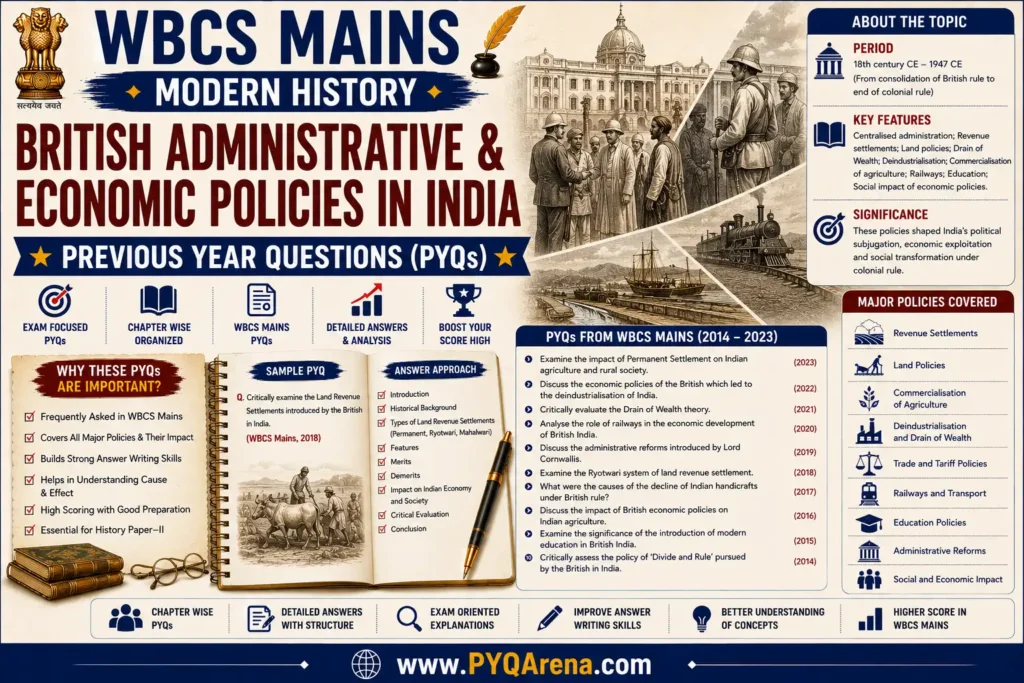
This compilation contains all multiple-choice questions from the West Bengal Civil Service (WBCS) Mains History examinations (2014-2023) that focus on the colonial land revenue systems (Permanent Settlement, Ryotwari, Mahalwari), the economic drain theory, the commercialization of agriculture, de-industrialization, and popular, peasant, and tribal uprisings (including Sannyasi-Fakir, Kuka, Wahabi, Santhal, Titu Mir, Indigo Revolt, Tebhaga, and Telangana movements).
WBCS Mains Economic Impact of British Rule & Popular Uprisings Questions 2023
Q. The Ryotwari System was first introduced in
(A) Bengal
(B) Delhi
(C) Madras
(D) Gujarat
Answer & Explanation
Correct Answer: (C) Madras
Explanation
The Ryotwari System was first introduced on a large scale in the Madras Presidency during the early 19th century. It was developed by Alexander Read and later extensively implemented by Thomas Munro. Under this system, the ryot (cultivator) paid land revenue directly to the government, without the intermediary of a zamindar.
Exam Facts
- The Ryotwari System was first introduced in the Madras Presidency.
- Alexander Read pioneered the system in parts of the Madras Presidency.
- Thomas Munro played the major role in its subsequent development and implementation.
- Under Ryotwari, the cultivator (ryot) had a direct revenue relationship with the government.
- There was no zamindar intermediary between the government and the cultivator.
- The system was subsequently extended to parts of the Bombay Presidency.
- The Permanent Settlement was introduced in Bengal in 1793 under Lord Cornwallis.
- The Mahalwari System was introduced mainly in parts of North-Western India, including areas of the North-Western Provinces.
- Exam shortcut: Ryotwari → Madras → Thomas Munro → Direct settlement with cultivator.
Q. Who was associated with the ‘Sunset Law’?
(A) Lord Lytton
(B) Lord Ripon
(C) Lord William Bentinck
(D) Lord Cornwallis
Answer & Explanation
Correct Answer: (D) Lord Cornwallis
Explanation
The Sunset Law was associated with the Permanent Settlement of 1793, introduced under Lord Cornwallis. According to this rule, if a zamindar failed to pay the land revenue by sunset on the specified date, the estate could be sold by the government to recover the arrears. The rule was intended to ensure timely payment of revenue under the Permanent Settlement.
Exam Facts
- The Sunset Law was associated with Lord Cornwallis.
- It was connected with the Permanent Settlement of 1793.
- The Permanent Settlement was introduced in Bengal, Bihar and parts of Orissa.
- Under the Permanent Settlement, zamindars were recognised as hereditary proprietors, subject to payment of fixed land revenue.
- Under the Sunset Law, failure to pay revenue by the prescribed deadline could result in the sale of the zamindar’s estate.
- The law contributed to the auction of estates when zamindars failed to meet revenue demands.
- Lord Cornwallis served as Governor-General from 1786–1793 and again briefly in 1805.
- Lord William Bentinck was Governor-General from 1828–1835 and is particularly associated with the abolition of Sati in 1829.
- Lord Ripon served as Viceroy from 1880–1884 and is associated with local self-government reforms.
- Lord Lytton served as Viceroy from 1876–1880 and is associated with the Vernacular Press Act (1878).
Q. Who was the leader of Santhal Rebellion?
(A) Sindhu Murmu
(B) Jyotiba Phule
(C) Birsa Munda
(D) Visnucharan Biswas
Answer & Explanation
Correct Answer: (A) Sindhu Murmu
Explanation
The Santhal Rebellion (Santhal Hul) of 1855–1856 was led primarily by the brothers Sidhu (Sido) Murmu and Kanhu Murmu, along with their brothers Chand and Bhairav. They organised the Santhals against the exploitation of zamindars, moneylenders and British authorities in the Santhal region. Among the given options, Sindhu Murmu is intended to refer to Sidhu Murmu.
Exam Facts
- The Santhal Rebellion (Santhal Hul) took place in 1855–1856.
- The principal leaders were Sidhu Murmu and Kanhu Murmu.
- Chand Murmu and Bhairav Murmu were also important leaders of the rebellion.
- The rebellion began at Bhagnadih in present-day Jharkhand in June 1855.
- The Santhals rebelled against exploitation by zamindars, moneylenders, traders and British officials.
- The British ultimately suppressed the rebellion with considerable force.
- The rebellion led to administrative changes, including the creation of the Santhal Pargana region.
- Birsa Munda led the Munda Ulgulan (1899–1900), not the Santhal Rebellion.
- Jyotiba Phule was a prominent social reformer and anti-caste activist of 19th-century Maharashtra.
- Vishnucharan Biswas was associated with the Indigo Revolt (1859–1860) in Bengal.
- Exam shortcut: Santhal Hul → Sidhu & Kanhu Murmu → 1855–56 → Bhagnadih.
Q. Who appointed the Amini Commission?
(A) Lord Cornwallis
(B) Lord Dalhousie
(C) Lord Warren Hastings
(D) Lord Minto
Answer & Explanation
Correct Answer: (C) Lord Warren Hastings
Explanation
The Amini Commission was appointed by Warren Hastings in 1776 to investigate and assess the land revenue and agricultural conditions in Bengal. The commission was headed by Amini, and its work contributed to the East India Company’s attempts to establish a more systematic system of revenue assessment.
Exam Facts
- The Amini Commission was appointed by Warren Hastings in 1776.
- It was concerned with the assessment of land revenue in Bengal.
- The commission investigated landholdings, cultivation and revenue collection.
- The Amini Commission was part of Warren Hastings’ efforts to reorganise the Company’s revenue administration.
- Warren Hastings served as the first Governor-General of Bengal from 1773 to 1785.
- Lord Cornwallis introduced the Permanent Settlement in 1793.
- Lord Dalhousie served as Governor-General from 1848 to 1856 and is associated with the Doctrine of Lapse and railway development.
- Lord Minto I served as Governor-General from 1807 to 1813.
- The revenue experiments of the late 18th century eventually contributed to the development of the Company’s various land-revenue systems. WBCS Mains Economic Impact of British Rule & Popular Uprisings Questions 2022
WBCS Mains Economic Impact of British Rule & Popular Uprisings Questions 2022
Q. The Permanent Settlement was passed in the year
(A) 1803
(B) 1813
(C) 1793
(D) 1834
Answer & Explanation
Correct Answer: (C) 1793
Explanation
The Permanent Settlement was introduced in 1793 by Lord Cornwallis in Bengal, Bihar and parts of Orissa. Under this system, the land revenue payable by the zamindars to the East India Company was fixed permanently. The zamindars were recognised as the proprietors of the land, subject to the payment of the stipulated revenue.
Want more exam facts on this question? Get the WBCS Mains Indian History PYQ PDF
Q. The Hindoo Patriot was edited by
(A) Manmohan Ghosh
(B) Harish Chandra Mookherjee
(C) Debendranath Tagore
(D) Acharya Binoba Bhave
Answer & Explanation
Correct Answer: (B) Harish Chandra Mookherjee
Explanation
The Hindoo Patriot was edited by Harish Chandra Mookherjee, a prominent 19th-century journalist and social commentator in Bengal. He used the newspaper to strongly criticise the exploitation of indigo cultivators by European planters and played an important role in bringing attention to the Indigo Revolt of 1859–60.
Want more exam facts on this question? Get the WBCS Mains Indian History PYQ PDF
Q. Neel Darpan was written in the context of
(A) Sepoy Mutiny
(B) Deccan
(C) Indigo Revolt
(D) Ramosi Rebellion
Answer & Explanation
Correct Answer: (C) Indigo Revolt
Explanation
Neel Darpan was a Bengali play written by Dinabandhu Mitra in 1860. It portrayed the exploitation and suffering of indigo cultivators under European planters in Bengal and was closely associated with the Indigo Revolt of 1859–60. The play drew attention to the coercive practices used to force peasants to cultivate indigo.
Want more exam facts on this question? Get the WBCS Mains Indian History PYQ PDF
Q. Anandamath was written by
(A) Bankim Chandra Chattopadhyay
(B) Sarat Chandra Chattopadhyay
(C) Sarat Chandra Bose
(D) Dwijendralal Roy
Answer & Explanation
Correct Answer: (A) Bankim Chandra Chattopadhyay
Explanation
Anandamath was written by Bankim Chandra Chattopadhyay and was first published in 1882. The novel is set against the background of the Sannyasi-Fakir Rebellion in Bengal during the late 18th century. It is particularly famous for the song “Vande Mataram,” which later became an important part of India’s nationalist movement.
Want more exam facts on this question? Get the WBCS Mains Indian History PYQ PDF
WBCS Mains Economic Impact of British Rule & Popular Uprisings Questions 2021
Q. What is the Ulgulan?
(A) Santhal uprising of 1840s and ’50s
(B) Kol uprising
(C) Munda uprising, 1899–1900
(D) None of the above
Answer & Explanation
Correct Answer: (C) Munda uprising, 1899–1900
Explanation
Ulgulan, meaning “Great Tumult” or “Great Revolt,” refers to the Munda uprising of 1899–1900 led by Birsa Munda in the Chotanagpur region. The movement was directed against the exploitation of the Mundas by zamindars, moneylenders, missionaries and colonial authorities and sought to restore Munda control over their traditional land and social order.
Want more exam facts on this question? Get the WBCS Mains Indian History PYQ PDF
Q. Where among the following places was Permanent Settlement not introduced?
(A) Bengal
(B) Bihar
(C) Assam
(D) Punjab
Answer & Explanation
Correct Answer: (D) Punjab
Explanation
The Permanent Settlement of 1793 was introduced mainly in Bengal, Bihar and parts of Orissa under Lord Cornwallis. It was not introduced in Punjab, where different land-revenue arrangements were developed under British rule.
Want more exam facts on this question? Get the WBCS Mains Indian History PYQ PDF
Q. Which of the following settlements was a result of the Holt Mackenzie surveys of the 1820s?
(A) Taluqdari system
(B) Ryotwari system
(C) Anganwadi system
(D) Mahalwari system
Answer & Explanation
Correct Answer: (D) Mahalwari system
Explanation
The Mahalwari Settlement developed from the surveys and revenue experiments conducted under Holt Mackenzie in the 1820s. His plan of 1822 provided for the assessment of land revenue based on the mahal, meaning a village or group of villages. The system was later revised and implemented under Robert Merttins Bird.
Want more exam facts on this question? Get the WBCS Mains Indian History PYQ PDF
Q. Which of the following statements is not true of the Permanent Settlement?
(A) The settlement was introduced initially as a decennial settlement
(B) It gave rise to a market in land
(C) It resulted in pauperisation of the peasantry
(D) None of the above
Answer & Explanation
Correct Answer: (D) None of the above
Explanation
All the statements given in (A), (B) and (C) are considered correct regarding the Permanent Settlement. It was initially introduced as a decennial settlement in 1790 and was made permanent in 1793. The system contributed to the development of a market in land, as estates could be sold or auctioned for failure to pay revenue. It also contributed to the impoverishment of many peasants due to the pressure of rents and revenue demands.
Want more exam facts on this question? Get the WBCS Mains Indian History PYQ PDF
Q. With the revenue settlement of which region was Mountstuart Elphinstone associated?
(A) Punjab
(B) Agra
(C) Bombay
(D) Awadh
Answer & Explanation
Correct Answer: (C) Bombay
Explanation
Mountstuart Elphinstone was associated with the revenue administration of the Bombay Presidency. During his tenure as Governor of Bombay, he supported and developed administrative and revenue arrangements in the region, where the Ryotwari system was an important form of land-revenue settlement.
Want more exam facts on this question? Get the WBCS Mains Indian History PYQ PDF
Q. When was the first Factory Act passed in India?
(A) 1881
(B) 1911
(C) 1921
(D) 1931
Answer & Explanation
Correct Answer: (A) 1881
Explanation
The first Factory Act in India was passed in 1881 during the tenure of Lord Ripon. It was introduced to regulate working conditions in factories, particularly the employment of children. The Act placed restrictions on the employment and working hours of children and introduced basic safety provisions.
Want more exam facts on this question? Get the WBCS Mains Indian History PYQ PDF
Q. In which session of the Congress was the movement provided with a peasant agenda?
(A) Calcutta
(B) Delhi
(C) Haripura
(D) Tripuri
Answer & Explanation
Correct Answer: (C) Haripura
Explanation
The Haripura Session of the Indian National Congress (1938), presided over by Subhas Chandra Bose, gave greater recognition to the peasant movement and Kisan Sabhas within the broader nationalist movement. The session dealt with agrarian issues and recognised the growing importance of organised peasant movements.
Want more exam facts on this question? Get the WBCS Mains Indian History PYQ PDF
Q. Which party fought the 1937 elections in Bengal with the agenda of land reform?
(A) Congress
(B) Muslim League
(C) Kisan Sabha
(D) Krishak Praja Party
Answer & Explanation
Correct Answer: (D) Krishak Praja Party
Explanation
The Krishak Praja Party (KPP), led by A. K. Fazlul Huq, contested the 1937 Bengal Provincial Legislative Assembly elections with a strong emphasis on agrarian and land reforms. The party represented the interests of peasants and tenants, particularly those suffering under the zamindari system. Its programme included measures to reduce the burden of rent and indebtedness on cultivators.
Want more exam facts on this question? Get the WBCS Mains Indian History PYQ PDF
Q. In many of the peasant revolts, religion played an important role. Who was the leader of the Fakirs leading the Sannyasi-Fakir uprising? (Duplicate)
(A) Majnu Shah
(B) Tipu Shah
(C) Karim Shah
(D) Chirag Ali
Answer & Explanation
Correct Answer: (A) Majnu Shah
Explanation
Majnu Shah was the most prominent leader of the Fakir section of the Sannyasi-Fakir Rebellion in Bengal during the late 18th century. He led Fakir resistance against the East India Company’s revenue policies and interference, often operating in Bengal and northern Bengal. The movement involved both Fakirs and Sannyasis and continued intermittently from the 1760s into the early 19th century.
Want more exam facts on this question? Get the WBCS Mains Indian History PYQ PDF
Q. Titu Mir defeated ________, the Indigo Planter.
(A) Okenelly
(B) Davis
(C) Thornton
(D) Alexander
Answer & Explanation
Correct Answer: (B) Davis
Explanation
Titu Mir (Mir Nisar Ali), leader of the Tariqah-i-Muhammadiya movement in Barasat (Bengal), clashed with the European indigo planters who sided with the zamindars. He defeated the indigo planter Davis and his men in 1831.
Want more exam facts on this question? Get the WBCS Mains Indian History PYQ PDF
Q. Sati Daha Bill was passed in the year
(A) 1830
(B) 1829
(C) 1831
(D) 1832
Answer & Explanation
Correct Answer: (B) 1829
Explanation
The Sati Daha Bill (Sati Regulation) was passed in 1829 during the tenure of Lord William Bentinck, the Governor-General of India. The regulation declared the practice of Sati illegal and punishable by criminal courts in the territories under the Bengal Presidency. Raja Rammohan Roy played an important role in campaigning against the practice.
Want more exam facts on this question? Get the WBCS Mains Indian History PYQ PDF
WBCS Mains Economic Impact of British Rule & Popular Uprisings Questions 2020
Q. The Kuka Movement was started in the mid nineteenth century in
(A) Western Punjab
(B) Maharashtra
(C) Bengal
(D) Madhya Pradesh
Answer & Explanation
Correct Answer: (A) Western Punjab
Explanation
The Kuka Movement, also known as the Namdhari Movement, originated in Punjab in the mid-19th century. It was founded by Bhagat Jawahar Mal (Sian Sahib) and later developed into a more organised movement under Baba Ram Singh. The movement combined religious reform with opposition to British rule and became particularly active in the Punjab region.
Want more exam facts on this question? Get the WBCS Mains Indian History PYQ PDF
Q. The Tebhaga Movement of 1946 is associated with which of the following states of India?
(A) Andhra Pradesh
(B) West Bengal
(C) Bihar
(D) Odisha
Answer & Explanation
Correct Answer: (B) West Bengal
Explanation
The Tebhaga Movement of 1946–47 was a major sharecroppers’ movement in Bengal, led largely by the Bengal Provincial Kisan Sabha under the influence of the Communist movement. The sharecroppers, known as bargadars, demanded that they should retain two-thirds (tebhaga) of the produce, while the landowner would receive one-third.
Want more exam facts on this question? Get the WBCS Mains Indian History PYQ PDF
Q. The revolt of the Khasis against the British was led by
(A) Surendra Rai
(B) Utirot Sing
(C) Birsa Munda
(D) None of the above
Answer & Explanation
Correct Answer: (B) Utirot Sing
Explanation
The Khasi Revolt took place in 1829–1833 in the Khasi Hills of present-day Meghalaya. It was led by U Tirot Sing, the chief of Nongkhlaw. He resisted British attempts to establish control over the Khasi Hills and construct a road connecting Brahmaputra Valley with Sylhet.
Want more exam facts on this question? Get the WBCS Mains Indian History PYQ PDF
Q. Which of the following is correctly matched?
(A) Rabindranath Tagore — Nil Darpan
(B) Dadabhai Naoroji — Indian Unrest
(C) Dinabandhu Mitra — Gora
(D) Ramesh Chandra Dutt — Economic History of India
Answer & Explanation
Correct Answer: (D) Ramesh Chandra Dutt — Economic History of India
Explanation
Ramesh Chandra Dutt was a prominent Indian civil servant, historian and economic critic of British colonial rule. His major work, The EconomicHistory of India, examined the economic consequences of British policies in India. The other pairs are incorrect: Nil Darpanwas written by Dinabandhu Mitra, Goraby Rabindranath Tagore, while Indian Unrestwas written by Valentine Chirol.
Want more exam facts on this question? Get the WBCS Mains Indian History PYQ PDF
Q. Apart from the Quit India Movement, which started on 9th August 1942, what other sensational activity of the freedom fighters took place on that date in 1925?
(A) Salt Satyagraha
(B) Boycott of Simon Commission
(C) Champaran Satyagraha
(D) Kakori mail train robbery
Answer & Explanation
Correct Answer: (D) Kakori mail train robbery
Explanation
The Kakori Train Action, popularly known as the Kakori Train Robbery, took place on 9 August 1925 near Kakori, close to Lucknow. Revolutionary members of the Hindustan Republican Association (HRA) stopped a train carrying government treasury money and seized the funds to finance their revolutionary activities.
Want more exam facts on this question? Get the WBCS Mains Indian History PYQ PDF
WBCS Mains Economic Impact of British Rule & Popular Uprisings Questions 2019
Q. A remarkable feature of the spread of landlordism was the growth of
(A) Aristocracy
(B) Capitalism
(C) Sub-infeudation
(D) Cultivation
Answer & Explanation
Correct Answer: (C) Sub-infeudation
Explanation
A remarkable feature of the spread of landlordism in colonial India was the growth of sub-infeudation. Under this process, a zamindar or superior landholder transferred or leased rights over land to intermediary sub-landholders, who in turn collected rent from cultivators. This created a hierarchy of intermediaries between the actual cultivator and the government.
Want more exam facts on this question? Get the WBCS Mains Indian History PYQ PDF
Q. The extension of the cultivation of indigo, cotton, opium, tea and coffee in India, besides benefitting the British planters, also benefited
(A) The Zamindars
(B) The small merchants
(C) Both (A) and (B)
(D) The Indian Bankers
Answer & Explanation
Correct Answer: (C) Both (A) and (B)
Explanation
The expansion of commercial or cash-crop cultivation such as indigo, cotton, opium, tea and coffee during British rule benefited not only European planters but also sections of Indian zamindars and small merchants. Zamindars could gain through increased rents and commercial opportunities, while merchants benefited from the growth of trade and the movement of agricultural commodities.
Want more exam facts on this question? Get the WBCS Mains Indian History PYQ PDF
Q. What was the primary reason for the failure of Mahalwari Settlement in checking the process of destruction of the village communities?
(A) It was introduced only as a temporary measure to be replaced ultimately by the Ryotwari system.
(B) Individual rights in the land were recognized and guaranteed by the state.
(C) There were several defects and lacunae in the implementation of the measure.
(D) It met with severe opposition from certain sections of the village community.
Answer & Explanation
Correct Answer: (B) Individual rights in the land were recognized and guaranteed by the state.
Explanation
The Mahalwari Settlement was intended to preserve the traditional village community as the basic unit of land-revenue assessment. However, the recognition and protection of individual rights in land weakened the collective character of village communities. As individual ownership and proprietary rights became more significant, traditional communal arrangements gradually declined.
Want more exam facts on this question? Get the WBCS Mains Indian History PYQ PDF
Q. Which of the following consequences of the British rule did not affect the Muslim middle classes?
(A) The tyranny of the British Indigo Planters
(B) The disbandment of the Nawab’s forces
(C) The abolition of the rural police
(D) The resumptions of Imam’s lands which provided sustenance to the learned
Answer & Explanation
Correct Answer: (A) The tyranny of the British Indigo Planters
Explanation
The Muslim middle classes in Bengal were affected by several British administrative and economic changes. The disbandment of the Nawab’s forces, the abolition of the rural police, and the resumption of Imam’s lands weakened the traditional sources of employment and livelihood of sections of the Muslim middle classes. The tyranny of British indigo planters, however, primarily affected peasant cultivators, particularly those forced to grow indigo, rather than being a direct consequence affecting the Muslim middle classes as a class.
Want more exam facts on this question? Get the WBCS Mains Indian History PYQ PDF
Q. The tribal leader who was regarded as the Father of the World (Dharti Aba) was
(A) Buddha Bhagat
(B) Tilka Manjhi
(C) Birsa Munda
(D) Bonangi Pandu Paral
Answer & Explanation
Correct Answer: (C) Birsa Munda
Explanation
Birsa Munda was popularly known as Dharti Aba, meaning “Father of the Earth” or “Father of the World.” He was the leader of the Munda Ulgulan (Great Revolt) of 1899–1900 in the Chotanagpur region. He became a major symbol of tribal resistance against British rule, land alienation and exploitation by intermediaries.
Want more exam facts on this question? Get the WBCS Mains Indian History PYQ PDF
Q. Certain movements of the early twentieth century described as ‘Movements from below’ were
(A) Caste movements
(B) Revolutionary movements
(C) Peasant and tribal movements
(D) Socio-religious movements
Answer & Explanation
Correct Answer: (C) Peasant and tribal movements
Explanation
The term “Movements from below” is used by historians to describe peasant and tribal movements that emerged from the grassroots and involved ordinary cultivators and tribal communities. These movements often arose in response to land alienation, exploitation, high rents, indebtedness, forced cultivation and colonial policies.
Want more exam facts on this question? Get the WBCS Mains Indian History PYQ PDF
Q. When was the first Census carried out in India?
(A) 1851
(B) 1861
(C) 1871
(D) 1881
Answer & Explanation
Correct Answer: (C) 1871
Explanation
The first all-India census was conducted under Lord Mayo in a non-synchronous way between 1867 and 1872; it is known as the Census of 1871–72. The first synchronous census, taken across British India at the same time, was held in 1881 under Lord Ripon. No all-India census was taken in 1851 or 1861.
Want more exam facts on this question? Get the WBCS Mains Indian History PYQ PDF
Q. Which prominent Indian nationalist leader found Gandhi’s definition of Swaraj in 1921 Ahmedabad session of the INC ‘delightfully vague’?
(A) Jawaharlal Nehru
(B) Subhas Bose
(C) M. A. Jinnah
(D) C. R. Das
Answer & Explanation
Correct Answer: (A) Jawaharlal Nehru
Explanation
Jawaharlal Nehru described Mahatma Gandhi’s definition of Swaraj at the Ahmedabad Session of the Indian National Congress in 1921 as “delightfully vague.” Gandhi deliberately kept the concept broad, allowing Swaraj to encompass political freedom, self-government and wider national aspirations rather than restricting it to a narrowly defined constitutional arrangement.
Want more exam facts on this question? Get the WBCS Mains Indian History PYQ PDF
Q. In the first session of the INC (1885), who represented the province of Bengal?
(A) W.C. Bonnerjea
(B) Surendranath Banerjee
(C) Sisir Kumar Ghosh
(D) R.B. Bose
Answer & Explanation
Correct Answer: (A) W.C. Bonnerjea
Explanation
W. C. Bonnerjea (Womesh Chandra Bonnerjee) represented Bengal at the first session of the Indian National Congress, held at Bombay in December 1885. He was also elected as the first President of the Indian National Congress.
Want more exam facts on this question? Get the WBCS Mains Indian History PYQ PDF
Q. Under the Ryotwari system, after how many years could there be a reassessment of revenue demand?
(A) 10 years
(B) 20 years
(C) 30 years
(D) Never
Answer & Explanation
Correct Answer: (C) 30 years
Explanation
Under the Ryotwari system, land revenue was settled directly between the government and the individual cultivator (ryot). Unlike the Permanent Settlement, the revenue demand was not fixed permanently. It was subject to periodic revision, generally after 30 years in the standard Ryotwari settlement.
Want more exam facts on this question? Get the WBCS Mains Indian History PYQ PDF
WBCS Mains Economic Impact of British Rule & Popular Uprisings Questions 2018
Q. Arrange the following armed resistance in the nineteenth century against the colonial rule in chronological order and choose the correct answer from the codes given below:
(i) Satara disturbance
(ii) Gadkari rebellion
(iii) Revolt of Rao Bharamal
(iv) Rebellion of Birabhadra Raju
(A) (i), (ii), (iii), (iv)
(B) (iv), (iii), (ii), (i)
(C) (iv), (ii), (i), (iii)
(D) (i), (iv), (iii), (ii)
Answer & Explanation
Correct Answer: (B) (iv), (iii), (ii), (i)
Explanation
The real dates are: Revolt of Rao Bharamal of Kutch (1816–19), Rebellion of Birabhadra Raju in Visakhapatnam (1827–33), Satara disturbances (1840–41) and Gadkari rebellion in Kolhapur (1844–45). The exact order is therefore (iii), (iv), (i), (ii). None of the options gives this exact order; (B) is the closest, as it is the only option that places both early revolts before both 1840s revolts.
Want more exam facts on this question? Get the WBCS Mains Indian History PYQ PDF
Q. During the first century of British rule there were a series of ‘restorative rebellions’ started by disaffected local rulers. Arrange the following revolts in chronological order:
(i) Paik rebellion led by Jagabandhu
(ii) Poligar rebellion led by Kattabomman
(iii) Kittur uprising led by Queen Chennamma
(iv) Travancore revolt led by Velu Thampi
(A) (i), (ii), (iii), (iv)
(B) (ii), (iv), (i), (iii)
(C) (i), (iv), (ii), (iii)
(D) (ii), (i), (iv), (iii)
Answer & Explanation
Correct Answer: (B) (ii), (iv), (i), (iii)
Explanation
The correct chronological order is:
Poligar Rebellion → Travancore Revolt → Paik Rebellion → Kittur Uprising
Want more exam facts on this question? Get the WBCS Mains Indian History PYQ PDF
Q. Ho and Munda tribesmen were from
(A) Chotanagpur
(B) Araballi hills
(C) Sahayadri hills
(D) None of the above
Answer & Explanation
Correct Answer: (A) Chotanagpur
Explanation
The Ho and Munda tribes were primarily associated with the Chotanagpur Plateau, particularly present-day Jharkhand and adjoining regions. Both communities played important roles in several tribal uprisings against British rule and local exploitation.
Want more exam facts on this question? Get the WBCS Mains Indian History PYQ PDF
Q. In many of the peasant revolt religion played an important role. Who among the following was the leader of the Fakirs leading the Sannyasi-Fakir uprising in Bengal?
(A) Tipu Shah
(B) Karim Shah
(C) Majnu Shah
(D) Golam Masum
Answer & Explanation
Correct Answer: (C) Majnu Shah
Explanation
Majnu Shah was the prominent leader of the Fakir resistance associated with the Sannyasi-Fakir uprising in Bengal during the late 18th century. The movement involved both Muslim Fakirs and Hindu Sannyasis and was directed against the expanding authority and economic policies of the East India Company.
Want more exam facts on this question? Get the WBCS Mains Indian History PYQ PDF
Q. Match List I with List II and choose the correct answer from the codes given below:
List I:
(a) Pagalpanthi uprising
(b) Tariqah-i-Muhammadiya
(c) Faraizi movement
(d) Shah-i-Madar
List II:
(i) Chirag Ali
(ii) Haji Shariatullah
(iii) Karim Shah
(iv) Mir Nisar
(A) (a)-(ii), (b)-(i), (c)-(iv), (d)-(iii)
(B) (a)-(i), (b)-(iv), (c)-(ii), (d)-(iii)
(C) (a)-(ii), (b)-(iii), (c)-(iv), (d)-(i)
(D) (a)-(ii), (b)-(i), (c)-(iii), (d)-(iv)
Answer & Explanation
Correct Answer: None of the given options. Correct matching: (a)-(iii), (b)-(iv), (c)-(ii), (d)-(i)
Explanation
The correct matching is (a)-(iii), (b)-(iv), (c)-(ii), (d)-(i): Pagalpanthi uprising – Karim Shah; Tariqah-i-Muhammadiya – Mir Nisar (Titu Mir); Faraizi movement – Haji Shariatullah; Shah-i-Madar – Chirag Ali. None of the four options gives this combination.
Want more exam facts on this question? Get the WBCS Mains Indian History PYQ PDF
Q. Some of the peasant rebellions were participated in exclusively by the tribal population. Arrange the following tribal movements chronologically:
(i) Gudem Rampa rebellion led by Alluri Sitaramaraju
(ii) Kol rebellion led by Buddha Bhagat
(iii) Hul rebellion led by Sidho and Kanho
(iv) Thadoe Kuki movement led by Jadonang and his niece Gaidinilu
(A) (ii), (iii), (i), (iv)
(B) (i), (iv), (ii), (iii)
(C) (i), (ii), (iii), (iv)
(D) (ii), (i), (iv), (iii)
Answer & Explanation
Correct Answer: (A) (ii), (iii), (i), (iv)
Explanation
The correct chronological order is:
Kol Rebellion → Hul Rebellion → Gudem Rampa Rebellion → Thadoe Kuki Movement
Want more exam facts on this question? Get the WBCS Mains Indian History PYQ PDF
Q. The first sign of revolt led by Titu Mir was a raid on zamindar ________.
(A) Ramram Chakraborty
(B) Kaliprasanna Mukhopadhyay
(C) Debnath Roy
(D) Krishnadeva Roy
Answer & Explanation
Correct Answer: (D) Krishnadeva Roy
Explanation
Titu Mir’s revolt began in 1831 with a raid on the zamindar Krishnadeva Roy (Krishna Deva Rai) of Purha, who had imposed a tax on beards and on mosques used by his Muslim tenants.
Want more exam facts on this question? Get the WBCS Mains Indian History PYQ PDF
Q. Which of the following conditions didn’t prompt the making of Mahalwari Settlement?
(A) To curb the refractory and oppressive nature of the Taluqdars.
(B) Need to maximise revenue.
(C) Protecting the rights of the present proprietors to ensure improvement of agriculture.
(D) Influence of the Ricardian theory of Rent.
Answer & Explanation
Correct Answer: (D) Influence of the Ricardian theory of Rent
Explanation
The Mahalwari Settlement was developed in the 1820s, particularly following Holt Mackenzie’s 1822 revenue regulations. Its objectives included increasing government revenue, dealing with the power of taluqdars, and recognising the rights of village proprietors to encourage agricultural improvement.
The Ricardian theory of rent, associated with economist David Ricardo, influenced some later British economic thinking but was not a principal condition that prompted the creation of the Mahalwari Settlement.
Want more exam facts on this question? Get the WBCS Mains Indian History PYQ PDF
Q. Who among the following was the founder of Wahabi movement in India?
(A) Waliullah
(B) Shah Muhammad Hossein
(C) Muhammad Abdul Wahab
(D) Syed Ahmed of Rai Bareilly
Answer & Explanation
Correct Answer: (D) Syed Ahmed of Rai Bareilly
Explanation
The Wahabi Movement in India was led and organised by Syed Ahmad Barelvi (Syed Ahmed of Rai Bareilly) in the early 19th century. He was influenced by the teachings of Muhammad ibn Abd al-Wahhab of Arabia and sought to reform Muslim society and oppose practices he considered un-Islamic.
Want more exam facts on this question? Get the WBCS Mains Indian History PYQ PDF
Q. Who among the following was the leader of the Faraijis?
(A) Duddu Miyan
(B) Titu Mir
(C) Karim Shah
(D) Majnu Fakir
Answer & Explanation
Correct Answer: (A) Duddu Miyan
Explanation
The Faraizi Movement was founded by Haji Shariatullah in Bengal in the early 19th century. After his death in 1840, his son Duddu Miyan (Muhsinuddin Ahmad) became the prominent leader of the movement. He transformed it into a broader agrarian movement against the oppression of zamindars and indigo planters.
Want more exam facts on this question? Get the WBCS Mains Indian History PYQ PDF
Q. Tebhaga Movement was launched by Bengal Provincial Kisan Sabha to force implementation of the recommendations of ________ Commission through mass struggle.
(A) Fowler Commission
(B) Frazer Commission
(C) Sapru Commission
(D) Floud Commission
Answer & Explanation
Correct Answer: (D) Floud Commission
Explanation
The Tebhaga Movement (1946–47) was launched in Bengal under the leadership of the Bengal Provincial Kisan Sabha. It sought to implement the recommendations of the Floud Commission (Bengal Land Revenue Commission), which had recommended that sharecroppers (bargadars) should receive two-thirds of the produce, while the landlord would receive one-third.
The movement’s central demand was therefore “Tebhaga” (two-thirds share) for the cultivator.
Want more exam facts on this question? Get the WBCS Mains Indian History PYQ PDF
WBCS Mains Economic Impact of British Rule & Popular Uprisings Questions 2017
Q. The ‘Drain Theory’ was first propounded by
(A) Womesh Chandra Bonerjee
(B) G. V. Joshi
(C) Dadabhai Naoroji
(D) Romesh Chandra Dutt
Answer & Explanation
Correct Answer: (C) Dadabhai Naoroji
Explanation
The Drain Theory was first systematically propounded by Dadabhai Naoroji. He argued that a substantial portion of India’s wealth was being transferred to Britain without an adequate economic return to India. He presented this as a major cause of India’s economic impoverishment under British rule.
Naoroji developed the theory in his writings and speeches and later elaborated it in his famous book Poverty and Un-British Rule in India(1901).
Want more exam facts on this question? Get the WBCS Mains Indian History PYQ PDF
Q. The Landholders’ Association was founded in the year
(A) 1838
(B) 1851
(C) 1875
(D) 1876
Answer & Explanation
Correct Answer: (A) 1838
Explanation
The Landholders’ Association was founded in 1838 in Calcutta. It was one of the earliest organised political associations in British India and was formed mainly to protect the interests of landowners and zamindars. It was also known as the Zamindari Association.
Want more exam facts on this question? Get the WBCS Mains Indian History PYQ PDF
Q. Who was the founder of Gramvarta Prakashika?
(A) Bhavani Charan
(B) Harish Chandra Mukhopadhyay
(C) Sisir Kumar Ghosh
(D) Harinath Majumder
Answer & Explanation
Correct Answer: (D) Harinath Majumder
Explanation
Gramvarta Prakashika was a Bengali newspaper founded by Harinath Majumder, popularly known as Kangal Harinath. Published from Kushtia, it highlighted the problems and exploitation faced by peasants and rural people, particularly under the oppressive practices of zamindars and indigo planters.
Want more exam facts on this question? Get the WBCS Mains Indian History PYQ PDF
Q. What was the first all India movement launched by M. K. Gandhi?
(A) Rowlatt Satyagraha
(B) Khilafat Movement
(C) Non-Cooperation Movement
(D) Champaran Satyagraha
Answer & Explanation
Correct Answer: (A) Rowlatt Satyagraha
Explanation
The Rowlatt Satyagraha of 1919 was the first nationwide movement led by Mahatma Gandhi. It was launched against the Rowlatt Act of 1919, which extended extraordinary powers to the colonial government to suppress political activities and detain people without trial.
Gandhi called for a nationwide hartal on 6 April 1919. Although the movement was later suspended because of widespread violence, it marked Gandhi’s first major all-India political mobilisation.
Want more exam facts on this question? Get the WBCS Mains Indian History PYQ PDF
Q. In which year the Indian Penal Code came into effect?
(A) 1860
(B) 1862
(C) 1865
(D) 1875
Answer & Explanation
Correct Answer: (B) 1862
Explanation
The Indian Penal Code (IPC) was enacted in 1860, but it came into effect on 1 January 1862. It was drafted by the First Law Commission, chaired by Lord Thomas Babington Macaulay. The distinction between the year of enactment and the year it came into force is important for examinations.
Want more exam facts on this question? Get the WBCS Mains Indian History PYQ PDF
WBCS Mains Economic Impact of British Rule & Popular Uprisings Questions 2016
Q. Which movement, though started as a religious reform movement, became a movement for the restoration of Sikh sovereignty by the annexation of Punjab by the British?
(A) Kittur Rising
(B) Bundela Revolt
(C) Kuka Movement
(D) Satavandi Revolt
Answer & Explanation
Correct Answer: (C) Kuka Movement
Explanation
The Kuka Movement, also known as the Namdhari Movement, began in the 19th century as a religious and social reform movement among the Sikhs. After the British annexation of Punjab in 1849, it increasingly developed a political character, with some followers seeking the restoration of Sikh rule.
The movement was later led by Baba Ram Singh, who promoted social reform and resistance to British rule.
Want more exam facts on this question? Get the WBCS Mains Indian History PYQ PDF
Q. Who was mainly responsible for introducing the Ryotwari system in Madras?
(A) Macartney
(B) Elphinstone
(C) Thomas Munro
(D) John Lawrence
Answer & Explanation
Correct Answer: (C) Thomas Munro
Explanation
Thomas Munro was mainly responsible for introducing and developing the Ryotwari System in the Madras Presidency during the early 19th century. The system established a direct relationship between the colonial government and individual cultivators (ryots), eliminating the need for zamindars as revenue intermediaries.
Want more exam facts on this question? Get the WBCS Mains Indian History PYQ PDF
Q. In which year Tebhaga Movement was launched in Bengal?
(A) 1942
(B) 1946
(C) 1947
(D) 1952
Answer & Explanation
Correct Answer: (B) 1946
Explanation
The Tebhaga Movement was launched in Bengal in 1946 under the leadership of the Bengal Provincial Kisan Sabha. Sharecroppers, known as bargadars, demanded two-thirds of the harvested produce instead of the traditional half share given to them by landlords.
The movement was influenced by the recommendations of the Floud Commission, which proposed a two-thirds share for cultivators.
Want more exam facts on this question? Get the WBCS Mains Indian History PYQ PDF
Q. The labour movement in India primarily owes its origin to
(A) draft recommendations of the Washington International Labour Conference.
(B) economic depression.
(C) the General awakening following the First World War.
(D) the efforts of the Indian National Congress.
Answer & Explanation
Correct Answer: (C) the General awakening following the First World War.
Explanation
The modern labour movement in India grew significantly after the First World War (1914–1918). Rising prices, declining real wages, poor working conditions and growing political awareness encouraged workers to organise strikes and form trade unions. This period witnessed the expansion of organised labour activism, culminating in the establishment of the All India Trade Union Congress (AITUC) in 1920.
Want more exam facts on this question? Get the WBCS Mains Indian History PYQ PDF
Q. When and where was the All India Kisan Sabha formed?
(A) 1930-Bombay
(B) 1936-Lucknow
(C) 1938-Calcutta
(D) 1942-Lucknow
Answer & Explanation
Correct Answer: (B) 1936-Lucknow
Explanation
The All India Kisan Sabha (AIKS) was formed on 11 April 1936 in Lucknow to organise peasants across India and fight against zamindari exploitation, excessive land revenue and other agrarian injustices. Swami Sahajanand Saraswati was elected its first president, while N. G. Ranga was another prominent leader of the peasant movement.
Want more exam facts on this question? Get the WBCS Mains Indian History PYQ PDF
Q. Which of the following movements was started by Swami Sahajanand Saraswati in Bihar?
(A) Zamidari Movement
(B) Socialist Movement
(C) Kisan Sabha Movement
(D) Labour Movement
Answer & Explanation
Correct Answer: (C) Kisan Sabha Movement
Explanation
Swami Sahajanand Saraswati was a prominent peasant leader who organised farmers against zamindari oppression and exploitation in Bihar. He founded the Bihar Provincial Kisan Sabha in 1929 to protect peasants’ rights and mobilise them against excessive rents and other forms of exploitation. He later became the first president of the All India Kisan Sabha, established in 1936.
Want more exam facts on this question? Get the WBCS Mains Indian History PYQ PDF
Q. Which of the following was perhaps the most widespread, most intense and most organized peasant movement in the history of colonial India?
(A) Tebhaga Movement
(B) Telangana Movement
(C) Indigo Movement
(D) Deccan Riots
Answer & Explanation
Correct Answer: (B) Telangana Movement
Explanation
The Telangana Peasant Movement (1946–51) was one of the most extensive, intense and organised peasant struggles in colonial and early postcolonial India. It began in the Telangana region of the erstwhile Hyderabad State against the exploitation of peasants by landlords (doras), forced labour (vetti), and oppressive agrarian practices. The movement was associated with the Communist Party of India (CPI) and involved demands for land rights and an end to feudal oppression.
Want more exam facts on this question? Get the WBCS Mains Indian History PYQ PDF
WBCS Mains Economic Impact of British Rule & Popular Uprisings Questions 2015
Q. Indenture regulations which bound the artisans of Eastern India to sell their products exclusively to the English company from the Late 18th Century were known as
(A) Dadni
(B) Damdupat
(C) Khatbandi
(D) Kamiya
Answer & Explanation
Correct Answer: (A) Dadni
Explanation
Dadni was an advance-payment system used by the English East India Company and its agents to procure goods from Indian artisans and weavers. Artisans received advances for producing textiles and other goods, but they were often compelled to sell their products exclusively to the Company at prices fixed by its agents. This system contributed to the exploitation and loss of economic freedom of many artisans in Eastern India.
Want more exam facts on this question? Get the WBCS Mains Indian History PYQ PDF
Q. Which of the following is not one of the causes responsible for the rise of money lenders in British India?
(A) New revenue policy
(B) New legal system
(C) New educational system
(D) Commercialization of agriculture
Answer & Explanation
Correct Answer: (C) New educational system
Explanation
The rise of moneylenders in British India was closely connected with colonial land revenue policies, the new legal system and the commercialization of agriculture. High revenue demands often forced peasants to borrow money to pay taxes. The legal system enabled creditors to recover debts through courts and, in some cases, seize land. Commercialization of agriculture increased peasants’ dependence on credit to purchase inputs and meet expenses before harvest.
The new educational system was not a direct major cause of the rise of moneylenders.
Want more exam facts on this question? Get the WBCS Mains Indian History PYQ PDF
Q. Which of the following results of the Zamindari System was not an advantage to the British?
(A) Creation of political allies
(B) Minimisation of revenue administrative expenditure
(C) Permanent fixation of revenue demand
(D) Provision of financial security
Answer & Explanation
Correct Answer: (D) Provision of financial security
Explanation
The Zamindari System under the Permanent Settlement of 1793 offered several advantages to the British government. It created a class of loyal landholders who could act as political allies, reduced the administrative burden of collecting land revenue, and fixed the government’s revenue demand permanently.
However, provision of financial security was not a direct advantage to the British government in the same sense. The permanent fixation of revenue limited the government’s ability to increase its land revenue income as agricultural production and prices rose.
Want more exam facts on this question? Get the WBCS Mains Indian History PYQ PDF
Q. Who among the following Britishers were associated with the introduction of Mahalwari System?
(A) R.M. Bird
(B) Sir John Lawrence
(C) William Karey
(D) Sir Alexandar Cunningham
Answer & Explanation
Correct Answer: (A) R.M. Bird
Explanation
The Mahalwari System was introduced following the revenue proposals of Holt Mackenzie in 1822 and was later developed and implemented under Robert Merttins Bird (R. M. Bird) in the North-Western Provinces during the 1830s.
Under this system, land revenue was assessed for a mahal, generally a village or group of villages, with the village community or its proprietors collectively responsible for payment.
Want more exam facts on this question? Get the WBCS Mains Indian History PYQ PDF
Q. The Public Postal System in India was started in which year?
(A) 1837
(B) 1838
(C) 1848
(D) 1839
Answer & Explanation
Correct Answer: (A) 1837
Explanation
The Public Postal System in India was established in 1837 under British rule. The Post Office Act of 1837 provided a legal framework for postal services across British India and helped develop a more organised postal administration.
Want more exam facts on this question? Get the WBCS Mains Indian History PYQ PDF
Q. Who was the first to attempt decentralization of financial administration?
(A) Ripon
(B) Mayo
(C) Curzon
(D) Lytton
Answer & Explanation
Correct Answer: (B) Mayo
Explanation
Lord Mayo initiated the decentralisation of financial administration in British India through his Financial Decentralisation Resolution of 1870. The aim was to give provincial governments greater responsibility for managing certain expenditures and to encourage economy and efficiency in administration.
Want more exam facts on this question? Get the WBCS Mains Indian History PYQ PDF
WBCS Mains Economic Impact of British Rule & Popular Uprisings Questions 2014
Q. Which of the following towns was chosen as the headquarter of the Wahabi Movement in 1826?
(A) Kandahar
(B) Quetta
(C) Peshawar
(D) Charsadda
Answer & Explanation
Correct Answer: (C) Peshawar
Explanation
In 1826, Syed Ahmad Barelvi (also known as Syed Ahmad of Rai Bareilly) led the Wahabi movement in north-western India against Sikh rule. Peshawar became an important centre of his movement, which aimed to establish Islamic rule in the region. The movement later faced opposition from the Sikh forces of Maharaja Ranjit Singh.
Want more exam facts on this question? Get the WBCS Mains Indian History PYQ PDF
Leave a Comment