


WBP SI Prelims Reasoning Questions 2021
Q. Find the missing number in the given grid:

(A) 12
(B) 18
(C) 20
(D) 16
Answer & Explanation
Correct Answer: (A) 12
Explanation

Study the rows of the grid one by one: (72, 24, 6), (96, 16, 12), (108, ?, 18).
Row 1: multiply the middle number and the last number: 24 × 6 = 144.
Half of 144 is 72, which is the first number of row 1.
Row 2: 16 × 12 = 192, and half of 192 is 96, which is the first number of row 2.
So the rule is: first number = (middle number × last number) ÷ 2.
Row 3: (? × 18) ÷ 2 = 108, so ? × 18 = 216.
? = 216 ÷ 18 = 12.
Check: 12 × 18 = 216 and 216 ÷ 2 = 108, which matches.
Options 18, 20 and 16 give 18 × 18 ÷ 2 = 162, 20 × 18 ÷ 2 = 180 and 16 × 18 ÷ 2 = 144, none of which is 108.
Hence, the correct answer is (A) 12.
Want this as a PDF? Get the WBP SI Prelims PYQ PDF
Q. If ‘+’ means ‘×’, ‘÷’ means ‘−’, ‘×’ means ‘+’ and ‘−’ means ‘÷’, then what is the value of (2 + 27 − 3 + 2 × 3 ÷ 2)?
(A) 35
(B) 27
(C) 39
(D) 37
Answer & Explanation
Correct Answer: (D) 37
Explanation
The given interchanges are: + becomes ×, ÷ becomes −, × becomes +, and − becomes ÷.
Original expression: 2 + 27 − 3 + 2 × 3 ÷ 2.
Replace every sign by its new meaning: 2 × 27 ÷ 3 × 2 + 3 − 2.
Apply BODMAS: first do division and multiplication from left to right.
2 × 27 = 54.
54 ÷ 3 = 18.
18 × 2 = 36.
Now only addition and subtraction are left: 36 + 3 − 2.
36 + 3 = 39 and 39 − 2 = 37.
Option (C) 39 is what we get if the last ‘− 2’ is forgotten; options (A) 35 and (B) 27 do not come out from any correct step.
Hence, the correct answer is (D) 37.
Want this as a PDF? Get the WBP SI Prelims PYQ PDF
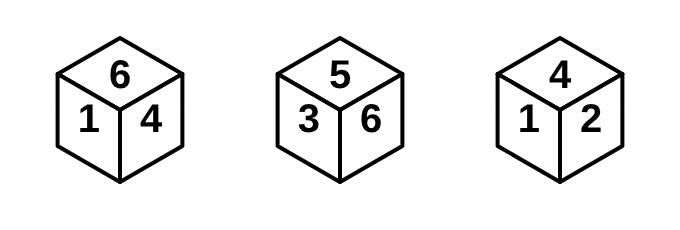
Q. If number 2 is in bottom, then which number is on top on a dice?
(A) 5
(B) 1
(C) 6
(D) 3
Answer & Explanation
Correct Answer: (C) 6
Explanation

Cube 1 shows 6 on top, 1 on the left and 4 on the right.
Cube 3 shows 4 on top, 1 on the left and 2 on the right.
The faces 1 and 4 are common to cube 1 and cube 3, so these two cubes are the same dice seen from two positions.
The faces 1 and 4 are next to each other in both views, so the third face at their common corner must differ: it is 6 in cube 1 and 2 in cube 3.
Going round the common corner 4 → 1 → 6 in cube 1 gives the opposite direction to 4 → 1 → 2 in cube 3.
For one and the same dice this happens only when the two third faces are opposite to each other, so 6 is opposite 2.
Cube 2 supports this: it shows 5, 3 and 6 together, so 6 is adjacent to 5 and 3 and cannot be opposite either of them.
Therefore 2 is opposite 6.
If 2 is at the bottom, the face on the top is 6.
Hence, the correct answer is (C) 6.
Want this as a PDF? Get the WBP SI Prelims PYQ PDF
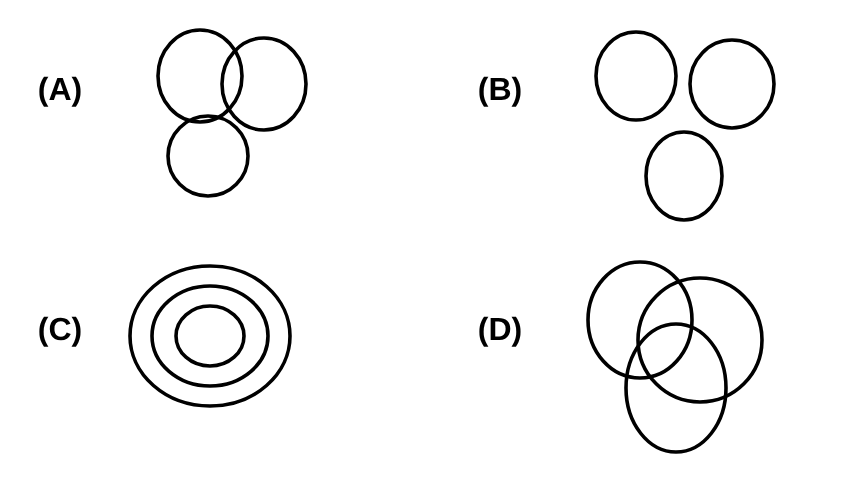
Q. Explain the following relationship with the help of Venn diagram: Singer, Musician, Doctor
Answer & Explanation
Correct Answer: (D) the three overlapping circles (figure D)
Explanation
Note: no option shows ‘singer’ fully inside ‘musician’, so this question is loosely framed; (D) is the best available diagram.
A singer sings, a musician plays or composes music and a doctor treats patients; these are different professions.
Yet one person can belong to more than one class: a doctor can also be a singer, or a musician, or both.
So the right diagram must show every pair of circles overlapping and also a region common to all three.
Option (A): the circles overlap in pairs, but there is no region common to all three circles, so a person who is a singer, a musician and a doctor cannot be shown.
Option (B): three separate circles would mean that no singer is a musician or a doctor, which is not true.
Option (C): concentric circles would mean that every singer is a musician and every musician is a doctor, which is clearly wrong.
Option (D): three circles overlap each other and share a common middle region, which shows all the possible overlaps.
Hence, the correct answer is (D), the diagram of three mutually intersecting circles.
Want this as a PDF? Get the WBP SI Prelims PYQ PDF
Q. If the following words are arranged in alphabetical order which word will come last?
1. Abandon 2. Actuate 3. Accumulate
4. Acquit 5. Achieve
(A) Actuate
(B) Acquit
(C) Achieve
(D) Accumulate
Answer & Explanation
Correct Answer: (A) Actuate
Explanation
All five words begin with A, so compare the second letter.
Abandon has b as its second letter, while the other four have c, and b comes before c, so Abandon comes first.
Now compare the third letter of the remaining words: Actuate (t), Accumulate (c), Acquit (q), Achieve (h).
In alphabetical order c, h, q, t gives Accumulate, Achieve, Acquit, Actuate.
So the full order is: Abandon, Accumulate, Achieve, Acquit, Actuate.
The last word is Actuate.
Accumulate (D) comes second, Achieve (C) comes third and Acquit (B) comes fourth, so none of them is last.
Hence, the correct answer is (A) Actuate.
Want this as a PDF? Get the WBP SI Prelims PYQ PDF
Q. In a code language 724 means ‘leaf is green’, 371 means ‘green and blue’ and 438 means ‘sky is blue’. Then which numbers represent ‘leaf’ and ‘is’?
(A) 2 and 7
(B) 7 and 4
(C) 2 and 8
(D) 2 and 4
Answer & Explanation
Correct Answer: (D) 2 and 4
Explanation
Write the three statements with their codes:
724 = leaf, is, green
371 = green, and, blue
438 = sky, is, blue
The word ‘green’ is common to the first and second statements, and the digit 7 is common to 724 and 371, so green = 7.
The word ‘blue’ is common to the second and third statements, and the digit 3 is common to 371 and 438, so blue = 3.
The word ‘is’ is common to the first and third statements, and the digit 4 is common to 724 and 438, so is = 4.
In 724, after removing green = 7 and is = 4, the digit left is 2, so leaf = 2.
Hence ‘leaf’ = 2 and ‘is’ = 4.
Options (A) and (B) give 7 for leaf or is, but 7 means green; option (C) gives 8, which belongs to ‘sky’.
Hence, the correct answer is (D) 2 and 4.
Want this as a PDF? Get the WBP SI Prelims PYQ PDF
Q. If 1 + 4 = 9, 2 + 8 = 18, 3 + 6 = 15, then the value of 7 + 8 = ?
(A) 41
(B) 30
(C) 32
(D) 23
Answer & Explanation
Correct Answer: (D) 23
Explanation
Compare the given results with the numbers on the left side.
For 1 + 4: 1 + (2 × 4) = 1 + 8 = 9.
For 2 + 8: 2 + (2 × 8) = 2 + 16 = 18.
For 3 + 6: 3 + (2 × 6) = 3 + 12 = 15.
So the rule is: result = first number + 2 × second number.
All three examples fit this rule.
For 7 + 8: 7 + (2 × 8) = 7 + 16 = 23.
Other simple rules such as a + b or a × b + 5 fail on the examples (for example 2 × 8 + 5 = 21, not 18).
Hence, the correct answer is (D) 23.
Want this as a PDF? Get the WBP SI Prelims PYQ PDF
Q. 12, 25, 37, 49, ?
(A) 69
(B) 56
(C) 60
(D) 65
Answer & Explanation
Correct Answer: (C) 60
Explanation
Note: the question is flawed: the correct next number by the pattern is 61, which is not among the options.
Find the difference between consecutive terms.
25 − 12 = 13.
37 − 25 = 12.
49 − 37 = 12.
After the first step of 13, the series goes up by 12 each time.
So the next term = 49 + 12 = 61.
No option equals 61: the printed options are 69, 56, 60 and 65.
Option (C) 60 is the nearest to 61 (it differs by only 1), while 69, 56 and 65 are far away.
So 60 is kept as the most sensible answer, treating it as a misprint of 61.
Hence, the correct answer is (C) 60, the option nearest to the correct value 61.
Want this as a PDF? Get the WBP SI Prelims PYQ PDF
Q. Choose the alternative which closely resembles the water-image of the given word: NUCLEAR

Answer & Explanation
Correct Answer: (C) the word in figure (C)
Explanation
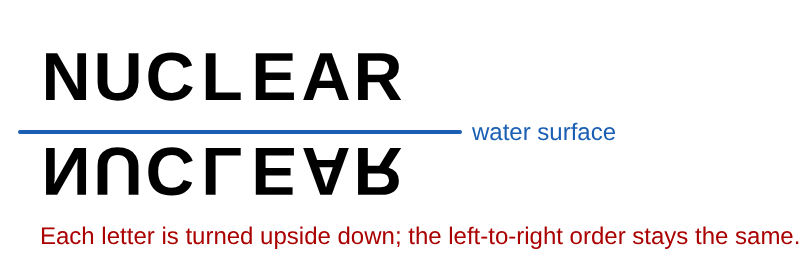
A water-image is the reflection seen in water lying below the word, so it is a top-to-bottom (vertical) flip.
In a vertical flip every letter turns upside down, but the letters stay in the same left-to-right order: N, U, C, L, E, A, R.
After the flip, N looks like a reversed N, U becomes an arch, C stays C, L becomes a stem with the bar on top at the left, E stays E, A becomes an upside-down A and R has its bowl at the bottom.
Option (A) writes the letters in the order R, A, E, L, C, U, N, which is the reverse order, so it is wrong.
Option (B) shows the E turned back to front (open to the left), which a vertical flip never does.
Option (D) shows the L with its stem on the right, which is a left-right reversal and not a water-image.
Option (C) keeps the order NUCLEAR with every letter simply turned upside down.
Hence, the correct answer is (C), the third word in the figure.
Want this as a PDF? Get the WBP SI Prelims PYQ PDF
Q. Rashik walks 20 m North. Then he turns right and walks 30 m. Then he turns right and walks 35 m. Then he turns left and walks 15 m. Then he again turns left and walks 15 m. In which direction and how many meters away is he from his original position?
(A) 15 m West
(B) 30 m West
(C) 45 m East
(D) 30 m East
Answer & Explanation
Correct Answer: (C) 45 m East
Explanation
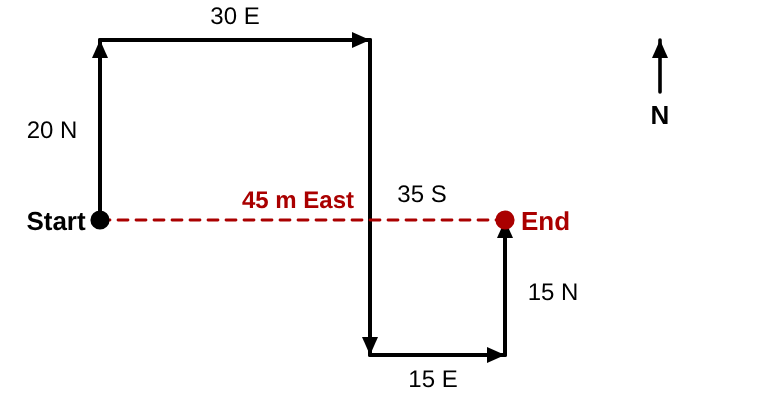
Take the starting point as the origin, with North up and East to the right.
Rashik walks 20 m North and is now 20 m north of the start.
He turns right (East) and walks 30 m: he is 30 m east and 20 m north.
He turns right again (facing East, right is South) and walks 35 m: he is 30 m east and 15 m south of the start (20 − 35 = −15).
He turns left (facing South, left is East) and walks 15 m: he is 45 m east and 15 m south.
He turns left again (facing East, left is North) and walks 15 m: he is 45 m east and 0 m north or south.
So the north-south distance is 20 − 35 + 15 = 0 and the east-west distance is 30 + 15 = 45 m to the East.
He is exactly on the east-west line through the start, 45 m away.
Hence, the correct answer is (C) 45 m East.
Want this as a PDF? Get the WBP SI Prelims PYQ PDF
Q. A B C D E F G H I J K L M N O P Q R S T U V W X Y Z.
Which letter in this alphabet is the eighth letter to the right of the letter which is tenth letter to the left of the last but one letter of the alphabet?
(A) X
(B) I
(C) H
(D) W
Answer & Explanation
Correct Answer: (D) W
Explanation
The alphabet has 26 letters, so the last letter is Z (26th).
The last but one letter is Y, whose position is 25.
The tenth letter to the left of Y has position 25 − 10 = 15, which is O.
Now take the eighth letter to the right of O: position 15 + 8 = 23.
The 23rd letter of the alphabet is W (counting A = 1, …, U = 21, V = 22, W = 23).
Check by counting: after O come P, Q, R, S, T, U, V, W, and W is the 8th.
Option (A) X is the 24th letter, so it is the ninth to the right of O.
Options (B) I and (C) H lie to the left of O, so they cannot be to its right.
Hence, the correct answer is (D) W.
Want this as a PDF? Get the WBP SI Prelims PYQ PDF
Q. How many pairs of letters are there in the word ‘CASTRAPHONE’ which have as many letters between them in the word as in the alphabet?
(A) 3
(B) 5
(C) 6
(D) 4
Answer & Explanation
Correct Answer: (C) 6
Explanation
Number the letters of CASTRAPHONE by their place in the word: C1 A2 S3 T4 R5 A6 P7 H8 O9 N10 E11.
A pair qualifies when the letters between the two letters in the word equal the letters between them in the alphabet, that is, the gap in the word equals the gap in the alphabet.
S (3) and T (4): no letter between them in the word and none between S and T in the alphabet. Pair 1.
T (4) and O (9): the word has R, A, P, H between them (4); the alphabet has P, Q, R, S between O and T (4). Pair 2.
T (4) and N (10): the word has R, A, P, H, O between them (5); the alphabet has O, P, Q, R, S (5). Pair 3.
R (5) and P (7): the word has A between them (1); the alphabet has Q between P and R (1). Pair 4.
H (8) and E (11): the word has O, N between them (2); the alphabet has F, G between E and H (2). Pair 5.
O (9) and N (10): no letter between them in the word, and none between N and O in the alphabet. Pair 6.
All other pairs were checked and their gaps differ, so the total is 6.
Hence, the correct answer is (C) 6.
Want this as a PDF? Get the WBP SI Prelims PYQ PDF
Q. If a mirror is placed on the line MN, then which of the answer figures is the right image of the given figure?
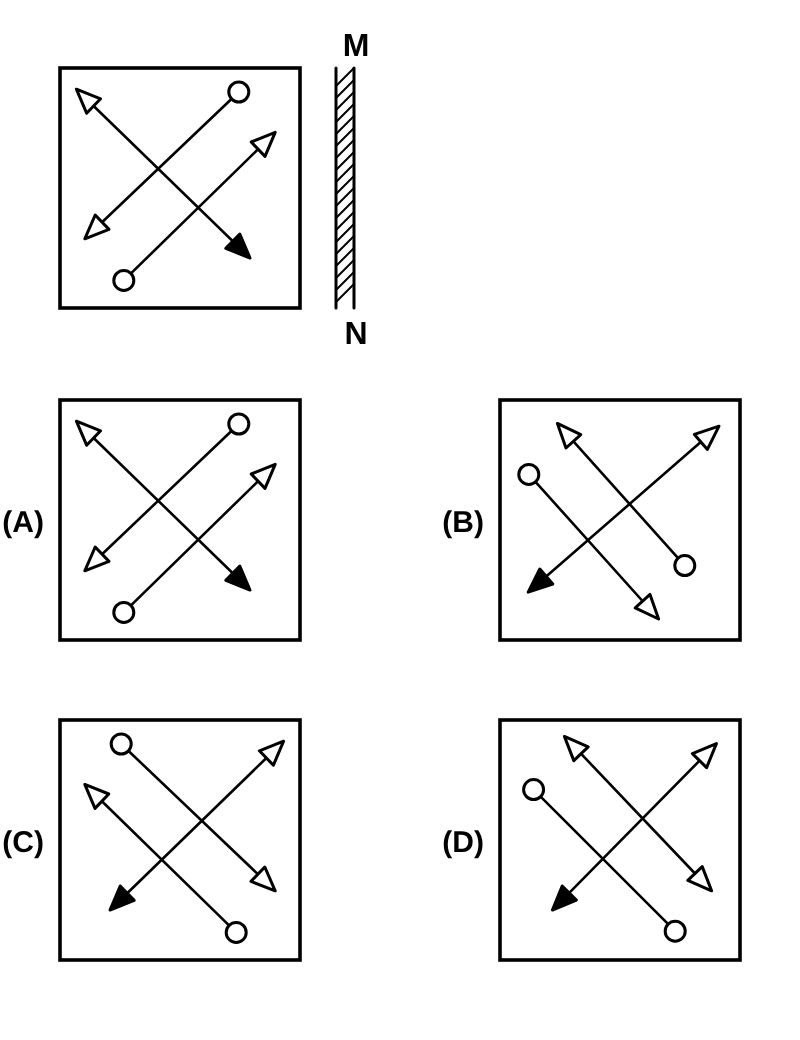
Answer & Explanation
Correct Answer: (C) the figure marked (C)
Explanation
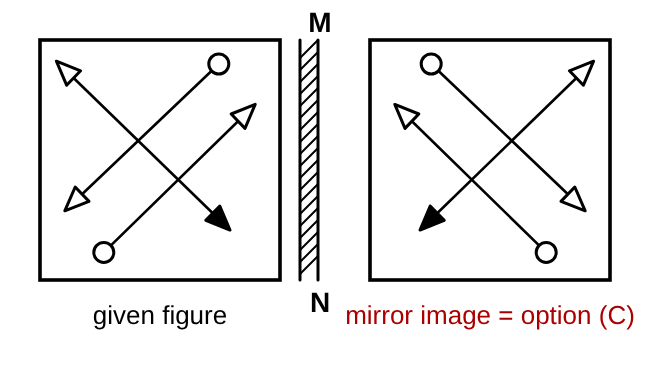
The mirror MN stands on the right side of the figure, so the image is a left-to-right reversal: left becomes right and right becomes left, while top stays top.
The given figure has three lines: a long line with a triangle at the top left and a black arrow head at the bottom right, a line with a circle at the top right and a triangle at the bottom left, and a line with a triangle at the top right and a circle at the bottom left.
After the left-right reversal the long line has its triangle at the top right and its black arrow head at the bottom left.
The second line has its circle at the top left and its triangle at the bottom right; the third line has its triangle at the top left and its circle at the bottom right.
Option (A) is the same as the given figure, so nothing has been reversed.
Option (B) has the circle and the triangle at the ends of the two thin lines interchanged, so it is wrong.
Option (D) shows one thin line with two triangles and the other with two circles, which cannot come from the given figure.
Option (C) matches every end of every line in the reversed positions.
Hence, the correct answer is (C), the figure marked (C).
Want this as a PDF? Get the WBP SI Prelims PYQ PDF
Q. G’s father is X’s son. P is G’s uncle. Y is X’s brother. Then how is Y related to P?
(A) Uncle
(B) Brother
(C) Father
(D) Nephew
Answer & Explanation
Correct Answer: (A) Uncle
Explanation
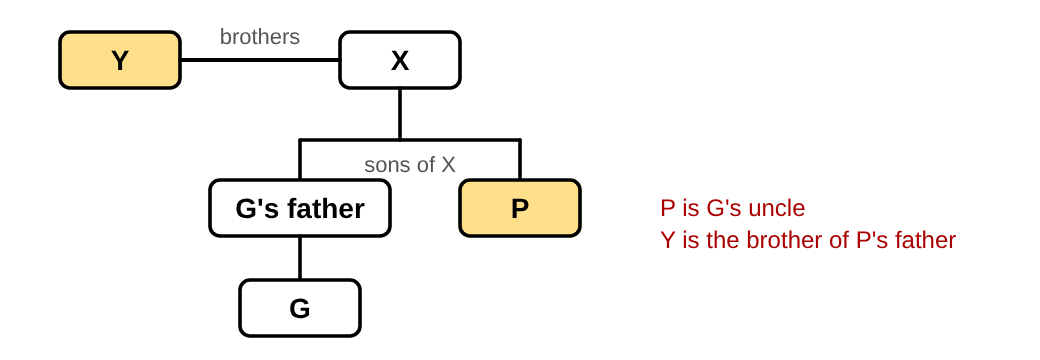
Note: the question assumes that P, the uncle of G, is a brother of G’s father; if P were G’s maternal uncle the relation could not be fixed.
G’s father is a son of X, so X is G’s grandfather.
P is G’s uncle, that is, a brother of G’s father, so P is also a son of X.
Therefore X is the father of P.
Y is the brother of X, so Y is the brother of P’s father.
The brother of one’s father is one’s uncle (paternal uncle).
So Y is the uncle of P.
Option (B) brother would need Y to be a son of X, which is not given; (C) father would need Y to be X; (D) nephew is the reverse direction, since P is the younger generation.
Hence, the correct answer is (A) Uncle.
Want this as a PDF? Get the WBP SI Prelims PYQ PDF
Q. Six friends, namely, A, B, C, D, E, F are sitting on a bench. E and F are sitting in the middle. A and B are sitting in the furthest corner. If C is sitting just left to A, then who is sitting just right to B?
(A) D
(B) C
(C) E
(D) A
Answer & Explanation
Correct Answer: (A) D
Explanation
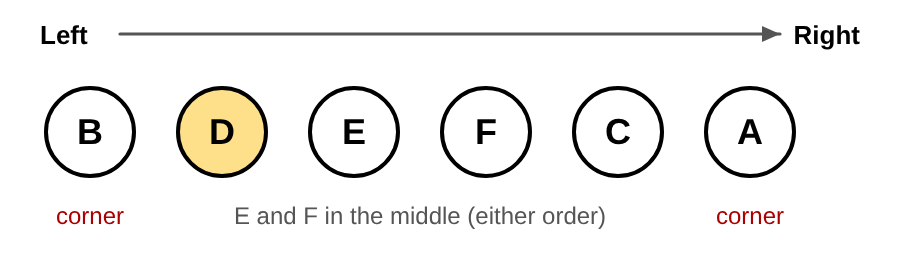
Six seats in a row: positions 1 to 6 from the left.
E and F sit in the middle, so they occupy positions 3 and 4 (in either order).
A and B sit at the two corners, so they occupy positions 1 and 6.
C is just to the left of A, so A cannot be at position 1 (nothing is to its left); A is at position 6 and C is at position 5.
Therefore B is at position 1.
The only friend left is D, who takes position 2.
The arrangement from the left is B, D, E/F, F/E, C, A.
The person just right of B (position 2) is D.
Hence, the correct answer is (A) D.
Want this as a PDF? Get the WBP SI Prelims PYQ PDF
Q. Mohini is taller than Nita but not shorter than Sarita. Sarita and Malini are of the same height. Mohini is shorter than Hema. Among them, who is the second tallest?
(A) Mohini
(B) Hema
(C) Can not be determined
(D) Nita
Answer & Explanation
Correct Answer: (A) Mohini
Explanation
Note: ‘not shorter than Sarita’ allows Mohini and Sarita to be equal, so the question is a little loose; Mohini is still the best answer.
Write the statements as heights: Mohini > Nita, Mohini ≥ Sarita, Sarita = Malini, Hema > Mohini.
Hema is taller than Mohini, who is at least as tall as Sarita and Malini and taller than Nita.
So Hema is the tallest, and everyone else is not taller than Mohini.
Hence Mohini is the second tallest (taking the intended meaning that Mohini is taller than Sarita).
Option (B) Hema is the tallest, not the second.
Option (D) Nita is shorter than Mohini, so she cannot be second.
Option (C) ‘cannot be determined’ is rejected because nobody can be taller than Mohini apart from Hema; Sarita and Malini could at most equal her.
Hence, the correct answer is (A) Mohini.
Want this as a PDF? Get the WBP SI Prelims PYQ PDF
Q. How many 4’s are there preceded by 7 but not followed by 3 in the following number series?
5 9 3 2 1 7 4 2 6 9 7 4 6 1 3 2 8 7 4
1 3 8 3 2 5 6 7 4 3 9 5 8 2 0 1 8 7 4 6 3
(A) Four
(B) Six
(C) Five
(D) Three
Answer & Explanation
Correct Answer: (A) Four
Explanation
Look for each 4 whose left neighbour is 7, that is, the pairs 7 4, and then see what follows it.
First line: 1 7 4 2: the 4 is preceded by 7 and followed by 2. Count 1.
First line: 9 7 4 6: followed by 6. Count 2.
First line (last two numbers): 8 7 4, and the next number is the 1 at the start of the second line, so it is not followed by 3. Count 3.
Second line: 6 7 4 3: followed by 3, so it is not counted.
Second line: 8 7 4 6: followed by 6. Count 4.
There are no other 7 4 pairs in the series.
So the total is 4.
Hence, the correct answer is (A) Four.
Want this as a PDF? Get the WBP SI Prelims PYQ PDF
Q. If 27th September in a year is Saturday, then what day will 27th October be in the same year?
(A) Monday
(B) Saturday
(C) Sunday
(D) Thursday
Answer & Explanation
Correct Answer: (A) Monday
Explanation
September has 30 days, so from 27th September to 27th October there are 30 days.
Divide the number of days by 7: 30 = 4 × 7 + 2.
So 27th October is 4 complete weeks and 2 extra days after 27th September.
After 4 complete weeks the day is again Saturday.
Two extra days after Saturday: Sunday, then Monday.
So 27th October falls on a Monday.
Saturday (B) would need a gap of exactly 28 days, Sunday (C) a gap of 29 days, and Thursday (D) a gap of 33 days.
Hence, the correct answer is (A) Monday.
Want this as a PDF? Get the WBP SI Prelims PYQ PDF
Q. CMM, EOO, GQQ, ___?___, KUU
(A) GRR
(B) ISS
(C) ITT
(D) GSS
Answer & Explanation
Correct Answer: (B) ISS
Explanation
Write the letters of each term by their place in the alphabet.
First letters: C (3), E (5), G (7), ?, K (11): they go up by 2 each time.
So the missing first letter is 7 + 2 = 9, which is I.
Second letters: M (13), O (15), Q (17), ?, U (21): they go up by 2 each time.
So the missing second letter is 17 + 2 = 19, which is S.
The third letter in every term is the same as the second letter, so it is also S.
The missing term is ISS.
Options (A) GRR and (D) GSS start with G, which was already used; option (C) ITT has T (20), which does not fit the +2 step.
Hence, the correct answer is (B) ISS.
Want this as a PDF? Get the WBP SI Prelims PYQ PDF
Q. From the given alternative words, select the word which cannot be formed using the letters of the given word: PHOTOSYNTHETIC
(A) THOSE
(B) PRONE
(C) COTTON
(D) SCENT
Answer & Explanation
Correct Answer: (B) PRONE
Explanation
Count the letters available in PHOTOSYNTHETIC: P 1, H 2, O 2, T 3, S 1, Y 1, N 1, E 1, I 1, C 1.
THOSE needs T, H, O, S, E: all are available, so it can be formed.
PRONE needs P, R, O, N, E: the letter R is not present in PHOTOSYNTHETIC, so it cannot be formed.
COTTON needs C 1, O 2, T 2, N 1: PHOTOSYNTHETIC has C 1, O 2, T 3 and N 1, so it can be formed.
SCENT needs S, C, E, N, T: all are available, so it can be formed.
Only PRONE fails.
Hence, the correct answer is (B) PRONE.
Want this as a PDF? Get the WBP SI Prelims PYQ PDF
Q. If ‘X $ Y’ means ‘X is father of Y’; ‘X # Y’ means ‘X is mother of Y’; ‘X × Y’ means ‘X is sister of Y’, then how is D related to N in N # A $ B × D?
(A) Nephew
(B) Granddaughter
(C) Can not be determined
(D) Grandson
Answer & Explanation
Correct Answer: (C) Can not be determined
Explanation
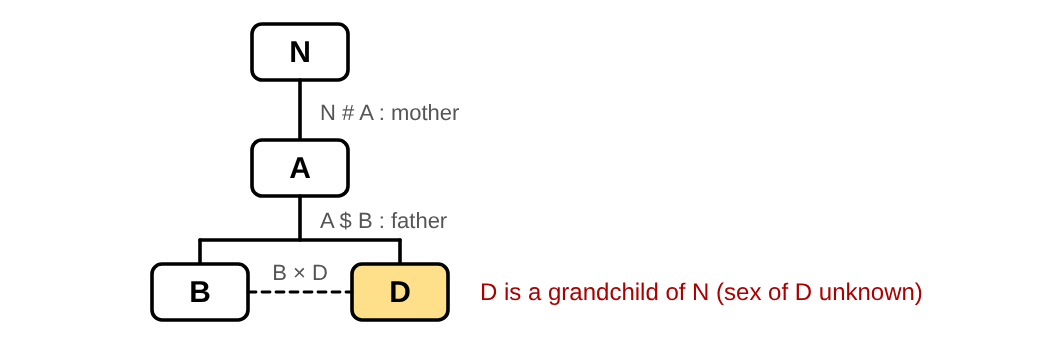
Read the chain from left to right: N # A $ B × D.
N # A means N is the mother of A.
A $ B means A is the father of B.
B × D means B is the sister of D, so B and D are brother or sister of each other and both are children of A.
Since N is the mother of A, the children of A, that is B and D, are the grandchildren of N.
So D is a grandchild of N.
The sex of D is not given: B is the sister of D, and D may be either a brother or a sister.
So D may be the grandson or the granddaughter, and the relation cannot be fixed.
Option (A) nephew is wrong because D is two generations below N.
Hence, the correct answer is (C) Can not be determined.
Want this as a PDF? Get the WBP SI Prelims PYQ PDF
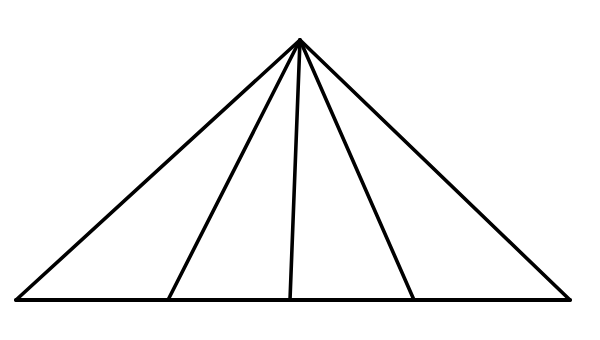
Q. How many triangles are there in the given figure?
(A) 10
(B) 14
(C) 16
(D) 12
Answer & Explanation
Correct Answer: (A) 10
Explanation
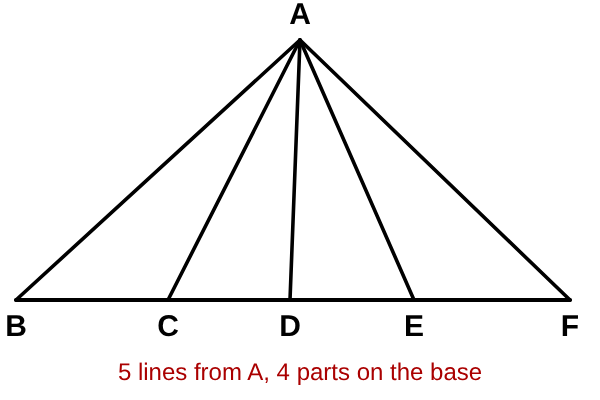
Label the apex A and the points on the base B, C, D, E, F from the left.
Five straight lines start from A: AB, AC, AD, AE and AF.
Every triangle in the figure has A as its vertex and two of the five lines as its sides, with the base line cutting them.
Triangles with one base part: ABC, ACD, ADE, AEF = 4.
Triangles with two base parts: ABD, ACE, ADF = 3.
Triangles with three base parts: ABE, ACF = 2.
Triangles with four base parts: ABF = 1.
Total = 4 + 3 + 2 + 1 = 10 (which is also 5C2, choosing 2 of the 5 lines).
Hence, the correct answer is (A) 10.
Want this as a PDF? Get the WBP SI Prelims PYQ PDF
Q. Fill in the blanks with appropriate set of letters: _a_bca_dabba_bac_c_a
(A) adcdba
(B) acbdba
(C) acbdab
(D) acdbba
Answer & Explanation
Correct Answer: (B) acbdba
Explanation
The series has 20 places; let us number them 1 to 20: _ a _ b c a _ d a b b a _ b a c _ c _ a.
The middle part “abba” (places 9 to 12) reads the same forwards and backwards, which suggests that the whole series is a palindrome (it reads the same from both ends).
In a 20-letter palindrome, place 1 matches place 20, place 2 matches place 19, and so on up to places 10 and 11.
Place 20 is a, so place 1 = a; place 18 is c, so place 3 = c; place 14 is b, so place 7 = b; place 8 is d, so place 13 = d; place 4 is b, so place 17 = b; place 2 is a, so place 19 = a.
The blanks in order are therefore a, c, b, d, b, a.
The completed series is aacbcabdabbadbacbcaa, which reads the same in both directions.
Options (A), (C) and (D) break the symmetry: for example (A) puts d at place 3 while place 18 is c.
Hence, the correct answer is (B) acbdba.
Want this as a PDF? Get the WBP SI Prelims PYQ PDF
Q. If ACID is written as 1C3D, PAMPER is written as P1MP2R, then how will BOMBAY be written?
(A) B4MB1Y
(B) B5MB2Y
(C) B4MB2Y
(D) B3MB1Y
Answer & Explanation
Correct Answer: (A) B4MB1Y
Explanation
Compare the words with their codes: ACID = 1C3D and PAMPER = P1MP2R.
Only the vowels change; the consonants stay as they are.
A is replaced by 1 and E by 2, and I by 3.
The vowels are numbered in alphabetical order: A = 1, E = 2, I = 3, O = 4, U = 5.
In BOMBAY the vowels are O and A, and the consonants are B, M, B and Y (Y is not a vowel).
O = 4 and A = 1, so BOMBAY = B 4 M B 1 Y.
Option (B) uses 5 for O (that is U), (C) uses 2 for A (that is E), and (D) uses 3 for O (that is I); all are wrong.
Hence, the correct answer is (A) B4MB1Y.
Want this as a PDF? Get the WBP SI Prelims PYQ PDF
WBP SI Prelims Reasoning Questions 2019
Q. Find the odd one out
(A) Carl Lewis
(B) Usain Bolt
(C) Ben Johnson
(D) Emil Jacktopek
Answer & Explanation
Correct Answer: (D) Emil Jacktopek
Explanation
Note: the name in option (D) is a misprint for Emil Zátopek, the Czech athlete.
Group the four athletes by the event in which each is famous.
Carl Lewis (USA) won Olympic gold medals in the 100 m, 200 m, long jump and 4 × 100 m relay: he is a sprinter.
Usain Bolt (Jamaica) holds the world records in the 100 m and 200 m: he is a sprinter.
Ben Johnson (Canada) ran the 100 m in 9.79 seconds at the 1988 Olympics and was disqualified for doping: he is a sprinter.
Emil Zátopek (Czechoslovakia) won the 5000 m, 10,000 m and the marathon at the 1952 Olympics: he is a long-distance runner.
So the first three are 100 m sprinters, while the fourth belongs to long-distance running.
Hence, the correct answer is (D) Emil Jacktopek (Emil Zátopek), the odd one out.
Want this as a PDF? Get the WBP SI Prelims PYQ PDF
Q. 7 : 49 :: 17 : ?
(A) 288
(B) 324
(C) 119
(D) 290
Answer & Explanation
Correct Answer: (A) 288
Explanation
Note: this question is flawed: the correct number is 289, which is not printed among the options.
Find the relation between the first pair, 7 and 49.
49 = 7 × 7 = 7², so the second number is the square of the first.
Apply the same rule to 17.
17² = 17 × 17 = 289.
Check the options: 288 is 1 less than 289 and 290 is 1 more than 289, so neither fits the rule exactly.
324 = 18² and 119 = 17 × 7; neither follows the square rule.
No option equals 289, so the question has a misprint (most probably 289 was printed as 288).
Keeping the option nearest to the correct value 289, we take (A) 288.
Hence, the correct answer is (A) 288, being the nearest to 289 (the exact answer by the rule).
Want this as a PDF? Get the WBP SI Prelims PYQ PDF
Q. Which of the following words will appear fourth in the dictionary ?
(A) Sanatorium
(B) Sanction
(C) Sanctity
(D) Sanskrit
Answer & Explanation
Correct Answer: (D) Sanskrit
Explanation
All four words begin with “San”, so compare the letters after it.
Sanatorium: San-a… (fourth letter a)
Sanction: San-c… (fourth letter c)
Sanctity: San-c… (fourth letter c)
Sanskrit: San-s… (fourth letter s)
Order of the fourth letter: a, c, c, s, so Sanatorium comes first and Sanskrit comes last.
Sanction and Sanctity both have “Sanct”, so compare the next letters: Sanction has “i-o” and Sanctity has “i-t”.
The sixth letter is the same (i); the seventh letter is o in Sanction and t in Sanctity, and o comes before t.
So the order is Sanatorium, Sanction, Sanctity, Sanskrit.
Hence, the correct answer is (D) Sanskrit, which appears fourth.
Want this as a PDF? Get the WBP SI Prelims PYQ PDF
Q. Gopal said, pointing to Govind ‘His father is my father’s only son’. How is Gopal related to Govind ?
(A) Grandson
(B) Son
(C) Grandfather
(D) Father
Answer & Explanation
Correct Answer: (D) Father
Explanation
Take the sentence in parts: “His father is my father’s only son.”
“My father’s only son”: Gopal’s father has only one son.
Gopal himself is a son of his father, so that only son must be Gopal himself.
So “His father” (the father of Govind) = Gopal.
That means Govind is the son of Gopal.
Check: if the person were Gopal’s brother, then Gopal’s father would have two sons, which contradicts “only son”.
So Gopal is Govind’s father.
Hence, the correct answer is (D) Father.
Want this as a PDF? Get the WBP SI Prelims PYQ PDF
Q. Molly travelled from point A to point B which is 5 feet. He travelled 6 feet to his right and then turned to left and went 4 feet. Finally, he again went 6 feet to his left. How far is he from point B now ?
(A) 6 feet
(B) 4 feet
(C) 10 feet
(D) 5 feet
Answer & Explanation
Correct Answer: (B) 4 feet
Explanation

Let Molly walk from A to B towards the east, so that he is facing east at B.
At B he turns right (facing east, right is south) and walks 6 feet south to point C.
Now he is facing south. He turns left (facing south, left is east) and walks 4 feet east to point D.
Now he is facing east. He again turns left (facing east, left is north) and walks 6 feet north to point E.
The 6 feet south and the 6 feet north cancel each other, so E is on the same line as A and B.
E is 4 feet to the east of B (the 4 feet walked east in the middle).
So the distance of E from B = 4 feet.
Hence, the correct answer is (B) 4 feet.
Want this as a PDF? Get the WBP SI Prelims PYQ PDF
Q. Vinod introduces Vishal as the son of the only brother of his father’s wife. How is Vinod related to Vishal ?
(A) Son
(B) Brother
(C) Uncle
(D) Cousin
Answer & Explanation
Correct Answer: (D) Cousin
Explanation

Start from Vinod and move step by step through the sentence.
“His father’s wife” means Vinod’s mother (father’s wife).
“The only brother of his father’s wife” = the only brother of Vinod’s mother = Vinod’s maternal uncle.
“The son of” that uncle = Vishal, so Vishal is the son of Vinod’s maternal uncle.
The children of a maternal uncle are the first cousins of Vinod.
Vishal is a male, so he is Vinod’s cousin (maternal cousin), and Vinod is likewise a cousin of Vishal.
Option (A) Son and option (C) Uncle are wrong, because Vinod’s own generation is the same as that of Vishal.
Option (B) Brother is wrong, because they do not have the same parents.
Hence, the correct answer is (D) Cousin.
Want this as a PDF? Get the WBP SI Prelims PYQ PDF
Q. Sita is older than Swapna. Lavanya is older than Swapna but younger than Sita. Varna is younger than both Hari and Swapna. Swapna is older than Hari. Who is the youngest ?
(A) Varna
(B) Hari
(C) Sita
(D) Lavanya
Answer & Explanation
Correct Answer: (A) Varna
Explanation
Write each statement using the symbol > for “older than”.
Sita is older than Swapna: Sita > Swapna.
Lavanya is older than Swapna but younger than Sita: Sita > Lavanya > Swapna.
Swapna is older than Hari: Swapna > Hari.
Varna is younger than both Hari and Swapna: Hari > Varna and Swapna > Varna.
Combine all the statements into one line: Sita > Lavanya > Swapna > Hari > Varna.
The last person in the line is the youngest, so Varna is the youngest.
Check: Varna is younger than Hari, and Hari is younger than Swapna, so Varna is also younger than Swapna, which agrees with the statement.
Hence, the correct answer is (A) Varna.
Want this as a PDF? Get the WBP SI Prelims PYQ PDF
Q. If MEKLF is coded as 91782 and LLLJK as 88867, then how can IGHED be coded ?
(A) 64521
(B) 53410
(C) 97854
(D) 75632
Answer & Explanation
Correct Answer: (B) 53410
Explanation
Match the letters of MEKLF with the digits of 91782.
M = 9, E = 1, K = 7, L = 8, F = 2
Match the letters of LLLJK with the digits of 88867.
L = 8 (repeated three times), J = 6, K = 7
Look at the alphabet positions: E = 5, F = 6, J = 10, K = 11, L = 12, M = 13.
Each letter is coded by its position minus 4: E = 5 − 4 = 1, F = 6 − 4 = 2, J = 10 − 4 = 6, K = 11 − 4 = 7, L = 12 − 4 = 8, M = 13 − 4 = 9.
Apply the same rule to IGHED: I = 9 − 4 = 5, G = 7 − 4 = 3, H = 8 − 4 = 4, E = 5 − 4 = 1, D = 4 − 4 = 0.
So IGHED = 5 3 4 1 0 = 53410.
Options (A) 64521, (C) 97854 and (D) 75632 do not begin with 5 and do not end with 0, so they fail the rule.
Hence, the correct answer is (B) 53410.
Want this as a PDF? Get the WBP SI Prelims PYQ PDF
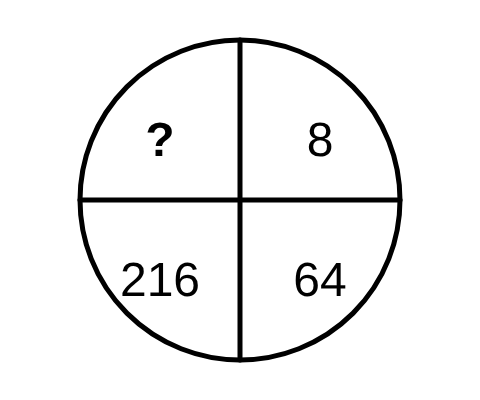
Q. Select the missing number from the given responses:
(A) 512
(B) 1000
(C) 343
(D) 729
Answer & Explanation
Correct Answer: (A) 512
Explanation

Write the given numbers as cubes.
8 = 2 × 2 × 2 = 2³
64 = 4 × 4 × 4 = 4³
216 = 6 × 6 × 6 = 6³
The bases are 2, 4, 6, which are consecutive even numbers.
Going round the circle (top right, bottom right, bottom left) the bases increase by 2 each time.
So the next base is 6 + 2 = 8, and it falls in the empty top-left part.
Missing number = 8³ = 8 × 8 × 8 = 512.
Check the options: 1000 = 10³, 343 = 7³ and 729 = 9³ do not follow the even sequence 2, 4, 6, 8.
Hence, the correct answer is (A) 512.
Want this as a PDF? Get the WBP SI Prelims PYQ PDF
Q. What should come in the place of question mark (?) in the following number series ?
2, 10, 30, ?, 130, 222
(A) 95
(B) 42
(C) 125
(D) 68
Answer & Explanation
Correct Answer: (D) 68
Explanation
Check the differences: 8, 20, ?, ?, 92. They are not constant, so look for a power rule.
The terms are close to cubes: 1³ = 1, 2³ = 8, 3³ = 27, 4³ = 64, 5³ = 125, 6³ = 216.
Compare each term with the cube: 2 = 1³ + 1, 10 = 2³ + 2, 30 = 3³ + 3.
130 = 5³ + 5 = 125 + 5 and 222 = 6³ + 6 = 216 + 6.
So the rule is n³ + n for n = 1, 2, 3, 4, 5, 6.
The fourth term = 4³ + 4 = 64 + 4 = 68.
Check the sequence: 2, 10, 30, 68, 130, 222.
Options (A) 95, (B) 42 and (C) 125 do not equal 4³ + 4.
Hence, the correct answer is (D) 68.
Want this as a PDF? Get the WBP SI Prelims PYQ PDF
Q. How many such ‘R’s are there in the following letter series which are immediately preceded by ‘M’ and immediately followed by ‘K’?
NPKRMDCNMRKPQKRNMRKRMKPRM
(A) Four
(B) Five
(C) Three
(D) Two
Answer & Explanation
Correct Answer: (D) Two
Explanation
Write the series with the position numbers.
1 N, 2 P, 3 K, 4 R, 5 M, 6 D, 7 C, 8 N, 9 M, 10 R, 11 K, 12 P, 13 Q, 14 K, 15 R, 16 N, 17 M, 18 R, 19 K, 20 R, 21 M, 22 K, 23 P, 24 R, 25 M
We need the pattern M R K, with R in the middle.
R at position 4: preceded by K and followed by M, so no.
R at position 10: preceded by M (9) and followed by K (11), so yes.
R at position 15: preceded by K and followed by N, so no.
R at position 18: preceded by M (17) and followed by K (19), so yes.
R at position 20: preceded by K and followed by M, so no.
R at position 24: preceded by P and followed by M, so no.
The pattern M R K occurs at positions 9-10-11 and 17-18-19, that is, 2 times.
Hence, the correct answer is (D) Two.
Want this as a PDF? Get the WBP SI Prelims PYQ PDF
Q. If 84 × 13 = 8 and 37 × 13 = 6 then 56 × 22 = _______
(A) 7
(B) 9
(C) 6
(D) 8
Answer & Explanation
Correct Answer: (A) 7
Explanation
Here “×” does not mean multiplication; find the rule from the two given examples.
For 84 × 13: sum of the digits of 84 = 8 + 4 = 12 and sum of the digits of 13 = 1 + 3 = 4.
Difference = 12 − 4 = 8, which is the result given.
For 37 × 13: sum of the digits of 37 = 3 + 7 = 10 and sum of the digits of 13 = 4.
Difference = 10 − 4 = 6, which is the result given.
So the rule is: (sum of the digits of the first number) − (sum of the digits of the second number).
For 56 × 22: sum of the digits of 56 = 5 + 6 = 11 and sum of the digits of 22 = 2 + 2 = 4.
Result = 11 − 4 = 7.
Another rule, subtracting the numbers and adding the digits of the result, gives the same answer: 84 − 13 = 71 and 7 + 1 = 8; 37 − 13 = 24 and 2 + 4 = 6; 56 − 22 = 34 and 3 + 4 = 7.
Hence, the correct answer is (A) 7.
Want this as a PDF? Get the WBP SI Prelims PYQ PDF
Q. What should come in place of ‘?’ mark in the given number series?
1, 8, 9, 64, 25, ?, 49
(A) 40
(B) 216
(C) 36
(D) 99
Answer & Explanation
Correct Answer: (B) 216
Explanation
There are two series mixed together, one at the odd places and one at the even places.
Odd places (1st, 3rd, 5th, 7th terms): 1, 9, 25, 49.
These are squares of odd numbers: 1², 3², 5², 7².
Even places (2nd, 4th, 6th terms): 8, 64, ?.
8 = 2³ and 64 = 4³, which are cubes of even numbers.
The next cube of an even number is 6³ = 216.
So the full series is 1², 2³, 3², 4³, 5², 6³, 7² = 1, 8, 9, 64, 25, 216, 49.
Options (A) 40, (C) 36 and (D) 99 are not cubes, so they cannot be the 6th term.
Hence, the correct answer is (B) 216.
Want this as a PDF? Get the WBP SI Prelims PYQ PDF
Q. Find the odd one out:
(A) Japan
(B) Sri Lanka
(C) India
(D) New Zealand
Answer & Explanation
Correct Answer: (D) New Zealand
Explanation
Classify the four countries by the continent in which each lies.
Japan lies in East Asia.
Sri Lanka lies in South Asia.
India lies in South Asia.
New Zealand lies in Oceania (the south-west Pacific Ocean), not in Asia.
So three of the four countries are Asian countries.
New Zealand is the only country which does not belong to Asia.
Hence, the correct answer is (D) New Zealand, the odd one out.
Want this as a PDF? Get the WBP SI Prelims PYQ PDF
Q. Five girls M,N,O,P and Q are standing in row. P is on the right of Q. N is on the left of Q, but is on the right of M. P is on the left of O. Who is standing on the extreme right ?
(A) O
(B) Q
(C) N
(D) P
Answer & Explanation
Correct Answer: (A) O
Explanation
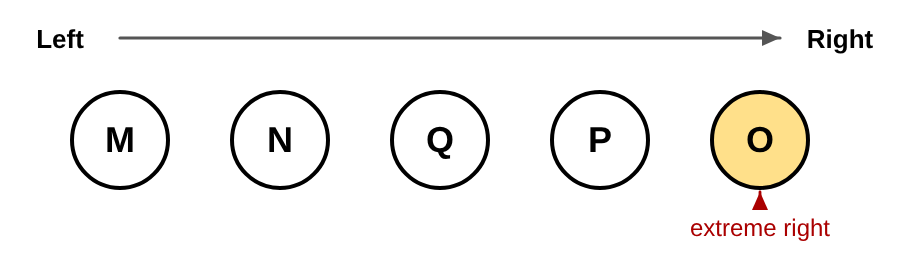
Note: the second statement has no subject before “but is on the right of M”; it can only refer to N.
Take the statements one by one, with the left end of the row on the left of the page.
P is on the right of Q: Q … P.
N is on the left of Q: N … Q … P.
N is on the right of M: M … N … Q … P.
P is on the left of O: M … N … Q … P … O.
Final order from left to right: M, N, Q, P, O.
The person at the extreme right is O.
Check: all four statements hold for the order M N Q P O, and the order is the only one that fits all of them.
Hence, the correct answer is (A) O.
Want this as a PDF? Get the WBP SI Prelims PYQ PDF
Q. If ‘A’ means ‘+’, ‘B’ means ‘–’, ‘C’ means ‘×’ and ‘D’ means ‘÷’ then what will be the value of following expression ?
8 D 2 A 6 C 3 B 5
(A) 25
(B) 10
(C) 30
(D) 17
Answer & Explanation
Correct Answer: (D) 17
Explanation
Replace each letter by its sign: A = +, B = −, C = ×, D = ÷.
8 D 2 A 6 C 3 B 5 becomes 8 ÷ 2 + 6 × 3 − 5.
Apply BODMAS: division and multiplication first, then addition and subtraction.
8 ÷ 2 = 4
6 × 3 = 18
The expression becomes 4 + 18 − 5.
4 + 18 = 22
22 − 5 = 17
Options (A) 25, (B) 10 and (C) 30 come from wrong order of operations, for example adding before multiplying.
Hence, the correct answer is (D) 17.
Want this as a PDF? Get the WBP SI Prelims PYQ PDF
Q. What should come in the place of question mark (?) in the following number series ?
9, 20, 33, 48, ?, 84, 105
(A) 68
(B) 62
(C) 72
(D) 65
Answer & Explanation
Correct Answer: (D) 65
Explanation
Find the difference between consecutive terms.
20 − 9 = 11
33 − 20 = 13
48 − 33 = 15
The differences are 11, 13, 15, which are consecutive odd numbers, so the next difference is 17.
? = 48 + 17 = 65
Check the rest of the series: the next difference is 19, so 65 + 19 = 84, which is the given term.
The last difference is 21, and 84 + 21 = 105, which is the given term.
So the series is 9, 20, 33, 48, 65, 84, 105.
Options (A) 68, (B) 62 and (C) 72 break the pattern of differences 17 and 19.
Hence, the correct answer is (D) 65.
Want this as a PDF? Get the WBP SI Prelims PYQ PDF
Q. If 72 × 96 = 6927, 58 × 87 = 7885, then 79 × 86 = ?
(A) 7689
(B) 6897
(C) 8976
(D) 6978
Answer & Explanation
Correct Answer: (B) 6897
Explanation
Here “×” is a code symbol, so find how the answer is formed from the two numbers.
72 × 96 = 6927: reverse 96 to get 69, and reverse 72 to get 27, then write 69 followed by 27 = 6927.
58 × 87 = 7885: reverse 87 to get 78, and reverse 58 to get 85, then write 78 followed by 85 = 7885.
So the rule is: reverse the second number, reverse the first number, and write the second reversed number first.
Apply the rule to 79 × 86: reverse 86 = 68 and reverse 79 = 97.
Write 68 followed by 97 = 6897.
Option (A) 7689 and option (D) 6978 give wrong digits, and option (C) 8976 does not follow the rule.
Hence, the correct answer is (B) 6897.
Want this as a PDF? Get the WBP SI Prelims PYQ PDF
Q. Coffee : Caffeine :: Tobacco : ?
(A) Nicotine
(B) Tanin
(C) Alexine
(D) Novocaine
Answer & Explanation
Correct Answer: (A) Nicotine
Explanation
Find the relation in the first pair: coffee contains the stimulant (alkaloid) caffeine.
So the relation is “substance : the chemical (alkaloid) present in it”.
Tobacco contains the alkaloid nicotine, which makes it addictive.
Option (B) Tanin (tannin) is found in tea and bark, not mainly in tobacco.
Option (C) Alexine is a protein in blood serum that helps destroy germs.
Option (D) Novocaine is a local anaesthetic used by dentists.
So only nicotine has the same relation to tobacco as caffeine has to coffee.
Hence, the correct answer is (A) Nicotine.
Want this as a PDF? Get the WBP SI Prelims PYQ PDF
Q. Complete the given letter series in the following:
a__ab _baa_bb _
(A) aabb
(B) baba
(C) abab
(D) bbaa
Answer & Explanation
Correct Answer: (C) abab
Explanation
Write the series with the blanks numbered: a (1) a b (2) b a a (3) b b (4).
It has 12 positions, in three-letter groups of the same letter repeated: a a a, b b b, a a a, b b b.
So the complete series should be aaabbbaaabbb.
Compare the series with the given letters: a _ a b _ b a a _ b b _.
Position 2 must be a, to make the first group aaa.
Position 5 must be b, to make the second group bbb.
Position 9 must be a, to make the third group aaa.
Position 12 must be b, to make the last group bbb.
Blanks in order: a, b, a, b = abab.
Check: a a a b b b a a a b b b, which follows the pattern exactly.
Hence, the correct answer is (C) abab.
Want this as a PDF? Get the WBP SI Prelims PYQ PDF
Q. X is the east of Y which is in the north of Z. If P is in the east of Z, then in which direction of X, is P?
(A) South-West
(B) West
(C) South-East
(D) South
Answer & Explanation
Correct Answer: (D) South
Explanation
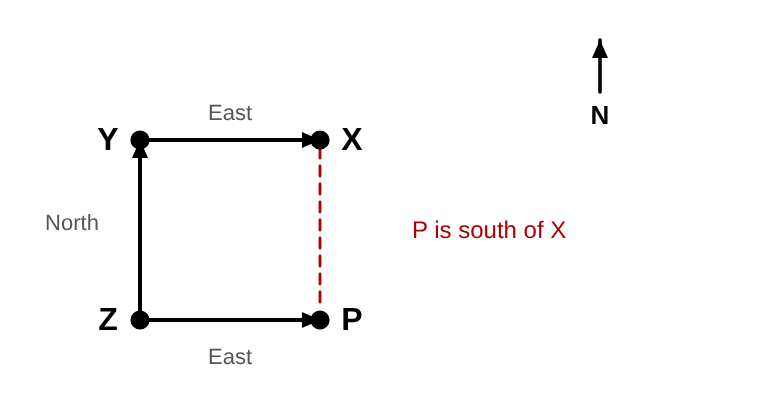
Y is in the north of Z, so Y is directly above Z.
X is in the east of Y, so X is on the same line as Y, to the right of Y.
P is in the east of Z, so P is on the same line as Z, to the right of Z.
The question gives only directions, no distances, so the usual convention is taken: the eastward distances Y to X and Z to P are equal.
Then X and P are on the same north-south line, with X at the level of Y and P at the level of Z.
Y is north of Z, so X (at Y’s level) is north of P (at Z’s level).
So P lies directly below X, in the south direction.
If the two eastward distances were unequal, P would be to the south-east or south-west of X, but the question expects one direction among the options, which is South.
Hence, the correct answer is (D) South.
Want this as a PDF? Get the WBP SI Prelims PYQ PDF
Q. Vivek and Ashok start from a fixed point. Vivek moves 3 km north and turns right and then covers 4 km. Ashok moves 5 km west and turns right and walks 3 km. Now how far are they apart ?
(A) 9 km
(B) 6 km
(C) 10 km
(D) 8 km
Answer & Explanation
Correct Answer: (A) 9 km
Explanation
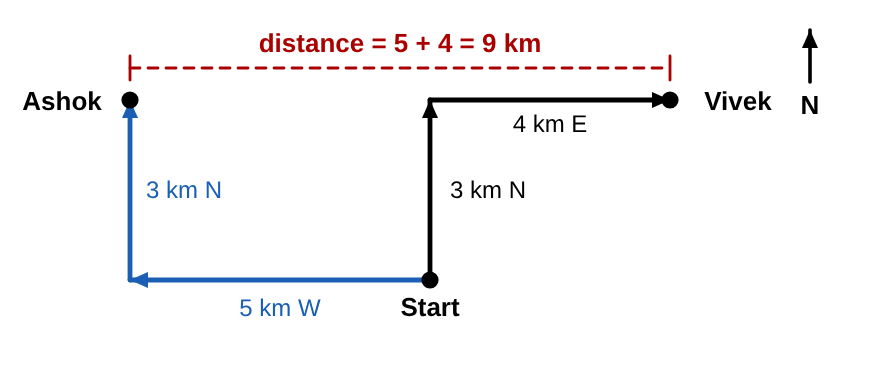
Take the starting point as the origin O.
Vivek goes 3 km north, then turns right (east) and goes 4 km: he is 4 km east and 3 km north of O.
Ashok goes 5 km west, then turns right (north) and goes 3 km: he is 5 km west and 3 km north of O.
Both are 3 km north of O, so they are on the same east-west line.
The distance between them = 4 km (east side) + 5 km (west side) = 9 km.
Check: no right-angled triangle is needed because the north-south distances are equal.
Hence, the correct answer is (A) 9 km.
Want this as a PDF? Get the WBP SI Prelims PYQ PDF
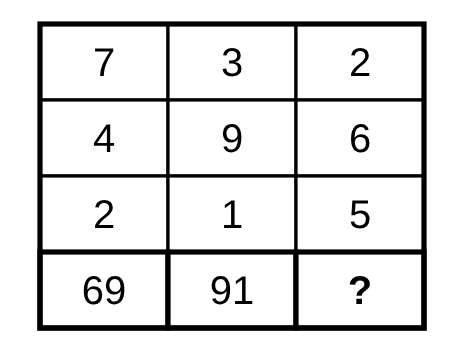
Q. Select the missing number from the given responses:
(A) 58
(B) 65
(C) 51
(D) 64
Answer & Explanation
Correct Answer: (B) 65
Explanation
Look at the last row. It gives a result for each column: 69 and 91.
Column 1: 7, 4, 2. Square each number and add: 7² + 4² + 2² = 49 + 16 + 4 = 69.
Column 2: 3, 9, 1. 3² + 9² + 1² = 9 + 81 + 1 = 91.
The rule is: the number in the last row is the sum of the squares of the three numbers above it.
Column 3: 2, 6, 5.
2² + 6² + 5² = 4 + 36 + 25 = 65.
So the missing number is 65.
Options (A) 58, (C) 51 and (D) 64 are not equal to 4 + 36 + 25.
Hence, the correct answer is (B) 65.
Want this as a PDF? Get the WBP SI Prelims PYQ PDF
Q. In a certain code language ‘T’ is written as 20, ‘TAX’ is written as 20124 and ‘XERO’ is written as 2451815. How would the word ‘BABY’ be written in that code language ?
(A) 21224
(B) Cannot be determined
(C) 21225
(D) 21220
Answer & Explanation
Correct Answer: (C) 21225
Explanation
In the code each letter is written as its position in the English alphabet.
T is the 20th letter, so T = 20.
TAX = T (20), A (1), X (24) = 20 1 24 = 20124, which matches.
XERO = X (24), E (5), R (18), O (15) = 24 5 18 15 = 2451815, which matches.
So the rule is confirmed: every letter is replaced by its alphabet position.
BABY = B (2), A (1), B (2), Y (25).
Write the numbers together: 2, 1, 2, 25 = 21225.
Option (A) 21224 has 24 for the last letter, which is X, not Y; option (D) 21220 has 20, which is T.
The code can be determined, so option (B) is wrong.
Hence, the correct answer is (C) 21225.
Want this as a PDF? Get the WBP SI Prelims PYQ PDF
Q. Choose the odd one :
(A) JKL
(B) TUV
(C) CDE
(D) PQS
Answer & Explanation
Correct Answer: (D) PQS
Explanation
Write the alphabet positions of the letters in each group.
JKL = 10, 11, 12 (consecutive letters)
TUV = 20, 21, 22 (consecutive letters)
CDE = 3, 4, 5 (consecutive letters)
PQS = 16, 17, 19 (R = 18 is skipped)
Three groups have three consecutive letters with a gap of 1 between them.
PQS has a gap of 1 and then a gap of 2.
So PQS does not follow the pattern of the others.
Hence, the correct answer is (D) PQS.
Want this as a PDF? Get the WBP SI Prelims PYQ PDF
WBP SI Prelims Reasoning Questions 2018
Q. MATCH = OCVEJ, then SCORE = ?
(A) UEQGT
(B) UEQTG
(C) UETQH
(D) UETQG
Answer & Explanation
Correct Answer: (B) UEQTG
Explanation
Compare each letter of MATCH with the code OCVEJ.
M (13) → O (15) : +2
A (1) → C (3) : +2
T (20) → V (22) : +2
C (3) → E (5) : +2
H (8) → J (10) : +2
Rule: every letter is moved 2 places forward in the alphabet.
Apply the same rule to SCORE.
S (19) → U (21)
C (3) → E (5)
O (15) → Q (17)
R (18) → T (20)
E (5) → G (7)
So SCORE = UEQTG.
Option (A) UEQGT has the right letters, but the last two are in the wrong order (G and T are interchanged).
Option (C) UETQH and option (D) UETQG have T in the third place, but O + 2 = Q, so both break the rule.
Hence, the correct answer is (B) UEQTG.
Want this as a PDF? Get the WBP SI Prelims PYQ PDF
Q. In a certain code language, A is written as C, B is written as D, C is written as E and so on up to Z. How is CHIKMAGALUR written in that code?
(A) EJKMOCIBNWT
(B) EJKMOCICNWT
(C) EJKMNCICNWT
(D) EJKMOCICNVT
Answer & Explanation
Correct Answer: (B) EJKMOCICNWT
Explanation
Given: A → C, B → D, C → E and so on up to Z, so every letter is moved 2 places forward.
Write the word CHIKMAGALUR and code each letter.
C (3) → E (5)
H (8) → J (10)
I (9) → K (11)
K (11) → M (13)
M (13) → O (15)
A (1) → C (3)
G (7) → I (9)
A (1) → C (3)
L (12) → N (14)
U (21) → W (23)
R (18) → T (20)
Coded word = EJKMOCICNWT (11 letters, the same as CHIKMAGALUR).
Option (A) EJKMOCIBNWT has B in the 8th place; the second A must become C, so it fails.
Option (C) EJKMNCICNWT has N in the 5th place; M + 2 = O, not N, so it fails.
Option (D) EJKMOCICNVT has V in the 10th place; R + 2 = T, not V, so it fails.
Hence, the correct answer is (B) EJKMOCICNWT.
Want this as a PDF? Get the WBP SI Prelims PYQ PDF
Q. Arrange the following in meaningful sequence:-
i. Consultation
ii. Illness
iii. Doctor
iv. Treatment
v. Recovery
The meaningful sequence is:-
(A) i, iii, iv, v, ii
(B) iii, iv, ii, i, v
(C) iii, ii, i, iv, v
(D) ii, iii, i, iv, v
Answer & Explanation
Correct Answer: (D) ii, iii, i, iv, v
Explanation
The five words describe what happens when a person falls ill. Arrange them in the order in which they occur in real life.
A person first falls ill, so Illness (ii) comes first.
He then goes to a Doctor (iii).
The doctor holds a Consultation (i) and examines him.
After the consultation the doctor gives Treatment (iv).
At the end the patient reaches Recovery (v).
So the order is ii, iii, i, iv, v.
Option (A) i, iii, iv, v, ii starts with Consultation and ends with Illness, which is the reverse of real life.
Option (B) iii, iv, ii, i, v puts Doctor and Treatment before Illness, which is impossible.
Option (C) iii, ii, i, iv, v puts Doctor before Illness; a doctor is approached only after illness begins.
Hence, the correct answer is (D) ii, iii, i, iv, v.
Want this as a PDF? Get the WBP SI Prelims PYQ PDF
Q. During a certain year, Gandhiji’s birthday falls on Sunday. What day will be Christmas in that year?
(A) Friday
(B) Wednesday
(C) Monday
(D) Sunday
Answer & Explanation
Correct Answer: (D) Sunday
Explanation
Gandhiji’s birthday = 2 October, which falls on Sunday in that year.
Christmas = 25 December of the same year.
Count the days from 2 October to 25 December.
Days left in October after 2 October = 31 − 2 = 29
Days in November = 30
Days in December up to the 25th = 25
Total days = 29 + 30 + 25 = 84
84 ÷ 7 = 12 weeks exactly, remainder (odd days) = 0
After exactly 12 weeks the weekday does not change.
February lies outside this period, so the answer is the same in a leap year and in an ordinary year.
Check the other options: Friday needs 5 odd days, Wednesday needs 3 and Monday needs 1, but there are 0 odd days.
So Christmas falls on Sunday.
Hence, the correct answer is (D) Sunday.
Want this as a PDF? Get the WBP SI Prelims PYQ PDF
Q. If ‘+’ means ‘−’, ‘−’ means ‘×’, ‘÷’ means ‘+’ and ‘×’ means ‘÷’, then 10 × 5 ÷ 3 − 2 + 3 = ?
(A) 53/3
(B) 21
(C) 5
(D) 18
Answer & Explanation
Correct Answer: (C) 5
Explanation
Given: ‘+’ means ‘−’, ‘−’ means ‘×’, ‘÷’ means ‘+’ and ‘×’ means ‘÷’.
Replace each symbol in 10 × 5 ÷ 3 − 2 + 3 by its real meaning.
× becomes ÷
÷ becomes +
− becomes ×
+ becomes −
The expression becomes 10 ÷ 5 + 3 × 2 − 3
Apply BODMAS (division and multiplication first)
10 ÷ 5 = 2
3 × 2 = 6
Now the expression is 2 + 6 − 3
= 8 − 3
= 5
Option (A) 53/3 is what you get by solving with the printed symbols (50 ÷ 3 − 2 + 3), which is the trap.
Options (B) 21 and (D) 18 do not follow from any consistent substitution.
Hence, the correct answer is (C) 5.
Want this as a PDF? Get the WBP SI Prelims PYQ PDF
Q. Consider the following years:
1600, 1700, 1800, 1900, 2000, 2100, 2200, 2300 and 2400
How many leap years are there in the above?
(A) 6
(B) 3
(C) 4
(D) 9
Answer & Explanation
Correct Answer: (B) 3
Explanation
A year is a leap year if it is divisible by 4. A century year (ending in 00) is a leap year only if it is divisible by 400.
Check each given year.
1600 ÷ 400 = 4, divisible, so leap year
1700 ÷ 400 = 4.25, not divisible, so not a leap year
1800 ÷ 400 = 4.5, not divisible, so not a leap year
1900 ÷ 400 = 4.75, not divisible, so not a leap year
2000 ÷ 400 = 5, divisible, so leap year
2100 ÷ 400 = 5.25, not divisible, so not a leap year
2200 ÷ 400 = 5.5, not divisible, so not a leap year
2300 ÷ 400 = 5.75, not divisible, so not a leap year
2400 ÷ 400 = 6, divisible, so leap year
Leap years are 1600, 2000 and 2400, which makes 3.
Option (D) 9 counts every century year as a leap year, ignoring the rule of 400.
Options (A) 6 and (C) 4 wrongly count some of 1700, 1800, 1900, 2100, 2200 and 2300.
Hence, the correct answer is (B) 3.
Want this as a PDF? Get the WBP SI Prelims PYQ PDF
Q. Pointing to a photograph, Suresh said “she is the only daughter of my grandfather’s only son.” How is Suresh related to the person in the photograph?
(A) Niece
(B) Mother
(C) Sister
(D) No relation
Answer & Explanation
Correct Answer: (C) Sister
Explanation
Read the sentence from the end: “the only daughter of my grandfather’s only son”.
Suresh’s grandfather’s son is either Suresh’s father or his uncle.
Since he is the only son of the grandfather, there is no other son, so he is Suresh’s father.
The only daughter of Suresh’s father is Suresh’s sister.
So the lady in the photograph is Suresh’s sister.
Option (A) Niece would need her to be the daughter of Suresh’s brother or sister.
Option (B) Mother is wrong because the mother is the wife of Suresh’s father, not his daughter.
Option (D) No relation is wrong because the chain clearly gives a family relation.
Hence, the correct answer is (C) Sister.
Want this as a PDF? Get the WBP SI Prelims PYQ PDF
Q. Find the number of triangles in the given figure:-
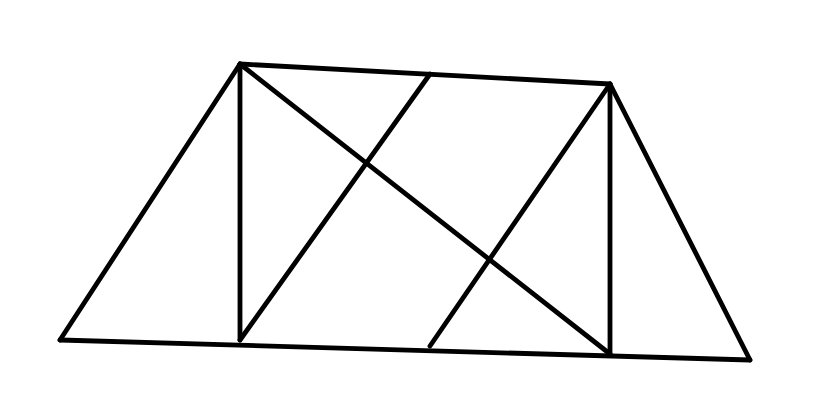
(A) 12
(B) 10
(C) 8
(D) 14
Answer & Explanation
Correct Answer: (D) 14
Explanation
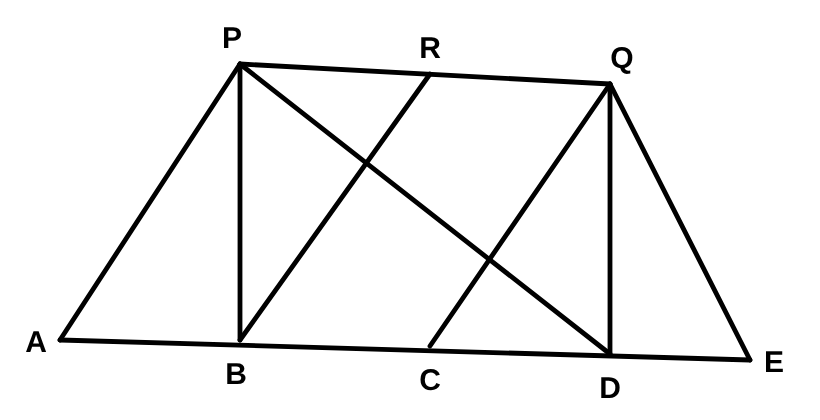
Label the figure as shown. A, B, C, D, E are the points on the base line; P, R, Q are the points on the top line; X is the point where PD cuts BR, and Y is the point where PD cuts CQ.
Count the triangles line by line, so that none is counted twice.
Group 1: triangles that have a side on the top line (P, R, Q)
PRB, PRX, PQY, PQD = 4
Group 2: triangles that have a side on the base line (A, B, C, D, E)
APB, APD, BPD, BXD, CYD, CDQ, CQE, DQE = 8
Group 3: triangles with no side on the top or base line
PBX and YDQ = 2
Total = 4 + 8 + 2 = 14
Check: lines PA, PB and PD all meet at the single point P, so they do not form a triangle among themselves.
Option (A) 12 is what you get if the two triangles of Group 3 are missed.
Options (B) 10 and (C) 8 come from missing the larger triangles such as APD and PQD.
Hence, the correct answer is (D) 14.
Want this as a PDF? Get the WBP SI Prelims PYQ PDF
Q. If in a mirror a clock shows time as 12 : 40, then the real time is:-
(A) 11 : 20
(B) 10 : 10
(C) 8 : 50
(D) 12 : 40
Answer & Explanation
Correct Answer: (A) 11 : 20
Explanation
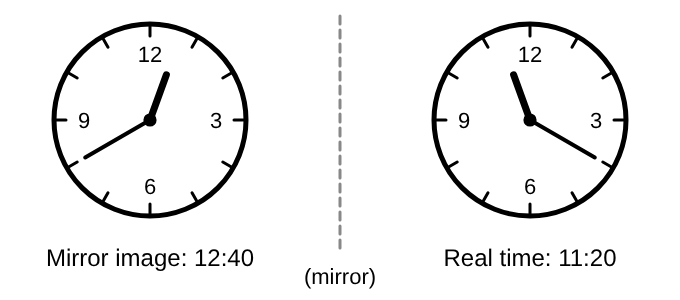
For a clock seen in a mirror, the real time and the mirrored time add up to 12:00 (or 24:00 in a 24-hour count).
Mirror shows 12:40
Real time = 11:60 − 12:40
= 11:20
Verify with the hands.
At 11:20 the hour hand is at (11 × 30°) + (20 × 0.5°) = 340° and the minute hand is at 20 × 6° = 120°.
A mirror reflects every angle θ as 360° − θ, so the hands move to 20° and 240°.
The hour hand at 20° and the minute hand at 240° show 12:40, which is the time seen in the mirror.
Option (B) 10:10 is the real time of a mirror reading 1:50.
Option (C) 8:50 is the real time of a mirror reading 3:10.
Option (D) 12:40 would be correct only if the clock were not reflected.
Hence, the correct answer is (A) 11:20.
Want this as a PDF? Get the WBP SI Prelims PYQ PDF
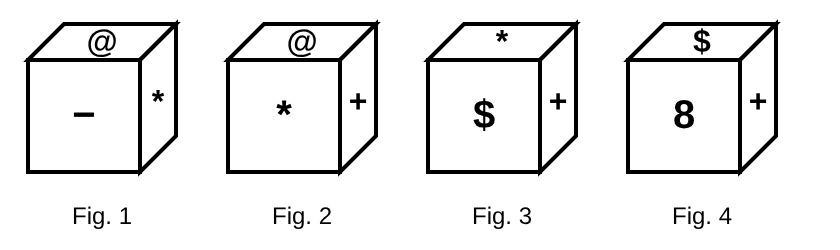
Q. Which symbol will be on the face opposite to the face with symbol * ?
(A) 8
(B) $
(C) @
(D) +
Answer & Explanation
Correct Answer: (A) 8
Explanation
Study the four views of the cube. Faces seen together in one view are adjacent faces.
View 1 and view 2 have the same top face @.
In view 1 the side faces going round @ are − (front) and * (right).
In view 2 the side faces going round @ are * (front) and + (right).
So the side faces around @ follow the order −, *, + and then one more face. That fourth side face is opposite the face *.
The six faces are @, −, *, +, $ and 8. The fourth face must be $ or 8.
View 3 shows * and $ together, so $ is adjacent to * and cannot be opposite to it.
So the face opposite * is 8.
Pairs of opposite faces: * and 8, @ and $, − and +.
Check with view 4: $, 8 and + are seen together, and none of these three is opposite another, so this agrees.
Option (B) $ is next to * in view 3.
Option (C) @ is next to * in views 1 and 2.
Option (D) + is next to * in view 2.
Hence, the correct answer is (A) 8.
Want this as a PDF? Get the WBP SI Prelims PYQ PDF
Q. Among five boys, B is taller than A, but not as tall as D. C is taller than E, but shorter than A. Who is the tallest in the batch?
(A) Cannot be determined
(B) B
(C) A
(D) D
Answer & Explanation
Correct Answer: (D) D
Explanation
Write each statement as a height order.
B is taller than A, but not as tall as D: D > B > A
C is taller than E, but shorter than A: A > C > E
Join the two chains through the common boy A.
D > B > A > C > E
Tallest = D, shortest = E.
Option (A) Cannot be determined is wrong because all five boys fit into one order.
Option (B) B is wrong because D is taller than B.
Option (C) A is wrong because both B and D are taller than A.
Hence, the correct answer is (D) D.
Want this as a PDF? Get the WBP SI Prelims PYQ PDF
Q. In a row of 18 children, Raju is seventh from the left. If Moti exchanges his positions with Raju, Raju will be fifteenth from the left. What is Moti’s present position from the right?
(A) Eleventh
(B) Fourth
(C) Eighth
(D) Twelfth
Answer & Explanation
Correct Answer: (D) Twelfth
Explanation
Total children in the row = 18
Raju is 7th from the left.
After the exchange Raju stands in Moti’s old place and is 15th from the left.
So Moti’s old position = 15th from the left.
Moti now stands in Raju’s old place = 7th from the left.
Moti’s present position from the right = Total − Position from the left + 1
= 18 − 7 + 1
= 12
Check: 7 (from the left) + 12 (from the right) = 19 = 18 + 1
Option (A) Eleventh comes from 18 − 7, which forgets to add 1.
Option (B) Fourth is Moti’s old position from the right (18 − 15 + 1 = 4).
Option (C) Eighth has no basis in the data.
Hence, the correct answer is (D) Twelfth.
Want this as a PDF? Get the WBP SI Prelims PYQ PDF
Q. Radha is younger to Sunita but elder than Rita. Rita is elder than Geeta. Shyam is elder to Rita but younger to Radha. Who is the youngest of all?
(A) Shyam
(B) Sunita
(C) Rita
(D) Geeta
Answer & Explanation
Correct Answer: (D) Geeta
Explanation
Write each statement as an age order (elder > younger).
Radha is younger than Sunita but elder than Rita: Sunita > Radha > Rita
Rita is elder than Geeta: Rita > Geeta
Shyam is elder than Rita but younger than Radha: Radha > Shyam > Rita
Join the chains.
Sunita > Radha > Shyam > Rita > Geeta
The youngest is Geeta.
Option (A) Shyam is wrong because Rita and Geeta are younger than Shyam.
Option (B) Sunita is the eldest of all.
Option (C) Rita is wrong because Geeta is younger than Rita.
Hence, the correct answer is (D) Geeta.
Want this as a PDF? Get the WBP SI Prelims PYQ PDF
Q. Find the odd one out:-
(A) Chilli
(B) Garlic
(C) Ginger
(D) Potato
Answer & Explanation
Correct Answer: (A) Chilli
Explanation
Find what is common to three of the items.
Garlic is a bulb that grows underground.
Ginger is a rhizome (a modified stem) that grows underground.
Potato is a stem tuber that grows underground.
All three are underground parts of the plant that are dug out of the soil.
Chilli is the fruit of the chilli plant and grows above the ground, on the plant.
So chilli does not belong to the group.
Options (B) Garlic, (C) Ginger and (D) Potato belong to the underground group, so none of them is the odd one.
Hence, the correct answer is (A) Chilli.
Want this as a PDF? Get the WBP SI Prelims PYQ PDF
Q. One morning Uday and Vishal were talking to each other face to face at a crossing. If Vishal’s shadow was exactly to the left of Uday, which direction was Uday facing?
(A) North
(B) West
(C) East
(D) South
Answer & Explanation
Correct Answer: (A) North
Explanation
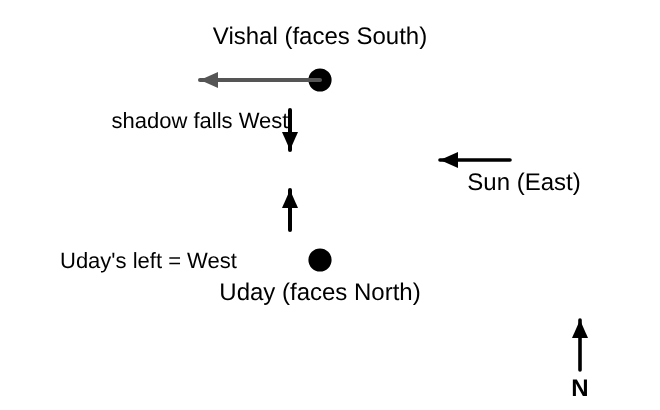
Fact 1: In the morning the sun is in the east, so every shadow falls towards the west.
Fact 2: Uday and Vishal face each other, so they face opposite directions.
Vishal’s shadow falls towards the west, and it falls exactly on Uday’s left side.
So Uday’s left side is the west.
A person whose left side is west is facing north.
(If you face north, your left hand points to the west.)
So Uday is facing north and Vishal is facing south.
Option (B) West: facing west, the left side is south, and the shadow (west) would be in front of Uday.
Option (C) East: facing east, the left side is north, which is not the shadow direction.
Option (D) South: facing south, the left side is east, so the shadow would fall on his right side.
Hence, the correct answer is (A) North.
Directions (Qs. 84 to 88): Study the following information carefully to answer these questions.
A, B, C, D, E, F, G and H are sitting around a circle facing the centre. F is third to the right of C and second to the left of H. D is not an immediate neighbour of C or H. E is to the immediate right of A who is second to the right of G.
Want this as a PDF? Get the WBP SI Prelims PYQ PDF
Q. Who is to the immediate right of C?
(A) D
(B) B
(C) E
(D) B or D
Answer & Explanation
Correct Answer: (B) B
Explanation
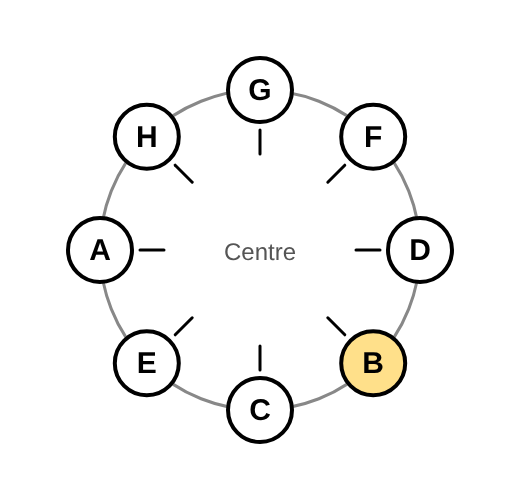
Facing the centre, the right-hand side of a person is the anticlockwise side. Number the seats 0 to 7 to the right, starting from C at seat 0.
Clue 1: F is third to the right of C, so F is at seat 3.
Clue 2: F is second to the left of H, so H is 2 seats to the right of F, at seat 5.
Clue 3: A is second to the right of G, and E is immediately to the right of A. So G, A, E occupy seats g, g + 2 and g + 3.
The free seats are 1, 2, 4, 6, 7. Only two fits are possible.
Fit 1: G at 4, A at 6, E at 7. Then B and D take seats 1 and 2.
Fit 2: G at 7, A at 1, E at 2. Then B and D take seats 4 and 6, both next to H.
Clue 4: D is not a neighbour of C or H. Fit 2 puts D next to H, so it is rejected.
In Fit 1, D cannot sit at seat 1 (next to C), so D is at seat 2 and B is at seat 1.
Final order to the right from C: C, B, D, F, G, H, A, E.
The person immediately to the right of C is B.
Option (A) D is second to the right of C, not the immediate right.
Option (C) E is the immediate left of C.
Option (D) B or D is wrong because the answer is exactly B.
Hence, the correct answer is (B) B.
Want this as a PDF? Get the WBP SI Prelims PYQ PDF
Q. Who is second to the left of C?
(A) E
(B) B
(C) A
(D) D
Answer & Explanation
Correct Answer: (C) A
Explanation

Using the arrangement found from the clues: C, B, D, F, G, H, A, E (each person is to the right of the one before, and C is to the right of E).
Left of C is the reverse direction.
First to the left of C = E
Second to the left of C = A
Option (A) E is first, not second, to the left.
Option (B) B is to the right of C.
Option (D) D is second to the right of C.
Hence, the correct answer is (C) A.
Want this as a PDF? Get the WBP SI Prelims PYQ PDF
Q. Which of the following is the correct position of B with respect to H?
i. Second to the right
ii. Fourth to the right
iii. Third to the left
iv. Second to the left
(A) iii
(B) ii
(C) i
(D) Both ii and iii
Answer & Explanation
Correct Answer: (B) ii
Explanation

Using the arrangement C, B, D, F, G, H, A, E (to the right from C), find B with respect to H.
To the right of H: first A, second E, third C, fourth B.
To the left of H: first G, second F, third D, fourth B.
So B is fourth to the right of H, and also fourth to the left, because B sits exactly opposite H.
Check each statement.
Statement i (second to the right): second to the right is E, so it is false.
Statement ii (fourth to the right): B, so it is true.
Statement iii (third to the left): third to the left is D, so it is false.
Statement iv (second to the left): second to the left is F, so it is false.
Option (D) Both ii and iii is wrong because statement iii is false.
Hence, the correct answer is (B) ii.
Want this as a PDF? Get the WBP SI Prelims PYQ PDF
Q. Which of the following pair of persons has first person sitting to the right of the second person?
(A) FG
(B) DB
(C) CB
(D) HA
Answer & Explanation
Correct Answer: (B) DB
Explanation

Arrangement (to the right from C): C, B, D, F, G, H, A, E.
The first person sits to the right of the second person if the first person comes just after the second one in this order.
(A) FG: F comes before G, so G is to the right of F. F is to the left of G. Not correct.
(B) DB: D comes just after B, so D is to the right of B. Correct.
(C) CB: B comes just after C, so C is to the left of B. Not correct.
(D) HA: A comes just after H, so H is to the left of A. Not correct.
Hence, the correct answer is (B) DB.
Want this as a PDF? Get the WBP SI Prelims PYQ PDF
Q. Who sits between G and D?
(A) F
(B) D
(C) H
(D) E
Answer & Explanation
Correct Answer: (A) F
Explanation
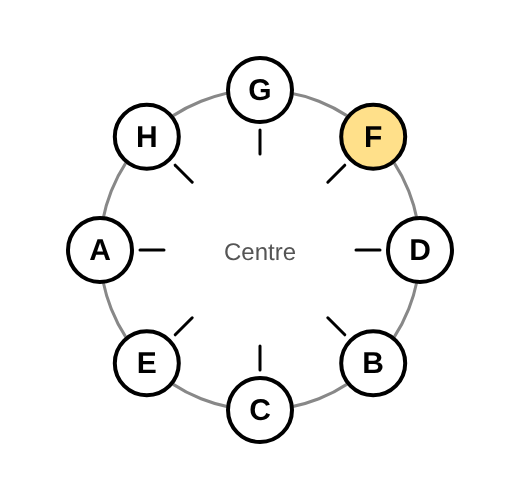
Arrangement: C, B, D, F, G, H, A, E (in a circle).
D and G are two seats apart on the short side: D, F, G.
So only F sits between D and G on that side.
On the other side the persons between G and D are H, A, E, C and B (five persons), so the short side is taken.
Option (B) D is one of the two named persons.
Option (C) H sits on the other side of G.
Option (D) E sits between A and C, far from both.
Hence, the correct answer is (A) F.
Want this as a PDF? Get the WBP SI Prelims PYQ PDF
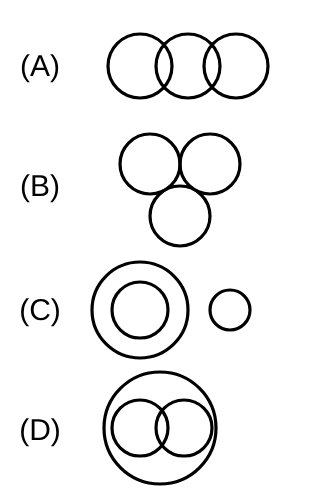
Q. Which one of the following diagrams indicates the best relation between Travellers, Train and Bus?
Answer & Explanation
Correct Answer: (A) Three circles in a row, the middle circle overlapping both end circles
Explanation
Travellers use both trains and buses, so the circle of Travellers must overlap the circle of Train and the circle of Bus.
No train is a bus, so the circles of Train and Bus must not overlap each other.
The middle circle is Travellers; the two end circles are Train and Bus.
Option (A): three circles in a row, the middle one overlapping both end circles. This fits.
Option (B): three separate circles mean that no traveller uses a train or a bus, which is wrong.
Option (C): one circle inside another and one separate circle make one class a part of another, which is wrong.
Option (D): two overlapping circles inside a big circle mean that some trains are buses and that all trains and buses are travellers, which is wrong.
Hence, the correct answer is (A).
Want this as a PDF? Get the WBP SI Prelims PYQ PDF
Q. From the following 4 numbers, select that one which does not conform to the others:-
125, 64, 216, 81
(A) 216
(B) 64
(C) 125
(D) 81
Answer & Explanation
Correct Answer: (D) 81
Explanation
Express each number as a power.
125 = 5 × 5 × 5 = 5³ (perfect cube)
64 = 4 × 4 × 4 = 4³ (perfect cube)
216 = 6 × 6 × 6 = 6³ (perfect cube)
81 = 3 × 3 × 3 × 3 = 3⁴, which is a perfect square (9²) but not a perfect cube.
Cube roots: ∛125 = 5, ∛64 = 4, ∛216 = 6, but ∛81 is between 4 and 5, not a whole number.
So 81 is the number that does not conform to the others.
Options (A) 216, (B) 64 and (C) 125 are all cubes, so they are not odd.
Hence, the correct answer is (D) 81.
Want this as a PDF? Get the WBP SI Prelims PYQ PDF
Q. A man walks 3 km northwards and then turns left and goes 2 km. He again turns left and goes 3 km. Then he turns right and walks straight. In which direction he is walking now?
(A) North
(B) West
(C) East
(D) South
Answer & Explanation
Correct Answer: (B) West
Explanation

Take north as up. Follow the man step by step.
He walks 3 km towards the north.
He turns left. Facing north, left is west, so he walks 2 km towards the west.
He turns left again. Facing west, left is south, so he walks 3 km towards the south.
He turns right. Facing south, right is west, so he now walks towards the west.
(After step 3 he is 2 km west of the starting point, on the same line as the start.)
Option (A) North would need a U-turn from south.
Option (C) East is the direction after a left turn from south.
Option (D) South is the direction of the previous leg, so no turn would be needed.
Hence, the correct answer is (B) West.
Want this as a PDF? Get the WBP SI Prelims PYQ PDF
Q. Select a suitable figure from the four alternatives that would complete the figure matrix:-
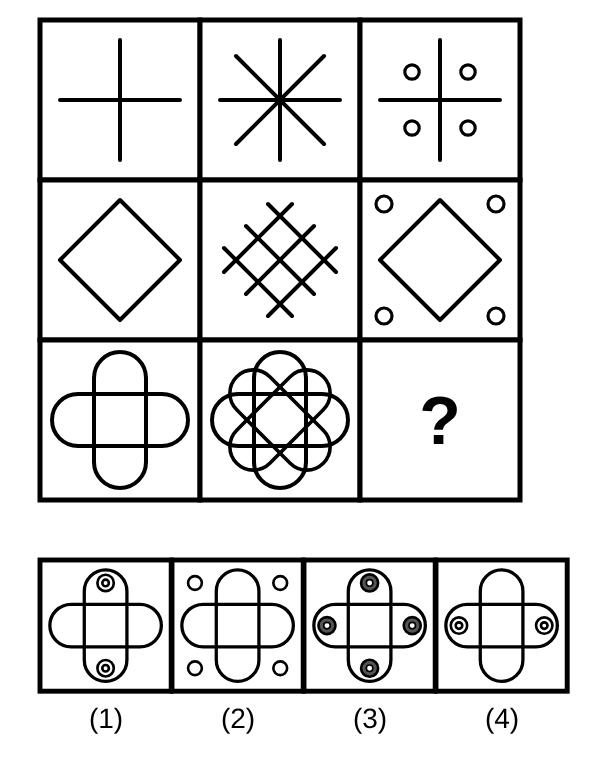
(A) 3
(B) 2
(C) 1
(D) 4
Answer & Explanation
Correct Answer: (B) 2
Explanation
Compare the figures in each row.
Row 1: first figure is a plus sign; third figure is the same plus sign with 4 small circles, one in each quarter.
Row 2: first figure is a diamond; third figure is the same diamond with 4 small circles at its 4 corners.
So, in every row, third figure = first figure + 4 small circles at the four corners.
(The middle figure of each row is the first figure overlapped by its copy turned through 45°; it does not decide the third figure.)
Row 3: first figure is the cross made of two overlapping ovals. The missing figure must be the same cross with 4 small circles at its four corners.
Check the options.
Figure (1) has circles only at the top and bottom arms (2 circles).
Figure (2) has 4 small circles at the 4 corners of the cross. This fits.
Figure (3) has circles on the ends of all four arms, not at the corners.
Figure (4) has circles at the left and right ends only (2 circles).
Hence, the correct answer is (B) 2.
Want this as a PDF? Get the WBP SI Prelims PYQ PDF
Q. Which one set of letters when sequentially placed at the gaps in the given letter series shall complete it?
a_bbc_aab_cca_bbcc
(A) caba
(B) acba
(C) bacb
(D) abba
Answer & Explanation
Correct Answer: (B) acba
Explanation
The given series is a_bbc_aab_cca_bbcc, which has 18 letters.
Divide it into 3 groups of 6 letters, since the pattern aabbcc repeats.
Group 1: a _ b b c _ , to make aabbcc the gaps are a and c
Group 2: a a b _ c c , to make aabbcc the gap is b
Group 3: a _ b b c c , to make aabbcc the gap is a
The missing letters in order are a, c, b, a.
Complete series: aabbcc aabbcc aabbcc
Option (A) caba puts c in the first gap (acbbc…), which breaks the pattern.
Option (C) bacb puts b in the first gap (abbbc…), which breaks the pattern.
Option (D) abba puts b in the second gap (group 1 becomes aabbcb), which breaks the pattern.
Hence, the correct answer is (B) acba.
Want this as a PDF? Get the WBP SI Prelims PYQ PDF
Leave a Comment