

Who is this for? Beginners and aspirants for UPSC Prelims, WBCS, other State PSCs and SSC. Each section opens with an “In simple words” explanation and then goes to exam-level detail.
Practise alongside: WBCS Mains Gupta Empire PYQs | WBCS Prelims Ancient Indian History PYQs
Previous chapters: Prehistoric India Notes → Indus Valley Civilization Notes → Vedic Age Notes → Mahajanapadas & Rise of Magadha Notes → Buddhism and Jainism → Schools of Indian Philosophy → Mauryan Empire → Post-Mauryan Dynasties
1. Introduction: The Classical Age of India
In simple words: After the Kushanas and Satavahanas, North India was again united by a family from Magadha: the Guptas. From about 320 CE to 550 CE they ruled from Pataliputra. Their age is famous for Kalidasa’s poetry, Aryabhata’s mathematics, the first stone temples, the Ajanta paintings and beautiful gold coins. That is why it is called the “Classical Age” or “Golden Age” of ancient India.
- Period: c. 319–320 CE to c. 550 CE.
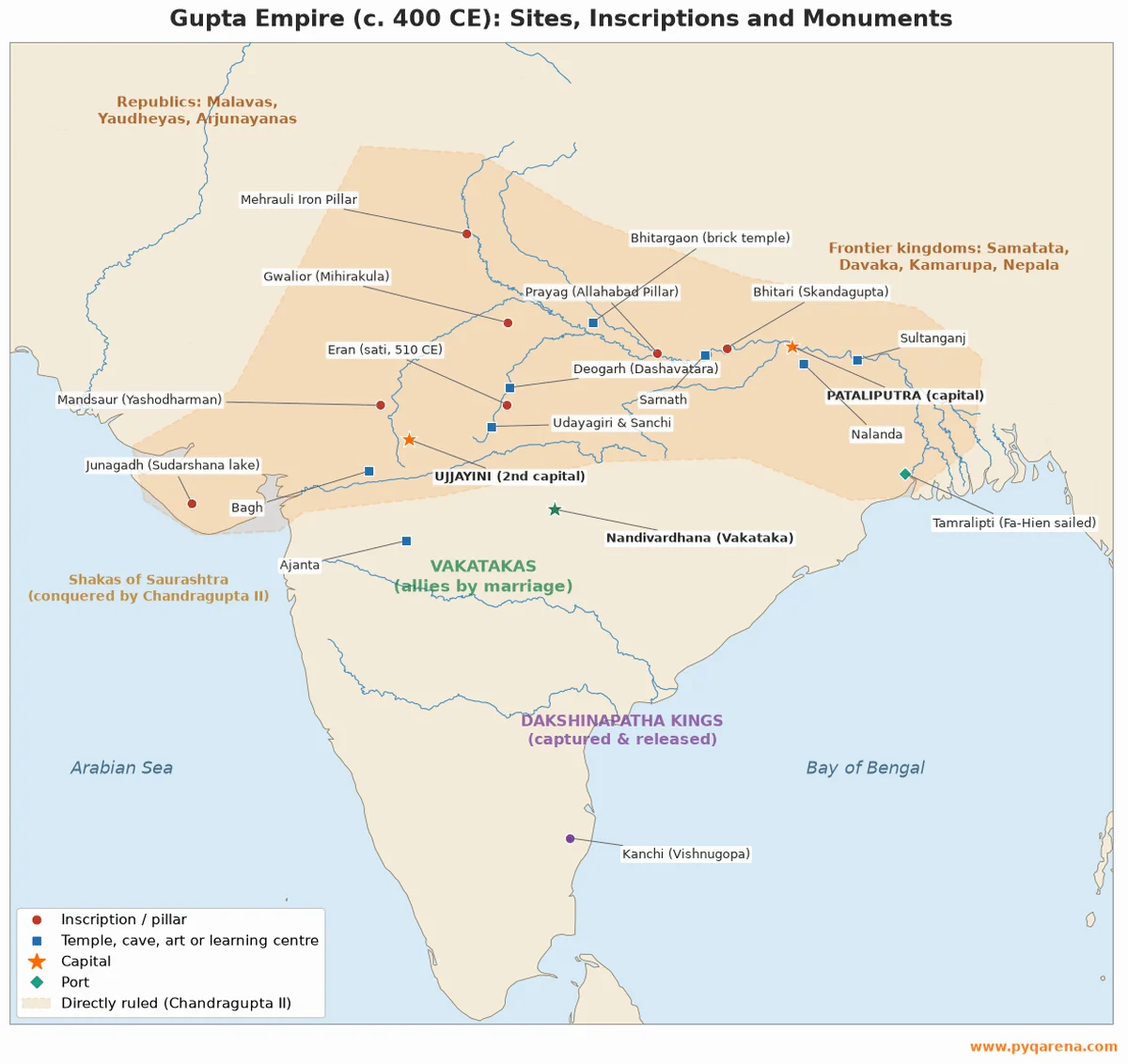
- Capital: Pataliputra. Ujjayini was the second capital under Chandragupta II.
- Emblem: Garuda (the eagle mount of Vishnu), on royal seals and coins.
- Main sources:
| Type | Source | What it tells |
|---|---|---|
| Inscriptions | Allahabad (Prayag) Prashasti of Samudragupta | Conquests of Samudragupta |
| Inscriptions | Mehrauli Iron Pillar | Victories of King “Chandra” (Chandragupta II) |
| Inscriptions | Bhitari and Junagadh inscriptions | Skandagupta’s war with the Hunas; Sudarshana lake |
| Inscriptions | Eran inscription (510 CE) | Earliest inscriptional record of sati |
| Inscriptions | Damodarpur copper plates (Bengal) | Land sales and district administration |
| Coins | Gold dinaras | Kings, titles, Ashvamedha, religion |
| Literature | Puranas, Kalidasa, Devichandraguptam, Kamandaka Nitisara | Genealogy, society |
| Foreign accounts | Fa-Hien (Fo-Kuo-Ki), later Xuanzang and I-tsing | Society, Buddhism, Nalanda |
- Oldest of the big dynasties: among Maurya, Kanva, Kushana and Gupta, the Maurya is the oldest. The Guptas are the latest. → PYQ: WBCS Mains GK 2021
- Allahabad Pillar Inscription: it belongs to the Gupta period (Samudragupta). → PYQ: WBCS Mains 2022
2. Origins: Sri Gupta and Ghatotkacha
- Founder:Sri Gupta (c. 240–280 CE), with the title Maharaja. → PYQ: WBCS Prelims 2009
- I-tsing records that a king “Che-li-ki-to” (Sri Gupta) built a temple for Chinese pilgrims near Mrigashikhavana.
- Successor: his son Ghatotkacha (c. 280–319 CE), also a Maharaja.
- Home region: eastern Uttar Pradesh, Magadha and Bengal (the Ganga plains).
- Status: the early Guptas were small chiefs under the later Kushanas and Murundas. They were of the Vaishya varna.
3. Chandragupta I (319–335 CE)
In simple words: Chandragupta I turned a small kingdom into a power. He did this mainly by marrying a princess of the powerful Lichchhavi clan. To mark his greatness, he started a new calendar: the Gupta era.
- Title: the first Gupta to take the imperial title Maharajadhiraja (“great king of kings”).
- Marriage: married Kumaradevi, a Lichchhavi princess of Vaishali.
- The “Chandragupta–Kumaradevi” (king-and-queen) gold coins show both, with the legend Lichchhavayah.
- Their son Samudragupta proudly called himself Lichchhavi-dauhitra (“daughter’s son of the Lichchhavis”). → PYQ: WBCS Prelims 2012
- Gupta era:
- Started by Chandragupta I in 319–320 CE, the date of his accession. → PYQ: WBCS Mains 2022, 2017
- Year 1 of the Gupta era = 319–320 CE.
- Kingdom: Magadha, Saketa (Ayodhya) and Prayag.
4. Samudragupta (335–375 CE)
In simple words: Samudragupta was the greatest conqueror of the dynasty. He fought in every direction, but used different policies for different regions. His court poet Harisena described his victories in a long poem carved on an Ashokan pillar at Allahabad. He was also a poet and a musician; his coins show him playing the veena.
4.1 Allahabad Prashasti (Prayag Prashasti)
- Author: composed by Harisena, his court poet. → PYQ: WBCS Prelims 2012, 2011, 2008, 2005, 2000 | PYQ: WBPSC Clerkship
- Harisena was also the Sandhivigrahika (minister of peace and war), Kumaramatya and Mahadandanayaka.
- Do not confuse: Ravikirti composed the Aihole inscription of Pulakeshin II, not the Allahabad Prashasti. → PYQ: WBCS Prelims 2013 | PYQ: WBCS Mains 2017
- Where: engraved on the Ashokan pillar now at Allahabad (Prayagraj) fort.
- It was originally at Kaushambi.
- The same pillar has Ashoka’s edicts and an inscription of Jahangir.
- Language and style: Sanskrit, in champu style (a mix of prose and verse).
- Content:
- A list of his campaigns and the policy he used in each region.
- It praises him as equal to the gods Kubera, Varuna, Indra and Yama.
4.2 Campaigns and policies
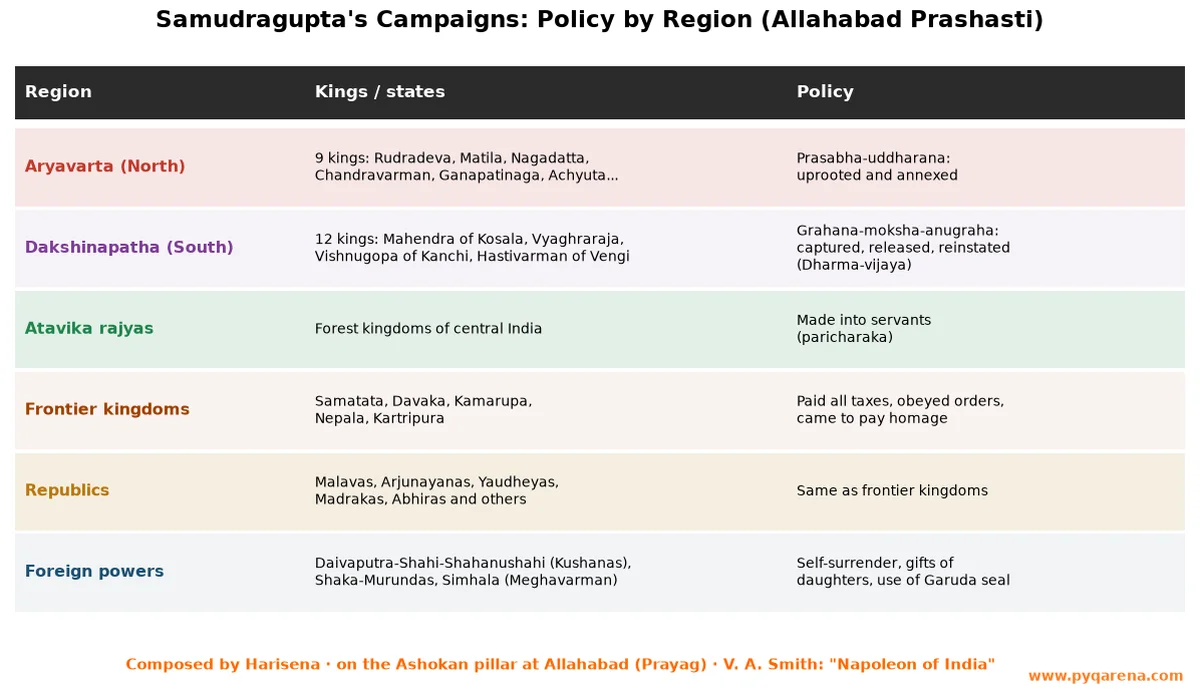
- Aryavarta (North India):
- He uprooted 9 kings, including Rudradeva, Matila, Nagadatta, Chandravarman, Ganapatinaga, Nagasena, Achyuta, Nandin and Balavarman.
- He annexed their lands: prasabha-uddharana.
- Dakshinapatha (South India):
- He defeated 12 kings but gave their kingdoms back: grahana-moksha-anugraha (capture, release, favour).
- This southern policy is called Dharma-vijaya (righteous conquest). → PYQ: WBCS Prelims 2000
- The kings included Mahendra of Kosala, Vyaghraraja of Mahakantara, Vishnugopa of Kanchi and Hastivarman of Vengi.
- Atavika rajyas (forest kingdoms): in central India; made into servants.
- Frontier kingdoms:
- Samatata (south-east Bengal), Davaka (Assam), Kamarupa (Assam), Nepala and Kartripura.
- They paid all taxes, obeyed orders and came to pay homage.
- Republics: the Malavas, Arjunayanas, Yaudheyas, Madrakas, Abhiras, Prarjunas, Sanakanikas, Kakas and Kharaparikas. They were treated the same way as the frontier kingdoms.
- Foreign rulers: the Daivaputra-Shahi-Shahanushahi (later Kushanas), the Shaka-Murundas and the king of Simhala (Sri Lanka).
- They offered self-surrender, daughters in marriage and requests to use the Garuda seal.
- Meghavarman embassy:
- Meghavarman, king of Sri Lanka, sent gifts and an embassy.
- He asked permission to build a Buddhist monastery at Bodh Gaya for Sri Lankan pilgrims. Samudragupta granted it.
4.3 Titles, coins and personality
- “Napoleon of India”: the historian V. A. Smith called him this because of his many victories. → PYQ: WBCS Mains 2022 | PYQ: WBCS Prelims 2009 | PYQ: WBPSC Misc 2008
- Other titles:
- Kaviraja (“king of poets”): he was a poet himself.
- Parakramanka, Vyaghraparakrama and Sarvarajochchheta (“uprooter of all kings”).
- Coins (he issued 8 types of gold coins):
- Lyrist type: playing the veena, showing his love of music.
- Ashvamedha type: he performed the Ashvamedha sacrifice.
- Archer, battle-axe and tiger-slayer types.
- Religion: a devotee of Vishnu, yet tolerant. His minister was the Buddhist scholar Vasubandhu.
- Eran inscription: a record of Samudragupta at Eran (Madhya Pradesh).
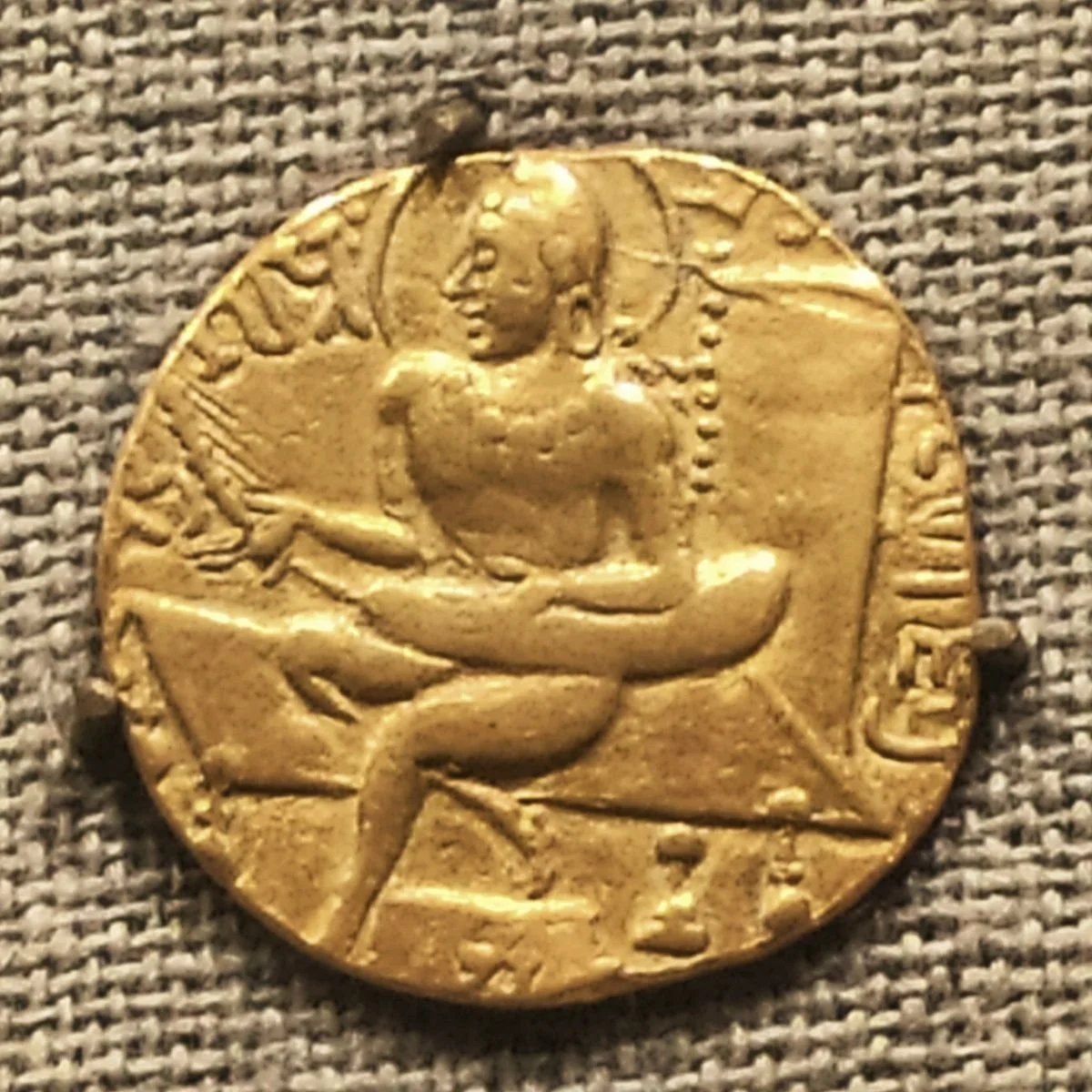
Image Source: Wikimedia
5. Ramagupta
- Who he was: the elder son of Samudragupta. He ruled for a short time after his father.
- Sources:
- Copper coins with his name, found at Vidisha and Eran.
- The play Devichandraguptam by Vishakhadatta.
- The story:
- Ramagupta was defeated by a Shaka king and agreed to give away his queen Dhruvadevi.
- His younger brother Chandragupta went to the Shaka camp disguised as the queen and killed the Shaka king.
- Chandragupta later killed Ramagupta and married Dhruvadevi.
- Succession: in the official Gupta genealogy, the next ruler after Samudragupta is Chandragupta II. → PYQ: WBCS Prelims 2019
6. Chandragupta II “Vikramaditya” (375–415 CE)
In simple words: Chandragupta II completed his father’s work. He destroyed the Shaka rulers of western India, which gave the Guptas the rich ports of Gujarat. He made friends with the Vakatakas of the Deccan through marriage. His reign is the high point of Gupta glory, with the Navaratnas (“nine gems”) at his court and the Chinese pilgrim Fa-Hien visiting India.
6.1 Titles
- Main title: Vikramaditya (“sun of valour”). → PYQ: WBCS Mains 2023 | PYQ: WBCS Prelims 2013
- Other titles:Simhavikrama, Devaraja and Shakari.
- Shakari means “destroyer of the Shakas”. → PYQ: WBCS Mains 2022 | PYQ: WBPSC Clerkship
6.2 Conquest of the Shakas
- What he did: he defeated Rudrasimha III, the last Western Kshatrapa (Shaka) ruler of Gujarat and Malwa, around 409 CE. → PYQ: WBCS Prelims 2022 | PYQ: WBPSC Clerkship
- Results:
- The Guptas gained the western coast and its ports, such as Bharuch (Broach) and Sopara, and trade with the West.
- He issued silver coins in the Shaka style for this region.
- Second capital: Ujjayini (Ujjain). → PYQ: WBCS Prelims 2000
- Inscriptions of his officers:
- Udayagiri cave inscription of his minister Virasena (near Vidisha).
- Sanchi inscription of Amrakardava.
6.3 Marriage alliances
- His own marriages:
- Dhruvadevi, mother of Kumaragupta I.
- Kuberanaga, a Naga princess.
- Vakataka alliance:
- His daughter Prabhavatigupta married the Vakataka king Rudrasena II of the Deccan.
- After Rudrasena’s early death she ruled as regent for her young sons. The Poona copper plates of Prabhavatigupta record this.
- This alliance secured the southern flank before the Shaka war.
6.4 Mehrauli Iron Pillar
- Where: in the Qutb complex, Mehrauli (Delhi). It was brought there from elsewhere; it was first set up as a Vishnudhvaja (standard of Vishnu) on Vishnupada hill.
- Whom it praises: a Sanskrit inscription praises a king named “Chandra”, identified with Chandragupta II. → PYQ: WBCS Mains 2017
- What it records:
- Chandra’s victory over enemies in Vanga (Bengal).
- His crossing of the seven mouths of the Indus to defeat the Vahlikas.
- Metallurgy: about 7.2 m tall and more than 1,600 years old, it has not rusted. This is a marvel of Gupta metallurgy.
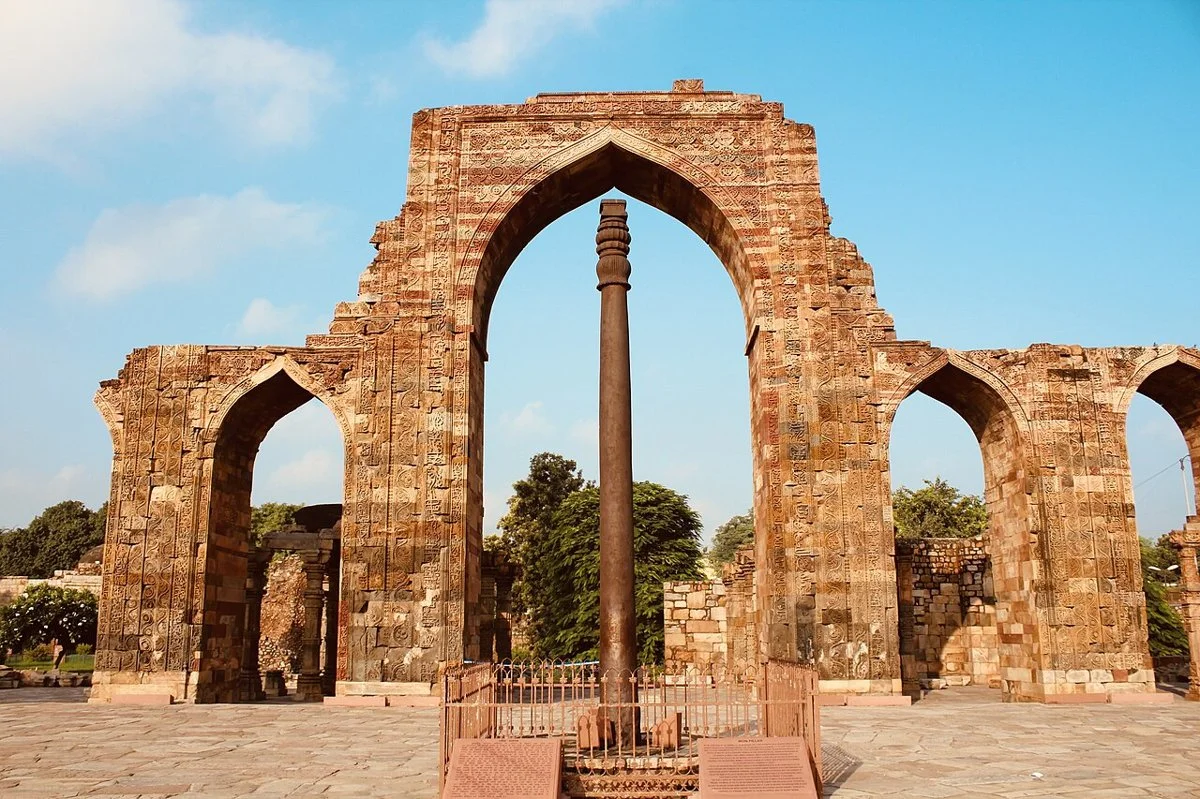
Image Source: Wikimedia
6.5 Navaratnas (Nine Gems)
- Whose court: Chandragupta II (Vikramaditya) had the Nine Jewels. → PYQ: WBCS Mains 2023
- The nine:
- Kalidasa: poet and dramatist.
- Amarasimha: lexicographer (Amarakosha).
- Varahamihira: astronomer.
- Dhanvantari: physician.
- Vararuchi: grammarian.
- Vetala Bhatta: magic and mantra.
- Ghatakarpara: poet.
- Kshapanaka: astrologer.
- Shanku: architect.
6.6 Fa-Hien (Faxian), 399–414 CE
- When: the Chinese Buddhist pilgrim came during the reign of Chandragupta II. → PYQ: WBCS Mains 2022
- Book: Fo-Kuo-Ki (“Record of Buddhist Kingdoms”). → PYQ: WBCS Prelims 2004
- Order of travellers: Megasthenes → Fa-Hien → Xuanzang → I-tsing. → PYQ: WBCS Prelims 2022
- What he saw:
- People were prosperous and happy, with light taxes and mild punishments (mostly fines; no death penalty).
- There were free hospitals and rest houses in Pataliputra.
- Chandalas (untouchables) lived outside the towns. They had to strike a piece of wood to warn others of their approach.
- Most people did not eat meat, drink wine or eat onions and garlic. Only Chandalas did.
- Cowries were used for small purchases.
- He studied in Pataliputra and sailed home from Tamralipti via Sri Lanka.
- What he did not mention: the name of the king.
7. Kumaragupta I (415–455 CE)
- Titles: Mahendraditya and Shakraditya.
- Nalanda:
- He founded Nalanda Mahavihara (University), near Rajgir, Bihar. → PYQ: WBCS Prelims 2023 | PYQ: WBCS Mains 2017 | PYQ: WBPSC Clerkship
- Nalanda became the greatest centre of Buddhist learning. Later kings, including Harsha and the Palas, enlarged it.
- The Chinese traveller I-tsing (Yijing) of the 7th century lived and studied at Nalanda for ten years. → PYQ: WBCS Mains 2017
- Ashvamedha: he performed it, and his Ashvamedha coins record it.
- Coins: Kartikeya (peacock) type gold coins; he issued many coin types.
- Mandasor inscription (436–437 CE): records that a guild of silk weavers from Lata (Gujarat) built a Sun temple at Dashapura.
- Damodarpur copper plates (Dinajpur, Bengal): begin in his reign and show Gupta rule in north Bengal (Pundravardhana bhukti).
- End of his reign: the Pushyamitra tribe attacked. His son Skandagupta drove them back.
8. Skandagupta (455–467 CE)
In simple words: Skandagupta was the last great Gupta. He saved the empire from the fierce Hunas who came through the north-west. He also repaired the famous Sudarshana lake in Gujarat.
- Saviour from the Hunas:
- He defeated the Hunas and saved the empire. → PYQ: WBCS Mains 2023 | PYQ: WBCS Prelims 2024, 2018 | PYQ: WBPSC Misc
- He also defeated the Pushyamitras.
- Title: Kramaditya.
- Bhitari Pillar Inscription (Ghazipur, UP): describes his fight with the Pushyamitras and the Hunas and how he restored the family fortune.
- Junagadh inscription (455–457 CE):
- His governor of Saurashtra, Parnadatta, and Parnadatta’s son Chakrapalita repaired the Sudarshana lake after its dam burst.
- The lake was first built under Chandragupta Maurya and repaired by Rudradaman I (see Post-Mauryan Dynasties).
- Coins: his gold coins contain less gold, which shows the strain of war on the treasury.
9. Later Guptas, the Hunas and the Decline
9.1 Later Gupta rulers
- Purugupta, then Budhagupta (c. 476–495 CE): the last strong ruler. His inscriptions are found from Bengal to Malwa.
- Narasimhagupta Baladitya:
- He fought Mihirakula.
- He built a vihara at Nalanda.
- Bhanugupta: the Eran inscription of 510 CE records the death of his general Goparaja in battle. Goparaja’s wife became sati.
- Vishnugupta (c. 540–550 CE): the last Gupta ruler.
- Do not confuse: the “Later Guptas of Magadha” (Krishnagupta and others) were a separate, later family.
9.2 The Hunas
- Who they were: the White Huns (Hephthalites) from Central Asia, who came through Afghanistan.
- Toramana:
- He conquered Punjab, Rajasthan and Malwa around 500 CE.
- His Eran boar (Varaha) inscription records this.
- Mihirakula:
- A Huna king, son of Toramana. His capital was Sakala (Sialkot). → PYQ: WBCS Prelims 2023
- A Shaiva; Xuanzang records that he persecuted Buddhists.
- Gwalior inscription of his reign.
- He was defeated by Yashodharman of Malwa and by Narasimhagupta Baladitya.
- Yashodharman:
- The Aulikara ruler of Mandasor (Dashapura), Malwa.
- His Mandasor (Sondani) pillar inscription of the early 6th century (c. 532 CE) boasts of defeating Mihirakula. → PYQ: WBCS Mains 2016
- Assimilation: the Hunas and other later immigrants were absorbed into Indian society. They are identified with the culturally assimilated Rajput clans. → PYQ: WBCS Mains 2015
9.3 Causes of the decline
| Cause | Explanation |
|---|---|
| Huna invasions | Drained the treasury and army; broke Gupta control of the north-west |
| Weak successors | Quarrels within the family after Skandagupta |
| Rise of feudatories | Maukharis (Kannauj), Maitrakas (Valabhi), Later Guptas, Pushyabhutis (Thanesar), Gaudas (Bengal) became independent |
| Land grants | Kings gave away land and revenue to Brahmins and officials, which weakened central income and control |
| Decline of trade | Fall of the Roman trade; less income; debased gold coins |
| Administrative decentralisation | Hereditary officials and feudatories with their own armies |
10. The Vakatakas: Deccan Allies of the Guptas
In simple words: The Vakatakas ruled the Deccan (Maharashtra and Vidarbha) at the same time as the Guptas. They were Brahmins, great patrons of art, and were tied to the Guptas by marriage. The finest Ajanta caves were cut under them.
- Founder: Vindhyashakti (3rd century CE).
- Pravarasena I: the only Vakataka to take the title Samrat; he performed four Ashvamedhas.
- Rudrasena II: married Prabhavatigupta, daughter of Chandragupta II.
- Pravarasena II:
- Wrote Setubandha in Maharashtri Prakrit.
- Founded the city of Pravarapura.
- Harishena (c. 475–500 CE): the last great king. His minister Varahadeva sponsored Ajanta Cave 16, and a feudatory sponsored Cave 17.
- Capitals: Nandivardhana (near Nagpur) and Vatsagulma (Washim).
- Land grants:
- The Vakatakas were the first to transfer all sources of revenue to Brahmins in their land grants. → PYQ: WBCS Mains 2016
- Their many copper-plate charters record tax-free grants to Brahmins.
- Do not confuse: the Nasik inscription is about the Satavahanas, not the Vakatakas (see Post-Mauryan Dynasties). → PYQ: WBCS Mains 2023
11. Gupta Rulers at a Glance
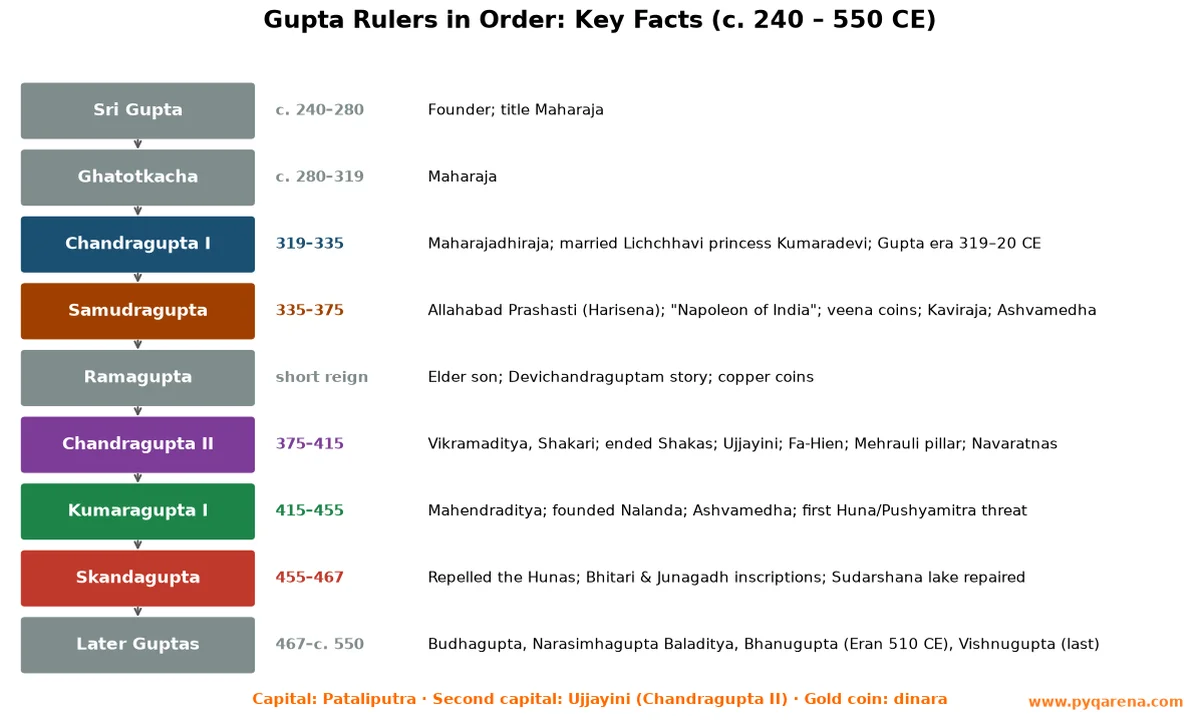
| Ruler | Years (CE) | Title | Remember for |
|---|---|---|---|
| Sri Gupta | c. 240–280 | Maharaja | Founder |
| Ghatotkacha | c. 280–319 | Maharaja | Son of Sri Gupta |
| Chandragupta I | 319–335 | Maharajadhiraja | Lichchhavi marriage; Gupta era 319–20 |
| Samudragupta | 335–375 | Kaviraja, Parakramanka | Allahabad Prashasti (Harisena); “Napoleon of India”; veena coins |
| Ramagupta | short reign | – | Devichandraguptam; copper coins |
| Chandragupta II | 375–415 | Vikramaditya, Shakari | Ended Shaka rule; Navaratnas; Fa-Hien; Iron Pillar |
| Kumaragupta I | 415–455 | Mahendraditya | Nalanda; Ashvamedha; Kartikeya coins |
| Skandagupta | 455–467 | Kramaditya | Defeated the Hunas; Junagadh & Bhitari inscriptions |
| Budhagupta | c. 476–495 | – | Last strong ruler |
| Bhanugupta | c. 510 | – | Eran inscription (sati) |
| Vishnugupta | c. 540–550 | – | Last Gupta ruler |
12. Administration
In simple words: The Gupta king was very powerful in name, with grand titles, but his government was less centralised than the Mauryan one. Governors and local chiefs ran most affairs. Officials were often paid with land instead of cash, and many posts became hereditary. This is why historians see “feudal” tendencies in Gupta rule.
12.1 The king
- Titles:
- Maharajadhiraja (king of kings), Parameshvara (supreme lord) and Paramabhattaraka.
- Paramabhagavata (devout Vaishnava).
- Divine kingship: the king was compared to the gods (Samudragupta with Kubera, Varuna, Indra and Yama).
- Succession: usually the eldest son, but the king could choose. Chandragupta II was chosen by Samudragupta.
12.2 Central officials
| Official | Duty |
|---|---|
| Mantrin | Chief minister |
| Sandhivigrahika | Minister of peace and war (foreign affairs) |
| Mahabaladhikrita | Commander of the army |
| Mahadandanayaka | Chief of justice / general |
| Mahapratihara | Chief of the palace guards |
| Dandapashika | Head of the police |
| Vinayasthitisthapaka | Officer for law, order and public morals |
| Kumaramatya | A high cadre of officers, posted in the centre and provinces |
| Bhandagaradhikrita | Treasury officer |
| Akshapataladhikrita | Keeper of records |
12.3 Provinces and local government
| Unit | Head | Note |
|---|---|---|
| Desha / Rashtra | – | Large division of the empire |
| Bhukti (province) | Uparika | Appointed by the king; e.g. Pundravardhana bhukti in north Bengal |
| Vishaya (district) | Vishayapati | Assisted by a council (adhishthana-adhikarana) |
| Vithi | – | Group of villages |
| Grama (village) | Gramika / Gramadhyaksha | Helped by elders (mahattaras) |
- District council (Damodarpur copper plates): the town council had four members:
- Nagara-shreshthi: chief of the town’s bankers and merchants.
- Sarthavaha: chief of the trading caravans.
- Prathama-kulika: chief artisan.
- Prathama-kayastha: chief scribe.
- Village affairs: run by village elders with little interference from the state.
12.4 Army, justice and police
- Army:
- A standing army, but feudatories also supplied troops.
- Cavalry and mounted archers became more important. Samudragupta’s coins show him as an archer.
- Justice:
- Civil and criminal law were clearly separated for the first time.
- Law books: Yajnavalkya, Narada, Brihaspati and Katyayana Smritis.
- The oldest Smriti is the Manu Smriti. → PYQ: WBCS Mains GK | PYQ: WBCS Mains GK Books 2022
- Punishments: mild. Fa-Hien says there was no death penalty; most crimes were punished with fines.
- Mitakshara:
- A treatise on Hindu law of inheritance, written by Vijnaneshvara in the 11th–12th century (Chalukya court of Kalyani).
- It is a commentary on the Gupta-age Yajnavalkya Smriti. → PYQ: WBCS Prelims 2020, 2005
12.5 Feudal tendencies
- Payment in land: officials and priests received land grants instead of salaries.
- Hereditary posts: Harisena, his father and his son all held high posts.
- Samantas: conquered kings became feudatories who paid tribute and supplied troops. In the late Gupta period they became independent.
- Rights given away: grantees received administrative and judicial rights over villages, and the state’s officers could not enter granted land.
- Indian feudalism: R. S. Sharma calls these trends “Indian feudalism”, while historians such as Harbans Mukhia reject a European-style feudalism for India. The idea of Gupta and post-Gupta feudalism is therefore a disputed concept. → PYQ: WBCS Mains 2018
13. Economy
In simple words: The Gupta economy rested on agriculture. Kings gave away land generously, especially to Brahmins, which spread farming into new areas but weakened the state’s own income. The Guptas issued the largest number of gold coins in ancient India. Long-distance trade with the Roman world, however, declined in this period, and many towns shrank.
13.1 Land and agriculture
- Owner of land: the king was regarded as the owner of all land.
- Classes of land: land was classified on every basis: use, fertility and ownership. → PYQ: WBCS Mains 2019
| Type of land | Meaning |
|---|---|
| Kshetra | Cultivated land |
| Khila | Uncultivated (fallow) land |
| Aprahata | Forest or jungle land |
| Vasti | Habitable land |
| Gopata Sarah | Pasture land |
- Irrigation:
- The Araghatta was a device to lift water from wells, using a wheel with pots. → PYQ: WBCS Mains 2020
- Big works like the Sudarshana lake dam were repaired by the state.
13.2 Land grants
- Agrahara:
- Tax-free land or villages granted to Brahmins in perpetuity, recorded on copper plates.
- This is the usual North Indian term.
- Brahmadeya:
- Villages granted to and inhabited by Brahmins. The term is common in South Indian inscriptions. → PYQ: WBCS Mains 2021
- Devadana: land given to temples. In Gupta records, temple grants are called devagrahara.
- Effects of land grants:
- Farming spread into forest and tribal areas.
- Brahmins became powerful landlords.
- The king’s income and control weakened.
13.3 Taxes
| Tax | Meaning |
|---|---|
| Bhaga | King’s share of the produce, usually 1/6 |
| Bhoga | Periodic supply of fruits, firewood, flowers, etc. to the king |
| Kara | Periodic tax on villagers |
| Bali | Originally a voluntary offering; later compulsory |
| Udranga / Uparikara | Land taxes (on permanent and temporary tenants) |
| Hiranya | Tax paid in cash (gold) |
| Vishti | Forced labour for the state |
13.4 Guilds, trade and towns
- Guilds (shreni):
- Very powerful and largely self-governing.
- They had their own laws, which the king respected.
- Seals of guilds have been found at Vaishali and Bhita.
- The silk weavers’ guild of the Mandasor inscription built a Sun temple.
- Ujjain: the nodal point where trade routes from north to south and east to west met in the pre-Gupta and Gupta periods. → PYQ: WBCS Mains 2020
- Ports:
- West: Bharuch, Sopara and Kalyan.
- East: Tamralipti.
- Decline of trade with the West:
- The Western Roman Empire fell (476 CE).
- The Hunas disrupted the Central Asian routes.
- In 551 CE silkworms were smuggled from China into the Byzantine Empire, so the Byzantines no longer needed Indian middlemen for silk. → PYQ: WBCS Mains 2015
- Trade with Southeast Asia and China grew instead.
- Urban decay: many old towns declined after the 5th century; archaeology at sites like Taxila and Kausambi shows this.
13.5 Coins
- Gold coins:
- Called dinara. → PYQ: WBCS Mains 2014
- The Guptas issued the largest number of gold coins in ancient India.
- The Kushanas were the first to issue gold coins in India. → PYQ: WBCS Prelims 2007 | PYQ: WBCS Mains 2017
- Gupta gold coins were less pure than Kushana ones, and later Gupta coins had even less gold.
- Silver coins: issued after the conquest of the Shakas (rupaka).
- Copper coins: few.
- Cowries: Fa-Hien says common people used cowries for daily purchases.
14. Society
In simple words: Gupta society was built on the varna (caste) system, which became more rigid. New castes appeared. Women lost status, with child marriage and the first record of sati. The untouchables (Chandalas) were treated very badly. But the Shudras’ position improved as they became farmers.
14.1 Caste
- Brahmins: at the top; they gained land and privileges through grants.
- Kshatriya status for foreigners: foreign groups (Shakas, Hunas) were absorbed as Kshatriyas.
- Mixed castes: the number of jatis grew as tribes and foreigners joined society.
- Kayasthas: scribes who rose with the growing use of land records and copper plates; they became a distinct caste.
- Shudras:
- Their position improved. Many became agriculturists and were allowed to hear the epics and Puranas.
- Xuanzang (Hiuen Tsang), in the 7th century, was the first to describe the Shudras as agriculturists.
- Untouchables (Chandalas):
- Their number grew.
- Fa-Hien says they lived outside the village, and had to strike a piece of wood to warn others when entering a town.
- Slavery: existed; Narada Smriti lists 15 types of slaves.
14.2 Women
- Status: women’s status declined.
- Child marriage became common.
- Women could not study the Vedas.
- Women were closely tied to husbands, as the Smritis required.
- Property: women had a right to stridhana (jewellery, gifts at marriage).
- Sati:
- The earliest inscriptional evidence of sati is the Eran inscription (510 CE) of Bhanugupta’s time. → PYQ: WBCS Prelims 2022
- It records that the wife of Goparaja burnt herself on his funeral pyre.
- Exceptions:
- Prabhavatigupta ruled the Vakataka kingdom as regent.
- Royal women such as Kumaradevi appear on coins.
- Devadasis: appear in Kalidasa’s Meghaduta, at the Mahakala temple of Ujjain.
15. Religion
In simple words: The Gupta age saw the rise of Puranic Hinduism: worship of Vishnu, Shiva and the Goddess through images in temples, with bhakti (devotion) instead of big Vedic sacrifices. The Gupta kings were devotees of Vishnu, but they respected Buddhism and Jainism too.
- Bhagavatism / Vaishnavism:
- The Gupta kings called themselves Paramabhagavata.
- Their emblem was Garuda, Vishnu’s mount.
- The ten avatars of Vishnu became popular. The Varaha (boar) panel at Udayagiri is a famous example.
- Vishnu worship had earlier roots too, such as the Heliodorus pillar (see Post-Mauryan Dynasties).
- Shaivism:
- Many Shiva temples were built, for example at Bhumara.
- The Hunas (Mihirakula) and some later Guptas were Shaivas.
- Shaktism: goddess worship grew, with Devi Mahatmya in the Markandeya Purana.
- Puranas:
- Given their final form in this age, for example the Vishnu, Vayu and Matsya Puranas.
- The Ramayana and Mahabharata were also finalised.
- Temples and images: image worship (puja) replaced Vedic sacrifice for common people. Temples began to be built in stone and brick.
- Ashvamedha: Samudragupta and Kumaragupta I still performed the Vedic Ashvamedha, to proclaim their supremacy.
- Buddhism:
- Royal patronage of Nalanda.
- Mahayana grew.
- Scholars: Asanga, Vasubandhu and Dignaga (logic). For their schools see Buddhism and Jainism and Schools of Indian Philosophy.
- Jainism: the second Jain council at Valabhi (Gujarat) in the 5th century, under Devarddhi Kshamashramana, wrote down the Jain canon.
16. Art and Architecture
In simple words: The Guptas gave India its first proper Hindu temples, the most graceful Buddha images (Sarnath school) and the famous Ajanta paintings (under their Vakataka allies). Gupta art is calm, balanced and elegant. It became the model for later Indian art.
16.1 Temples
- Stages: temple building grew from simple flat-roofed shrines to temples with a shikhara (tower). This was the start of the Nagara style.
- Basic plan: a small garbhagriha (sanctum) for the image, a porch, and a raised platform.
| Temple | Place | Feature |
|---|---|---|
| Sanchi Temple 17 | Madhya Pradesh | One of the earliest; flat roof, pillared porch |
| Tigawa (Kankali Devi) | Jabalpur, MP | Early flat-roofed temple |
| Bhumara Shiva temple | Satna, MP | Shiva temple |
| Nachna-Kuthara Parvati temple | Panna, MP | Early shrine with a circumambulation path |
| Dashavatara temple, Deogarh | Lalitpur, UP | Earliest temple with a shikhara (c. 500 CE); panchayatana plan; Vishnu on Sheshanaga panel |
| Bhitargaon temple | Kanpur, UP | Brick temple with terracotta panels and a tall shikhara |
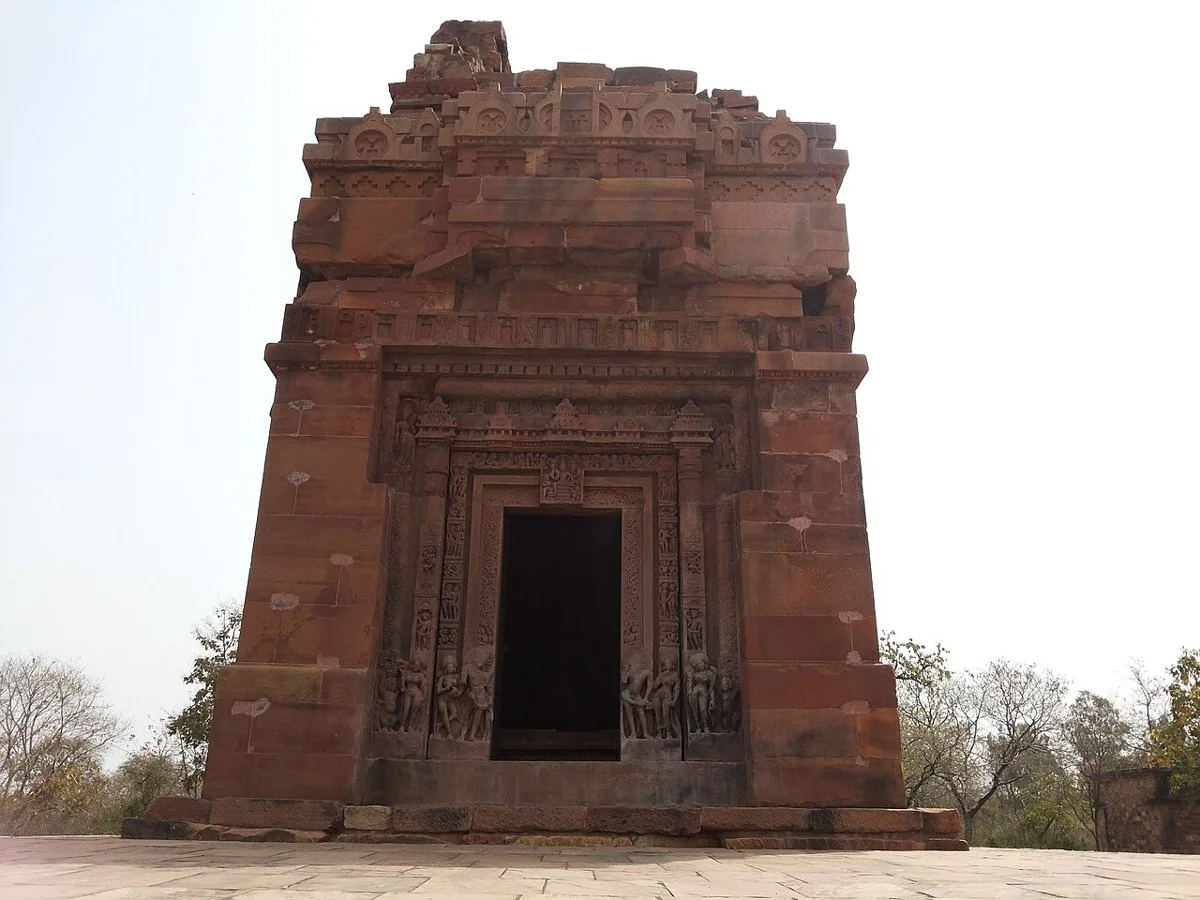
Image Source: Wikimedia
16.2 Caves and paintings
- Udayagiri caves (near Vidisha):
- Rock-cut Hindu caves of Chandragupta II’s time.
- Famous for the huge Varaha (boar) avatar panel.
- Ajanta caves (Aurangabad, Maharashtra):
- 30 Buddhist caves.
- The finest paintings are in Caves 1, 2, 16 and 17, made in the 5th century under the Vakatakas (Harishena), in the Gupta style.
- Famous works:
- Bodhisattva Padmapani and Vajrapani in Cave 1.
- The “Dying Princess” in Cave 16.
- The “Mother and Child” before the Buddha in Cave 17.
- Technique: fresco-like tempera painting on a dry plaster of mud, cow dung and rice husk.
- Bagh caves (Dhar, Madhya Pradesh): Buddhist caves with paintings of processions, music and dance, close in style to Ajanta.
- Do not confuse: Bhimbetka has the largest belt of prehistoric rock paintings, not Ajanta (see Prehistoric India). → PYQ: WBCS Mains 2014
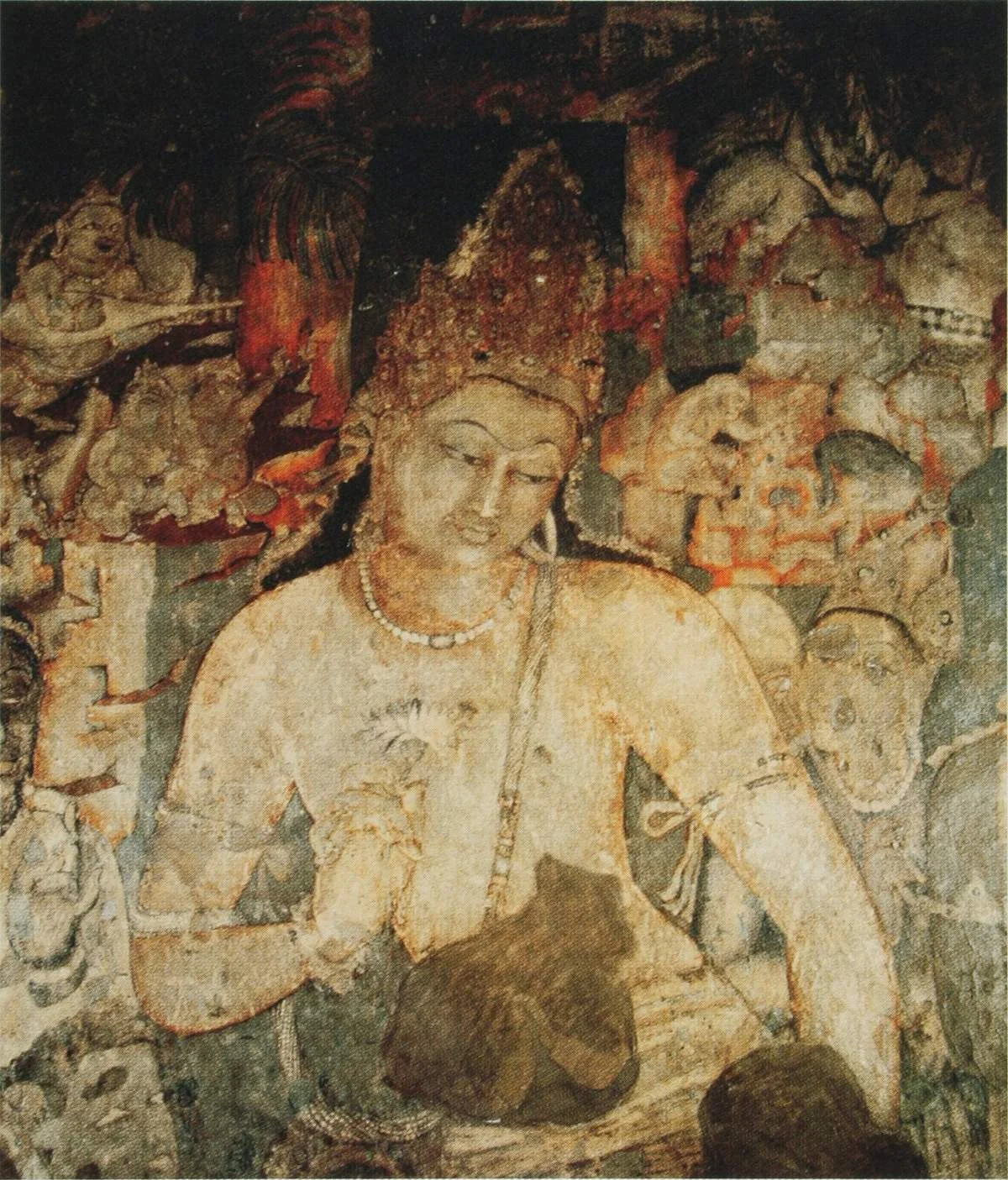
Image Source: Wikimedia
16.3 Sculpture
- Sarnath school:
- Images of the Buddha in cream-coloured Chunar sandstone.
- Transparent drapery that seems to cling to the body.
- Calm, half-closed eyes and a decorated halo.
- The “Buddha preaching the first sermon” (Dharmachakra-pravartana mudra) is its masterpiece. Sarnath is where the Buddha gave his first sermon. → PYQ: WBCS Mains 2022
- Mathura school: continued in the Gupta age, in red sandstone, with standing Buddhas in thick, pleated robes.
- Sultanganj Buddha:
- A copper Buddha about 2.3 m tall, from Sultanganj (Bhagalpur, Bihar).
- It is now in the Birmingham Museum, UK.
- Metal and metallurgy: the Mehrauli Iron Pillar and the Sultanganj Buddha show great skill in metal work.
- Terracotta: fine terracotta figures and panels come from Bhitargaon and Ahichchhatra.
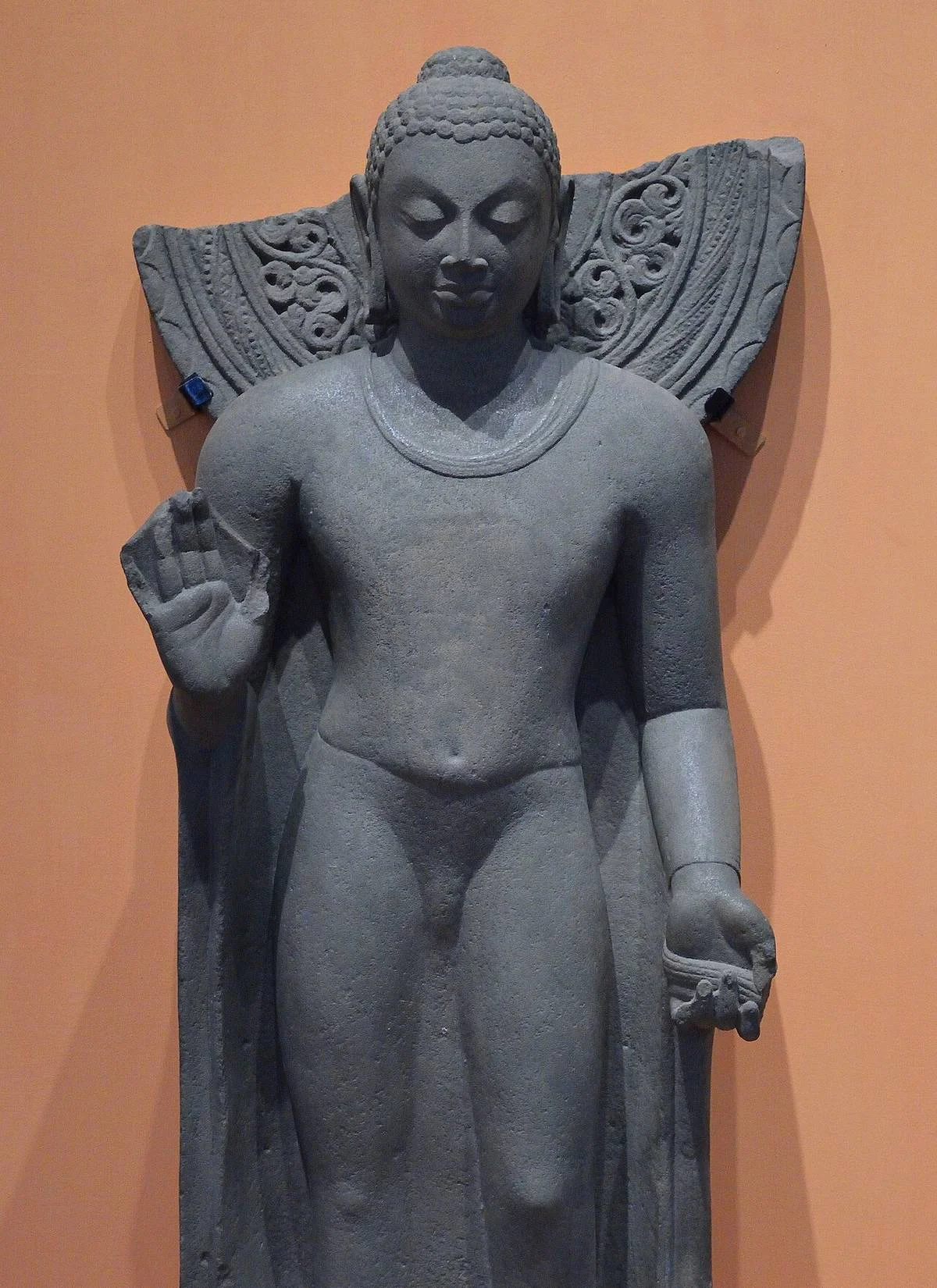
Image Source: Wikimedia
17. Literature
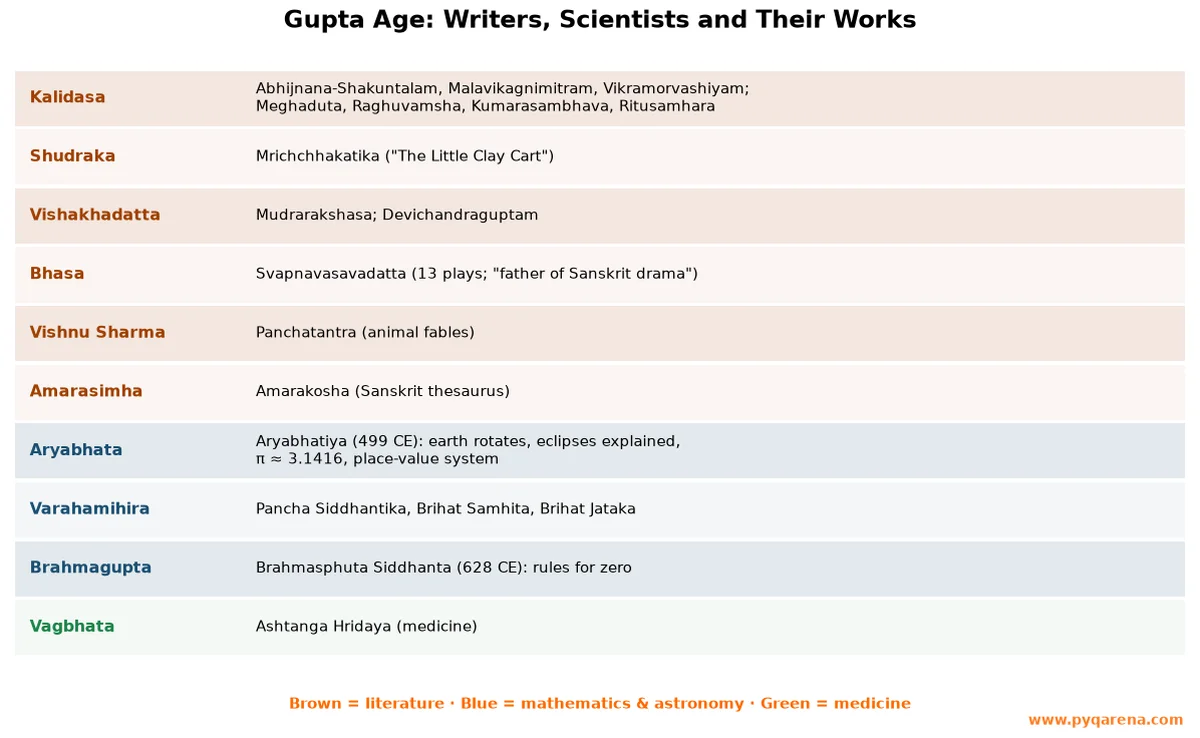
In simple words: The Gupta age is the golden age of Sanskrit literature. Sanskrit became the language of the court. Kalidasa, India’s greatest Sanskrit poet, wrote plays and poems. Other famous works were plays by Shudraka and Vishakhadatta, the Panchatantra fables and the Amarakosha dictionary.
17.1 Kalidasa
- Who: the greatest poet of the age, one of the Navaratnas of Chandragupta II. He is called the “Shakespeare of India”.
- Works: all of the following are his. → PYQ: WBCS Mains 2015
- Plays:
- Abhijnana-Shakuntalam: King Dushyanta and Shakuntala.
- Malavikagnimitram: King Agnimitra Shunga and Malavika.
- Vikramorvashiyam: Pururava and Urvashi.
- Epics (mahakavya):
- Raghuvamsha: the kings of Raghu’s line. → PYQ: WBPSC Misc 2000
- Kumarasambhava: the birth of Kartikeya. → PYQ: WBCS Prelims 2000
- Lyric poems:
- Meghaduta: a cloud carries a message.
- Ritusamhara: the six seasons.
- Plays:
- Shakuntalam: written by Kalidasa, not by Krittibas, Valmiki or Kautilya. → PYQ: WBPSC Misc 2018
- Do not confuse:
- Kadambari and Harshacharita are by Banabhatta (Harsha’s court). → PYQ: WBPSC Misc 2006
- Gitagovinda is by Jayadeva (12th century, Bengal).
17.2 Other writers
| Writer | Work | Note |
|---|---|---|
| Bhasa | Svapnavasavadatta, Pratijna-Yaugandharayana, Charudatta | 13 plays; earlier than Kalidasa; the father / pioneer of classical Sanskrit drama |
| Shudraka | Mrichchhakatika (“The Little Clay Cart”) | Love of Brahmin Charudatta and courtesan Vasantasena; shows city life |
| Vishakhadatta | Mudrarakshasa, Devichandraguptam | Mudrarakshasa: Chanakya’s plot against the Nandas’ minister Rakshasa |
| Vishnu Sharma | Panchatantra | Animal fables to teach princes statecraft |
| Amarasimha | Amarakosha | Sanskrit thesaurus |
| Bharavi | Kiratarjuniya | Arjuna and Shiva as a hunter (6th century) |
| Bhatti | Bhattikavya | Story of Rama, teaching grammar |
| Vatsyayana | Kamasutra | Treatise on love and household life |
| Kamandaka | Nitisara | Polity, based on the Arthashastra |
| Ishvarakrishna | Samkhya Karika | Samkhya philosophy |
- Bhasa:
- The father / pioneer of classical Indian drama. → PYQ: WBPSC Misc 2006
- His 13 plays were discovered in 1912 by T. Ganapati Shastri in Kerala.
- Mrichchhakatika is by Shudraka. → PYQ: WBCS Prelims 2019 | PYQ: WBCS Mains GK Books 2015
- Mudrarakshasa is by Vishakhadatta. → PYQ: WBP SI 2021
- Panchatantra is by Vishnu Sharma. It was translated into Pahlavi (Persian) in the 6th century and later into Arabic as Kalila wa Dimna.
- Language: Sanskrit dramas used Sanskrit for kings and Brahmins and Prakrit for women and common people.
- Prakrit: Vakataka king Pravarasena II wrote Setubandha in Maharashtri Prakrit.
18. Science and Mathematics
In simple words: The Gupta age gave the world some of its greatest scientific ideas: the decimal place-value system with zero, a nearly exact value of π, and the idea that the Earth rotates on its axis. Aryabhata and Varahamihira are the two names to remember.
18.1 Aryabhata (476–550 CE)
- Who: the most famous mathematician and astronomer of ancient India. → PYQ: WBCS Prelims 2000
- He worked at Kusumapura (Pataliputra).
- Book: Aryabhatiya (499 CE).
- Discoveries:
- The Earth rotates on its axis; the sky does not turn.
- Eclipses are caused by the shadows of the Earth and Moon, not by Rahu and Ketu.
- The value of π = 3.1416.
- The place-value system and the sine function (jya).
- The solar year at 365.358 days.
- Honour: India’s first satellite (1975) was named Aryabhata.
18.2 Varahamihira (505–587 CE)
- Who: astronomer and astrologer at Ujjain, one of the Navaratnas.
- Books:
- Pancha Siddhantika:
- Summarises five astronomical systems: Surya, Romaka, Paulisha, Vasishtha and Paitamaha Siddhantas.
- Through it, the Surya Siddhanta is associated with Varahamihira.
- The Surya Siddhanta is the text where the term “Bhugol” is first used. → PYQ: WBCS Prelims 2005 | PYQ: WBCS Mains GK 2020
- Brihat Samhita: an encyclopaedia on astronomy, weather, architecture, gems, plants and more. → PYQ: WBCS Prelims 2018
- Brihat Jataka: astrology.
- Pancha Siddhantika:
18.3 Brahmagupta (598–668 CE)
- Book: Brahmasphuta Siddhanta (628 CE). It was the first book to give rules for calculating with zero and negative numbers.
- Also:
- He hinted at gravity (“the earth attracts all things”).
- His works reached the Arab world as Sindhind.
18.4 Zero and decimal system
- Place value:
- The decimal place-value system with zero as a number was perfected in this age.
- Aryabhata used place value, and Brahmagupta gave rules for zero.
- Bakhshali Manuscript: uses a dot for zero.
- Spread: the Arabs carried these “Hindu numerals” to Europe.
18.5 Medicine
- Vagbhata:
- The great medical writer of the Gupta age. → PYQ: WBCS Prelims 2001
- Works: Ashtanga Sangraha and Ashtanga Hridaya. With Charaka and Sushruta, he forms the “three great” of Ayurveda.
- Navanitakam:
- A text on medicine, part of the Bower Manuscript found in Kucha (Central Asia). → PYQ: WBCS Mains 2016
- Charaka and Sushruta belong to the earlier Kushana age.
- Dhanvantari: physician at Chandragupta II’s court.
- Palakapya: wrote Hastyayurveda, on the diseases of elephants.
19. The Golden Age
In simple words: The Gupta age is called the “Golden Age” because of its brilliant culture: literature, science, art, temples and coins. This title belongs to its classical culture and the life of the upper classes. For peasants, women and untouchables, it was an age of new burdens.
| Golden for | Not golden for |
|---|---|
| Sanskrit literature: Kalidasa, Shudraka, Vishakhadatta | Women: child marriage, sati (Eran 510 CE) |
| Science: Aryabhata, Varahamihira, zero and decimal place value | Untouchables: Chandalas lived outside towns (Fa-Hien) |
| Art: Ajanta, Sarnath Buddhas, Deogarh temple | Peasants: forced labour (vishti), many taxes |
| Coins: most gold coins of ancient India | Trade and towns: decline of Roman trade; urban decay |
| Political unity over North India; mild punishments | Central power: land grants, feudal tendencies |
- Who called it golden: nationalist historians such as R. C. Majumdar and K. P. Jayaswal.
- The critique:
- Historians such as R. S. Sharma and D. N. Jha point to land grants, feudalism and social inequality.
- They also note that the Kushana age was more prosperous in trade and towns.
- The balanced verdict: the Gupta age is the classical age of Indian culture. Its standards in literature, art and science became the model for later centuries. Its society and economy, however, were moving towards feudalism.
20. Quick Revision: One-Liners
- Founder of the Gupta dynasty: Sri Gupta
- Gupta era (319–320 CE) started by: Chandragupta I
- Lichchhavi-dauhitra: Samudragupta
- Allahabad Prashasti composed by: Harisena
- “Napoleon of India”: Samudragupta (V. A. Smith)
- Kaviraja and veena coins: Samudragupta
- Sri Lankan king who sent an embassy to Samudragupta: Meghavarman
- Vikramaditya, Shakari, Navaratnas: Chandragupta II
- Gupta king who destroyed the Shakas: Chandragupta II
- Second capital: Ujjayini
- Fa-Hien came under: Chandragupta II; his book: Fo-Kuo-Ki
- Mehrauli Iron Pillar “Chandra”: Chandragupta II
- Nalanda founded by: Kumaragupta I
- Lived ten years at Nalanda (7th century): I-tsing (Yijing)
- Hunas repulsed by: Skandagupta
- Sudarshana lake repaired under Skandagupta by: Chakrapalita
- Mihirakula: a Huna king; defeated by Yashodharman
- Mandasor pillar (early 6th century): Yashodharman
- Earliest sati record: Eran inscription, 510 CE
- Gupta gold coin: dinara
- First to issue gold coins in India: Kushanas
- Araghatta: device to lift water
- Silkworms reached Byzantium: 551 CE
- First to give all revenues to Brahmins in grants: Vakatakas
- Mrichchhakatika: Shudraka; Mudrarakshasa: Vishakhadatta
- Father of Sanskrit drama: Bhasa
- Panchatantra: Vishnu Sharma; Amarakosha: Amarasimha
- Brihat Samhita: Varahamihira; Aryabhatiya: Aryabhata
- Gupta-age medical writer: Vagbhata; Navanitakam: medicine
- Earliest temple with a shikhara: Dashavatara temple, Deogarh
- Brick temple: Bhitargaon
- Sri Gupta → Ghatotkacha → Chandragupta I → Samudragupta → Ramagupta → Chandragupta II → Kumaragupta I → Skandagupta.
- Read it as: “Some Great Chiefs Set Rules, Created Kingly Splendour.”
- Navaratnas: Chandragupta II.
- Nalanda: Kumaragupta I.
- Hunas defeated: Skandagupta.
21. FAQ
Q1. Who was the greatest Gupta ruler? Samudragupta was the greatest conqueror (“Napoleon of India”). Chandragupta II took the empire to its peak of power and culture.
Q2. What is the Gupta era? A calendar started by Chandragupta I in 319–320 CE, the year of his accession.
Q3. Why is the Allahabad Pillar important? It carries Harisena’s Prashasti, the main source for Samudragupta’s conquests. The same pillar also has Ashoka’s edicts and Jahangir’s inscription.
Q4. Who were the Navaratnas? Nine scholars at the court of Chandragupta II, among them Kalidasa, Amarasimha, Varahamihira and Dhanvantari.
Q5. Why did the Gupta Empire decline? Huna invasions, weak successors, independent feudatories, land grants that cut royal income, and the decline of foreign trade.
Q6. What did Fa-Hien say about India? People were prosperous, taxes light and punishments mild, but the Chandalas (untouchables) lived outside towns and were shunned.
Q7. Which Gupta temple first had a shikhara? The Dashavatara temple at Deogarh (Lalitpur, UP), around 500 CE.
Q8. Why is the Gupta age called the Golden Age? For its classical achievements in Sanskrit literature, science (zero, decimal system, astronomy), temple art, sculpture and gold coinage.
🔗 Related Notes and Practice
- WBCS Mains Gupta Empire PYQs
- WBCS Prelims Ancient Indian History PYQs
- Post-Mauryan Dynasties Notes
- Mauryan Empire Notes
- Buddhism and Jainism Notes
Leave a Comment