

Who is this for? Beginners and aspirants for UPSC Prelims, WBCS, other State PSCs and SSC. Each section opens with an “In simple words” explanation and then goes to exam-level detail.
Practise alongside: WBCS Prelims Ancient Indian History PYQs | WBCS Mains South Indian Dynasties PYQs
Previous chapters: Prehistoric India → Indus Valley Civilization → Vedic Age → Mahajanapadas & Rise of Magadha → Buddhism and Jainism → Schools of Indian Philosophy → Mauryan Empire → Post-Mauryan Dynasties → Gupta Empire
1. Introduction: India after the Guptas
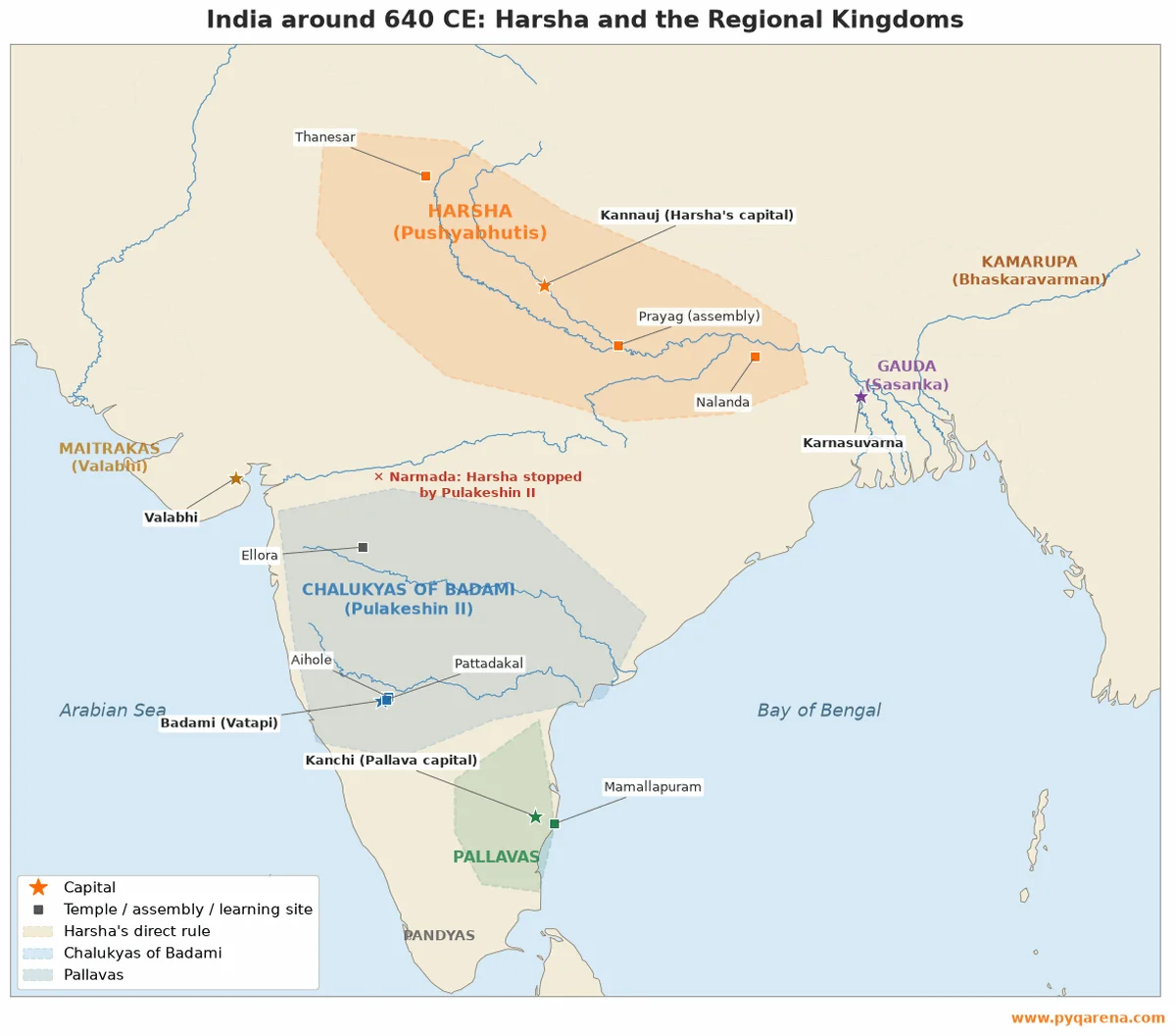
In simple words: When the Gupta Empire broke up around 550 CE, North India split into several smaller kingdoms. In the early 7th century Harshavardhana of Thanesar united much of the north again and ruled from Kannauj. At the same time, strong regional powers rose elsewhere: Sasanka in Bengal, Bhaskaravarman in Assam, the Chalukyas of Badami in the Deccan and the Pallavas of Kanchi in the Tamil country. This chapter covers all of them.
- Period: c. 550 CE to c. 750 CE.
- Big picture:
- North: Harsha (606–647 CE) was the last great Hindu king to rule a large North Indian empire before the Rajput age.
- East: Sasanka made Bengal (Gauda) a major power for the first time.
- Deccan: the Chalukyas of Badami stopped Harsha at the Narmada.
- South: the Pallavas and Chalukyas fought each other for over a century, and both built India’s early great temples.
- Main sources:
| Type | Source | What it tells |
|---|---|---|
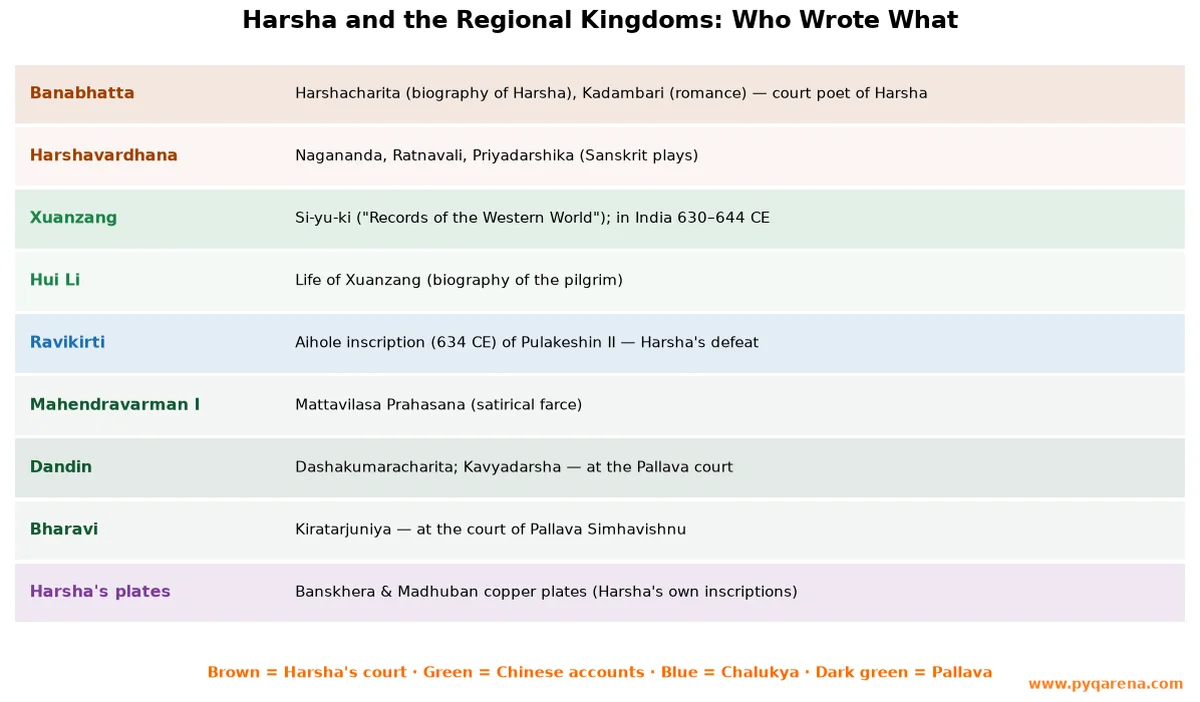
| Biography | Harshacharita by Banabhatta | Harsha’s early life and rise |
| Travel account | Si-yu-ki by Xuanzang (Hiuen Tsang) | Harsha’s empire, Buddhism, Nalanda, society |
| Biography | Life of Xuanzang by Hui Li | Kannauj and Prayag assemblies |
| Inscriptions | Banskhera (628 CE) and Madhuban (631 CE) copper plates | Harsha’s land grants and genealogy |
| Inscriptions | Sonepat copper seal, Nalanda clay seals | Pushyabhuti genealogy |
| Inscriptions | Aihole inscription (634 CE) by Ravikirti | Pulakeshin II’s victory over Harsha |
| Coins and seals | Gold coins and Rohtasgarh seal of Sasanka | Sasanka’s power in Bengal |
2. Post-Gupta Background
In simple words: After the Guptas, four families shared the Ganga valley and western India: the Maukharis at Kannauj, the Later Guptas in Magadha and Malwa, the Maitrakas at Valabhi in Gujarat and the Pushyabhutis at Thanesar. They fought and married one another. Out of their quarrels came Harsha’s empire.
2.1 Maukharis of Kannauj
- Region: western Uttar Pradesh, with Kannauj as capital. Earlier they were Gupta feudatories in the Gaya region.
- Important kings:
- Ishanavarman: the first to take the title Maharajadhiraja; fought the Later Guptas and the Hunas.
- Grahavarman: the last Maukhari; married Rajyashri, sister of Harsha.
- End: Grahavarman was killed in 605–606 CE by Deva Gupta of Malwa, and Harsha later took over Kannauj.
2.2 Later Guptas of Magadha
- Who they were: a family in Magadha and Malwa, separate from the imperial Guptas (see Gupta Empire).
- Important kings:
- Mahasenagupta: his sister, Mahasenagupta Devi, married the Pushyabhuti king Adityavardhana and was Harsha’s grandmother.
- Deva Gupta of Malwa: enemy of the Maukharis; killed Grahavarman.
- Madhavagupta: a friend of Harsha and his feudatory in Magadha.
- Adityasena: became powerful in Magadha after Harsha’s death.
2.3 Maitrakas of Valabhi
- Founder: Bhatarka, a Gupta general, around 475 CE.
- Capital: Valabhi (Saurashtra, Gujarat).
- Importance:
- Valabhi was a great centre of learning, second only to Nalanda; Xuanzang and I-tsing praised it.
- The second Jain council met at Valabhi in the 5th century.
- Relation with Harsha: Dhruvasena II was defeated by Harsha and then married Harsha’s daughter.
3. The Pushyabhutis of Thanesar
In simple words: Harsha’s family is called the Pushyabhuti (or Vardhana) dynasty. They ruled from Thanesar (Sthanvishvara, near Kurukshetra in Haryana). Harsha’s father made the family powerful; tragedy struck in 605–606 CE when his father died and his brother and brother-in-law were killed.
- Dynasty: Harsha belonged to the Pushyabhuti dynasty. → PYQ: WBCS Mains 2017
- Do not confuse: the Maukharis (Kannauj), Varmans (Kamarupa) and Pushyamitras (a 5th-century tribe that attacked the Guptas) are different.
- Founder: Pushyabhuti.
- Capital: Thanesar (Sthanvishvara).
- Prabhakaravardhana:
- The first important king; took the title Maharajadhiraja.
- Bana calls him a “lion to the Huna deer”, because he fought the Hunas, Sindh, Gujarat and Malwa.
- His wife Yashomati became sati before his death.
- His children:
- Rajyavardhana (elder son).
- Harshavardhana (younger son).
- Rajyashri (daughter), married to the Maukhari king Grahavarman of Kannauj.
3.1 The crisis of 605–606 CE
- Step 1: Prabhakaravardhana died of illness (605 CE).
- Step 2: Deva Gupta of Malwa killed Grahavarman and imprisoned Rajyashri at Kannauj.
- Step 3: Rajyavardhana defeated Deva Gupta but was then treacherously killed by Sasanka, king of Gauda (Bengal), who was Deva Gupta’s ally.
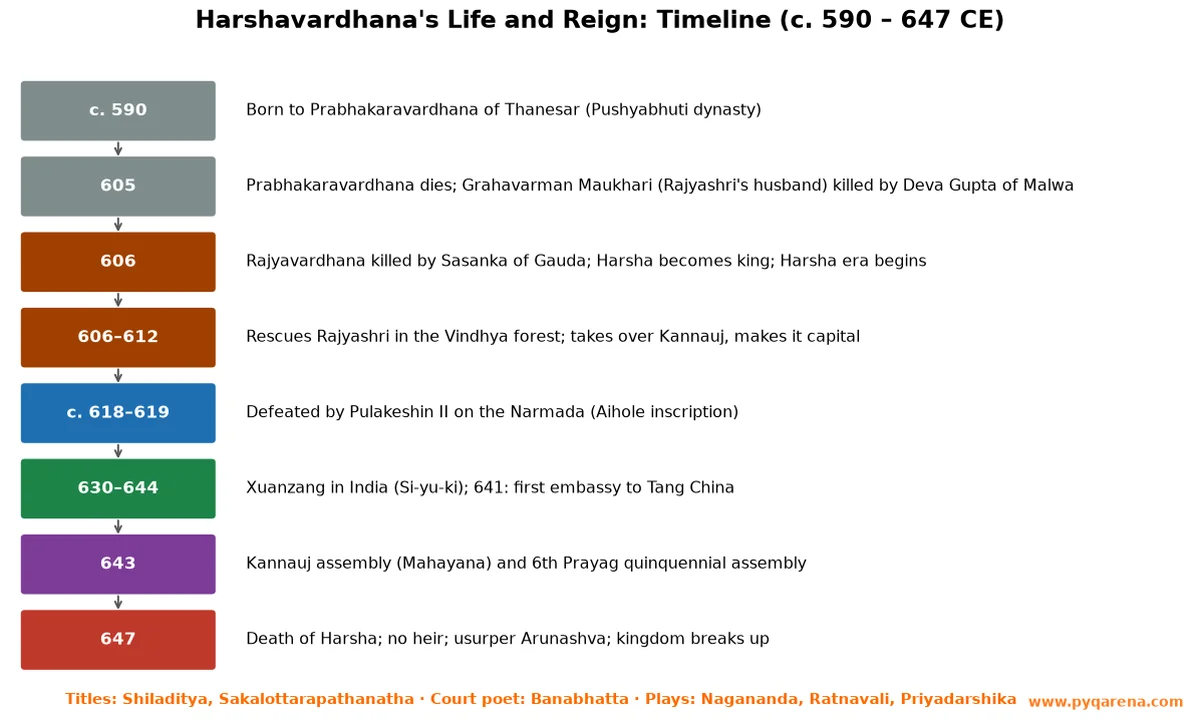
- Step 4: Harsha, aged 16, became king in 606 CE.
- Step 5: Harsha found Rajyashri in the Vindhya forest just as she was about to enter the fire (sati), with the help of the Buddhist monk Divakaramitra, and brought her back.
4. Harshavardhana (606–647 CE)
In simple words: Harsha came to the throne after his brother’s murder. He took over Kannauj, made it his capital and ruled most of North India for 41 years. He was a warrior, an able ruler, a generous patron of Buddhism and a playwright. His fame rests mainly on two writers: his court poet Banabhatta and the Chinese pilgrim Xuanzang.
4.1 Accession, era and capital
- Accession: 606 CE, at the age of 16.
- Harsha era: began in 606 CE, the year of his accession.
- First title: at first he called himself Rajaputra and Shiladitya; he took the title Maharajadhiraja after uniting Thanesar and Kannauj.
- Capital: he joined the Maukhari kingdom of Kannauj with Thanesar and moved his capital to Kannauj. From now on, Kannauj became the most important city of North India; later the Palas, Pratiharas and Rashtrakutas fought over it (the Tripartite Struggle). → PYQ: WBCS Prelims 2016
- Titles:
- Shiladitya.
- Sakalottarapathanatha (“lord of the whole of North India”). → PYQ: WBPSC Misc 2023
4.2 Wars and conquests
- Against Sasanka:
- Harsha swore to punish Sasanka for killing his brother.
- He made an alliance with Bhaskaravarman of Kamarupa, Sasanka’s eastern enemy.
- Sasanka kept his kingdom while he lived. After Sasanka’s death (c. 637 CE) Harsha took Magadha and Kongoda (Odisha).
- Valabhi: defeated Dhruvasena II of Valabhi, who became his son-in-law and ally.
- Defeat by Pulakeshin II:
- Harsha marched south but was defeated on the banks of the Narmada by the Chalukya king Pulakeshin II of Badami. → PYQ: WBCS Prelims 2023
- The Aihole inscription (634 CE) of Pulakeshin II, composed by Ravikirti, records it: Harsha’s harsha (joy) melted away when his elephants fell in battle.
- After this, the Narmada became the southern frontier of Harsha’s empire.
- Extent: Punjab (eastern part), Uttar Pradesh, Bihar, Bengal (after Sasanka) and Odisha, with tributary kings in Rajasthan and Gujarat.
- Army (Xuanzang): about 60,000 elephants and 100,000 cavalry.
4.3 Xuanzang (Hiuen Tsang)
- Who: the most famous Chinese Buddhist pilgrim, called the “Prince of Pilgrims”.
- When: he came to India during the reign of Harshavardhana. → PYQ: WBCS Prelims 2017
- He left China in 629 CE and stayed in India from 630 to 644 CE.
- Book: Si-yu-ki (“Records of the Western World”). → PYQ: WBCS Prelims 2000
- Order of travellers: Megasthenes → Fa-Hien → Xuanzang → I-tsing. → PYQ: WBCS Prelims 2022
- At Nalanda:
- He studied at Nalanda for about five years under its head, Shilabhadra.
- He describes about 10,000 students and teachers there, free education, and support from the revenue of 100 villages granted by the king (Harsha raised this to 200).
- What he says about Harsha’s India:
- Harsha toured his kingdom constantly, and divided his day between state work and religious work.
- Taxes were light; the main tax was one-sixth of the produce.
- Officials were paid in land, not cash.
- Roads were not safe: he was robbed more than once. Punishments were harsher than in Gupta times (mutilation, trial by ordeal).
- Shudras were agriculturists; untouchables lived outside towns.
- Pataliputra was in ruins, while Kannauj and Prayag were flourishing.
- Other visits: he met Pulakeshin II in the Deccan, visited Kanchi (Pallava capital) and stayed with Bhaskaravarman of Kamarupa.
- Biography: Life of Xuanzang by his disciple Hui Li.
- Do not confuse: Fa-Hien came under Chandragupta II (Gupta), and I-tsing lived at Nalanda later in the 7th century.
4.4 The two assemblies
- Kannauj assembly (643 CE):
- Held to honour Xuanzang and spread Mahayana Buddhism.
- Attended by 20 kings, including Bhaskaravarman, and thousands of Buddhist, Jain and Brahmin scholars.
- A golden image of the Buddha was placed in a tall tower; Xuanzang presided over the debate for many days.
- Prayag assembly (Mahamoksha Parishad):
- Harsha held a great religious festival at Prayag every five years (quinquennial).
- Xuanzang attended the sixth such assembly in 643 CE, which lasted 75 days.
- Harsha gave away all his wealth, even his clothes, and borrowed a used garment from Rajyashri.
- The Buddha, Surya and Shiva were worshipped on successive days.
4.5 Religion
- Early life: worshipped Shiva and Surya like his ancestors.
- Later: turned to Mahayana Buddhism under Xuanzang’s influence.
- Tolerance: he honoured all sects, and his Prayag festival honoured Buddha, Surya and Shiva.
- Nalanda: he was a great patron of Nalanda, which Kumaragupta I had founded (see Gupta Empire). He built a bronze-plated vihara there.
- Buddhist works: built stupas and rest houses; banned killing animals.
4.6 Literature at Harsha’s court
- Harsha the playwright: Harsha wrote three Sanskrit plays: → PYQ: WBCS Mains 2023
- Nagananda: the Buddhist story of prince Jimutavahana, who sacrifices himself to save the nagas.
- Ratnavali: a romantic comedy.
- Priyadarshika: a romantic comedy.
- Banabhatta:
- Court poet of Harshavardhana. → PYQ: WBCS Mains GK 2020
- Wrote Harshacharita (“Deeds of Harsha”), the first historical biography in Sanskrit, in 8 chapters. → PYQ: WBCS Mains 2022
- Wrote Kadambari, a prose romance, finished by his son Bhushanabhatta. → PYQ: WBCS Prelims 2017, 2015 | PYQ: WBPSC Misc 2006
- Other court poets: Mayura (Suryashataka) and the Jain Matanga Divakara.
- Do not confuse:
- Rajatarangini (history of Kashmir, 12th century) is by Kalhana, not Bana. → PYQ: WBCS Mains 2023 | PYQ: WBCS Mains GK Books 2023
- Vikramankadevacharita is by Bilhana, not Ravikirti or Bana. → PYQ: WBCS Mains 2023
4.7 Administration and feudal features
- King: the centre of power, helped by a council of ministers (mantri-parishad). He toured the kingdom to check on officials.
- Key officials (from Bana and the inscriptions):
| Official | Duty |
|---|---|
| Avanti | Minister of war and peace (foreign affairs) |
| Simhanada | Commander-in-chief |
| Kuntala | Head of the cavalry |
| Skandagupta | Head of the elephant force |
| Mahasamanta / Samanta | Feudal chiefs |
| Uparika | Governor of a province (bhukti) |
| Vishayapati | Head of a district (vishaya) |
- Divisions: bhukti (province) → vishaya (district) → pathaka → grama (village).
- Revenue: the main land tax was bhaga, one-sixth of the produce; other taxes were hiranya (cash) and bali.
- Use of revenue (Xuanzang): one quarter each for government, public servants, scholars and religious gifts.
- Records: an office called Nilopitu kept records of good and bad events.
- Feudal features:
- Officials and priests were paid with land grants instead of salaries.
- Samantas and Mahasamantas (feudal chiefs) were many; they paid tribute, supplied troops and attended court.
- Land grants to Brahmins gave away revenue and rights over villages.
- The army depended heavily on the troops of feudatories.
- Inscriptions:
- Banskhera copper plate (628 CE), Shahjahanpur (UP): carries Harsha’s own signature; records a land grant.
- Madhuban copper plate (631 CE), Azamgarh (UP): records a village grant to Brahmins and the Pushyabhuti genealogy.
4.8 Embassy to China and death
- Embassy: in 641 CE Harsha sent an envoy to the Tang emperor Taizong of China. Chinese missions came back, including those of Li Yibiao and Wang Xuance.
- Death: Harsha died in 647 CE without an heir.
- After him: a minister, Arunashva (Arjuna), seized the throne and attacked the Chinese envoy Wang Xuance, who defeated him with Tibetan and Nepali troops. Harsha’s empire broke up.
4.9 Society in Harsha’s time
- Caste: the four varnas continued; many mixed castes (jatis). Shudras were mostly farmers.
- Untouchables: lived outside villages and towns (Xuanzang).
- Women: no purdah among common people, but sati was practised: Harsha’s mother Yashomati became sati, and Rajyashri nearly did.
- Towns: old towns such as Pataliputra and Vaishali declined; Kannauj rose.
- Trade: trade with the West declined, and feudal village economy grew.
5. Sasanka of Gauda
In simple words: Sasanka was the first great king of Bengal. He started as a feudal chief, became independent and built a kingdom from Bengal to Odisha and Magadha. He is famous as Harsha’s enemy, because he killed Harsha’s brother Rajyavardhana.
- Kingdom: Gauda (Bengal). → PYQ: WBCS Mains 2022 | PYQ: WBCS Prelims 2000
- Capital: Karnasuvarna, near present Murshidabad (West Bengal). → PYQ: WBCS Prelims 2009
- Status: the first independent king of Bengal to rule a large kingdom. → PYQ: WBCS Prelims 2004
- He began as a Mahasamanta (feudal chief) under the Later Guptas; the Rohtasgarh seal names him “Mahasamanta Shashankadeva”.
- Extent: Gauda, Magadha, Dandabhukti (Midnapore) and Utkala-Kongoda (Odisha). The Midnapore and Ganjam inscriptions show his rule there.
- Conflict with the Pushyabhutis:
- Allied with Deva Gupta of Malwa against the Maukharis.
- Killed Rajyavardhana (606 CE), which made Harsha his lifelong enemy.
- Kept his kingdom against Harsha and Bhaskaravarman until his death around 637 CE.
- Coins: issued gold coins, with Shiva on his bull Nandi on one side and Lakshmi on the other. Their gold content is lower than Gupta coins.
- Religion: a devoted Shaiva.
- Xuanzang records that Sasanka cut down the Bodhi tree at Bodh Gaya and removed a Buddha image; the Buddhist text Arya-Manjushri-Mulakalpa also calls him hostile to Buddhism.
- Xuanzang also records flourishing Buddhist monasteries in Karnasuvarna, such as Raktamrittika (Rajbadidanga), within Sasanka’s own capital region.
- So the anti-Buddhist picture comes from Buddhist writers who were close to his enemy Harsha.
- Bengali calendar: the Bangabda (Bengali era, 593–594 CE) is linked with Sasanka’s reign.
5.1 Bengal after Sasanka: Matsyanyaya
- What happened: after Sasanka’s death, Bengal fell into about a century of anarchy.
- Matsyanyaya: “the law of the fish”, where big fish eat the small fish, meaning the strong oppressed the weak.
- End: around 750 CE the people (chiefs) chose Gopala as king; he founded the Pala dynasty. The Khalimpur copper plate of his son Dharmapala records this. → PYQ: WBCS Prelims 2011
6. Kamarupa: Bhaskaravarman
- Kingdom: Kamarupa (Assam), ruled by the Varman dynasty, founded by Pushyavarman.
- Bhaskaravarman (c. 600–650 CE):
- Title Kumara.
- The greatest king of the dynasty and Harsha’s ally against Sasanka.
- Nidhanpur copper plate: issued from Karnasuvarna, which shows he held Sasanka’s capital for a time after Sasanka’s death.
- Invited Xuanzang to Kamarupa, and came with him to Harsha’s Kannauj assembly.
- Sent an embassy to China.
7. The Chalukyas of Badami (Vatapi)
In simple words: The Chalukyas of Badami ruled the western Deccan (Karnataka and Maharashtra) from the 6th to the 8th century. Their greatest king, Pulakeshin II, defeated Harsha. They built the first great temples of the Deccan at Aihole, Badami and Pattadakal, in a style called Vesara.
- Region: the Chalukyas set up their empire in the Deccan. → PYQ: WBCS Prelims 2001
- Capital: Vatapi (Badami), Bagalkot district, Karnataka.
7.1 Rulers
- Pulakeshin I (c. 543–566 CE):
- Founder of the Chalukyas of Badami. → PYQ: WBCS Mains 2016
- Built the fort at Badami and performed the Ashvamedha sacrifice. → PYQ: WBCS Prelims 2005
- Kirtivarman I and Mangalesha: extended the kingdom; Mangalesha completed the Vishnu cave at Badami (578 CE).
- Pulakeshin II (610–642 CE):
- The greatest Chalukya king.
- Defeated Harshavardhana on the Narmada. → PYQ: WBCS Prelims 2023
- Took the titles Parameshvara and Dakshinapatheshvara (“lord of the south”).
- Defeated the Kadambas, Gangas and the Pallava king Mahendravarman I, and took Vengi, where his brother founded the Eastern Chalukyas.
- Xuanzang visited his kingdom and praised his power.
- Exchanged embassies with the Persian king Khusrau II.
- Killed in 642 CE when the Pallava Narasimhavarman I captured Vatapi.
- Vikramaditya I: restored the kingdom and attacked Kanchi.
- Vikramaditya II (733–744 CE):
- Captured Kanchi but spared it, and gave gifts to the Kailasanatha temple.
- His feudatory Avanijanashraya Pulakeshin repelled the Arab invasion of South Gujarat (Navsari, 739 CE) during his reign. → PYQ: WBCS Mains 2017
- His queen Lokamahadevi built the Virupaksha temple at Pattadakal to celebrate his victory over the Pallavas.
- Kirtivarman II: the last ruler; overthrown by the Rashtrakuta Dantidurga around 753 CE.
7.2 Aihole inscription
- Composer: Ravikirti, Pulakeshin II’s Jain court poet. → PYQ: WBCS Prelims 2013 | PYQ: WBCS Mains 2017
- Date: 634 CE, on the Meguti Jain temple at Aihole.
- Language: Sanskrit poetry.
- Content: a eulogy (prashasti) of Pulakeshin II: his victory over Harsha, the Pallavas and other kings.
- Do not confuse: the Allahabad Prashasti is by Harisena (see Gupta Empire), and the Nasik inscription is of the Satavahanas (see Post-Mauryan Dynasties).
7.3 Chalukya art and architecture
- Style: the Chalukyas of Badami developed the Vesara style, a mix of the northern Nagara and southern Dravida styles. → PYQ: WBCS Mains 2017
- Aihole (the “cradle of Indian temple architecture”):
- About 70 temples.
- Lad Khan temple: one of the earliest, with a flat roof.
- Durga temple: an apsidal (rounded-back) plan with a gallery of pillars around it.
- Meguti Jain temple: carries the Aihole inscription.
- Badami: four rock-cut cave temples: three Hindu (Shiva and Vishnu) and one Jain.
- Pattadakal (UNESCO World Heritage Site):
- Ten temples in both Nagara and Dravida styles side by side.
- Virupaksha temple (Dravida style), built by Queen Lokamahadevi; modelled on the Kailasanatha temple of Kanchi.
- Papanatha temple (Nagara style).
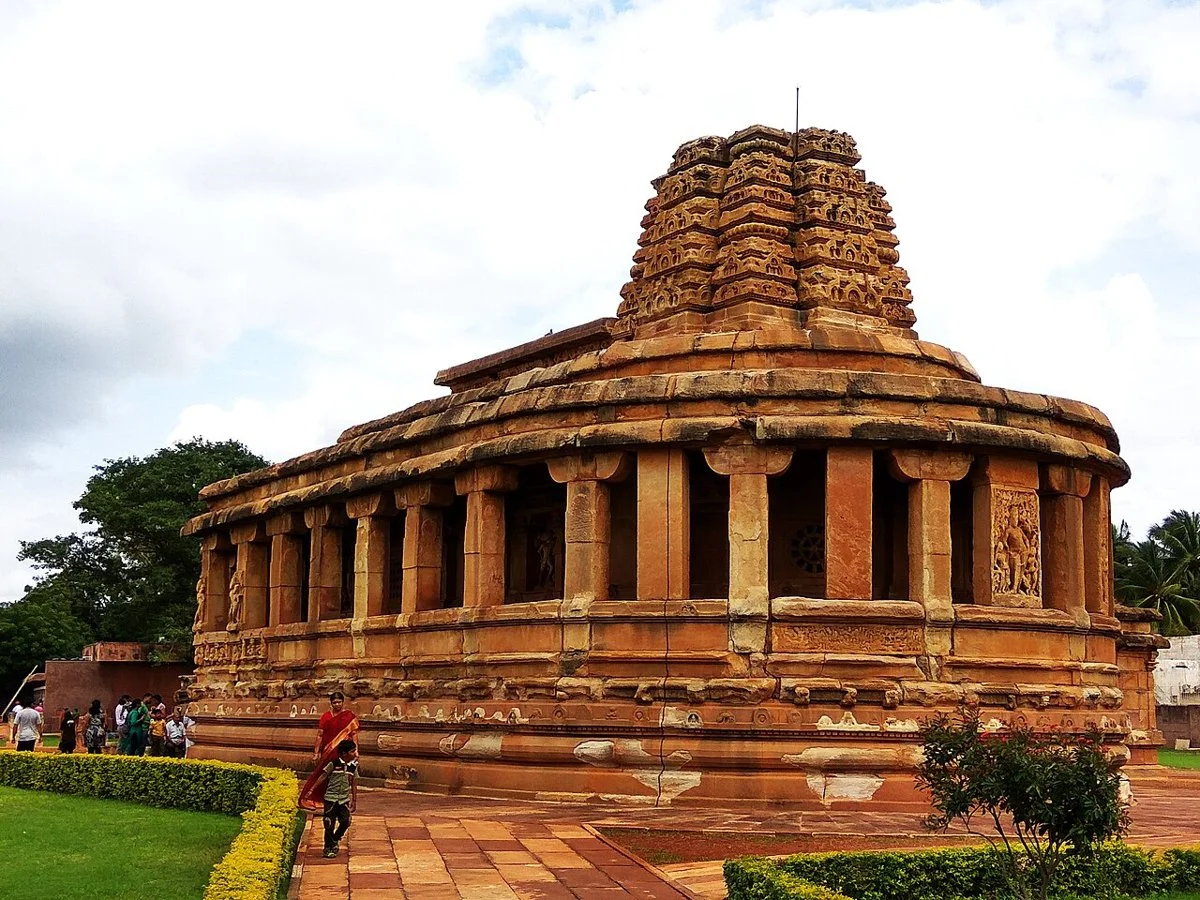
Image Source: Wikimedia
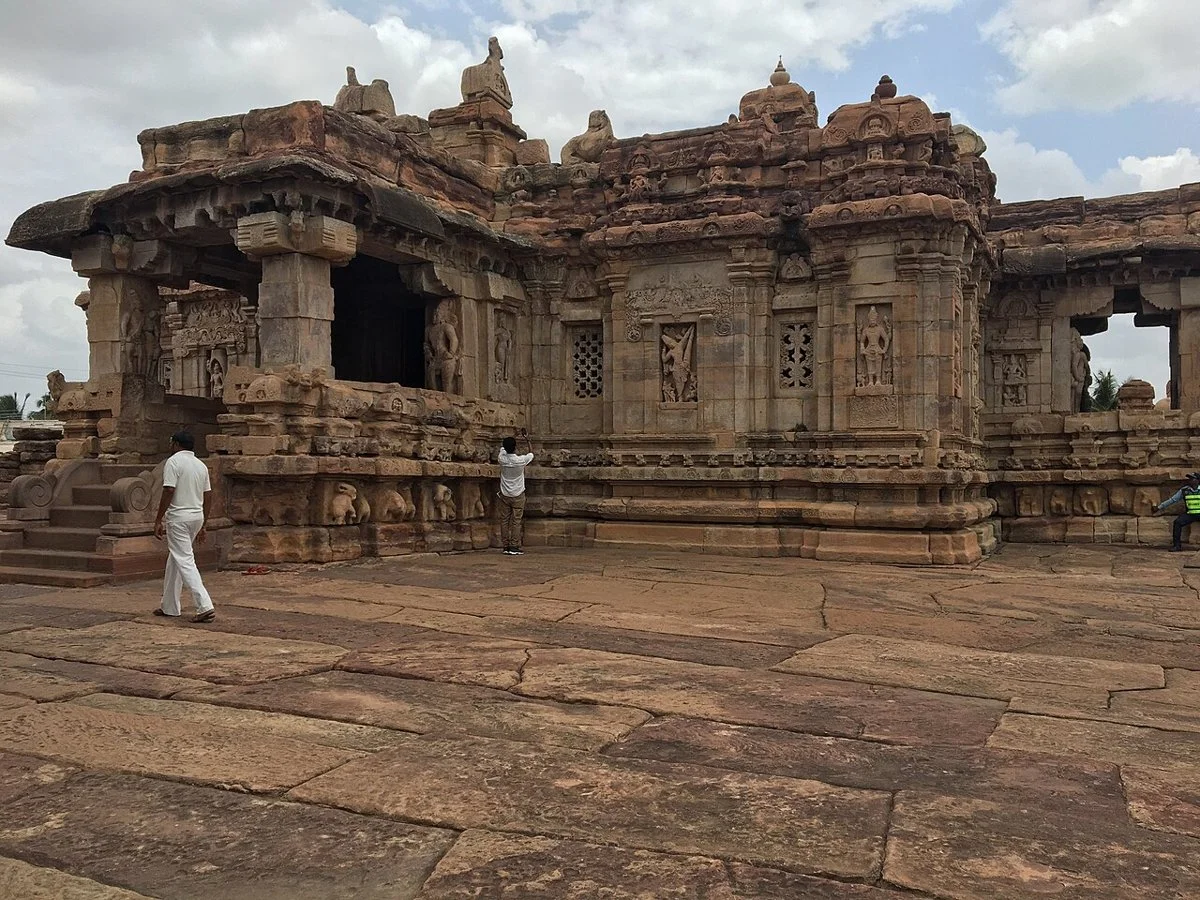
Image Source: Wikimedia
8. The Pallavas of Kanchi
In simple words: The Pallavas ruled the northern Tamil country from Kanchipuram. They were great temple builders. They moved from cave temples to monolithic rathas (temples carved from a single rock) and finally to structural stone temples like the Shore Temple and the Kailasanatha temple. This style became the Dravida style of South India.
- Capital: Kanchipuram (Kanchi). → PYQ: WBCS Mains 2023
- Chief port: Mamallapuram (Mahabalipuram).
- Language and religion: Sanskrit inscriptions; Shaiva and Vaishnava kings, with Jainism and Buddhism also present.
8.1 Rulers
- Simhavishnu (late 6th century): founder of the imperial line; drove the Kalabhras out of the Kaveri region. The poet Bharavi (Kiratarjuniya) was at his court.
- Mahendravarman I (c. 600–630 CE):
- A Jain at first, he became a Shaiva under the influence of the Nayanar saint Appar.
- Wrote the Sanskrit farce Mattavilasa Prahasana.
- Titles: Vichitrachitta and Chaityakari (temple builder).
- Started rock-cut cave temples (Mandagapattu).
- Lost northern territory to Pulakeshin II.
- Narasimhavarman I “Mamalla” (630–668 CE):
- The greatest Pallava king.
- Defeated and killed Pulakeshin II, captured Vatapi (642 CE) and took the title Vatapikonda (“conqueror of Vatapi”).
- Sent a naval expedition to Sri Lanka to put his friend Manavarma on the throne.
- The port Mamallapuram is named after him.
- The rathas of Mamallapuram were made in his reign. → PYQ: WBCS Prelims 2006
- Xuanzang visited Kanchi in his reign (640 CE).
- Narasimhavarman II “Rajasimha” (c. 700–728 CE):
- A peaceful reign of temple building.
- Built the Shore Temple at Mamallapuram and the Kailasanatha temple at Kanchi.
- Sent an embassy to China.
- The poet Dandin (Dashakumaracharita, Kavyadarsha) lived at his court.
- Nandivarman II Pallavamalla: built the Vaikuntha Perumal temple at Kanchi.
- End: the last Pallava, Aparajita, was defeated by the Chola Aditya I around 897 CE.
8.2 Pallava architecture
- Dravida style: the Pallava-Chola style of temple architecture is called the Dravida style. → PYQ: WBCS Mains 2019
| Stage | Example | Feature |
|---|---|---|
| Mahendra style (rock-cut caves) | Mandagapattu, Mahendravadi | Pillared halls cut into rock |
| Mamalla style (monolithic rathas and mandapas) | Pancha Rathas, Mahishasuramardini mandapa, Arjuna’s Penance | Temples carved from single rocks; open-air reliefs |
| Rajasimha style (structural temples) | Shore Temple (Mamallapuram), Kailasanatha (Kanchi) | Built of cut stone blocks; pyramid towers |
| Nandivarman style | Vaikuntha Perumal (Kanchi) | Smaller, refined structural temples |
- Rathas of Mamallapuram:
- Pancha Rathas (“five chariots”): Dharmaraja, Bhima, Arjuna, Draupadi and Nakula-Sahadeva rathas, each carved from one rock.
- Built by the Pallavas in the reign of Narasimhavarman I. → PYQ: WBPSC Clerkship
- The rock-cut Ratha temples are the finest specimens of Pallava architecture. → PYQ: WBCS Prelims 2001
- Arjuna’s Penance (Descent of the Ganga): a huge open-air relief carved on two boulders at Mamallapuram.
- Shore Temple: a structural granite temple on the seashore with two Shiva shrines and one Vishnu shrine, built by Rajasimha.
- Kailasanatha temple, Kanchi: built by the Pallavas (Rajasimha), the finest Pallava structural temple. → PYQ: WBCS Mains 2023
- Do not confuse: the Kailasa temple at Ellora is a Rashtrakuta temple (Krishna I).
- Mamallapuram today:
- The group of monuments at Mamallapuram is a UNESCO World Heritage Site (1984) and a major tourist spot.
- Kathakali dance has nothing to do with it; Kathakali belongs to Kerala. → PYQ: WBPSC Clerkship
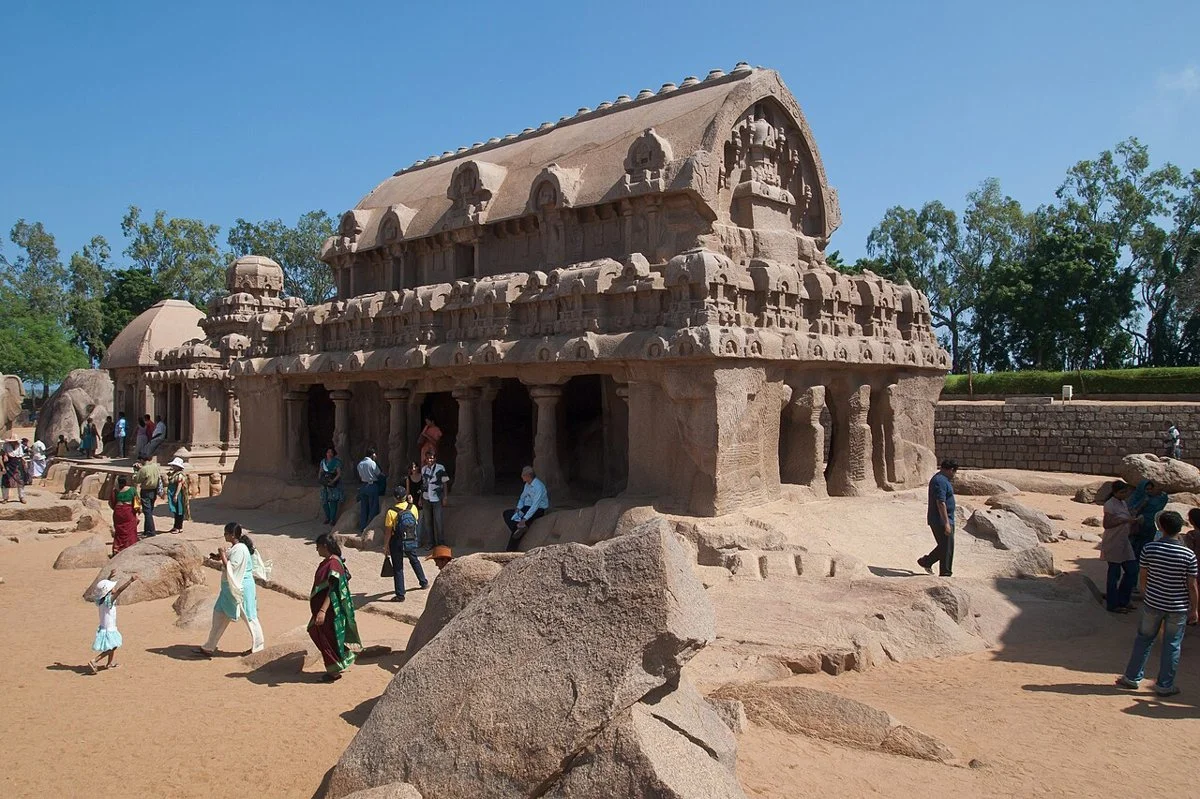
Image Source: Wikimedia
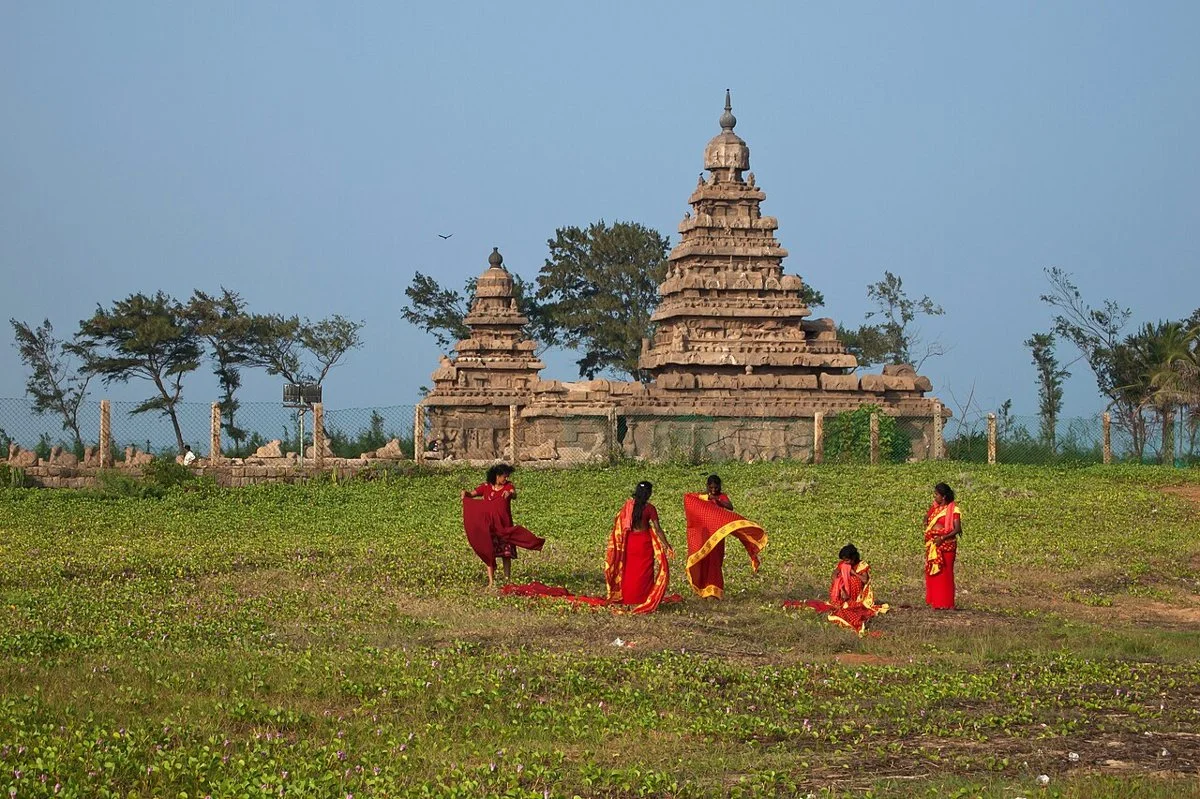
Image Source: Wikimedia
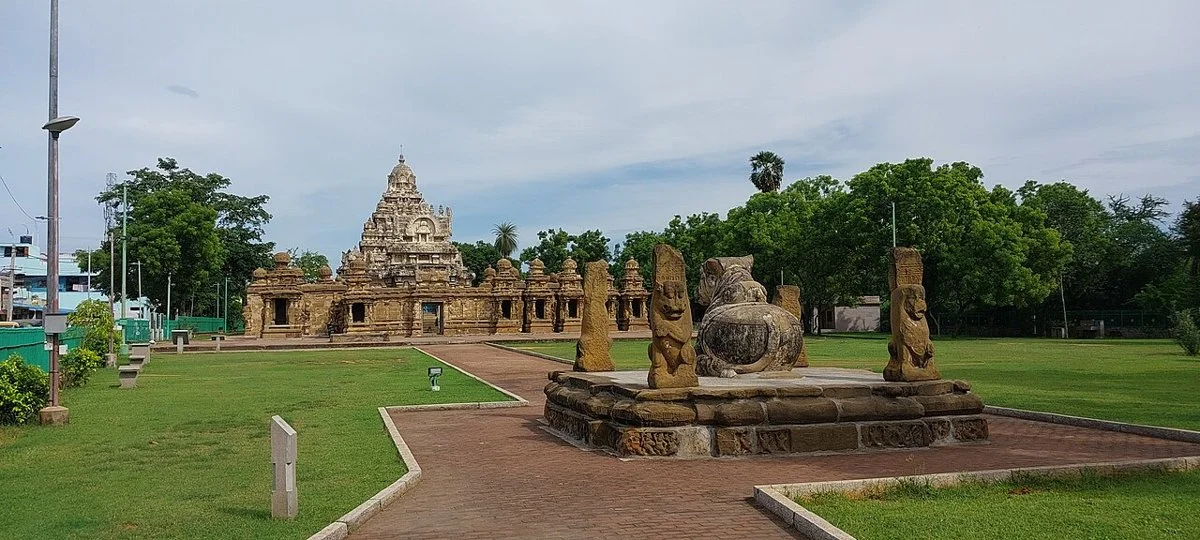
Image Source: Wikimedia
9. The Pallava–Chalukya Conflict
In simple words: For about 150 years the Pallavas of Kanchi and the Chalukyas of Badami fought each other. Each side won and lost in turn. The prize was the rich land between the Krishna and Tungabhadra rivers and the Vengi region.
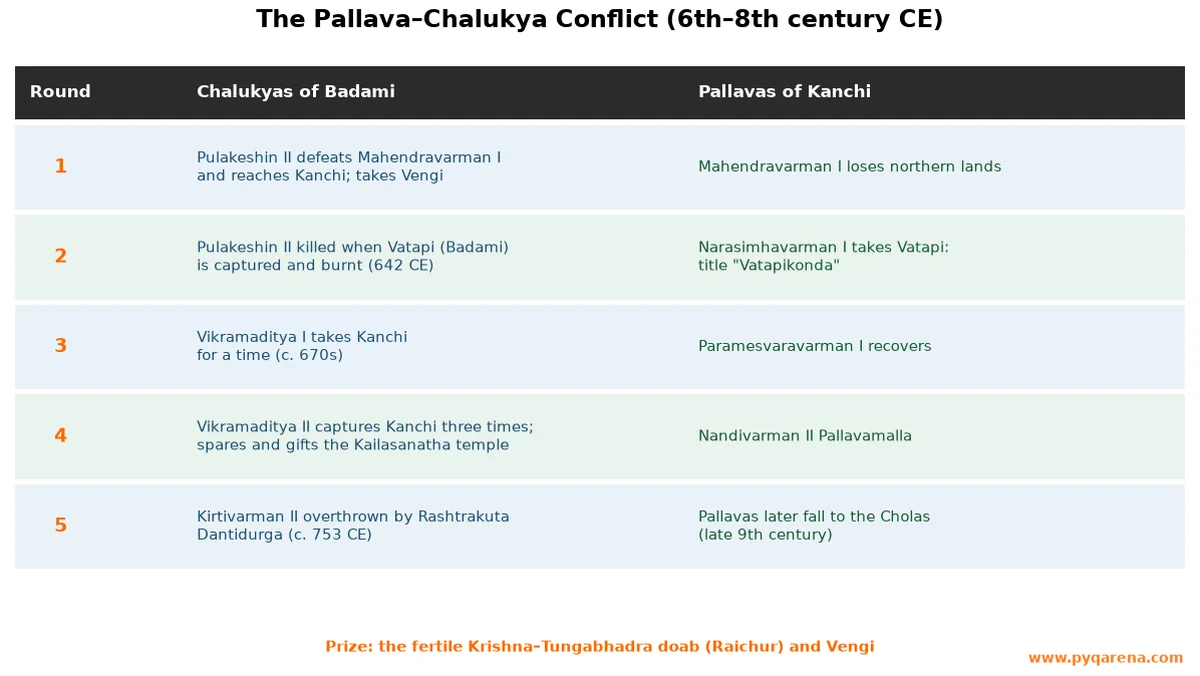
- Round 1: Pulakeshin II defeated Mahendravarman I and took Vengi.
- Round 2: Narasimhavarman I defeated and killed Pulakeshin II and captured Vatapi (642 CE).
- Round 3: Vikramaditya I took Kanchi for a time; Parameshvaravarman I won it back.
- Round 4: Vikramaditya II captured Kanchi three times but spared its temples.
- Result: both powers were weakened. The Chalukyas fell to the Rashtrakutas (753 CE), and the Pallavas later fell to the Cholas.
10. The Rise of the Rashtrakutas
- Founder: Dantidurga, a Chalukya feudatory, overthrew Kirtivarman II around 753 CE.
- Krishna I: built the rock-cut Kailasa temple at Ellora, carved from a single rock.
- Capital: later Manyakheta (Malkhed), under Amoghavarsha I.
- Religion: the Rashtrakuta rulers patronised Jainism. Amoghavarsha I favoured Jainism and wrote the Kannada work Kavirajamarga. → PYQ: WBCS Mains 2020
- Arab name: Arab travellers called the Rashtrakuta king “Balhara” (Ballhar), from Vallabharaja. → PYQ: WBCS Prelims 2022
- Tripartite Struggle: from the 8th to the 10th century the Palas, Pratiharas and Rashtrakutas fought for control of Kannauj. → PYQ: WBCS Prelims 2016
11. Bhakti Saints of the Tamil Country
In simple words: In the Pallava age, Tamil saints spread bhakti (loving devotion) to Shiva and Vishnu through songs in Tamil. They travelled from temple to temple and turned many people away from Jainism and Buddhism.
| Group | God | Number | Famous saints | Collection |
|---|---|---|---|---|
| Alvars | Vishnu (Vaishnava) | 12 | Andal (woman saint), Nammalvar, Periyalvar | Nalayira Divya Prabandham |
| Nayanars | Shiva (Shaiva) | 63 | Appar, Sambandar, Sundarar, Manikkavachakar | Tevaram, Tirumurai |
- Alvar: a Vaishnavite hymn-singer of the Tamil devotional movement. → PYQ: WBCS Mains 2018
- Nayanars: Shaiva saints; Appar converted Mahendravarman I from Jainism to Shaivism.
- Women and low castes: the movement included women (Andal, Karaikkal Ammaiyar) and people of all castes.
12. Kingdoms at a Glance
| Kingdom | Capital | Greatest ruler | Remember for |
|---|---|---|---|
| Pushyabhutis | Thanesar → Kannauj | Harshavardhana | Harsha era 606 CE; Xuanzang; Kannauj & Prayag assemblies |
| Maukharis | Kannauj | Ishanavarman | Grahavarman married Rajyashri |
| Later Guptas | Magadha / Malwa | Adityasena | Deva Gupta killed Grahavarman |
| Maitrakas | Valabhi | Dhruvasena II | Centre of learning; married Harsha’s daughter |
| Gauda | Karnasuvarna | Sasanka | First independent king of Bengal; killed Rajyavardhana |
| Varmans of Kamarupa | Pragjyotishpura | Bhaskaravarman | Harsha’s ally; Nidhanpur plate |
| Chalukyas of Badami | Vatapi (Badami) | Pulakeshin II | Defeated Harsha; Aihole inscription; Vesara style |
| Pallavas | Kanchipuram | Narasimhavarman I | Vatapikonda; Mamallapuram rathas; Dravida style |
| Rashtrakutas | Manyakheta | Dantidurga (founder) | Overthrew Chalukyas; Kailasa temple, Ellora |
13. Timeline
| Year (CE) | Event |
|---|---|
| c. 543 | Pulakeshin I founds the Chalukya kingdom of Badami |
| c. 593–594 | Start of the Bangabda (Bengali era), linked with Sasanka |
| 605 | Death of Prabhakaravardhana; Grahavarman killed |
| 606 | Rajyavardhana killed by Sasanka; Harsha’s accession; Harsha era begins |
| 610 | Pulakeshin II becomes Chalukya king |
| c. 618–619 | Harsha defeated by Pulakeshin II on the Narmada |
| 628 | Banskhera copper plate of Harsha |
| 630 | Narasimhavarman I becomes Pallava king; Xuanzang reaches India |
| 631 | Madhuban copper plate of Harsha |
| 634 | Aihole inscription by Ravikirti |
| c. 637 | Death of Sasanka; Matsyanyaya begins in Bengal |
| 641 | Harsha’s embassy to Tang China |
| 642 | Narasimhavarman I takes Vatapi; Pulakeshin II killed |
| 643 | Kannauj assembly and 6th Prayag assembly |
| 644 | Xuanzang returns to China |
| 647 | Death of Harsha |
| c. 700–728 | Rajasimha builds the Shore Temple and Kailasanatha temple |
| 739 | Arab invasion of South Gujarat repelled (Vikramaditya II’s reign) |
| c. 750 | Gopala chosen king of Bengal; end of Matsyanyaya |
| c. 753 | Dantidurga overthrows the Chalukyas; Rashtrakutas rise |
14. Quick Revision: One-Liners
- Harsha’s dynasty: Pushyabhuti
- Harsha’s accession and Harsha era: 606 CE
- Harsha’s capital: Kannauj (first Thanesar)
- Title Sakalottarapathanatha: Harshavardhana
- Killed Harsha’s brother Rajyavardhana: Sasanka
- Chalukya king who defeated Harsha: Pulakeshin II, on the Narmada
- Aihole inscription (634 CE) composed by: Ravikirti
- Chinese pilgrim in Harsha’s time: Xuanzang; book Si-yu-ki
- Order of travellers: Megasthenes → Fa-Hien → Xuanzang → I-tsing
- Harsha’s court poet: Banabhatta; works Harshacharita, Kadambari
- Harsha’s plays: Nagananda, Ratnavali, Priyadarshika
- Harsha’s own inscriptions: Banskhera (628) and Madhuban (631)
- Quinquennial assembly: Prayag; Xuanzang saw the 6th (643 CE)
- Death of Harsha: 647 CE
- Sasanka: king of Gauda; capital Karnasuvarna; first independent king of Bengal
- Anarchy in Bengal after Sasanka: Matsyanyaya; ended by Gopala (Pala founder)
- Harsha’s ally in Assam: Bhaskaravarman of Kamarupa
- Founder of the Chalukyas of Badami: Pulakeshin I (performed Ashvamedha)
- Chalukya architecture style: Vesara
- Arab invasion of South Gujarat repelled in the reign of: Vikramaditya II
- Virupaksha temple, Pattadakal: built by Queen Lokamahadevi
- Pallava capital: Kanchipuram
- Vatapikonda: Narasimhavarman I Mamalla
- Rathas of Mamallapuram: Narasimhavarman I (Pallavas)
- Shore Temple and Kailasanatha, Kanchi: Rajasimha (Narasimhavarman II)
- Mattavilasa Prahasana: Mahendravarman I
- Pallava-Chola temple style: Dravida
- Alvars: Vaishnava; Nayanars: Shaiva
- Rashtrakuta founder: Dantidurga; Arabs called the king Balhara
- Tripartite Struggle: Palas, Pratiharas, Rashtrakutas
Memory trick: “Harsha’s 3 Ps”
- Pushyabhuti: his dynasty.
- Pulakeshin II: the king who defeated him.
- Prayag: his five-yearly assembly.
Memory trick: Pallava builders “M-N-R”
- Mahendravarman I: Mandapas (caves).
- Narasimhavarman I: Natural rock rathas (monolithic).
- Rajasimha: Real structural temples (Shore Temple, Kailasanatha).
15. FAQ
Q1. Why is Harsha important? He reunited most of North India after the Guptas, made Kannauj its leading city, patronised Buddhism and learning, and wrote three plays. His reign is well recorded by Banabhatta and Xuanzang.
Q2. Who defeated Harsha? The Chalukya king Pulakeshin II of Badami, on the banks of the Narmada. The Aihole inscription by Ravikirti records it.
Q3. What were the Kannauj and Prayag assemblies? The Kannauj assembly (643 CE) honoured Xuanzang and Mahayana Buddhism. At Prayag, Harsha held a five-yearly festival where he gave away all his wealth.
Q4. Who was Sasanka? The king of Gauda (Bengal) with his capital at Karnasuvarna, the first independent king of Bengal and Harsha’s chief enemy.
Q5. What is Matsyanyaya? The anarchy in Bengal after Sasanka’s death, when the strong oppressed the weak like big fish eating small fish. It ended when Gopala was chosen king around 750 CE.
Q6. What is the difference between Vesara and Dravida styles? Dravida is the South Indian style with pyramid-shaped towers (Pallavas, Cholas). Vesara mixes Nagara and Dravida features and was developed by the Chalukyas of Badami.
Q7. Who built the rathas and the Shore Temple of Mamallapuram? The rathas were carved under Narasimhavarman I Mamalla; the Shore Temple was built by Narasimhavarman II Rajasimha.
Q8. Who were the Alvars and Nayanars? Tamil bhakti saints: the 12 Alvars sang of Vishnu and the 63 Nayanars of Shiva.
Related Notes and Practice
- WBCS Prelims Ancient Indian History PYQs
- WBCS Mains South Indian Dynasties PYQs
- WBCS Mains Gupta Empire PYQs
- Gupta Empire Notes
- Post-Mauryan Dynasties Notes
- Buddhism and Jainism Notes
Leave a Comment