

WBP Constable Mathematics Previous Year Questions with Answers
WBP Constable PYQs: WBP Constable Hub | Mathematics | Reasoning | English | General Science | History | Geography | Polity | Economy | Computer & Technology | General Knowledge | Current Affairs
WBP Constable Mathematics Questions 2025
Q. The compound interest on a sum for 2 years at 20% per annum is ₹5632. What is the simple interest on the same sum for 3 years at 12% per annum?
(A) ₹4608
(B) ₹4604
(C) ₹6048
(D) ₹4610
Answer & Explanation
Correct Answer: (A) ₹4608
Explanation
CI for 2 years at 20% = P[(1.2)² − 1] = 0.44P.
0.44P = 5632, so P = 5632 ÷ 0.44 = ₹12,800.
SI = 12800 × 12 × 3 ÷ 100 = ₹4608.
Hence, the simple interest is ₹4608.
Shortcut Method
CI for 2 years at 20% = 44% of P, so P = 5632 × 100/44 = 12,800; SI = 36% of 12,800 = ₹4608.
Answer: (A) ₹4608
Q. [890.9 − 512.3] ÷ 126.2 = ?
(A) 3
(B) 5
(C) 2
(D) 4
Answer & Explanation
Correct Answer: (A) 3
Explanation
890.9 − 512.3 = 378.6.
378.6 ÷ 126.2 = 3.
Hence, the value is 3.
Shortcut Method
126.2 × 3 = 378.6, so the quotient is exactly 3.
Answer: (A) 3
Q. A train running at 90 km/h crosses a platform twice its own length in 36 seconds. What is the length of the platform in metres?
(A) 300
(B) 900
(C) 1200
(D) 600
Answer & Explanation
Correct Answer: (D) 600
Explanation
Speed = 90 × 5/18 = 25 m/s.
Distance covered = 25 × 36 = 900 m = train + platform.
Train = L, platform = 2L, so 3L = 900 and L = 300 m.
Platform = 2 × 300 = 600 m.
Hence, the platform is 600 m long.
Shortcut Method
Platform = 2/3 of the distance covered = 2/3 × 900 = 600 m.
Answer: (D) 600
Q. A and B start a business by investing ₹10,400 and ₹14,300 respectively. After 4 months C invests ₹9,100. If the total annual profit is ₹11,360, what is C’s share of the profit?
(A) ₹2240
(B) ₹2440
(C) ₹1840
(D) ₹2040
Answer & Explanation
Correct Answer: (A) ₹2240
Explanation
Capital × months: A = 10400 × 12 = 124800; B = 14300 × 12 = 171600; C = 9100 × 8 = 72800.
Divide by 1300: A : B : C = 96 : 132 : 56.
Total parts = 96 + 132 + 56 = 284.
C’s share = 11360 × 56/284 = 40 × 56 = ₹2240.
Hence, C’s share is ₹2240.
Shortcut Method
10400 : 14300 : 9100 = 8 : 11 : 7; times months 12 : 12 : 8 → 96 : 132 : 56; 11360 ÷ 284 = 40, so C = 40 × 56 = ₹2240.
Answer: (A) ₹2240
Q. A seller marks his goods 20% above the cost price and allows a discount of 15% on the marked price. What is his percentage profit or loss?
(A) 2% loss
(B) 4% profit
(C) 4% loss
(D) 2% profit
Answer & Explanation
Correct Answer: (D) 2% profit
Explanation
Let CP = ₹100; marked price = ₹120.
Discount = 15% of 120 = ₹18; SP = 120 − 18 = ₹102.
Profit = 102 − 100 = ₹2 on ₹100.
Hence, he makes a 2% profit.
Shortcut Method
Net % = +20 − 15 − (20 × 15)/100 = +2%, i.e. 2% profit.
Answer: (D) 2% profit
Q. The sum of two numbers is 506. If the second number is 5/18 of the first, what is the difference between 4/9 of the first number and 2/11 of the second number?
(A) 206
(B) 186
(C) 168
(D) 156
Answer & Explanation
Correct Answer: (D) 156
Explanation
Let the first number = x; the second = 5x/18.
x + 5x/18 = 506, so 23x/18 = 506 and x = 506 × 18/23 = 396.
Second number = 5/18 × 396 = 110.
4/9 of 396 = 176; 2/11 of 110 = 20.
Difference = 176 − 20 = 156.
Hence, the difference is 156.
Shortcut Method
Ratio first : second = 18 : 5, total 23 parts = 506, so 1 part = 22; numbers 396 and 110; 176 − 20 = 156.
Answer: (D) 156
Q. If the selling price of an article is doubled, its profit becomes four times. What is the original profit percentage?
(A) 25
(B) 50
(C) 75
(D) 33 1/3
Answer & Explanation
Correct Answer: (B) 50
Explanation
Let CP = c and profit = p; SP = c + p.
New SP = 2(c + p); new profit = 2c + 2p − c = c + 2p.
c + 2p = 4p, so c = 2p.
Profit % = p/c × 100 = 50%.
Hence, the original profit is 50%.
Shortcut Method
Test (B): CP 100, SP 150 (profit 50); doubled SP 300 gives profit 200 = 4 × 50. ✓
Answer: (B) 50
Q. If 5^(a+b) = 5 × 25 × 125, then (a + b)² = ?
(A) 9
(B) 36
(C) 64
(D) 25
Answer & Explanation
Correct Answer: (B) 36
Explanation
5 × 25 × 125 = 5¹ × 5² × 5³ = 5⁶.
5^(a+b) = 5⁶, so a + b = 6.
(a + b)² = 6² = 36.
Hence, (a + b)² = 36.
Shortcut Method
Powers add: 1 + 2 + 3 = 6, and 6² = 36.
Answer: (B) 36
Q. (512 × 5² × 3) ÷ (45 × 32) = ?
(A) 28 2/3
(B) 27 1/3
(C) 25 2/3
(D) 26 2/3
Answer & Explanation
Correct Answer: (D) 26 2/3
Explanation
Numerator = 512 × 25 × 3 = 38,400.
Denominator = 45 × 32 = 1440.
38400 ÷ 1440 = 80/3 = 26 2/3.
Hence, the value is 26 2/3.
Shortcut Method
Cancel first: 512/32 = 16; 25 × 3/45 = 5/3; 16 × 5/3 = 80/3 = 26 2/3.
Answer: (D) 26 2/3
Q. What is the value of √98 + √8 − 2√32?
(A) 0
(B) 2√2
(C) 2√5
(D) √2
Answer & Explanation
Correct Answer: (D) √2
Explanation
√98 = 7√2; √8 = 2√2; 2√32 = 2 × 4√2 = 8√2.
7√2 + 2√2 − 8√2 = √2.
Hence, the value is √2.
Shortcut Method
Coefficients of √2: 7 + 2 − 8 = 1, so the answer is √2.
Answer: (D) √2
Q. If 2a = 3b = 4c, then a : b : c = ?
(A) 3 : 4 : 6
(B) 8 : 6 : 5
(C) 3 : 6 : 4
(D) 6 : 4 : 3
Answer & Explanation
Correct Answer: (D) 6 : 4 : 3
Explanation
Let 2a = 3b = 4c = k.
a = k/2, b = k/3, c = k/4.
a : b : c = 1/2 : 1/3 : 1/4; multiply by 12: 6 : 4 : 3.
Hence, a : b : c = 6 : 4 : 3.
Shortcut Method
Take k = LCM(2, 3, 4) = 12: a = 6, b = 4, c = 3.
Answer: (D) 6 : 4 : 3
Q. Two cars A and B start at the same time from the same place in opposite directions (A northward, B southward). If A’s speed is 34.5 km/h and B’s speed is 41.5 km/h, after how many hours will they be 684 km apart?
(A) 9
(B) 8
(C) 10
(D) 11
Answer & Explanation
Correct Answer: (A) 9
Explanation
Moving in opposite directions, the speeds add: 34.5 + 41.5 = 76 km/h.
Time = 684 ÷ 76 = 9 hours.
Hence, they will be 684 km apart after 9 hours.
Shortcut Method
76 × 9 = 684. ✓
Answer: (A) 9
Q. Five numbers are in continued proportion. If the fourth and fifth numbers are 54 and 162 respectively, find the first number.
(A) 2
(B) 6
(C) 8
(D) 4
Answer & Explanation
Correct Answer: (A) 2
Explanation
In continued proportion, each term is a constant multiple of the one before: r = 162 ÷ 54 = 3.
Third = 54 ÷ 3 = 18; second = 18 ÷ 3 = 6; first = 6 ÷ 3 = 2.
Hence, the first number is 2.
Shortcut Method
First = 162 ÷ 3⁴ = 162 ÷ 81 = 2.
Answer: (A) 2
Q. At what rate per cent per annum simple interest will the interest on a sum for 10 years be 2/5 of the sum?
(A) 2
(B) 6
(C) 5
(D) 4
Answer & Explanation
Correct Answer: (D) 4
Explanation
SI = 2/5 of P = 0.4P.
R = (SI × 100) ÷ (P × T) = (0.4P × 100) ÷ (P × 10).
R = 40 ÷ 10 = 4%.
Hence, the rate is 4% per annum.
Shortcut Method
2/5 = 40% in 10 years, so 4% per year.
Answer: (D) 4
Q. What will come in place of the question mark?
120% of 750 ÷ 25 − 16 = ?% of 1240 ÷ 31
(A) 60
(B) 50
(C) 40
(D) 30
Answer & Explanation
Correct Answer: (B) 50
Explanation
120% of 750 = 900.
900 ÷ 25 = 36; 36 − 16 = 20.
RHS: (x/100 × 1240) ÷ 31 = 12.4x ÷ 31 = 0.4x.
0.4x = 20, so x = 50.
Hence, the missing value is 50.
Shortcut Method
1240 ÷ 31 = 40, so x% of 40 = 20 and x = 50.
Answer: (B) 50
Q. If (x − 5y)/(x + 5y) = 7/13, what is the value of x/y?
(A) 25/13
(B) 25/3
(C) 35/13
(D) 50/3
Answer & Explanation
Correct Answer: (D) 50/3
Explanation
Cross-multiply: 13(x − 5y) = 7(x + 5y).
13x − 65y = 7x + 35y.
6x = 100y.
x/y = 100/6 = 50/3.
Hence, x/y = 50/3.
Shortcut Method
Componendo–dividendo: x/5y = (13 + 7)/(13 − 7) = 20/6, so x/y = 5 × 20/6 = 50/3.
Answer: (D) 50/3
Q. If (x + 1/x) = 10, then (x⁴ + 1/x⁴) = ?
(A) 9602
(B) 10000
(C) 9998
(D) 9604
Answer & Explanation
Correct Answer: (A) 9602
Explanation
x² + 1/x² = (x + 1/x)² − 2 = 100 − 2 = 98.
x⁴ + 1/x⁴ = (x² + 1/x²)² − 2 = 98² − 2.
98² = 9604, so the value = 9604 − 2 = 9602.
Hence, x⁴ + 1/x⁴ = 9602.
Shortcut Method
Square and subtract 2 twice: 10 → 98 → 9602.
Answer: (A) 9602
Q. The average age of 24 boys in a class is 11 years. When the teacher’s age is included, the average age increases by 1 year. What is the teacher’s age?
(A) 32
(B) 30
(C) 28
(D) 36
Answer & Explanation
Correct Answer: (D) 36
Explanation
Total age of 24 boys = 24 × 11 = 264 years.
New average = 12 for 25 people, so the total = 25 × 12 = 300 years.
Teacher’s age = 300 − 264 = 36 years.
Hence, the teacher is 36 years old.
Shortcut Method
Teacher = new average + (number of boys × increase) = 12 + 24 × 1 = 36.
Answer: (D) 36
Q. A test has 25 MCQs. Each correct answer gets 4 marks, and 1 mark is deducted for each wrong answer. If a candidate scores 74 marks, how many questions did he not answer?
(A) 2
(B) 4
(C) 3
(D) 5
Answer & Explanation
Correct Answer: (B) 4
Explanation
Let correct = c and wrong = w; 4c − w = 74 and c + w ≤ 25.
4c ≥ 74, so c ≥ 19 (as c is a whole number).
c = 19 gives w = 76 − 74 = 2; c + w = 21 ≤ 25 ✓. (c = 20 gives w = 6 and c + w = 26 > 25 ✗.)
Unanswered = 25 − 21 = 4.
Hence, he left 4 questions unanswered.
Shortcut Method
Test (B): 21 attempted; if 19 are correct, 76 − 2 = 74 ✓.
Answer: (B) 4
Q. If x = −5 and y = −7, what is the value of (27x³ − 58x²y + 31xy² − 8y³)?
(A) −1924
(B) 1927
(C) −1927
(D) 1924
Answer & Explanation
Correct Answer: (D) 1924
Explanation
27x³ = 27 × (−125) = −3375.
−58x²y = −58 × 25 × (−7) = +10150.
31xy² = 31 × (−5) × 49 = −7595.
−8y³ = −8 × (−343) = +2744.
Total = −3375 + 10150 − 7595 + 2744 = 1924.
Hence, the value is 1924.
Shortcut Method
Group positives and negatives: (10150 + 2744) − (3375 + 7595) = 12894 − 10970 = 1924.
Answer: (D) 1924
Q. √36 × 18 × √1024 = ? × 360 ÷ 5
(A) 72
(B) 36
(C) 84
(D) 48
Answer & Explanation
Correct Answer: (D) 48
Explanation
LHS = 6 × 18 × 32 = 3456.
RHS = ? × 360 ÷ 5 = ? × 72.
? = 3456 ÷ 72 = 48.
Hence, the missing number is 48.
Shortcut Method
6 × 18 × 32 ÷ 72 = 6 × 32 ÷ 4 = 48.
Answer: (D) 48
Q. A number is 124 more than one-third of itself. What is the number?
(A) 186
(B) 184
(C) 148
(D) 168
Answer & Explanation
Correct Answer: (A) 186
Explanation
Let the number = x; x − x/3 = 124.
2x/3 = 124.
x = 124 × 3 ÷ 2 = 186.
Hence, the number is 186.
Shortcut Method
Two-thirds of the number = 124, so one-third = 62 and the number = 186.
Answer: (A) 186
Q. What will come in place of the question mark?
452 + 312 − 16 = 34 × ?
(A) 22
(B) 26
(C) 18
(D) 24
Answer & Explanation
Correct Answer: (A) 22
Explanation
LHS = 452 + 312 − 16 = 748.
34 × ? = 748.
? = 748 ÷ 34 = 22.
Hence, the missing number is 22.
Shortcut Method
34 × 22 = 748 ✓.
Answer: (A) 22
Q. The ratio of the length to the breadth of a rectangular plot is 6 : 5. If the breadth is 34 m less than the length, what is the perimeter of the plot in metres?
(A) 894
(B) 784
(C) 874
(D) 748
Answer & Explanation
Correct Answer: (D) 748
Explanation
Let length = 6x and breadth = 5x; 6x − 5x = 34, so x = 34.
Length = 204 m; breadth = 170 m.
Perimeter = 2(204 + 170) = 2 × 374 = 748 m.
Hence, the perimeter is 748 m.
Shortcut Method
Perimeter = 2 × 11 parts = 22 parts = 22 × 34 = 748 m.
Answer: (D) 748
Q. Ashish has ₹10 and ₹20 notes. If the number of ₹20 notes is twice the number of ₹10 notes and he has ₹3250 in all, how many notes does he have in total?
(A) 195
(B) 185
(C) 200
(D) 205
Answer & Explanation
Correct Answer: (A) 195
Explanation
Let ₹10 notes = x; ₹20 notes = 2x.
Value: 10x + 20 × 2x = 50x = 3250.
x = 65; ₹20 notes = 130.
Total notes = 65 + 130 = 195.
Hence, he has 195 notes.
Shortcut Method
One “set” (one ₹10 + two ₹20 notes) = ₹50 and 3 notes; 3250 ÷ 50 = 65 sets; 65 × 3 = 195.
Answer: (A) 195
WBP Constable Mathematics Questions 2021
Q. A principal triples itself in 20 years at simple interest. At the same rate of interest, in how many years will it double?
(A) 10 years
(B) 8 years
(C) 14 years
(D) 12 years
Answer & Explanation
Correct Answer: (A) 10 years
Explanation
Let principal = P. Amount after 20 years = 3P, so interest = 3P − P = 2P.
Rate R = (2P × 100) ÷ (P × 20) = 10% per annum.
To double, interest needed = P.
Time = (P × 100) ÷ (P × 10) = 10 years.
Hence, the principal doubles in 10 years.
Shortcut Method
Interest 2P takes 20 years, so interest P takes 20 ÷ 2 = 10 years.
Answer: (A) 10 years
Q. A dog takes 4 leaps in the time a cat takes 5 leaps, but 3 leaps of the dog equal 4 leaps of the cat. What is the ratio of the speeds of the cat and the dog?
(A) 15 : 11
(B) 15 : 16
(C) 16 : 15
(D) 11 : 15
Answer & Explanation
Correct Answer: (B) 15 : 16
Explanation
3 dog leaps = 4 cat leaps, so 1 dog leap = 4/3 cat leaps.
In the same time, cat covers 5 cat leaps.
In the same time, dog covers 4 × 4/3 = 16/3 cat leaps.
Cat : Dog = 5 : 16/3 = 15 : 16.
Hence, the ratio of the speeds of the cat and the dog is 15 : 16.
Shortcut Method
Speed ratio = (leaps ratio) × (leap-length ratio) = (5 : 4) × (3 : 4) = 15 : 16.
Answer: (B) 15 : 16
Q. The profit made by selling an article for ₹1754 equals the loss made by selling it for ₹1492. What is the cost price of the article?
(A) ₹1695
(B) ₹1523
(C) ₹1623
(D) ₹1589
Answer & Explanation
Correct Answer: (C) ₹1623
Explanation
Let cost price = x.
Profit = 1754 − x; loss = x − 1492.
1754 − x = x − 1492, so 2x = 3246.
x = 1623.
Hence, the cost price is ₹1623.
Shortcut Method
When profit equals loss, CP is the average of the two selling prices: (1754 + 1492) ÷ 2 = ₹1623.
Answer: (C) ₹1623
Q. In what ratio should a shopkeeper mix pulses costing ₹15 per kg and ₹12 per kg so that by selling the mixture at ₹16.50 per kg he makes a 20% profit?
(A) 7 : 3
(B) 3 : 7
(C) 7 : 5
(D) 5 : 7
Answer & Explanation
Correct Answer: (C) 7 : 5
Explanation
CP of mixture = 16.50 × 100/120 = ₹13.75 per kg.
By alligation, (₹15 pulse) : (₹12 pulse) = (13.75 − 12) : (15 − 13.75).
= 1.75 : 1.25 = 7 : 5.
Hence, the pulses must be mixed in the ratio 7 : 5.
Shortcut Method
Mean price = 16.5 ÷ 1.2 = 13.75; differences 1.75 and 1.25 give 7 : 5.
Answer: (C) 7 : 5
Q. O is the circumcentre of triangle ABC and ∠BAC = 50°. Then ∠OBC = ?
(A) 50°
(B) 60°
(C) 40°
(D) 30°
Answer & Explanation
Correct Answer: (C) 40°
Explanation
The angle at the centre is twice the angle at the circumference: ∠BOC = 2 × ∠BAC = 2 × 50° = 100°.
OB = OC (radii), so triangle OBC is isosceles and ∠OBC = ∠OCB.
∠OBC = (180° − 100°) ÷ 2 = 40°.
Hence, ∠OBC = 40°.
Shortcut Method
For an acute triangle, ∠OBC = 90° − ∠BAC = 90° − 50° = 40°.
Answer: (C) 40°
Q. Ajay and Anil are partners in a business. Ajay invests ₹8000 for 8 months and Anil invests for the remaining 4 months. If Anil gets 20% of the profit at the end of the year, how much did Anil invest?
(A) ₹5400
(B) ₹2000
(C) ₹3000
(D) ₹4000
Answer & Explanation
Correct Answer: (D) ₹4000
Explanation
Ajay’s capital-months = 8000 × 8 = 64,000.
Anil gets 20%, so Ajay gets 80%; Anil : Ajay = 20 : 80 = 1 : 4.
Anil’s capital-months = 64,000 ÷ 4 = 16,000.
Anil’s investment = 16,000 ÷ 4 = ₹4000.
Hence, Anil invested ₹4000.
Shortcut Method
Anil’s share is 1/4 of Ajay’s: x × 4 = (8000 × 8) ÷ 4, so x = ₹4000.
Answer: (D) ₹4000
Q. An iron sphere of radius 8 cm is melted. How many spheres of radius 1 cm can be made from it?
(A) 321
(B) 418
(C) 512
(D) 614
Answer & Explanation
Correct Answer: (C) 512
Explanation
Volume of a sphere = (4/3)πr³.
Number of small spheres = (4/3)π(8)³ ÷ (4/3)π(1)³.
= 8³ ÷ 1³ = 512.
Hence, 512 spheres can be made.
Shortcut Method
Number = (R ÷ r)³ = (8 ÷ 1)³ = 512.
Answer: (C) 512
Q. A hostel had 35 students. If the number of students increases by 7, the mess expenses rise by ₹42 per day, but the average expenditure per head falls by ₹1. What was the original expenditure of the mess per day?
(A) ₹420
(B) ₹400
(C) ₹433
(D) ₹430
Answer & Explanation
Correct Answer: (A) ₹420
Explanation
Let the original average = ₹x per head; original expense = 35x.
New students = 35 + 7 = 42; new average = x − 1; new expense = 42(x − 1).
42(x − 1) − 35x = 42, so 7x − 42 = 42.
7x = 84, so x = 12.
Original daily expense = 35 × 12 = ₹420.
Hence, the original expenditure was ₹420 per day.
Shortcut Method
Test the options: 420 ÷ 35 = 12; 42 × 11 = 462 = 420 + 42. ✓
Answer: (A) ₹420
Q. If the average of 6 numbers is 17, what is the sum of the numbers?
(A) 112
(B) 102
(C) 132
(D) 122
Answer & Explanation
Correct Answer: (B) 102
Explanation
Sum = average × number of terms.
Sum = 17 × 6 = 102.
Hence, the sum of the numbers is 102.
Shortcut Method
17 × 6 = 100 + 2 = 102.
Answer: (B) 102
Q. If each side of a cube is decreased by 10%, by what percentage will its surface area decrease?
(A) 15%
(B) 19%
(C) 16%
(D) 21%
Answer & Explanation
Correct Answer: (B) 19%
Explanation
Surface area = 6a², so it varies as a².
New side = 0.9a, so new area = 6(0.9a)² = 0.81 × 6a².
Decrease = (1 − 0.81) × 100% = 19%.
Hence, the surface area decreases by 19%.
Shortcut Method
For area, net change = −10 − 10 + (10 × 10)/100 = −19%.
Answer: (B) 19%
Q. In the triangle below, if AC = 20 m, AB = x m and BC = (50 − x) m, then AB = ?
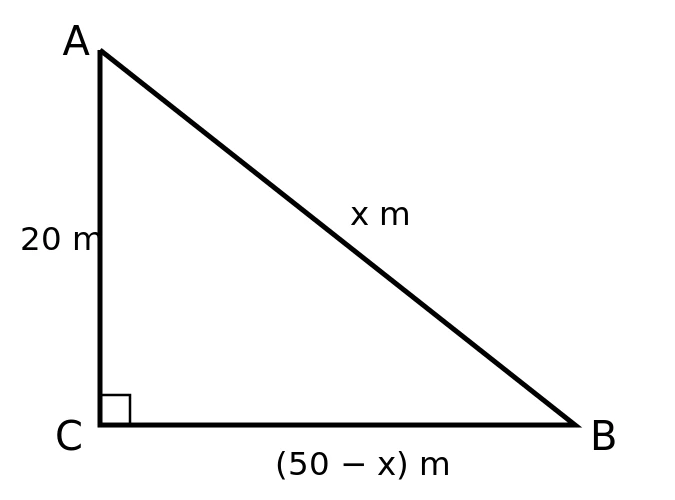
(A) 30 m
(B) 29 m
(C) 25 m
(D) 27 m
Answer & Explanation
Correct Answer: (B) 29 m
Explanation
The right angle is at C, so AB is the hypotenuse: AB² = AC² + BC².
x² = 20² + (50 − x)² = 400 + 2500 − 100x + x².
0 = 2900 − 100x, so x = 29.
Hence, AB = 29 m.
Shortcut Method
Check (B): BC = 50 − 29 = 21; 20² + 21² = 400 + 441 = 841 = 29². ✓
Answer: (B) 29 m
Q. The difference between compound interest and simple interest on ₹15,000 for 2 years at the same rate of interest is ₹96. What was the annual rate of interest?
(A) 6%
(B) 10%
(C) 12%
(D) 8%
Answer & Explanation
Correct Answer: (D) 8%
Explanation
For 2 years, CI − SI = P × (R/100)².
96 = 15000 × R²/10000.
R² = 96 × 10000 ÷ 15000 = 64.
R = 8%.
Hence, the rate of interest is 8% per annum.
Shortcut Method
(R/100)² = 96/15000 = 0.0064, so R/100 = 0.08 and R = 8%.
Answer: (D) 8%
Q. The sum of two numbers is 27 and their product is 182. What is the smaller number?
(A) 16
(B) 12
(C) 14
(D) 13
Answer & Explanation
Correct Answer: (D) 13
Explanation
Let the numbers be x and 27 − x; x(27 − x) = 182.
x² − 27x + 182 = 0.
(x − 13)(x − 14) = 0, so x = 13 or 14.
Hence, the smaller number is 13.
Shortcut Method
Look for two factors of 182 that add to 27: 13 × 14 = 182 and 13 + 14 = 27.
Answer: (D) 13
Q. A bag contains 50-paise, 25-paise and 10-paise coins in the ratio 5 : 8 : 3, and the total amount is ₹144. How many 50-paise coins are there?
(A) 150
(B) 140
(C) 200
(D) 175
Answer & Explanation
Correct Answer: (A) 150
Explanation
Let the numbers of coins be 5x, 8x and 3x.
Value = 5x × 0.50 + 8x × 0.25 + 3x × 0.10 = 2.5x + 2x + 0.3x = 4.8x rupees.
4.8x = 144, so x = 30.
Number of 50-paise coins = 5 × 30 = 150.
Hence, there are 150 fifty-paise coins.
Shortcut Method
Value of one “set” (5 + 8 + 3 coins) = ₹4.80; 144 ÷ 4.8 = 30 sets; 30 × 5 = 150.
Answer: (A) 150
Q. If x tan 45° sin 30° = cos 30° tan 30°, what is the value of x?
(A) 1
(B) √3
(C) √3/2
(D) 1/2
Answer & Explanation
Correct Answer: (A) 1
Explanation
tan 45° = 1, sin 30° = 1/2, cos 30° = √3/2, tan 30° = 1/√3.
LHS = x × 1 × 1/2 = x/2.
RHS = (√3/2) × (1/√3) = 1/2.
x/2 = 1/2, so x = 1.
Hence, x = 1.
Shortcut Method
cos 30° × tan 30° = sin 30° = 1/2, so x × 1/2 = 1/2 and x = 1.
Answer: (A) 1
Q. A can do a piece of work alone in 20 days, and B alone can do it in 30 days. In how many days will they finish it working together?
(A) 10 days
(B) 16 days
(C) 15 days
(D) 12 days
Answer & Explanation
Correct Answer: (D) 12 days
Explanation
A’s one-day work = 1/20; B’s one-day work = 1/30.
Together = 1/20 + 1/30 = (3 + 2)/60 = 5/60 = 1/12.
Time = 12 days.
Hence, together they finish the work in 12 days.
Shortcut Method
Together = (20 × 30) ÷ (20 + 30) = 600 ÷ 50 = 12 days.
Answer: (D) 12 days
Q. The LCM and HCF of two numbers are 315 and 7 respectively. If one number is 35, what is the other number?
(A) 35
(B) 55
(C) 63
(D) 105
Answer & Explanation
Correct Answer: (C) 63
Explanation
Product of two numbers = LCM × HCF.
35 × x = 315 × 7 = 2205.
x = 2205 ÷ 35 = 63.
Hence, the other number is 63.
Shortcut Method
x = (315 × 7) ÷ 35 = 315 ÷ 5 = 63.
Answer: (C) 63
Q. A sum of money becomes ₹40 when increased by 1/7 of itself. What was the original sum?
(A) ₹37
(B) ₹35
(C) ₹25
(D) ₹30
Answer & Explanation
Correct Answer: (B) ₹35
Explanation
Let the sum = x; x + x/7 = 40.
8x/7 = 40.
x = 40 × 7 ÷ 8 = 35.
Hence, the original sum was ₹35.
Shortcut Method
The new amount is 8/7 of the old, so the old amount = 40 × 7/8 = ₹35.
Answer: (B) ₹35
Q. If K means ‘−’, L means ‘÷’, M means ‘+’ and D means ‘×’, then 117 L 3 K 5 M 12 D 8 = ?
(A) 93.6
(B) 368
(C) 130
(D) 256
Answer & Explanation
Correct Answer: (C) 130
Explanation
Replace the letters: 117 ÷ 3 − 5 + 12 × 8.
Division and multiplication first (BODMAS): 117 ÷ 3 = 39; 12 × 8 = 96.
39 − 5 + 96 = 130.
Hence, the value is 130.
Shortcut Method
39 + 96 − 5 = 130.
Answer: (C) 130
Q. (999 1/7 + 999 2/7 + 999 3/7 + 999 4/7 + 999 5/7 + 999 6/7) = ?
(A) 5999
(B) 5997
(C) 5799
(D) 5979
Answer & Explanation
Correct Answer: (B) 5997
Explanation
Whole-number parts: 999 × 6 = 5994.
Fractions: (1 + 2 + 3 + 4 + 5 + 6)/7 = 21/7 = 3.
Total = 5994 + 3 = 5997.
Hence, the sum is 5997.
Shortcut Method
Pair the terms (1/7 + 6/7 = 1, and so on): 3 pairs of (999 + 999 + 1) = 3 × 1999 = 5997.
Answer: (B) 5997
Q. ₹710 is divided among A, B and C so that A gets ₹40 more than B and C gets ₹30 more than A. How much does C get?
(A) ₹235
(B) ₹300
(C) ₹135
(D) ₹270
Answer & Explanation
Correct Answer: (D) ₹270
Explanation
Let B = x; then A = x + 40 and C = x + 70.
x + (x + 40) + (x + 70) = 710, so 3x + 110 = 710.
3x = 600, so x = 200.
C = 200 + 70 = 270.
Hence, C gets ₹270.
Shortcut Method
Remove the extras: (710 − 40 − 70) ÷ 3 = 200 = B; C = 200 + 70 = ₹270.
Answer: (D) ₹270
Q. If 25% of a number is added to 30% of 150, the sum is 75. What is the number?
(A) 102
(B) 120
(C) 210
(D) 220
Answer & Explanation
Correct Answer: (B) 120
Explanation
30% of 150 = 45.
25% of x = 75 − 45 = 30.
x = 30 × 4 = 120.
Hence, the number is 120.
Shortcut Method
x/4 = 75 − 45 = 30, so x = 120.
Answer: (B) 120
Q. A pipe can empty one-third of a tank in 3 minutes. What part of the tank can it empty in 7½ minutes?
(A) 1/2
(B) 2/3
(C) 5/6
(D) 5/7
Answer & Explanation
Correct Answer: (C) 5/6
Explanation
1/3 of the tank takes 3 minutes, so the full tank takes 9 minutes.
In 1 minute it empties 1/9 of the tank.
In 7½ minutes it empties 7.5 × 1/9 = 7.5/9 = 5/6.
Hence, it empties 5/6 of the tank.
Shortcut Method
(7.5 ÷ 3) × 1/3 = 2.5/3 = 5/6.
Answer: (C) 5/6
Q. A, B and C are partners in a business. A contributes one-third of the capital, and B contributes as much as A and C together. If the profit at the end of the year is ₹900, how much will C get?
(A) ₹300
(B) ₹100
(C) ₹200
(D) ₹150
Answer & Explanation
Correct Answer: (D) ₹150
Explanation
A = 1/3 of the capital. B = A + C, and A + B + C = 1.
So 2B = 1, and B = 1/2.
C = 1 − 1/3 − 1/2 = 1/6.
C’s share = 900 × 1/6 = ₹150.
Hence, C gets ₹150.
Shortcut Method
Shares A : B : C = 2 : 3 : 1 (sixths), so C = 900 × 1/6 = ₹150.
Answer: (D) ₹150
Q. Two numbers are in the ratio 5 : 8 and their difference is 69. What is the greater number?
(A) 115
(B) 128
(C) 184
(D) 112
Answer & Explanation
Correct Answer: (C) 184
Explanation
Let the numbers be 5x and 8x; 8x − 5x = 69.
3x = 69, so x = 23.
Greater number = 8 × 23 = 184.
Hence, the greater number is 184.
Shortcut Method
3 parts = 69, so 1 part = 23 and 8 parts = 184.
Answer: (C) 184
Q. A father’s present age is 6 times his son’s age. After 6 years, the father’s age will be 3 times the son’s age. What is the father’s present age?
(A) 48 years
(B) 24 years
(C) 36 years
(D) 30 years
Answer & Explanation
Correct Answer: (B) 24 years
Explanation
Let son = x; father = 6x.
After 6 years: 6x + 6 = 3(x + 6) = 3x + 18.
3x = 12, so x = 4.
Father = 6 × 4 = 24 years.
Hence, the father’s present age is 24 years.
Shortcut Method
Check (B): son 4, father 24; after 6 years 30 = 3 × 10. ✓
Answer: (B) 24 years
WBP Constable Mathematics Questions 2019
Q. Find the value: (1 − 1/3)(1 − 1/4)(1 − 1/5) … (1 − 1/99)(1 − 1/100)
(A) 1/25
(B) 1/50
(C) 2/99
(D) 1/100
Answer & Explanation
Correct Answer: (B) 1/50
Explanation
Each bracket: 1 − 1/n = (n − 1)/n, so the product = 2/3 × 3/4 × 4/5 × … × 98/99 × 99/100.
Every numerator cancels the previous denominator.
Product = 2/100 = 1/50.
Hence, the value is 1/50.
Shortcut Method
Telescoping product = first numerator ÷ last denominator = 2/100 = 1/50.
Answer: (B) 1/50
Q. The present ages of X and Y are in the ratio 3 : 4. Five years ago the ratio was 5 : 7. What is Y’s present age?
(A) 50 years
(B) 30 years
(C) 60 years
(D) 40 years
Answer & Explanation
Correct Answer: (D) 40 years
Explanation
Let ages = 3x and 4x; (3x − 5)/(4x − 5) = 5/7.
21x − 35 = 20x − 25, so x = 10.
Y = 4 × 10 = 40 years.
Hence, Y’s present age is 40 years.
Shortcut Method
Check options: Y = 40 gives X = 30; five years ago 25 : 35 = 5 : 7 ✓.
Answer: (D) 40 years
Q. What is the least number that must be added to 1728 to make it a perfect square?
(A) 26
(B) 36
(C) 30
(D) 32
Answer & Explanation
Correct Answer: (B) 36
Explanation
41² = 1681 < 1728 < 42² = 1764.
Number to add = 1764 − 1728.
= 36.
Hence, the least number to add is 36.
Shortcut Method
1728 = 12³; the next square after it is 42² = 1764, so add 36.
Answer: (B) 36
Q. ₹680 is divided among A, B and C so that A gets 2/3 of what B gets and B gets 1/4 of what C gets. How much does B get?
(A) ₹210
(B) ₹120
(C) ₹320
(D) ₹325
Answer & Explanation
Correct Answer: (B) ₹120
Explanation
Let B = x; A = 2x/3; C = 4x.
Total = 2x/3 + x + 4x = 17x/3 = 680.
x = 680 × 3 ÷ 17 = 120.
Hence, B gets ₹120.
Shortcut Method
Ratio A : B : C = 2 : 3 : 12 (17 parts); B = 3/17 × 680 = ₹120.
Answer: (B) ₹120
Q. If 35% of a number is 91, what is the number?
(A) 260
(B) 266
(C) 245
(D) 252
Answer & Explanation
Correct Answer: (A) 260
Explanation
35% of N = 91, so N = 91 × 100 ÷ 35.
= 9100 ÷ 35.
= 260.
Hence, the number is 260.
Shortcut Method
35% = 7/20, so N = 91 × 20/7 = 13 × 20 = 260.
Answer: (A) 260
Q. What is the greatest 4-digit number which, when divided by 3, 5, 7 and 9, leaves remainders 1, 3, 5 and 7 respectively?
(A) 9764
(B) 9767
(C) 9763
(D) 9765
Answer & Explanation
Correct Answer: (C) 9763
Explanation
In each case divisor − remainder = 2, so N + 2 is divisible by LCM(3, 5, 7, 9) = 315.
Greatest 4-digit multiple of 315: 315 × 31 = 9765.
N = 9765 − 2 = 9763.
Hence, the number is 9763.
Shortcut Method
When divisor − remainder is constant (k), the answer is (multiple of LCM) − k = 9765 − 2 = 9763.
Answer: (C) 9763
Q. If 5% of √(2x) = 0.01, then x = ?
(A) 0.01
(B) 0.05
(C) 0.02
(D) 0.03
Answer & Explanation
Correct Answer: (C) 0.02
Explanation
0.05 × √(2x) = 0.01, so √(2x) = 0.2.
2x = 0.04.
x = 0.02.
Hence, x = 0.02.
Shortcut Method
Check: √(0.04) = 0.2, and 5% of 0.2 = 0.01 ✓.
Answer: (C) 0.02
Q. In what ratio must tea at ₹15 per kg be mixed with tea at ₹20 per kg so that the mixture costs ₹16.50 per kg?
(A) 5 : 7
(B) 7 : 3
(C) 3 : 7
(D) 7 : 5
Answer & Explanation
Correct Answer: (B) 7 : 3
Explanation
By alligation: (20 − 16.50) : (16.50 − 15).
= 3.50 : 1.50.
= 7 : 3.
Hence, the ratio is 7 : 3.
Shortcut Method
Cheaper : dearer = (dearer − mean) : (mean − cheaper) = 3.5 : 1.5 = 7 : 3.
Answer: (B) 7 : 3
Q. Two trains 137 m and 163 m long are moving towards each other at 42 km/h and 48 km/h respectively. How long will they take to cross each other?
(A) 24 seconds
(B) 12 seconds
(C) 30 seconds
(D) 10 seconds
Answer & Explanation
Correct Answer: (B) 12 seconds
Explanation
Total length = 137 + 163 = 300 m.
Relative speed = 42 + 48 = 90 km/h = 90 × 5/18 = 25 m/s.
Time = 300 ÷ 25 = 12 s.
Hence, the trains cross each other in 12 seconds.
Shortcut Method
Opposite directions mean the speeds add: 300 ÷ 25 = 12 s.
Answer: (B) 12 seconds
Q. If √(2ⁿ) = 64, then n = ?
(A) 4
(B) 6
(C) 2
(D) 12
Answer & Explanation
Correct Answer: (D) 12
Explanation
√(2ⁿ) = 2^(n/2).
64 = 2⁶, so n/2 = 6.
n = 12.
Hence, n = 12.
Shortcut Method
Square both sides: 2ⁿ = 64² = 4096 = 2¹².
Answer: (D) 12
Q. A kite and a reel (latai) together cost ₹1.10. If the reel costs ₹1 more than the kite, what is the price of the kite?
(A) 10 paise
(B) 20 paise
(C) 5 paise
(D) 25 paise
Answer & Explanation
Correct Answer: (C) 5 paise
Explanation
Let kite = x; reel = x + 1.
x + (x + 1) = 1.10, so 2x = 0.10.
x = ₹0.05 = 5 paise.
Hence, the kite costs 5 paise.
Shortcut Method
Kite = (total − difference)/2 = (1.10 − 1.00)/2 = 0.05 = 5 paise.
Answer: (C) 5 paise
Q. Pipes A and B can fill a tank in 12 minutes and 16 minutes respectively. Both are opened together. After how many minutes should B be closed so that the tank is filled in 9 minutes in all?
(A) 4 minutes
(B) 4 1/2 minutes
(C) 3 1/2 minutes
(D) 4 3/4 minutes
Answer & Explanation
Correct Answer: (A) 4 minutes
Explanation
A works all 9 minutes: 9/12 = 3/4 of the tank.
B fills the remaining 1/4: t/16 = 1/4.
t = 4 minutes.
Hence, B should be closed after 4 minutes.
Shortcut Method
B’s share = 1 − 9/12 = 1/4 of the tank = 16/4 = 4 minutes.
Answer: (A) 4 minutes
Q. The diagonal of a rectangle is 10 cm and it is double one of its sides. What is the area of the rectangle?
(A) 100 cm²
(B) 25√3 cm²
(C) 25 cm²
(D) 10√3 cm²
Answer & Explanation
Correct Answer: (B) 25√3 cm²
Explanation
Diagonal = 10 = 2 × side, so one side = 5 cm.
Other side = √(10² − 5²) = √75 = 5√3 cm.
Area = 5 × 5√3 = 25√3 cm².
Hence, the area is 25√3 cm².
Shortcut Method
Diagonal = 2 × short side gives a 30°–60°–90° triangle with sides 5, 5√3 and 10, so area = 5 × 5√3.
Answer: (B) 25√3 cm²
Q. A square and a rectangle have the same perimeter. If their areas are S and R respectively, which of the following is true?
(A) S = 2R
(B) S = R
(C) S < R
(D) S > R
Answer & Explanation
Correct Answer: (D) S > R
Explanation
Take perimeter = 40: square side = 10, so S = 100.
A rectangle, e.g. 12 × 8, has R = 96 < 100; any non-square rectangle gives less.
Hence S > R.
Hence, S > R.
Shortcut Method
For a fixed perimeter, the square has the maximum area: (a + b)²/4 ≥ ab.
Answer: (D) S > R
Q. By selling an article for ₹616, a profit of 12% is made. What would be the loss if it is sold for ₹462?
(A) ₹64
(B) ₹72
(C) ₹46
(D) ₹88
Answer & Explanation
Correct Answer: (D) ₹88
Explanation
CP = 616 × 100/112 = ₹550.
New SP = ₹462.
Loss = 550 − 462 = ₹88.
Hence, the loss would be ₹88.
Shortcut Method
616 = 1.12 × CP gives CP = 550 (616 ÷ 1.12); then 550 − 462 = 88.
Answer: (D) ₹88
Q. Arrange in descending order: 7/11, 16/20, 21/22
(A) 21/22, 7/11, 16/20
(B) 21/22, 16/20, 7/11
(C) 7/11, 16/20, 21/22
(D) 7/11, 21/22, 16/20
Answer & Explanation
Correct Answer: (B) 21/22, 16/20, 7/11
Explanation
7/11 = 0.636; 16/20 = 0.8; 21/22 = 0.955.
Descending: 0.955 > 0.8 > 0.636.
Order: 21/22, 16/20, 7/11.
Hence, the descending order is 21/22, 16/20, 7/11.
Shortcut Method
Gaps from 1: 1/22, 4/20 = 1/5, 4/11. The smallest gap is the largest fraction.
Answer: (B) 21/22, 16/20, 7/11
Q. A starts a business with ₹7000. After 5 months B joins as a partner. If the profit after one year is shared in the ratio 2 : 3, how much did B invest?
(A) ₹6500
(B) ₹18,000
(C) ₹10,000
(D) ₹9000
Answer & Explanation
Correct Answer: (B) ₹18,000
Explanation
A’s share = 7000 × 12 = 84000 (rupee-months).
B’s share = x × 7 (12 − 5 months).
84000 : 7x = 2 : 3, so 14x = 252000 and x = 18000.
Hence, B invested ₹18,000.
Shortcut Method
B = 7000 × 12 × 3 ÷ (2 × 7) = 18000.
Answer: (B) ₹18,000
Q. If the selling price of 4 articles equals the cost price of 5 articles, what is the profit percentage?
(A) 22 1/2%
(B) 25%
(C) 20%
(D) 30%
Answer & Explanation
Correct Answer: (B) 25%
Explanation
Let CP of 1 = ₹1; SP of 4 = CP of 5 = ₹5.
SP of 1 = 5/4 = ₹1.25.
Profit% = 0.25/1 × 100 = 25%.
Hence, the profit is 25%.
Shortcut Method
Profit% = (5 − 4)/4 × 100 = 25%.
Answer: (B) 25%
Q. The sum of the present ages of a father and son is 100 years. Five years ago their ages were in the ratio 2 : 1. What will their ages be after 10 years?
(A) 65 years, 55 years
(B) 70 years, 50 years
(C) 75 years, 45 years
(D) 80 years, 40 years
Answer & Explanation
Correct Answer: (C) 75 years, 45 years
Explanation
Five years ago the total = 100 − 10 = 90, split 2 : 1 = 60 and 30.
Present ages = 65 and 35.
After 10 years = 75 and 45.
Hence, their ages will be 75 years and 45 years.
Shortcut Method
Check option (C): sum 120 − 20 = 100 now ✓; 5 years ago 60 : 30 = 2 : 1 ✓.
Answer: (C) 75 years, 45 years
Q. In how many years will a sum double itself at 18.75% per annum simple interest?
(A) 4 years 5 months
(B) 5 years 4 months
(C) 6 years 2 months
(D) 6 years 5 months
Answer & Explanation
Correct Answer: (B) 5 years 4 months
Explanation
Doubling means SI = P, so T = 100/R.
T = 100 ÷ 18.75 = 16/3 years.
16/3 years = 5 1/3 years = 5 years 4 months.
Hence, it doubles in 5 years 4 months.
Shortcut Method
18.75% = 3/16, so T = 16/3 = 5 yr 4 m.
Answer: (B) 5 years 4 months
Q. The product of two numbers is 2160 and their HCF is 6. What is the ratio of their HCF to LCM?
(A) 60 : 1
(B) 7 : 20
(C) 1 : 60
(D) 20 : 7
Answer & Explanation
Correct Answer: (C) 1 : 60
Explanation
HCF × LCM = product, so LCM = 2160 ÷ 6 = 360.
HCF : LCM = 6 : 360.
= 1 : 60.
Hence, the ratio is 1 : 60.
Shortcut Method
HCF : LCM = HCF² : product = 36 : 2160 = 1 : 60.
Answer: (C) 1 : 60
Q. The speed of a boat downstream is 12 km/h and upstream 8 km/h. How long will the boat take to travel 24 km in still water?
(A) 3 hours
(B) 2.4 hours
(C) 2 hours
(D) 1.2 hours
Answer & Explanation
Correct Answer: (B) 2.4 hours
Explanation
Speed in still water = (12 + 8) ÷ 2 = 10 km/h.
Time = 24 ÷ 10.
= 2.4 hours.
Hence, the boat takes 2.4 hours.
Shortcut Method
Still-water speed = average of downstream and upstream speeds = 10 km/h.
Answer: (B) 2.4 hours
Q. A man covers 61 km in 9 hours, partly on foot at 4 km/h and the rest by cycle at 9 km/h. How much distance did he cover on foot?
(A) 16 km
(B) 20 km
(C) 12 km
(D) 24 km
Answer & Explanation
Correct Answer: (A) 16 km
Explanation
Let distance on foot = x; x/4 + (61 − x)/9 = 9.
9x + 4(61 − x) = 324, so 5x = 80.
x = 16 km.
Hence, he walked 16 km.
Shortcut Method
Check option (A): 16/4 = 4 h and 45/9 = 5 h, total 9 h ✓.
Answer: (A) 16 km
Q. A rectangular garden is 100 m long and 80 m wide. A path 10 m wide runs all round it outside. What is the area of the path?
(A) 2400 m²
(B) 3660 m²
(C) 1900 m²
(D) 4000 m²
Answer & Explanation
Correct Answer: (D) 4000 m²
Explanation
Outer dimensions = (100 + 20) × (80 + 20) = 120 × 100 = 12000 m².
Garden area = 100 × 80 = 8000 m².
Path area = 12000 − 8000 = 4000 m².
Hence, the area of the path is 4000 m².
Shortcut Method
Outer path area = 2w(l + b + 2w) = 2 × 10 × (100 + 80 + 20) = 4000 m².
Answer: (D) 4000 m²
Q. The average of 7 consecutive numbers is 20. What is the largest number?
(A) 23
(B) 22
(C) 24
(D) 20
Answer & Explanation
Correct Answer: (A) 23
Explanation
For consecutive numbers, the average = the middle (4th) number = 20.
The numbers are 17, 18, 19, 20, 21, 22, 23.
Largest = 23.
Hence, the largest number is 23.
Shortcut Method
Largest = average + (n − 1)/2 = 20 + 3 = 23.
Answer: (A) 23
Q. The sum of the digits of a two-digit number is 8. If 18 is subtracted from the number, its digits are reversed. What is the number?
(A) 35
(B) 62
(C) 44
(D) 53
Answer & Explanation
Correct Answer: (D) 53
Explanation
Let the number = 10a + b with a + b = 8.
(10a + b) − (10b + a) = 18, so 9(a − b) = 18 and a − b = 2.
a = 5, b = 3, so the number is 53.
Hence, the number is 53.
Shortcut Method
Reversal difference = 9 × (digit difference): 18/9 = 2; digits 5 and 3 → 53.
Answer: (D) 53
Q. If 90% of A = 30% of B and B = 2x% of A, then x = ?
(A) 400
(B) 300
(C) 450
(D) 150
Answer & Explanation
Correct Answer: (D) 150
Explanation
0.9A = 0.3B, so B = 3A = 300% of A.
2x = 300.
x = 150.
Hence, x = 150.
Shortcut Method
B/A = 90/30 = 3 = 300%, and half of 300 is 150.
Answer: (D) 150
Q. The three angles of a triangle are 3x°, (2x − 7)° and (4x − 11)°. What is x?
(A) 20°
(B) 22°
(C) 18°
(D) 23°
Answer & Explanation
Correct Answer: (B) 22°
Explanation
3x + (2x − 7) + (4x − 11) = 180.
9x − 18 = 180, so 9x = 198.
x = 22.
Hence, x = 22°.
Shortcut Method
Check: 66 + 37 + 77 = 180 ✓.
Answer: (B) 22°
Q. A motorcyclist goes from A to B at 20 km/h and returns at 30 km/h. What is his average speed?
(A) 23 km/h
(B) 26 km/h
(C) 22 km/h
(D) 24 km/h
Answer & Explanation
Correct Answer: (D) 24 km/h
Explanation
For equal distances, average speed = 2xy/(x + y).
= 2 × 20 × 30 ÷ 50.
= 24 km/h.
Hence, the average speed is 24 km/h.
Shortcut Method
Take distance 60 km: 3 h + 2 h = 5 h for 120 km, so 24 km/h.
Answer: (D) 24 km/h
Q. Three numbers are in the ratio 1 : 2 : 3 and their HCF is 12. What is the largest number?
(A) 15
(B) 12
(C) 36
(D) 30
Answer & Explanation
Correct Answer: (C) 36
Explanation
The numbers are x, 2x and 3x, with HCF = x.
x = 12.
Largest = 3 × 12 = 36.
Hence, the largest number is 36.
Shortcut Method
In a ratio of co-prime terms, the HCF is the multiplier: 12 × 3 = 36.
Answer: (C) 36
WBP Constable Mathematics Questions 2018
Q. Which is the greatest 5-digit number exactly divisible by 315?
(A) 99875
(B) 99855
(C) 99985
(D) 99835
Answer & Explanation
Correct Answer: (B) 99855
Explanation
Greatest 5-digit number = 99999.
99999 ÷ 315 gives quotient 317 and remainder 144 (315 × 317 = 99855).
99999 − 144 = 99855.
Hence, the required number is 99855.
Shortcut Method
A multiple of 315 must be divisible by 5 and 9. Among the options only 99855 has digit sum 36 (a multiple of 9) and ends in 5.
Answer: (B) 99855
Q. Find the value: (1/2 ÷ 1/2 of 1/2) / (1/2 + 1/2 of 1/2) = ?
(A) 1 2/3
(B) 1/3
(C) 2 2/3
(D) 2/3
Answer & Explanation
Correct Answer: (C) 2 2/3
Explanation
“of” is done first: 1/2 of 1/2 = 1/4.
Numerator = 1/2 ÷ 1/4 = 2.
Denominator = 1/2 + 1/4 = 3/4.
Value = 2 ÷ 3/4 = 8/3 = 2 2/3.
Hence, the value is 2 2/3.
Shortcut Method
Remember BODMAS (“O” = of): do “of” before ÷. Then 2 ÷ 0.75 = 2.67 = 2 2/3.
Answer: (C) 2 2/3
Q. What is the ratio of the speed of the hour hand to that of the minute hand of a clock?
(A) 2 : 9
(B) Can’t be determined
(C) 1 : 12
(D) 5 : 24
Answer & Explanation
Correct Answer: (C) 1 : 12
Explanation
Hour hand turns 360° in 12 h = 30° per hour.
Minute hand turns 360° in 1 h = 360° per hour.
Ratio = 30 : 360 = 1 : 12.
Hence, the ratio of speeds is 1 : 12.
Shortcut Method
In the time the hour hand completes one round (12 h), the minute hand completes 12 rounds, so 1 : 12.
Answer: (C) 1 : 12
Q. A sum lent at simple interest amounts to ₹720 in 2 years and to ₹1020 after a further 5 years. What is the rate of interest per annum?
(A) 10%
(B) 20%
(C) 15%
(D) 5%
Answer & Explanation
Correct Answer: (A) 10%
Explanation
SI for 5 years = 1020 − 720 = ₹300, so SI for 1 year = ₹60.
SI for 2 years = ₹120, so principal = 720 − 120 = ₹600.
Rate = 60 × 100 ÷ 600 = 10%.
Hence, the rate of interest is 10% per annum.
Shortcut Method
Rate = (yearly SI ÷ principal) × 100 = 60/600 × 100 = 10%.
Answer: (A) 10%
Q. How many numbers between 1 and 100 are exactly divisible by 4 and also contain the digit 4?
(A) 20
(B) 21
(C) 10
(D) 7
Answer & Explanation
Correct Answer: (D) 7
Explanation
Multiples of 4 with digit 4 in the units place: 4, 24, 44, 64, 84.
Multiples of 4 in the forties: 40, 44, 48 (44 already counted).
List: 4, 24, 40, 44, 48, 64, 84 = 7 numbers.
Hence, there are 7 such numbers.
Shortcut Method
Units digit 4 and divisible by 4 means the tens digit is even (4, 24, 44, 64, 84). Then add 40 and 48: 5 + 2 = 7.
Answer: (D) 7
Q. Two numbers are in the ratio 2 : 3. If 8 is added to each, the ratio becomes 3 : 4. The numbers are
(A) 40, 56
(B) 30, 40
(C) 16, 24
(D) 15, 20
Answer & Explanation
Correct Answer: (C) 16, 24
Explanation
Let the numbers be 2x and 3x; (2x + 8)/(3x + 8) = 3/4.
8x + 32 = 9x + 24, so x = 8.
Numbers = 16 and 24.
Hence, the numbers are 16 and 24.
Shortcut Method
Check the options: 16 : 24 = 2 : 3 and 24 : 32 = 3 : 4 ✓.
Answer: (C) 16, 24
Q. By selling 28 articles, a man gains the selling price of 4 articles. What is his gain percentage?
(A) 16 2/3%
(B) 16 1/3%
(C) Can’t be determined
(D) 16%
Answer & Explanation
Correct Answer: (A) 16 2/3%
Explanation
SP of 28 − CP of 28 = SP of 4, so CP of 28 = SP of 24.
Gain on 24 articles’ worth of cost = SP of 4.
Gain% = 4/24 × 100 = 16 2/3%.
Hence, the gain is 16 2/3%.
Shortcut Method
When the gain = SP of x articles out of n sold, Gain% = x/(n − x) × 100 = 4/24 × 100 = 16 2/3%.
Answer: (A) 16 2/3%
Q. 2 men and 7 boys complete a work in 4 days, while 4 men and 4 boys complete it in 3 days. In how many days will 1 man complete the work?
(A) 6 days
(B) 51 days
(C) 15 days
(D) 60 days
Answer & Explanation
Correct Answer: (C) 15 days
Explanation
Work = 4(2M + 7B) = 8M + 28B; also work = 3(4M + 4B) = 12M + 12B.
8M + 28B = 12M + 12B, so 4M = 16B and M = 4B.
Work = 12M + 12B = 12M + 3M = 15M (man-days).
Hence, one man completes the work in 15 days.
Shortcut Method
1 man = 4 boys, so 4M + 4B = 5M working 3 days = 15 man-days.
Answer: (C) 15 days
Q. Due to a 20% fall in the price of sugar, a person can buy 2 1/2 kg more sugar for ₹160. What was the original price of sugar per kg?
(A) ₹16
(B) ₹18
(C) ₹15
(D) ₹12
Answer & Explanation
Correct Answer: (A) ₹16
Explanation
Money saved = 20% of 160 = ₹32, which buys 2.5 kg at the new price.
New price = 32 ÷ 2.5 = ₹12.80 per kg.
Original price = 12.80 ÷ 0.8 = ₹16 per kg.
Hence, the original price was ₹16 per kg.
Shortcut Method
Original price = (r% × money) ÷ (extra qty × (100 − r)%) = 32 ÷ (2.5 × 0.8) = ₹16.
Answer: (A) ₹16
Q. At 10 a.m., R and S start walking towards each other at 3 km/h and 4 km/h respectively. If the distance between them at the start is 17.5 km, at what time will they meet?
(A) 1:30 PM
(B) 12:30 PM
(C) 11:30 AM
(D) 2:30 PM
Answer & Explanation
Correct Answer: (B) 12:30 PM
Explanation
Relative speed = 3 + 4 = 7 km/h.
Time = 17.5 ÷ 7 = 2.5 hours.
10:00 a.m. + 2 h 30 min = 12:30 p.m.
Hence, they meet at 12:30 PM.
Shortcut Method
Moving towards each other means the speeds add, so the time is distance ÷ (sum of speeds).
Answer: (B) 12:30 PM
Q. Due to a printing error, a perfect square number was printed as 150062’k’. What is the value of ‘k’?
(A) 4
(B) 6
(C) 9
(D) 5
Answer & Explanation
Correct Answer: (D) 5
Explanation
The number is the 7-digit 150062k; √1500620 ≈ 1225.
1225² = 1500625.
So k = 5.
Hence, the value of k is 5.
Shortcut Method
A square ending in 25 comes from a number ending in 5. Since 1225² = 1500625, k = 5.
Answer: (D) 5
Q. A tank is filled in 5 hours, but because of a leak in its bottom it takes 6 hours to fill. In how much time will the leak empty the full tank?
(A) 30 hours
(B) 15 hours
(C) 5 hours
(D) 6 hours
Answer & Explanation
Correct Answer: (A) 30 hours
Explanation
Filling rate = 1/5 per hour; with the leak = 1/6 per hour.
Leak rate = 1/5 − 1/6 = 1/30 per hour.
Leak empties the tank in 30 hours.
Hence, the leak empties the tank in 30 hours.
Shortcut Method
Leak time = (a × b) ÷ (b − a) = 5 × 6 ÷ 1 = 30 hours.
Answer: (A) 30 hours
Q. A man wants to cross a river perpendicularly. In still water he takes 4 minutes to cross, and against the current (upstream) he takes 5 minutes. If the river is 100 m wide, what is the speed of the current?
(A) 100 m/h
(B) 200 m/h
(C) 300 m/h
(D) 150 m/h
Answer & Explanation
Correct Answer: (C) 300 m/h
Explanation
Note: The question is loosely worded. The intended method treats the 5-minute crossing as straight upstream motion and gives 300 m/h. A strict vector treatment of a perpendicular crossing would give √(25² − 20²) = 15 m/min = 900 m/h, which is not among the options.
Speed in still water = 100 ÷ 4 = 25 m/min.
Upstream speed = 100 ÷ 5 = 20 m/min.
Speed of current = 25 − 20 = 5 m/min = 5 × 60 = 300 m/h.
Hence, the speed of the current is 300 m/h (intended answer).
Shortcut Method
Current = still-water speed − upstream speed = (100/4 − 100/5) × 60 = 300 m/h.
Answer: (C) 300 m/h
Q. The sides of a rectangular field are in the ratio 3 : 4 and its area is 7500 m². What will it cost to fence the field at ₹2.50 per metre?
(A) ₹855
(B) ₹1830
(C) ₹1875
(D) ₹875
Answer & Explanation
Correct Answer: (D) ₹875
Explanation
Sides = 3x and 4x; 12x² = 7500, so x² = 625 and x = 25.
Sides = 75 m and 100 m.
Perimeter = 2(75 + 100) = 350 m.
Cost = 350 × 2.50 = ₹875.
Hence, the cost of fencing is ₹875.
Shortcut Method
7500 = 75 × 100 directly (a 3 : 4 pair), so cost = 2 × 175 × 2.5 = ₹875.
Answer: (D) ₹875
Q. If 0.36 part of a property is worth ₹14,400, what is the value of the whole property?
(A) Can’t be determined
(B) ₹48,000
(C) ₹40,000
(D) ₹28,000
Answer & Explanation
Correct Answer: (C) ₹40,000
Explanation
0.36 × whole = 14400.
Whole = 14400 ÷ 0.36 = 1440000 ÷ 36.
Whole = ₹40,000.
Hence, the property is worth ₹40,000.
Shortcut Method
36% = 14400, so 1% = 400 and 100% = ₹40,000.
Answer: (C) ₹40,000
Q. If the cost price of 12 pencils equals the selling price of 10 pencils, what is the gain percentage?
(A) 20%
(B) 25%
(C) 18%
(D) 16 2/3%
Answer & Explanation
Correct Answer: (A) 20%
Explanation
Let CP of 1 pencil = ₹1; CP of 12 = ₹12 = SP of 10.
SP of 1 = 12/10 = ₹1.20.
Gain% = 0.20/1 × 100 = 20%.
Hence, the gain is 20%.
Shortcut Method
Gain% = (12 − 10)/10 × 100 = 20%.
Answer: (A) 20%
Q. Find the value of ∛√0.000064.
(A) 0.4
(B) 0.04
(C) 0.2
(D) 0.02
Answer & Explanation
Correct Answer: (C) 0.2
Explanation
√0.000064 = 0.008 (since 0.008² = 0.000064).
∛0.008 = 0.2 (since 0.2³ = 0.008).
Hence, the value is 0.2.
Shortcut Method
0.000064 = 64 × 10⁻⁶ and its sixth root = 2 × 10⁻¹ = 0.2.
Answer: (C) 0.2
Q. In 45 litres of a mixture, milk and water are in the ratio 3 : 2. How much water must be added to make the ratio 9 : 11?
(A) 17 litres
(B) 20 litres
(C) 15 litres
(D) 10 litres
Answer & Explanation
Correct Answer: (C) 15 litres
Explanation
Milk = 3/5 × 45 = 27 L; water = 18 L.
27 : (18 + x) = 9 : 11, so 18 + x = 33.
x = 15 L.
Hence, 15 litres of water must be added.
Shortcut Method
Milk stays the same: 27 = 9 parts, so 1 part = 3 L. Water needed = 11 × 3 = 33 L, so add 33 − 18 = 15 L.
Answer: (C) 15 litres
Q. In a committee of 8 people, two men aged 35 and 45 years are replaced by 2 women, and the average age of the 8 people rises by 2 years. What is the average age of the two women?
(A) 48 years
(B) 44 years
(C) 56 years
(D) 52 years
Answer & Explanation
Correct Answer: (A) 48 years
Explanation
Increase in total age = 8 × 2 = 16 years.
Total age of women = (35 + 45) + 16 = 96 years.
Average age of the women = 96 ÷ 2 = 48 years.
Hence, the average age of the two women is 48 years.
Shortcut Method
Average of the newcomers = average of those replaced + (n × rise)/2 = 40 + 8 = 48.
Answer: (A) 48 years
Q. A father’s age is three times the sum of the ages of his two sons. After 20 years his age will be equal to the sum of their ages. What is the father’s present age?
(A) 35
(B) 45
(C) 40
(D) 30
Answer & Explanation
Correct Answer: (D) 30
Explanation
Let the sons’ total age = s; father = 3s.
After 20 years: 3s + 20 = s + 40 (each son gains 20 years).
2s = 20, so s = 10 and the father = 30 years.
Hence, the father’s present age is 30 years.
Shortcut Method
Check: 30 = 3 × 10 now; after 20 years 50 = 10 + 40 ✓.
Answer: (D) 30
Q. What is the least number that must be added to 2819042 to make the sum a perfect square?
(A) 3438
(B) 3385
(C) 3358
(D) 3058
Answer & Explanation
Correct Answer: (C) 3358
Explanation
√2819042 ≈ 1679.0; 1679² = 2819041, just below it.
The next square is 1680² = 2822400.
Number to add = 2822400 − 2819042 = 3358.
Hence, the least number to add is 3358.
Shortcut Method
1680² = 168² × 100 = 28224 × 100. Subtract: 2822400 − 2819042 = 3358.
Answer: (C) 3358
Q. A general arranges his soldiers in a square formation with as many soldiers as possible in the front line. Out of 63535 soldiers, 31 are left over. How many soldiers were in the front line?
(A) 265
(B) 228
(C) 256
(D) 252
Answer & Explanation
Correct Answer: (D) 252
Explanation
Soldiers in the square = 63535 − 31 = 63504.
Front line = √63504.
252² = 63504.
Hence, there were 252 soldiers in the front line.
Shortcut Method
250² = 62500 and 63504 − 62500 = 1004 = 2 × 250 × 2 + 4, so 252² = 63504.
Answer: (D) 252
Q. A man’s salary is reduced by 20%. By what percent must the reduced salary be increased to restore his original salary?
(A) 17.5%
(B) 22.5%
(C) 25%
(D) 20%
Answer & Explanation
Correct Answer: (C) 25%
Explanation
Let the original salary = 100; reduced salary = 80.
Increase needed = 20 on 80.
Percentage = 20/80 × 100 = 25%.
Hence, the salary must be increased by 25%.
Shortcut Method
Required % = r/(100 − r) × 100 = 20/80 × 100 = 25%.
Answer: (C) 25%
Q. Two numbers are in the ratio 6 : 13 and their LCM is 312. What is their sum?
(A) 76
(B) 67
(C) 57
(D) 75
Answer & Explanation
Correct Answer: (A) 76
Explanation
Let the numbers = 6x and 13x; LCM = 6 × 13 × x = 78x.
78x = 312, so x = 4.
Numbers = 24 and 52; sum = 76.
Hence, the sum is 76.
Shortcut Method
Sum = (6 + 13) × (312 ÷ 78) = 19 × 4 = 76.
Answer: (A) 76
Q. Two persons walk in the same direction at 3 km/h and 6 km/h respectively. A train coming from behind passes them in 9 seconds and 10 seconds respectively. What is the speed of the train?
(A) 33 km/h
(B) 35 km/h
(C) 40 km/h
(D) 22 km/h
Answer & Explanation
Correct Answer: (A) 33 km/h
Explanation
Length of train = (v − 3) × 9 = (v − 6) × 10 (relative speeds; units cancel).
9v − 27 = 10v − 60.
v = 33 km/h.
Hence, the speed of the train is 33 km/h.
Shortcut Method
v = (10 × 6 − 9 × 3) ÷ (10 − 9) = (60 − 27) ÷ 1 = 33 km/h.
Answer: (A) 33 km/h
Q. When Koushik gives 6 paise to each of some beggars, he is left with 7 paise. If he gives 8 paise to each, he is 5 paise short. How many beggars are there?
(A) 6
(B) 7
(C) 5
(D) 8
Answer & Explanation
Correct Answer: (A) 6
Explanation
Let the number of beggars = n; money = 6n + 7 = 8n − 5.
2n = 12.
n = 6.
Hence, there are 6 beggars.
Shortcut Method
Number = (surplus + shortage) ÷ (difference per head) = (7 + 5) ÷ 2 = 6.
Answer: (A) 6
Q. A fruit seller sells 1/4 of his oranges to one buyer and 4/15 of the remainder to another. If 33 oranges are still left, how many oranges did the second buyer buy?
(A) 18
(B) 20
(C) 15
(D) 12
Answer & Explanation
Correct Answer: (D) 12
Explanation
Let total = N; after the first sale, 3N/4 remains.
Second buyer gets 4/15 × 3N/4 = N/5; left = 3N/4 − N/5 = 11N/20.
11N/20 = 33, so N = 60.
Second buyer = 60/5 = 12.
Hence, the second buyer bought 12 oranges.
Shortcut Method
The 33 left = 11/15 of the remainder, so remainder = 45 and second buyer = 45 − 33 = 12.
Answer: (D) 12
Q. Arrange the fractions in ascending order: 5/7, 9/13, 2/3, 8/11
(A) 2/3, 8/11, 5/7, 9/13
(B) 5/7, 8/11, 2/3, 9/13
(C) 2/3, 9/13, 5/7, 8/11
(D) 9/13, 2/3, 8/11, 5/7
Answer & Explanation
Correct Answer: (C) 2/3, 9/13, 5/7, 8/11
Explanation
Decimal values: 5/7 = 0.714, 9/13 = 0.692, 2/3 = 0.667, 8/11 = 0.727.
Ascending: 0.667 < 0.692 < 0.714 < 0.727.
Order: 2/3, 9/13, 5/7, 8/11.
Hence, the ascending order is 2/3, 9/13, 5/7, 8/11.
Shortcut Method
Each fraction = 1 − (gap)/(denominator): 1/3, 4/13, 2/7, 3/11. The smaller the gap fraction, the larger the number.
Answer: (C) 2/3, 9/13, 5/7, 8/11
Q. A bag contains ₹1, 50-paise and 25-paise coins in the ratio 2 : 3 : 5. What is the ratio of their values?
(A) 8 : 5 : 3
(B) 7 : 3 : 2
(C) 8 : 6 : 5
(D) 7 : 5 : 4
Answer & Explanation
Correct Answer: (C) 8 : 6 : 5
Explanation
Values ∝ number × coin value = 2 × 1 : 3 × 0.50 : 5 × 0.25.
= 2 : 1.5 : 1.25.
Multiply by 4: 8 : 6 : 5.
Hence, the ratio of values is 8 : 6 : 5.
Shortcut Method
In paise: 2 × 100 : 3 × 50 : 5 × 25 = 200 : 150 : 125 = 8 : 6 : 5.
Answer: (C) 8 : 6 : 5
Q. By what should the square root of 841/2025 be multiplied to get the product 1?
(A) 55/39
(B) 39/45
(C) 45/29
(D) 2025/841
Answer & Explanation
Correct Answer: (C) 45/29
Explanation
√(841/2025) = 29/45.
Product 1 means multiplying by the reciprocal.
Reciprocal = 45/29.
Hence, it must be multiplied by 45/29.
Shortcut Method
29² = 841 and 45² = 2025, so just flip 29/45.
Answer: (C) 45/29
Q. A clock takes 4 seconds to strike 4. How long will it take to strike 8?
(A) 9 1/3 seconds
(B) 9 2/3 seconds
(C) 12 seconds
(D) 6 seconds
Answer & Explanation
Correct Answer: (A) 9 1/3 seconds
Explanation
Striking 4 has 3 intervals in 4 s, so 1 interval = 4/3 s.
Striking 8 has 7 intervals.
Time = 7 × 4/3 = 28/3 = 9 1/3 s.
Hence, it takes 9 1/3 seconds.
Shortcut Method
Count the gaps, not the strikes: (8 − 1)/(4 − 1) × 4 = 28/3 s.
Answer: (A) 9 1/3 seconds
WBP Constable Mathematics Questions 2016
Q. A copper sphere of radius 6 cm is melted to form spheres of radius 2 cm. How many such spheres can be formed?
(A) 27
(B) 31
(C) 14
(D) 36
Answer & Explanation
Correct Answer: (A) 27
Explanation
Volume is conserved: number = (4/3)π(6)³ ÷ (4/3)π(2)³.
= 6³ ÷ 2³ = 216 ÷ 8.
= 27.
Hence, 27 spheres can be formed.
Shortcut Method
Number of small spheres = (R/r)³ = (6/2)³ = 3³ = 27.
Answer: (A) 27
Q. Conversion of 0.5% into a decimal is
(A) 0.005
(B) 0.05
(C) 5/100
(D) 0.5 × 10
Answer & Explanation
Correct Answer: (A) 0.005
Explanation
0.5% = 0.5/100.
= 5/1000.
= 0.005.
Hence, 0.5% = 0.005.
Shortcut Method
To change % to decimal, move the decimal point two places left: 0.5 → 0.005.
Answer: (A) 0.005
Q. The age of the father 10 years ago was thrice the age of his son. Ten years hence, the father’s age will be twice that of his son. The ratio of their present ages is
(A) 7 : 3
(B) 5 : 2
(C) 9 : 2
(D) 13 : 4
Answer & Explanation
Correct Answer: (A) 7 : 3
Explanation
Let son = S, father = F; F − 10 = 3(S − 10), so F = 3S − 20.
F + 10 = 2(S + 10), so 3S − 10 = 2S + 20 and S = 30.
F = 70; ratio = 70 : 30 = 7 : 3.
Hence, the ratio is 7 : 3.
Shortcut Method
Check (A): 70, 30 → 10 years ago 60 = 3 × 20 ✓; 10 years later 80 = 2 × 40 ✓.
Answer: (A) 7 : 3
Q. A rectangle has a width of 5 cm and a diagonal of 13 cm. Find its perimeter.
(A) 34 cm
(B) 36 cm
(C) 30 cm
(D) 38 cm
Answer & Explanation
Correct Answer: (A) 34 cm
Explanation
Length = √(13² − 5²) = √(169 − 25) = √144 = 12 cm.
Perimeter = 2(12 + 5).
= 34 cm.
Hence, the perimeter is 34 cm.
Shortcut Method
5–12–13 is a Pythagorean triple, so length = 12 and perimeter = 2 × 17 = 34.
Answer: (A) 34 cm
Q. The average age of a mother and her six children is 12 years, which is reduced by 5 years if the age of the mother is excluded. The age of the mother is
(A) 40 years
(B) 48 years
(C) 50 years
(D) 42 years
Answer & Explanation
Correct Answer: (D) 42 years
Explanation
Total of 7 people = 7 × 12 = 84 years.
Total of 6 children = 6 × (12 − 5) = 42 years.
Mother = 84 − 42 = 42 years.
Hence, the mother is 42 years old.
Shortcut Method
Mother = new average + (n + 1) × fall = 7 + 7 × 5 = 42.
Answer: (D) 42 years
Q. A man has some hens and cows. If the number of heads is 48 and the number of legs is 140, the number of hens will be
(A) 22
(B) 23
(C) 26
(D) 24
Answer & Explanation
Correct Answer: (C) 26
Explanation
Let hens = h, cows = c; h + c = 48 and 2h + 4c = 140.
Subtract 2 × (first): 2c = 140 − 96 = 44, so c = 22.
h = 48 − 22 = 26.
Hence, there are 26 hens.
Shortcut Method
If all 48 were hens, legs = 96; the extra 44 legs ÷ 2 = 22 cows, so hens = 26.
Answer: (C) 26
Q. An autorickshaw moves at 40 km/h for 2 hours 30 minutes. If it reaches the destination in another hour (at the same speed), the total distance covered will be
(A) 120 km
(B) 140 km
(C) 160 km
(D) 200 km
Answer & Explanation
Correct Answer: (B) 140 km
Explanation
Total time = 2.5 + 1 = 3.5 hours.
Distance = 40 × 3.5.
= 140 km.
Hence, the total distance is 140 km.
Shortcut Method
40 km/h × 3½ h = 140 km.
Answer: (B) 140 km
Q. A pump can fill a tank with water in 2 hours. Because of a leak in the tank, it takes 2 1/3 hours to fill the tank. The leak can empty the filled tank in
(A) 2 1/3 hours
(B) 8 hours
(C) 7 hours
(D) 14 hours
Answer & Explanation
Correct Answer: (D) 14 hours
Explanation
Pump rate = 1/2 per hour; with leak = 1 ÷ (7/3) = 3/7 per hour.
Leak rate = 1/2 − 3/7 = (7 − 6)/14 = 1/14 per hour.
Leak empties the tank in 14 hours.
Hence, the leak empties the tank in 14 hours.
Shortcut Method
Leak time = (a × b)/(b − a) = (2 × 7/3)/(7/3 − 2) = (14/3)/(1/3) = 14 h.
Answer: (D) 14 hours
Q. When a plot of land is sold for ₹18,700, the owner loses 15%. At what price should the plot be sold in order to gain 15%?
(A) ₹22,500
(B) ₹21,000
(C) ₹25,300
(D) ₹25,800
Answer & Explanation
Correct Answer: (C) ₹25,300
Explanation
85% of CP = 18700, so CP = 18700 × 100/85 = ₹22,000.
SP for 15% gain = 115% of 22000.
= ₹25,300.
Hence, it should be sold for ₹25,300.
Shortcut Method
New SP = 18700 × 115/85 = 220 × 115 = ₹25,300.
Answer: (C) ₹25,300
Q. A clock loses 5 seconds an hour. If the clock is set right on Sunday noon, what time will it show on Monday noon (i.e. the next day)?
(A) 12:00 noon
(B) 11:58 PM
(C) 12:02 PM
(D) 11:58 AM
Answer & Explanation
Correct Answer: (D) 11:58 AM
Explanation
Sunday noon to Monday noon = 24 hours.
Time lost = 24 × 5 = 120 s = 2 minutes.
The clock shows 12:00 − 2 min = 11:58 AM.
Hence, it will show 11:58 AM.
Shortcut Method
A slow clock shows less than true time: 24 h × 5 s = 2 min behind.
Answer: (D) 11:58 AM
Q. The sum of two numbers is 45. Their difference is 1/9th of their sum. Their LCM is
(A) 100
(B) 150
(C) 250
(D) 200
Answer & Explanation
Correct Answer: (A) 100
Explanation
Difference = 45/9 = 5.
Numbers = (45 + 5)/2 = 25 and (45 − 5)/2 = 20.
LCM(25, 20) = 100.
Hence, the LCM is 100.
Shortcut Method
25 = 5², 20 = 2² × 5, so LCM = 2² × 5² = 100.
Answer: (A) 100
Q. The sides of a triangle are in the ratio 7 : 9 : 12. The difference between the lengths of the largest and smallest sides is 15 cm. The length of the largest side is
(A) 12 cm
(B) 24 cm
(C) 60 cm
(D) 36 cm
Answer & Explanation
Correct Answer: (D) 36 cm
Explanation
Difference = 12 − 7 = 5 parts = 15 cm.
1 part = 3 cm.
Largest side = 12 × 3 = 36 cm.
Hence, the largest side is 36 cm.
Shortcut Method
15 ÷ 5 × 12 = 36 cm.
Answer: (D) 36 cm
Q. 630 items are divided among X, Y and Z such that X gets thrice that of Y and Y gets 5 times that of Z. Find the number of items received by X.
(A) 425
(B) 400
(C) 450
(D) 475
Answer & Explanation
Correct Answer: (C) 450
Explanation
Let Z = z; Y = 5z; X = 3 × 5z = 15z.
15z + 5z + z = 21z = 630, so z = 30.
X = 15 × 30 = 450.
Hence, X receives 450 items.
Shortcut Method
Ratio X : Y : Z = 15 : 5 : 1 (21 parts); X = 15/21 × 630 = 450.
Answer: (C) 450
Q. If y = 3x + 12 and y = 5, then the value of x is
(A) 3/7
(B) 7/3
(C) −7
(D) −7/3
Answer & Explanation
Correct Answer: (D) −7/3
Explanation
5 = 3x + 12.
3x = −7.
x = −7/3.
Hence, x = −7/3.
Shortcut Method
x = (5 − 12)/3 = −7/3.
Answer: (D) −7/3
Q. When a number is first increased by 10% and then reduced by 10%, the number
(A) decreases by 1%
(B) does not change
(C) increases by 1%
(D) increases by 9%
Answer & Explanation
Correct Answer: (A) decreases by 1%
Explanation
Let the number = 100; after +10% it is 110.
After −10% of 110: 110 − 11 = 99.
Change = 100 → 99, a 1% decrease.
Hence, the number decreases by 1%.
Shortcut Method
Net % = a + b + ab/100 = 10 − 10 − 1 = −1%.
Answer: (A) decreases by 1%
Q. Evaluate: [(√81 × 3) − (√16 × 4)] / [(√16 × 4) − (√81 × 3)]
(A) 1
(B) −11
(C) 11
(D) −1
Answer & Explanation
Correct Answer: (D) −1
Explanation
√81 × 3 = 9 × 3 = 27; √16 × 4 = 4 × 4 = 16.
Numerator = 27 − 16 = 11; denominator = 16 − 27 = −11.
Value = 11 ÷ (−11) = −1.
Hence, the value is −1.
Shortcut Method
(a − b)/(b − a) = −1 always (a ≠ b).
Answer: (D) −1
WBP Constable Mathematics Questions 2015
Q. If 2t + 3t = 4t + 6t − 10, what is the value of t?
(A) −1
(B) 0
(C) 1/2
(D) 2
Answer & Explanation
Correct Answer: (D) 2
Explanation
LHS = 5t; RHS = 10t − 10.
5t = 10t − 10, so 5t = 10.
t = 2.
Hence, t = 2.
Shortcut Method
Check: 2(2) + 3(2) = 10 and 4(2) + 6(2) − 10 = 10 ✓.
Answer: (D) 2
Q. If 1/2 is 3/4 of 4/5 of a certain number, what is the number?
(A) 3/10
(B) 5/6
(C) 6/5
(D) 11/10
Answer & Explanation
Correct Answer: (B) 5/6
Explanation
3/4 × 4/5 × N = 1/2.
3/5 × N = 1/2.
N = 1/2 × 5/3 = 5/6.
Hence, the number is 5/6.
Shortcut Method
3/4 × 4/5 = 3/5; so N = (1/2) ÷ (3/5) = 5/6.
Answer: (B) 5/6
Q. A class is sponsoring a drama production to raise funds and plans to charge the same price for all tickets. The class has ₹700 in expenses. If 300 tickets are sold, the class will make a profit of ₹1,100. What will be the profit if 500 tickets are sold?
(A) ₹1,133
(B) ₹3,700
(C) ₹2,300
(D) ₹1,833
Answer & Explanation
Correct Answer: (C) ₹2,300
Explanation
Revenue from 300 tickets = 1100 + 700 = ₹1800, so price = ₹6.
Revenue from 500 tickets = 500 × 6 = ₹3000.
Profit = 3000 − 700 = ₹2300.
Hence, the profit will be ₹2,300.
Shortcut Method
Extra 200 tickets × ₹6 = ₹1200 more profit: 1100 + 1200 = 2300.
Answer: (C) ₹2,300
Q. A total of 9 students took a test and their average score was 86. If the average score of 4 students was 81, what was the average score of the remaining 5 students?
(A) 87
(B) 86
(C) 90
(D) 91
Answer & Explanation
Correct Answer: (C) 90
Explanation
Total of 9 = 9 × 86 = 774.
Total of 4 = 4 × 81 = 324.
Remaining 5 = 774 − 324 = 450; average = 450 ÷ 5 = 90.
Hence, the average of the remaining 5 is 90.
Shortcut Method
The 4 students are 5 below average (−20 in all), so the 5 must be +20/5 = 4 above: 86 + 4 = 90.
Answer: (C) 90
Q. If xy + 7y = 84 and x + 7 = 3, then what is the value of y?
(A) −4
(B) 4.9
(C) 8.4
(D) 28
Answer & Explanation
Correct Answer: (D) 28
Explanation
xy + 7y = y(x + 7).
y × 3 = 84.
y = 28.
Hence, y = 28.
Shortcut Method
Take y common: y(x + 7) = 84, and x + 7 = 3 gives y = 84/3 = 28.
Answer: (D) 28
Q. When four given numbers are multiplied together, the product is negative. Which one of the following could be true about the four numbers?
(A) One is negative, two are positive and one is zero
(B) Four are negative
(C) Two are negative and two are positive
(D) Three are negative and one is positive
Answer & Explanation
Correct Answer: (D) Three are negative and one is positive
Explanation
A product is negative only when it has an odd number of negative factors and no zero.
(A) has a zero (product 0); (B) has 4 negatives (positive); (C) has 2 negatives (positive).
(D) has 3 negatives (odd), so the product is negative.
Hence, the answer is three negative and one positive.
Shortcut Method
Count negatives: odd → negative product, even → positive; any zero → 0.
Answer: (D) Three are negative and one is positive
Q. On a blueprint, 0.4 inch represents 6 feet. If the actual distance between two buildings is 76 feet, what is the distance between them on the blueprint?
(A) 3.2 inch
(B) 5.1 inch
(C) 12.7 inch
(D) 30.4 inch
Answer & Explanation
Correct Answer: (B) 5.1 inch
Explanation
6 feet ↔ 0.4 inch, so 1 foot ↔ 0.4/6 inch.
76 feet ↔ 76 × 0.4/6 = 30.4/6.
≈ 5.07 inch ≈ 5.1 inch.
Hence, the distance on the blueprint is about 5.1 inch.
Shortcut Method
76/6 ≈ 12.67 units × 0.4 ≈ 5.07 inch.
Answer: (B) 5.1 inch
Q. Calculate the average of the square of first five natural numbers.
(A) 11
(B) 25.5
(C) 28
(D) 45
Answer & Explanation
Correct Answer: (A) 11
Explanation
Squares: 1, 4, 9, 16, 25.
Sum = 1 + 4 + 9 + 16 + 25 = 55.
Average = 55 ÷ 5 = 11.
Hence, the average is 11.
Shortcut Method
Σn² = n(n + 1)(2n + 1)/6 = 5 × 6 × 11/6 = 55; 55/5 = 11.
Answer: (A) 11
Q. A can lay a railway track between two given stations in 16 days and B can do the same job in 12 days. With the help of C, they can do the job in 4 days. Then, C alone can do the job in
(A) 9 1/5 days
(B) 9 2/5 days
(C) 9 3/5 days
(D) 10 days
Answer & Explanation
Correct Answer: (C) 9 3/5 days
Explanation
A’s 1-day work = 1/16; B’s = 1/12; (A + B + C) = 1/4.
C’s 1-day work = 1/4 − 1/16 − 1/12.
LCM 48: = 12/48 − 3/48 − 4/48 = 5/48.
C alone takes 48/5 = 9 3/5 days.
Hence, C alone can do the job in 9 3/5 days.
Shortcut Method
Total work = 48 units: A 3/day, B 4/day, all three 12/day → C = 12 − 7 = 5/day → 48/5 = 9.6 days.
Answer: (C) 9 3/5 days
Q. If one worker can pack 15 boxes every two minutes, and another can pack 15 boxes every three minutes, how many minutes will it take these two workers, working together, to pack 300 boxes?
(A) 10
(B) 12
(C) 24
(D) 30
Answer & Explanation
Correct Answer: (C) 24
Explanation
Worker 1: 15/2 = 7.5 boxes per minute.
Worker 2: 15/3 = 5 boxes per minute.
Together: 7.5 + 5 = 12.5 boxes per minute.
Time = 300 ÷ 12.5 = 24 minutes.
Hence, they take 24 minutes.
Shortcut Method
In 6 minutes they pack 45 + 30 = 75 boxes; 300/75 = 4 → 4 × 6 = 24 min.
Answer: (C) 24
Q. In what ratio must the grocer mix two varieties of pulses costing Rs. 15 and Rs. 20 per kg respectively, so as to get a mixture worth Rs. 16.50 per kg?
(A) 3 : 7
(B) 5 : 7
(C) 7 : 3
(D) 7 : 5
Answer & Explanation
Correct Answer: (C) 7 : 3
Explanation
By alligation, cheaper : dearer = (20 − 16.50) : (16.50 − 15).
= 3.50 : 1.50.
= 7 : 3.
Hence, the pulses must be mixed in the ratio 7 : 3.
Shortcut Method
Mean 16.5 is nearer to 15, so more of the cheaper kind; differences 3.5 and 1.5 → 7 : 3.
Answer: (C) 7 : 3
Q. What is the value of x² if x = √(15² − 12²)?
(A) √3
(B) (81)²
(C) 9
(D) 81
Answer & Explanation
Correct Answer: (D) 81
Explanation
x² = 15² − 12² (squaring both sides).
= 225 − 144.
= 81.
Hence, x² = 81 (and x = 9).
Shortcut Method
15² − 12² = (15 + 12)(15 − 12) = 27 × 3 = 81.
Answer: (D) 81
Q. The length of a rectangle is four times its width. If the perimeter of the rectangle is 40 centimetres, what is the area?
(A) 4 cm²
(B) 16 cm²
(C) 40 cm²
(D) 64 cm²
Answer & Explanation
Correct Answer: (D) 64 cm²
Explanation
Let width = w, so length = 4w.
Perimeter = 2(4w + w) = 10w = 40, so w = 4 cm.
Length = 4 × 4 = 16 cm.
Area = 16 × 4 = 64 cm².
Hence, the area is 64 cm².
Shortcut Method
Half-perimeter 20 split 4 : 1 → 16 and 4 → 16 × 4 = 64.
Answer: (D) 64 cm²
Q. For a given year, a Mayor has Rs. 45,000 allotted to spend on the sanitation department, the police department and fire department. If 1/5 of his money goes to the sanitation department and 2/3 of the remaining money goes to the police department, how much does the Mayor have left for the fire department?
(A) Rs. 21,000
(B) Rs. 6,000
(C) Rs. 24,000
(D) Rs. 12,000
Answer & Explanation
Correct Answer: (D) Rs. 12,000
Explanation
Sanitation = 1/5 × 45,000 = Rs. 9,000.
Remaining = 45,000 − 9,000 = Rs. 36,000.
Police = 2/3 × 36,000 = Rs. 24,000.
Fire = 36,000 − 24,000 = Rs. 12,000.
Hence, the fire department gets Rs. 12,000.
Shortcut Method
Fire = 45,000 × 4/5 × 1/3 = Rs. 12,000.
Answer: (D) Rs. 12,000
Q. A bag contains 25 paisa, 10 paisa and 5 paisa coins in the ratio of 1:2:3. If the total value is Rs. 30, then what is the number of 5 paisa coins?
(A) 50
(B) 100
(C) 150
(D) 200
Answer & Explanation
Correct Answer: (C) 150
Explanation
Let the numbers of coins be x, 2x and 3x.
Value in paise = 25x + 10(2x) + 5(3x) = 60x.
60x = 3000 (Rs. 30 = 3000 paise), so x = 50.
5 paisa coins = 3x = 150.
Hence, there are 150 five-paisa coins.
Shortcut Method
Value ratio 25 : 20 : 15 = 5 : 4 : 3 → 5-paisa value = 3/12 × 30 = Rs. 7.50 = 150 coins.
Answer: (C) 150
Q. If the sum of two numbers is 10, and one of those numbers is equal to the sum of 6 and twice the other number, what is the value of the larger number minus the smaller number?
(A) 2
(B) 7 1/3
(C) 6
(D) 8 1/2
Answer & Explanation
Correct Answer: (B) 7 1/3
Explanation
Let the numbers be a and b, with a = 6 + 2b.
a + b = 10, so 6 + 2b + b = 10, giving 3b = 4.
b = 4/3, a = 10 − 4/3 = 26/3.
a − b = 26/3 − 4/3 = 22/3 = 7 1/3.
Hence, the difference is 7 1/3.
Shortcut Method
a − b = (a + b) − 2b = 10 − 8/3 = 22/3 = 7 1/3.
Answer: (B) 7 1/3
WBP Constable PYQs: WBP Constable Hub | Mathematics | Reasoning | English | General Science | History | Geography | Polity | Economy | Computer & Technology | General Knowledge | Current Affairs
Leave a Comment