

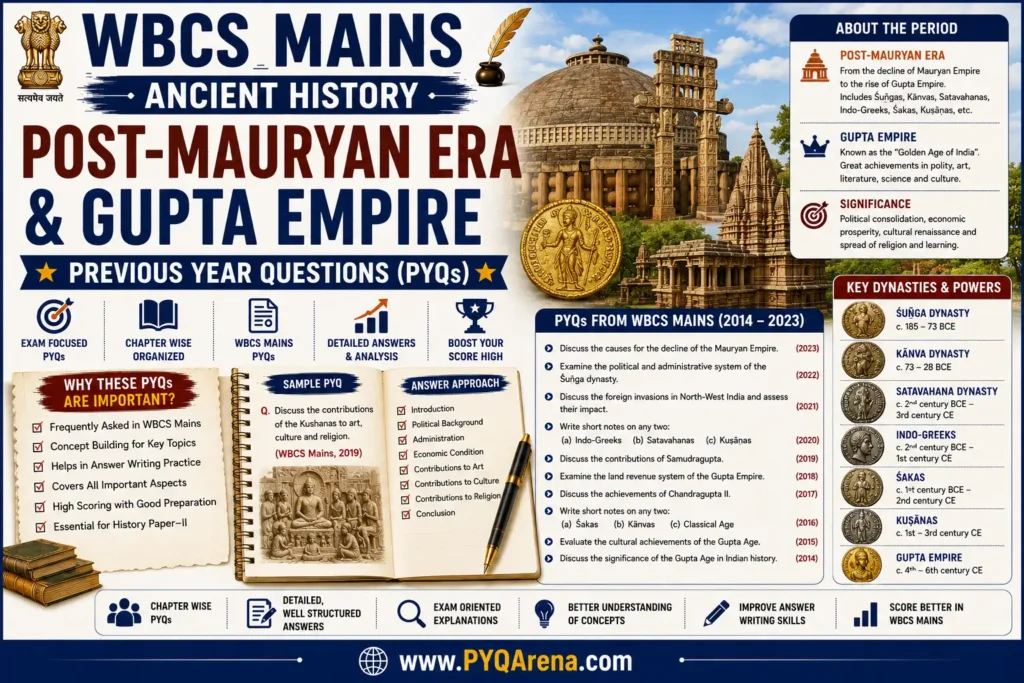
WBCS Mains Gupta Empire Questions 2023
Q. Which Gupta ruler saved the Gupta Empire from the invasion of the Hunas?
(A) Skandagupta
(B) Budhagupta
(C) Tathagata Gupta
(D) Vishnu Gupta
Answer & Explanation
Correct Answer: (A) Skandagupta
Explanation
Skandagupta successfully defended the Gupta Empire against the Hunas (Huns) during the 5th century CE. His inscriptions, particularly the Junagadh inscription, indicate that he faced serious military challenges during his reign. His victories over the invading forces helped preserve the Gupta Empire for a time, although the empire gradually weakened after his death.
Exam Facts
- Skandagupta ruled approximately from c. 455 to 467 CE.
- He is generally regarded as the last powerful Gupta ruler.
- Skandagupta successfully resisted the early Huna invasions into the Gupta Empire.
- The Junagadh inscription provides important information about his reign and mentions his military achievements.
- The Bhitari Pillar Inscription also records Skandagupta’s military successes.
- The Hunas later established a strong presence in northwestern and northern India under rulers such as Toramana and Mihirakula.
- Buddhagupta was a later Gupta ruler whose reign saw the increasing weakening of Gupta political authority.
- The Gupta Empire gradually declined due to factors including Huna invasions, succession problems, and the rise of regional powers.
- Skandagupta is sometimes compared with Chandragupta II and Samudragupta as one of the major military rulers of the Gupta period.
Q. Which Gupta ruler took the title of ‘Vikramaditya’?
(A) Chandragupta I
(B) Samudragupta
(C) Chandragupta II
(D) Skandagupta
Answer & Explanation
Correct Answer: (C) Chandragupta II
Explanation
Chandragupta II, the son of Samudragupta, adopted the title Vikramaditya, meaning “Valour of the Sun” or “Sun of Valour.” He was one of the most powerful Gupta rulers, and his reign witnessed major achievements in politics, trade, art, literature, and culture. His victory over the Western Kshatrapas (Sakas) greatly expanded the Gupta Empire toward western India.
Exam Facts
- Chandragupta II ruled approximately from c. 380 to 415 CE.
- He adopted the prestigious title Vikramaditya.
- He defeated the Western Kshatrapas (Sakas) and annexed important territories in western India.
- His victory over the Sakas gave the Guptas access to important western coastal trade routes and ports.
- The Gupta period under Chandragupta II is associated with major developments in art, literature, science, and culture.
- The Chinese Buddhist pilgrim Faxian (Fa-Hien) visited India during Chandragupta II’s reign.
- Samudragupta, Chandragupta II’s father, is famous for his extensive military conquests and is described as the “Napoleon of India” by historian V.A. Smith.
- Chandragupta I adopted the title Maharajadhiraja and strengthened the Gupta dynasty through his marriage with Kumaradevi, a Lichchhavi princess.
- Skandagupta is particularly remembered for successfully resisting the Huna invasions.
Q. Who composed ‘Nagananda’ and ‘Ratnabali’?
(A) Harshavardhana
(B) Kanishka
(C) Samudragupta
(D) Chandragupta II
Answer & Explanation
Correct Answer: (A) Harshavardhana
Explanation
Harshavardhana, the ruler of the Pushyabhuti (Vardhana) dynasty, is traditionally credited with composing three Sanskrit dramas: Nagananda, Ratnavali, and Priyadarshika. These works demonstrate his literary interests and knowledge of Sanskrit literature. Nagananda is particularly notable for its theme of compassion and self-sacrifice, reflecting Buddhist ethical influences.
Exam Facts
- Harshavardhana (Harsha) ruled much of northern India from approximately 606 to 647 CE.
- He is traditionally credited with writing Nagananda, Ratnavali, and Priyadarshika.
- These works were composed in Sanskrit.
- Nagananda tells the story of Jimutavahana, who offers himself to save the Nagas from the serpent Garuda.
- Ratnavali is a romantic drama centred on King Udayana and Ratnavali.
- Priyadarshika is another Sanskrit romantic drama attributed to Harsha.
- Banabhatta, Harsha’s court poet, wrote Harshacharita, an important source for Harsha’s life and reign.
- The Chinese pilgrim Xuanzang (Hiuen Tsang) visited Harsha’s kingdom and provides valuable information about his administration and society.
- Samudragupta is famous for his military conquests and is praised in the Allahabad Pillar Inscription composed by Harisena.
Q. Who had Nine Jewels in his royal court?
(A) Chandragupta II
(B) Samudragupta
(C) Chandragupta I
(D) Chandragupta Maurya
Answer & Explanation
Correct Answer: (A) Chandragupta II
Explanation
Chandragupta II, also known as Vikramaditya, is traditionally associated with the Navaratnas (Nine Jewels) in his royal court. These were renowned scholars, poets, scientists, and intellectuals who are said to have contributed to the cultural brilliance of the Gupta age. However, historians note that the traditional list of nine jewels is found in later literary traditions and cannot be firmly established as a contemporary historical court list.
Exam Facts
- Chandragupta II is traditionally associated with the Navaratnas (Nine Jewels).
- He ruled approximately from c. 380 to 415 CE and was one of the most powerful Gupta rulers.
- The traditional Navaratna list includes figures such as Kalidasa, Amarasimha, Varahamihira, Dhanvantari, and Vararuchi.
- Kalidasa is regarded as one of India’s greatest Sanskrit poets and dramatists.
- Varahamihira was a renowned astronomer and mathematician who wrote Brihat Samhita and Pancha-Siddhantika.
- Amarasimha is traditionally credited with Amarakosha, an important Sanskrit thesaurus.
- The association of all nine figures with Chandragupta II’s actual court is not firmly supported by contemporary Gupta inscriptions.
- Chandragupta II adopted the title Vikramaditya and defeated the Western Kshatrapas (Sakas).
- The Chinese traveller Faxian (Fa-Hien) visited India during Chandragupta II’s reign and left valuable observations about contemporary Indian society.
WBCS Mains Gupta Empire Questions 2022
Q. Sasanka was the ruler of
(A) Kanauj
(B) Pataliputra
(C) Gaur
(D) Assam
Answer & Explanation
Correct Answer: (C) Gaur
Explanation
Sasanka (Shashanka) was the powerful ruler of Gaur (Gauda) in Bengal during the early 7th century CE. He is generally regarded as the first major independent ruler of ancient Bengal. His kingdom was centred in Gauda, and he played an important role in the political struggles of northern India during the period of Harshavardhana.
Exam Facts
- Sasanka ruled Gauda (Gaur) in Bengal during the early 7th century CE.
- He is generally regarded as one of the earliest major rulers to establish an independent kingdom in Bengal.
- His capital was Karnasuvarna, near present-day Murshidabad, West Bengal.
- Sasanka was a contemporary of Harshavardhana of Kanauj.
- He was involved in political rivalry with Harsha and Bhaskaravarman of Kamarupa (Assam).
- After Sasanka’s death, political instability affected Bengal, eventually contributing to the emergence of the Pala dynasty.
- Sasanka was a prominent Shaiva ruler and is associated with the worship of Shiva.
- Harshavardhana ruled from Kanauj and became the dominant ruler of much of northern India during the 7th century.
- Bhaskaravarman was the important ruler of Kamarupa (Assam) and was an ally of Harsha.
Q. The Allahabad Pillar Inscription dates back to the
(A) Maurya period
(B) Gupta period
(C) Kushan period
(D) Saka period
Answer & Explanation
Correct Answer: (B) Gupta period
Explanation
The Allahabad Pillar Inscription, also known as the Prayaga Prashasti, belongs to the Gupta period and is an important source for the reign and conquests of Samudragupta. It was composed by his court poet and minister Harisena in Sanskrit. The inscription describes Samudragupta’s military campaigns and provides valuable information about the political geography of 4th-century India.
Exam Facts
- The Allahabad Pillar Inscription is also called the Prayaga Prashasti.
- It is associated with Samudragupta, one of the greatest Gupta rulers.
- The inscription was composed by Harisena, Samudragupta’s court poet and high official.
- It is written in Sanskrit and uses the Brahmi script.
- The inscription provides detailed information about Samudragupta’s conquests and political relationships.
- Samudragupta’s southern campaign and his treatment of different rulers are described in the inscription.
- The pillar itself originally dates to the Mauryan period and is associated with Ashoka; the Gupta-period inscription was later engraved on it.
- The same pillar also contains inscriptions associated with Ashoka and later rulers.
- Samudragupta is famously described by V. A. Smith as the “Napoleon of India” because of his extensive military campaigns.
- The Allahabad Pillar Inscription is one of the most important epigraphic sources for Gupta history.
Q. The Chinese pilgrim Fa Hien had visited India during the reign of
(A) Chandragupta II Vikramaditya
(B) Bimbisara
(C) Harshavardhan
(D) Kharvela
Answer & Explanation
Correct Answer: (A) Chandragupta II Vikramaditya
Explanation
The Chinese Buddhist pilgrim Fa Hien (Faxian) visited India during the reign of Chandragupta II Vikramaditya, approximately between 399 and 414 CE. His main purpose was to visit important Buddhist sites and obtain Buddhist scriptures. His travel account, known as the Record of Buddhist Kingdoms, provides valuable information about Indian society, religion, administration, and the condition of Buddhism during the Gupta period.
Exam Facts
- Fa Hien (Faxian) was a Chinese Buddhist monk and pilgrim.
- He visited India during the reign of Chandragupta II, approximately 399–414 CE.
- His journey to India was primarily motivated by the desire to obtain Buddhist texts and visit sacred Buddhist sites.
- His travel account is commonly known as Foguo Ji (Record of Buddhist Kingdoms).
- Fa Hien visited important Buddhist centres including Pataliputra, Mathura, and Kapilavastu, among others.
- He described Pataliputra as a prosperous city and praised the charitable institutions and public facilities he observed.
- His account suggests that Buddhism was flourishing in several parts of India, although Brahmanical traditions were also prominent.
- Xuanzang (Hiuen Tsang) visited India much later, during the reign of Harshavardhana in the 7th century CE.
- Chandragupta II is also known by the title Vikramaditya and is associated with the Gupta Empire’s expansion into western India.
Q. The Gupta Era starts from the reign of
(A) Chandragupta I
(B) Samudragupta
(C) Kumargupta
(D) Budhagupta
Answer & Explanation
Correct Answer: (A) Chandragupta I
Explanation
The Gupta Era is generally considered to have begun in 319–320 CE, during the reign of Chandragupta I. The beginning of this era is traditionally associated with Chandragupta I’s accession and marks the rise of the Gupta dynasty as a major imperial power in northern India.
Exam Facts
- The Gupta Era began around 319–320 CE.
- It is traditionally associated with the reign and accession of Chandragupta I.
- Chandragupta I ruled approximately from c. 319 to 335 CE.
- He adopted the prestigious title Maharajadhiraja, reflecting the growing power of the Gupta dynasty.
- Chandragupta I strengthened his position through his marriage with Kumaradevi, a Lichchhavi princess.
- Gupta coins depicting Chandragupta I and Kumaradevi are important sources for this royal alliance.
- Samudragupta, Chandragupta I’s successor, greatly expanded the Gupta Empire through military campaigns.
- Chandragupta II Vikramaditya later expanded the empire into western India by defeating the Western Kshatrapas.
- The Gupta Era should not be confused with the Saka Era, which begins in 78 CE.
Q. The author of ‘Harshacharit’ was
(A) Nagarjuna
(B) Banabhatta
(C) Aryabhatta
(D) Varahamihir
Answer & Explanation
Correct Answer: (B) Banabhatta
Explanation
Harshacharita was written by Banabhatta (Bana), the court poet of Harshavardhana. Composed in Sanskrit, it is a biographical account of Harsha’s life and reign and is one of the most important literary sources for the history of 7th-century northern India. Although it contains literary embellishments, it provides valuable information about Harsha and his contemporary political environment.
Exam Facts
- Harshacharita was written by Banabhatta.
- Banabhatta was the court poet of Harshavardhana.
- The work was composed in Sanskrit.
- It describes the life, family background, accession, and early career of Harshavardhana.
- Harshacharita is considered one of the earliest important historical biographies in Sanskrit literature.
- Banabhatta also wrote Kadambari, one of the famous prose romances of Sanskrit literature.
- Harshavardhana ruled much of northern India approximately from 606 to 647 CE.
- The Chinese pilgrim Xuanzang (Hiuen Tsang) visited Harsha’s kingdom and provides an independent account of his reign.
- Aryabhata was a renowned mathematician and astronomer who wrote Aryabhatiya.
- Varahamihira was an astronomer and mathematician associated with works such as Brihat Samhita and Pancha-Siddhantika.
Q. The term “Sakari” was used for
(A) Chandragupta II Vikramaditya
(B) Samudragupta
(C) Kumargupta
(D) Skandagupta
Answer & Explanation
Correct Answer: (A) Chandragupta II Vikramaditya
Explanation
The title “Sakari” means “destroyer of the Sakas” or “enemy of the Sakas.” It is associated with Chandragupta II Vikramaditya, who defeated the Western Kshatrapas (Sakas) and annexed their territories in western India. His victory over the Sakas significantly expanded the Gupta Empire and strengthened its control over important western trade routes.
Exam Facts
- Chandragupta II is associated with the title Sakari, meaning “destroyer of the Sakas.”
- He defeated the Western Kshatrapas (Saka rulers) in western India.
- The conquest of Malwa, Gujarat, and Saurashtra greatly expanded Gupta territory.
- Control of western India gave the Guptas access to important trade routes and ports on the Arabian Sea.
- Chandragupta II also adopted the famous title Vikramaditya.
- His reign is regarded as an important phase of the Gupta cultural and political high point.
- The Chinese pilgrim Fa Hien (Faxian) visited India during Chandragupta II’s reign.
- Samudragupta is famous for his extensive military campaigns and is described in the Allahabad Pillar Inscription.
- Skandagupta is particularly remembered for successfully resisting the Huna invasions.
Q. Who was known as the “Indian Napoleon”?
(A) Kumargupta
(B) Skandagupta
(C) Samudaurgupta
(D) Yasodharman
Answer & Explanation
Correct Answer: (C) Samudragupta
Explanation
Samudragupta, one of the greatest rulers of the Gupta Empire, is popularly described as the “Napoleon of India” by historian V. A. Smith because of his extensive military conquests. His victories across northern and southern India are recorded in detail in the Allahabad Pillar Inscription (Prayaga Prashasti), composed by his court poet Harisena.
Exam Facts
- Samudragupta ruled approximately from c. 335 to 375 CE.
- Historian V. A. Smith famously called him the “Napoleon of India” because of his military achievements.
- His military campaigns are described in the Allahabad Pillar Inscription.
- The inscription was composed by Harisena, who was Samudragupta’s court poet and high official.
- Samudragupta conquered numerous kingdoms in northern India and undertook a major expedition into southern India.
- In southern India, he generally followed a policy of defeating rulers and then reinstating them rather than directly annexing their territories.
- Samudragupta was also a patron of art and music and is depicted playing the veena on some of his gold coins.
- He performed the Ashvamedha sacrifice, commemorated through special gold coins.
- Chandragupta II succeeded Samudragupta and is associated with the titles Vikramaditya and Sakari.
- Yashodharman of Malwa is famous for defeating the Huna ruler Mihirakula in the 6th century CE.
WBCS Mains Gupta Empire Questions 2020
Q. What was the ‘Araghatta’?
(A) A machine to break forts
(B) An irrigation
(C) A device to lift water
(D) A type of cloth
Answer & Explanation
Correct Answer: (C) A device to lift water
Explanation
The Araghatta was a water-lifting device used for irrigation in ancient and medieval India. It generally consisted of a wheel fitted with pots or containers that lifted water from wells or other water sources as the wheel rotated. It played an important role in expanding irrigated agriculture, particularly in regions where wells were used for cultivation.
Exam Facts
- Araghatta was a water-lifting device used primarily for irrigation.
- It commonly operated using a wheel with attached pots or buckets to raise water.
- The device was particularly useful for lifting groundwater from wells.
- Water-lifting technology helped expand agricultural cultivation and irrigation in medieval India.
- The term is associated with the broader development of Persian-wheel-type irrigation technology in the Indian subcontinent.
- The Persian wheel (Saqqiya) was another important water-lifting mechanism that became widely used in medieval India.
- Irrigation systems were especially important for the growth of agriculture and state revenue.
- The development and use of water-lifting devices demonstrate the importance of agricultural technology in pre-modern India.
Q. Which particular city became the nodal point for trade routes running from north to south and east to west in the pre-Gupta and Gupta periods?
(A) Taxila
(B) Mathura
(C) Ujjain
(D) Vidisa
Answer & Explanation
Correct Answer: (C) Ujjain
Explanation
Ujjain emerged as an important nodal centre of trade and communication during the pre-Gupta and Gupta periods because it was strategically located at the intersection of major north–south and east–west trade routes. Its position in Malwa connected northern India with the Deccan and western coastal ports, making it an important commercial and cultural centre.
Exam Facts
- Ujjain was a major commercial and political centre of ancient India.
- Its strategic location made it a junction for north–south and east–west trade routes.
- Ujjain was the capital of the ancient kingdom of Avanti.
- It was located on important routes connecting the Gangetic plain, western India, and the Deccan.
- Ujjain was also connected with major western ports, facilitating long-distance trade.
- The city was an important centre of astronomy and mathematics in later periods.
- Varahamihira, the famous Gupta-period astronomer, was associated with Ujjain.
- Mathura was another major trade and religious centre, particularly important for routes connecting northern India with western regions.
- Taxila was a major commercial and cultural centre in the northwestern subcontinent, connecting India with Central Asia.
- Vidisa (Vidisha) was an important commercial and cultural centre of central India, but Ujjain was the major nodal point described in this context.
WBCS Mains Gupta Empire Questions 2019
Q. Lands, during the post-Gupta period, were classified on the basis of
(A) Being cultivated and uncultivated
(B) Being irrigated and unirrigated
(C) Crops being grown on the lands
(D) All of the above
Answer & Explanation
Correct Answer: (D) All of the above
Explanation
During the post-Gupta period, land was classified using several criteria to facilitate agricultural administration and revenue assessment. The classification could take into account whether land was cultivated or uncultivated, whether it was irrigated or unirrigated, and the type of crops cultivated. Such classifications helped rulers and local authorities assess agricultural productivity and revenue obligations.
Exam Facts
- Land classification became increasingly important for revenue assessment and agricultural administration during the post-Gupta period.
- Land could be distinguished as cultivated and uncultivated.
- Agricultural land could also be classified as irrigated or unirrigated, reflecting differences in productivity.
- The type of crop grown was another factor relevant to agricultural assessment.
- The expansion of agriculture and irrigation was an important feature of the post-Gupta period.
- Land grants to Brahmanas, temples, and religious institutions became increasingly common during the early medieval period.
- Such grants are recorded in numerous copper-plate inscriptions, which provide valuable information about land, boundaries, taxes, and administrative arrangements.
- The growth of land grants contributed to the development of regional landed elites and intermediary groups.
- Agricultural expansion and changing patterns of landholding played an important role in the transition toward early medieval political and social structures.
WBCS Mains Gupta Empire Questions 2018
Q. The theory of the emergence of feudalism in the post-Gupta period is disputed on the ground that
(A) all the lands donated were not secular land grants.
(B) the status of the peasants was not that of serfs.
(C) the brahmin donees did not always belong to the ruling class.
(D) All of the three above
Answer & Explanation
Correct Answer: (D) All of the three above
Explanation
The Indian feudalism debate concerning the post-Gupta period is disputed because the socio-economic conditions of early medieval India did not exactly correspond to the European model of feudalism. Historians have questioned the theory on several grounds: not all land grants were secular, peasants cannot uniformly be equated with European serfs, and Brahmin donees were not necessarily members of a conventional ruling or warrior class. Therefore, all three statements provide grounds for questioning a simplistic application of the feudalism model to India.
Exam Facts
- The theory of Indian feudalism was particularly developed by historian R. S. Sharma.
- The post-Gupta period witnessed a significant increase in land grants to Brahmanas, temples, and religious institutions.
- Land grants were often recorded in copper-plate inscriptions, which provide information about boundaries, taxes, rights, and obligations.
- Not all land grants were secular grants intended to create a conventional feudal landed class.
- Indian peasants cannot simply be equated with European serfs, as the nature of their obligations and rights varied across regions and periods.
- Brahmin donees were primarily religious beneficiaries and did not necessarily constitute a ruling or military aristocracy.
- The concept of Indian feudalism remains a subject of historiographical debate, with historians differing over the extent and nature of feudal relationships.
- The post-Gupta period also witnessed the growth of regional political powers, agrarian expansion, and intermediary groups.
- Land grants and decentralisation of certain administrative and fiscal rights are important elements in the debate over early medieval Indian social and economic structures.
WBCS Mains Gupta Empire Questions 2017
Q. By whom and when the Gupta era was started?
(A) Kumargupta I in 324 CE
(B) Srigupta in 309-10 CE
(C) Chandragupta I in 319-320 CE
(D) Samudragupta in 324 CE
Answer & Explanation
Correct Answer: (C) Chandragupta I in 319–320 CE
Explanation
The Gupta Era is traditionally considered to have begun in 319–320 CE, generally associated with the accession of Chandragupta I. The beginning of the era marks the emergence of the Guptas as a major imperial power in northern India. Chandragupta I adopted the title Maharajadhiraja and strengthened his position through his marriage with Kumaradevi, a Lichchhavi princess.
Exam Facts
- The Gupta Era began in 319–320 CE.
- It is traditionally associated with Chandragupta I.
- Chandragupta I ruled approximately from c. 319 to 335 CE.
- He adopted the title Maharajadhiraja, indicating his elevated imperial status.
- His marriage with Kumaradevi, a Lichchhavi princess, strengthened the Gupta dynasty’s political position.
- Coins depicting Chandragupta I and Kumaradevi are important evidence of this alliance.
- Samudragupta succeeded Chandragupta I and greatly expanded the Gupta Empire through extensive military campaigns.
- The Allahabad Pillar Inscription (Prayaga Prashasti) records the achievements of Samudragupta.
- The Gupta Era is also known as the Gupta-Vikrama Era in some historical contexts.
- The Gupta Era should not be confused with the Saka Era, which begins in 78 CE.
Q. King “Chandra” of Mehrauli Iron Pillar inscription has been identified with
(A) Chandragupta Maurya
(B) Chandragupta I (Gupta)
(C) Chandrasen
(D) Chandragupta II (Gupta)
Answer & Explanation
Correct Answer: (D) Chandragupta II (Gupta)
Explanation
The “Chandra” mentioned in the Mehrauli Iron Pillar Inscription is generally identified with Chandragupta II, the powerful Gupta ruler who also adopted the title Vikramaditya. The inscription praises King Chandra for his military victories, particularly in Vanga (Bengal) and against rulers in the northwest, and for his devotion to Vishnu.
Exam Facts
- The Mehrauli Iron Pillar Inscription is an important source for the history of the Gupta period.
- The king named “Chandra” in the inscription is generally identified with Chandragupta II Vikramaditya.
- Chandragupta II ruled approximately from c. 380 to 415 CE.
- The inscription records Chandra’s military victories in Vanga and against enemies in the northwest.
- The Iron Pillar is associated with Vishnu, and the inscription indicates that King Chandra was a devotee of Vishnu.
- The pillar is located in the Qutb complex at Mehrauli, Delhi.
- The iron pillar is famous for its remarkable resistance to corrosion and is an outstanding example of ancient Indian metallurgical skill.
- Chandragupta II defeated the Western Kshatrapas (Sakas) and expanded Gupta power into Malwa, Gujarat, and Saurashtra.
- Chandragupta II adopted the title Vikramaditya and is traditionally associated with the Navaratnas (Nine Jewels).
- The Chinese pilgrim Fa Hien (Faxian) visited India during Chandragupta II’s reign.
Q. Name the author of ‘Panchatantra’ and ‘Svapna-Vasavadatta’.
(A) Kalidasa
(B) Bhasa
(C) Ashvaghosha
(D) Kalhan
Answer & Explanation
Correct Answer: (B) Bhasa
Explanation
Bhasa is traditionally credited with the Sanskrit drama Svapna-Vasavadatta. However, the Panchatantra is traditionally attributed to Vishnu Sharma, not Bhasa. Therefore, the question as framed contains an error. Among the given options, Bhasa is the correct answer only if the question is asking specifically about Svapna-Vasavadatta.
Exam Facts
- Svapna-Vasavadatta (“The Dream of Vasavadatta”) is traditionally attributed to Bhasa, one of the earliest known Sanskrit dramatists.
- Bhasa is traditionally credited with several Sanskrit plays, including Pratijna-Yaugandharayana and Urubhanga.
- The Panchatantra is traditionally attributed to Vishnu Sharma.
- The Panchatantra is a collection of animal fables and moral stories, traditionally organised into five books.
- Panchatantra had a major influence on storytelling traditions beyond India and was translated into Persian and Arabic, among other languages.
- Kalidasa is famous for works such as Abhijnanashakuntalam, Meghaduta, and Raghuvamsha.
- Ashvaghosha was a Buddhist poet and philosopher associated with Buddhacharita.
- Kalhana wrote Rajatarangini, a famous historical chronicle of Kashmir.
- Exam caution: If this exact MCQ appears in a PYQ source, it may contain a printing/compilation error, because no option correctly identifies the traditional author of both works.
Q. The dynasty which Harshavardhan belonged to was
(A) Varmans
(B) Maukharis
(C) Pushyamitras
(D) Pushyabhutis
Answer & Explanation
Correct Answer: (D) Pushyabhutis
Explanation
Harshavardhana belonged to the Pushyabhuti dynasty, also known as the Vardhana dynasty. He became ruler in 606 CE and established his political centre at Kannauj, eventually becoming the dominant ruler of much of northern India. His reign is an important phase in the history of post-Gupta northern India.
Exam Facts
- Harshavardhana belonged to the Pushyabhuti (Vardhana) dynasty.
- He ruled approximately from 606 to 647 CE.
- His political centre became Kannauj, which emerged as a major centre of power in northern India.
- Harsha succeeded his brother Rajyavardhana after the latter’s death.
- His sister Rajyashri was married to Grahavarman, the Maukhari ruler of Kannauj.
- Harsha was a contemporary of Sasanka of Gauda and Bhaskaravarman of Kamarupa.
- The Chinese pilgrim Xuanzang (Hiuen Tsang) visited Harsha’s kingdom and left a detailed account of his reign.
- Banabhatta, Harsha’s court poet, wrote Harshacharita.
- Harsha is traditionally credited with composing Nagananda, Ratnavali, and Priyadarshika.
- The Maukharis were a separate dynasty that ruled Kannauj before Harsha established his dominance there.
Q. Which of the following 7th century Chinese travellers lived for ten years in the great monastery of Nalanda?
(A) Fa Hien
(B) Hiuen Tsang
(C) Yijing
(D) Arrian
Answer & Explanation
Correct Answer: (C) Yijing
Explanation
Yijing (I-Tsing) was a 7th-century Chinese Buddhist monk and traveller who spent several years studying at Nalanda Mahavihara. He stayed in India for roughly 10 years, including a long period at Nalanda, where he studied Buddhist philosophy, Sanskrit, and monastic practices. His writings provide valuable information about Nalanda and Buddhist education in India.
Exam Facts
- Yijing (I-Tsing) was a Chinese Buddhist monk and traveller of the 7th century CE.
- He travelled to India in 671 CE to study Buddhism and collect Buddhist scriptures.
- He spent approximately 10 years in India, with a significant period at Nalanda.
- Yijing studied Buddhist philosophy, Sanskrit, and monastic discipline at Nalanda.
- His writings provide valuable information about Nalanda’s academic life, Buddhist practices, and daily routines of monks.
- Hiuen Tsang (Xuanzang) also studied at Nalanda for an extended period and described the university in considerable detail, but the traveller traditionally associated with a ten-year stay in India/Nalanda in this question is Yijing.
- Fa Hien visited India during the reign of Chandragupta II in the early 5th century CE.
- Arrian was a Greek historian and writer, not a Chinese traveller.
- Nalanda developed into one of the most important centres of Buddhist learning and higher education in ancient India.
Q. Which of the following Gupta rulers is said to have embraced Buddhism towards the end of his life and also founded the Nalanda University?
(A) Skandagupta
(B) Buddhagupta
(C) Purugupta
(D) Kumaragupta I
Answer & Explanation
Correct Answer: (D) Kumaragupta I
Explanation
Kumaragupta I is traditionally credited with founding or establishing the great Buddhist centre of learning at Nalanda during the 5th century CE. He is also said in some later traditions to have shown sympathy towards Buddhism toward the end of his life. Nalanda subsequently developed into one of the most renowned centres of Buddhist learning in Asia.
Exam Facts
- Kumaragupta I ruled the Gupta Empire approximately from c. 415 to 455 CE.
- He is traditionally associated with the foundation of Nalanda Mahavihara.
- Nalanda was located in present-day Bihar and eventually became a major centre of Buddhist learning.
- Chinese pilgrims such as Xuanzang (Hiuen Tsang) and Yijing (I-Tsing) later described Nalanda’s academic and monastic life.
- Kumaragupta I adopted the title Mahendraditya.
- His reign witnessed the early stages of the Huna threat, which became more serious during the reign of his successor Skandagupta.
- Skandagupta is famous for successfully resisting the early Huna invasions.
- Buddhagupta was a later Gupta ruler during a period of increasing political fragmentation.
- Nalanda eventually became one of the most important centres for the study of Buddhism, philosophy, grammar, logic, and other branches of knowledge.
Q. Who among the following was the first to describe Sudras as a class of agriculturists?
(A) Manu
(B) Fa Hien
(C) Hiuen Tsang
(D) Narad
Answer & Explanation
Correct Answer: (B) Fa Hien
Explanation
The Chinese Buddhist traveller Fa Hien (Faxian) was the first among these sources to describe the Sudras as agriculturists in his account of India. His observations, made during the reign of Chandragupta II, provide valuable information about Indian society, administration, religion, and economic life in the early Gupta period.
Exam Facts
- Fa Hien (Faxian) visited India during the reign of Chandragupta II Vikramaditya.
- He travelled in India approximately between 399 and 414 CE.
- His account is generally known as the Record of Buddhist Kingdoms.
- Fa Hien provides observations on social conditions, religious practices, administration, and economic life.
- His account suggests that agriculture was an important occupation among sections of the population.
- Hiuen Tsang (Xuanzang) visited India much later, during the reign of Harshavardhana in the 7th century CE.
- Manu is traditionally associated with the Manusmriti, which discusses the duties and social position of the four varnas.
- Narada is associated with the Narada Smriti, an important text dealing particularly with law and jurisprudence.
- Fa Hien’s account is an important foreign source for Gupta-period India, although his primary interest was Buddhist religious sites and institutions.
WBCS Mains Gupta Empire Questions 2016
Q. Mandsor pillar inscription of the early 6th Century CE belongs to
(A) Anantavarman
(B) Mihirkula
(C) Yasodharman
(D) Toramana
Answer & Explanation
Correct Answer: (C) Yasodharman
Explanation
The Mandsor (Mandsaur) Pillar Inscription of the early 6th century CE is associated with Yasodharman of Malwa. The inscription celebrates his victories and claims that he defeated the powerful Huna ruler Mihirakula. It is an important source for understanding the decline of Huna power and the rise of regional rulers in northern India.
Exam Facts
- The Mandsor Pillar Inscription is associated with Yasodharman of Malwa.
- It dates to approximately 532 CE, in the early 6th century.
- The inscription records Yasodharman’s military victories and political achievements.
- It famously claims that Mihirakula, the Huna ruler, was defeated by Yasodharman.
- Mihirakula was one of the most powerful Huna rulers in India and was associated with the Alchon Huns.
- Yasodharman’s kingdom was centred in Malwa, with Mandsaur as an important centre.
- The inscription is an important source for the history of post-Gupta India and the decline of Huna dominance.
- Toramana was the father and predecessor of Mihirakula among the prominent Huna rulers in India.
- Anantavarman is associated with later regional history and is not the ruler commemorated in the Mandsor pillar inscription.
Q. Navanityakam of the Gupta period was a book on
(A) Medicine
(B) Metallurgy
(C) Mathematics
(D) Astronomy
Answer & Explanation
Correct Answer: (A) Medicine
Explanation
Navanitakam was a work on medicine associated with the Gupta period. It is considered an important text in the history of Ayurvedic medicine and contains medical knowledge relating to diseases, treatments, and medicinal preparations.
Exam Facts
- Navanitakam was a medical text associated with the Gupta period.
- It deals with Ayurvedic medicine and medical treatment.
- The Gupta period witnessed significant developments in medicine, mathematics, astronomy, and other sciences.
- Charaka Samhita is a foundational work of Ayurvedic medicine, particularly associated with internal medicine.
- Sushruta Samhita is famous for its detailed treatment of surgery and surgical techniques.
- Aryabhata wrote Aryabhatiya, an important work on mathematics and astronomy.
- Varahamihira wrote Brihat Samhita and Pancha-Siddhantika, important works dealing with astronomy and related sciences.
- The Gupta period is often described as a major period of advancement in Indian science and intellectual traditions.
Q. Who among the following dynasties were the first to transfer all sources of revenue to the Brahmans?
(A) Vakatakas
(B) Guptas
(C) Pallavas
(D) Chalukyas
Answer & Explanation
Correct Answer: (A) Vakatakas
Explanation
The Vakatakas are regarded in many historical accounts as among the earliest dynasties to make extensive land grants to Brahmanas, sometimes transferring not merely land but also various fiscal privileges and revenue rights associated with the donated territory. These grants contributed to the growing importance of Brahmana landholders during the post-Gupta/early medieval transition.
Exam Facts
- The Vakatakas ruled parts of the Deccan and central India, approximately from the 3rd to 5th centuries CE.
- Vakataka rulers made numerous land grants to Brahmanas, often recorded on copper plates.
- Such grants could include rights over taxes, dues, and other sources of revenue from the donated villages.
- Pravarasena I was one of the most important Vakataka rulers and is known for performing several Vedic sacrifices, including the Ashvamedha.
- The Vakatakas were important patrons of Brahmanical religion, while also being connected with the cultural development of the Deccan.
- The famous Ajanta caves received significant patronage during the later Vakataka period, particularly under Harishena.
- The expansion of land grants and fiscal privileges to religious beneficiaries became increasingly common in the post-Gupta and early medieval period.
- The Guptas, Pallavas, and Chalukyas also issued substantial land grants to Brahmanas, but the Vakatakas are particularly highlighted in this context.
- Copper-plate grants are valuable sources for reconstructing the agrarian, fiscal, and administrative history of early India.
WBCS Mains Gupta Empire Questions 2015
Q. Kalidasa’s work include: (i) Abhigyana Sakuntalam (ii) Meghadootam (iii) Raghuvamsa (iv) Malavikagnimitram (v) Ritusamhara (vi) Kumara Sambhava
(A) All of them
(B) i, ii, iii and iv
(C) i, ii, v and vi
(D) i, iii, iv and v
Answer & Explanation
Correct Answer: (A) All of them
Explanation
All six works listed are traditionally attributed to Kalidasa, one of the greatest Sanskrit poets and dramatists of ancient India. His works cover drama, epic poetry, lyric poetry, and descriptive poetry. Abhijnana Shakuntalam is his most famous drama, while Raghuvamsa and Kumarasambhava are celebrated Sanskrit mahakavyas.
Exam Facts
- Kalidasa is traditionally regarded as one of the greatest poets and dramatists of classical Sanskrit literature.
- His three famous dramas are Abhijnana Shakuntalam, Malavikagnimitram, and Vikramorvashiyam.
- Abhijnana Shakuntalam tells the story of Shakuntala and King Dushyanta and is one of the best-known works of Sanskrit literature.
- Meghadutam (Meghaduta) is a famous lyric poem in which an exiled Yaksha sends a message to his beloved through a cloud.
- Raghuvamsa is a mahakavya describing the lineage of the Raghu dynasty, including rulers such as Rama.
- Kumarasambhava deals with the birth of Kumara (Kartikeya) and the union of Shiva and Parvati.
- Ritusamhara is a descriptive poem traditionally attributed to Kalidasa that celebrates the six seasons of India.
- Malavikagnimitram is a Sanskrit drama centred on King Agnimitra and Malavika.
- Kalidasa’s exact historical date and royal patronage remain debated, although he is traditionally associated with the Gupta age.
Q. When were the Silkworms introduced into the Byzantine empire from China, adversely affecting India’s already declining foreign trade?
(A) 451 AD
(B) 551 AD
(C) 615 AD
(D) 351 AD
Answer & Explanation
Correct Answer: (B) 551 AD
Explanation
According to traditional historical accounts, silkworms were secretly taken from China to the Byzantine Empire around 551 CE by two monks, during the reign of Emperor Justinian I. This enabled the Byzantines to develop their own silk industry, reducing their dependence on imported Chinese silk and affecting the traditional silk trade routes that had also benefited India.
Exam Facts
- Silkworms were introduced into the Byzantine Empire around 551 CE.
- The event occurred during the reign of Byzantine Emperor Justinian I (527–565 CE).
- According to the traditional account, two monks secretly carried silkworm eggs or larvae from China to the Byzantine Empire.
- This enabled the Byzantine Empire to develop sericulture and silk production domestically.
- Before this, China dominated the production of high-quality silk, while silk travelled westward through long-distance trade networks.
- India played an important role in interregional trade between the eastern and western parts of Asia.
- The development of Byzantine silk production reduced the empire’s dependence on Chinese silk imports.
- The 6th century CE witnessed significant changes in long-distance trade networks and the economic position of several Indian regions.
- Justinian I was the Byzantine emperor associated with the codification of Roman law known as the Corpus Juris Civilis.
Q. With which one of the following are the later foreign immigrants like Hunas, who came after the fall of Imperial Guptas, identified?
(A) Kshatriyas
(B) Fallen Kshatriyas
(C) Culturally assimilated Rajputs
(D) Mlechchas
Answer & Explanation
Correct Answer: (C) Culturally assimilated Rajputs
Explanation
The Hunas and other foreign groups who entered India after the decline of the Gupta Empire were gradually assimilated into Indian society. Over time, some of these groups were incorporated into the Rajput social and political order. Therefore, historians have associated certain later foreign immigrant groups with the emergence of culturally assimilated Rajput lineages.
Exam Facts
- The Hunas entered northwestern India in significant numbers during the 5th–6th centuries CE.
- Important Huna rulers in India included Toramana and Mihirakula.
- After the decline of Huna political power, many groups were gradually absorbed into Indian society.
- Some foreign-origin groups are traditionally linked by historians with the formation of Rajput lineages.
- The process involved cultural assimilation, adoption of local customs, and integration into the political and social structure.
- The term Mlechchha was used in ancient Indian texts for groups regarded as outside the established cultural or social order; it does not necessarily describe their eventual social status.
- The Rajput polity became increasingly prominent in northern and western India during the early medieval period.
- The origins of the Rajputs remain a subject of historical debate, with theories involving indigenous lineages as well as the assimilation of foreign groups.
- The Gupta Empire weakened significantly after the reign of Skandagupta, partly due to Huna invasions and internal political pressures.
WBCS Mains Gupta Empire Questions 2014
Q. The Gold coins of the Gupta dynasty were known as
(A) Sataman
(B) Dinara
(C) Muhara
(D) Varaha
Answer & Explanation
Correct Answer: (B) Dinara
Explanation
The gold coins of the Gupta dynasty were known as Dinaras, derived from the Roman denarius/aureus tradition. Gupta rulers issued a large and varied series of gold coins, especially from the reign of Chandragupta I onwards. These coins are important sources for understanding Gupta rulers, their titles, religious beliefs, military achievements, and royal activities.
Exam Facts
- Gupta gold coins were commonly known as Dinaras.
- The term Dinara was derived from the Roman monetary tradition, reflecting the influence of Indo-Roman economic contacts.
- Gupta gold coins are renowned for their high artistic quality and variety of designs.
- Chandragupta I issued gold coins depicting himself with his queen Kumaradevi.
- Samudragupta issued several types of gold coins, including the famous Veena player type, showing him playing a musical instrument.
- Samudragupta also issued Ashvamedha type coins commemorating the performance of the Ashvamedha sacrifice.
- Chandragupta II issued gold coins depicting him as a lion-slayer, reflecting his royal and martial ideals.
- Gupta gold coins provide valuable information about royal titles, religious traditions, military activities, and cultural life.
- Satamana was an ancient unit of weight, while Varaha became associated with later Indian coinage.
Leave a Comment