

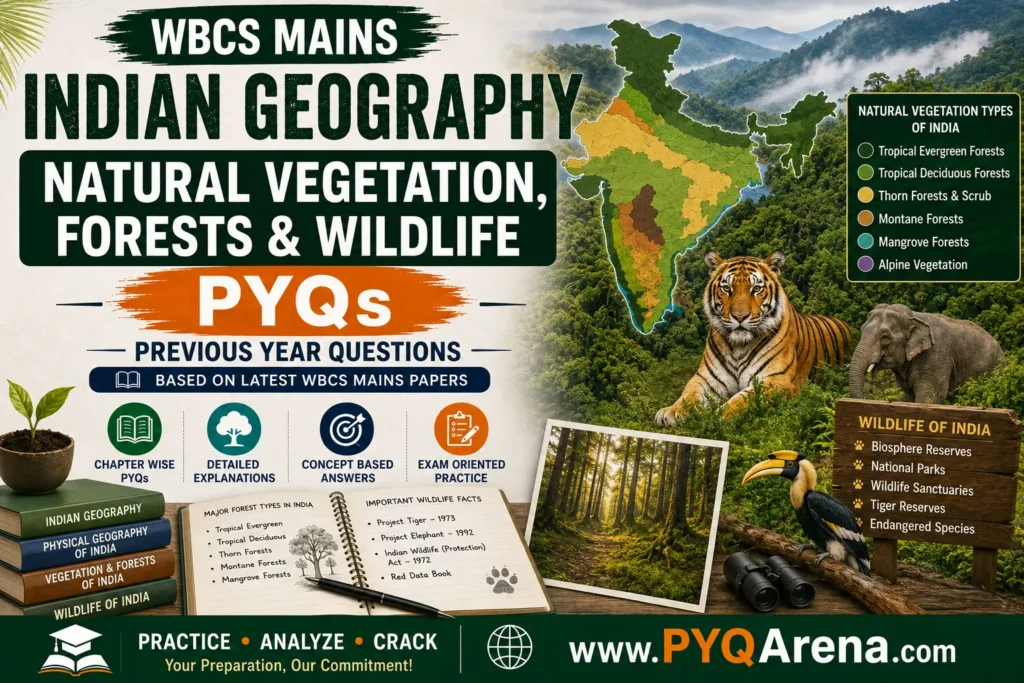
WBCS Mains Natural Vegetation, Forests & Wildlife Questions 2023
Q. Sanjay Dubri Tiger Reserve is located in –
(A) Tamil Nadu
(B) Assam
(C) Goa
(D) Madhya Pradesh
Correct Answer: (D) Madhya Pradesh.
Q. Alpine forests in India occur at the height between –
(A) 4000-5000 meters
(B) 3000-4000 meters
(C) 2000-3000 meters
(D) None of the above
Correct Answer: (B) 3000-4000 meters.
Q. Which Indian state has the largest forest cover by area?
(A) Madhya Pradesh
(B) Arunachal Pradesh
(C) Chhattisgarh
(D) Maharashtra
Correct Answer: (A) Madhya Pradesh.
Q. Which one of the following states of India has the highest area under forest?
(A) Odisha
(B) Himachal Pradesh
(C) Arunachal Pradesh
(D) Assam
Correct Answer: (C) Arunachal Pradesh.
Q. Which state in India is known for its unique “Living Root Bridges”?
(A) Nagaland
(B) Mizoram
(C) Meghalaya
(D) Manipur
Correct Answer: (C) Meghalaya.
Q. H.G. Champion classified India’s vegetation into –
(A) 120 types
(B) 116 types
(C) 110 types
(D) 200 types
Correct Answer: (B) 116 types.
Q. The “Jaldapara National Park” is famous for –
(A) Asiatic lion
(B) Indian rhinoceros
(C) Snow leopard
(D) Bengal tiger
Correct Answer: (B) Indian rhinoceros.
Q. Which Indian state is famous for the Dachigam National Park?
(A) Himachal Pradesh
(B) Uttarakhand
(C) Jammu & Kashmir
(D) Sikkim
Correct Answer: (C) Jammu & Kashmir.
Q. Match the following:
List-I (Wildlife Sanctuary):
I. Kanha
II. Periyar
III. Madumalai
IV. Manas
List-II (Location):
- Assam
- Kerala
- Madhya Pradesh
- Tamil Nadu
Codes:
(A) (3) (2) (1) (4)
(B) (1) (2) (3) (4)
(C) (3) (2) (4) (1)
(D) (4) (3) (2) (1)
Correct Answer: (C) (3) (2) (4) (1).
Q. In which part of India is the Silent Valley National Park located?
(A) Tamil Nadu
(B) Kerala
(C) Karnataka
(D) Andhra Pradesh
Correct Answer: (B) Kerala.
WBCS Mains Natural Vegetation, Forests & Wildlife Questions 2022
Q. Which types of forests are found in the southern slopes of the high Himalayas?
(A) Wet deciduous
(B) Dry deciduous
(C) Tropical evergreen
(D) Conifer evergreen
Correct Answer: (D) Conifer evergreen.
Q. Match the following:
List I (Vegetation Zone):
I. Sub-Tropical Broad Leaved hill forests
II. Himalayan Moist Temperate forests
III. Sub-Tropical Dry Evergreen forests
IV. Montane Wet Temperate
List II (Rainfall):
- 150 cm-300cm
- 75 cm-125 cm
- 150cm-250cm
- 50cm-100cm
Codes:
(A) I – 1, II – 2, III – 3, IV – 4
(B) I – 4, II – 1, III – 2, IV – 3
(C) I – 2, II – 3, III – 4, IV – 1
(D) I – 3, II – 4, III – 1, IV – 2
Correct Answer: (B) I – 4, II – 1, III – 2, IV – 3.
Q. Which State of India has the lowest percentage of its total area under forests?
(A) Jammu & Kashmir
(B) Bihar
(C) Tamil Nadu
(D) Haryana
Correct Answer: (D) Haryana.
Q. The natural vegetation of the desert region in India is called –
(A) Halophytes
(B) Xerophytes
(C) Lithophytes
(D) Heliophytes
Correct Answer: (B) Xerophytes.
Q. In India sandalwood is mostly found in the State of –
(A) Madhya Pradesh
(B) Maharastra
(C) Karnataka
(D) Kerala
Correct Answer: (C) Karnataka.
Q. Kanha National Park is located under which of the following bio-geographical regions?
(A) Tropical sub-humid forest
(B) Tropical humid forest
(C) Tropical dry forest
(D) Tropical monsoon forest
Correct Answer: (C) Tropical dry forest.
Q. Match the following:
List I (Wildlife Sanctuary):
I. Gir
II. Dachigam
III. Kaziranga
IV. Bandipur
List II (Location):
- Assam
- Uttar Pradesh
- Gujarat
- Karnataka
Codes:
(A) I – 3, II – 2, III – 1, IV – 4
(B) I – 1, II – 3, III – 4, IV – 2
(C) I – 2, II – 1, III – 3, IV – 4
(D) I – 4, II – 3, III – 2, IV – 1
Correct Answer: (A) I – 3, II – 2, III – 1, IV – 4.
Q. Which State of India has the maximum number of tiger reserves?
(A) Assam
(B) West Bengal
(C) Maharastra
(D) Madhya Pradesh
Correct Answer: (D) Madhya Pradesh.
WBCS Mains Natural Vegetation, Forests & Wildlife Questions 2021
Q. Which state has the maximum of the teak forests of India?
(A) Bihar
(B) Uttar Pradesh
(C) Karnataka
(D) Madhya Pradesh
Correct Answer: (D) Madhya Pradesh.
Q. White Tiger is conserved in –
(A) Corbett National Park
(B) Kanha National Park
(C) Tadoba National Park
(D) Bandipur National Park
Correct Answer: (B) Kanha National Park.
Q. The region of India is very important from biodiversity point of view –
(A) Eastern Himalaya
(B) Eastern Ghat
(C) Panchmari Hill
(D) Kashmir Valley
Correct Answer: (A) Eastern Himalaya.
Q. The highest area under forest in India lies in –
(A) Arunachal Pradesh
(B) Jammu and Kashmir
(C) Mizoram
(D) The Andaman and Nicobar Islands
Correct Answer: (A) Arunachal Pradesh.
Q. Name the state where the only Ass Sanctuary in India is located.
(A) Bihar
(B) Gujarat
(C) Madhya Pradesh
(D) Rajasthan
Correct Answer: (B) Gujarat.
WBCS Mains Natural Vegetation, Forests & Wildlife Questions 2020
Q. Tadoba National Park known for Sheltering tiger, panther and bear is located in –
(A) Assam
(B) Maharashtra
(C) Karnataka
(D) Tamil Nadu
Correct Answer: (B) Maharashtra.
Q. The minimum forest cover necessary to maintain ecological balance is –
(A) 50% of the total land area.
(B) 40% of the total land area.
(C) 33% of the total land area.
(D) 25% of the total land area.
Correct Answer: (C) 33% of the total land area.
Q. The main species of the coniferous forests of the Himalayas between the altitudes 1600 metres and 3300 meters are –
(A) Cedar, Pine, Sine, Silverfir, Spruce
(B) Sagon and Sakhu
(C) Sandalwood, Rosewood
(D) Oak, Chestnut, Chir, Chil
Correct Answer: (A) Cedar, Pine, Sine, Silverfir, Spruce.
Q. Introduction of Joint Forest Management was an important objective of –
(A) National Forest Policy, 1988
(B) Man and Biosphere Program
(C) Wild Life Protection Act, 1972
(D) None of the above
Correct Answer: (A) National Forest Policy, 1988.
Q. The Baratang Island mangroves is located in which of the following places of India?
(A) Lakshadweep
(B) Andaman and Nicobar
(C) New Moore
(D) Odisha
Correct Answer: (B) Andaman and Nicobar.
Q. With reference to Indian forests, consider the following pairs:
- Tropical Moist Deciduous Forest: Sandalwood (Santalum album)
- Tropical Dry Deciduous Forests: (Shorea robusta)
- Tropical Thorn Forests: Shisham (Dalbergia sissoo)
Which of the pairs given above is/are correctly matched?
(A) 1 only
(B) 1 and 2
(C) 2 and 3
(D) 1, 2 and 3
Correct Answer: (A) 1 only.
Q. The tropical forest in India have been exploited more in India as:
- They are the only forest we have.
- They provide good quality timber.
- They are more accessible.
- There are restrictions on cutting of temperate forests.
Codes:
(A) 1 and 2 are true
(B) 2 and 3 are true
(C) 3 and 4 are true
(D) 1 and 3 are true
Correct Answer: (B) 2 and 3 are true.
Q. Wild asses are found in –
(A) Parkal, Warangal (Andhra Pradesh)
(B) Rann of Kutch (Gujarat)
(C) Manas, Barpeta (Assam)
(D) Chandraprabha, Varanasi
Correct Answer: (B) Rann of Kutch (Gujarat).
WBCS Mains Natural Vegetation, Forests & Wildlife Questions 2019
Q. Wet temperate forest is found in ______ region of India.
(A) Nilgiri
(B) Eastern Ghats
(C) Kashmir Himalayas
(D) Kachch Peninsula
Correct Answer: (A) Nilgiri.
Q. The ______ is first national park established in India in the year 1936.
(A) Bandhavgarh
(B) Gir
(C) Indira Gandhi
(D) Jim Corbett
Correct Answer: (D) Jim Corbett.
Q. ______ national park is located in the state of Jharkhand.
(A) Bhitarkanika
(B) Betla
(C) Bandipur
(D) Bandhavgarh
Correct Answer: (B) Betla.
Q. ______ is declared as national park in the year 2014 and became the newest national park of India.
(A) Dachigam
(B) Gorumara
(C) Jaldhapara
(D) Inderkilla
Correct Answer: (D) Inderkilla.
Q. The Indian Wild Life Protection Act was passed in the year ______.
(A) 1962
(B) 1972
(C) 1975
(D) 1965
Correct Answer: (B) 1972.
Q. Barren Island Wild Life Sanctuary is located in ______.
(A) Dadra and Nagar Haveli
(B) Pondicherry
(C) Andaman and Nicobar Island
(D) Lakshwadeep
Correct Answer: (C) Andaman and Nicobar Island.
Q. ‘Sal’ tree is found in ______ forest.
(A) Moist Tropical
(B) Aline
(C) Dry Tropical
(D) None of the above
Correct Answer: (A) Moist Tropical.
Q. Tropical Moist deciduous is not found in ______.
(A) West Bengal
(B) Bihar
(C) Gujrat
(D) Orrisa
Correct Answer: (C) Gujrat.
Q. Woods of sundari tree is used mainly for making ______.
(A) Railway sleepers
(B) Boat making
(C) Cricket bat
(D) None of the above
Correct Answer: (A) Railway sleepers.
Q. Introduction of Joint Forest Management was an important objective of ______.
(A) National Forest Policy, 1988
(B) Man and Biosphere Program
(C) Wild Life Protection Act, 1972
(D) None of the above
Correct Answer: (A) National Forest Policy, 1988.
WBCS Mains Natural Vegetation, Forests & Wildlife Questions 2018
Q. Bandhavgarh National Park is located in which State?
(A) Maharashtra
(B) Madhya Pradesh
(C) Gujarat
(D) Jharkhand
Correct Answer: (B) Madhya Pradesh.
Q. Biosphere Reserve of India, Nanda Devi (UNESCO) is located in the state of –
(A) Uttarakhand
(B) Sikkim
(C) Meghalaya
(D) Himachal Pradesh
Correct Answer: (A) Uttarakhand.
Q. Which of the following cities in India is considered as greenest?
(A) Bengaluru
(B) Delhi
(C) Chandigarh
(D) Thiruvananthapuram
Correct Answer: (A) Bengaluru.
Q. Which is the best known bird sanctuary in Haryana?
(A) Sultanpur
(B) Bharatpur
(C) Rajaji
(D) Sariska
Correct Answer: (A) Sultanpur.
Q. National Botanical Garden is located at –
(A) Shimla
(B) Howrah
(C) Lucknow
(D) Bengaluru
Correct Answer: (C) Lucknow.
Q. Which one of the following is a wildlife sanctuary?
(A) Jaldapara
(B) Garumara
(C) Corbett Park
(D) Chapramari
Correct Answer: (D) Chapramari.
Q. Where was the first Bio-reserve established in India?
(A) Nokrek
(B) Kanha
(C) Nilgiris
(D) Periyar
Correct Answer: (C) Nilgiris.
Q. The common tree species in Nilgiri hills is –
(A) Sal
(B) Pine
(C) Eucalyptus
(D) Teak
Correct Answer: (C) Eucalyptus.
Q. Which wildlife sanctuary has the project to conserve the rhinos in India?
(A) Bandipur
(B) Pariyar
(C) Kaziranga
(D) Gir
Correct Answer: (C) Kaziranga.
Q. Namdhapa National Park is in –
(A) Mizoram
(B) Manipur
(C) Tripura
(D) Arunachal Pradesh
Correct Answer: (D) Arunachal Pradesh.
Q. When was the first National Forest Policy issued by the Government of India?
(A) 1952
(B) 1940
(C) 1942
(D) 1999
Correct Answer: (A) 1952.
Q. The Gir Forest is noted for its –
(A) Lion sanctuary
(B) Deer Park
(C) Tiger sanctuary
(D) Crocodile Park
Correct Answer: (A) Lion sanctuary.
Q. World’s maximum newsprint paper comes from –
(A) Deciduous forest
(B) Monsoon forest
(C) Mangrove forest
(D) Rain forest
Correct Answer: (D) Rain forest.
Q. The Sundarban is found in –
(A) Kutch
(B) West Ghats
(C) Konkan Coast
(D) Deltaic W.B.
Correct Answer: (D) Deltaic W.B.
Q. Where is the Forest Research Institute located?
(A) Dehradun
(B) Bhopal
(C) Lucknow
(D) Delhi
Correct Answer: (A) Dehradun.
Q. Where is the Bandipur National Park?
(A) Rajasthan
(B) Andhra Pradesh
(C) Karnataka
(D) Assam
Correct Answer: (C) Karnataka.
Q. Which of the following areas is noted for mangrove vegetation?
(A) Lava forest of Kalimpong
(B) Sajnekhali forest of South 24-Parganas
(C) Dandakaranya forest of Orissa
(D) Corbet National Park of U.P.
Correct Answer: (B) Sajnekhali forest of South 24-Parganas.
Q. What should be the proportion of forest cover for India to maintain ecological balance?
(A) 11.1%
(B) 22.2%
(C) 33.3%
(D) 44.4%
Correct Answer: (C) 33.3%.
Q. A tropical deciduous plant special to the Deccan plateau is –
(A) Teak
(B) Shisam
(C) Sandalwood
(D) Sal
Correct Answer: (C) Sandalwood.
WBCS Mains Natural Vegetation, Forests & Wildlife Questions 2017
Q. Tropical wet evergreen forests are found in –
(A) the Andaman-Nicobar islands
(B) the Assam valley
(C) the Chotanagpur plateau
(D) the Lesser Himalayan region
Correct Answer: (A) the Andaman-Nicobar islands.
Q. Which one of the following is not a wood from the Himalayan forests?
(A) Deodar
(B) Chir
(C) Teak
(D) Cypress
Correct Answer: (C) Teak.
Q. The headquarters of the Forest Survey of India is located in –
(A) Dehradun
(B) New Delhi
(C) Bhopal
(D) Coimbatore
Correct Answer: (A) Dehradun.
Q. Which one of the following Biosphere Reserves in India is not correctly matched?
(A) Nandadevi — Uttarakhand
(B) Namdhapa — Assam
(C) Gulf of Mannar — Tamil Nadu
(D) Nokrek — Meghalaya
Correct Answer: (B) Namdhapa — Assam.
Q. Which one of the following states has the maximum forest cover compared to its total area?
(A) Jharkhand
(B) Chattishgarh
(C) Sikkim
(D) Arunachal Pradesh
Correct Answer: (D) Arunachal Pradesh.
Q. Mangrove vegetation in India is the most extensive in –
(A) The Rann of kutch
(B) The Malabar Coast
(C) The Andaman and Nicober Islands
(D) The Sundarban
Correct Answer: (D) The Sundarban.
Q. The three indigenous silkworms in India are –
(A) Tassar, Gir, Mullet
(B) Eel, Muga, Carp
(C) Tassar, Eri, Muga
(D) Muga, Eel, Gir
Correct Answer: (C) Tassar, Eri, Muga.
WBCS Mains Natural Vegetation, Forests & Wildlife Questions 2016
Q. The mangrove forests are found in –
(A) Western Ghat
(B) Eastern Ghat
(C) Deltaic region of Krishna and Godavari
(D) North-East Himalaya
Correct Answer: (C) Deltaic region of Krishna and Godavari.
Q. Moist Tropical Evergreen forests are found in –
(A) the Deccan Plateau
(B) the Shillong Plateau
(C) Southern States
(D) the Siwaliks
Correct Answer: (B) the Shillong Plateau.
Q. UNESCO declared ______ as a Biosphere Reserve as well as a World Heritage site in 1997.
(A) Bitarkanika
(B) Jim Corbet
(C) Kanha
(D) Sundarban
Correct Answer: (D) Sundarban.
Q. Where is the forest research institute located?
(A) Delhi
(B) Bhopal
(C) Dehradun
(D) Lucknow
Correct Answer: (C) Dehradun.
Q. Which one of the following is not correctly matched?
(A) Kaziranaga—Assam
(B) Shivpuri—Madhya Pradesh
(C) Chandraprabhya—Bihar
(D) Corbett National Park—Uttaranchal
Correct Answer: (C) Chandraprabhya—Bihar.
Q. In which state silent valley is located?
(A) Tamil Nadu
(B) Assam
(C) Kerala
(D) Rajasthan
Correct Answer: (C) Kerala.
Q. The largest reserve of Sal forests is found in –
(A) Eastern Peninsula
(B) Nilgiri hills
(C) Dehradun valley
(D) Aravali
Correct Answer: (A) Eastern Peninsula.
WBCS Mains Natural Vegetation, Forests & Wildlife Questions 2015
Q. The typical area of ‘Sal’ forests in the Indian Peninsula occurs –
(A) On the Western Ghats
(B) Between the Tapti and the Narmada
(C) To the North-East of Godavari
(D) On the Malwa Plateau
Correct Answer: (C) To the North-East of Godavari.
Q. Which Sanctuary in Kerala is known for elephants?
(A) Parakal
(B) Periyar
(C) Chandraprabha
(D) Kanha
Correct Answer: (B) Periyar.
Q. Among the following States, which one has the largest forest area?
(A) Gujarat
(B) Karnataka
(C) Odisha
(D) Tamil Nadu
Correct Answer: (C) Odisha.
Q. Which one of the following does not belong to biosphere reserves set-up so far?
(A) Great Nicobar
(B) Sunderbans
(C) Nanda Devi
(D) Gulf of Kachch
Correct Answer: (D) Gulf of Kachch.
Q. Reserved Forest is a forest –
(A) Totally under Government control
(B) Meant mainly for tribal people
(C) Earmarked for commercial exploitation with restricted grazing
(D) With wild life protection
Correct Answer: (A) Totally under Government control.
Q. Ecosystem has two components :
(A) Plants and animals
(B) Weeds and trees
(C) Biotic and abiotic
(D) Frogs and man
Correct Answer: (C) Biotic and abiotic.
WBCS Mains Natural Vegetation, Forests & Wildlife Questions 2014
Q. ‘Silent Valley’ is located in –
(A) Karnataka
(B) Kerala
(C) Himachal Pradesh
(D) Uttarakhand
Correct Answer: (B) Kerala.
Q. Kudremukh National park is located in –
(A) Kerala
(B) Tamil Nadu
(C) Karnataka
(D) Andhra Pradesh
Correct Answer: (C) Karnataka.
Q. Which one is not a component/part of Social Forestry?
(A) Urban forestry
(B) Agro forestry
(C) Commercial farm forestry
(D) None of the above
Correct Answer: (D) None of the above.
Q. Which one is not an objective of the social forestry?
(A) Securing revenue
(B) Improving aesthetic values
(C) Reduction of environmental pollution
(D) To reduce pressure on the traditional forest areas
Correct Answer: (A) Securing revenue.
Q. In which year the first Forest Policy of independent India was declared?
(A) 1950
(B) 1951
(C) 1952
(D) 1956
Correct Answer: (C) 1952.
Q. In India, which type of forest among the following occupies the largest area?
(A) Tropical Moist Deciduous
(B) Montane Wet Temperate
(C) Tropical Dry Deciduous
(D) Tropical Wet Evergreen
Correct Answer: (C) Tropical Dry Deciduous.
Q. The Little Rann of Kutch is the only home of the –
(A) Great Indian Bustard
(B) Blackbuck
(C) Flamingo
(D) Indian Wild Ass
Correct Answer: (D) Indian Wild Ass.
Q. The shola grasslands are found in –
(A) The Himalaya
(B) The Vindhyan
(C) The Western Ghats
(D) The Eastern Ghats
Correct Answer: (C) The Western Ghats.
Q. Wildlife Protection Act was passed in –
(A) 1970
(B) 1972
(C) 1980
(D) 1986
Correct Answer: (B) 1972.
Leave a Comment