

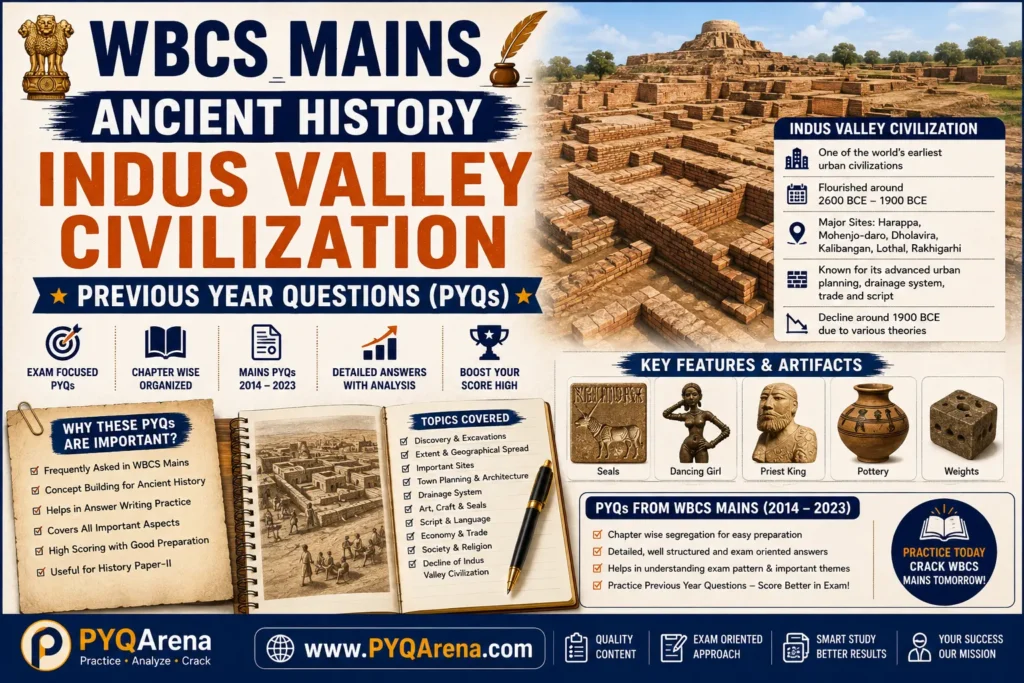
WBCS Mains Indus Valley Civilization Questions 2023
Q. Lothal is located at
(A) Rajasthan
(B) Uttar Pradesh
(C) Gujarat
(D) Hariyana
Answer & Explanation
Correct Answer: (C) Gujarat
Explanation
Lothal is an important Harappan Civilization (Indus Valley Civilization) site located in Gujarat, near the Gulf of Khambhat. It is particularly famous for its ancient dockyard, which indicates the importance of maritime trade during the Harappan period.
Exam Facts
- Lothal is located in Gujarat, near the village of Saragwala in Ahmedabad district.
- It was excavated by S. R. Rao during the 1950s.
- Lothal is famous for its ancient dockyard, considered evidence of Harappan maritime trade.
- The site was an important centre of trade and commerce, with links to regions outside the Indus Valley.
- Lothal had a bead-making industry, and objects made of copper, bronze, ivory and semi-precious stones have been found there.
- Other important Harappan sites in Gujarat include Dholavira, Surkotada and Rangpur.
WBCS Mains Indus Valley Civilization Questions 2022
Q. Mohenjodaro and Harappa belong to
(A) Egyptian civilization
(B) Sumerian civilization
(C) Mesopotamian civilization
(D) Indus valley civilization
Answer & Explanation
Correct Answer: (D) Indus Valley Civilization
Explanation
Mohenjodaro and Harappa were two major urban centres of the Indus Valley Civilization (Harappan Civilization). Harappa is located in present-day Pakistan’s Punjab region, while Mohenjodaro is located in Sindh. Both sites are known for their advanced urban planning, drainage systems, standardized weights and measures, and craft production.
Exam Facts
- Harappa is located on the banks of the Ravi River in present-day Punjab, Pakistan.
- Mohenjodaro is located in Sindh, Pakistan, near the Indus River.
- Harappa was excavated by Daya Ram Sahni in 1921, while Mohenjodaro was excavated by R. D. Banerji in 1922.
- The Great Bath is one of the most famous structures discovered at Mohenjodaro.
- The Indus Valley Civilization is also called the Harappan Civilization, after Harappa, one of its earliest discovered sites.
- Other important Harappan sites include Lothal (Gujarat), Dholavira (Gujarat), Kalibangan (Rajasthan), and Rakhigarhi (Haryana).
Q. What was importance of Lothal?
(A) Port
(B) Granary
(C) Zoo
(D) Market
Answer & Explanation
Correct Answer: (A) Port
Explanation
Lothal was an important maritime trade centre and port town of the Indus Valley Civilization. It is especially famous for its ancient dockyard, which provides evidence of the Harappans’ advanced knowledge of maritime trade and water management.
Exam Facts
- Lothal is located in Gujarat, near the Gulf of Khambhat.
- The site is famous for its ancient dockyard, one of the most important archaeological discoveries of the Harappan Civilization.
- Lothal played an important role in maritime trade with regions such as Mesopotamia.
- It was also a major centre of bead-making and craft production.
- S. R. Rao led the major archaeological excavations at Lothal beginning in the 1950s.
- Mohenjodaro is famous for the Great Bath, while Harappa is associated with major granary structures.
Q. Where was the figure of the dancing girl to be found?
(A) Indus valley
(B) Araku valley
(C) Kashmir valley
(D) Nubra valley
Answer & Explanation
Correct Answer: (A) Indus Valley
Explanation
The famous Dancing Girl was discovered at Mohenjodaro, an important site of the Indus Valley (Harappan) Civilization. It is a small bronze statue, made using the lost-wax casting technique, and represents the advanced metalworking skills of the Harappans.
Exam Facts
- The Dancing Girl was discovered at Mohenjodaro, in present-day Sindh, Pakistan.
- The statue is made of bronze and is approximately 10.5 cm tall.
- It was made using the lost-wax (cire perdue) technique.
- The figure depicts a young girl standing confidently with one hand on her hip.
- The Dancing Girl is considered an important example of Harappan bronze art and metallurgy.
- Mohenjodaro is also famous for the Great Bath, while Lothal is particularly known for its dockyard.
WBCS Mains Indus Valley Civilization Questions 2021
Q. Which of the following statements is true of the Harappan civilisation? (i) Harappan civilisation comprised of a network of urban constellations drawing on the agricultural surplus generated by the surrounding countryside. (ii) The Harappans seem to have flourishing trade relation with Sumeria and Egypt. (iii) The seals are suspected to be connected with trading activities of the Harappans. (iv) Overland trade rested primarily on bullock and horse-drawn carriages. (v) Some deities akin to the mother-goddess and Pashupati seem to have been popular.
(A) (i), (ii), (iii)
(B) (i), (ii), (iii), (v)
(C) (ii), (iv), (v)
(D) (iii), (iv)
Answer & Explanation
Correct Answer: (B) (i), (ii), (iii), (v)
Explanation
Statements (i), (ii), (iii), and (v) are correct. The Harappan Civilization developed a network of urban settlements supported by agricultural production in the surrounding countryside. The Harappans maintained long-distance trade, particularly with Mesopotamia/Sumer, while their seals were probably associated with trade, identification and the movement of goods. Archaeological evidence also suggests the popularity of religious figures or cults resembling the Mother Goddess and Pashupati.
Statement (iv) is incorrect because bullock carts and pack animals were important for land transport, but the evidence does not support the claim that overland trade rested primarily on horse-drawn carriages. Horse evidence in the Harappan context is limited and debated.
Exam Facts
- Harappan cities depended significantly on the agricultural surplus of surrounding rural settlements, creating a rural-urban economic relationship.
- The Harappans had established trade relations with Mesopotamia/Sumer. Harappan seals and other artefacts have been discovered at Mesopotamian sites.
- Meluhha, mentioned in Mesopotamian sources, is generally identified with the Indus/Harappan region.
- Harappan seals and sealings were probably used to identify the sender/owner and secure packages of goods during long-distance communication and trade.
- Bullock carts were used for land transportation, while boats and ships were used for riverine and maritime trade.
- The Pashupati Seal depicts a horned figure surrounded by animals and is traditionally associated with a proto-Shiva/Pashupati figure, although the exact interpretation remains debated.
- Numerous female terracotta figurines, traditionally interpreted as Mother Goddess figures, have been found at Harappan sites.
- Lothal was an important maritime centre of the Harappan Civilization and is famous for its dockyard.
WBCS Mains Indus Valley Civilization Questions 2020
Q. “The most unique feature of this site is its dockyard; the world’s first tidal port, which served as a main seaport for the Indus people”. The above statement holds true for which site?
(A) Ropar
(B) Lothal
(C) Rakhigarhi
(D) Banawali
Answer & Explanation
Correct Answer: (B) Lothal
Explanation
Lothal, located in Gujarat, was an important maritime centre of the Harappan Civilization. It is particularly famous for its dockyard, which is widely regarded as evidence of the Harappans’ advanced maritime and hydraulic engineering and their involvement in long-distance trade.
Exam Facts
- Lothal is located in present-day Gujarat, near the Gulf of Khambhat.
- Lothal’s most famous feature is its large brick-built dockyard, associated with maritime trade.
- The site was excavated extensively by archaeologist S. R. Rao from 1955–1962.
- Lothal was an important trade and craft-production centre, particularly known for its bead-making industry.
- Lothal had trade links with regions including Mesopotamia, reflecting the long-distance commercial networks of the Harappans.
- Ropar (Rupnagar) is located in Punjab, Rakhigarhi in Haryana, and Banawali in Haryana; none is famous for the dockyard associated with Lothal.
Q. Kalibangan is located at
(A) Gujarat
(B) Rajasthan
(C) Himachal Pradesh
(D) Punjab
Answer & Explanation
Correct Answer: (B) Rajasthan
Explanation
Kalibangan is an important archaeological site of the Indus Valley (Harappan) Civilization, located in Hanumangarh district of Rajasthan, on the banks of the Ghaggar River. The site is particularly famous for evidence of an early ploughed agricultural field and fire altars.
Exam Facts
- Kalibangan is located in Rajasthan, on the banks of the Ghaggar River, generally identified with the ancient Saraswati in traditional interpretations.
- The site was excavated by B. B. Lal and B. K. Thapar during the 1960s.
- Kalibangan provides important evidence of a ploughed field, showing the agricultural practices of the Harappans.
- Several fire altars have been discovered at Kalibangan, suggesting the performance of ritual activities.
- The site has both Pre-Harappan and Harappan cultural phases.
Q. The Indian who was involved in the excavations of Harappa and Mohenjodaro is
(A) S. D. Rathore
(B) K. K. Menon
(C) R. D. Banerjee
(D) R. D. Sharma
Answer & Explanation
Correct Answer: (C) R. D. Banerjee
Explanation
Rakhal Das Banerjee (R. D. Banerji) was a prominent Indian archaeologist of the Archaeological Survey of India (ASI). He is credited with identifying and excavating the remains of Mohenjodaro in 1922, which played a crucial role in the recognition of the Indus Valley Civilization. He also worked at Harappa during his archaeological career.
Exam Facts
- R. D. Banerji was an Indian archaeologist associated with the Archaeological Survey of India (ASI).
- He began excavations at Mohenjodaro in 1922 and recognized its importance.
- Daya Ram Sahni began the systematic excavation of Harappa in 1921.
- The discovery of Harappa and Mohenjodaro helped establish the existence of the Indus Valley Civilization as a major Bronze Age civilization.
- John Marshall, then Director-General of the ASI, announced the discovery of the Indus Civilization in 1924.
- S. R. Rao is particularly associated with the excavation of Lothal, while B. B. Lal and B. K. Thapar are associated with the excavation of Kalibangan.
Q. Which of the following is the biggest Harappan civilization site?
(A) Ropar
(B) Lothal
(C) Kalibangan
(D) Rakhigarhi
Answer & Explanation
Correct Answer: (D) Rakhigarhi
Explanation
Rakhigarhi, located in Hisar district of Haryana, is regarded as the largest known Harappan Civilization site in India and one of the largest settlements of the entire Harappan cultural sphere. Excavations have revealed extensive remains of planned habitation, drainage systems, streets, craft-production areas and burials.
Exam Facts
- Rakhigarhi is located in Hisar district, Haryana, in the Ghaggar-Hakra region.
- It is regarded as the largest known Harappan site in India.
- Rakhigarhi contains remains belonging to different phases of the Harappan cultural tradition.
- Archaeological discoveries include drainage systems, brick structures, pottery, seals, jewellery, craft-production evidence and burials.
- Ropar (Rupnagar) is a Harappan site in Punjab, while Kalibangan is in Rajasthan.
- Lothal, located in Gujarat, is particularly famous for its dockyard and maritime trade.
WBCS Mains Indus Valley Civilization Questions 2019
Q. Which of the following is not a feature of Lothal?
(A) Discovery of a dockyard
(B) Rectangular and circular fire alters for animal sacrifice
(C) Depiction of a ship on a seal
(D) Evidence of the use of the plough
Answer & Explanation
Correct Answer: (D) Evidence of the use of the plough
Explanation
Evidence of the use of the plough is particularly associated with Kalibangan in Rajasthan, where archaeologists discovered the remains of a ploughed agricultural field. Lothal, in contrast, is famous for its dockyard, maritime trade, and evidence of craft and commercial activities. A ship depiction on a seal has also been found at Lothal.
Exam Facts
- Lothal → Gujarat and is famous for its dockyard, indicating maritime trade.
- Lothal has yielded evidence of fire altars, reflecting ritual practices.
- A ship is depicted on a seal from Lothal, providing evidence of maritime activity.
- Kalibangan → Rajasthan is famous for the discovery of an early ploughed field.
- The ploughed field at Kalibangan shows two sets of furrows crossing each other, suggesting an agricultural technique suited to growing different crops.
WBCS Mains Indus Valley Civilization Questions 2018
Q. Which one among the Harappan sites was probably a trading outpost meant for procuring lapis-lazuli?
(A) Shortugai
(B) Musa Khel
(C) Mundigak
(D) Damb Sadat
Answer & Explanation
Correct Answer: (A) Shortugai
Explanation
Shortugai was a Harappan trading settlement located in northern Afghanistan, near the Oxus (Amu Darya) region. It is believed to have served as a trading outpost that helped the Harappans obtain valuable raw materials, particularly lapis lazuli, from the mines of Badakhshan.
Exam Facts
- Shortugai → Afghanistan and is regarded as a Harappan trading outpost.
- Shortugai was strategically located to facilitate access to Central Asian trade routes.
- Lapis lazuli was an important luxury stone used for ornaments and beads during the Harappan period.
- The major ancient source of lapis lazuli was the Badakhshan region of Afghanistan.
- Harappan sites have yielded evidence of long-distance trade with regions of Afghanistan, Central Asia and Mesopotamia.
- Mundigak and Damb Sadat are archaeological sites in Afghanistan associated with prehistoric/early Bronze Age cultures, but Shortugai is particularly significant for its connection with the Harappan trading network.
WBCS Mains Indus Valley Civilization Questions 2017
Q. Among the Bronze Age Civilizations which one was undoubtedly the largest in extent?
(A) Egyptian
(B) Mesopotamian
(C) Harappan
(D) Mehargarh
Answer & Explanation
Correct Answer: (C) Harappan
Explanation
The Harappan Civilization was the most extensive of the major Bronze Age civilizations in terms of geographical spread. At its mature phase, it covered a vast area extending from Afghanistan in the northwest to western Uttar Pradesh in the east, and from Jammu in the north to Gujarat in the south. Its estimated area was around 1.3 million square kilometres.
Exam Facts
- The Harappan Civilization covered approximately 1.3 million sq. km, making it one of the largest Bronze Age cultural zones.
- Its westernmost important site was Sutkagendor in present-day Balochistan, Pakistan.
- Manda in Jammu and Kashmir is generally considered the northernmost Harappan site.
- Daimabad in Maharashtra represents the southernmost extension of the Harappan cultural influence.
- Alamgirpur in Uttar Pradesh marks the eastern extent of the Harappan cultural zone.
- Mehrgarh is much earlier than the Mature Harappan Civilization and is associated primarily with the Neolithic and Chalcolithic periods, making it an incorrect option here.
Q. The ruins of Harappa were first noticed by
(A) M.S. Vats
(B) M. Wheeler
(C) B.B. Lal
(D) Charles Mason
Answer & Explanation
Correct Answer: (D) Charles Masson
Explanation
The ruins of Harappa were first noticed by Charles Masson, an English traveller and antiquarian, during his travels in the 1830s. He described the ancient ruins and mounds at Harappa in his writings. However, systematic archaeological excavation at Harappa began much later under Daya Ram Sahni in 1921, which helped establish the importance of the site.
Exam Facts
- Charles Masson first noticed and described the ruins of Harappa during the 1830s.
- Daya Ram Sahni began systematic excavations at Harappa in 1921.
- R. D. Banerji discovered the archaeological significance of Mohenjodaro in 1922.
- Sir John Marshall, Director-General of the Archaeological Survey of India, announced the discovery of the Indus Valley Civilization in 1924.
- M. S. Vats conducted important excavations at Harappa during the 1920s and 1930s.
- Mortimer Wheeler later conducted major excavations at Harappa in 1946 and contributed significantly to the study of the site’s fortifications and stratigraphy.
Q. The urban centres of the Harappan Civilisation faded out around
(A) 2200 BC
(B) 2100–2000 BC
(C) 2000–1900 BC
(D) 1800–1750 BC
Answer & Explanation
Correct Answer: (C) 2000–1900 BC
Explanation
The major urban centres of the Harappan Civilization began to decline and fade out around 2000–1900 BCE. This marked the end of the Mature Harappan urban phase, although Harappan cultural traditions continued in several regions for centuries afterward. The decline was gradual rather than a sudden disappearance of the civilization.
Exam Facts
- The Mature Harappan phase is generally dated to approximately 2600–1900 BCE.
- Around 2000–1900 BCE, major urban centres such as Harappa and Mohenjodaro began to experience significant decline.
- The decline was gradual and regionally varied, rather than the result of a single universally accepted event.
- After the urban decline, several Late Harappan cultures continued in different parts of northwestern India and Pakistan.
- Possible factors discussed for the decline include climatic changes, weakening of trade networks, changes in river systems and ecological pressures.
- The decline of Harappan cities did not mean the complete disappearance of the Harappan population or culture.
- The Harappan Civilization is generally divided into Early Harappan, Mature Harappan and Late Harappan phases.
WBCS Mains Indus Valley Civilization Questions 2016
Q. Which archaeologist has recently contested the identification of impressive brick-built structure at Harappa as a ‘Granary’?
(A) R.E.M. Wheeler
(B) Bridget Allchin
(C) Raymond Allchin
(D) J.M. Kenoyer
Answer & Explanation
Correct Answer: (D) J. M. Kenoyer
Explanation
J. M. Kenoyer (Jonathan Mark Kenoyer) has questioned the traditional identification of the large brick-built structure at Harappa as a “Granary.” Excavations and subsequent analysis did not reveal convincing evidence such as stored grain or storage vessels. Kenoyer and other researchers therefore suggest that it may have been a large public or monumental building, rather than a granary.
Exam Facts
- J. M. Kenoyer is a prominent archaeologist and specialist in the Indus Valley/Harappan Civilization.
- The so-called “Great Granary” at Harappa is located on Mound F.
- The structure consists of two rows of six rectangular units, separated by a central passage.
- There is no compelling archaeological evidence of stored grain within the structure; hence its exact function remains uncertain.
- The traditional identification of some Harappan structures as granaries was partly based on comparisons with Roman buildings, rather than direct evidence of grain storage.
- Mortimer Wheeler is associated with the identification of certain large structures at Harappa and Mohenjodaro as granaries, but this interpretation has subsequently been questioned.
- Harappa is located in Punjab, Pakistan, while Mohenjodaro is located in Sindh, Pakistan.
Q. Which civilization was undoubtedly the largest in extent among the Bronze age civilizations?
(A) The Harappan civilization
(B) Egyptian civilization
(C) Mesopotamian civilization
(D) Roman civilization
Answer & Explanation
Correct Answer: (A) The Harappan Civilization
Explanation
The Harappan Civilization was the most extensive in geographical spread among the major Bronze Age civilizations. At its mature stage, it covered approximately 1.3 million square kilometres, extending across parts of present-day Pakistan and northwestern and western India. Its enormous geographical extent makes it one of the largest known Bronze Age cultural regions.
Exam Facts
- The Harappan Civilization covered approximately 1.3 million sq. km at its maximum extent.
- It extended from Sutkagendor in Balochistan in the west to Alamgirpur in Uttar Pradesh in the east.
- Manda in Jammu and Kashmir represents the northern extent of the Harappan cultural zone.
- Daimabad in Maharashtra represents the southernmost site associated with Harappan cultural influence.
- The civilization is also called the Indus Valley Civilization or Harappan Civilization, after the site of Harappa.
- The Roman Civilization belongs largely to a much later historical period and therefore is not normally classified among the Bronze Age civilizations.
Q. Who considered the Harappan crafts “technically the peer of the rest” among products of the Bronze Age?
(A) Gordon Childe
(B) Shereen Ratnagar
(C) R.S. Bisht
(D) Asco Parpola
Answer & Explanation
Correct Answer: (B) Shereen Ratnagar
Explanation
Shereen Ratnagar, an eminent Indian archaeologist and historian of the Harappan Civilization, described Harappan crafts as “technically the peer of the rest” among the products of the Bronze Age. Her observation highlights the high level of technical skill and craftsmanship achieved by the Harappans in metallurgy, pottery, bead-making, jewellery and other specialized crafts.
Exam Facts
- Shereen Ratnagar is a noted Indian archaeologist and historian specializing in the Indus/Harappan Civilization.
- Harappan crafts included bead-making, metallurgy, pottery, shell-working, faience and jewellery-making.
- Chanhudaro was an important Harappan craft-production centre, particularly known for bead-making and other specialized crafts.
- Lothal was another major centre of bead-making and maritime trade.
- Harappan craftsmen used materials such as copper, bronze, gold, silver, shell, faience, terracotta and semi-precious stones.
- R. S. Bisht is particularly associated with the excavation and study of Dholavira in Gujarat.
- Asko Parpola is a Finnish Indologist known especially for his research on the Indus script and Harappan Civilization.
WBCS Mains Indus Valley Civilization Questions 2015
Q. According to the latest excavations, Manda is the __________ site of the Indus civilization?
(A) Northernmost
(B) Southernmost
(C) Easternmost
(D) Westernmost
Answer & Explanation
Correct Answer: (A) Northernmost
Explanation
Manda is considered the northernmost site of the Harappan (Indus) Civilization. It is located near the Chenab River in Jammu and Kashmir, and represents the northern extension of the Harappan cultural zone.
Exam Facts
- Manda → Jammu and Kashmir and is traditionally regarded as the northernmost Harappan site.
- Manda is situated on the right bank of the Chenab River, near Akhnoor.
- It was excavated by J. P. Joshi of the Archaeological Survey of India.
- Sutkagendor → Balochistan is generally regarded as the westernmost Harappan site.
- Alamgirpur → Uttar Pradesh is generally regarded as the easternmost Harappan site.
- Daimabad → Maharashtra is traditionally regarded as the southernmost site associated with the Harappan cultural tradition.
Q. The Harappan bricks were mainly
(A) Sawn with the help of a saw-like instrument
(B) Made in an open mould
(C) Hand-made
(D) Cut with the help of a chisel
Answer & Explanation
Correct Answer: (B) Made in an open mould
Explanation
Harappan bricks were generally standardized and mould-made, rather than individually shaped by hand or cut using tools. The use of moulds enabled the Harappans to produce bricks of uniform size and shape, which contributed to their well-planned urban architecture.
Exam Facts
- Harappan bricks were commonly baked (kiln-fired) and standardized in size.
- A characteristic Harappan brick proportion was approximately 1 : 2 : 4 for height : width : length.
- Standardization of bricks was an important feature of Harappan urban construction.
- Baked bricks were extensively used for houses, drains, wells, platforms and other structures.
- Mohenjodaro is particularly famous for its extensive use of baked bricks and sophisticated drainage systems.
- Harappan builders also used mud bricks, especially in some structural contexts.
- The widespread standardization of construction materials reflects the advanced planning and organization of Harappan cities.
Q. Which of the following is the main reason for the development of towns in the Harappan period?
(A) Development of Science and technology
(B) Development of Arts and crafts
(C) Growth of Trade and commerce
(D) Increase in Agrarian surplus
Answer & Explanation
Correct Answer: (D) Increase in Agrarian Surplus
Explanation
The development of urban centres during the Harappan period was closely linked to the production of an agricultural surplus. Surplus food production supported people engaged in non-agricultural occupations such as craft production, trade, administration and other specialized activities. This economic foundation helped sustain large and well-planned urban settlements.
Exam Facts
- Agricultural surplus provided the food necessary to support a growing non-agricultural population in Harappan towns.
- Harappan society had considerable occupational specialization, including potters, bead-makers, metalworkers, masons and traders.
- Trade and commerce played an important role in Harappan urban life but depended substantially on the broader agricultural economy.
- Harappan cities such as Mohenjodaro, Harappa, Dholavira and Lothal show evidence of sophisticated urban planning.
- The Harappans developed extensive drainage systems, wells, streets and standardized brick architecture.
- Lothal was an important centre of maritime trade, while Chanhudaro was particularly associated with specialized craft production.
- The emergence of cities is generally understood as the result of a combination of agricultural surplus, craft specialization, trade and social organization, rather than a single factor alone.
Q. Which of the following were the main items of export of the Indus people? (i) Gold and Silver (ii) Cotton goods (iii) Terracottas (iv) Seals (v) Pottery
(A) ii, iii and v
(B) i, iii and iv
(C) i, ii, iv and v
(D) All of them
Answer & Explanation
Correct Answer: (A) ii, iii and v
Explanation
The major export items associated with the Indus/Harappan people included cotton goods, terracotta objects and pottery. The Harappans maintained extensive trade networks with Mesopotamia, Oman, Bahrain and other regions. Gold and silver were valuable materials that the Harappans generally obtained through trade rather than exporting as major finished commodities. Seals were primarily associated with identification, administration and trade-related activities, rather than being a major export commodity.
Exam Facts
- The Harappans were among the earliest known people to produce cotton textiles; Greek writers later referred to India as a land where “trees bear wool.”
- Cotton goods were an important product associated with Harappan trade.
- Terracotta objects and pottery were among the craft products exchanged through regional and long-distance trade.
- The Harappans imported or obtained raw materials such as lapis lazuli, copper, tin, gold and silver from different regions.
- Lapis lazuli was obtained particularly from Badakhshan in Afghanistan, with Shortugai serving as an important Harappan trading outpost.
- Harappan seals were mainly used for purposes connected with identification, ownership, administration and trade, rather than being a principal export commodity.
- Mesopotamian records refer to a region called Meluhha, which is generally associated with the Indus/Harappan region, indicating long-distance commercial contacts.
Q. Which one of the following types of Harappan pottery is said to be the earliest example of its kind in the world?
(A) Polychrome
(B) Glazed
(C) Perforated
(D) Knobbed
Answer & Explanation
Correct Answer: (B) Glazed
Explanation
Glazed pottery found in the Harappan Civilization is considered one of the earliest known examples of glazed pottery in the world. Harappan craftsmen developed a primitive form of glazing using materials such as alkaline salts and mineral pigments, producing a coloured, glass-like surface on pottery and other objects.
Exam Facts
- Glazed pottery → Harappan Civilization is an important fact for competitive examinations.
- Harappan glazed objects were generally made using faience-like glazing techniques and mineral-based materials.
- Faience was widely used by the Harappans for beads, bangles, amulets and small decorative objects.
- Harappan pottery was generally wheel-made, often with a red surface and black painted designs.
- Perforated jars are another distinctive type of Harappan pottery, but they are not regarded as the earliest glazed pottery.
- Harappan pottery demonstrates the civilization’s advanced ceramic technology and specialized craftsmanship.
- Important Harappan craft centres such as Lothal and Chanhudaro provide evidence of specialized production and skilled artisans.
Q. Who among the following archeologists has been claiming that he was successfully deciphered the Indus script, though others have not accepted the claim?
(A) M.E.M. Wheeler
(B) Gordon Childe
(C) K.M. Srivastava
(D) S.R. Rao
Answer & Explanation
Correct Answer: (D) S. R. Rao
Explanation
S. R. Rao (Seshadri R. Rao) was a prominent Indian archaeologist who claimed to have deciphered the Indus script. He proposed that the script represented an early form of an Indo-Aryan language and attempted to relate it to later Indian scripts. However, his proposed decipherment has not been generally accepted by other scholars, and the Indus script remains undeciphered.
Exam Facts
- S. R. Rao is particularly associated with the archaeological excavation of Lothal, the famous Harappan port site in Gujarat.
- Rao proposed a decipherment of the Indus script, but his interpretation did not gain general scholarly acceptance.
- The Indus script remains undeciphered despite numerous attempts by scholars.
- Indus inscriptions are generally very short, often appearing on seals, pottery, tablets and other objects.
- The script contains approximately 400–450 commonly identified signs, although the exact number varies depending on how variants are counted.
- Gordon Childe was a famous archaeologist who developed influential theories concerning the development of early urban civilizations, including the concept of the Urban Revolution.
- Mortimer Wheeler (R. E. M. Wheeler) is associated with major excavations at Harappa and is known for introducing more systematic stratigraphic methods to Indian archaeology.
Leave a Comment