
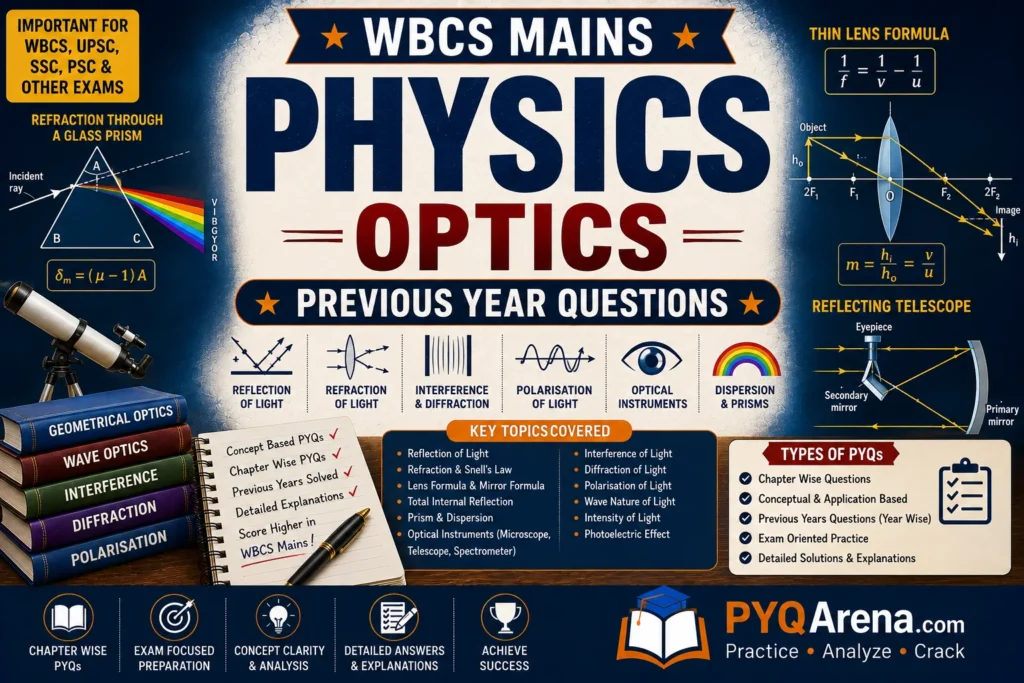
This chapter covers light reflection, refraction, refractive index, scattering (blueness of sky), dispersion (rainbows), interference (soap bubbles, thin films), polarization, optical activity, eye defects (myopia, astigmatism), and lenses.
WBCS Mains Physics Optics Questions 2023
Q10. When light is refracted, which of the following does not change?
(A) Wavelength
(B) Frequency
(C) Velocity
(D) Amplitude
Correct Answer: (B) Frequency
Q143. What is the source of UV radiation?
(A) Hydrogen gas discharge lamp
(B) RF oscillator
(C) Klystron oscillator
(D) Nernst filament
Correct Answer: (A) Hydrogen gas discharge lamp
Q165. When the power of the eye lens increases, the defect of vision produced is known as
(A) Shortsightedness
(B) Longsightedness
(C) Colour blindness
(D) Astigmatism
Correct Answer: (A) Shortsightedness
Q167. An astronaut in a spaceship sees the outer space as
(A) Red
(B) Blue
(C) Indigo
(D) Black
Correct Answer: (D) Black
Q182. The range of visible spectrum is
(A) 350–650 nm
(B) 380–750 nm
(C) 390–700 nm
(D) 400–800 nm
Correct Answer: (B) 380–750 nm
WBCS Mains Physics Optics Questions 2022
Q81. Polarization of light proves the
(A) Longitudinal nature of light
(B) Quantum nature of light
(C) Corpuscular nature of light
(D) Transverse nature of light
Correct Answer: (D) Transverse nature of light
Q117. The blueness of the sky is mainly due to
(A) The scattering of sunlight by air molecules.
(B) The presence of water vapor.
(C) Absorption of blue light by the air.
(D) Emission of blue light by the atmosphere.
Correct Answer: (A) The scattering of sunlight by air molecules.
WBCS Mains Physics Optics Questions 2021
Q46. A thin oil film on a water surface appears coloured because of
(A) Reflection
(B) Refraction
(C) Interference
(D) Polarization
Correct Answer: (C) Interference
Q78. The colour of a star indicates its
(A) Weight
(B) Size
(C) Distance
(D) Temperature
Correct Answer: (D) Temperature
Q152. The splitting of white light into its components is due to
(A) Reflection
(B) Refraction
(C) Transmission
(D) Dispersion
Correct Answer: (D) Dispersion
WBCS Mains Physics Optics Questions 2020
Q29. The quanta of light is called
(A) Proton
(B) Photon
(C) Phonon
(D) Neutron
Correct Answer: (B) Photon
Q49. The stars twinkle because of
(A) Reflection
(B) Refraction
(C) Diffraction
(D) Interference
Correct Answer: (B) Refraction
Q55. When light is refracted, which of the following does not change?
(A) Frequency
(B) Wavelength
(C) Velocity
(D) Amplitude
Correct Answer: (A) Frequency
WBCS Mains Physics Optics Questions 2018
Q44. Wavelength of visible light lies in between
(A) 400 to 800 nm
(B) 500 to 1000 nm
(C) 300 to 600 nm
(D) 200 to 400 nm
Correct Answer: (A) 400 to 800 nm
Q93. Solar spectrum is the example of
(A) Continuous emission spectrum
(B) Band absorption spectrum
(C) Line absorption spectrum
(D) Continuous absorption spectrum
Correct Answer: (C) Line absorption spectrum
WBCS Mains Physics Optics Questions 2017
Q158. Refractive index of a medium is defined by
(A) The ratio of the cosine of the angles of incidence and refraction of light is constant when it passes between two given media.
(B) The ratio of the sine of the angles of refraction and incidence of light is constant when it passes between two given media.
(C) The ratio of the sine of the angles of incidence and refraction of light is constant when it passes between two given media.
(D) None of the above.
Correct Answer: (C) The ratio of the sine of the angles of incidence and refraction of light is constant when it passes between two given media.
Q199. Line spectrum is produced by
(A) The Sun
(B) Mercury vapour lamp
(C) Candle
(D) Electric bulb
Correct Answer: (B) Mercury vapour lamp
WBCS Mains Physics Optics Questions 2016
Q7. When viewed in white light, soap bubbles show colours because of
(A) Scattering
(B) Diffraction
(C) Interference
(D) Dispersion
Correct Answer: (C) Interference
Q15. Which one among the following has the highest energy?
(A) Blue light
(B) Green light
(C) Red light
(D) Yellow light
Correct Answer: (A) Blue light
Q16. Cylindrical lens is used by a person suffering from
(A) Astigmatism
(B) Myopia
(C) Hypermetropia
(D) Presbyopia
Correct Answer: (A) Astigmatism
Q17. To an observer on the lunar surface, during the daytime the sky will appear to be
(A) Light yellow
(B) Orange
(C) Blue
(D) Black
Correct Answer: (D) Black
WBCS Mains Physics Optics Questions 2015
Q43. Blue colour of the sky is due to the phenomenon of
(A) Scattering
(B) Dispersion
(C) Reflection
(D) Refraction
Correct Answer: (A) Scattering
Q51. Diffusion of light in the atmosphere takes place due to
(A) Dust particles
(B) Carbon dioxide
(C) Helium
(D) Water vapours
Correct Answer: (A) Dust particles
Q56. Which one of the following reflects back more sunlight as compared to the other three?
(A) Sand desert
(B) Paddy crop land
(C) Land covered with fresh snow
(D) Prairie grass land
Correct Answer: (C) Land covered with fresh snow
Q57. Rainbow is produced when sunlight falls on drops of rain. The physical phenomena responsible for this are (1) Dispersion, (2) Refraction, (3) Internal reflection.
(A) 1 & 2
(B) 2 & 3
(C) 1 & 3
(D) All of the above
Correct Answer: (D) All of the above
Q114. Several colours on the screen of a colour television are produced by mixing lights of colours
(A) Red, Yellow, Green
(B) Red, Yellow, Blue
(C) Red, Green, Blue
(D) Yellow, Green, Blue
Correct Answer: (C) Red, Green, Blue
WBCS Mains Physics Optics Questions 2014
Q11. The wavelength of visible light lies between
(A) 200–400 nm
(B) 400–700 nm
(C) 700–1000 nm
(D) 1000–2000 nm
Correct Answer: (B) 400–700 nm
Leave a Comment