

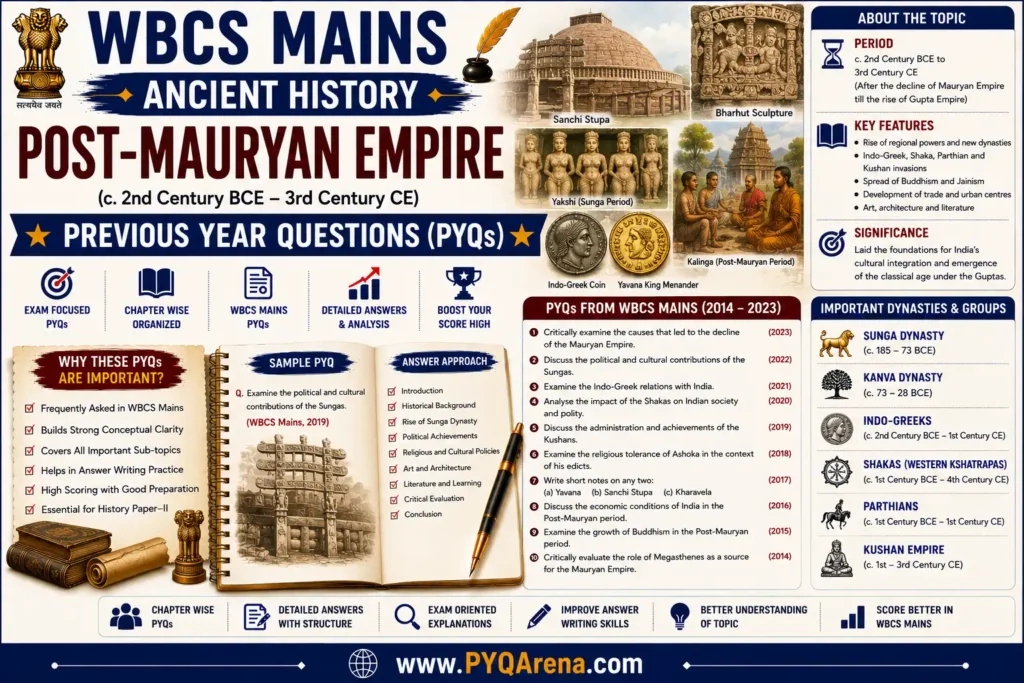
WBCS Mains Post-Mauryan Empire Questions 2023
Q. From which inscription we get important information about the Saka ruler Rudra Damana?
(A) Junagarh inscription
(B) Aihole inscription
(C) Allahabad Pillar inscription
(D) Bhitari Pillar inscription
Answer & Explanation
Correct Answer: (A) Junagadh Inscription
Explanation
The Junagadh Inscription of Rudradaman I is one of the most important sources for the history of the Western Kshatrapas. It records the achievements of the Saka ruler Rudradaman I, including his military victories and restoration of the Sudarshana Lake in Gujarat. It is also famous for being one of the earliest long inscriptions composed in classical Sanskrit.
Exam Facts
- Rudradaman I was a prominent ruler of the Western Kshatrapas (Saka Kshatrapas).
- The Junagadh Inscription was issued by Rudradaman around 150 CE.
- It is located at Junagadh in Gujarat, near the Sudarshana Lake.
- The inscription records Rudradaman’s restoration of the Sudarshana Lake after it was damaged by heavy rains and floods.
- It is one of the earliest important long Sanskrit inscriptions of ancient India.
- The inscription praises Rudradaman’s military achievements, administrative abilities, learning, and personal qualities.
- The Aihole Inscription of Pulakeshin II provides information about the achievements of the Chalukya ruler and was composed by Ravikirti.
- The Allahabad Pillar Inscription of Samudragupta, composed by Harisena, is an important source for Gupta history.
- The Bhitari Pillar Inscription is associated with the Gupta ruler Skandagupta and provides information about his reign and conflicts.
Q. The Nasik inscription gives us information about
(A) The Bakatakas
(B) The Rastrakutas
(C) The Satavahanas
(D) The Guptas
Answer & Explanation
Correct Answer: (C) The Satavahanas
Explanation
The Nasik inscriptions are an important source for the history of the Satavahana dynasty. They provide valuable information about rulers such as Gautamiputra Satakarni and Vashishthiputra Pulumavi, as well as the political achievements, administration, genealogy, and religious donations of the Satavahana rulers. One of the most important is the inscription of Gautami Balashri, mother of Gautamiputra Satakarni.
Exam Facts
- The Nasik inscriptions are primarily associated with the Satavahana period.
- Gautami Balashri, the mother of Gautamiputra Satakarni, commissioned an important Nasik inscription.
- The inscription praises Gautamiputra Satakarni for defeating the Sakas, Yavanas, and Pahlavas.
- Gautamiputra Satakarni is described as the destroyer of the Kshaharata lineage, associated with the Western Kshatrapas.
- The Nasik caves were important centres of Buddhist religious activity.
- Several inscriptions record donations of caves, land, and other resources to Buddhist monks.
- Satavahana inscriptions are generally written in Prakrit using the Brahmi script.
- The Vakatakas were a later Deccan dynasty and are particularly associated with the Ajanta caves.
- The Allahabad Pillar Inscription is a major source for the history of Samudragupta and the Gupta Empire
Q. The School of Gandhara Art flourished during the reign of the
(A) Mauryan Dynasty.
(B) Kushan Dynasty.
(C) Satavahana Dynasty.
(D) Gupta Dynasty.
Answer & Explanation
Correct Answer: (B) Kushan Dynasty
Explanation
The Gandhara School of Art flourished particularly during the Kushan period, especially under Kanishka I in the 1st–2nd centuries CE. It developed in the northwestern regions of the Indian subcontinent and is famous for its Greco-Roman influence, realistic depiction of the human body, wavy hair, and Buddha images with distinctive drapery.
Exam Facts
- The Gandhara School of Art flourished mainly under the Kushans, particularly during the reign of Kanishka I.
- Gandhara was located primarily in the northwestern region of the Indian subcontinent, covering parts of present-day Pakistan and Afghanistan.
- Gandhara art shows strong influence from Greek and Roman artistic traditions, hence it is often called Greco-Buddhist art.
- Buddha images in Gandhara art commonly show wavy hair, sharp facial features, and heavy, realistic drapery resembling Greco-Roman sculptures.
- Mathura School of Art developed alongside Gandhara and used more distinctly indigenous Indian artistic traditions.
- The Kushans played an important role in the spread of Mahayana Buddhism.
- Kanishka I is traditionally associated with the Fourth Buddhist Council, held at Kundalavana in Kashmir according to Buddhist tradition.
- The Gupta period is often regarded as a classical age of Indian sculpture, particularly associated with the Mathura and Sarnath traditions.
WBCS Mains Post-Mauryan Empire Questions 2022
Q. Menander was a
(A) Kushan
(B) Indo-Greek
(C) Saka
(D) Chinese
Answer & Explanation
Correct Answer: (B) Indo-Greek
Explanation
Menander I, also known as Milinda, was a prominent Indo-Greek ruler who ruled over parts of northwestern India during the 2nd century BCE. He is particularly famous for his association with Buddhism and his dialogue with the Buddhist monk Nagasena, recorded in the Buddhist text Milindapanha (Questions of Milinda).
Exam Facts
- Menander I (Milinda) was an important Indo-Greek ruler.
- He ruled approximately during the 2nd century BCE, with his kingdom centred in northwestern India.
- His capital was Sakala (modern Sialkot, Pakistan) according to Buddhist tradition.
- His dialogue with Nagasena is recorded in Milindapanha.
- According to Buddhist tradition, Menander became a follower or patron of Buddhism.
- Menander issued numerous coins bearing Greek and Kharosthi legends, providing important evidence about Indo-Greek history.
- The Indo-Greeks emerged in northwestern India after the decline of Greek power following the death of Alexander the Great.
- Kushans came later and reached their greatest power under rulers such as Kanishka.
- Sakas (Scythians) were another group that established kingdoms in northwestern and western India.
Q. The Garuda Pillar at Besnagar was endowed by
(A) Heliodorus
(B) Megasthanes
(C) Bimbisara
(D) Ajatasatru
Answer & Explanation
Correct Answer: (A) Heliodorus
Explanation
The Garuda Pillar at Besnagar (Vidisha) was erected by Heliodorus, a Greek ambassador sent by the Indo-Greek ruler Antialcidas to the court of the Shunga king Bhagabhadra. The inscription on the pillar describes Heliodorus as a Bhagavata, a devotee of Vasudeva (Krishna), making it an important early archaeological evidence for Vaishnavism and the Bhagavata tradition.
Exam Facts
- The Garuda Pillar is located at Besnagar near Vidisha, Madhya Pradesh.
- It was erected around the 2nd century BCE by Heliodorus.
- Heliodorus was a Greek ambassador sent by the Indo-Greek king Antialcidas.
- He served as an envoy to the court of Bhagabhadra, a ruler of the Shunga dynasty.
- The pillar is also known as the Heliodorus Pillar.
- The inscription calls Heliodorus a Bhagavata, indicating his devotion to Vasudeva.
- It is one of the earliest significant epigraphic evidences for the Vasudeva-Krishna tradition.
- The pillar is topped by or associated with a Garuda, the vehicle (vahana) of Vishnu.
- The inscription mentions the three virtues of self-control, generosity, and vigilance as the path to immortality.
- Megasthenes was a Greek ambassador at the court of Chandragupta Maurya, not the person associated with the Besnagar Garuda Pillar.
Q. The Kushanas were originally from
(A) Greece
(B) Iran
(C) Central Asia
(D) Europe
Answer & Explanation
Correct Answer: (C) Central Asia
Explanation
The Kushanas were originally a people of Central Asian origin, generally identified with the Yuezhi (Yueh-chi) tribal confederation. The Yuezhi migrated from the region of northwestern China/Central Asia toward Bactria, and one of their branches, the Kushanas, eventually established a powerful empire in northern India.
Exam Facts
- The Kushanas originated from Central Asia and were associated with the Yuezhi.
- The Yuezhi migrated westward and eventually established themselves in Bactria.
- Kujula Kadphises is regarded as the founder of the Kushana power in the Indian subcontinent.
- Kanishka I was the most famous Kushana ruler and greatly expanded the empire.
- The Kushana Empire extended across parts of Central Asia, Afghanistan, Pakistan, and northern India.
- Purushapura (Peshawar) was an important Kushana centre, while Mathura was another major political and cultural centre.
- The Kushana period witnessed the flourishing of Gandhara and Mathura schools of Buddhist art.
- The Kushanas played an important role in the expansion of Mahayana Buddhism.
- The Kushana Empire also benefited greatly from Silk Route trade, linking India with Central Asia, China, and the Roman world.
Q. The Saka Era was started by
(A) Bimbisara
(B) Ajatasatru
(C) Kanishka
(D) Menander
Answer & Explanation
Correct Answer: (C) Kanishka
Explanation
In the traditional historical account, the Saka Era is associated with Kanishka, the great Kushana ruler, and begins in 78 CE. However, modern historians debate the exact identity of the ruler who initiated the era. For competitive examinations, Kanishka is the conventionally accepted answer.
Exam Facts
- The Saka Era begins in 78 CE.
- Kanishka I was a major ruler of the Kushana dynasty.
- Kanishka’s empire extended across parts of Central Asia, Afghanistan, and northern India.
- Kanishka is strongly associated with the spread of Mahayana Buddhism.
- The Fourth Buddhist Council is traditionally associated with Kanishka’s reign and is said to have been held in Kashmir.
- The Saka Era is used in the Indian National Calendar, officially adopted by India in 1957.
- The Saka calendar’s Chaitra 1 generally falls on 22 March, or 21 March in a leap year.
- Menander was an important Indo-Greek ruler of the 2nd century BCE and is associated with the Buddhist text Milindapanha.
- Bimbisara and Ajatashatru were rulers of Magadha during the 6th–5th centuries BCE.
Q. The capital of Kanishka was
(A) Purushpura
(B) Sialkot
(C) Pathankot
(D) Bodhgaya
Answer & Explanation
Correct Answer: (A) Purushpura
Explanation
Purushpura, identified with modern Peshawar in Pakistan, was an important capital of the Kushana ruler Kanishka I. It was a major political, commercial, and Buddhist centre of the Kushana Empire. Kanishka also had an important imperial centre at Mathura.
Exam Facts
- Purushpura (Peshawar) was the principal capital associated with Kanishka I.
- Kanishka belonged to the Kushana dynasty and ruled approximately in the 2nd century CE.
- Mathura was another major administrative and cultural centre under Kanishka.
- Kanishka is traditionally associated with the Fourth Buddhist Council, said to have been held in Kashmir.
- The famous Kanishka Stupa at Purushpura was described by Chinese Buddhist pilgrims as a magnificent monument.
- Sialkot (Sakala) was associated with Menander, the famous Indo-Greek ruler, in Buddhist tradition.
- Bodh Gaya is associated with Gautama Buddha’s Enlightenment, not Kanishka’s capital.
- Kanishka’s empire played an important role in the development and spread of Mahayana Buddhism along the Silk Routes.
Q. The greatest Kushan ruler was
(A) Menander
(B) Gondophernes
(C) Maga
(D) Kanishka
Answer & Explanation
Correct Answer: (D) Kanishka
Explanation
Kanishka I is generally regarded as the greatest ruler of the Kushana dynasty. He greatly expanded the Kushana Empire across northern India, Afghanistan, and parts of Central Asia. He was also a major patron of Buddhism, particularly Mahayana Buddhism, and his reign witnessed significant developments in art, culture, and international trade.
Exam Facts
- Kanishka I was the most famous ruler of the Kushana dynasty.
- His empire extended from Central Asia and Afghanistan to northern India.
- Purushpura (Peshawar) was an important capital of his empire, while Mathura was another major centre.
- Kanishka is traditionally associated with the Fourth Buddhist Council, held in Kashmir according to Buddhist tradition.
- He played a major role in the spread of Mahayana Buddhism to Central Asia and China.
- The Gandhara School of Art flourished significantly during the Kushana period.
- The Mathura School of Art also developed greatly under Kushana patronage.
- Kanishka’s reign benefited from extensive Silk Route trade connecting India with Central Asia, China, and the Roman world.
- Menander was an Indo-Greek ruler, not a Kushana ruler.
- Gondophernes was an Indo-Parthian ruler associated with the northwestern region.
WBCS Mains Post-Mauryan Empire Questions 2020
Q. Which dynasty ruled over Magadha after the Mauryan dynasty?
(A) Satavahana
(B) Sunga
(C) Nanda
(D) Kanva
Answer & Explanation
Correct Answer: (B) Sunga
Explanation
The Sunga dynasty succeeded the Mauryan dynasty in Magadha around 185 BCE. The founder of the Sunga dynasty, Pushyamitra Sunga, was a military commander under the last Mauryan ruler Brihadratha. According to the Puranas and other sources, Pushyamitra overthrew Brihadratha and established Sunga rule.
Exam Facts
- The Sunga dynasty ruled Magadha after the decline of the Mauryan Empire.
- Pushyamitra Sunga founded the dynasty around 185 BCE.
- Pushyamitra was originally a senapati (military commander) under the last Mauryan ruler, Brihadratha.
- Brihadratha Maurya was the last Mauryan ruler.
- The Sunga capital was primarily Pataliputra, though Vidisha became an important centre under the Sungas.
- Pushyamitra is traditionally associated with the performance of Ashvamedha sacrifices.
- The Kanva dynasty succeeded the Sungas in Magadha around 73 BCE.
- The Nanda dynasty ruled Magadha before the Mauryas, and Chandragupta Maurya overthrew the last Nanda ruler.
- The Satavahanas were a major Deccan dynasty and were not the immediate successors of the Mauryas in Magadha.
WBCS Mains Post-Mauryan Empire Questions 2017
Q. The first Indian rulers to issue gold coins on the Roman pattern were
(A) Sungas
(B) Kushanas
(C) Indo-Greeks
(D) Vakatakas
Answer & Explanation
Correct Answer: (B) Kushanas
Explanation
The Kushanas were the first major Indian rulers to issue large quantities of gold coins influenced by Roman coinage. Their gold coinage reflects the extensive commercial contacts between the Kushana Empire and the Roman Empire. Kushana rulers, particularly Kanishka I, issued a wide variety of gold coins depicting the ruler and different deities.
Exam Facts
- The Kushanas issued extensive gold coinage, making their currency an important source for Kushana history.
- Kushana gold coins show strong influence from Roman monetary standards and artistic conventions.
- Kanishka I issued gold coins depicting himself and various Iranian, Greek, Indian, and Buddhist deities.
- Kushana coins commonly carry legends in Greek script, although the language and script evolved over time.
- The Kushana gold coinage reflects their role in long-distance trade along the Silk Routes.
- Indo-Greek rulers were among the earliest Indian rulers to issue coins with sophisticated Hellenistic designs, but the question specifically refers to the large-scale gold coinage on the Roman pattern.
- Sungas are not particularly known for issuing extensive gold coinage.
- Vakatakas ruled parts of the Deccan during the Gupta period and are not associated with the earliest Roman-pattern gold coinage.
- Roman gold and silver coins have also been discovered in India, particularly in regions connected with Indo-Roman trade.
WBCS Mains Post-Mauryan Empire Questions 2016
Q. During the post-Maurya times, elaborate Vedic sacrificial rituals like the Vajapeya, Rajasuya and Aswamedha were regularly performed by the rulers of
(A) North India
(B) The Deccan
(C) both North India and Deccan
(D) Chola dynasty
Answer & Explanation
Correct Answer: (C) Both North India and Deccan
Explanation
During the post-Mauryan period, both North Indian and Deccan rulers revived and patronised elaborate Vedic sacrificial rituals as a means of demonstrating royal authority and political legitimacy. The Ashvamedha, Rajasuya, and Vajapeya sacrifices were performed by rulers in different regions. For example, Pushyamitra Sunga is traditionally associated with the performance of two Ashvamedha sacrifices, while Satavahana rulers also patronised Vedic rituals.
Exam Facts
- The Ashvamedha was a royal horse sacrifice symbolising the ruler’s sovereignty and territorial authority.
- The Rajasuya was a royal consecration ceremony associated with the ruler’s supreme status and political authority.
- The Vajapeya was an important Vedic sacrifice associated with royal prestige and ritual status.
- Pushyamitra Sunga, founder of the Sunga dynasty, is traditionally said to have performed two Ashvamedha sacrifices.
- The Satavahana rulers of the Deccan also patronised Brahmanical rituals and Vedic sacrifices.
- Gautamiputra Satakarni is associated with the revival of Brahmanical traditions while also supporting other religious communities.
- Naganika, the wife of Satakarni I, is known from the Naneghat inscription, which records several Vedic sacrifices performed by the Satavahana ruler.
- The performance of these sacrifices helped post-Mauryan rulers establish Brahmanical legitimacy and royal authority.
- The revival of Vedic rituals during this period occurred alongside the continued growth of Buddhism and Jainism.
Q. Which period of Indian history has been designated by Romila Thapar as ‘Threshold Times’?
(A) BCE 200-300 CE
(B) CE 300-CE 600
(C) CE 300-CE 800
(D) CE 600-CE 1300
Answer & Explanation
Correct Answer: (C) 300 CE–800 CE
Explanation
Historian Romila Thapar has described the period from approximately 300 CE to 800 CE as “Threshold Times.” It represents a transitional phase in Indian history, marked by major changes in political structures, economy, society, religion, and cultural patterns. This period witnessed the decline of some earlier political formations and the emergence of new regional kingdoms and social institutions.
Exam Facts
- “Threshold Times” refers to approximately 300 CE–800 CE in Romila Thapar’s interpretation of Indian history.
- The period witnessed the transition from the ancient to the early medieval phase of Indian history.
- The Gupta period falls substantially within the early part of this period.
- After the decline of the Gupta Empire, numerous regional kingdoms emerged across the Indian subcontinent.
- This period saw the growing importance of land grants and changes in agrarian and administrative relationships.
- The period also witnessed the expansion of Brahmanical traditions, alongside the continued presence of Buddhism and Jainism.
- The rise of regional cultures and languages became increasingly important during this transitional phase.
- Major developments in temple architecture, sculpture, literature, and religious traditions occurred during these centuries.
- The term highlights that Indian society and political structures were undergoing significant transformation rather than changing abruptly from one period to another.
Q. Which school of Art flourished in the region between the lower valleys of Krishna and Godavari during 2nd Century BCE–3rd Century CE?
(A) Gandhara School
(B) Mathura School
(C) Nagarjuna School
(D) Amravati School
Answer & Explanation
Correct Answer: (D) Amravati School
Explanation
The Amaravati School of Art flourished in the lower Krishna–Godavari valley of the Deccan from approximately the 2nd century BCE to the 3rd century CE. It developed mainly under the patronage of the Satavahanas and later rulers and is particularly famous for its richly carved limestone reliefs depicting Buddhist themes.
Exam Facts
- The Amaravati School developed in the lower Krishna and Godavari valleys of present-day Andhra Pradesh.
- Its major centre was Amaravati, famous for its magnificent Buddhist stupa.
- The school flourished approximately from the 2nd century BCE to the 3rd century CE.
- Satavahana rulers and their successors provided important patronage to Buddhist monuments in the region.
- Amaravati sculptures are characterised by dynamic figures, elaborate ornamentation, graceful movement, and detailed narrative reliefs.
- Early Amaravati art often represented Buddha through symbols such as the Bodhi tree, empty throne, footprints, and Dharmachakra.
- The Gandhara School flourished mainly in the northwestern region and displayed strong Greco-Roman influence.
- The Mathura School developed around Mathura in northern India and had a more distinctly indigenous artistic style.
- Nagarjunakonda, another important Buddhist centre in the Andhra region, became particularly prominent during the Ikshvaku period.
WBCS Mains Post-Mauryan Empire Questions 2015
Q. Who was the Bacterian King that invaded India in about 182 BC and wrested a considerable part of the North-West?
(A) Demetrius
(B) Antigonus
(C) Philadelphus
(D) Gondophernes
Answer & Explanation
Correct Answer: (A) Demetrius
Explanation
Demetrius I, the Indo-Greek/Bactrian ruler, invaded northwestern India around the early 2nd century BCE and established Greek rule over a considerable part of the region. His expansion into India followed the decline of the Mauryan Empire and contributed to the emergence of the Indo-Greek kingdoms in northwestern India.
Exam Facts
- Demetrius I was a prominent Greco-Bactrian ruler associated with the expansion of Greek power into India.
- His Indian campaigns are generally dated to the early 2nd century BCE, with traditional accounts placing the beginning around c. 200–180 BCE.
- He established control over parts of northwestern India, including areas of present-day Pakistan and northwestern India.
- The Indo-Greek kingdoms emerged after Greek rulers from Bactria expanded into the Indian subcontinent.
- Menander I (Milinda) was another famous Indo-Greek ruler who ruled later and is associated with the Buddhist text Milindapanha.
- Indo-Greek rulers issued coins displaying Greek legends and Hellenistic artistic features, often alongside Indian scripts.
- Gondophernes was an Indo-Parthian ruler, not a Bactrian king.
- Antigonus belonged to the Hellenistic world but was not the Bactrian ruler associated with the invasion of India.
- The decline of the Mauryan Empire after Ashoka created political opportunities for foreign powers and regional kingdoms in northwestern India.
WBCS Mains Post-Mauryan Empire Questions 2014
Q. The Kharosthi script derived from
(A) Pictographs
(B) Aramic
(C) Sanskrit
(D) Brahmi
Answer & Explanation
Correct Answer: (B) Aramaic
Explanation
The Kharosthi script is generally considered to have been derived from the Aramaic script. It developed in the northwestern Indian subcontinent, particularly in the region of ancient Gandhara, and was widely used during the Mauryan and post-Mauryan periods. Unlike Brahmi, Kharosthi was written from right to left.
Exam Facts
- Kharosthi was derived from the Aramaic script, which was widely used in the Achaemenid administrative system.
- It was primarily used in northwestern India, especially Gandhara and adjoining regions.
- Kharosthi was written from right to left, unlike Brahmi, which was normally written from left to right.
- Some of Ashoka’s inscriptions in present-day Pakistan and Afghanistan use Kharosthi, particularly at Shahbazgarhi and Mansehra.
- Kharosthi was commonly used to write Gandhari Prakrit.
- The script remained in use for several centuries and eventually disappeared around the 3rd–4th century CE.
- Brahmi was the principal script used for Ashokan inscriptions across most of the Indian subcontinent.
- The decipherment of Kharosthi was greatly advanced by James Prinsep in the 19th century.
- The Aramaic script itself has an ancient West Asian origin and influenced several scripts of the region.
Q. We know about the Bactrian Greeks only from
(A) Inscriptions
(B) Coins
(C) Manuscripts
(D) Relics
Answer & Explanation
Correct Answer: (B) Coins
Explanation
Our knowledge of the Bactrian Greeks is derived largely from their coins, because very few literary records of their own have survived. Their coins provide valuable information about the names, titles, chronology, territories, and religious affiliations of various Greco-Bactrian and Indo-Greek rulers.
Exam Facts
- Coins are the most important source for reconstructing the history of the Bactrian Greeks.
- Greco-Bactrian rulers issued coins bearing portraits of kings, royal titles, and inscriptions.
- Their coins commonly used the Greek script and language, reflecting their Hellenistic heritage.
- Indo-Greek coins often combined Greek and Kharosthi legends, helping historians identify rulers and understand their territories.
- Important rulers known through their coinage include Demetrius, Apollodotus, Menander, and Antialcidas.
- Menander I (Milinda) is particularly well known from both his coins and the Buddhist text Milindapanha.
- The scarcity of contemporary Bactrian literary records makes numismatic evidence especially important.
- Coins also provide evidence of trade, political authority, royal succession, and religious symbolism in the Indo-Greek world.
Q. Who introduced Gold Coins in India?
(A) The Mauryas
(B) The Kushanas
(C) The Greeks
(D) The Cholas
Answer & Explanation
Correct Answer: (C) The Greeks
Explanation
The Indo-Greeks are generally credited with introducing gold coins in India. Their coinage was influenced by the Hellenistic monetary tradition and included high-quality portraits of rulers and inscriptions. The Kushanas later developed gold coinage on a much larger scale, particularly during the reign of Kanishka.
Exam Facts
- The Indo-Greeks are traditionally credited with introducing gold coinage into India.
- Indo-Greek coins often carried portraits of rulers and legends in the Greek script.
- Menander I was one of the most famous Indo-Greek rulers and issued a large variety of coins.
- Indo-Greek coinage also used Kharosthi legends, especially in the Indian territories.
- The Kushanas later issued abundant gold coins, particularly under Kanishka I.
- Kushana gold coins are important evidence of their political power, religious beliefs, and commercial links with the Roman world.
- The Mauryas used mainly punch-marked coins, generally made of silver and other metals rather than the later large-scale gold coinage.
- The Cholas issued gold coins during the medieval period, but they were much later than the Indo-Greek introduction of gold coinage.
- Roman gold coins also circulated in India through extensive Indo-Roman trade, particularly in southern India.
Q. Who was Minandar?
(A) A Parthian king
(B) A Bactrian Greek King
(C) A Saka King
(D) None of the above
Answer & Explanation
Correct Answer: (B) A Bactrian Greek King
Explanation
Menander I, also known as Milinda, was a famous Indo-Greek ruler who ruled parts of northwestern India during the 2nd century BCE. He was originally associated with the Greco-Bactrian/Indo-Greek political tradition and became one of the most prominent Indo-Greek kings in India. He is especially remembered for his association with Buddhism and his dialogue with the Buddhist monk Nagasena.
Exam Facts
- Menander I (Milinda) was a prominent Indo-Greek ruler of the 2nd century BCE.
- His capital is traditionally identified as Sakala (Sialkot) in present-day Pakistan.
- His dialogue with the Buddhist monk Nagasena is recorded in Milindapanha (Questions of Milinda).
- Buddhist tradition states that Menander became a patron or follower of Buddhism.
- Menander issued numerous silver and bronze coins, often carrying Greek and Kharosthi inscriptions.
- His coins are important sources for reconstructing the history of the Indo-Greek kingdoms.
- Parthian rulers belonged to the Iranian Arsacid tradition, while Saka rulers were associated with the Scythian peoples.
- Menander should not be confused with Gondophernes, who was an Indo-Parthian ruler.
Leave a Comment