

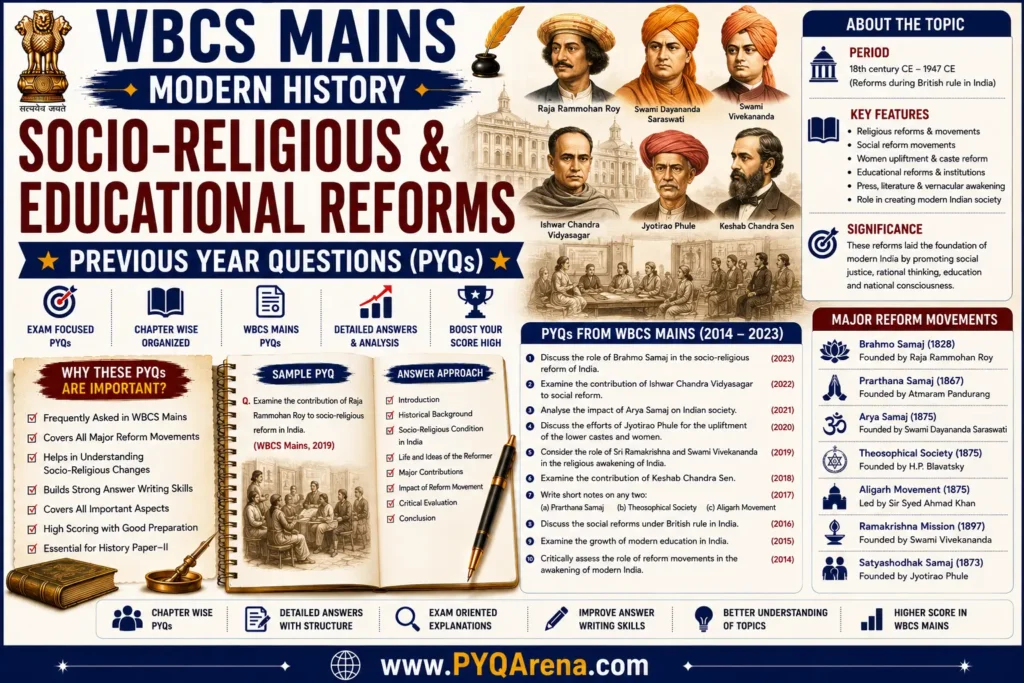
This compilation contains all the multiple-choice questions from the West Bengal Civil Service (WBCS) Mains History examinations (2014-2023) that focus on Brahmo Samaj, Arya Samaj, Ramakrishna Mission, Theosophical Society, Satyashodhak Samaj, Aligarh Movement, Young Bengal, social reforms (Sati abolition, Sarda Act), educational institutions (Fort William, Sanskrit, Hindu, Calcutta Madrasa, universities), education/press commissions, and newspaper/press acts.
WBCS Mains Socio-Religious & Educational Reforms Questions 2023
Q. Fort William College was founded in
(A) 1800
(B) 1820
(C) 1850
(D) 1900
Correct Answer: (A) 1800
Q. Hindu College was established in
(A) 1817
(B) 1812
(C) 1858
(D) 1885
Correct Answer: (A) 1817
Q. Sati Act was passed in the year
(A) 1856
(B) 1829
(C) 1729
(D) 1929
Correct Answer: (B) 1829
Q. Who started the Brahmo Samaj Movement?
(A) Dayananda Saraswati
(B) Raja Rammohan Roy
(C) Swami Vivekananda
(D) Mahadev Govinda Ranade
Correct Answer: (B) Raja Rammohan Roy
Q. The Vernacular Press Act was enacted by
(A) Lord Curzon
(B) Lord Ripon
(C) Lord Lytton
(D) None of the above
Correct Answer: (C) Lord Lytton
Q. Who was associated with the Theosophical Society in India?
(A) Sarojini Naidu
(B) Lakshmi Sahgal
(C) Padmaja Naidu
(D) Annie Besant
Correct Answer: (D) Annie Besant
Q. Who was the founder of the ‘Servants of India Society’?
(A) Madanmohan Malaviya
(B) Sardar Vallabhbhai Patel
(C) Subhash Chandra Bose
(D) Gopal Krishna Gokhale
Correct Answer: (D) Gopal Krishna Gokhale
WBCS Mains Socio-Religious & Educational Reforms Questions 2022
Q. Raja Rammohan Roy was the founder of
(A) Bahujan Sabha
(B) Brahmo Sabha
(C) Jatiyo Sabha
(D) Lok Sabha
Correct Answer: (B) Brahmo Sabha
Q. Sati Daha Bill was passed in the year
(A) 1830
(B) 1829
(C) 1831
(D) 1832
Correct Answer: (B) 1829
Q. The Hindu College was founded in the year
(A) 1818
(B) 1816
(C) 1817
(D) 1819
Correct Answer: (C) 1817
Q. The Tattwabodhini Patrika was founded by
(A) Raja Rammohan Roy
(B) Pandit Iswar Chandra Vidyasagar
(C) Debendranath Tagore
(D) Keshab Sen
Correct Answer: (C) Debendranath Tagore
WBCS Mains Socio-Religious & Educational Reforms Questions 2021
Q. When was the first ICS examination held in London?
(A) 1853
(B) 1855
(C) 1857
(D) 1860
Correct Answer: (B) 1855
Q. Which Governor-General of Bengal set up the General Committee of Public Instruction to supervise Company’s expenditure in the realm of education?
(A) Lord Hastings
(B) Lord Amherst
(C) Lord Bentinck
(D) Charles Metcalfe
Correct Answer: (B) Lord Amherst
Q. During whose tenure in office was the ‘Indian University Commission’ set up?
(A) Lord Lytton
(B) Lord Dufferin
(C) Lord Lansdowne
(D) Lord Curzon
Correct Answer: (D) Lord Curzon
Q. When was the Native Press Association founded?
(A) 1858
(B) 1877
(C) 1882
(D) 1900
Correct Answer: (B) 1877
Q. When was the first Census carried out in India?
(A) 1851
(B) 1861
(C) 1871
(D) 1881
Correct Answer: (C) 1871
Q. Who started the Statutory Civil Services and when?
(A) Lord Lytton — 1877
(B) Lord Lytton — 1879
(C) Lord Ripon — 1881
(D) Lord Ripon — 1883
Correct Answer: (B) Lord Lytton — 1879
Q. Who was associated with the Servants of India Society?
(A) G. K. Gokhale
(B) Sir Syed Ahmed Khan
(C) A. O. Hume
(D) M. M. Malviya
Correct Answer: (A) G. K. Gokhale
Q. Who was the founder of the Satyashodhak Samaj?
(A) B. R. Ambedkar
(B) E. V. Ramaswamy
(C) Jyotiba Phule
(D) C. Rajagopalachari
Correct Answer: (C) Jyotiba Phule
Q. Who was the editor of the Rast Goftar?
(A) Amir Ali
(B) Sir Syed Ahmed
(C) Maulana Azad
(D) Dadabhai Naoroji
Correct Answer: (D) Dadabhai Naoroji
WBCS Mains Socio-Religious & Educational Reforms Questions 2020
Q. The Asiatic Society of Bengal was founded by
(A) Ram Mohan Roy
(B) William Jones
(C) W. W. Hunter
(D) William Bentinck
Correct Answer: (B) William Jones
Q. Universities in the Presidency towns in India were established in the year
(A) 1857
(B) 1858
(C) 1900
(D) 1909
Correct Answer: (A) 1857
Q. Which of the following reform movements was the first to be started in the 19th century?
(A) Prarthana Samaj
(B) Arya Samaj
(C) Brahmo Samaj
(D) Ramakrishna Mission
Correct Answer: (C) Brahmo Samaj
Q. Which of the following statements about Henry Louis Vivian Derozio is incorrect?
(A) He was born in Calcutta in 1809.
(B) He taught at the Sanskrit College between 1826–1830.
(C) He died of Cholera at the age of 22.
(D) His followers were known as Derozians.
Correct Answer: (B) He taught at the Sanskrit College between 1826–1830.
Exam Fact: Derozio was a teacher at Hindu College, Calcutta, not Sanskrit College. He died of cholera in 1831 at the age of 22.
Q. The National Council for Education was set up in the year
(A) 1906
(B) 1908
(C) 1909
(D) 1911
Correct Answer: (A) 1906
Q. Which of the following is correctly matched?
(A) Rabindranath Tagore — Nil Darpan
(B) Dadabhai Naoroji — Indian Unrest
(C) Dinabandhu Mitra — Gora
(D) Ramesh Chandra Dutt — Economic History of India
Correct Answer: (D) Ramesh Chandra Dutt — Economic History of India
Q. Who was the founder of the Prarthana Samaj?
(A) Raja Ram Mohan Roy
(B) Dayanand Saraswati
(C) Atmaram Pandurang
(D) Gopal Krishna Gokhale
Correct Answer: (C) Atmaram Pandurang
WBCS Mains Socio-Religious & Educational Reforms Questions 2019
Q. Match the social reformers of the nineteenth century with their individual contributions:
Reformers:
(a) Raja Rammohan Roy
(b) Keshab Chandra Sen
(c) Jyotiba Phule
(d) Dayanand Saraswati
Contributions:
(i) Abolition of Sati
(ii) Intercaste marriage, widow remarriage and emancipation of women
(iii) Removal of untouchability
(iv) Shuddhi movement and rejection of hereditary caste system
(A) (a)-(i), (b)-(ii), (c)-(iii), (d)-(iv)
(B) (a)-(ii), (b)-(i), (c)-(iv), (d)-(iii)
(C) (a)-(ii), (b)-(iii), (c)-(iv), (d)-(i)
(D) (a)-(i), (b)-(ii), (c)-(iv), (d)-(iii)
Correct Answer: (A) (a)-(i), (b)-(ii), (c)-(iii), (d)-(iv)
Q. A brilliant and patriotic Anglo-Indian teacher, Henry Vivian Derozeo, was the founder of:
(A) The Young Bengal Movement
(B) The Indian National Union
(C) The Servants of India Society
(D) The British India Association
Correct Answer: (A) The Young Bengal Movement
Q. Gopal Hari Deshmukh is popularly known as ‘Lokhitwadi’ because:
(A) He was a great philanthropist and social worker.
(B) He distributed money and medicines to the poor and the needy.
(C) He edited a monthly magazine, the Lokhitwadi.
(D) All of the above
Correct Answer: (D) All of the above
Q. Match the papers or periodicals with the National leaders who published them:
(a) Abul Kalam Azad — (i) Bombay Chronicle
(b) Pheroze Shah Mehta — (ii) Al Hilal
(c) Mrs. Annie Besant — (iii) Young India
(d) M. K. Gandhi — (iv) New India
(A) (a)-(ii), (b)-(i), (c)-(iv), (d)-(iii)
(B) (a)-(i), (b)-(ii), (c)-(iv), (d)-(iii)
(C) (a)-(ii), (b)-(i), (c)-(iii), (d)-(iv)
(D) (a)-(iii), (b)-(ii), (c)-(i), (d)-(iv)
Correct Answer: (A) (a)-(ii), (b)-(i), (c)-(iv), (d)-(iii)
WBCS Mains Socio-Religious & Educational Reforms Questions 2018
Q. Arrange the following Commissions constituted for the development of education in colonial India in chronological order:
(i) Sadler Commission
(ii) Wood’s Despatch
(iii) Hunter Commission
(iv) Raleigh Commission
(A) (i), (ii), (iii), (iv)
(B) (ii), (iv), (iii), (i)
(C) (ii), (iii), (iv), (i)
(D) (ii), (iii), (i), (iv)
Correct Answer: (C) (ii), (iii), (iv), (i)
Chronology: Wood’s Despatch (1854) → Hunter Commission (1882) → Raleigh Commission (1902) → Sadler Commission (1917).
Q. Atmiya Sabha was founded by
(A) Raja Rammohan Roy
(B) Devendranath Tagore
(C) Kesav Chandra Sen
(D) Dayananda Saraswati
Correct Answer: (A) Raja Rammohan Roy
Q. Calcutta (Shibpur) Engineering College was established in the year
(A) 1817
(B) 1854
(C) 1855
(D) 1856
Correct Answer: (C) 1855
Q. Who among the following played an instrumental role in the formation of Calcutta School Book Society?
(A) Radhakanta Dev
(B) Raja Rammohan Roy
(C) Dwarakanath Mitra
(D) Madanmohan Tarkalankar
Correct Answer: (B) Raja Rammohan Roy
Q. Who among the following was not a proponent of Anglicism?
(A) William Jones
(B) Thomas Babington Macaulay
(C) Holt Mackenzie
(D) Charles Trevelyan
Correct Answer: (C) Holt Mackenzie
Q. Who established Calcutta Madrasa?
(A) Warren Hastings
(B) William Bentinck
(C) Lord Cornwallis
(D) Lord Wellesley
Correct Answer: (A) Warren Hastings
Q. Who was the first editor of Tattwabodhini Patrika?
(A) Rammohan Roy
(B) Debendranath Tagore
(C) Akshay Kumar Dutta
(D) Harish Chandra Mukherjee
Correct Answer: (C) Akshay Kumar Dutta
Q. Who was the founder of Tattwabodhini Sabha?
(A) Rammohan Roy
(B) Debendranath Tagore
(C) Dwarakanath Tagore
(D) Kesav Chandra Sen
Correct Answer: (B) Debendranath Tagore
Q. Bartaman Bharat was written by _________
(A) Bankim Chandra Chattopadhyay
(B) Swami Vivekananda
(C) Sarat Chandra Chattopadhyay
(D) Rabindranath Tagore
Correct Answer: (B) Swami Vivekananda
Q. Dayanand’s pamphlet on the subject of cow protection Gokarunanidhi was published in the year _________.
(A) 1879
(B) 1881
(C) 1885
(D) 1892
Correct Answer: (B) 1881
Q. Dramatic Performances Act (DPA) was brought into force under the administration of
(A) Lord Lytton
(B) Lord Mayo
(C) Lord Napier
(D) Lord Northbrook
Correct Answer: (A) Lord Lytton
Q. In the 1880s and 1890s ‘communalism’ acquired an All India dimension. The demand for the use of Devanagari script was granted in the year ________.
(A) 1868
(B) 1879
(C) 1898
(D) 1900
Correct Answer: (D) 1900
Q. Jyotirao Phule started his Satyashodhak Samaj in
(A) 1872
(B) 1873
(C) 1879
(D) 1910
Correct Answer: (B) 1873
Q. Mahakali Pathshala was founded by _________.
(A) Ramabai Ranade
(B) Mataji Tapaswini
(C) Anandibhai Bhagat
(D) Anandibai Karve
Correct Answer: (B) Mataji Tapaswini
Q. Nair Service Society under the leadership of Mannath Padmanabha Pillai was founded in
(A) 1900
(B) 1905
(C) 1914
(D) 1917
Correct Answer: (C) 1914
Q. Pandita Ramabai Saraswati arrived in Western India in 1882 and with the help from Ramabai Ranade set up _________ for general uplift and enlightenment of women.
(A) Bharat Stri Mahamandal
(B) Women’s Indian Association
(C) Arya Mahila Samaj
(D) Mahila Rashtriya Sangha
Correct Answer: (C) Arya Mahila Samaj
Q. Sri Narayana Dharma Paripalana Yogum (SNDP) was founded by
(A) Sri Narayana Guru
(B) Dr. Palgu
(C) N. Kumaran Asan
(D) All of them
Correct Answer: (D) All of them
Q. The news magazine Bharat Shramajivi was published by
(A) Dwarakanath Ganguly
(B) Sashipada Ganguly
(C) Shivnath Sastri
(D) Ramkumar Vidyaratna
Correct Answer: (B) Sashipada Ganguly
Q. When did the first schism within the Brahmo Samaj first take place?
(A) 1865
(B) 1866
(C) 1867
(D) 1868
Correct Answer: (B) 1866
Q. ‘Child Marriage Restraint Act’, popularly known as the Sarda Act, was passed in the year _________.
(A) 1927
(B) 1928
(C) 1929
(D) 1942
Correct Answer: (C) 1929
Q. All India Women’s Conference was founded in the year 1927 by _________.
(A) Latika Ghosh
(B) Urmila Devi
(C) Sarojini Naidu
(D) Margaret Cousins
Correct Answer: (D) Margaret Cousins
Q. Basu Vijnan Mandir (Bose Institute) was established on
(A) 1917
(B) 1916
(C) 1919
(D) 1920
Correct Answer: (A) 1917
Q. Rast Goftan was a newspaper established by
(A) Muhammad Ali
(B) Zafar Ali
(C) Syed Agmathullah
(D) Fardinji Naoroji
Correct Answer: (D) Fardinji Naoroji
Q. Who was the founder of Gramvarta Prakashika?
(A) Bhavani Charan
(B) Harish Chandra Mukhopadhyay
(C) Sisir Kumar Ghosh
(D) Harinath Majumder
Correct Answer: (D) Harinath Majumder
Q. Atmiya Sabha was founded by
(A) Raja Rammohan Roy
(B) Devendranath Tagore
(C) Kesav Chandra Sen
(D) Dayananda Saraswati
Correct Answer: (A) Raja Rammohan Roy
WBCS Mains Socio-Religious & Educational Reforms Questions 2017
Q. Which Mughal ruler conferred the title of ‘Raja’ on Ram Mohan Roy and requested him to go to England to plead for a hike in the Emperor’s pension?
(A) Shah Alam II
(B) Akbar II
(C) Bahadur Shah II
(D) None of the above
Correct Answer: (B) Akbar II
Q. Who among the following gave official sanction to the education of girls in India?
(A) William Bentinck
(B) Hardinge I
(C) Lord Dalhousie
(D) Lord Canning
Correct Answer: (B) Hardinge I
Q. By which Act did education officially come under Indian control for the first time?
(A) Indian Council Act of 1892
(B) Indian Council Act of 1909
(C) Government of India Act of 1919
(D) Government of India Act of 1935
Correct Answer: (C) Government of India Act of 1919
Q. The Jamia Millia Islamia of Aligarh, the Bihar Vidyapith, and the Kashi Vidyapith were established during
(A) Swadeshi and Boycott Movement, 1905–1908
(B) Non-Cooperation Movement, 1921–1922
(C) Civil Disobedience Movement, 1930–1934
(D) Quit India Movement, 1942–1943
Correct Answer: (B) Non-Cooperation Movement, 1921–1922
WBCS Mains Socio-Religious & Educational Reforms Questions 2016
Q. Jonathan Duncan founded the Sanskrit College in 1792 at
(A) Allahabad
(B) Varanasi
(C) Calcutta
(D) Madras
Correct Answer: (B) Varanasi
Q. To justify one of their colonial policies, the British continued with the “Downward Filtration Theory”. That colonial policy was on
(A) Education
(B) Industry
(C) Maritime trade
(D) De-industrialization
Correct Answer: (A) Education
Q. Which movement, though started as a religious reform movement, became a movement for the restoration of Sikh sovereignty by the annexation of Punjab by the British?
(A) Kittur Rising
(B) Bundela Revolt
(C) Kuka Movement
(D) Satavandi Revolt
Correct Answer: (C) Kuka Movement
Q. Which of the following statements is/are correct?
(i) Fort William College was closed in 1802.
(ii) In 1805 the East India College was established at Hertford near London.
(iii) The East India College was moved to Haileybury in 1809.
(iv) All of the above
(A) A only
(B) B only
(C) C only
(D) All of the above
Correct Answer: (D) All of the above
Q. Which of the following organizations, according to Sumit Sarkar, “left little distinctive or permanent on the plane of religion and philosophy” in 19th Century India?
(A) Brahmo Samaj
(B) Ramakrishna Mission
(C) Aligarh Movement
(D) Young Bengal
Correct Answer: (D) Young Bengal
Q. Which of the following statements is/are true about the Vernacular Press Act, 1878?
(i) It was passed by Lord Lytton.
(ii) It came to be known as the “Gagging Act”.
(iii) It liberated the Indian Press from restrictions.
(iv) It was repealed in 1882 by the Ripon Government.
(A) (ii) and (iv)
(B) (i) and (ii)
(C) (i) and (iii)
(D) (iii) and (iv)
Correct Answer: (A) (ii) and (iv)
WBCS Mains Socio-Religious & Educational Reforms Questions 2015
Q. Lord Macaulay was associated with
(A) Reforms in the army
(B) Abolition of Sati
(C) Codification of Laws
(D) Permanent Settlement
Correct Answer: (C) Codification of Laws
Q. Keshab Chandra Sen:
(i) Adopted a radical and comprehensive scheme of social reforms.
(ii) Infused the concept of Bhakti into Brahmoism.
(iii) Influenced the socio-religious reformers in Bombay and Madras.
(iv) Opposed the introduction of western education in India.
(A) i, ii and iii
(B) ii, iii and iv
(C) i, iii and iv
(D) All of them
Correct Answer: (A) i, ii and iii
Q. What is the name of the Bengali monthly founded and edited by Bankim Chandra Chatterjee in 1873?
(A) Soma Prakasha
(B) Bangaduta
(C) Bangadarshana
(D) Bengalee
Correct Answer: (C) Bangadarshana
Q. When and by whom was the ‘Nair Service Society’ founded?
(A) 1905 – Narayana Guru
(B) 1910 – T.M. Nair
(C) 1914 – M. Padmanabha Pillai
(D) 1916 – K. Ramakrishna Pillai
Correct Answer: (C) 1914 – M. Padmanabha Pillai
Q. Which of the following books was not written by Swami Dayanand Saraswati?
(A) Satyartha Prakash
(B) Veda Prakash
(C) Satyartha Bhumika
(D) Veda Bhashya Bhumika
Correct Answer: (B) Veda Prakash
Q. Which of the following is correctly paired?
(A) Anti-Partition and Swadeshi Movements — Lord Lansdowne
(B) Factory Act of 1891 — Lord Curzon
(C) Establishment of an Agricultural Research Institution at Pusa — Lord Minto
(D) Rowlatt Act — Lord Chelmsford
Correct Answer: (D) Rowlatt Act — Lord Chelmsford
Q. Which of the following were the original founders of the Theosophical Society?
(i) Madam H.P. Blavatsky
(ii) Mrs. Annie Besant
(iii) Colonel H.S. Olcott
(iv) Colonel O.P. Walburn
(A) i and ii
(B) ii and iii
(C) i and iii
(D) iii and iv
Correct Answer: (C) i and iii
Q. Who founded the Indian Reforms Association in 1870?
(A) Ram Mohan Roy
(B) Debendranath Tagore
(C) Keshab Chandra Sen
(D) Ishwar Chandra Vidyasagar
Correct Answer: (C) Keshab Chandra Sen
WBCS Mains Socio-Religious & Educational Reforms Questions 2014
Q. Vidyasagar has been described as “Traditional Moderniser” by historian
(A) Ramesh Chandra Majumder
(B) Binoy Ghosh
(C) Amalesh Tripathy
(D) Jadunath Sarkar
Correct Answer: (B) Binoy Ghosh
Leave a Comment