

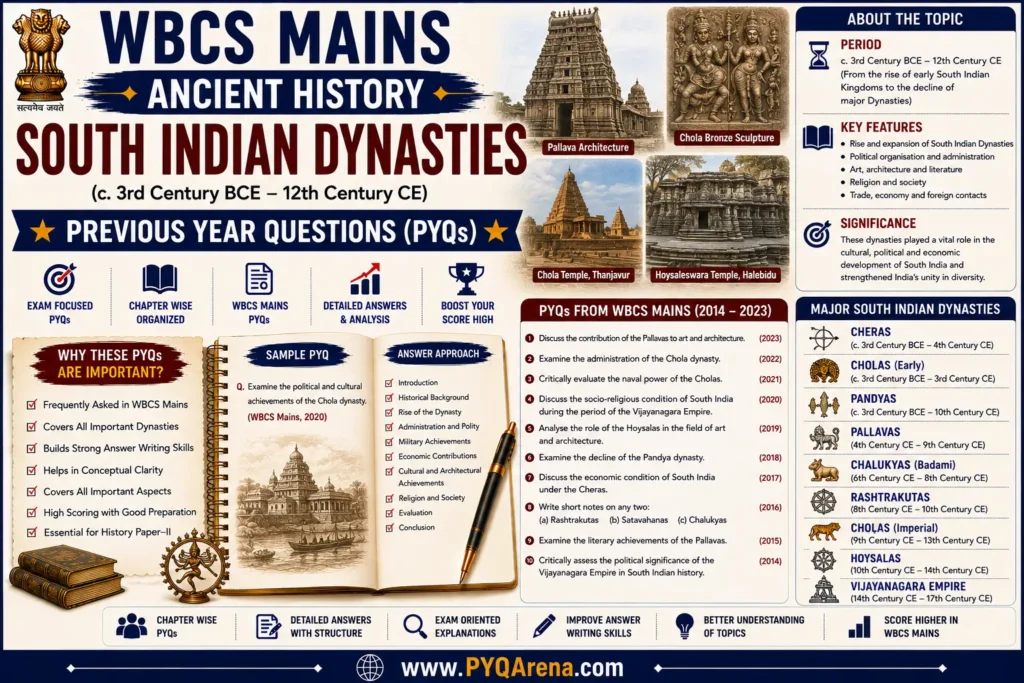
WBCS Mains South Indian Dynasties Questions 2023
Q. ‘Mandalam’ and ‘Nadu’ these two institutions were associated with
(A) The Pallavas
(B) The Cholas
(C) The Pandyas
(D) The Rashtrakutas
Answer & Explanation
Correct Answer: (B) The Cholas
Explanation
Mandalam and Nadu were important administrative divisions under the Chola Empire. The Chola kingdom was divided into large provinces called Mandalam, which were further divided into Valanadus and Nadus. This administrative system, along with well-developed local self-government, was a notable feature of Chola administration.
Exam Facts
- Mandalam was a major provincial or territorial division under the Cholas.
- A Nadu was an important administrative division comprising a group of villages.
- The Chola Empire had a highly developed system of local self-government.
- Ur was the assembly of ordinary villages.
- Sabha or Mahasabha was the assembly of Brahmadeya villages, generally dominated by Brahmin landholders.
- Nagaram referred to an organisation or assembly associated with merchants and towns.
- The famous Uttaramerur inscriptions provide important information about Chola local administration.
- The Uttaramerur inscriptions describe the Kudavolai system, a method used for selecting members of village committees.
Q. The Kailasanath temple in Kanchipuram was built by the
(A) Cholas
(B) Pallavas
(C) Pandyas
(D) Guptas
Answer & Explanation
Correct Answer: (B) Pallavas
Explanation
The Kailasanath Temple at Kanchipuram was built by the Pallavas, primarily during the reign of Narasimhavarman II (Rajasimha) in the late 7th to early 8th century CE. It is one of the earliest and most important examples of Dravidian-style structural temple architecture.
Exam Facts
- The Kailasanath Temple is located at Kanchipuram in Tamil Nadu.
- It was built by the Pallava dynasty.
- The temple is mainly associated with Narasimhavarman II (Rajasimha).
- It is dedicated to Lord Shiva.
- The temple is an important example of early Dravidian architecture.
- The Pallavas made important contributions to the development of rock-cut and structural temple architecture in South India.
- Mahabalipuram (Mamallapuram) is famous for Pallava monuments, including the Shore Temple and the Pancha Rathas.
- The Cholas later became famous for magnificent temples such as the Brihadeeswara Temple at Thanjavur, built by Rajaraja I.
Q. The capital of the Pallava rulers was
(A) Hampi
(B) Dwarka
(C) Kanchipuram
(D) Ujjain
Answer & Explanation
Correct Answer: (C) Kanchipuram
Explanation
Kanchipuram was the capital of the Pallava dynasty, which ruled significant parts of South India between approximately the 3rd and 9th centuries CE. The Pallavas made Kanchipuram an important centre of politics, religion, learning and temple architecture.
Exam Facts
- Kanchipuram was the capital of the Pallava rulers.
- The Pallavas were an important dynasty of South India.
- Kanchipuram is located in present-day Tamil Nadu.
- The Pallavas were major patrons of Dravidian temple architecture.
- The famous Kailasanath Temple at Kanchipuram was built by the Pallavas.
- Mahabalipuram (Mamallapuram) is famous for Pallava monuments such as the Shore Temple and Pancha Rathas.
- Hampi was the capital of the Vijayanagara Empire.
- Ujjain was an important ancient city and served as the capital of several rulers, including the Paramaras of Malwa, but not the Pallavas.
WBCS Mains South Indian Dynasties Questions 2021
Q. How were foreign merchants referred to in Chola documents?
(A) Manigramam
(B) Nanadeshi
(C) Ayyavole
(D) Pattinam
Answer & Explanation
Correct Answer: (B) Nanadeshi
Explanation
In Chola inscriptions and documents, Nanadeshi (Nanadesis) referred to merchant groups engaged in long-distance and overseas trade, including merchants who came from or traded with different countries and regions. They were important participants in the extensive commercial network of South India.
Exam Facts
- Nanadeshi literally means merchants associated with many countries or different regions.
- The Nanadeshi merchants were involved in long-distance and overseas trade during the Chola period.
- Manigramam was an important South Indian merchant guild involved in inland and overseas trade.
- Ayyavole (also known as Ayyavole 500) was a powerful merchant guild engaged in long-distance trade.
- Pattinam generally referred to a town or port town, rather than a specific group of foreign merchants.
- The Chola period witnessed significant growth in maritime trade, particularly with Southeast Asia and other regions of the Indian Ocean.
- Merchant guilds played an important role in the economic prosperity of the Chola Empire.
Q. What were villages granted to Brahmins and inhabited by Brahmins known as?
(A) Devadana
(B) Brahmadeya
(C) Agrahara
(D) Mangalam
Answer & Explanation
Correct Answer: (B) Brahmadeya
Explanation
Brahmadeya refers to land or villages granted to Brahmins, generally tax-free, by rulers. Such villages were often inhabited by Brahmin settlers and enjoyed special privileges. Brahmadeya villages were an important feature of South Indian administration, particularly during the Chola period.
Exam Facts
- Brahmadeya refers to land or villages granted to Brahmins.
- Brahmadeya grants were often tax-free or enjoyed special fiscal privileges.
- Devadana refers to land granted to temples or religious institutions.
- Agrahara generally refers to a settlement or village granted to Brahmins, often with special privileges.
- In South Indian inscriptions, Brahmin settlements were important centres of learning and religious activity.
- The Sabha or Mahasabha was the village assembly of Brahmadeya villages.
- The Ur was the assembly of ordinary non-Brahmadeya villages.
- Mangalam was often used as a suffix in the names of Brahmin settlements or villages in South India.
WBCS Mains South Indian Dynasties Questions 2020
Q. Kamban’s Ramayana in Tamil was written during the reign of
(A) Chalukya
(B) Pallavas
(C) Cholas
(D) Kakatiyas
Answer & Explanation
Correct Answer: (C) Cholas
Explanation
Kamban, one of the greatest Tamil poets, composed the Tamil version of the Ramayana, popularly known as Kamba Ramayanam, during the Chola period, generally placed in the 12th century CE. The work is regarded as one of the greatest masterpieces of Tamil literature.
Exam Facts
- Kamban was a famous Tamil poet.
- His Tamil version of the Ramayana is popularly known as the Kamba Ramayanam or Ramavataram.
- Kamban lived and composed his work during the Chola period.
- He is generally placed in the 12th century CE.
- The Kamba Ramayanam is one of the greatest classics of Tamil literature.
- The Chola period witnessed significant growth in Tamil literature, art and temple architecture.
- The Cholas were important patrons of Dravidian culture and architecture.
- The Chola rulers are particularly famous for temples such as the Brihadeeswara Temple at Thanjavur, built by Rajaraja I.
Q. Rulers of which dynasty patronised Jainism?
(A) Chalukya
(B) Pallava
(C) Rashtrakuta
(D) Chauhan
Answer & Explanation
Correct Answer: (C) Rashtrakuta
Explanation
The Rashtrakuta rulers were important patrons of Jainism, although they also supported other religions such as Hinduism. Several Jain scholars received royal patronage during the Rashtrakuta period, making the dynasty particularly important in the history of Jainism in medieval South India.
Exam Facts
- The Rashtrakutas were important patrons of Jainism.
- The Rashtrakutas ruled large parts of the Deccan between approximately the 8th and 10th centuries CE.
- Amoghavarsha I was one of the most famous Rashtrakuta rulers and was a notable patron of Jainism.
- The Jain scholar Jinasena was associated with the Rashtrakuta court.
- Amoghavarsha I authored Kavirajamarga, an important early work on Kannada literature.
- The Rashtrakutas also patronised Hinduism, reflecting religious tolerance during their rule.
- The famous Kailasa Temple at Ellora was built by the Rashtrakuta ruler Krishna I.
- The Chalukyas and Pallavas were primarily associated with the patronage of Hindu temple architecture, though they also supported other religious traditions.
Q. What is the meaning of the word ‘Sangam’ in the Sangam Age?
(A) Royal Court
(B) Assembly of Poets
(C) Assembly of religious teachers
(D) Meeting of rivers
Answer & Explanation
Correct Answer: (B) Assembly of Poets
Explanation
The word “Sangam” literally means an assembly or association. In the context of the Sangam Age, it refers to the traditional assemblies of Tamil poets and scholars believed to have been held under the patronage of the Pandya rulers. Sangam literature is one of the earliest and most important bodies of literature in the Tamil language.
Exam Facts
- Sangam means an assembly or association, particularly an assembly of poets in this context.
- The Sangam Age is associated with the early history and literature of Tamilakam.
- The Sangam assemblies are traditionally believed to have received patronage from the Pandya rulers.
- Sangam literature is broadly divided into Ettuthogai (Eight Anthologies) and Pattuppattu (Ten Idylls).
- Important works associated with the Sangam corpus include Silappadikaram and Manimekalai, though they are generally classified among the later Tamil epics.
- Tolkappiyam is regarded as the earliest extant work on Tamil grammar and poetics.
- The three major Tamil dynasties associated with the Sangam Age were the Cheras, Cholas and Pandyas.
WBCS Mains South Indian Dynasties Questions 2019
Q. The Pallava-Chola style of architecture is commonly known as
(A) Pallava
(B) Chola
(C) Nagara
(D) Dravida
Answer & Explanation
Correct Answer: (D) Dravida
Explanation
The temple architecture developed under the Pallavas and Cholas in South India is commonly known as the Dravida style of architecture. Its main features include a pyramidal, multi-storeyed tower (Vimana) over the sanctum and the use of large temple complexes with pillared halls and gateways.
Exam Facts
- The Pallava-Chola style of temple architecture is known as the Dravida style.
- The Dravida style developed mainly in South India.
- The Vimana, a pyramidal tower over the sanctum (garbhagriha), is a major feature of Dravida architecture.
- The Pallavas were pioneers in the development of early Dravidian temple architecture.
- The Cholas further developed and expanded the Dravida architectural tradition.
- The Kailasanath Temple at Kanchipuram is an important example of Pallava architecture.
- The Brihadeeswara Temple at Thanjavur, built by Rajaraja I, is a famous example of Chola architecture.
- Nagara architecture is primarily associated with North Indian temple architecture and generally features a curvilinear Shikhara.
Q. The spies during the Sangam age was known as
(A) Spasas
(B) Dutas
(C) Orrars
(D) Sanjayans
Answer & Explanation
Correct Answer: (C) Orrars
Explanation
During the Sangam Age, spies and secret agents were known as Orrars (Otrar). They were employed by rulers to collect secret information and intelligence regarding enemies and political affairs.
Exam Facts
- Spies during the Sangam Age were known as Orrars (Otrar).
- They performed the function of secret agents and intelligence gatherers.
- Dutas generally referred to messengers or envoys.
- The term Spasas was used for spies in ancient Indian administrative systems, particularly in Sanskrit sources.
- The Sangam Age was associated with the ancient Tamil region known as Tamilakam.
- The major ruling dynasties of the Sangam Age were the Cheras, Cholas and Pandyas.
- Sangam literature provides important information about the political, social and economic life of ancient South India.
WBCS Mains South Indian Dynasties Questions 2018
Q. Alvar was ________ hymnodist of the Tamil devotional cult.
(A) Shaivite
(B) Vaishnavite
(C) Buddhist
(D) Jain
Answer & Explanation
Correct Answer: (B) Vaishnavite
Explanation
The Alvars were Vaishnavite poet-saints of the Tamil Bhakti tradition who composed devotional hymns in praise of Lord Vishnu and his various incarnations. They played a major role in the growth and spread of the Bhakti Movement in South India.
Exam Facts
- The Alvars were Vaishnavite saint-poets of South India.
- They composed devotional hymns mainly in praise of Lord Vishnu.
- The Alvar saints are traditionally counted as 12 in number.
- Their devotional hymns were later compiled into the Nalayira Divya Prabandham.
- The Nayanars were the Shaivite saint-poets of the Tamil Bhakti tradition.
- The Nayanars composed devotional hymns in praise of Lord Shiva.
- The Bhakti Movement emphasised personal devotion to a deity as a path to spiritual salvation.
- The Alvars and Nayanars played a significant role in the development of the Tamil devotional movement.
Q. The centre of Sangam literature and the patrons of Sangam poets were
(A) The Cheras of Vanji
(B) The Cholas of Uraiyur
(C) The Pandyas of Madurai
(D) All of the above
Answer & Explanation
Correct Answer: (C) The Pandyas of Madurai
Explanation
Madurai, the capital of the Pandya kingdom, was the principal centre of Sangam literature. The Pandya rulers are traditionally regarded as the chief patrons of the Sangam assemblies and Tamil poets. According to tradition, the famous Sangams or assemblies of poets were held under Pandya patronage at Madurai.
Exam Facts
- Madurai was the principal centre of Sangam literature.
- The Pandya rulers of Madurai were the traditional patrons of the Sangam poets and assemblies.
- The word Sangam refers to an assembly of poets and scholars.
- The three major Tamil dynasties of the Sangam Age were the Cheras, Cholas and Pandyas.
- The capital of the Cheras was Vanji (Karur is often identified with it).
- Uraiyur was an important early capital of the Cholas.
- The Sangam Age is associated with ancient Tamilakam.
- Sangam literature provides valuable information about the political, social, economic and cultural life of ancient South India.
Q. The famous Uttaramerur inscription belongs to the reign of
(A) Parantaka I
(B) Parantaka II
(C) Rajaraja I
(D) Rajaraja II
Answer & Explanation
Correct Answer: (A) Parantaka I
Explanation
The famous Uttaramerur inscriptions belong mainly to the reign of Parantaka I of the Chola dynasty. These inscriptions are particularly important because they provide detailed information about the system of local self-government and village administration under the Cholas, including the method of selecting members of village committees.
Exam Facts
- The famous Uttaramerur inscriptions belong to the reign of Parantaka I of the Chola dynasty.
- Parantaka I ruled approximately from 907 CE to 955 CE.
- The inscriptions provide detailed information about Chola local self-government.
- They describe the Kudavolai system used for selecting members of village committees.
- Kudavolai was a system of selection by drawing names written on palm leaves from a pot.
- Uttaramerur was an important Brahmadeya village.
- The Sabha or Mahasabha managed the affairs of Brahmadeya villages.
- The Uttaramerur inscriptions are among the most important sources for understanding the local administration of the Chola Empire.
WBCS Mains South Indian Dynasties Questions 2017
Q. The term ‘Malaimandalam’ refers to
(A) Coromandal coast
(B) Malabar coast
(C) Pandya coast
(D) Konkan coast
Answer & Explanation
Correct Answer: (B) Malabar Coast
Explanation
The term Malaimandalam refers to the Malabar region or Malabar Coast of South India. The word is associated with the western coastal region of present-day Kerala, lying between the Western Ghats and the Arabian Sea.
Exam Facts
- Malaimandalam refers to the Malabar region/coast.
- The Malabar Coast is located along the south-western coast of India, mainly in present-day Kerala.
- It lies between the Western Ghats and the Arabian Sea.
- The Coromandel Coast lies along the south-eastern coast of India, mainly bordering the Bay of Bengal.
- The Malabar Coast was historically famous for the spice trade, especially pepper.
- Ancient and medieval South India maintained extensive maritime trade with the Arab world and other regions.
- The Cheras were one of the important ancient dynasties associated with the Malabar region.
Q. Which Chalukya ruler is credited with repelling the Arab invasion of South Gujarat?
(A) Vikramaditya I
(B) Pulakesin I
(C) Pulakesin II
(D) Vikramaditya II
Answer & Explanation
Correct Answer: (D) Vikramaditya II
Explanation
Vikramaditya II of the Badami Chalukya dynasty is credited in some historical accounts with checking Arab expansion in western India. However, the more specific and commonly cited victory over an Arab invasion in the Gujarat region is associated with the Chalukya governor Avanijanashraya Pulakeshin, who defeated the Arab forces around 738 CE while serving under the Chalukyas.
Exam Facts
- Vikramaditya II was a prominent ruler of the Badami Chalukya dynasty.
- He ruled approximately from 733 CE to 746 CE.
- The Arabs expanded into Sindh in the early 8th century CE after the conquest led by Muhammad bin Qasim.
- Arab attempts to expand further into western and northern India were resisted by several Indian rulers.
- The Navsari inscription records the defeat of Arab forces around 738 CE.
- The victory recorded in the Navsari inscription is associated with Avanijanashraya Pulakeshin, a Chalukya governor.
- Pulakesin II was the famous Chalukya ruler who defeated Harshavardhana on the banks of the Narmada.
- Vikramaditya II is also known for his campaigns against the Pallavas, including the capture of Kanchipuram.
Q. Which style of architecture was developed by the Chalukyas of Badami?
(A) Vesara
(B) Dravida
(C) Nagara
(D) Gopuram
Answer & Explanation
Correct Answer: (A) Vesara
Explanation
The Chalukyas of Badami are credited with developing the Vesara style of temple architecture. The Vesara style is generally regarded as a blend of the Nagara style of North India and the Dravida style of South India. The Chalukya rulers made important contributions to the evolution of Indian temple architecture through monuments at Badami, Aihole and Pattadakal.
Exam Facts
- The Chalukyas of Badami are associated with the development of the Vesara style of architecture.
- The Vesara style is generally described as a combination of Nagara and Dravida architectural features.
- Badami was the capital of the Early or Badami Chalukyas.
- Aihole is often called the “cradle of Indian temple architecture.”
- Pattadakal is famous for temples displaying both Nagara and Dravida styles.
- The Pattadakal Group of Monuments is a UNESCO World Heritage Site.
- The Nagara style is primarily associated with North Indian temple architecture.
- The Dravida style is primarily associated with South Indian temple architecture.
Q. Who composed the Aihole Inscription?
(A) Ravikirti
(B) Harisen
(C) Bilhan
(D) None of the above
Answer & Explanation
Correct Answer: (A) Ravikirti
Explanation
The Aihole Inscription was composed by Ravikirti, the court poet of the Chalukya ruler Pulakesin II. Written in Sanskrit, the inscription praises Pulakesin II and records his military achievements, including his famous victory over Harshavardhana.
Exam Facts
- The Aihole Inscription was composed by Ravikirti.
- Ravikirti was the court poet of Pulakesin II.
- The inscription belongs to the Chalukya dynasty of Badami.
- It is generally dated to 634 CE.
- The Aihole Inscription is also known as the Meguti Temple Inscription.
- It was written in Sanskrit.
- The inscription records the achievements of Pulakesin II.
- It mentions Pulakesin II’s victory over Harshavardhana near the Narmada River.
- Harisen composed the Allahabad Pillar Inscription (Prayag Prashasti) of Samudragupta.
WBCS Mains South Indian Dynasties Questions 2016
Q. At which of the following Ports have a sizable Roman settlement and a Roman factory have been discovered?
(A) Tamralipti
(B) Muziris or Mushri
(C) Arikamedu
(D) Kaveripattanam
Answer & Explanation
Correct Answer: (C) Arikamedu
Explanation
Arikamedu, located near present-day Puducherry, was an important ancient port and trading centre. Archaeological excavations have revealed evidence of a Roman trading settlement, including structures associated with Roman merchants and large quantities of Roman pottery and other artefacts. Therefore, Arikamedu is closely associated with a sizable Roman settlement and trading establishment in ancient India.
Exam Facts
- Arikamedu was an important ancient port and trading centre.
- It is located near present-day Puducherry (Pondicherry).
- Archaeological excavations have revealed evidence of Indo-Roman trade at Arikamedu.
- Important finds include Roman amphorae, Arretine ware and other Roman artefacts.
- Arikamedu was known in ancient times as an important centre for trade with the Roman Empire.
- Muziris was another important ancient port on the Malabar Coast, famous for Indo-Roman trade.
- Tamralipti was an important ancient port in eastern India, located in present-day West Bengal.
- Kaveripattanam (Puhar) was an important ancient Chola port on the Tamil coast
Q. On the basis of evidences emerging from the site of Kodumanal the beginning of urbanization in Tamil Nadu goes back to
(A) 800 BCE
(B) 500-400 BCE
(C) 300 BCE-200 CE
(D) CE 200
Answer & Explanation
Correct Answer: (B) 500–400 BCE
Explanation
Archaeological evidence from Kodumanal, an important early historic site in present-day Tamil Nadu, indicates that the process of urbanization in Tamil Nadu began around 500–400 BCE. Excavations at the site have revealed evidence of craft production, trade and an organised settlement, pointing to the early development of urban centres in the Tamil region.
Exam Facts
- Kodumanal is an important archaeological site in present-day Tamil Nadu.
- Evidence from Kodumanal suggests the beginning of urbanization in Tamil Nadu around 500–400 BCE.
- Kodumanal was an important centre of craft production and trade.
- Archaeological findings include evidence of bead-making, iron and steel working, and other crafts.
- The site was connected with important trade networks in ancient South India.
- Kodumanal provides valuable evidence for the transition from the Megalithic to the Early Historic period in Tamil Nadu.
- The development of towns and trade contributed significantly to the growth of the early Tamil/Sangam-age economy.
- Ancient Tamil regions maintained commercial links with other parts of India and with overseas trading centres.
Q. Seaborne trade between India and Rome received great impetus during the reign of Roman Emperor
(A) Augustus
(B) Claudius
(C) Trajan
(D) Nero
Answer & Explanation
Correct Answer: (A) Augustus
Explanation
Seaborne trade between India and the Roman Empire received a major boost during the reign of Emperor Augustus (27 BCE–14 CE). The discovery and effective use of the monsoon winds for direct navigation across the Arabian Sea greatly facilitated maritime trade between Indian ports and Roman Egypt during this period.
Exam Facts
- Augustus was the first Roman Emperor and ruled from 27 BCE to 14 CE.
- Indo-Roman maritime trade expanded significantly during the reign of Augustus.
- The use of monsoon winds made direct sea voyages between the Red Sea and Indian ports easier.
- The Greek navigator Hippalus is traditionally associated with the discovery of the monsoon route to India.
- The Periplus of the Erythraean Sea is an important source of information on Indo-Roman maritime trade.
- Important Indian ports involved in Roman trade included Muziris, Arikamedu and Kaveripattanam.
- India exported goods such as spices, pepper, textiles, precious stones and ivory to the Roman world.
- Numerous Roman coins have been discovered in different parts of South India, providing evidence of Indo-Roman trade.
Q. Who was the founder of the Chalukyas of Badami?
(A) Vikramaditya I
(B) Pulkesin I
(C) Kirtivarman I
(D) Vijayaditya
Answer & Explanation
Correct Answer: (B) Pulkesin I
Explanation
Pulkesin I (Pulakesin I) is regarded as the founder of the Chalukya dynasty of Badami (Vatapi). He established the dynasty as an independent ruling power in the 6th century CE and made Vatapi (modern Badami in Karnataka) his capital.
Exam Facts
- Pulkesin I (Pulakesin I) was the founder of the Chalukyas of Badami.
- He established the Chalukya kingdom in the 6th century CE.
- The capital of the Badami Chalukyas was Vatapi (modern Badami) in Karnataka.
- Kirtivarman I was the son and successor of Pulkesin I.
- Pulakesin II was one of the greatest rulers of the Badami Chalukya dynasty.
- Pulakesin II is famous for defeating Harshavardhana near the Narmada River.
- The Aihole Inscription of 634 CE, composed by Ravikirti, describes the achievements of Pulakesin II.
- The Badami Chalukyas were important patrons of early Indian temple architecture and contributed to the development of the Vesara style.
WBCS Mains South Indian Dynasties Questions 2015
Q. Which one of the following was the meeting ground for the Brahmanical and devotional religious levels?
(A) Maths
(B) Temples
(C) Ghatikas
(D) Samas
Answer & Explanation
Correct Answer: (B) Temples
Explanation
Temples served as the main meeting ground for the Brahmanical tradition and the devotional (Bhakti) tradition in ancient and early medieval India. They became important centres of religious worship, rituals, social activities and the growth of popular devotional movements.
Exam Facts
- Temples acted as an important meeting point between Brahmanical and Bhakti traditions.
- They were centres not only of worship but also of social, cultural and economic activities.
- The Bhakti Movement emphasised personal devotion to a chosen deity.
- The Alvars were Vaishnavite poet-saints associated with the Tamil Bhakti tradition.
- The Nayanars were Shaivite poet-saints associated with the Tamil Bhakti tradition.
- Mathas (Maths) were primarily religious monasteries or centres of learning.
- Ghatikas were centres of higher learning, particularly associated with South Indian religious and educational traditions.
- Temples played a major role in the development and spread of Brahmanical Hinduism and popular devotional practices.
Leave a Comment