

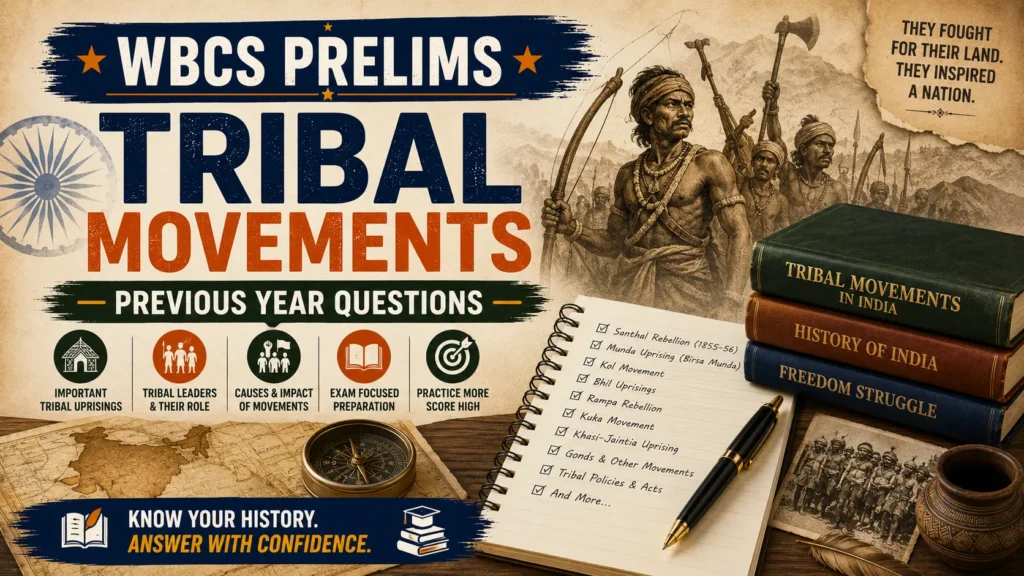
WBCS Prelims Tribal Movements Questions 2024
1. Which tribal leader was regarded as an incarnation of God (Dharti Aba)?
(A) Kanu Santhal
(B) Rupa Naik
(C) Birsa Munda
(D) Joria Bhagat
Answer & Explanation
Answer: (C) Birsa Munda
Explanation
Birsa Munda was a great tribal freedom fighter and social reformer who led the Munda Ulgulan (Great Tumult) against British rule in the Chotanagpur region (present-day Jharkhand) during 1899–1900.
His followers regarded him as “Dharti Aba” (Father of the Earth) and believed him to be a divinely inspired leader. He fought against British exploitation, missionary influence, and the zamindari system, while seeking to restore the traditional land rights of the tribal people.
Exam Facts
- Correct Answer: Birsa Munda
- Title: Dharti Aba (Father of the Earth)
- Movement: Munda Ulgulan (1899–1900)
- Region: Chotanagpur (present-day Jharkhand)
- Community: Munda tribe
- Died: 9 June 1900 in Ranchi Jail
- Related law: His movement contributed to the enactment of the Chotanagpur Tenancy Act, 1908, which protected tribal land rights.
2. The leader of the Kherwar or Safa Hor Movement was
(A) Birsa Munda
(B) Bhagirath Manjhi
(C) Baba Ramchandra
(D) Madari Pasi
Answer & Explanation
Answer: (B) Bhagirath Manjhi
Explanation
The Kherwar Movement, also known as the Safa Hor Movement, was led by Bhagirath Manjhi among the Santhal tribe in the 1870s (mainly in present-day Jharkhand and adjoining areas).
The movement aimed at:
- Religious and social reform among the Santhals.
- Purification of tribal customs (hence the name Safa Hor, meaning “pure people”).
- Resistance to the exploitation by zamindars, moneylenders, and the British administration.
Bhagirath Manjhi proclaimed himself as the rightful ruler of the Santhals and encouraged his followers to refuse payment of unjust taxes and rents.
Exam Facts
- Correct Answer: Bhagirath Manjhi
- Movement: Kherwar (Safa Hor) Movement
- Period: 1870s
- Tribe: Santhal
- Objectives:
- Social and religious reform
- Protection of tribal rights
- Resistance against exploitation by zamindars and British authorities
Remember the Leaders of Important Tribal Movements
| Movement | Leader |
|---|---|
| Santhal Rebellion (1855–56) | Sidhu & Kanhu Murmu |
| Kherwar (Safa Hor) Movement | Bhagirath Manjhi |
| Munda Ulgulan (1899–1900) | Birsa Munda |
| Rampa Rebellion (1922–24) | Alluri Sitarama Raju |
| Bhil Revolt | Govind Guru (among the prominent leaders) |
3. The leader of the Reang Uprising in Tripura (1942–43) was
(A) Parikshit Jamatia
(B) Ratan Mani
(C) Birsa Munda
(D) Bir Bikram Manikya
Answer & Explanation
Answer: (B) Ratan Mani
Explanation
The Reang (Bru) Uprising (1942–43) in Tripura was led by Ratan Mani (Ratan Mani Noatia), a religious and tribal leader. He mobilized the Reang (Bru) tribal community against the feudal administration of the princely state of Tripura, protesting exploitation, excessive taxation, and administrative oppression.
The movement was eventually suppressed by the Tripura State forces.
Exam Facts
- Correct Answer: Ratan Mani
- Movement: Reang (Bru) Uprising
- Period: 1942–43
- Region: Tripura
- Community involved: Reang (Bru) tribe
- Cause: Opposition to feudal exploitation, heavy taxation, and administrative oppression in the princely state of Tripura.
4. The leader of the Eka Movement was
(A) Birsa Munda
(B) Annie Besant
(C) Madari Pasi
(D) A. N. Sinha
Answer & Explanation
Answer: (C) Madari Pasi
Explanation
The Eka Movement (Unity Movement) was a peasant movement launched in 1921–22 in the Hardoi, Bahraich, Sitapur, and Unnao districts of United Provinces (present-day Uttar Pradesh).
The movement was led by Madari Pasi, a leader from the Pasi community. Initially, it had the support of the Congress and the Khilafat Movement, but later became independent.
The peasants took an “Eka” (unity) oath to:
- Pay only the recorded rent.
- Refuse illegal cesses and forced labour (begar).
- Remain united against oppressive landlords.
Exam Facts
- Correct Answer: Madari Pasi
- Movement: Eka Movement (Unity Movement)
- Period: 1921–22
- Region: United Provinces (Uttar Pradesh)
- Leader: Madari Pasi
- Main Issues:
- High rents
- Illegal cesses
- Oppression by zamindars
- Forced labour (begar)
5. The leader of the Khaksar Movement was
(A) M. A. Jinnah
(B) Inayatullah Khan Mashriqi
(C) Swami Shraddhanand
(D) M. A. Jayakar
Answer & Explanation
Answer: (B) Inayatullah Khan Mashriqi
Explanation
The Khaksar Movement (Khaksar Tehrik) was founded and led by Allama Inayatullah Khan Mashriqi in 1931 at Lahore. The movement aimed at the social, moral, and political upliftment of Indian Muslims through discipline, self-help, equality, and national service.
Members of the movement wore khaki uniforms and carried spades (belchas) as symbols of humility, labour, and service, which gave the movement its name “Khaksar” (meaning humble or one made of dust).
Exam Facts
- Correct Answer: Inayatullah Khan Mashriqi
- Movement: Khaksar Movement (Khaksar Tehrik)
- Founded: 1931
- Place: Lahore
- Founder & Leader: Allama Inayatullah Khan Mashriqi
- Symbol: Spade (Belcha)
- Uniform: Khaki dress
- Objective: Social reform, discipline, self-reliance, and service to society.
6. The leader of the Tana Bhagat movement was
(A) Sidho Majhi
(B) Birsa Munda
(C) Jatra Oraon
(D) Bhai Mukund
Answer & Explanation
Answer: (C) Jatra Oraon (Jatra Bhagat)
Explanation
The Tana Bhagat Movement was started by Jatra Oraon (also known as Jatra Bhagat) in 1914 among the Oraon tribe in the Chotanagpur region (present-day Jharkhand).
The movement began as a religious and social reform movement but gradually acquired a political character, opposing British rule, excessive taxation, and forced labour (begar). The Tana Bhagats later became followers of Mahatma Gandhi and actively participated in the Non-Cooperation Movement, adopting non-violence, khadi, and Swadeshi.
Exam Facts
- Correct Answer: Jatra Oraon (Jatra Bhagat)
- Movement: Tana Bhagat Movement
- Started: 1914
- Region: Chotanagpur (Jharkhand)
- Tribe: Oraon
- Nature of movement:
- Religious and social reform
- Opposition to taxes and forced labour
- Later associated with Gandhian non-violence
WBCS Prelims Tribal Movements Questions 2023
7. Who started the Faraizi Movement in Bengal?
(A) Titumir
(B) Kunwar Singh
(C) Digambar Biswas
(D) Haji Shariatullah
Answer & Explanation
Answer: (D) Haji Shariatullah
Explanation
The Faraizi Movement was started by Haji Shariatullah in 1818 in Eastern Bengal (present-day Bangladesh). It was a religious and socio-economic reform movement among the Muslim peasantry.
The movement urged Muslims to perform the Faraiz (obligatory duties) of Islam and opposed un-Islamic practices, as well as the oppression of zamindars, indigo planters, and the colonial administration.
After the death of Haji Shariatullah, the movement was led by his son Dudu Miyan (Muhsinuddin Ahmad), under whom it became more agrarian and anti-zamindari in character.
Exam Facts
- Correct Answer: Haji Shariatullah
- Movement: Faraizi Movement
- Started: 1818
- Region: Eastern Bengal
- Succeeded by: Dudu Miyan (Muhsinuddin Ahmad)
- Objectives:
- Purification of Islamic practices
- Protection of Muslim peasants
- Opposition to zamindari oppression
WBCS Prelims Tribal Movements Questions 2021
8. What was the ‘Eka Movement’?
(A) A Religious movement
(B) A Peasant movement
(C) A Secret revolutionary movement
(D) None of the above
Answer & Explanation
Answer: (B) A Peasant movement
Explanation
The Eka Movement (Unity Movement) was a peasant movement that took place in 1921–22 in the United Provinces (present-day Uttar Pradesh). It was led by Madari Pasi and emerged due to the exploitation of peasants by zamindars, high rents, illegal cesses, and forced labour (begar).
Initially, the movement had the support of the Congress and the Khilafat Movement, but it later became an independent peasant agitation.
The name “Eka” means “Unity”, reflecting the peasants’ pledge to remain united against exploitation.
9. To which following movement is the term ‘Ulgulan’ associated with?
(A) Munda Uprising
(B) Santal Uprising
(C) Kol Uprising
(D) Gurkha Uprising
Answer & Explanation
Answer: (A) Munda Uprising
Explanation
Ulgulan, meaning “The Great Tumult” or “The Great Upheaval”, is associated with the Munda Uprising (1899–1900) led by Birsa Munda in the Chotanagpur region (present-day Jharkhand).
The movement was directed against:
- British colonial rule
- Exploitation by zamindars and moneylenders
- Restrictive forest laws
- Alienation of tribal land
The objective was to restore the traditional Munda Raj and protect the land rights of the tribal people.
Exam Facts
- Correct Answer: Munda Uprising
- Leader: Birsa Munda
- Period: 1899–1900
- Region: Chotanagpur (Jharkhand)
- Meaning of “Ulgulan”: The Great Tumult / Great Upheaval
- Title of Birsa Munda: Dharti Aba (Father of the Earth)
- Impact: Led to the enactment of the Chotanagpur Tenancy Act, 1908, which protected tribal land rights.
10. What was the original name of Titumir?
(A) Syed Amanullah Khan
(B) Syed Mir Nisar Ali
(C) Syed Amir Ali
(D) Syed Mir Muhammad Khan
Answer & Explanation
Answer: (B) Syed Mir Nisar Ali
Explanation
Titumir was the popular name of Syed Mir Nisar Ali, a prominent religious reformer and freedom fighter of Bengal. He led a movement against the oppression of zamindars, British authorities, and the illegal taxes imposed on poor Muslim peasants.
He is best remembered for constructing the famous Bamboo Fort (Bansher Kella) at Narkelberia in present-day North 24 Parganas, West Bengal. The British attacked and destroyed the fort on 19 November 1831, during which Titumir was killed.
Exam Facts
- Correct Answer: Syed Mir Nisar Ali
- Popular name: Titumir
- Famous for: Bamboo Fort (Bansher Kella)
- Place: Narkelberia, North 24 Parganas, Bengal
- Fort destroyed: 19 November 1831
- Movement: Resistance against British rule, zamindars, and oppressive taxation
- Influenced by: Syed Ahmad Barelvi and the Wahabi reform movement.
11. The names of Sidho and Kanho are associated with which rebellion?
(A) Chuar Rebellion
(B) Sannyasi Rebellion
(C) Santhal Rebellion
(D) Kol Rebellion
Answer & Explanation
Answer: (C) Santhal Rebellion
Explanation
Sidho Murmu and Kanho Murmu were the principal leaders of the Santhal Rebellion (Santhal Hul) of 1855–56. The rebellion took place in the Damin-i-Koh region (present-day Jharkhand) against the exploitation of the British, zamindars, moneylenders (mahajans), and revenue officials.
The Santhals declared the end of British authority and attempted to establish self-rule before the revolt was brutally suppressed.
Exam Facts
- Correct Answer: Santhal Rebellion
- Leaders: Sidho Murmu & Kanho Murmu
- Period: 1855–56
- Region: Damin-i-Koh (present-day Jharkhand)
- Also known as: Santhal Hul
- Causes:
- Exploitation by zamindars and moneylenders
- Oppressive British revenue policies
- Other important leaders: Chand and Bhairav Murmu; Phulo and Jhano Murmu also played notable roles.
WBCS Prelims Tribal Movements Questions 2020
12. What was meant by ‘Kherwari Hul’?
(A) Chuar movement
(B) Paik revolt
(C) Santhal movement
(D) Indigo revolt
Answer & Explanation
Answer: (C) Santhal Movement
Explanation
Kherwari Hul refers to the Kherwar (Kherwari) Movement, a Santhal reform movement led by Bhagirath Manjhi in the 1870s. It is also known as the Safa Hor Movement.
The movement sought:
- Religious and social reform among the Santhals.
- Purification of tribal customs.
- Resistance against the exploitation of zamindars, moneylenders, and the British administration.
The word “Hul” in the Santhali language means “rebellion” or “movement”.
Exam Facts
- Correct Answer: Santhal Movement
- Movement: Kherwar (Kherwari) Hul / Safa Hor Movement
- Leader: Bhagirath Manjhi
- Period: 1870s
- Community: Santhal tribe
- Objective: Social and religious reform, along with resistance to colonial and feudal exploitation.
WBCS Prelims Tribal Movements Questions 2017
13. The leader of the Munda Rebellion (Ulgulan) was ______.
(A) Sidho
(B) Birsa
(C) Bapat
(D) Korra Malya
Answer & Explanation
Answer: (B) Birsa
Explanation
The Munda Rebellion, popularly known as Ulgulan (The Great Tumult), was led by Birsa Munda during 1899–1900 in the Chotanagpur region against British rule, zamindars, and moneylenders.
Exam Facts
- Leader: Birsa Munda
- Period: 1899–1900
- Region: Chotanagpur (present-day Jharkhand)
- Popular name: Ulgulan (The Great Tumult)
- Birsa Munda is known as “Dharti Aba” (Father of the Earth)
14. With which Revolt are the names of Sidhu and Kanu associated?
(A) Santhal
(B) Chakma
(C) Khasi
(D) Indigo
Answer & Explanation
Answer: (A) Santhal
Explanation
Sidhu Murmu and Kanhu Murmu were the principal leaders of the Santhal Rebellion (Santhal Hul) of 1855–56. The revolt was launched against the oppressive policies of the British East India Company, zamindars, and moneylenders.
Exam Facts
- Leaders of the Santhal Rebellion: Sidhu Murmu and Kanhu Murmu
- Year: 1855–1856
- Region: Damin-i-Koh (present-day Jharkhand and parts of West Bengal)
- Main causes: Exploitation by British officials, zamindars, and moneylenders
- Santhal Rebellion is also known as the Santhal Hul.
WBCS Prelims Tribal Movements Questions 2016
15. The Moplah Rebellion of 1921 broke out in ______.
(A) Assam
(B) Kerala
(C) Punjab
(D) Bengal
Answer & Explanation
Answer: (B) Kerala
Explanation
The Moplah (Malabar) Rebellion of 1921 took place in the Malabar region of Kerala. It began as a peasant uprising by the Moplah (Mappila) Muslim tenants against British rule and oppressive landlords during the Khilafat and Non-Cooperation Movements, though it later assumed communal dimensions.
Exam Facts
- Year: 1921
- Region: Malabar, Kerala
- Community involved: Moplah (Mappila) Muslims
- Background: Khilafat Movement and Non-Cooperation Movement
- Main causes: Agrarian grievances, British repression, and exploitation by landlords
WBCS Prelims Tribal Movements Questions 2015
16. Which of the following upheavals took place in Bengal immediately after the Revolt of 1857?
(A) Pabna Riots
(B) Indigo Rebellion
(C) Sannyasi Rebellion
(D) Santhal Rebellion
Answer & Explanation
Answer: (B) Indigo Rebellion
Explanation
The Indigo Rebellion (Nil Bidroha) took place during 1859–1860 in Bengal, immediately after the Revolt of 1857. Indigo cultivators revolted against the European indigo planters, who forced them to cultivate indigo under exploitative conditions.
Exam Facts
- Year of the Indigo Rebellion: 1859–1860
- Region: Bengal
- Main cause: Forced indigo cultivation by European planters
- Indigo Commission: Appointed in 1860 to investigate the grievances
- Dinabandhu Mitra’s play Nil Darpan highlighted the sufferings of indigo cultivators.
WBCS Prelims Tribal Movements Questions 2014
17. The tribal rebellion against the British known as Ulgulan was organised by ______.
(A) Korra Mallya
(B) Ranade
(C) Birsa Munda
(D) Konda Dora
Answer & Explanation
Answer: (C) Birsa Munda
Explanation
The Ulgulan (The Great Tumult) was a major tribal uprising led by Birsa Munda during 1899–1900 in the Chotanagpur region. The movement was directed against British colonial rule, exploitative landlords, moneylenders, and the erosion of traditional tribal land rights.
Exam Facts
- Leader: Birsa Munda
- Rebellion: Ulgulan (Munda Rebellion)
- Period: 1899–1900
- Region: Chotanagpur (present-day Jharkhand)
- Birsa Munda is popularly known as “Dharti Aba” (Father of the Earth).
WBCS Prelims Tribal Movements Questions 2013
18. Where did the Bhil Revolt take place?
(A) Chhotanagpur
(B) Singhbhum
(C) Satara
(D) Khandesh
Answer & Explanation
Answer: (D) Khandesh
Explanation
The Bhil Revolt took place in the Khandesh region of present-day Maharashtra during the early 19th century. The Bhils revolted against British rule, oppressive revenue policies, and the loss of their traditional autonomy.
Exam Facts
- Region of the Bhil Revolt: Khandesh (Maharashtra)
- Period: 1818–1831 (with intermittent uprisings)
- Community involved: Bhil tribe
- Main causes: British interference, high revenue demands, and loss of tribal rights
- Bhil uprisings were finally suppressed by the British through military action and administrative reforms.
19. Which place did the Santhal call Damin-i-Koh?
(A) Dhalbhum
(B) Palamau
(C) Rajmahal Hills
(D) Hazaribag
Answer & Explanation
Answer: (C) Rajmahal Hills
Explanation
Damin-i-Koh (meaning “skirts of the hills”) referred to the Rajmahal Hills region, where the British settled the Santhals in the early 19th century. It later became the centre of the Santhal Rebellion (Santhal Hul) of 1855–56 against British rule, zamindars, and moneylenders.
Exam Facts
- Damin-i-Koh: Rajmahal Hills (present-day Jharkhand)
- Meaning: “Skirts of the Hills”
- Santhal Rebellion: 1855–1856
- Leaders: Sidhu Murmu and Kanhu Murmu
- The Santhal Parganas district was created by the British after the rebellion to improve administration.
WBCS Prelims Tribal Movements Questions 2012
20. The Santhal Revolt took place in the year ______.
(A) 1855
(B) 1857
(C) 1859
(D) 1871
Answer & Explanation
Answer: (A) 1855
Explanation
The Santhal Revolt (Santhal Hul) began in 1855 under the leadership of Sidhu Murmu and Kanhu Murmu in the Damin-i-Koh (Rajmahal Hills) region. The uprising continued into 1856 and was directed against the British administration, zamindars, and moneylenders.
Exam Facts
- Year of the Santhal Revolt: 1855–1856
- Leaders: Sidhu Murmu and Kanhu Murmu
- Region: Damin-i-Koh (Rajmahal Hills)
- Main causes: Exploitation by British officials, zamindars, and moneylenders
- Also known as: Santhal Hul
WBCS Prelims Tribal Movements Questions 2011
21. When did the Munda Revolt take place?
(A) 1854–55
(B) 1890
(C) 1899–1900
(D) 1902
Answer & Explanation
Answer: (C) 1899–1900
Explanation
The Munda Revolt, also known as Ulgulan (The Great Tumult), took place during 1899–1900 under the leadership of Birsa Munda. The movement aimed to protect the Khuntkatti system of tribal land ownership and resist British rule, landlords, and moneylenders.
Exam Facts
- Period of the Munda Revolt: 1899–1900
- Leader: Birsa Munda
- Region: Chotanagpur (present-day Jharkhand)
- Popular name: Ulgulan (The Great Tumult)
- Main objective: Restoration of tribal land rights (Khuntkatti) and resistance to British exploitation
WBCS Prelims Tribal Movements Questions 2008
22. Sidhu was associated with the ______.
(A) Sannyasi Rebellion
(B) Kol Rebellion
(C) Munda Rebellion
(D) Santhal Rebellion
Answer & Explanation
Answer: (D) Santhal Rebellion
Explanation
Sidhu Murmu, along with his brother Kanhu Murmu, led the Santhal Rebellion (Santhal Hul) of 1855–56 against the British East India Company, oppressive zamindars, and moneylenders in the Damin-i-Koh region.
Exam Facts
- Leader: Sidhu Murmu (along with Kanhu Murmu)
- Rebellion: Santhal Rebellion (Santhal Hul)
- Year: 1855–1856
- Region: Damin-i-Koh (Rajmahal Hills)
- The Santhal Rebellion was one of the largest tribal uprisings before the Revolt of 1857.
WBCS Prelims Tribal Movements Questions 2004
23. The leader of the ‘Ulgulan’ was ______.
(A) Gaya Munda
(B) Joa Bhagat
(C) Birsa Munda
(D) Digambar Biswas
Answer & Explanation
Answer: (C) Birsa Munda
Explanation
Birsa Munda led the Ulgulan (The Great Tumult), the famous Munda Rebellion (1899–1900) in the Chotanagpur region. The movement sought to end British rule and protect the traditional Khuntkatti system of tribal land ownership.
Exam Facts
- Leader of Ulgulan: Birsa Munda
- Rebellion: Munda Rebellion
- Period: 1899–1900
- Region: Chotanagpur (present-day Jharkhand)
- Birsa Munda is known as “Dharti Aba” (Father of the Earth).
WBCS Prelims Tribal Movements Questions 2003
24. ‘Divya’ was the leader of the ______.
(A) Kaivarta Rebellion
(B) Kol Rebellion
(C) Munda Rebellion
(D) Santal Rebellion
Answer & Explanation
Answer: (A) Kaivarta Rebellion
Explanation
Divya (Divvoka or Dibyak) was the leader of the Kaivarta Rebellion in Varendra (North Bengal) during the 11th century. He revolted against the Pala king Mahipala II, briefly established Kaivarta rule, and was later succeeded by Rudok and Bhima.
Exam Facts
- Leader: Divya (Divvoka/Dibyak)
- Rebellion: Kaivarta Rebellion
- Period: 11th century CE (c. 1075 CE)
- Against: Pala king Mahipala II
- Region: Varendra (North Bengal; present-day parts of Bangladesh and West Bengal)
WBCS Prelims Tribal Movements Questions 2000
25. The tribal revolt against the British known as ‘Ulgulan’ was organised by ______.
(A) Korra Mallya
(B) Ranade
(C) Birsa Munda
(D) Konda Dora
Answer & Explanation
Answer: (C) Birsa Munda
Explanation
The Ulgulan (The Great Tumult) was a major tribal uprising led by Birsa Munda during 1899–1900 in the Chotanagpur region. The movement opposed British rule, exploitation by landlords and moneylenders, and sought to restore the traditional Khuntkatti system of tribal land ownership.
Exam Facts
- Leader of Ulgulan: Birsa Munda
- Period: 1899–1900
- Region: Chotanagpur (present-day Jharkhand)
- Main objective: Protection of tribal land rights and resistance to British exploitation
- Birsa Munda is popularly known as “Dharti Aba” (Father of the Earth).
Leave a Comment