

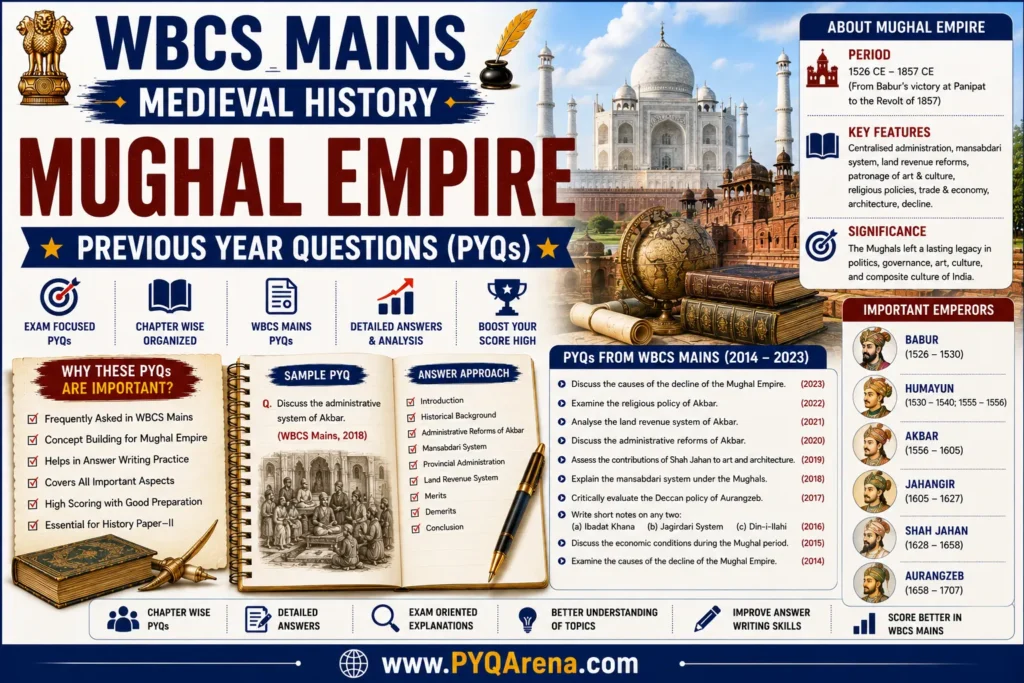
WBCS Mains Mughal Empire Questions 2023
Q. ‘Akbarnama’ was composed by
(A) Mughal Emperor Akbar.
(B) Abul Fazal.
(C) Faizi.
(D) Bairam Khan.
Answer & Explanation
Correct Answer: (B) Abul Fazal.
Explanation
The Akbarnama was composed by Abul Fazal, the celebrated court historian and one of the Navratnas of Emperor Akbar. Written in Persian, it records the history of Akbar’s reign and the Mughal Empire. The work is divided into three parts, with the third part known as the Ain-i-Akbari, which provides detailed information about Akbar’s administration, society, economy, military and imperial institutions.
Exam Facts
- Abul Fazal was the author of the Akbarnama.
- The Akbarnama was written in Persian during the reign of Akbar.
- It is divided into three volumes/parts.
- The third part of the Akbarnama is known as the Ain-i-Akbari.
- Ain-i-Akbari provides detailed information about Akbar’s administration, revenue system, army, court, provinces and society.
- Abul Fazal was one of the Navratnas (Nine Gems) of Akbar’s court.
- Faizi, Abul Fazal’s brother, was a famous Persian poet and scholar and also one of Akbar’s Navratnas.
- Bairam Khan served as Akbar’s regent and guardian during the early years of his reign.
- Akbar ruled the Mughal Empire from 1556 to 1605 CE.
- The Akbarnama and Ain-i-Akbari are important primary sources for studying the political, administrative and socio-economic history of Akbar’’s reign.
Q. First battle of Panipat took place in
(A) 1526
(B) 1528
(C) 1616
(D) 1626
Answer & Explanation
Correct Answer: (A) 1526
Explanation
The First Battle of Panipat was fought on 21 April 1526 between Babur and Ibrahim Lodi, the last ruler of the Lodi dynasty. Babur defeated Ibrahim Lodi and established the Mughal Empire in India. The battle is significant for the effective use of field artillery and gunpowder weapons by Babur.
Exam Facts
- The First Battle of Panipat was fought in 1526.
- The battle took place on 21 April 1526.
- Babur fought against Ibrahim Lodi, the Sultan of Delhi.
- Ibrahim Lodi was defeated and killed in the battle.
- The victory led to the establishment of the Mughal Empire in India.
- Babur effectively used artillery and gunpowder weapons in the battle.
- Babur employed the Tulughma tactic and Araba (cart) system in his battle strategy.
- Ibrahim Lodi was the last ruler of the Lodi dynasty.
- The Second Battle of Panipat (1556) was fought between Akbar’s forces under Bairam Khan and Hemu.
- The Third Battle of Panipat (1761) was fought between Ahmad Shah Abdali and the Marathas.
- Panipat is located in present-day Haryana and was the site of three major battles in Indian history.
Q. Ibadatkhana was founded by
(A) Akbar
(B) Jahangir
(C) Shah Jahan
(D) Aurangzeb
Answer & Explanation
Correct Answer: (A) Akbar
Explanation
The Ibadatkhana (House of Worship) was established by Emperor Akbar in 1575 at Fatehpur Sikri. It was initially a place where Muslim scholars and religious leaders gathered for discussions on religious matters. Later, Akbar opened these debates to scholars of different religions, reflecting his interest in religious dialogue and tolerance.
Exam Facts
- The Ibadatkhana was established by Akbar in 1575 CE.
- It was located at Fatehpur Sikri, near Agra.
- Initially, discussions were mainly among Muslim theologians and scholars.
- Later, scholars and representatives of different religions, including Hinduism, Jainism, Christianity and Zoroastrianism, were invited.
- Akbar’s religious discussions at the Ibadatkhana contributed to the development of his policy of Sulh-i-Kul (universal peace/tolerance).
- In 1582, Akbar promulgated the Din-i-Ilahi, also known as Tawhid-i-Ilahi, as a spiritual order or ethical system.
- Fatehpur Sikri was developed by Akbar and served as his imperial capital for a period during his reign.
- Jahangir, Shah Jahan and Aurangzeb were successors of Akbar and did not establish the Ibadatkhana.
Q. Jizya was reimposed by
(A) Aurangzeb
(B) Shah Jahan
(C) Jahangir
(D) Bahadur Shah
Answer & Explanation
Correct Answer: (A) Aurangzeb
Explanation
The Jizya tax was reimposed by Mughal Emperor Aurangzeb in 1679 CE. It was a tax traditionally imposed on non-Muslim subjects under certain Islamic states. Akbar had abolished the jizya in 1564, but Aurangzeb restored it during his reign.
Exam Facts
- Aurangzeb reimposed Jizya in 1679 CE.
- Akbar abolished Jizya in 1564 CE as part of his policy of religious tolerance.
- Jizya was traditionally a tax imposed on non-Muslim subjects in certain Islamic states.
- Aurangzeb ruled the Mughal Empire from 1658 to 1707 CE.
- The reimposition of Jizya was one aspect of the religious policy associated with Aurangzeb’s later reign.
- Shah Jahan ruled from 1628 to 1658 and did not reimpose Jizya.
- Jahangir ruled from 1605 to 1627 and did not reimpose Jizya.
- Bahadur Shah I ruled from 1707 to 1712; he did not reimpose Jizya after Aurangzeb’s death.
- Farrukhsiyar abolished Jizya in 1713? No. Jizya had already ceased to be effectively collected after Aurangzeb’’s reign; Muhammad Shah formally abolished it in 1720.
Q. Nadir Shah invaded India in
(A) 1708
(B) 1688
(C) 1739
(D) 1750
Answer & Explanation
Correct Answer: (C) 1739
Explanation
Nadir Shah, the ruler of Persia (Iran), invaded the Mughal Empire in 1739 CE during the reign of Muhammad Shah. He defeated the Mughal forces at the Battle of Karnal (1739) and subsequently entered Delhi, where a massacre took place. He carried away enormous wealth, including the famous Peacock Throne and Koh-i-Noor diamond.
Exam Facts
- Nadir Shah invaded India in 1739 CE.
- Nadir Shah was the ruler of Persia (Iran) and founded the Afsharid dynasty.
- The Battle of Karnal was fought in 1739 between Nadir Shah and the Mughal army.
- The Mughal emperor at the time was Muhammad Shah (1719-1748).
- The Mughal army was decisively defeated at the Battle of Karnal.
- Nadir Shah subsequently entered and occupied Delhi.
- The invasion exposed the political and military weakness of the Mughal Empire.
- Nadir Shah carried away enormous wealth from Delhi, including the Peacock Throne and the Koh-i-Noor.
- His invasion accelerated the decline of Mughal authority in 18th-century India.
- Ahmad Shah Abdali, another major invader of India, invaded India several times in the 18th century and later fought the Third Battle of Panipat (1761).
Q. The Yusufzai revolt took place during the reign of
(A) Shahjahan
(B) Akbar
(C) Aurangzeb
(D) Jahangir
Answer & Explanation
Correct Answer: (B) Akbar
Explanation
The Yusufzai revolt took place during the reign of Akbar, particularly in the 1580s. The Yusufzais were a powerful Pashtun (Afghan) tribe inhabiting the mountainous region of present-day Khyber Pakhtunkhwa. Akbar sent several expeditions to suppress their resistance, and the Mughal general Birbal was killed during an expedition against them in 1586.
Exam Facts
- The Yusufzai revolt occurred during the reign of Akbar.
- The Yusufzais were a prominent Pashtun/Afghan tribe.
- Their main area of resistance was in the north-western frontier region of the Mughal Empire.
- The Mughal campaign against the Yusufzais was particularly significant in 1586.
- Raja Birbal, one of Akbar’s famous courtiers, was killed during the Mughal expedition against the Yusufzais in 1586.
- The north-western frontier was a challenging region for the Mughal Empire because of the resistance of various Afghan and Pashtun tribes.
- Akbar ruled the Mughal Empire from 1556 to 1605 CE.
- Jahangir succeeded Akbar and ruled from 1605 to 1627 CE.
- Shah Jahan ruled from 1628 to 1658 CE.
- Aurangzeb ruled from 1658 to 1707 CE.
Q. Third battle of Panipat took place in
(A) 1761
(B) 1740
(C) 1770
(D) 1707
Answer & Explanation
Correct Answer: (A) 1761
Explanation
The Third Battle of Panipat was fought on 14 January 1761 between the Maratha forces and the army of Ahmad Shah Abdali (Ahmad Shah Durrani). The Marathas suffered a major defeat, which temporarily weakened their political and military influence in northern India.
Exam Facts
- The Third Battle of Panipat was fought on 14 January 1761.
- It was fought between the Marathas and Ahmad Shah Abdali (Durrani).
- The Maratha army was commanded by Sadashivrao Bhau.
- Vishwasrao, the son of Peshwa Balaji Baji Rao, was also killed in the battle.
- Ibrahim Khan Gardi commanded the Maratha artillery and infantry.
- The battle resulted in a decisive defeat of the Marathas.
- The defeat dealt a severe blow to Maratha expansion in northern India.
- The First Battle of Panipat (1526) was fought between Babur and Ibrahim Lodi.
- The Second Battle of Panipat (1556) was fought between Akbar’s forces under Bairam Khan and Hemu.
- The three major Battles of Panipat were fought in 1526, 1556 and 1761.
Q. Treaty of Purandar (1665) was concluded between
(A) Sivaji and Jay Singh.
(B) Tipu Sultan and English East India Company.
(C) English East India Company and Ranjit Singh.
(D) English East India Company and the Marathas.
Answer & Explanation
Correct Answer: (A) Sivaji and Jay Singh.
Explanation
The Treaty of Purandar (1665) was concluded between Shivaji Maharaj and Raja Jai Singh I of Amber, who represented the Mughal emperor Aurangzeb. Jai Singh was sent to lead the Mughal campaign against Shivaji. Under the treaty, Shivaji agreed to surrender several forts to the Mughals and accepted certain conditions concerning his territories and service.
Exam Facts
- The Treaty of Purandar was signed in 1665.
- It was concluded between Shivaji and Raja Jai Singh I (Mirza Raja Jai Singh).
- Jai Singh I was the Mughal commander appointed by Aurangzeb to lead the campaign against Shivaji.
- Under the treaty, Shivaji agreed to surrender 23 forts to the Mughals.
- Shivaji retained 12 forts, along with territories associated with them.
- Shivaji agreed to pay a war indemnity and accept certain Mughal conditions.
- Shivaji’s son Sambhaji was granted a mansab in the Mughal service.
- After the treaty, Shivaji visited Aurangzeb’s court at Agra in 1666.
- Shivaji subsequently escaped from Mughal custody at Agra and resumed his struggle against the Mughals.
- The treaty is an important event in the Mughal-Maratha conflict during Aurangzeb’s reign.
Q. Which Mughal ruler took the title of Alamgir?
(A) Akbar
(B) Jahangir
(C) Shah Jahan
(D) Aurangzeb
Answer & Explanation
Correct Answer: (D) Aurangzeb
Explanation
Aurangzeb assumed the title Alamgir, meaning “Conqueror of the World”, when he became Mughal emperor in 1658. He is therefore commonly referred to as Aurangzeb Alamgir. He was the sixth major Mughal emperor and ruled the empire until 1707.
Exam Facts
- Aurangzeb took the title Alamgir after ascending the Mughal throne.
- Alamgir means “Conqueror of the World” or “World Conqueror.”
- Aurangzeb ruled the Mughal Empire from 1658 to 1707 CE.
- Aurangzeb was the son of Shah Jahan and Mumtaz Mahal.
- He defeated his brothers in the Mughal war of succession (1657-1659) to secure the throne.
- Aurangzeb reimposed the Jizya tax in 1679 CE, which had been abolished by Akbar.
- Aurangzeb’s reign witnessed the territorial expansion of the Mughal Empire to its greatest extent.
- Shah Jahan was Aurangzeb’s father and ruled from 1628 to 1658.
- Akbar ruled from 1556 to 1605, while Jahangir ruled from 1605 to 1627.
Q. Who came to Jahangir’s Court?
(A) Sir Thomas Roe
(B) Ibn Battuta
(C) Nuniz
(D) Domingo Paes
Answer & Explanation
Correct Answer: (A) Sir Thomas Roe
Explanation
Sir Thomas Roe, an English diplomat and ambassador, visited the court of Mughal Emperor Jahangir during 1615-1619. He was sent by King James I of England to establish diplomatic and commercial relations with the Mughal Empire and secure trading privileges for the English East India Company.
Exam Facts
- Sir Thomas Roe visited the court of Jahangir.
- Roe served as the English ambassador to the Mughal court from 1615 to 1619.
- He was sent to India by King James I of England.
- His main objective was to obtain commercial privileges and trading concessions for the English.
- Roe’s visit contributed to the expansion of English East India Company trade in Mughal India.
- Jahangir ruled the Mughal Empire from 1605 to 1627 CE.
- Ibn Battuta was a famous Moroccan traveller who visited India during the reign of Muhammad bin Tughlaq.
- Domingo Paes was a Portuguese traveller who visited the Vijayanagara Empire during the reign of Krishnadevaraya.
- Fernao Nuniz (Nuniz) was another Portuguese traveller who provided an account of the Vijayanagara Empire, particularly during the 16th century.
- Sir Thomas Roe’s account is an important European source for understanding the Mughal court and political conditions during Jahangir’s reign.
Q. Who introduced ‘Kabuliyat’ and ‘Patta’?
(A) Shivaji
(B) Ashoka
(C) Sher Shah
(D) Akbar
Answer & Explanation
Correct Answer: (C) Sher Shah
Explanation
Sher Shah Suri introduced the system of Patta and Kabuliyat as part of his land-revenue administration. Under this system, the Patta was a written document issued by the state to the cultivator specifying the area of land and the amount of revenue payable, while the Kabuliyat was the cultivator’s written agreement accepting the revenue obligation.
Exam Facts
- Sher Shah Suri introduced the system of Patta and Kabuliyat.
- A Patta was a document issued by the state to the cultivator, specifying the landholding and revenue assessment.
- Kabuliyat was a written agreement by the cultivator accepting the terms of revenue payment.
- Sher Shah’s revenue system was based on the measurement of cultivated land and assessment of revenue.
- The land-revenue system developed under Sher Shah later influenced the Mughal revenue administration.
- Akbar subsequently developed a more elaborate land-revenue system under Raja Todar Mal.
- Todar Mal’s system under Akbar is associated with the Zabt system and Dahsala (ten-year revenue assessment).
- Sher Shah Suri founded the Sur Empire and ruled northern India from 1540 to 1545 CE.
- Sher Shah is also known for reforms in currency, roads, postal communication and administration.
- The Rupiya (silver coin) is traditionally associated with Sher Shah’s monetary reforms.
Q. Who reformed the revenue system during the rule of Akbar?
(A) Raja Maan Singh
(B) Birbal
(C) Todarmal
(D) Jai Singh
Answer & Explanation
Correct Answer: (C) Todarmal
Explanation
Raja Todarmal, one of Akbar’s Navratnas, played a major role in reforming the Mughal land-revenue system. He introduced a systematic method of land measurement, classification and revenue assessment. His reforms became the basis of Akbar’s Zabt system, with the Dahsala system being associated with the calculation of average produce and prices over a ten-year period.
Exam Facts
- Raja Todarmal was responsible for major reforms in Akbar’s land-revenue administration.
- The Zabt system was based on the measurement of land and systematic assessment of revenue.
- The Dahsala system used the average prices and produce of the preceding ten years for revenue assessment.
- Under the system, cultivated land was classified according to its productivity and cultivation pattern.
- Revenue was generally assessed at around one-third of the average produce, with payment often made in cash.
- Todarmal was one of the Navratnas (Nine Gems) of Akbar’s court.
- Todarmal had earlier gained administrative experience under Sher Shah Suri, whose revenue reforms influenced later Mughal practices.
- Raja Man Singh was a prominent Mughal general and noble under Akbar.
- Birbal was a famous courtier of Akbar, particularly known for his wit and literary abilities.
- Jai Singh is associated with the later Kachwaha rulers of Amber/Jaipur, including Mirza Raja Jai Singh I, who served the Mughals.
Q. Who was a famous artist of Akbar’s Court?
(A) Basawan
(B) Bebadal Khan
(C) Ravi Barma
(D) Minhaj us-Siraj
Answer & Explanation
Correct Answer: (A) Basawan
Explanation
Basawan was one of the most celebrated painters in Emperor Akbar’s court and played an important role in the development of Mughal miniature painting. He was particularly known for his skill in portraiture, realistic representation and the use of light and shade. He contributed to major illustrated manuscripts produced in Akbar’s atelier.
Exam Facts
- Basawan was a renowned painter associated with Akbar’s court.
- He was an important artist in the development of Mughal miniature painting.
- Basawan was particularly noted for realistic portraiture and naturalistic representation.
- He worked on the illustrations of important Mughal manuscripts, including the Akbarnama.
- Daswanth (Dasvant) was another prominent painter in Akbar’s imperial atelier.
- Bebadal Khan was a famous goldsmith and jeweller associated with Akbar’s court, rather than a principal painter.
- Ravi Varma (Raja Ravi Varma) was a famous 19th-century Indian painter, much later than Akbar.
- Minhaj-us-Siraj was a 13th-century Persian historian and author of Tabaqat-i-Nasiri, not a painter of Akbar’s court.
- Akbar greatly encouraged the development of painting and illustrated manuscripts in his imperial workshop.
- Mughal painting under Akbar showed increasing influence from Persian, Indian and Central Asian artistic traditions.
Q. Who was the author of the book ‘Muntakhab-ul-Tawarikh’?
(A) Nizam-ud-din
(B) Amir Khusrau
(C) Faizi
(D) Badauni
Answer & Explanation
Correct Answer: (D) Badauni
Explanation
Muntakhab-ul-Tawarikh was written by Abdul Qadir Badauni, a contemporary of Emperor Akbar. Written in Persian, the work provides an important account of the political and cultural history of Akbar’s reign. Badauni was critical of some of Akbar’s religious policies, making his work an important source for understanding contemporary reactions to the emperor’s reforms.
Exam Facts
- Abdul Qadir Badauni was the author of Muntakhab-ul-Tawarikh.
- The work was written in Persian.
- It was composed during the reign of Akbar.
- Badauni was a contemporary of Akbar and served at his court.
- The work is divided into three volumes.
- The first two volumes deal mainly with the history of Muslim rulers and India up to Akbar’s reign.
- The third volume provides information about Akbar’s reign and the intellectual and religious developments of his time.
- Badauni was critical of Akbar’s religious experiments and policies, making his account different in tone from Abul Fazal’s writings.
- Abul Fazal wrote the Akbarnama and Ain-i-Akbari.
- Amir Khusrau was a celebrated poet and scholar associated with the Delhi Sultanate, particularly the court of Alauddin Khalji.
- Faizi, brother of Abul Fazal, was a prominent Persian poet and one of Akbar’s Navratnas.
- Nizam-ud-din Ahmad wrote Tabaqat-i-Akbari, another important historical source for the Mughal period.
WBCS Mains Mughal Empire Questions 2022
Q. Abdul Hamid Lahori was the author of
(A) Padshahnama
(B) Razm Namah
(C) Iqbal Namah
(D) Tabaqat
Answer & Explanation
Correct Answer: (A) Padshahnama
Explanation
Abdul Hamid Lahori was a prominent historian in the court of Mughal Emperor Shah Jahan. He is best known for writing the Padshahnama (Badshahnama), a detailed account of Shah Jahan’s reign. The work is an important source for understanding the political, military and court history of the Mughal Empire under Shah Jahan.
Want more exam facts on this question? Get the WBCS Mains Indian History PYQ PDF
Q. Abul Fazl was the court poet of
(A) Babur
(B) Akbar
(C) Shah Jahan
(D) Jahangir
Answer & Explanation
Correct Answer: (B) Akbar
Explanation
Abul Fazl was a prominent court historian, scholar and administrator in the court of Emperor Akbar. He was one of Akbar’s Navratnas (Nine Gems) and is best known for writing the Akbarnama and Ain-i-Akbari, which provide valuable information about Akbar’s reign and administration.
Want more exam facts on this question? Get the WBCS Mains Indian History PYQ PDF
Q. Akbar defeated Hemu in the Second Battle of Panipat
(A) First Battle of Panipat
(B) Third Battle of Panipat
(C) Second Battle of Panipat
(D) Battle of Haldighati
Answer & Explanation
Correct Answer: (C) Second Battle of Panipat
Explanation
The Second Battle of Panipat was fought on 5 November 1556 between the Mughal forces led by Akbar and Bairam Khan and the forces of Hemu (Hemchandra Vikramaditya). Hemu was defeated after being wounded in the battle, and the Mughal victory helped Akbar consolidate Mughal rule in northern India.
Want more exam facts on this question? Get the WBCS Mains Indian History PYQ PDF
Q. Akbar defeated Hemu in the
(A) First Battle of Panipat
(B) Third Battle of Panipat
(C) Second Battle of Panipat
(D) Battle of Haldighati
Answer & Explanation
Correct Answer: (C) Second Battle of Panipat
Explanation
Akbar defeated Hemu in the Second Battle of Panipat, fought on 5 November 1556. The Mughal army was led by the young Akbar and his regent Bairam Khan, while Hemu (Hemchandra Vikramaditya) commanded the opposing forces. Hemu was defeated and captured, enabling the Mughals to re-establish their control over Delhi and Agra.
Want more exam facts on this question? Get the WBCS Mains Indian History PYQ PDF
Q. Akbar was born at
(A) Pathankot
(B) Sialkot
(C) Amarkot
(D) Nagarkot
Answer & Explanation
Correct Answer: (C) Amarkot
Explanation
Akbar was born at Amarkot (Umarkot) in Sindh on 15 October 1542. At the time of his birth, his father Humayun was facing difficulties after being defeated by Sher Shah Suri and was seeking refuge. Akbar’s birth at the Rajput ruler Rana Prasad’s residence at Amarkot is an important event in Mughal history.
Want more exam facts on this question? Get the WBCS Mains Indian History PYQ PDF
Q. Shah Jahan had built the Taj Mahal in memory of
(A) Arjumand Bano Begum
(B) Anarkali
(C) Jahanara
(D) Rowshanara
Answer & Explanation
Correct Answer: (A) Arjumand Bano Begum
Explanation
The Taj Mahal was commissioned by Mughal Emperor Shah Jahan in memory of his beloved wife Mumtaz Mahal, whose original name was Arjumand Bano Begum. She died in 1631 at Burhanpur while giving birth to their fourteenth child. Shah Jahan commissioned the magnificent mausoleum at Agra, and construction began soon after her death.
Want more exam facts on this question? Get the WBCS Mains Indian History PYQ PDF
Q. The First Battle of Panipat took place in
(A) 1520
(B) 1530
(C) 1525
(D) 1526
Answer & Explanation
Correct Answer: (D) 1526
Explanation
The First Battle of Panipat was fought on 21 April 1526 between Babur and Ibrahim Lodi, the last ruler of the Lodi dynasty. Babur’s victory led to the defeat of the Delhi Sultanate and laid the foundation of the Mughal Empire in India.
Want more exam facts on this question? Get the WBCS Mains Indian History PYQ PDF
Q. The Sadak-i-Azam was constructed by
(A) Akbar
(B) Bahadur Shah
(C) Babur
(D) Sher Shah
Answer & Explanation
Correct Answer: (D) Sher Shah
Explanation
The Sadak-i-Azam, meaning the “Great Road”, was developed and improved extensively by Sher Shah Suri. It connected important cities of his empire and later became known as the Grand Trunk Road. Sher Shah also established sarais, wells and trees along the route to facilitate travel, trade and communication.
Want more exam facts on this question? Get the WBCS Mains Indian History PYQ PDF
Q. The autobiography of Babur was known as
(A) Chach Namah
(B) Firdaus Namah
(C) Babur Namah
(D) Shah Namah
Answer & Explanation
Correct Answer: (C) Babur Namah
Explanation
The autobiography of Babur, the founder of the Mughal Empire in India, is known as the Baburnama (Tuzuk-i-Baburi). It was originally written in Chagatai Turkish and provides a detailed account of Babur’s life, military campaigns, political experiences, and observations of the places and people he encountered.
Want more exam facts on this question? Get the WBCS Mains Indian History PYQ PDF
Q. The land revenue system under Akbar was systematized by
(A) Raja Beharimal
(B) Raja Todarmal
(C) Raja Chunnumal
(D) Birbal
Answer & Explanation
Correct Answer: (B) Raja Todarmal
Explanation
The land revenue system under Akbar was systematized by Raja Todarmal, one of Akbar’s leading administrators. He introduced systematic land measurement, classification and revenue assessment. His reforms formed the basis of the Zabt system, while the Dahsala system used average prices and produce over a ten-year period for assessment.
Want more exam facts on this question? Get the WBCS Mains Indian History PYQ PDF
Q. The original name of Nurjahan was
(A) Luftunnissa
(B) Khairunnisa
(C) Meherunnisa
(D) Raziya
Answer & Explanation
Correct Answer: (C) Meherunnisa
Explanation
Nur Jahan’s original name was Meherunnisa (Mehr-un-Nissa). She was the daughter of Mirza Ghiyas Beg, a Persian noble who rose to prominence in the Mughal court. She married Emperor Jahangir in 1611, after which she was given the title Nur Jahan, meaning “Light of the World.”
Want more exam facts on this question? Get the WBCS Mains Indian History PYQ PDF
Q. Who was afflicted by the “Deccan Ulcer”?
(A) Akbar
(B) Babur
(C) Aurangzeb
(D) None of the above
Answer & Explanation
Correct Answer: (C) Aurangzeb
Explanation
The term “Deccan Ulcer” is used by historians to describe the prolonged Deccan campaigns of Aurangzeb. Aurangzeb spent the later part of his reign in the Deccan, fighting the Marathas and annexing the Bijapur and Golconda Sultanates. The long and costly campaigns placed enormous pressure on the Mughal Empire and contributed to its weakening after Aurangzeb’s death.
Want more exam facts on this question? Get the WBCS Mains Indian History PYQ PDF
WBCS Mains Mughal Empire Questions 2021
Q. What occasioned the break between the Mughals and the Rajputs?
(A) Increasing importance of the Marathas in Mughal state.
(B) Succession crisis in Marwar after the death of Jaswant Singh.
(C) Aurangzeb’s favouritism towards Muslims in Mughal service.
(D) Aurangzeb’s demolition of Hindu temples.
Answer & Explanation
Correct Answer: (B) Succession crisis in Marwar after the death of Jaswant Singh.
Explanation
The immediate cause of the break between the Mughals and the Rajputs was the succession crisis in Marwar following the death of Raja Jaswant Singh in 1678. Jaswant Singh died without leaving a surviving male heir at that time. Aurangzeb attempted to bring Marwar under direct Mughal control, leading to resistance from the Rathor Rajputs and the emergence of Durgadas Rathor as a prominent leader of the resistance.
Want more exam facts on this question? Get the WBCS Mains Indian History PYQ PDF
WBCS Mains Mughal Empire Questions 2020
Q. Jizya was abolished by the Mughal ruler
(A) Babur
(B) Humayun
(C) Akbar
(D) Aurangzeb
Answer & Explanation
Correct Answer: (C) Akbar
Explanation
Akbar abolished the Jizya tax in 1564 CE as part of his policy of religious tolerance and efforts to integrate different communities within the Mughal Empire. He also abolished the pilgrimage tax in 1563 CE. Later, Aurangzeb reimposed Jizya in 1679 CE.
Want more exam facts on this question? Get the WBCS Mains Indian History PYQ PDF
Q. Permission to the British to establish their trading centre at Surat was given by the Mughal Emperor
(A) Babur
(B) Humayun
(C) Akbar
(D) Jahangir
Answer & Explanation
Correct Answer: (D) Jahangir
Explanation
Mughal Emperor Jahangir granted permission to the English East India Company to establish a trading centre (factory) at Surat. This followed the English victory over the Portuguese in the Battle of Swally (1612) and the subsequent diplomatic efforts of Sir Thomas Roe, who visited Jahangir’s court from 1615 to 1619.
Want more exam facts on this question? Get the WBCS Mains Indian History PYQ PDF
Q. The Mughal Prince who was well versed in Arabic, Persian and Sanskrit was
(A) Prince Akbar
(B) Prince Salim
(C) Prince Sulaiman Shukoh
(D) Prince Dara Shikoh
Answer & Explanation
Correct Answer: (D) Prince Dara Shikoh
Explanation
Dara Shikoh, the eldest son of Shah Jahan, was well versed in Persian, Arabic and Sanskrit. He had a deep interest in comparative religion and Indian philosophy. He sponsored the translation of several Sanskrit works into Persian, including the Upanishads, which were translated into Persian as the Sirr-i-Akbar.
Want more exam facts on this question? Get the WBCS Mains Indian History PYQ PDF
Q. The Mughals imported fruits from
(A) Samarkand
(B) Arabia
(C) Kabul
(D) Portugal
Answer & Explanation
Correct Answer: (C) Kabul
Explanation
The Mughals imported various fruits from Kabul and the surrounding regions of Afghanistan, which were known for producing high-quality fruits. Mughal rulers, particularly Babur, appreciated fruits such as grapes, melons and pomegranates from Central Asian and Afghan regions. Kabul served as an important route for bringing these fruits into northern India.
Want more exam facts on this question? Get the WBCS Mains Indian History PYQ PDF
Q. The Persian ruler who besieged Qandahar in Jahangir’s reign was
(A) Shah Muhammad
(B) Shah Parvez
(C) Shah Abbas
(D) Shah Raza
Answer & Explanation
Correct Answer: (C) Shah Abbas
Explanation
The Persian ruler Shah Abbas I (Shah Abbas the Great) besieged and captured Qandahar (Kandahar) in 1622, during the reign of Mughal Emperor Jahangir. The loss of Qandahar was a significant setback for the Mughals because the city was strategically important as a gateway between India, Afghanistan and Persia.
Want more exam facts on this question? Get the WBCS Mains Indian History PYQ PDF
Q. Two major crops introduced in India during the Mughal period were
(A) Millet and Groundnut
(B) Potato and Mustard
(C) Tobacco and Maize
(D) Indigo and Maize
Answer & Explanation
Correct Answer: (C) Tobacco and Maize
Explanation
Tobacco and maize were introduced into India during the Mughal period, mainly through the Portuguese after the Columbian Exchange. Tobacco was introduced in India during the late 16th century, during Akbar’s reign, while maize also spread in India during this period.
Want more exam facts on this question? Get the WBCS Mains Indian History PYQ PDF
Q. Which Mughal Emperor transferred the capital from Agra to Delhi?
(A) Jahangir
(B) Shah Jahan
(C) Aurangzeb
(D) Bahadur Shah
Answer & Explanation
Correct Answer: (B) Shah Jahan
Explanation
Shah Jahan transferred the Mughal capital from Agra to Delhi and founded a new imperial city called Shahjahanabad in 1639. The new city was centred around the Red Fort, which became the principal imperial residence.
Want more exam facts on this question? Get the WBCS Mains Indian History PYQ PDF
Q. Which Mughal Emperor was a patron of Hindustani music and was popularly known as Rangila?
(A) Bahadur Shah I
(B) Bahadur Shah II
(C) Muhammad Shah
(D) Ahmed Shah
Answer & Explanation
Correct Answer: (C) Muhammad Shah
Explanation
Muhammad Shah (1719-1748) was a great patron of Hindustani classical music, dance and painting and was popularly known as Muhammad Shah Rangila. His reign witnessed significant developments in Hindustani music, including the growing prominence of khayal and the contributions of musicians such as Niyamat Khan Sadarang.
Want more exam facts on this question? Get the WBCS Mains Indian History PYQ PDF
Q. Which of the following facts about the Taj Mahal is incorrect?
(A) It is a magnificent Mausoleum
(B) It was built by Shah Jahan
(C) It is situated outside the Agra Fort
(D) The names of artisans who built are engraved on it
Answer & Explanation
Correct Answer: (D) The names of artisans who built are engraved on it
Explanation
The statement that the names of the artisans who built the Taj Mahal are engraved on it is incorrect. The Taj Mahal is a magnificent mausoleum commissioned by Shah Jahan in memory of Mumtaz Mahal and is situated on the opposite bank of the Yamuna from the Agra Fort. Although inscriptions and calligraphic panels adorn the monument, they do not constitute a list of the names of its artisans.
Want more exam facts on this question? Get the WBCS Mains Indian History PYQ PDF
Q. Who constructed the ‘Grand Trunk Road’?
(A) Akbar
(B) Sher Shah Suri
(C) Ashoka
(D) Samudra Gupta
Answer & Explanation
Correct Answer: (B) Sher Shah Suri
Explanation
Sher Shah Suri extensively developed and improved the ancient road connecting Sonargaon in Bengal to the Indus region, which became known as the Grand Trunk Road. He improved the road network to facilitate trade, communication, administration and military movement. He also established sarais, wells and trees along major routes.
Want more exam facts on this question? Get the WBCS Mains Indian History PYQ PDF
Q. Who is the only woman historian to write a historical account of the Mughal period?
(A) Gulbadan Begum
(B) Noorjahan
(C) Jahanara Begum
(D) Zebun-nissa Begum
Answer & Explanation
Correct Answer: (A) Gulbadan Begum
Explanation
Gulbadan Begum, the daughter of Babur and half-sister of Humayun, wrote the Humayun-nama (Ahval-i-Humayun Padshah). It is an important historical account of the Mughal period, particularly the life, family and reign of Humayun. She wrote the work at the request of Emperor Akbar.
Want more exam facts on this question? Get the WBCS Mains Indian History PYQ PDF
Q. Who of the following became a member of the Din-i-Ilahi?
(A) Todar Mal
(B) Raja Birbal
(C) Raja Man Singh
(D) Tansen
Answer & Explanation
Correct Answer: (B) Raja Birbal
Explanation
Raja Birbal was one of the few prominent members associated with Din-i-Ilahi, the spiritual and ethical order initiated by Akbar around 1582. Birbal, one of Akbar’s most trusted courtiers, was reportedly the only Hindu among the prominent members of the order.
Want more exam facts on this question? Get the WBCS Mains Indian History PYQ PDF
WBCS Mains Mughal Empire Questions 2019
Q. Which of the following did not form part of the contingents maintained by the mansabdars?
(A) Cavalrymen
(B) Artillerymen
(C) Bowmen
(D) Musketeers
Answer & Explanation
Correct Answer: (B) Artillerymen
Explanation
Under the Mansabdari system of the Mughal Empire, mansabdars were required to maintain military contingents, particularly cavalry (sawars). Their troops could include bowmen and musketeers, who formed part of the fighting forces. However, artillery was generally maintained directly by the Mughal state, rather than being part of the contingents maintained by individual mansabdars.
Want more exam facts on this question? Get the WBCS Mains Indian History PYQ PDF
WBCS Mains Mughal Empire Questions 2017
Q. During the reign of which Mughal was tobacco introduced in India?
(A) Aurangzeb
(B) Jahangir
(C) Akbar
(D) Shahjahan
Answer & Explanation
Correct Answer: (C) Akbar
Explanation
Tobacco was introduced into India during the reign of Akbar, towards the end of the 16th/early 17th century, through the Portuguese. Historical accounts record that Asad Beg brought tobacco from Bijapur to Akbar’s court around 1604-1605. Tobacco subsequently became increasingly popular during the reign of Jahangir.
Want more exam facts on this question? Get the WBCS Mains Indian History PYQ PDF
Q. How many Mughal provinces were there under Akbar and Aurangzeb respectively?
(A) 15 and 21
(B) 17 and 19
(C) 14 and 20
(D) 16 and 19
Answer & Explanation
Correct Answer: (A) 15 and 21
Explanation
Under Akbar, the Mughal Empire was divided into 15 provinces (subahs) by the end of his reign. As the empire expanded further under Aurangzeb, the number of provinces increased to 21. Each subah was headed by a Subahdar, who was responsible for provincial administration.
Want more exam facts on this question? Get the WBCS Mains Indian History PYQ PDF
Q. The royal ritual of ‘Jharokha Darshan’ was introduced by the Mughal emperor
(A) Akbar
(B) Shajahan
(C) Aurangzeb
(D) Bahadur Shah
Answer & Explanation
Correct Answer: (A) Akbar
Explanation
The royal practice of Jharokha Darshan was introduced by Emperor Akbar. Under this practice, the emperor appeared at a balcony or window of the palace each morning so that the people could see him and seek his blessings. The practice was influenced by Indian traditions of royal public appearance and helped strengthen the personal relationship between the emperor and his subjects.
Want more exam facts on this question? Get the WBCS Mains Indian History PYQ PDF
Q. The type of painting which made remarkable progress during the reign of Jahangir was
(A) Fresco painting
(B) Battle scenes
(C) Portrait painting
(D) Miniature painting
Answer & Explanation
Correct Answer: (C) Portrait painting
Explanation
Portrait painting made remarkable progress during the reign of Jahangir. Jahangir had a keen personal interest in painting and encouraged artists to produce realistic and detailed portraits of himself, members of the royal court, nobles and foreign visitors. Mughal painting during his reign became particularly noted for naturalism, fine detail and realistic representation.
Want more exam facts on this question? Get the WBCS Mains Indian History PYQ PDF
Q. Which Mughal building is said to possess the unique feature of being exactly equal in length and breadth?
(A) Red fort
(B) Agra fort
(C) Taj Mahal
(D) Buland Darwaja
Answer & Explanation
Correct Answer: (C) Taj Mahal
Explanation
The Taj Mahal is noted for its highly symmetrical architectural design. The main mausoleum has a square plan, with its length and breadth being essentially equal. This geometric symmetry, combined with the central dome, four minarets and balanced garden layout, is one of the defining features of Mughal architecture.
Want more exam facts on this question? Get the WBCS Mains Indian History PYQ PDF
Q. Which Mughal emperor for the first time divided the empire into provinces?
(A) Babur
(B) Humayun
(C) Jahangir
(D) Akbar
Answer & Explanation
Correct Answer: (D) Akbar
Explanation
Akbar systematically divided the Mughal Empire into provinces called Subahs as part of his administrative reforms. By the end of his reign, the empire had been organised into 15 Subahs, each headed by a Subahdar or provincial governor. This strengthened central control and made provincial administration more systematic.
Want more exam facts on this question? Get the WBCS Mains Indian History PYQ PDF
Q. Which Mughal is credited with prohibiting ‘Sati’ unless the widow herself, on her own free will, persistently desired it?
(A) Babur
(B) Humayun
(C) Akbar
(D) Aurangzeb
Answer & Explanation
Correct Answer: (C) Akbar
Explanation
Akbar took measures to restrict the practice of Sati. He prohibited forced Sati and required that a widow should not be compelled to undergo the practice. Even where a widow expressed a desire to perform Sati, officials were expected to ensure that her decision was voluntary and not the result of coercion. These measures formed part of Akbar’s broader social and religious reforms.
Want more exam facts on this question? Get the WBCS Mains Indian History PYQ PDF
WBCS Mains Mughal Empire Questions 2016
Q. A new technique of painting, known as Siyahi qalam, became fashionable during the reign of
(A) Akbar
(B) Aurangzeb
(C) Jahangir
(D) Shahjahan
Answer & Explanation
Correct Answer: (D) Shahjahan
Explanation
The Siyahi Qalam technique became fashionable during the reign of Shah Jahan. It consisted of fine and delicate line drawings, often enhanced with light washes of pale colours and gold. Although the technique had earlier origins, it became particularly fashionable during Shah Jahan’s reign.
Want more exam facts on this question? Get the WBCS Mains Indian History PYQ PDF
Q. During the reign of which Mughal was tobacco introduced in India?
(A) Akbar
(B) Aurangzeb
(C) Jahangir
(D) Shahjahan
Answer & Explanation
Correct Answer: (A) Akbar
Explanation
Tobacco was introduced into India during the reign of Akbar, towards the end of the 16th century. The Portuguese introduced tobacco to India after obtaining it from the Americas. It reached the Mughal court around 1604-1605, during the final years of Akbar’s reign, and subsequently became more widespread.
Want more exam facts on this question? Get the WBCS Mains Indian History PYQ PDF
Q. The only type of Jagir which could not be transferred was the
(A) Khidmati jagir
(B) Watan Jagir
(C) Milkiyat Jagir
(D) Tan Jagir
Answer & Explanation
Correct Answer: (B) Watan Jagir
Explanation
The Watan Jagir was a hereditary jagir associated with the ancestral homeland (watan) of a particular Rajput or other local ruling family. Unlike ordinary transferable jagirs, a Watan Jagir was generally hereditary and non-transferable, remaining attached to the family’s traditional territory.
Want more exam facts on this question? Get the WBCS Mains Indian History PYQ PDF
Q. Which Mughal is credited with prohibiting Sati unless the widow herself, of her own free will, persistently desired it?
(A) Babur
(B) Akbar
(C) Humayan
(D) Jahangir
Answer & Explanation
Correct Answer: (B) Akbar
Explanation
Akbar is credited with taking measures to restrict the practice of Sati. He prohibited forced Sati and required that a widow’s decision to perform Sati should be genuinely voluntary and persistent. His regulations were part of his broader efforts to address certain social practices and promote religious tolerance.
Want more exam facts on this question? Get the WBCS Mains Indian History PYQ PDF
Q. Which revenue system among the following is also known as the ‘bandobast’ system?
(A) Zabti
(B) Dahsala
(C) Nasaq
(D) Kankut
Answer & Explanation
Correct Answer: (B) Dahsala
Explanation
Tuzuk-i-Timuri was not written by Amir Khusrau. It is an autobiographical work attributed to Timur (Tamerlane), describing his life, military campaigns and conquests. In contrast, Dewal Rani Khizr Khan, Nuh Sipihr and Qiran-us-Sa’dain are well-known works associated with Amir Khusrau.
Want more exam facts on this question? Get the WBCS Mains Indian History PYQ PDF
Q. Who among the following Mughal rulers were half Rajput (born of a Rajput mother)?
(A) Shah Jahan and Aurangzeb
(B) Akbar and Jahangir
(C) Jahangir and Shahjahan
(D) Jahangir and Humayan
Answer & Explanation
Correct Answer: (C) Jahangir and Shahjahan
Explanation
Jahangir and Shah Jahan were born to Rajput mothers. Jahangir’s mother was Mariam-uz-Zamani, a Rajput princess of Amber, while Shah Jahan’s mother was Jagat Gosain, a Rajput princess of Marwar. Therefore, both rulers were born of Rajput mothers and are described in this context as half Rajput.
Want more exam facts on this question? Get the WBCS Mains Indian History PYQ PDF
Q. Who was the first Englishman to visit Jahangir’s court?
(A) William Edwards
(B) Red Dragon
(C) Thomas Roe
(D) Hawkins
Answer & Explanation
Correct Answer: (D) Hawkins
Explanation
Captain William Hawkins was the first Englishman to visit the court of Mughal Emperor Jahangir. He arrived at the Mughal court in 1609 as a representative of the English East India Company and was received by Jahangir at Agra. Hawkins sought permission for the English to establish trading facilities in the Mughal Empire.
Want more exam facts on this question? Get the WBCS Mains Indian History PYQ PDF
WBCS Mains Mughal Empire Questions 2015
Q. During the reign of which great Mughal was tobacco introduced in India?
(A) Jahangir
(B) Akbar
(C) Shahjahan
(D) Aurangzeb
Answer & Explanation
Correct Answer: (B) Akbar
Explanation
Tobacco was introduced into India during the reign of Akbar, towards the end of the 16th century. The Portuguese introduced tobacco to India from the Americas. It reached the Mughal court around 1604-1605, during the final years of Akbar’s reign, and subsequently became more widespread.
Want more exam facts on this question? Get the WBCS Mains Indian History PYQ PDF
Q. The only type of Jagir which could not be transferred was –
(A) Khidmati Jagir
(B) Watan Jagir
(C) Milkiyat Jagir
(D) Tan Jagir
Answer & Explanation
Correct Answer: (B) Watan Jagir
Explanation
The Watan Jagir was a hereditary jagir associated with the ancestral territory (watan) of a local ruling family, particularly Rajput chiefs. Unlike ordinary jagirs, which could be transferred by the Mughal emperor, a Watan Jagir was generally hereditary and non-transferable, remaining attached to the family’s traditional homeland.
Want more exam facts on this question? Get the WBCS Mains Indian History PYQ PDF
Q. The subject matter of Hamzahnamah is
(A) Architecture
(B) Painting
(C) Music
(D) Philosophy
Answer & Explanation
Correct Answer: (B) Painting
Explanation
The Hamzanama is a famous illustrated manuscript commissioned by Mughal Emperor Akbar. It narrates the legendary adventures of Amir Hamza, the uncle of the Prophet Muhammad according to Islamic tradition. The work is particularly famous for its large-scale miniature paintings, which were produced by artists of Akbar’s imperial atelier.
Want more exam facts on this question? Get the WBCS Mains Indian History PYQ PDF
Q. When and by whom were the Portugese driven out of Hugli in Bengal?
(A) 1625-Shaista Khan
(B) 1631-Qasim Khan
(C) 1650-Prince Murad
(D) 1666-Prince Shuja
Answer & Explanation
Correct Answer: (B) 1631-Qasim Khan
Explanation
The Portuguese were expelled from Hugli in 1632, during the reign of Shah Jahan, by the Mughal governor of Bengal Qasim Khan. The Portuguese settlement at Hugli had come into conflict with the Mughals over unauthorised trade, fortification and slave-taking, and Qasim Khan besieged and captured it.
Want more exam facts on this question? Get the WBCS Mains Indian History PYQ PDF
Q. Which of the following manuscripts, containing miniature paintings, reveals a sense of realism and authenticity witnessed or experienced by the painters themselves
(A) Timur Namah
(B) Akbar Namah
(C) Jamiut-Tawarikh
(D) Tariqi-Alfi
Answer & Explanation
Correct Answer: (B) Akbar Namah
Explanation
The Akbar Namah, written by Abul Fazl, contains numerous miniature paintings that depict events from the reign of Akbar. These illustrations are notable for their realistic representation of people, court scenes, battles, animals and contemporary events. Many of the scenes appear to reflect events and surroundings that the Mughal artists themselves had witnessed or observed, giving the paintings a strong sense of realism and authenticity.
Want more exam facts on this question? Get the WBCS Mains Indian History PYQ PDF
Q. Which of the following mosques of the Mughals is also known as the ‘pearl-mosque’?
(A) Jamia Masjid at Delhi
(B) Jamia Masjid at Fatehpuri
(C) Moti Masjid at Agra
(D) Aurangzebs personal mosque in the Red Fort.
Answer & Explanation
Correct Answer: (C) Moti Masjid at Agra
Explanation
The Moti Masjid (Pearl Mosque) at Agra Fort was built by Shah Jahan between 1648 and 1654. It was constructed primarily of white marble, which gave it a pearl-like appearance and led to its popular name, Moti Masjid.
Want more exam facts on this question? Get the WBCS Mains Indian History PYQ PDF
Q. Which one of the following Mughal emperors is credited with the composition of many Hindi Songs?
(A) Humayun
(B) Babur
(C) Akbar
(D) Jahangir
Answer & Explanation
Correct Answer: (C) Akbar
Explanation
Akbar is credited with composing several Hindi songs and was a notable patron of music and the arts. His court attracted celebrated musicians, including Tansen, one of the most famous figures in the history of Hindustani classical music. Akbar’s reign witnessed significant development of music through the interaction of Indian and Persian musical traditions.
Want more exam facts on this question? Get the WBCS Mains Indian History PYQ PDF
Q. Who among the following Englishmen was given the title ‘Khan’ by Jahangir?
(A) Thomas Roe
(B) Ralph Fitch
(C) Hawkins
(D) Newbery
Answer & Explanation
Correct Answer: (C) Hawkins
Explanation
Captain William Hawkins was received at the court of Jahangir in 1609. Jahangir treated him favourably and conferred upon him the title “Khan”, commonly referred to as “English Khan”. Hawkins represented the English East India Company and sought trading privileges for the English in the Mughal Empire.
Want more exam facts on this question? Get the WBCS Mains Indian History PYQ PDF
Q. Who among the following Mughal Minister was the ‘paymaster-general’ as well?
(A) Diwan
(B) Mir Bakshi
(C) Khan-i-Saman
(D) Vakil
Answer & Explanation
Correct Answer: (B) Mir Bakshi
Explanation
The Mir Bakshi was the head of the military establishment under the Mughals and also functioned as the paymaster-general. He was responsible for maintaining records of mansabdars and their contingents, supervising military appointments, and overseeing the payment of soldiers and other military personnel.
Want more exam facts on this question? Get the WBCS Mains Indian History PYQ PDF
Q. Who among the following Rajputs were the first to voluntarily submit to Akbar?
(A) Hadas
(B) Sisodias
(C) Rathors
(D) Kachchhawahas
Answer & Explanation
Correct Answer: (D) Kachchhawahas
Explanation
The Kachchhawaha Rajputs of Amber (Amer) were among the first Rajput ruling houses to voluntarily accept Akbar’s authority. In 1562, Raja Bharmal of Amber entered into an alliance with Akbar and gave his daughter, later known as Mariam-uz-Zamani, in marriage to the emperor. This marked an important beginning of Akbar’s policy of cooperation and alliance with Rajput rulers.
Want more exam facts on this question? Get the WBCS Mains Indian History PYQ PDF
Q. Who among the following nobles of Akbar was killed by the Afgan rebels in one of the Mughal campaigns to suppress them?
(A) Man Singh
(B) Todar Mal
(C) Birbal
(D) Bhagwan Das
Answer & Explanation
Correct Answer: (C) Birbal
Explanation
Raja Birbal was killed in 1586 during a Mughal campaign against the Yusufzai Afghans in the north-western frontier region. He was leading Mughal forces under orders from Akbar when the army was ambushed in a difficult mountainous area. Birbal and a large number of Mughal soldiers were killed.
Want more exam facts on this question? Get the WBCS Mains Indian History PYQ PDF
WBCS Mains Mughal Empire Questions 2014
Q. Which General of Aurangzeb conquered Ahom kingdom in the East India?
(A) Jai Singh
(B) Josowant Singh
(C) Sayesta Khan
(D) Mir Zumla
Answer & Explanation
Correct Answer: (D) Mir Zumla
Explanation
Mir Jumla was the Mughal general who led the campaign against the Ahom kingdom of Assam during the reign of Aurangzeb. In 1662, he invaded Assam and captured Garhgaon, the capital of the Ahom kingdom. However, the Mughals could not permanently consolidate their control over the region, and the Ahoms later regained much of their territory.
Want more exam facts on this question? Get the WBCS Mains Indian History PYQ PDF
Q. Who translated Atharvaveda into Persian during the Mughal period?
(A) Abdul Hamid Lahori
(B) Haji Ibrahim Sarhindi
(C) Khafi Khan
(D) Malik Muhammad Jayasi
Answer & Explanation
Correct Answer: (B) Haji Ibrahim Sarhindi
Explanation
Haji Ibrahim Sarhindi translated the Atharvaveda into Persian during the reign of Akbar. He was among the scholars associated with Akbar’s efforts to promote the translation of important Sanskrit works into Persian, as part of the emperor’s broader interest in understanding Indian religious and intellectual traditions.
Want more exam facts on this question? Get the WBCS Mains Indian History PYQ PDF
Leave a Comment