

Who is this for? Beginners and aspirants for WBCS, UPSC Prelims, other State PSCs, WBP and Clerkship exams. This is Chapter 7 of Medieval Indian History and covers the Bhakti and Sufi movements: the saints, the philosophic schools, the Sikh Gurus, and the Sufi silsilas that reshaped religious life in India from about the eighth century to the seventeenth. Each section opens with an “In simple words” explanation and then moves to exam-level detail. 🔗 Practise alongside: UPSC Prelims Medieval History: Bhakti and Sufism PYQs | WBCS Mains Religious Movements PYQs | WBCS Prelims Medieval Indian History PYQs | UPSC Prelims Art and Culture: Philosophy and Religion PYQs | UPSC Prelims Art and Culture: Dance PYQs | UPSC Prelims Art and Culture: Music PYQs | PSC Miscellaneous Prelims History PYQs | WBCS Mains Delhi Sultanate PYQs 📖 Read first: Religious Movements in Ancient India | Delhi Sultanate (Chapter 2) | Provincial Kingdoms of the Sultanate Period (Chapter 3) | Medieval Bengal (Chapter 4) | Vijayanagara Empire (Chapter 5) | Bahmani Empire and Deccan Sultanates (Chapter 6)
1. The Big Picture
In simple words: Between the later first millennium and the Mughal age, two currents changed how ordinary people in India approached God. Bhakti taught love and devotion, in the language of the home, as a path open to every caste and to women. Sufism taught a direct, loving approach to Allah, organised in silsilas that set up khanqahs and dargahs. The two met in saints such as Kabir and Guru Nanak, who spoke to Hindus and Muslims together.
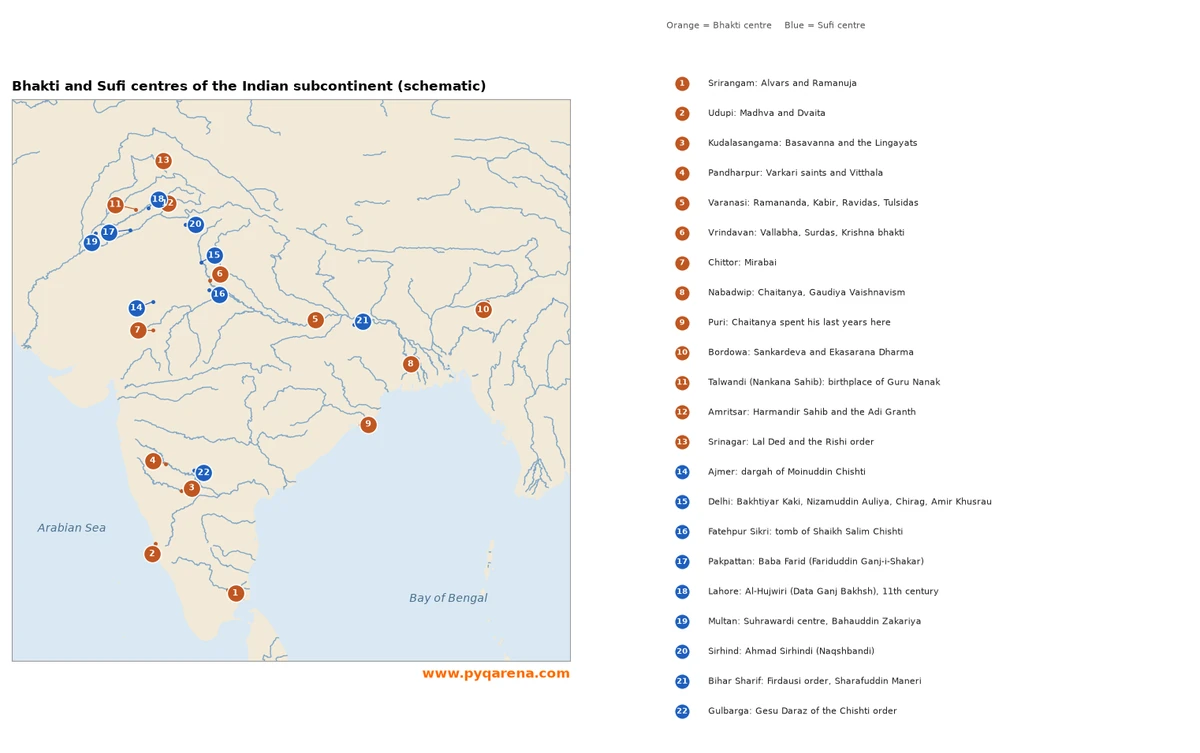
1.1 What this chapter covers
- The early Tamil Alvars (Vaishnava) and Nayanars (Shaiva), and the Vedanta acharyas Shankara, Ramanuja, Madhva, Nimbarka and Vallabha.
- Regional Bhakti: the Varkaris of Maharashtra, the Lingayats of Karnataka, the Haridasas, the north-Indian nirguna and saguna saints, the Sikh Gurus, Chaitanya in Bengal, Sankardeva in Assam, and Lal Ded in Kashmir.
- Sufism in India: terms (silsila, khanqah, pir, murid, sama, wahdat-ul-wujud), the arrival of Sufism in the eleventh century, and the Chishti, Suhrawardi, Qadiri, Naqshbandi and Firdausi orders, with saints from Moinuddin Chishti to Ahmad Sirhindi.
1.2 Why this chapter matters for exams
- UPSC Prelims has a dedicated Bhakti and Sufism set: Ramanuja and devotion (2022), Nimbarka and Sirhindi (2019), Siddhas and Lingayats (2016), Guru Nanak at the fall of the Lodis (2013), Sufi practices (2012), the first Hindi Bhakti saint (2002), and the Chishti name and music (1997, 1996). See UPSC Prelims Medieval History: Bhakti and Sufism PYQs.
- WBCS Mains asks silsilahs, the Qadri order, Jnaneshwar, Namadeva, Tulsidas, Janamsakhis, Vallabhacharya and Nizamuddin Auliya. WBCS Prelims returns again and again to the Sikh Gurus, Amir Khusrau, Chaitanya and Husain Shah, Kabir, Maladhar Basu and the date Sufism reached India. See WBCS Mains Religious Movements PYQs and WBCS Prelims Medieval Indian History PYQs.
- The chapter sits between the Delhi Sultanate and the regional kingdoms already covered: Medieval Bengal for Husain Shah and Chaitanya, Vijayanagara for the southern temples and Haridasas, and Bahmani for Gesu Daraz at Gulbarga. For the older Vaishnava and Shaiva background, start with Religious Movements in Ancient India.
2. What is Bhakti? Nirguna and Saguna
In simple words: Bhakti means loving devotion to God. A bhakta does not have to be a priest or a Sanskrit scholar. The saint sings, walks on pilgrimage and says that God hears a sincere heart. Two styles run through the whole movement. Saguna bhakti loves God with attributes and form — as Rama, Krishna or Shiva, in a temple and in a story. Nirguna bhakti loves God without form — a single formless absolute, reached by the Name, and hostile to caste pride and image worship.
2.1 The two paths, side by side
| Saguna | Nirguna | |
|---|---|---|
| Meaning | God with form and qualities | God without form |
| Typical names | Rama, Krishna, Vitthala, Venkateshwara, Shiva | The formless Ram / Hari / Allah of the Name |
| Typical saints | Tulsidas, Surdas, Mirabai, Chaitanya, Tukaram, Vallabha | Kabir, Ravidas, Dadu, Guru Nanak |
| Literature | Ramcharitmanas, Sursagar, abhangs, kirtana | Dohas, Bijak, bani in the Adi Granth |
| Ritual stance | Temple, murti, festival, pilgrimage | Name, inner purity; sharp attack on empty ritual |
2.2 Shared teachings
- Devotion over ritual: Ramanuja taught that the best means of salvation was devotion (UPSC Prelims 2022).
- The language of the people: Tamil, Marathi, Kannada, Hindi, Bengali, Assamese and Punjabi carried the message farther than Sanskrit alone. Ramananda was the first Bhakti saint to use Hindi for the propagation of his message (UPSC Prelims 2002).
- Openness of caste and gender: Andal and Karaikkal Ammaiyar among the Tamil saints; Kabir a weaver, Ravidas a cobbler, Namdev a tailor and Sena a barber (UPSC Prelims 2001); Mirabai, a Rajput princess, left the palace for Krishna. The Tamil Siddhas (Sittars) were monotheistic and condemned idolatry (UPSC Prelims 2016).
2.3 How the wave moved
South India came first: the Alvars and Nayanars (sixth to ninth centuries), then the Vedanta acharyas. From the twelfth century the movement took a social turn with Basavanna in Karnataka and the Varkaris in Maharashtra. In the Sultanate and early Mughal centuries it flowered in the north (Ramananda, Kabir, the Sikh Gurus, Tulsidas), in Bengal and Assam, and in Kashmir. Use the chronological order Shankaracharya – Ramanuja – Chaitanya (UPSC Prelims 2004). See UPSC Prelims Art and Culture: Philosophy and Religion PYQs.
3. Alvars and Nayanars
In simple words: Long before Kabir or Chaitanya, Tamil country had already sung of God in the people’s tongue. The Alvars were the Vaishnava hymn-singers of Vishnu and his avataras. The Nayanars were the Shaiva hymn-singers of Shiva. Their songs were later collected and became scripture for Sri Vaishnavism and Tamil Shaivism. This is the foundation on which Ramanuja and the later southern acharyas built.
3.1 The Alvars
- There are twelve Alvars. The best-known names for exams are Nammalvar, Periyalvar, Andal (Periyalvar’s adopted daughter, author of the Tiruppavai), Tirumangai Alvar and Kulasekhara Alvar.
- Their hymns, in Tamil, were gathered as the Nalayira Divya Prabandham (“Four Thousand Divine Verses”). Nathamuni compiled this corpus; he is a Vaishnava scholar (UPSC Prelims 2022: Nathamuni is correctly matched as a Vaishnava scholar; Aryadeva was a Buddhist, not a Jaina).
- Their great temples include Srirangam (Ranganatha), Tirupati, Kanchipuram and the other Divya Desams. For the older Tamil religious background, see Religious Movements in Ancient India and Sangam Age and Early South India.
Exam point: “Alvar was ________ hymnodist of the Tamil devotional cult.” Vaishnavite (WBCS Mains 2018). See WBCS Mains South Indian Dynasties PYQs.
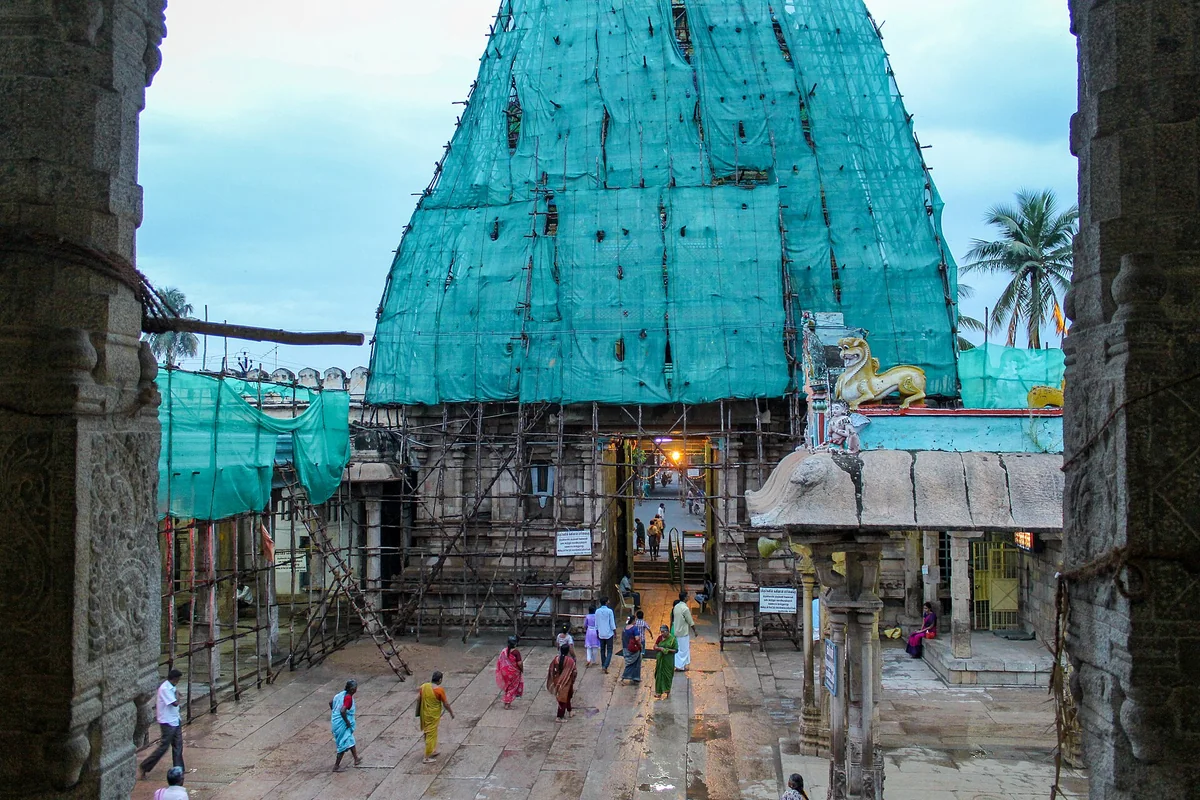
Image Source: Wikimedia
3.2 The Nayanars
- There are sixty-three Nayanars. Famous names are Appar (Tirunavukkarasar), Sambandar (Tirujnanasambandar), Sundarar and Manikkavachakar (author of the Tiruvachakam). Karaikkal Ammaiyar is the best-known woman Nayanar.
- Their hymns form the Tevaram and, with later works, the Tirumurai. The great Shaiva centres are Chidambaram, Madurai, Kanchipuram and the Chola temples of the Kaveri delta.
3.3 The Tamil Siddhas (Sittars)
The Siddhas or Sittars of the Tamil region were monotheistic and condemned idolatry (UPSC Prelims 2016). They stand a little apart from temple saguna bhakti: a yogic, anti-ritual current that the same 2016 question pairs with the Lingayats of Karnataka.
4. The Acharyas: Shankara, Ramanuja, Madhva, Nimbarka, Vallabha
In simple words: After the hymn-singers came the Vedanta teachers. Shankara taught that the soul and Brahman are one (Advaita). Ramanuja taught that the soul is distinct yet inseparable from a personal God (Vishishtadvaita), and that devotion is the way. Madhva taught Dvaita, Nimbarka Dvaitadvaita, and Vallabha pure non-dualism and the Pushtimarg of Krishna. Learn the names, the doctrines and who was not whose contemporary.
4.1 Shankara (c. 788–820)
- Advaita Vedanta: the individual soul (atman) and ultimate reality (Brahman) are one; the world of difference is maya. Knowledge (jnana), not ritual, is the path.
- He wrote commentaries on the Brahmasutras, the Upanishads and the Bhagavad Gita, and works such as the Vivekachudamani.
- He organised monks under four mathas: Sringeri, Dwaraka, Puri and Badrinath (Jyotirmath). In the exam chronology he stands first: Shankaracharya – Ramanuja – Chaitanya (UPSC Prelims 2004).
4.2 Ramanuja (1017–1137)
- Vishishtadvaita (“qualified non-dualism”): the soul and the world are real and are the body of a personal God, Vishnu / Narayana. The soul is not identical with God, but it is never separate from Him.
- The path is bhakti and prapatti (complete surrender). The UPSC asked this directly in 2022, when a colossal statue of Ramanuja was in the news at Hyderabad: the statement that correctly represents his teaching is that the best means of salvation was devotion.
- He taught at Srirangam, wrote the Sri Bhashya on the Brahmasutras, and organised Sri Vaishnavism. He is centuries later than Shankara and centuries earlier than Chaitanya.
4.3 Madhva (1238–1317)
- Dvaita (“dualism”): God (Vishnu) and the soul are eternally different. The world’s reality is not maya.
- He taught at Udupi in Karnataka, installed the Krishna image there, and set up the Ashta Mathas. Pushtimarg is not his doctrine. The statement “The philosophy of Pushti Marg was propounded by Madhvacharya” is false (UPSC Prelims 2014). Pushtimarg belongs to Vallabha.
4.4 Nimbarka (12th–13th century)
- Dvaitadvaita (or Bhedabheda): the soul is both distinct from and one with Krishna, in a Radha–Krishna sampradaya later centred in the Braj country.
- Saint Nimbarka was not a contemporary of Akbar (UPSC Prelims 2019). Nimbarka belongs to the twelfth–thirteenth century; Akbar ruled 1556–1605.
4.5 Vallabha (1479–1531)
- Shuddhadvaita (“pure non-dualism”) and the Pushtimarg (“path of grace”). God is Krishna, especially as Shrinathji; grace (pushti), not harsh asceticism, is the means.
- Vallabhacharya was the most distinguished preacher of the Krishna cult (WBCS Mains 2014). See WBCS Mains Religious Movements PYQs.
- He is a recognised proponent of the bhakti cult, with Tukaram and Tyagaraja; Nagarjuna is not (UPSC Prelims 2010). Nagarjuna was the Madhyamaka Buddhist philosopher of the early centuries CE.
- His working world was Braj (Mathura–Vrindavan) and later western India (including Nathdwara). He belongs to the same fifteenth–sixteenth-century world as Chaitanya and the early Sikh Gurus, not to the age of Shankara or Ramanuja.
4.6 The five acharyas in one table
| Acharya | Dates | School | God / stress | Exam trap |
|---|---|---|---|---|
| Shankara | c. 788–820 | Advaita | Nirguna Brahman; jnana | First in the 2004 chronology |
| Ramanuja | 1017–1137 | Vishishtadvaita | Vishnu; devotion / prapatti | Devotion is the best means of salvation (2022) |
| Madhva | 1238–1317 | Dvaita | Vishnu at Udupi | Not the author of Pushtimarg |
| Nimbarka | 12th–13th c. | Dvaitadvaita | Radha–Krishna | Not a contemporary of Akbar |
| Vallabha | 1479–1531 | Shuddhadvaita; Pushtimarg | Krishna | Pushtimarg is his, not Madhva’s |
5. The Varkari Saints of Maharashtra
In simple words: In Maharashtra, Bhakti gathered around Vitthala (Vithoba) of Pandharpur. Devotees called Varkaris walk to Pandharpur in the months of Ashadh and Kartik, singing abhangs. The great names are Jnaneshwar, Namdev, Eknath, Tukaram and Ramdas. The exams like to swap their books, so keep the titles straight: Amrutanubhav is Jnaneshwar’s, Dasbodh is Ramdas’s.

Image Source: Wikimedia
5.1 Jnaneshwar (Jnanadeva)
- He belongs to the late thirteenth century. He wrote the Jnaneshwari (also called Bhavartha Dipika), a Marathi commentary on the Bhagavad Gita.
- He also wrote Amrutanubhav (Amritanubhava). Sant Jnaneshwar was the author of Amrutanubhav (WBCS Mains 2020). The option Dasbodh in that question is Ramdas, not Jnaneshwar. Rukmini Swayamvar is a work of Eknath. See WBCS Mains Religious Movements PYQs.
- His samadhi is at Alandi near Pune.
5.2 Namdev
- Namdev (Namadeva) was a tailor by profession (UPSC Prelims 2001: Namdev – Tailor; Kabir – Weaver; Ravidas – Cobbler; Sena – Barber). See UPSC Prelims Medieval History: Bhakti and Sufism PYQs.
- He sang abhangs to Vitthala. Verses in his name stand in the Adi Granth.
- He was greatly influenced by Islam (WBCS Mains 2017). That is the official answer among Namadeva, Chaitanya, Ramananda and Ramanuja.
5.3 Eknath
- Eknath (sixteenth century), of Paithan, stands between Namdev and Tukaram. He wrote the Eknathi Bhagavata, bharud poems, and Rukmini Swayamvar, and he circulated the Jnaneshwari.
5.4 Tukaram
- Tukaram of Dehu, near Pune, is the great abhang poet of the seventeenth century; his Gatha is the classic of Varkari song.
- Bhakta Tukaram was a contemporary of Jahangir (UPSC Prelims 2006). Jahangir ruled 1605–1627; Tukaram’s working life falls in the early seventeenth century, so Babur, Akbar and Aurangzeb are the wrong emperors. See UPSC Prelims Art and Culture: Philosophy and Religion PYQs.
- He is a proponent of the bhakti cult, with Tyagaraja and Vallabhacharya (UPSC Prelims 2010).
5.5 Ramdas (Samarth Ramdas)
- Ramdas (1608–1681) wrote Dasbodh (also spelled Dasbodha). He is the guru associated with Shivaji, and his centre is Sajjangad. Do not give Dasbodh to Jnaneshwar, or Amrutanubhav to Ramdas: that swap is the point of the 2020 Mains question.
5.6 The Maharashtra saints in one table
| Saint | Century | Chief work | Remember |
|---|---|---|---|
| Jnaneshwar | 13th | Jnaneshwari, Amrutanubhav | Alandi; Gita in Marathi |
| Namdev | 13th–14th | Abhangs | Tailor; influenced by Islam; verses in the Adi Granth |
| Eknath | 16th | Eknathi Bhagavata, Rukmini Swayamvar | Paithan |
| Tukaram | 17th | Abhang Gatha | Contemporary of Jahangir |
| Ramdas | 17th | Dasbodh | Guru of Shivaji; Sajjangad |
6. Lingayats, Siddhas and the Haridasas of the South
In simple words: In twelfth-century Karnataka, Basavanna built a Shaiva movement that threw off caste and the idea of rebirth, and that worshipped Shiva in a personal ishtalinga. In the Tamil country the Siddhas condemned idolatry. Later, under and after Vijayanagara, the Haridasas and temple poets such as Annamacharya sang of Vishnu and Venkateshwara. Tyagaraja, who comes much later, belongs to the same southern devotional family but not to the medieval centuries of Kabir and Nanak.
6.1 Basavanna and the Lingayats
- Basavanna (Basaveshwara) served at the court of the Kalachuri king Bijjala of Kalyana in the twelfth century. Around him grew the Anubhava Mantapa and a body of Kannada vachanas. His followers, the Lingayats or Virashaivas, each wear a personal ishtalinga. Akkamahadevi is the best-known woman poet of the movement. Kudalasangama, at the Krishna–Malaprabha confluence, is tied to Basavanna’s last days.
- The Lingayats of the Kannada region questioned the theory of rebirth and rejected the caste hierarchy. Together with the statement that the Tamil Siddhas (Sittars) were monotheistic and condemned idolatry, this is both correct (UPSC Prelims 2016).
- For the older Shaiva background, see Religious Movements in Ancient India. For the later Deccan setting in which Lingayat communities lived, see Bahmani Empire and Deccan Sultanates and Vijayanagara Empire.
6.2 The Haridasas and Annamacharya
- The Haridasa movement of Karnataka sang of Vishnu in Kannada. Purandara Dasa and Kanaka Dasa belong to the Vijayanagara world. See Vijayanagara Empire.
- Annamacharya (15th century) of Tallapaka, at Tirupati, composed kirtanas in praise of Lord Venkateshwara. That statement is correct (UPSC Prelims 2018). He is not a contemporary of Tyagaraja. See UPSC Prelims Art and Culture: Music PYQs.
6.3 Tyagaraja (1767–1847)
- Tyagaraja of the Tanjore country is a later Carnatic composer and a proponent of the bhakti cult (UPSC Prelims 2010).
- Most of his kritis are not in praise of Lord Krishna; they are devotional songs of Rama. He created several new ragas. He and Annamacharya are not contemporaries. So the correct pair of statements in UPSC Prelims 2018 is 2 and 4 only (new ragas; Annamacharya’s kirtanas praise Venkateshwara).
- He was not preaching when the Lodi dynasty fell and Babur took over in 1526 (UPSC Prelims 2013). That date belongs to Guru Nanak alone among the three names in the question (Dadu Dayal, Guru Nanak, Tyagaraja).
7. Ramananda, Kabir, Ravidas and Dadu
In simple words: In the north, Bhakti split into a Hindi, caste-open stream. Ramananda of Varanasi preached Rama-bhakti in Hindi and took disciples from many castes. His name stands at the head of a list that includes Kabir the weaver, Ravidas the cobbler and Sena the barber. Kabir used the language of both Hindu and Muslim piety and mocked empty ritual on both sides. Dadu Dayal comes a generation later; the Bijak is not his book.
7.1 Ramananda
- Ramananda (fourteenth–fifteenth century) taught at Varanasi. He stands in the Sri Vaishnava line that goes back to Ramanuja, but he preached in the north and opened the path to disciples of every caste.
- He was the first Bhakti saint to use Hindi for the propagation of his message (UPSC Prelims 2002). Dadu, Kabir and Tulsidas all used Hindi, but Ramananda is the first in that list.
7.2 Kabir
- Kabir (c. 1440–1518) was a weaver of Varanasi (UPSC Prelims 2001). His verses are dohas and ramainis; his followers are the Kabirpanthis. The compilation of his teaching is the Bijak, which is not a work of Dadu Dayal (UPSC Prelims 2014).
- He taught that Ram and Rahim are one. In the Sultanate period the line “Ram Rahim ek hai, nam dhara hai do” is his (WBCS Prelims 2004). He also said “Hindus and Muslims are pots of the same clay” (WBCS Prelims 2000). See WBCS Prelims Medieval Indian History PYQs.
- In WBCS Prelims 2000 the official answer to “The Muslim saint of medieval India worshipped by Hindus and Muslims” is Kabir (the other options include Nizamuddin Auliya and Salim Chishti).
- Sikandar Lodi tried to have Kabir killed (WBCS Mains 2017). See WBCS Mains Delhi Sultanate PYQs and the Lodi section of Delhi Sultanate.
- Saint Kabir was not greatly influenced by Shaikh Ahmad Sirhindi (UPSC Prelims 2019). Kabir died in the early sixteenth century; Sirhindi lived 1564–1624. The two men were not contemporaries, and the influence did not run from Sirhindi to Kabir. The same 2019 question also rejects Nimbarka as a contemporary of Akbar: the answer is neither statement.
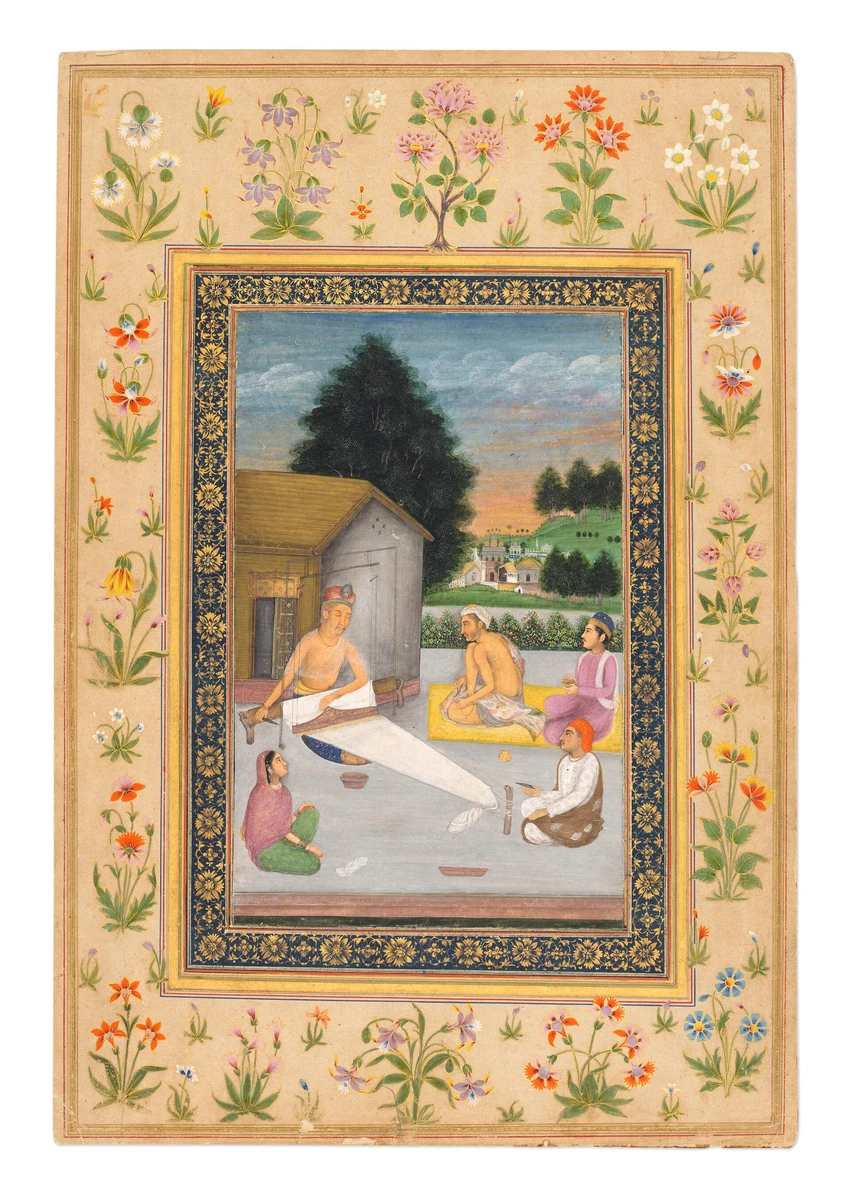
Image Source: Wikimedia
7.3 Ravidas and Sena
- Ravidas (Raidas) was a cobbler. Sena was a barber. Both stand, with Namdev the tailor and Kabir the weaver, in the UPSC Prelims 2001 matching list. Disciples of this circle, including Pipa and Dhanna, show how wide Ramananda’s net was.
- Ravidas’s bani also entered the Adi Granth. The exams mainly want his profession and his place beside Kabir.
7.4 Dadu Dayal
- Dadu Dayal (1544–1603) taught in Rajasthan (the Dadu Panth). He used Hindi, but he is not the first Hindi Bhakti saint, and the Bijak is not his.
- He was not preaching when the Lodi dynasty fell and Babur took over in 1526. Among Dadu Dayal, Guru Nanak and Tyagaraja, only Guru Nanak was then active (UPSC Prelims 2013).
8. Guru Nanak and the Sikh Gurus
In simple words: Guru Nanak (1469–1539) founded Sikhism. He was born at Talwandi, preached a formless God, and gathered a community that sang the Name and ran a langar. Nine Gurus followed him. Guru Angad introduced Gurmukhi; Guru Arjan compiled the Adi Granth. Guru Gobind Singh, the tenth and last Guru, founded the Khalsa in 1699. Guru Tegh Bahadur was executed under Aurangzeb.
8.1 Guru Nanak (1469–1539)
- He was born at Talwandi (today Nankana Sahib, in Punjab) (WBCS Mains GK History 2021). See WBCS Mains General Knowledge History PYQs.
- He founded Sikhism (WBCS Prelims 2007). A WBPSC Clerkship question has also asked the founder of the Sikh religion, with the same answer. See WBCS Prelims Medieval Indian History PYQs.
- His life-stories are the Janamsakhis. Janamsakhi is the biography of Guru Nanak (WBCS Mains 2014), not of Arjan, Hargobind or Tegh Bahadur. See WBCS Mains Religious Movements PYQs.
- He taught ik onkar (one God), honest work, and the company of the holy (satsang), and travelled widely (udasis) with Bhai Mardana.
- When the Lodi dynasty fell and Babur took over (1526), Guru Nanak was the one Bhakti saint, among Dadu Dayal, Nanak and Tyagaraja, who was then preaching (UPSC Prelims 2013). See UPSC Prelims Medieval History: Bhakti and Sufism PYQs.
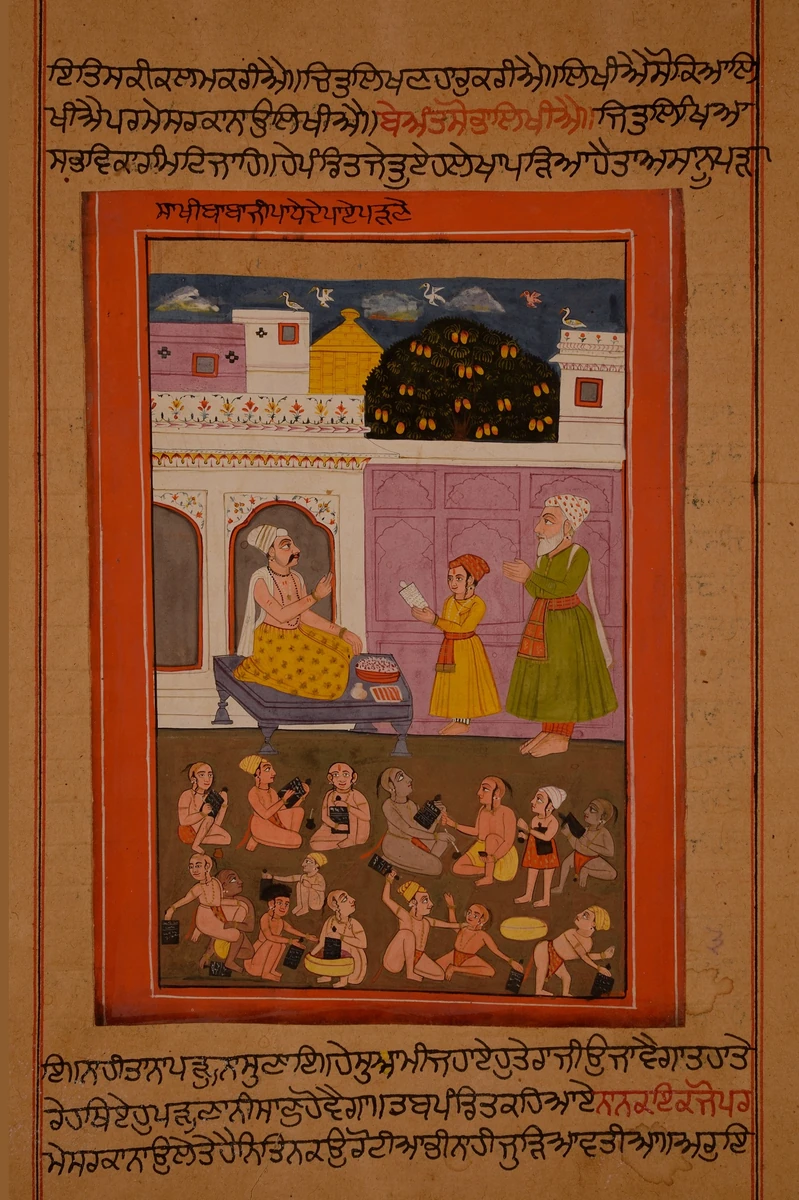
Image Source: Wikimedia
8.2 The ten Gurus, in order
| No. | Guru | Years | Exam fact |
|---|---|---|---|
| 1 | Guru Nanak | 1469–1539 | Founder; born at Talwandi; Janamsakhis |
| 2 | Guru Angad | 1539–1552 | Gurmukhi script was introduced by him (WBCS Prelims 2008) |
| 3 | Guru Amar Das | 1552–1574 | The Manji system of preaching circles is his, not Guru Gobind Singh’s |
| 4 | Guru Ram Das | 1574–1581 | Founded Ramdaspur (Amritsar). The Dal Khalsa is not his |
| 5 | Guru Arjan | 1581–1606 | Compiled the Adi Granth; built the Harmandir Sahib; executed under Jahangir |
| 6 | Guru Hargobind | 1606–1644 | Miri and Piri (temporal and spiritual swords) are his, not Amar Das’s |
| 7 | Guru Har Rai | 1644–1661 | Maintained the community through Shah Jahan’s reign |
| 8 | Guru Har Krishan | 1661–1664 | Died young at Delhi |
| 9 | Guru Tegh Bahadur | 1664–1675 | Executed by Aurangzeb (1675) |
| 10 | Guru Gobind Singh | 1675–1708 | Tenth and last Guru; founded the Khalsa (1699); made the Sikhs a martial community; appointed Banda Bahadur |
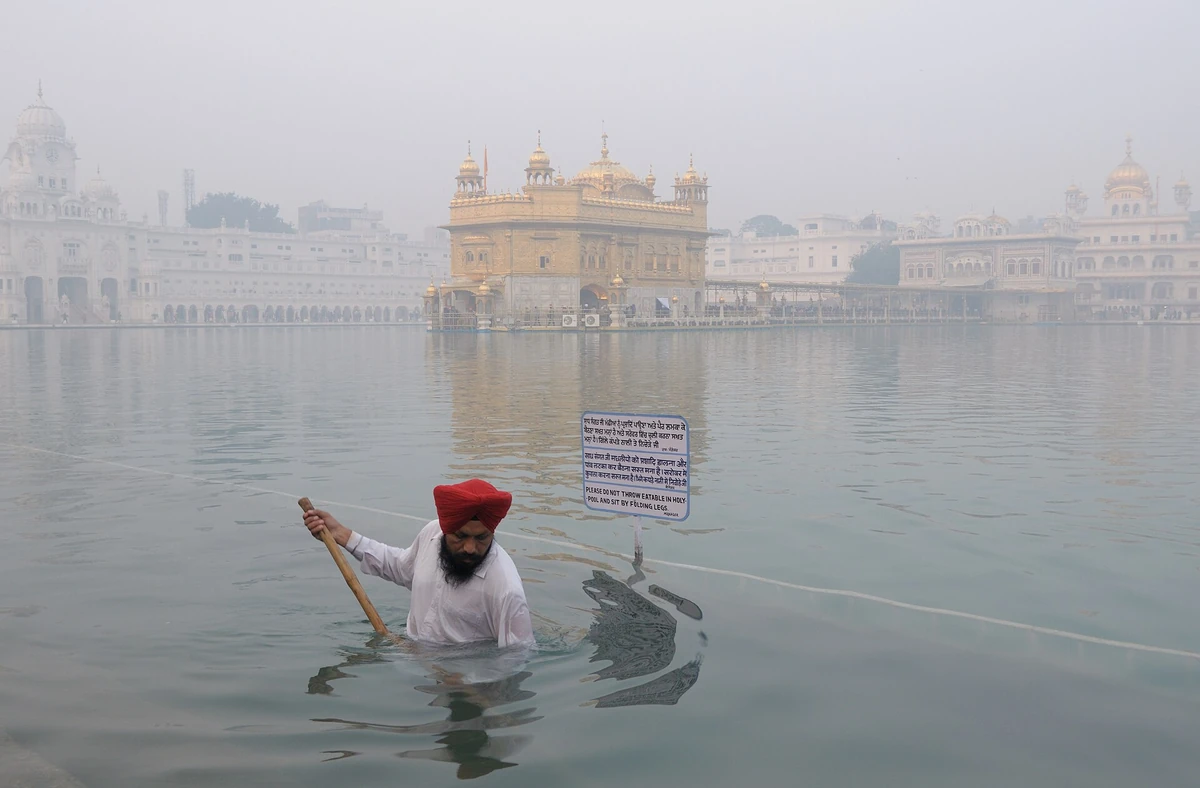
Image Source: Wikimedia
8.3 Script, scripture and institutions
- Gurmukhi was introduced by Guru Angad (WBCS Prelims 2008). UPSC Prelims 2004 also treats as correct the statement “Guru Arjun Dev gave to Sikhs their own script – Gurmukhi,” together with “Guru Arjan Dev became the Sikh Guru after Guru Ram Das.” Learn both facts: Angad standardised the script; Arjan used it for the Adi Granth. See WBCS Prelims Medieval Indian History PYQs and UPSC Prelims Medieval History: Vijayanagara and Regional Kingdoms PYQs.
- The Adi Granth, compiled by Guru Arjan at Amritsar, includes the bani of the Gurus and of bhagats such as Kabir, Ravidas and Namdev. Guru Gobind Singh added the hymns of Guru Tegh Bahadur and closed the Guruship; from then the Guru Granth Sahib is the Guru.
- Correct pair (UPSC Prelims 1996): Guru Arjan Dev … Adi Granth. Miri and Piri belong to Guru Hargobind, not Amar Das. The Dal Khalsa is not an institution of Guru Ram Das. The Manji system belongs to Guru Amar Das, not Guru Gobind Singh. See UPSC Prelims Art and Culture: Philosophy and Religion PYQs.
8.4 Tegh Bahadur, Gobind Singh and Banda Bahadur
- Guru Tegh Bahadur was a contemporary of Aurangzeb (WBCS Prelims 2003) and was executed / slaughtered by Aurangzeb (WBCS Prelims 2024, 2007 and 2000). The year is 1675, at Delhi.
- Guru Gobind Singh is the tenth and last Guru of the Sikhs (WBCS Prelims 2023). He founded the Khalsa in 1699 at Anandpur (WBCS Prelims 2024) and converted the Sikhs into a martial race (WBCS Prelims 2007).
- Banda Bahadur was appointed as the military leader of the Sikhs by Guru Gobind Singh, not by Guru Tegh Bahadur. In UPSC Prelims 2004, statement 1 is therefore false, and the correct choice is 2 and 3 only (Arjan followed Ram Das; Arjan and Gurmukhi, as that paper words it). See UPSC Prelims Medieval History: Vijayanagara and Regional Kingdoms PYQs.
9. Tulsidas, Surdas, Mirabai and Raskhan
In simple words: While Kabir and Nanak spoke of a formless God, another north-Indian stream loved God as Rama or Krishna. Tulsidas told the Rama story in Awadhi in the Ramcharitmanas and wrote Gitawali, Kavitawali and Vinaya Patrika. Surdas sang of the child Krishna in Braj. Mirabai, a Rajput princess of Mewar, gave herself to Giridhar (Krishna). Raskhan, a Muslim poet, wrote Prem Vatika on the life of Krishna.
9.1 Tulsidas
- Tulsidas (c. 1532–1623) lived in the Awadh–Varanasi world. His masterpiece is the Ramcharitmanas, the Rama story in Awadhi, distinct from Sandhyakar Nandi’s Sanskrit Ramcharita of the Pala period (see §19).
- He also wrote Gitawali, Kavitawali and Vinaya Patrika (WBCS Mains 2015). Surdas, Chaitanya and Namadeva are the traps in that question.
- He used Hindi, but he is not the first Bhakti saint to do so; that is Ramananda (UPSC Prelims 2002).

Image Source: Wikimedia
9.2 Surdas
- Surdas is the blind poet of Braj. The Sursagar gathers his songs of Krishna, especially the child Krishna of Braj. He is placed in the orbit of Vallabha’s Pushtimarg.
- He is a saguna Krishna poet. Prem Vatika, however, is not his: that work is by Raskhan (UPSC Prelims 1996).
9.3 Mirabai
- Mirabai (sixteenth century) was a princess of the Rathor house, married into Mewar. She took Krishna as her husband and left the palace for a life of song and pilgrimage (Dwarka and Braj). Her bhajans are not the basis of Sattriya in Assam (UPSC Prelims 2014: statement 3 is false). See UPSC Prelims Art and Culture: Dance PYQs and §10.3.
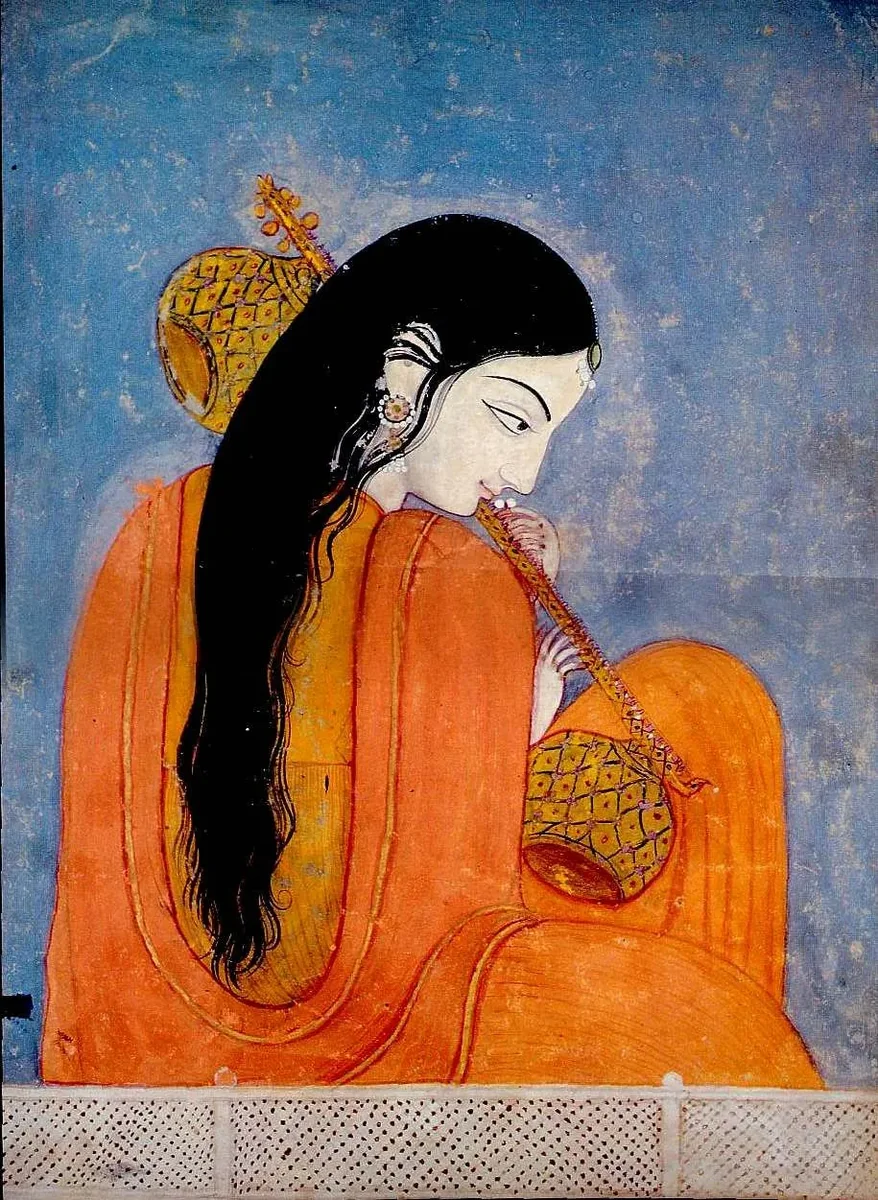
Image Source: Wikimedia
9.4 Raskhan
- Prem Vatika, poems on the life of Krishna, was composed by Raskhan (UPSC Prelims 1996). The traps are Bihari, Surdas and Kabir. Raskhan was a Muslim poet who wrote in Braj of Krishna-bhakti.
9.5 A note on Jayadeva
Jayadeva‘s Gita Govinda deals with the cult of Krishna (WBCS Mains 2017) and was composed in Sanskrit (PSC Miscellaneous 2007). It is a courtly Sanskrit lyric of the Sena age in Bengal, not a Hindi doha. See WBCS Mains Religious Movements PYQs, PSC Miscellaneous Prelims History PYQs and Medieval Bengal.
10. Chaitanya, Bengal Vaishnavism and Sankardeva
In simple words: In eastern India, Bhakti took a public, singing form. Chaitanya (1486–1534) of Nabadwip preached the name of Krishna and Radha, led sankirtana through the streets, and lived his last years at Puri. He flourished under Alauddin Husain Shah of Bengal. In the same Husain Shahi world, Maladhar Basu wrote Srikrishna Vijaya and received the title Gunaraj Khan. In Assam, Sankardeva built Ekasarana Dharma and the monastery-dance Sattriya, which is not based on the songs of Tulsidas, Kabir and Mirabai.
10.1 Chaitanya and Gaudiya Vaishnavism
- Chaitanya (also called Sri Chaitanya, Chaitanyadeva, Gauranga) was born in 1486 at Nabadwip in a Brahmin family, and died in 1534 at Puri. His path is Gaudiya Vaishnavism: love of Radha–Krishna, congregational sankirtana, and the theology later written down by the Six Goswamis of Vrindavan.
- He flourished under Alauddin Husain Shah (WBCS Prelims 2022 and 2003). Husain Shah ruled Bengal from 1493 to 1519; see Medieval Bengal for the Husain Shahi court.
- He is the Hindu saint (and the Brahmin spiritual leader) who had both Hindu and Muslim disciples (WBCS Prelims 2007 and 2000). See WBCS Prelims Medieval Indian History PYQs.
- In the Shankara–Ramanuja–Chaitanya chronology he is the last of the three (UPSC Prelims 2004).
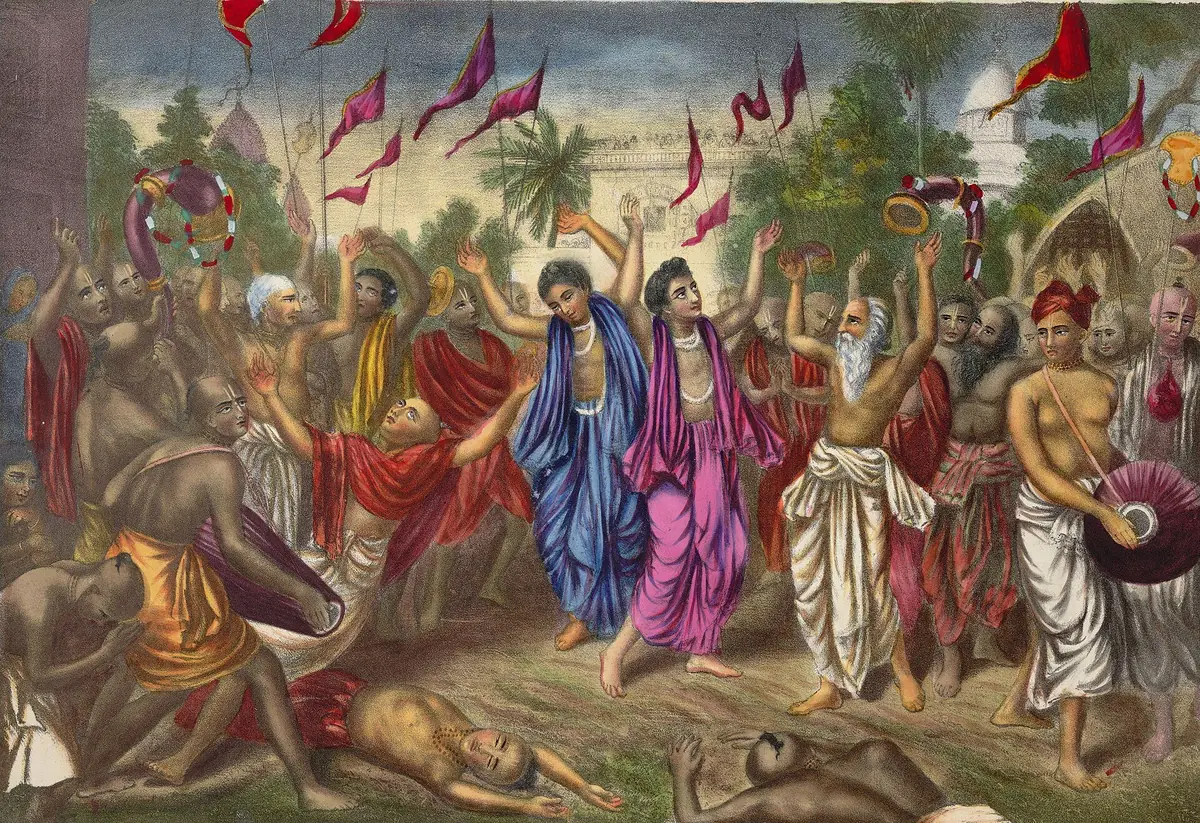
Image Source: Wikimedia
10.2 Maladhar Basu and the Krishna literature of Bengal
- Maladhar Basu composed the Srikrishna Vijaya (WBCS Prelims 2003). He was conferred the title Gunaraj Khan in the Sultanate period of Bengal (WBCS Prelims 2024). See WBCS Prelims Medieval Indian History PYQs and Medieval Bengal.
- This courtly Krishna literature, together with Jayadeva’s earlier Gita Govinda, is the literary soil of Chaitanya’s movement.
10.3 Sankardeva and Sattriya
- Sankardeva (1449–1568) of Assam founded Ekasarana Dharma (“shelter in one God”), a Vaishnava path centred on Krishna / Vishnu. His institutions are the sattras (monasteries) and the namghars (prayer halls). His birthplace is associated with Bordowa (Batadrava).
- He wrote Borgeets, and he created the dance-drama Ankiya Nat (and Bhaona). From this sattra culture comes Sattriya.
- On Sattriya (UPSC Prelims 2014): it is a combination of music, dance and drama, and it is a centuries-old living tradition of the Vaishnavites of Assam. It is not based on classical ragas and talas of devotional songs composed by Tulsidas, Kabir and Mirabai. The correct choice is 1 and 2 only. See UPSC Prelims Art and Culture: Dance PYQs.
11. Lal Ded and the Rishi Order of Kashmir
In simple words: Kashmir had its own meeting of Shaiva insight and Sufi piety. Lal Ded (Lalleshwari, Lalla) was a fourteenth-century woman saint who sang vakh verses in Kashmiri, walking a path of inward Shaivism that ordinary people could hear. Nund Rishi (Sheikh Nuruddin Wali) founded the Rishi order, a Kashmiri Sufi path that absorbed her ethical tone: a simple life, vegetarian practice, and respect for local custom. The valley’s later image of harmony sits on this double foundation.
11.1 Lal Ded
- Lal Ded lived in fourteenth-century Kashmir. Trained in Kashmir Shaivism, she took to a wandering life. Her vakhs (short spoken verses) reject hollow ritual and caste pride, and point the listener inward. She is the first great voice of Kashmiri in the vernacular.
11.2 The Rishi order
- The Rishi order of Kashmir is a regional Sufi path. Its fountainhead is Nund Rishi (Sheikh Nuruddin Wali), whose shrine is at Charar-e-Sharif. The Rishis lived simply, valued manual work and a vegetarian table, and stood closer to the village than to the court, distinct from the great pan-Indian silsilas of §§13–16.
- For the later Sultanate of Kashmir (including Zain-ul-Abidin), see Provincial Kingdoms of the Sultanate Period.
12. What is Sufism?
In simple words: Sufism is the mystical path in Islam. A Sufi wants a direct, loving experience of Allah, not only the observance of law. In India this path was organised as silsilas (orders). A pir (master) guided a murid (disciple) in a khanqah (hospice). People gathered at a dargah (tomb-shrine), and many Indian Sufis used sama — sung poetry — to draw the heart toward God. The big doctrinal phrase is wahdat-ul-wujud, the “unity of being.”
12.1 The essential terms
| Term | Meaning |
|---|---|
| Silsilah (also silsila) | A Sufi order — a chain of masters. Sufi orders were generally known as silsilah (WBCS Mains 2022). Siyasa, virasat and hukumat are the traps. See WBCS Mains Religious Movements PYQs. |
| Pir / shaikh / murshid | The spiritual master |
| Murid | The disciple who takes baiat (initiation) |
| Khanqah | The hospice or lodge where the pir lives, teaches and feeds visitors |
| Dargah | The tomb-shrine of a saint; the annual death-anniversary fair is the urs |
| Sama | Listening to devotional music to awaken ecstasy. Recitation of holy songs to arouse a state of ecstasy is a recognised Sufi practice (UPSC Prelims 2012) |
| Zikr (dhikr) | Repetition of the divine Name; some orders do it aloud, the Naqshbandis prefer a silent zikr |
| Wahdat-ul-wujud | “Unity of being”: God alone truly is, associated with Ibn Arabi and with many Indian Chishtis |
| Wahdat-ul-shuhud | “Unity of witnessing”: Ahmad Sirhindi‘s reply — the world is not identical with God |
| Futuh | Unsolicited gifts on which a khanqah might live |
| Auliya | “Friends of God,” that is, saints. Auliya is not the name of a Sufi order (WBCS Mains 2022) |
12.2 Practices the exams list
With reference to medieval India, Sufi mystics pursued all three of the following (UPSC Prelims 2012):
- Meditation and control of breath
- Severe ascetic exercises in a lonely place
- Recitation of holy songs to arouse a state of ecstasy in their audience (sama)
Nizamuddin Auliya adopted yogic breathing exercises and was called Sidh (“perfect”) (WBCS Mains 2015). See UPSC Prelims Medieval History: Bhakti and Sufism PYQs and WBCS Mains Religious Movements PYQs.
12.3 What is not a Sufi order
Namdhari is a nineteenth-century Sikh reform movement, not a Sufi silsila. Kirpandhari is not a Sufi order. Auliya means saints, not an order. In WBCS Mains 2022 the question “The following is a Sufi order: Namdhari / Kirpandhari / Auliya / None of the above” is answered None of the above.
13. How Sufism Came to India, and the Silsilas
In simple words: Islam first reached India through Arab merchants of the Malabar coast, centuries before the Turkish conquest. Sufism itself reached India in the eleventh century, when Al-Hujwiri (Data Ganj Bakhsh) settled at Lahore. From the late twelfth century the great orders arrived with the Sultanate: first the Chishtis and Suhrawardis, later the Qadiris, Firdausis and Naqshbandis.
13.1 First contact with Islam, then Sufism
- India’s earliest contact with Islam came through Arab merchants of the Malabar coast (WBCS Prelims 2016; PSC Miscellaneous 2018). “Sufi saints and Arab travellers” and the Arab or Turkish invasions are the wrong options for earliest contact. See WBCS Prelims Medieval Indian History PYQs and PSC Miscellaneous Prelims History PYQs.
- Sufism reached India in the eleventh century (WBCS Prelims 2014). The landmark is Ali ibn Uthman al-Hujwiri, called Data Ganj Bakhsh, who lived and died at Lahore (d. c. 1072) and wrote Kashf-ul-Mahjub. See WBCS Prelims Medieval Indian History PYQs. The great silsilas then took root under the Delhi Sultanate, from Moinuddin Chishti at Ajmer at the close of the twelfth century.
13.2 The main silsilas at a glance
| Silsila | Origin / Indian arrival | Indian centres | Tone in India |
|---|---|---|---|
| Chishti | Named from Chisht near Herat, not from Ajmer; brought by Moinuddin Chishti | Ajmer, Delhi, Pakpattan, Gulbarga, Fatehpur Sikri | Love, sama, distance from court (in the early generations) |
| Suhrawardi | From Shihabuddin Suhrawardi of Baghdad; Bahauddin Zakariya in India | Multan, Uch | Accepted official posts and state patronage |
| Qadiri | Founded in Baghdad by Abdul Qadir Jilani; introduced in India by Shaikh Niamatullah and Makhdum Muhammad Jilani | North India, later the Deccan and Punjab | Broad, later popular at the Mughal court |
| Firdausi | A branch that settled in Bihar | Bihar Sharif; Sharafuddin Yahya Maneri | Letters of guidance (maktubat) |
| Naqshbandi | From Central Asia; in India from the late sixteenth century | Delhi, Sirhind | Silent zikr, close to orthodoxy and to the Mughal court |
14. The Chishti Order and Amir Khusrau
In simple words: The Chishti order takes its name from the village of Chisht near Herat, not from Ajmer. Moinuddin Chishti brought it to India and made Ajmer its first great Indian home. The chain then runs Bakhtiyar Kaki → Baba Farid → Nizamuddin Auliya → Nasiruddin Chirag-i-Dehlavi, and south to Gesu Daraz at Gulbarga. Amir Khusrau, the “Parrot of India,” was Nizamuddin’s disciple. Shaikh Salim Chishti of Fatehpur Sikri was not a contemporary of Aurangzeb.
14.1 The name, and Moinuddin Chishti
- Assertion: “The sponsor and the most prominent figure of the Chishti order of Sufis in India is Khwaja Moinuddin Chishti.” That assertion is true. Reason: “The Chishti order takes its name from a village Chishti in Ajmer.” That reason is false. The village of Chisht is near Herat, not in Ajmer. So A is true, but R is false (UPSC Prelims 1997). See UPSC Prelims Medieval History: Bhakti and Sufism PYQs.
- Moinuddin Chishti (Khwaja Gharib Nawaz, d. 1236) settled at Ajmer after the Ghurid conquest. His dargah at Ajmer Sharif is the first great Indian centre of the order.
- He is the Sufi saint who maintained that devotional music was one way of coming close to God (UPSC Prelims 1996). Baba Farid, Gesu Daraz and Shah Alam Bukhari are the other options; the key is Muin-ud-din Chishti. This is why the Chishtis, unlike some more austere orders, made a home for sama and, in India, for qawwali.
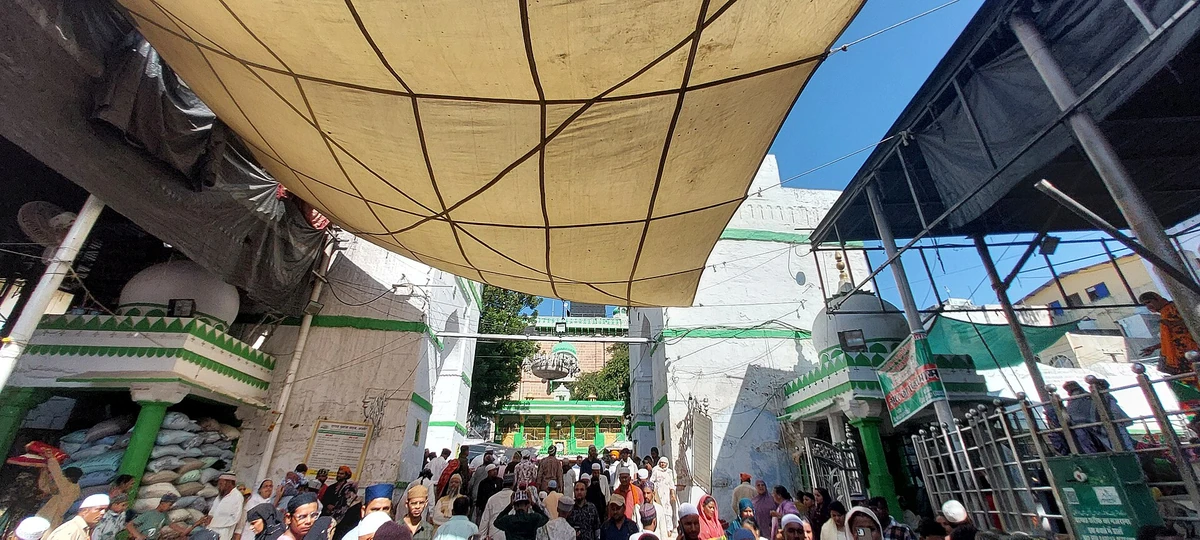
Image Source: Wikimedia
14.2 The Chishti chain in India
- Qutbuddin Bakhtiyar Kaki (d. 1235) was Moinuddin’s deputy in Delhi. His shrine is at Mehrauli, close to the Qutb complex (see Delhi Sultanate).
- Fariduddin Ganj-i-Shakar (Baba Farid, d. 1265) moved the centre to Ajodhan (Pakpattan). His Punjabi verses later entered the Adi Granth.
- Nizamuddin Auliya (d. 1325) made Delhi the heart of the order, with his khanqah at Ghiyaspur (today’s Nizamuddin). He adopted yogic breathing exercises and was called Sidh (WBCS Mains 2015). He is the master of Nasiruddin Chirag-i-Dehlavi and of Amir Khusrau.
- Shaikh Nasiruddin Chirag-i-Dehlavi (Chirag-i-Delhi, “Lamp of Delhi”) was a disciple of Shaikh Nizamuddin Auliya (UPSC Prelims 2002, statement 2, true). He belonged to the Chishti order (WBCS Prelims 2001). A WBCS Prelims 2024 question identifies Nasiruddin Chirag as a Sufi saint.
- Syed Muhammad Gesu Daraz (d. 1422) carried the order to the Deccan and lies at Gulbarga, in the world of the Bahmani Sultanate.
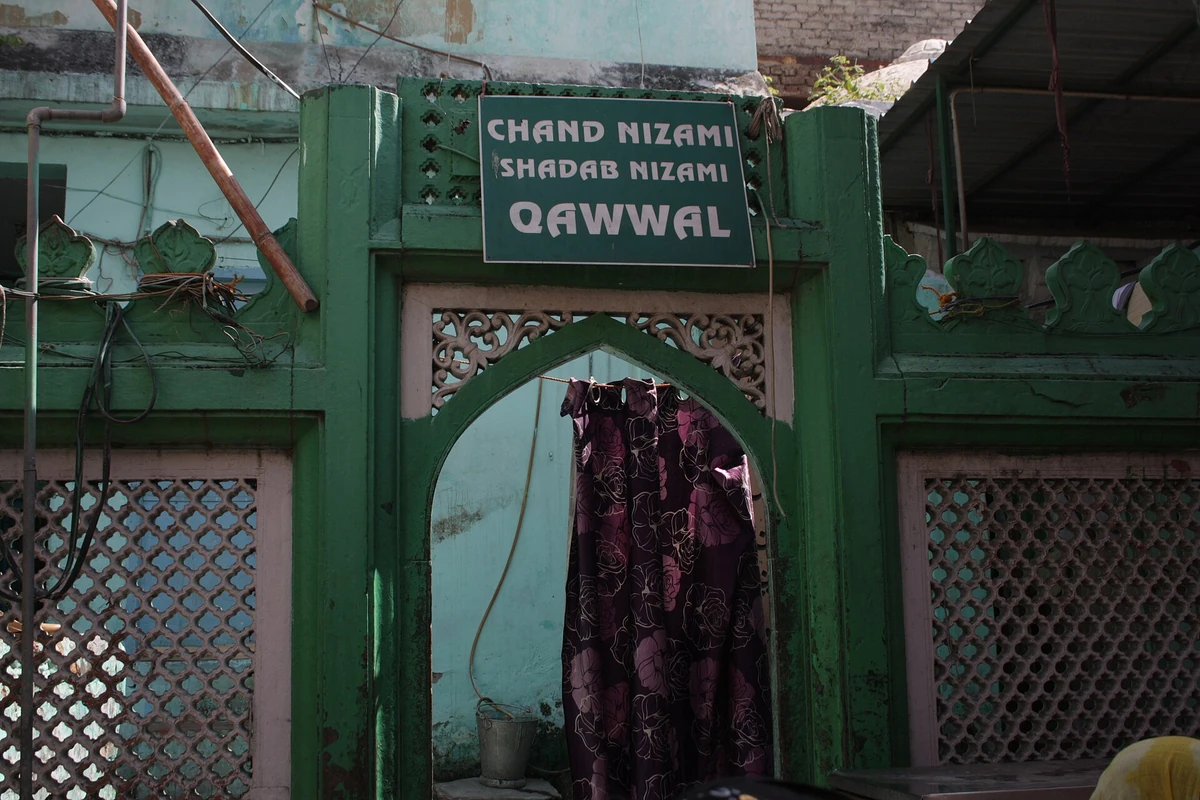
Image Source: Wikimedia
14.3 Amir Khusrau
- Amir Khusrau (1253–1325) was the great Persian and Hindavi poet of the Delhi Sultanate, and a murid of Nizamuddin Auliya. He served several sultans; WBCS Prelims 2008 asks him as the court poet of Alauddin Khalji, and that is the answer for that paper.
- He is known as the Parrot of India / Parrot of Hindustan / Parrot of Hindusthan (WBCS Prelims 2023, 2009 and 2007; WBCS Mains 2023; PSC Miscellaneous 2018). See WBCS Prelims Medieval Indian History PYQs, WBCS Mains Delhi Sultanate PYQs and PSC Miscellaneous Prelims History PYQs.
- He composed Khazain-ul-Futooh (WBCS Mains 2023), a prose history of Alauddin Khalji’s wars. He is also the author of the line, “Every pearl in the royal crown is but the crystallized drops of blood fallen from the tearful eyes of the poor peasant” (WBCS Mains 2015). See WBCS Mains Delhi Sultanate PYQs.
- In music: he was the originator in India of the early form of qawwali (UPSC Prelims 2003, both this and Ibrahim Adil Shah II’s Kitab-i-Nauras are true). He is the innovator of Kheyal (khayal) in Indian classical music (PSC Miscellaneous GK 2006). The musical instrument the exams attach to him is the sitar (PSC Miscellaneous 2010). See UPSC Prelims Art and Culture: Music PYQs and PSC Miscellaneous Prelims General Knowledge PYQs. For Kitab-i-Nauras, see also Bahmani Empire and Deccan Sultanates.
14.4 Shaikh Salim Chishti
- Shaikh Salim Chishti (d. 1572) lived at Sikri. Akbar honoured him, named his son Salim (the future Jahangir) after the saint, and built Fatehpur Sikri around the hospice. The marble tomb stands in the mosque court there.
- Aurangzeb was not a contemporary of Shaikh Salim Chishti (UPSC Prelims 2002, statement 3, false). Salim Chishti died in 1572; Aurangzeb was born in 1618 and ruled 1658–1707.

Image Source: Wikimedia
15. Suhrawardi, Qadiri, Naqshbandi and Firdausi
In simple words: Beside the Chishtis, four other orders matter for exams. The Suhrawardis of Multan worked with the state. The Qadiri order was founded, in the Indian exam wording, by Shah Niamatullah Qadri, who (with Makhdum Muhammad Jilani) first introduced it into India; its original Baghdad founder is Abdul Qadir Jilani. The Firdausis took root in Bihar. The Naqshbandis arrived last, closer to Sunni orthodoxy, and produced Ahmad Sirhindi.
15.1 The Suhrawardi order
- The order looks back to Shihabuddin Abu Hafs Umar Suhrawardi of Baghdad. In India its great name is Bahauddin Zakariya (d. 1262) of Multan, a contemporary of Baba Farid, with a branch at Uch. Unlike the early Chishtis, the Suhrawardis accepted land grants and official posts and advised sultans. See Delhi Sultanate.
15.2 The Qadiri order
- In the wider Islamic world the Qadiri silsila goes back to Abdul Qadir Jilani of Baghdad (twelfth century).
- In India the order was first introduced by Shaikh Niamatullah and Makhdum Muhammad Jilani (UPSC Prelims 2002, statement 4, true). WBCS Mains 2022 asks “The Qadri order of Sufis was founded by” and the official answer is Shah Niamatullah Qadri (the other options are Baba Farid, Bakhtiyar Kaki and Shah Jalal). Hold both facts: Baghdad origin under Abdul Qadir Jilani; Indian introduction and the WBCS wording of “founded by” Shah Niamatullah Qadri. See UPSC Prelims Medieval History: Bhakti and Sufism PYQs and WBCS Mains Religious Movements PYQs.
15.3 The Firdausi order
- The Firdausi silsila is the Bihar branch of a wider Suhrawardi family. Its great Indian saint is Sharafuddin Yahya Maneri of Bihar Sharif (d. 1381), whose letters (Maktubat-i-Sadi) are a classic of Indian Sufi counsel. See Medieval Bengal and Provincial Kingdoms of the Sultanate Period.
15.4 The Naqshbandi order
- The Naqshbandi silsila comes from Central Asia (Bahauddin Naqshband). It entered India in the late sixteenth century with Khwaja Baqi Billah at Delhi, under Akbar. Its marks are a silent zikr, a sober style, and a wish to bring the ruler back to a strict Sunni standard. From Baqi Billah the Indian line runs to Ahmad Sirhindi (§16).
16. Ahmad Sirhindi
In simple words: Shaikh Ahmad Sirhindi (1564–1624), called Mujaddid Alf-i-Sani (“renewer of the second millennium”), was the great Naqshbandi of Sirhind. He rejected the idea that the saint or the emperor could blur the line between God and the world, and he argued for wahdat-ul-shuhud against wahdat-ul-wujud. He is a figure of Jahangir’s age. He was not a contemporary of Ibrahim Lodi, and he did not influence Kabir.
16.1 Life and teaching
- Sirhindi was born in 1564 at Sirhind in the Punjab and died in 1624. He became the leading Indian Naqshbandi after Baqi Billah. His letters, the Maktubat-i-Imam Rabbani, argue for restoring the sharia and keeping the Creator and the creation distinct. Against wahdat-ul-wujud (“unity of being”) he set wahdat-ul-shuhud (“unity of witnessing”): the mystic may see only God, but the world is not itself God. Jahangir imprisoned him for a time in Gwalior, then released and honoured him.
16.2 The exam traps
- “Shaikh Ahmad Sarhandi was a contemporary of Ibrahim Lodi” is false (UPSC Prelims 2002, statement 1). Ibrahim Lodi died in 1526 at Panipat; Sirhindi was born in 1564.
- “Saint Kabir was greatly influenced by Shaikh Ahmad Sirhindi” is false (UPSC Prelims 2019). Kabir belongs to the fifteenth and early sixteenth centuries; Sirhindi was not yet born. The same 2019 question also rejects Nimbarka as a contemporary of Akbar, so the answer is neither 1 nor 2. See UPSC Prelims Medieval History: Bhakti and Sufism PYQs.
17. Bhakti and Sufi Compared
In simple words: The two movements grew in the same centuries, used song and the people’s language, honoured a living teacher, and told listeners that a sincere heart matters more than a proud ritual. They were not the same religion. Bhakti spoke from within Hindu sampradayas (and, with Nanak, founded a new one). Sufism spoke from within Islam. Where they met — in Kabir’s dohas, in Nanak’s journeys, in Baba Farid’s verses in the Adi Granth, in Chaitanya’s Muslim disciples — the exams like to linger.
They share a living master (guru / pir), song (kirtana, abhang, qawwali, sama), the vernacular, and a critique of empty ritual and social pride. Nizamuddin’s yogic breathing sits beside the 2012 UPSC list of Sufi practices.
They differ in theology (saguna form, nirguna Name, Sufi tawhid and wahdat-ul-wujud), in organisation (sampradayas, sattras, gurdwaras; silsilas, khanqahs, dargahs), and in their usual relation to the state: early Chishtis kept a distance; Suhrawardis and later Naqshbandis did not.
People on the bridge include Kabir, Guru Nanak, Namdev (influenced by Islam; verses in the Adi Granth), Baba Farid (Punjabi slokas in the Adi Granth), Raskhan, Chaitanya (Hindu and Muslim disciples in Husain Shahi Bengal), and Lal Ded and Nund Rishi in Kashmir.
18. Sources for Bhakti and Sufi History
In simple words: We know these saints from their own verses, from later compilations, from biographies written by disciples, and from the Persian histories of the Sultanate and the Mughals. For exams, match the book to the person and do not confuse a biography with a scripture.
- Bhakti and Sikh: Nalayira Divya Prabandham (Alvars, compiled by Nathamuni); Tevaram / Tirumurai; Basavanna’s vachanas; Jnaneshwari and Amrutanubhav; abhangs of Namdev and Tukaram; Dasbodh; Kabir’s Bijak; Tulsidas’s Ramcharitmanas, Gitawali, Kavitawali and Vinaya Patrika; Sursagar; Raskhan’s Prem Vatika; Maladhar Basu’s Srikrishna Vijaya; Sankardeva’s Borgeets and Ankiya Nat; the Janamsakhis of Guru Nanak (WBCS Mains 2014); the Adi Granth, compiled by Guru Arjan and later sealed as Guru under Guru Gobind Singh; the bhashyas of Shankara, Ramanuja’s Sri Bhashya, and the works of Madhva, Nimbarka and Vallabha.
- Sufi: Al-Hujwiri’s Kashf-ul-Mahjub (Lahore, eleventh century); the maktubat of Sharafuddin Maneri and of Ahmad Sirhindi; tazkiras of the pirs; Amir Khusrau’s Khazain-ul-Futooh and poems; the dargahs of Ajmer, Nizamuddin and Pakpattan, the tomb of Salim Chishti at Fatehpur Sikri, and Gesu Daraz at Gulbarga — buildings that also belong to the Delhi Sultanate and Bahmani stories.
19. Do Not Confuse
In simple words: A large share of the marks come from near-miss pairs: the book, the century, the contemporary and the order. Work through this list until the wrong option feels obviously wrong.
19.1 Books and authors
- Bijak is Kabir, not Dadu Dayal (UPSC Prelims 2014).
- Pushtimarg is Vallabha, not Madhva (UPSC Prelims 2014). Vallabha preaches the Krishna cult (WBCS Mains 2014).
- Amrutanubhav is Jnaneshwar; Dasbodh is Ramdas; Rukmini Swayamvar is Eknath (WBCS Mains 2020).
- Gitawali, Kavitawali and Vinaya Patrika are Tulsidas, not Surdas, Chaitanya or Namadeva (WBCS Mains 2015). The Ramcharitmanas is also Tulsidas.
- Ramcharit (or Ramcharita) is Sandhyakar Nandi of the Pala age, not Tulsidas (PSC Miscellaneous 2023). Do not confuse Ramcharit with Ramcharitmanas.
- Prem Vatika is Raskhan, not Surdas, Kabir or Bihari (UPSC Prelims 1996).
- Srikrishna Vijaya is Maladhar Basu, titled Gunaraj Khan (WBCS Prelims 2003 and 2024).
- Gita Govinda is Jayadeva, on the Krishna cult, in Sanskrit (WBCS Mains 2017; PSC Miscellaneous 2007).
- Khazain-ul-Futooh is Amir Khusrau, not Barani or Badauni (WBCS Mains 2023).
- Janamsakhi is the biography of Guru Nanak, not of Arjan, Hargobind or Tegh Bahadur (WBCS Mains 2014).
19.2 People and centuries
- Chronology: Shankaracharya – Ramanuja – Chaitanya (UPSC Prelims 2004).
- Nimbarka was not a contemporary of Akbar. Kabir was not influenced by Ahmad Sirhindi. Neither statement is true (UPSC Prelims 2019).
- Sirhindi was not a contemporary of Ibrahim Lodi. Aurangzeb was not a contemporary of Salim Chishti (UPSC Prelims 2002).
- When the Lodis fell and Babur took over (1526), only Guru Nanak among Dadu, Nanak and Tyagaraja was preaching (UPSC Prelims 2013). Dadu is 1544–1603; Tyagaraja is 1767–1847.
- Tukaram was a contemporary of Jahangir, not of Babur, Akbar or Aurangzeb (UPSC Prelims 2006).
- Annamacharya and Tyagaraja are not contemporaries. Tyagaraja’s kritis are not mostly in praise of Krishna; they praise Rama. Annamacharya’s kirtanas praise Venkateshwara (UPSC Prelims 2018).
- Nagarjuna was not a proponent of the bhakti cult; Tukaram, Tyagaraja and Vallabha were (UPSC Prelims 2010).
19.3 Sikh offices and names
- Gurmukhi was introduced by Guru Angad (WBCS Prelims 2008). UPSC Prelims 2004 also treats as correct the statement that Guru Arjan gave the Sikhs that script. Learn both facts. Adi Granth — Guru Arjan. Miri-Piri — Guru Hargobind, not Amar Das. Manji — Guru Amar Das, not Gobind Singh. Dal Khalsa is not Guru Ram Das (UPSC Prelims 1996). Banda Bahadur was appointed by Guru Gobind Singh, not by Tegh Bahadur (UPSC Prelims 2004). The tenth and last Guru is Gobind Singh, who founded the Khalsa (1699). Tegh Bahadur was executed by Aurangzeb (1675).
19.4 Sufi names and places
- The Chishti order is named from Chisht near Herat, not from Ajmer (UPSC Prelims 1997).
- Nasiruddin Chirag is a Chishti disciple of Nizamuddin Auliya, not of some other pir (UPSC Prelims 2002; WBCS Prelims 2001 and 2024).
- The Sufi who held that devotional music brings one close to God is Moinuddin Chishti (UPSC Prelims 1996).
- The saint called Sidh, who adopted yogic breathing, is Nizamuddin Auliya (WBCS Mains 2015).
- Qadiri / Qadri in India: Shah Niamatullah Qadri (with Makhdum Muhammad Jilani). Namdhari, Kirpandhari and Auliya are not Sufi orders (WBCS Mains 2022).
- India’s earliest contact with Islam is through Arab merchants of the Malabar coast, not through Sufi saints (WBCS Prelims 2016; PSC Miscellaneous 2018). Sufism reached India in the eleventh century (WBCS Prelims 2014), with Al-Hujwiri at Lahore.
19.5 Professions and labels
- Namdev — tailor; Kabir — weaver; Ravidas — cobbler; Sena — barber (UPSC Prelims 2001).
- Alvar = Vaishnavite hymnodist, not Shaiva (WBCS Mains 2018). The Shaiva counterparts are the Nayanars.
- Sattriya is Assamese Vaishnava dance-drama from Sankardeva‘s sattras. It is not based on Tulsidas, Kabir or Mirabai (UPSC Prelims 2014).
- The Parrot of India / Hindustan / Hindusthan is Amir Khusrau, not Tansen, Surdas or Abul Fazl.
- The “Muslim saint worshipped by Hindus and Muslims” in WBCS Prelims 2000 is Kabir. The “Hindu saint / Brahmin spiritual leader with Hindu and Muslim disciples” is Chaitanya.
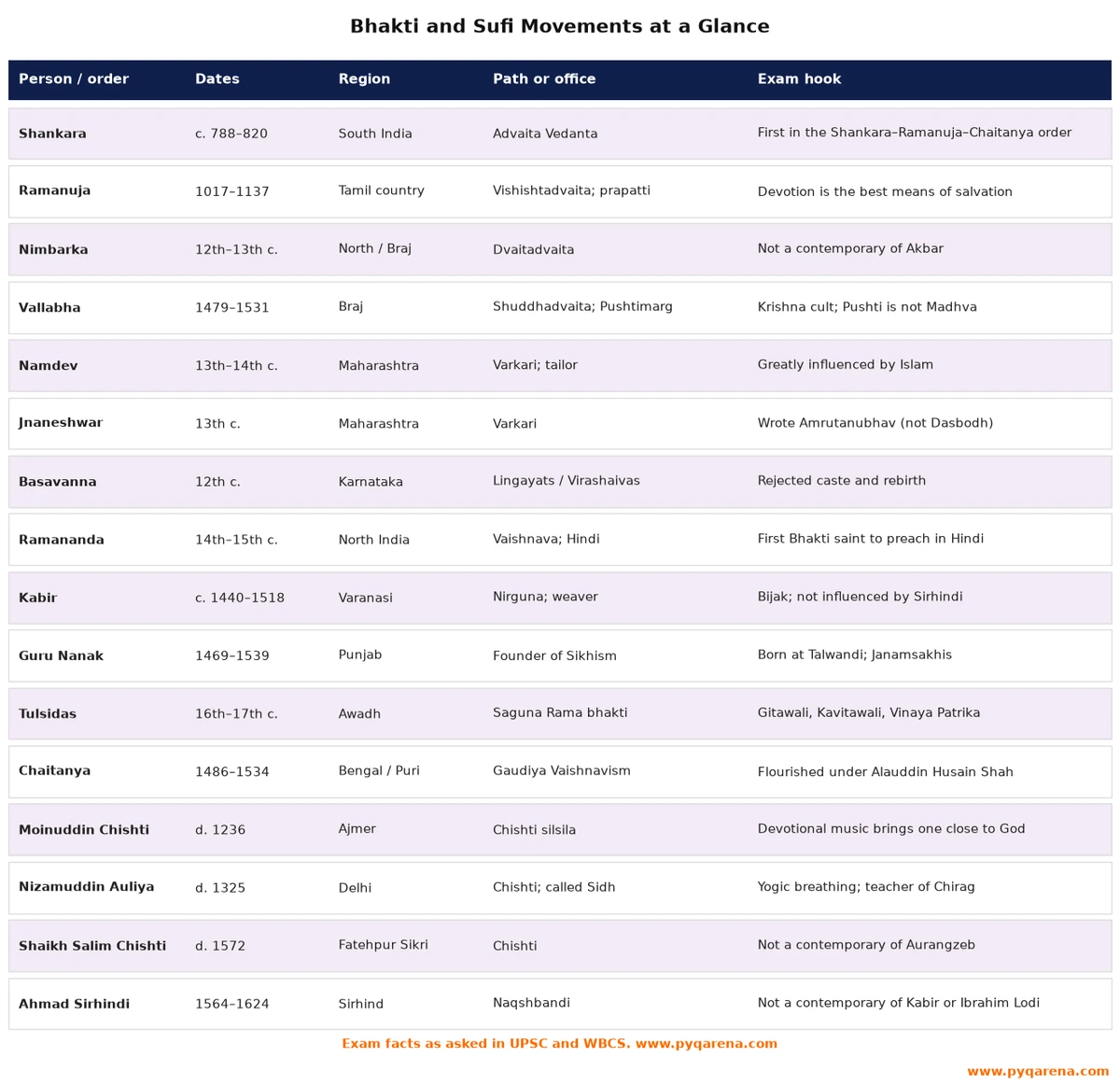
20. Bhakti and Sufi Movements at a Glance
In simple words: If you can reproduce the table and the hooks, you already have the core of the chapter.
21. Timeline
In simple words: Keep four dates as anchors: Al-Hujwiri at Lahore around 1072 (Sufism in India in the eleventh century); Moinuddin at Ajmer at the end of the twelfth; 1526, when Guru Nanak was preaching as the Lodis fell; 1699, when Guru Gobind Singh founded the Khalsa. Everything else hangs on those pegs.

Related Notes
- Religious Movements in Ancient India
- Delhi Sultanate
- Provincial Kingdoms of the Sultanate Period
- Medieval Bengal
- Vijayanagara Empire
- Bahmani Empire and Deccan Sultanates
- Sangam Age and Early South India
- Foreign Travellers in India
- Ancient Literature and Scientific Works
Practice
- UPSC Prelims Medieval History: Bhakti and Sufism PYQs
- WBCS Mains Religious Movements PYQs
- WBCS Prelims Medieval Indian History PYQs
- UPSC Prelims Art and Culture: Philosophy and Religion PYQs
- UPSC Prelims Art and Culture: Dance PYQs
- UPSC Prelims Art and Culture: Music PYQs
- UPSC Prelims Medieval History: Vijayanagara and Regional Kingdoms PYQs
- WBCS Mains Delhi Sultanate PYQs
- WBCS Mains South Indian Dynasties PYQs
- WBCS Mains General Knowledge History PYQs
- PSC Miscellaneous Prelims History PYQs
- PSC Miscellaneous Prelims General Knowledge PYQs
- WBCS Mains General Knowledge Books and Literature PYQs
- WBCS Mains Mughal Empire PYQs
Leave a Comment