

Who is this for? Beginners and aspirants for WBCS, UPSC Prelims, other State PSCs, WBP and Clerkship exams. This is Chapter 6 of Medieval Indian History and covers the Muslim kingdoms of the Deccan: the Bahmani Sultanate (1347–1527) and the five Deccan Sultanates that grew out of it (Bijapur, Golconda, Ahmadnagar, Berar and Bidar), down to the Mughal conquest in 1687. Each section opens with an “In simple words” explanation and then moves to exam-level detail. 🔗 Practise alongside: WBCS Mains Vijayanagar and Bahmani PYQs | WBCS Prelims Medieval Indian History PYQs | UPSC Prelims Medieval History: Vijayanagara and Regional Kingdoms PYQs | PSC Miscellaneous Prelims History PYQs | WBCS Mains Mughal Empire PYQs | WBCS Mains General Knowledge Art and Culture PYQs | UPSC Prelims Art and Culture: Music PYQs 📖 Read first: Delhi Sultanate (Chapter 2) | Provincial Kingdoms of the Sultanate Period (Chapter 3) | Medieval Bengal (Chapter 4) | Vijayanagara Empire (Chapter 5)
1. The Deccan Sultanates: The Big Picture
In simple words: In 1347 a group of rebel nobles broke away from Muhammad bin Tughlaq’s Delhi and set up the Bahmani Sultanate at Gulbarga in the Deccan. For nearly 180 years it was the great Muslim power of the south and the constant enemy of Vijayanagara. Around 1490–1518 its five provinces broke away as five separate Sultanates: Bijapur, Ahmadnagar, Berar, Golconda and Bidar. They joined together once, at Talikota (1565), to destroy Vijayanagara, and then fell one by one to the Mughals (Ahmadnagar 1600/1633, Bijapur 1686, Golconda 1687). Their lasting gifts are the Gol Gumbaz, the Charminar, the Mahmud Gawan Madrasa, Deccani painting and Dakhni (early Urdu) poetry.
1.1 The Deccan in one table
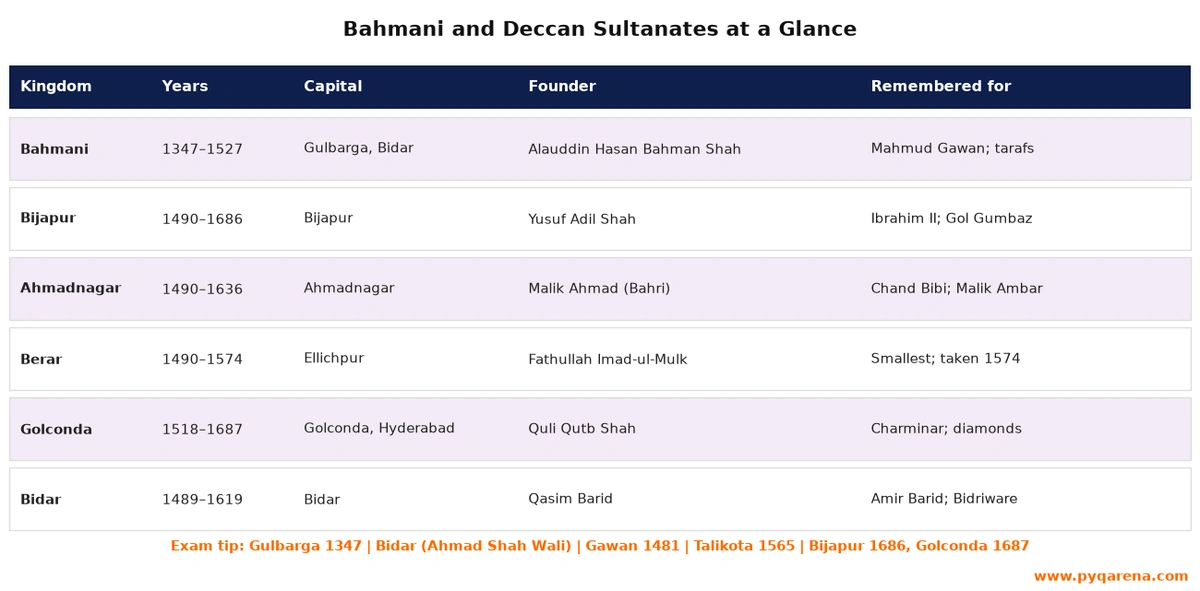
| Kingdom | Years | Capital | Founder | Remembered for |
|---|---|---|---|---|
| Bahmani | 1347–1527 | Gulbarga, then Bidar | Alauddin Hasan Bahman Shah | Mahmud Gawan; wars with Vijayanagara; four, later eight, tarafs |
| Bijapur (Adil Shahi) | 1490–1686 | Bijapur | Yusuf Adil Shah | Ibrahim Adil Shah II (Jagadguru), Gol Gumbaz, Kitab-i-Nauras |
| Ahmadnagar (Nizam Shahi) | 1490–1636 | Ahmadnagar | Malik Ahmad Nizam Shah | Chand Bibi; Malik Ambar |
| Berar (Imad Shahi) | 1490–1574 | Ellichpur | Fathullah Imad-ul-Mulk | Smallest; absorbed by Ahmadnagar |
| Golconda (Qutb Shahi) | 1518–1687 | Golconda, then Hyderabad | Quli Qutb Shah | Charminar; diamonds; Mir Jumla |
| Bidar (Barid Shahi) | 1489–1619 | Bidar | Qasim Barid | Amir Barid; absorbed by Bijapur |
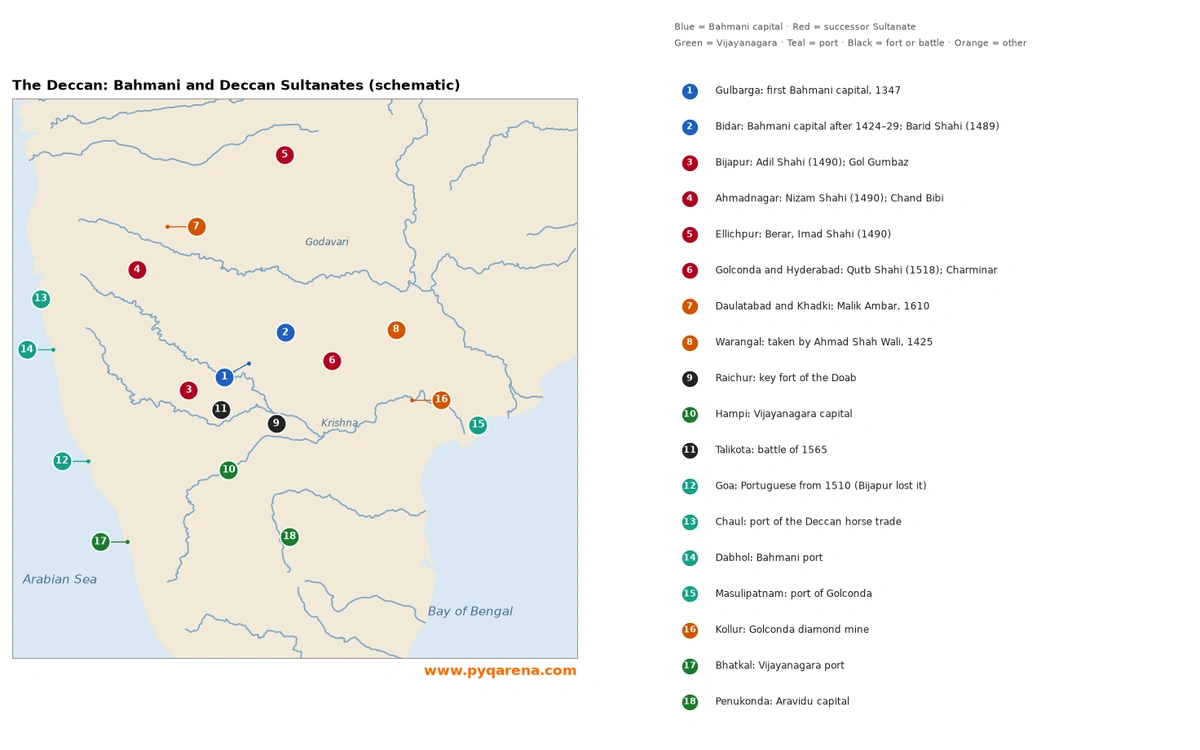
1.2 Why this chapter matters for exams
- WBCS Mains devotes a whole post to Vijayanagar and Bahmani (Bidar, Gol Gumbaz, Golconda and Warangal). WBCS Prelims asks the Bahmani founder, the Raichur Doab, Talikota, Chand Bibi, Jagadguru and the Kohinoor.
- UPSC Prelims has asked about the Nizam Shahis (2004), Kitab-i-Nauras (2003), Ibrahim Adil Shah II (2000), Gol Gumbaz (1995) and the Portuguese capture of Goa from Bijapur (2022).
- The chapter ties together four neighbours: the Delhi Sultanate (origin), Vijayanagara (rival), the Mughals (conqueror) and the Marathas (who grew up as officers of these Sultanates).
2. How the Bahmani Sultanate Began (1347)
In simple words: Muhammad bin Tughlaq moved his capital to Daulatabad in the Deccan (1327) and then demanded impossible taxes from the Deccan nobles. The amiran-i-sadah (commanders of a hundred) revolted, and in 1347 their leader Hasan, a soldier who had risen at Delhi, was crowned at Gulbarga as Alauddin Hasan Bahman Shah. Delhi could not take the south back.
2.1 The revolt
- Background: the Delhi Sultan’s southern capital Daulatabad and the harsh policies of Muhammad bin Tughlaq (see Delhi Sultanate) turned the Deccan officers against Delhi.
- The rebels: the amiran-i-sadah seized Daulatabad and chose Ismail Mukh as their king. Hasan, a senior officer, beat back the royal counter-attack, and Ismail, an old man, stepped aside; Hasan was crowned on 3 August 1347.
- The title: Hasan took the name Alauddin Hasan Bahman Shah (earlier Zafar Khan) and made Gulbarga his capital, renaming it Ahsanabad.
- Why Delhi could not return: Muhammad bin Tughlaq was busy putting down revolts in Gujarat and Sind; Bengal and Madurai had also broken away. The Deccan was lost for good.
2.2 Two explanations of the name “Bahmani”
| Explanation | Story |
|---|---|
| Persian descent | Bahman Shah claimed descent from Bahman, the hero-king of the Persian epic Shahnama (son of Isfandiyar) |
| Brahmin patron | Firishta tells of a Brahmin astrologer, Gangu, who was Hasan’s patron at Delhi and foretold his rise; Hasan took the name Hasan Gangu Bahmani (“Brahmani”) in his honour |
The dynasty is called Bahmani either way; textbooks use Hasan Gangu and Bahman Shah for the same man.
2.3 Alauddin Hasan Bahman Shah (1347–58)
- Held the Deccan from Gulbarga to Daulatabad and the coast, and fixed the first frame of government: four tarafs (provinces) under tarafdars: Gulbarga, Daulatabad, Berar and Bidar.
- Faced Vijayanagara across the Tungabhadra–Krishna doab, the border zone that the two powers fought over for two centuries.
- Died in 1358, leaving a state that would grow for a century.
2.4 Why the Bahmani Sultanate mattered
- It was the first independent Muslim kingdom of the Deccan and the model for the later Sultanates.
- It linked the Persian Gulf (horses, Iranian scholars and merchants) with the Indian peninsula.
- Its wars with Vijayanagara shaped the politics of South India for two centuries: see Vijayanagara Empire.
3. The Early Sultans (1358–1422)
In simple words: After the founder, three Sultans made the kingdom strong: Muhammad Shah I gave it laws and guns, Muhammad Shah II gave it peace, and Firuz Shah gave it learning and a strong Hindu and Muslim civil service. The map was fixed by wars with Vijayanagara and Warangal.
| Sultan | Years | Main events |
|---|---|---|
| Alauddin Hasan Bahman Shah | 1347–58 | Founded the state; Gulbarga; four tarafs |
| Muhammad Shah I | 1358–75 | Wars with Vijayanagara (Bukka I) and Warangal; first effective use of artillery in the Deccan; Golconda and the Turquoise Throne from the Kakatiya chief (1363); Jama Masjid, Gulbarga begun |
| Mujahid Shah | 1375–78 | Fought Vijayanagara over the Doab; murdered by his cousin Daud |
| Muhammad Shah II | 1378–97 | Long peace; patron of poets and scholars |
| Firuz Shah Bahmani | 1397–1422 | Scholar and linguist; built Firuzabad; large Hindu share in the civil service; defeated and was defeated by Deva Raya I |
| Ahmad Shah I Wali | 1422–36 | Shifted the capital to Bidar; conquered Warangal |
3.1 Muhammad Shah I (1358–75)
- Organisation: shared power among eight officers: the Wakil-us-Saltanat, Wazir-i-Kul, Amir-i-Jumla, Wazir-i-Ashraf, Nazir, Peshwa, Sadr-i-Jahan and the Kotwal. The Peshwa office later passed to the Marathas.
- Golconda: in 1363 the Kakatiya chief Kapaya Nayaka gave the Sultan Golconda and the Turquoise Throne (Takht-i-Firoza) to end a war. The fort later became the capital of the Qutb Shahis.
- War with Vijayanagara: the Bahmanis used cannon against Bukka I (1366–67) in the fight for Mudgal. Both sides then agreed not to harm the common people.
- Building: the Jama Masjid of Gulbarga (1367), designed by the Persian architect Rafi of Qazvin, is the Bahmani masterpiece (see §16).
3.2 Muhammad Shah II (1378–97)
His long reign was the Bahmani Sultanate’s peaceful time: roads, schools and orphanages were founded, and poets and scholars from Persia came to Gulbarga. The kingdom stayed in order until the first quarrels between old and new nobles.
3.3 Firuz Shah Bahmani (1397–1422)
- Learning: he knew Arabic, Persian, Turkish, Telugu, Kannada and Marathi, wrote poetry, and loved science and astronomy.
- Civil service: Hindu Brahmins, especially Deccani Brahmins, filled revenue offices, and Firuz Shah married a daughter of Deva Raya I. This gave the Deccan state a local base.
- Firuzabad: a new city on the Bhima river, near Gulbarga.
- War with Vijayanagara: in 1406 he forced Deva Raya I to pay a large sum and give him a daughter in marriage. Later the tide turned, and in 1417 Deva Raya I defeated him. His brother Ahmad Shah took the throne in 1422.
3.4 Ahmad Shah I Wali (1422–36) and the shift to Bidar
- Why “Wali”: he was a devoted follower of the Sufi saint Khwaja Bande Nawaz Gesu Daraz of Gulbarga, and was called Wali (saint).
- Warangal: conquered the last Kakatiya lands in 1425, so that Telangana became part of the Sultanate.
- Shift to Bidar: he moved the capital from Gulbarga to Bidar (the shift ran from 1424 to 1429). Bidar was closer to the Telangana and Berar provinces, cooler, better watered, and easier to defend. The reason, in the exam, is centrality and strategy.
Exam point: “Which Bahmani ruler shifted the capital from Gulbarga to Bidar?” Ahmad Shah Wali (WBCS Mains 2017). See the WBCS Mains Vijayanagar and Bahmani PYQs.
3.5 Warangal and Golconda
- Warangal was the capital of the Kakatiyas, who fell to Delhi in 1323 (see Early Medieval Regional Kingdoms for the dynasty).
- Warangal passed to the Bahmanis in 1425, and Telangana became a Bahmani province; Golconda, the fort in that province, later became the capital of the Qutb Shahi kingdom.
- In the exam: Golconda grew up on the ruins of the old Hindu kingdom of Warangal (WBCS Mains 2019).
4. Mahmud Gawan (1411–81)
In simple words: Mahmud Gawan was a Persian merchant who became the Bahmani Sultanate’s greatest minister. He won new land for the kingdom, reorganised its provinces and army, and built a famous college at Bidar. His enemies tricked the Sultan into executing him in 1481, and the kingdom began to break up soon after.
4.1 The man
- Origin: born in 1411 at Gilan in Persia; came to the Deccan in 1453 as a merchant and was given the title Malik-ut-Tujjar (chief of merchants) by Humayun Zalim.
- Rise: served as minister under Humayun, the child Nizam Shah and Muhammad Shah III (1463–82), and became Wakil-us-Saltanat (chief minister) with the title Khwaja-i-Jahan. For about 15 years he ran the kingdom.
- Writings: his letters survive as Riyaz-ul-Insha and Manazir-ul-Insha, a handbook of Persian prose.
4.2 Conquests
| Year | Conquest | Why it mattered |
|---|---|---|
| 1469–72 | Konkan coast, including Dabhol and Goa (1472) | Gave the Sultanate the ports through which Persian horses came in, and cut Vijayanagara’s trade |
| 1471–72 | Kondapalli and Rajahmundry, taken from the Gajapatis of Orissa | Pushed the Sultanate to the Bay of Bengal |
| 1472 | Belgaum | Took the northern edge of Vijayanagara’s land |
4.3 Reforms
- Eight tarafs: he split the four large provinces into eight tarafs, so no tarafdar was as strong as before.
- Crown lands: in each taraf one district was set apart as khalisa (land whose revenue went straight to the Sultan).
- Forts: the tarafdar held only one fort; the other forts went to commanders chosen by the Sultan.
- Pay and rank: nobles were graded by the number of horsemen they kept and were paid in cash or in jagirs; their troops were inspected.
- Land: land was measured and the revenue was fixed on actual produce, which raised income and reduced cheating.
4.4 The Mahmud Gawan Madrasa at Bidar (1472)
- A three-storeyed college with a library of about 3,000 manuscripts, lecture halls, a mosque and living rooms.
- Its high minaret and tilework follow the Persian (Khurasan and Samarkand) style, covered with glazed tiles.
- A lightning strike on its gunpowder store in 1696 destroyed part of the building.
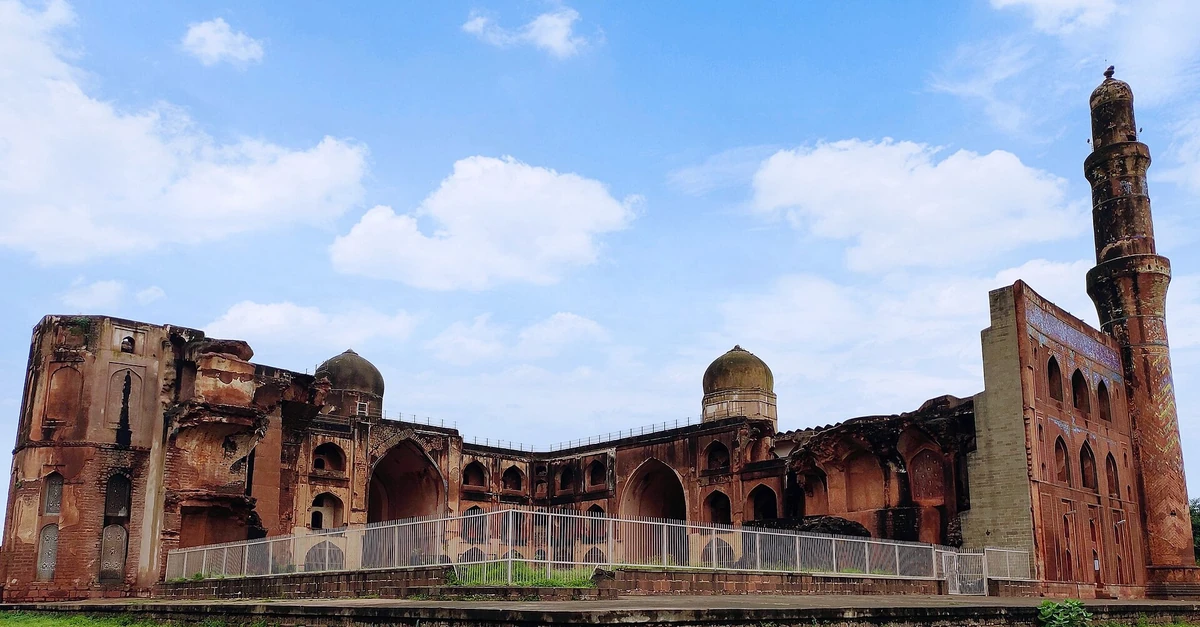
Image Source: Wikimedia
4.5 The execution (1481)
- Cause: the Deccani nobles hated Gawan for favouring foreigners. Their leader Nizam-ul-Mulk Bahri forged a letter in Gawan’s name to the king of Orissa, offering him the Sultanate.
- Result: on 5 April 1481, the young Sultan Muhammad Shah III ordered the aged minister, then 70, to be killed. The Sultan died in 1482, in regret.
- After him: Mahmud Shah II (1482–1518) was a puppet king in the hands of rival nobles, and the provinces fell away.
Exam point: Mahmud Gawan: Persian merchant, Wakil-us-Saltanat under Muhammad Shah III, eight tarafs, khalisa lands, Bidar madrasa (1472), executed 1481.
5. Deccanis and Afaqis (Gharibs)
In simple words: Two camps of nobles fought each other for a century. Deccanis were Muslims long settled in the south, together with the Abyssinians (Habshis) who sided with them. Afaqis (also called Gharibs, “strangers”) were newcomers from Iran, Iraq, Turkey and Central Asia, who held the highest posts. Their hatred weakened the Sultanate.
| Point | Deccanis | Afaqis (Gharibs) |
|---|---|---|
| Who | Muslims born or long settled in the Deccan, with Abyssinians | Newcomers from Persia, Arabia, Turkey and Central Asia |
| Faith | Mostly Sunni | Mostly Shia |
| Leader | Nizam-ul-Mulk Bahri | Mahmud Gawan |
| Strength | Local knowledge and numbers | Learning, trade links and high offices |
| Grievance | Foreigners took the best posts and pay | Locals refused to take orders from strangers |
- First clash: under Alauddin Ahmad II (1436–58) the Deccani officers massacred many Afaqi men at Chakan fort (1446).
- The balance: the Sultans tried to keep both groups in each province; Mahmud Gawan‘s system of mixed provinces was meant to stop the feud.
- Outcome: the Deccani victory over Gawan in 1481 broke the system, and the later Sultans who rose to independence were drawn from both camps: the Nizam Shahi founder was a Deccani; the Adil Shahi and Qutb Shahi founders were Afaqis.
6. Bahmani Administration
In simple words: The Bahmani kingdom was run in two layers: at the centre the Sultan and a council of ministers, and in the provinces tarafdars who governed and kept armies. The system copied the Delhi Sultanate, with a Persian court style, and left a long mark: even the Marathas later used the title Peshwa.
6.1 Central government
| Office | Duty |
|---|---|
| Wakil-us-Saltanat | Deputy of the Sultan; the highest minister (Gawan’s post) |
| Wazir-i-Kul | Prime minister |
| Amir-i-Jumla | Minister of finance (later the title of Mir Jumla) |
| Wazir-i-Ashraf | Minister for foreign affairs and the court |
| Nazir | Assistant to the finance minister |
| Peshwa | Assistant to the wazir; the office the Marathas later made famous |
| Sadr-i-Jahan | Head of justice and religious grants |
| Kotwal | City police and order |
6.2 Provincial government: tarafs and tarafdars
- A taraf was a province; its governor was the tarafdar.
- Muhammad Shah I fixed four tarafs: Gulbarga, Daulatabad, Berar, Bidar.
- Mahmud Gawan raised them to eight, kept one khalisa district in each, and let the tarafdar hold only one fort.
- Tarafdars collected revenue, kept troops and paid the Sultan a share. When the Sultan was weak, tarafdars rose as independent kings: this is exactly how the five Sultanates were born.
6.3 Revenue, army and trade
- Revenue: the state share of land was collected through village officers (deshmukhs, deshpandes, patils), many of them Hindu.
- Army: a force of cavalry and artillery (guns used from Muhammad Shah I‘s time); Abyssinians and Afaqis supplied many officers.
- Trade: the ports of Dabhol, Chaul and Goa brought in Arabian and Persian horses, and exported cotton, spices and cloth.
6.4 Culture of the Bahmani court
- Persian was the court language and Persian culture set the tone, but Marathi and Telugu were used in villages and accounts.
- Sufis such as Khwaja Bande Nawaz Gesu Daraz (Gulbarga) shaped religious life.
- Dakhni (early Urdu) began to grow in the Bahmani courts: see §18.
7. War with Vijayanagara: The Raichur Doab
In simple words: The Raichur Doab, the rich land between the Krishna and Tungabhadra rivers, lay on the border of the Bahmani Sultanate and Vijayanagara. Whoever held its forts, Raichur and Mudgal, could threaten the other’s heartland. For two centuries the two powers fought for it.
7.1 Why the Doab mattered
- Rich soil: two great rivers gave rich harvests of cotton, rice and millet.
- Forts: Raichur and Mudgal controlled the roads into both kingdoms.
- Religion and trade: each side wanted the Doab’s income and the horse trade of the western coast.
7.2 The wars in order
| Date | Ruler | What happened |
|---|---|---|
| 1366–67 | Muhammad Shah I vs Bukka I | Fight for Mudgal; Bahmani cannon; civilians spared by treaty |
| 1406 | Firuz Shah vs Deva Raya I | Firuz Shah besieged Vijayanagara and married Deva Raya I‘s daughter |
| 1417 | Deva Raya I vs Firuz Shah | Deva Raya I won |
| 1443–46 | Alauddin Ahmad II vs Deva Raya II | Several campaigns over the Doab |
| 1472 | Mahmud Gawan | Conquered Goa, Belgaum and the Konkan from Vijayanagara |
| 1520 | Krishnadevaraya vs Ismail Adil Shah | Raichur taken by Vijayanagara |
| 1565 | Four Sultans vs Rama Raya | Talikota; end of Vijayanagara’s power |
7.3 Result
- The Doab changed hands many times and was held by Vijayanagara under Krishnadevaraya after 1520, and then by the Adil Shahis after 1565.
- The wars drained both sides: the Bahmanis were left too weak to resist their own governors, and Vijayanagara too weak to resist the Sultans of 1565.
- Cross-link: see Vijayanagara Empire §4 and §7 for the Vijayanagara side.
Exam point: “The Bahmani Kingdom and Vijayanagar Empire clashed frequently over the territory of …” Raichur Doab (WBCS Prelims 2011 and 2001). See WBCS Prelims Medieval Indian History PYQs.
8. The Break-up of the Bahmani Sultanate (1490–1538)
In simple words: After Mahmud Gawan was killed in 1481, the tarafdars no longer obeyed the Sultan. Between 1489 and 1518 five tarafdars declared themselves independent kings. The Bahmani line lasted, as puppets, until 1527, but real power lay with the new Sultans.
8.1 The five successor Sultanates
| Sultanate | Dynasty | Year | Founder | Capital |
|---|---|---|---|---|
| Bidar | Barid Shahi | 1489 | Qasim Barid | Bidar |
| Bijapur | Adil Shahi | 1490 | Yusuf Adil Shah | Bijapur |
| Ahmadnagar | Nizam Shahi | 1490 | Malik Ahmad | Ahmadnagar |
| Berar | Imad Shahi | 1490 | Fathullah Imad-ul-Mulk | Ellichpur |
| Golconda | Qutb Shahi | 1518 | Quli Qutb Shah | Golconda |
8.2 Why the kingdom broke
- Faction fights between Deccanis and Afaqis.
- Weak Sultans after Muhammad Shah III, who were boys or puppets.
- Strong tarafdars with their own forts and armies.
- Costly wars with Vijayanagara, Orissa and Malwa.
- Distance: provinces such as Berar and Telangana were far from the capital.
8.3 The last Bahmani Sultans
- Mahmud Shah II (1482–1518) was the last Sultan with any real power.
- The next four Ahmad Shah II, Alauddin Shah III, Wali-ullah and Kalimullah were puppets of Amir Barid of Bidar. Kalimullah fled to Ahmadnagar in 1527, and with him the Bahmani line ended; he died in 1538.
Exam point: the last province to proclaim independence was Golconda (1518); the first Sultanate to be swallowed was Berar (by Ahmadnagar, 1574), then Bidar (by Bijapur, 1619).
9. Bijapur: The Adil Shahis (1490–1686)
In simple words: Yusuf Adil Shah, a Persian-born officer of the Bahmani kingdom, made himself king at Bijapur in 1490. His dynasty ruled the richest of the Deccan Sultanates, fought Vijayanagara and the Portuguese, and left the Gol Gumbaz. Its best-known king, Ibrahim Adil Shah II, was called Jagadguru for his love of Hindu and Muslim music and poetry. The Mughals took Bijapur in 1686.
9.1 The Adil Shahi kings
| Sultan | Years | Main events |
|---|---|---|
| Yusuf Adil Shah | 1490–1510 | Founder; made Shia worship the state faith (1502); fought Vijayanagara; lost Goa to Albuquerque (1510) |
| Ismail Adil Shah | 1510–34 | Lost Raichur to Krishnadevaraya (1520) |
| Ibrahim Adil Shah I | 1534–58 | Turned to Sunni worship; hired Marathas and Hindus in the administration |
| Ali Adil Shah I | 1558–80 | Joined the Talikota alliance (1565); married Chand Bibi; began the Jama Masjid and water works of Bijapur |
| Ibrahim Adil Shah II | 1580–1627 | Jagadguru; Kitab-i-Nauras; Nauraspur; Ibrahim Rauza |
| Muhammad Adil Shah | 1627–56 | Gol Gumbaz; the Mughal treaty of 1636; Shivaji‘s rise |
| Ali Adil Shah II | 1656–72 | Afzal Khan killed by Shivaji (1659) |
| Sikandar Adil Shah | 1672–86 | Last Sultan; Bijapur taken by Aurangzeb (1686) |
9.2 Yusuf Adil Shah and the early kings
- Origin: a foreign-born slave officer of Mahmud Gawan, who rose to be governor of Bijapur.
- 1502: he proclaimed the Shia form of Islam as the state faith, but tolerated Sunnis and Hindus.
- Goa: in 1510 Albuquerque captured Goa from the Bijapur Sultanate; it became the capital of the Portuguese in India. Cross-link: the UPSC asked in 2022 whether Albuquerque captured Goa from the Bijapur Sultanate (statement true): UPSC Prelims European Expansion PYQs.
- Raichur: Ismail Adil Shah lost the fort to Krishnadevaraya in 1520 (see Vijayanagara Empire).
9.3 Ali Adil Shah I and Talikota
- Relations: he was first an ally of Rama Raya against Ahmadnagar, and then turned on him.
- Talikota (1565): he led the four-Sultan alliance that destroyed Vijayanagara. See §13.
- Marriage: he married Chand Bibi, daughter of Hussain Nizam Shah I of Ahmadnagar (1564).
9.4 Ibrahim Adil Shah II (1580–1627): the Jagadguru
- Why Jagadguru (“world teacher”)? Hindus and Muslims alike honoured him because he honoured Saraswati and Ganesh in his poems, gave grants to temples, Sufis and Brahmins, and ruled without religious bias. He was a musician who played the tambur.
- Kitab-i-Nauras (1599): a book of about 59 songs set in 17 ragas in Dakhni, praising Saraswati, Ganesh and Muslim saints. It is a landmark of Dakhni verse written by a king. The name Nauras means “nine rasas” (moods).
- Nauraspur: a new music city that he planned near Bijapur.
- Rauza: the Ibrahim Rauza (completed about 1626–27), the tomb of the Sultan and his queen Taj Sultana, built by the architect Malik Sandal.
- Regency: he came to the throne as a boy, and Chand Bibi ruled for him for a short time.
- Bidar: he annexed Bidar in 1619.
Exam point: “The Muslim Sultan regarded by Hindus as Jagadguru” Ibrahim Adil Shah II of Bijapur (WBCS Prelims 2000; UPSC Prelims 2000). Kitab-i-Nauras was written by Ibrahim Adil Shah II, and Amir Khusrau originated the qawwali style in India (both statements true in UPSC 2003; see Delhi Sultanate for Amir Khusrau). See UPSC Prelims Art and Culture: Music PYQs and UPSC Prelims Medieval History: Vijayanagara and Regional Kingdoms PYQs.
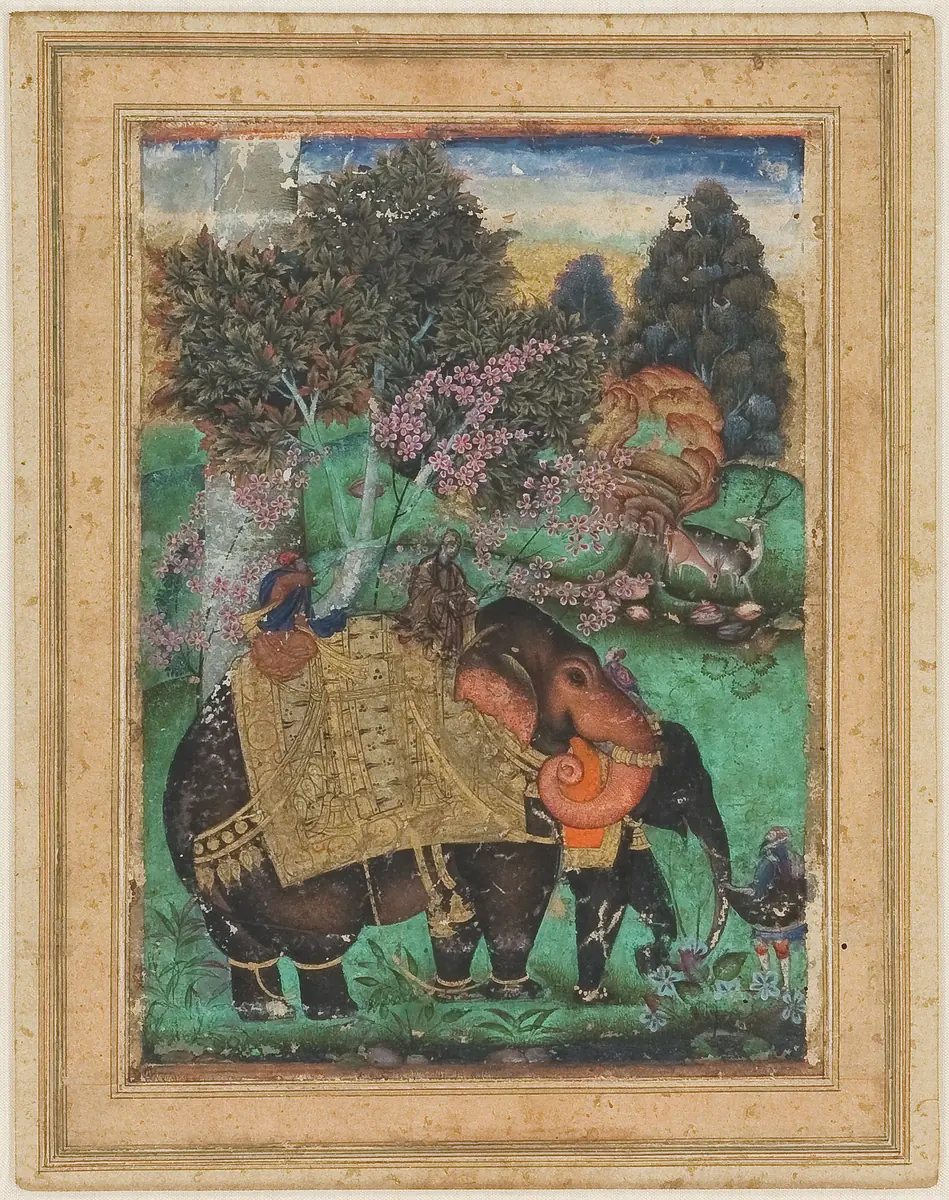
Image Source: Wikimedia
9.5 Muhammad Adil Shah (1627–56) and the Gol Gumbaz
- Gol Gumbaz: the Sultan’s own mausoleum at Bijapur, completed in 1656 and designed by Yaqut of Dabul.
- Size: the dome, counted as the second-largest in the world after St Peter’s Basilica in Rome, spans about 38 m inside; it rests on a vast hall and four seven-storey corner towers.
- Whispering gallery: a sound made on the gallery that runs round the base of the dome is repeated many times.
- Mughal pressure: in 1636 Bijapur accepted Shah Jahan‘s overlordship and agreed to pay tribute.
Exam point: Who built the Gol Gumbaz at Bijapur, famous for the world’s second largest dome and the whispering gallery? Muhammad Adil Shah (WBCS Mains 2015). Gol Gumbaz is in Bijapur (WBCS Mains Art and Culture 2020). A dome counted among the largest in the world: Gol Gumbaz, Bijapur (UPSC Prelims Architecture 1995). See WBCS Mains Vijayanagar and Bahmani PYQs, WBCS Mains General Knowledge Art and Culture PYQs and UPSC Prelims Art and Culture: Architecture PYQs.
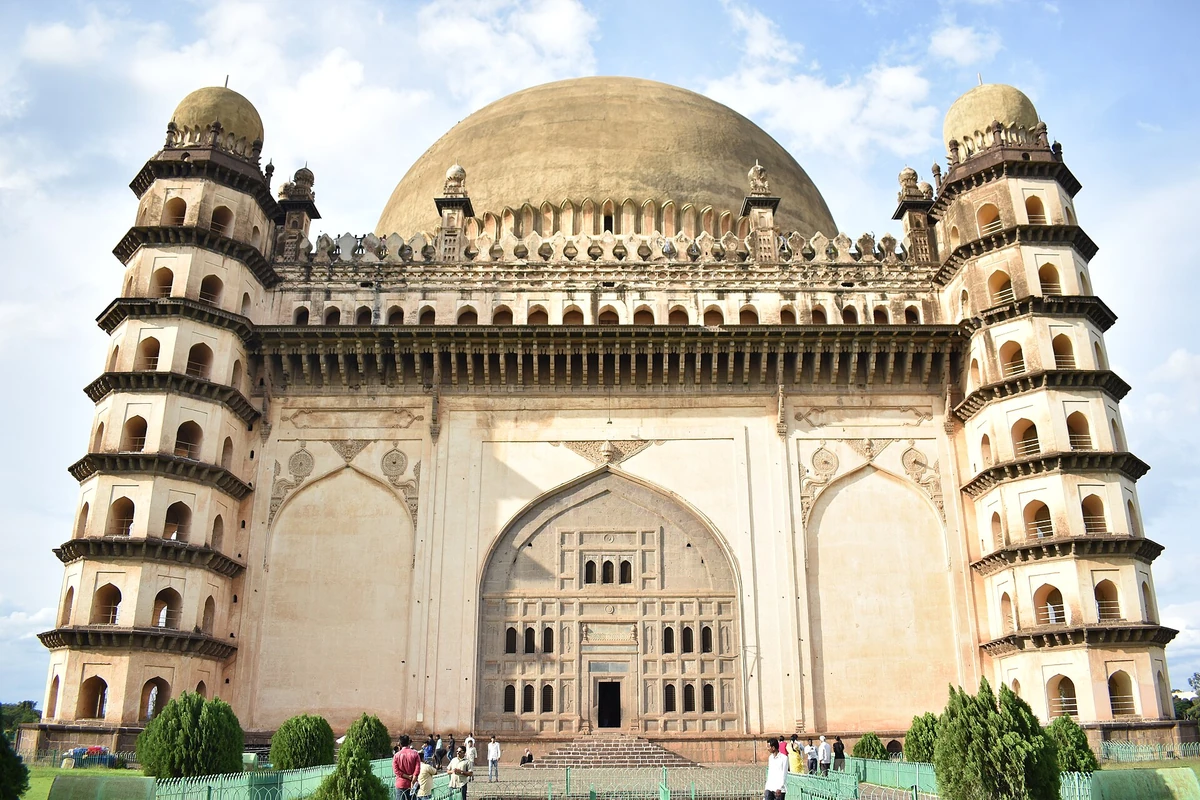
Image Source: Wikimedia
9.6 Other Bijapur monuments
| Monument | Fact |
|---|---|
| Ibrahim Rauza | Twin buildings (tomb and mosque) on a raised platform; slender minarets and fine stone carving |
| Jama Masjid, Bijapur | Begun by Ali Adil Shah I; large arches and a wide prayer hall |
| Malik-i-Maidan | Huge bronze cannon (about 55 tonnes), cast at Ahmadnagar in 1549 and brought to Bijapur in 1632 |
| Mehtar Mahal | A small, richly carved gateway of the Ibrahim II period |
| Asar Mahal | A hall of Muhammad Adil Shah with a water pool, built to keep a relic of the Prophet |
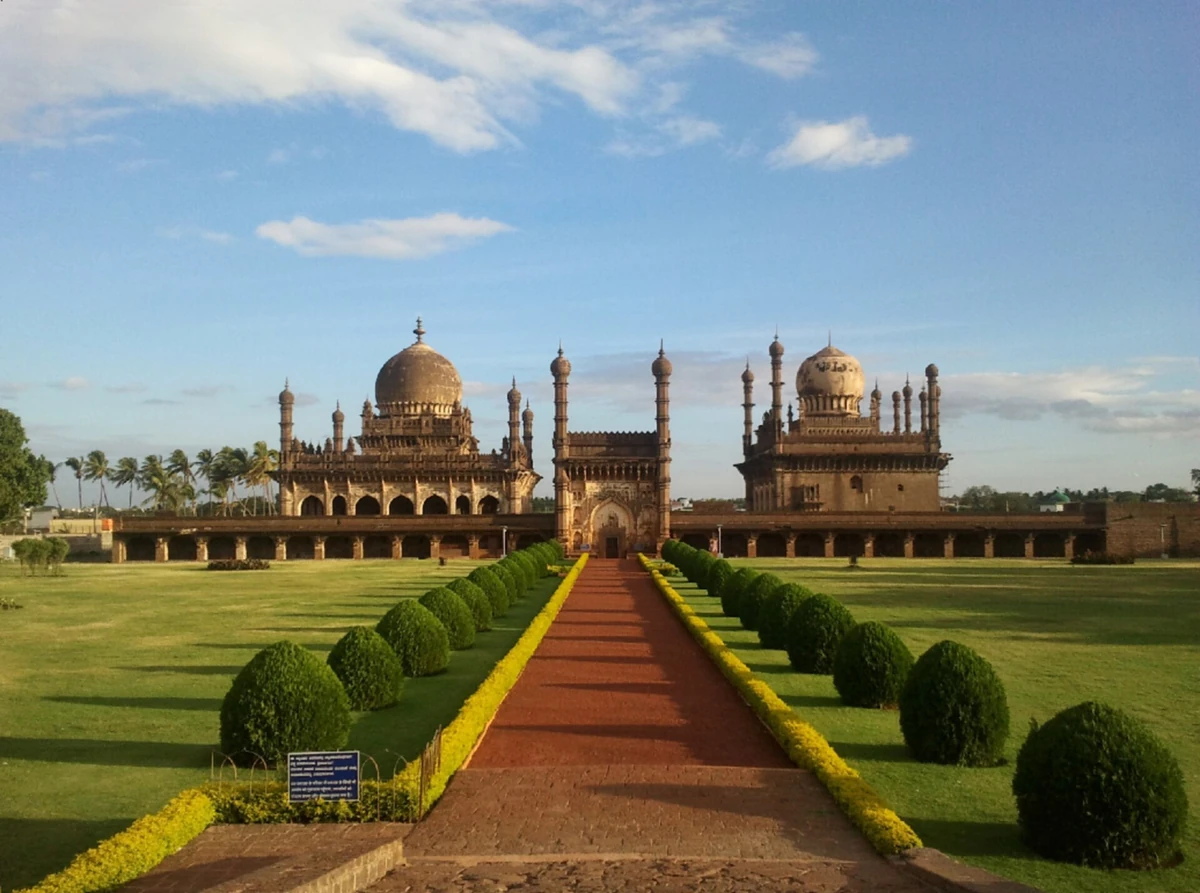
Image Source: Wikimedia
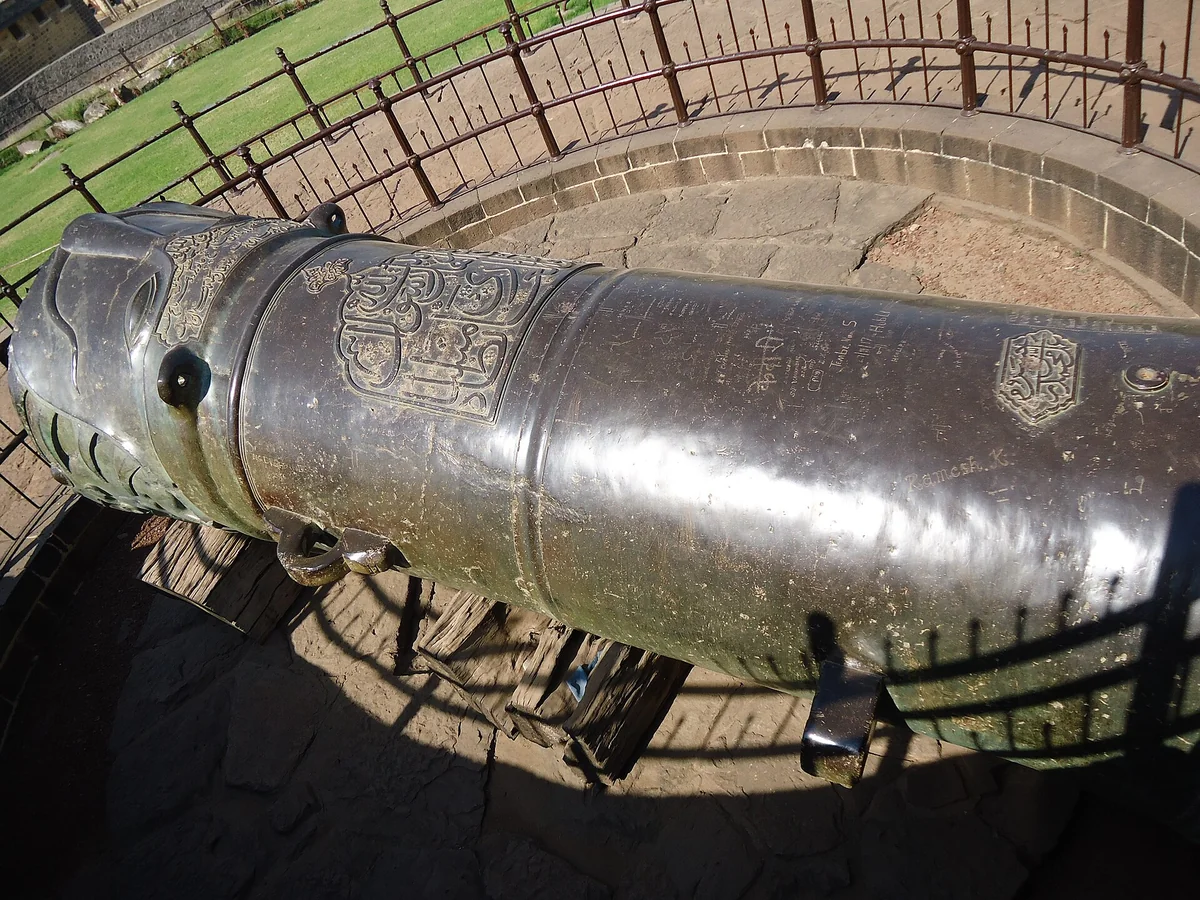
Image Source: Wikimedia
9.7 The end of Bijapur
- Shivaji: Shahji Bhonsle served Bijapur, and his son Shivaji began as a Bijapur jagirdar before building his own kingdom (see Marathas).
- Mughal siege: Mirza Raja Jai Singh attacked Bijapur in 1665–66 and failed, but Aurangzeb himself took it in 1686. Sikandar Adil Shah surrendered and was imprisoned.
- Treaty of Purandar (1665): the pact between Shivaji and Jai Singh, made during Jai Singh’s campaign against Bijapur, asked in WBCS Mains Mughal 2023: see WBCS Mains Mughal Empire PYQs.
10. Golconda: The Qutb Shahis (1518–1687)
In simple words: Quli Qutb Shah, a Turkmen noble from Hamadan in Persia and governor of the Bahmani province of Telangana, made himself independent at Golconda in 1518. His dynasty ruled the Telugu country, founded Hyderabad (1591) and the Charminar, and became rich from diamonds and cloth. The Mughals took Golconda in 1687.
10.1 The Qutb Shahi kings
| Sultan | Years | Main events |
|---|---|---|
| Quli Qutb Shah | 1518–43 | Founder; killed by his son Jamshid |
| Jamshid Quli | 1543–50 | Cruel; died after a short reign |
| Ibrahim Quli Qutb Shah | 1550–80 | Talikota (1565); built Hussain Sagar (1562); patron of Telugu |
| Muhammad Quli Qutb Shah | 1580–1612 | Founded Hyderabad and built the Charminar (1591); poet |
| Muhammad Qutb Shah | 1612–26 | Mecca Masjid begun (1617), finished by Aurangzeb in 1694 |
| Abdullah Qutb Shah | 1626–72 | Great trade; Mir Jumla; Mughal treaty (1636); Dakhni poets |
| Abul Hasan Tana Shah | 1672–87 | Last Sultan; ministers Madanna and Akkanna; Golconda falls |
10.2 Muhammad Quli Qutb Shah and Hyderabad
- City plan: in 1591 he founded a new capital on the Musi river, away from the crowded fort of Golconda. It was laid out on a grid, with the Charminar at its centre. The planner was the minister Mir Momin Astarabadi.
- Name: the city was first called Bhagnagar and then Hyderabad.
- The Charminar (1591): a square monument with four minarets, the whole about 48 m high, built at the meeting of four roads in the new city, to mark the end of a plague. Its mosque is on the top floor.
- Poet-king: he wrote poetry in Dakhni, Persian and Telugu, and his Kulliyat is the first collected diwan of Urdu verse by a single poet.
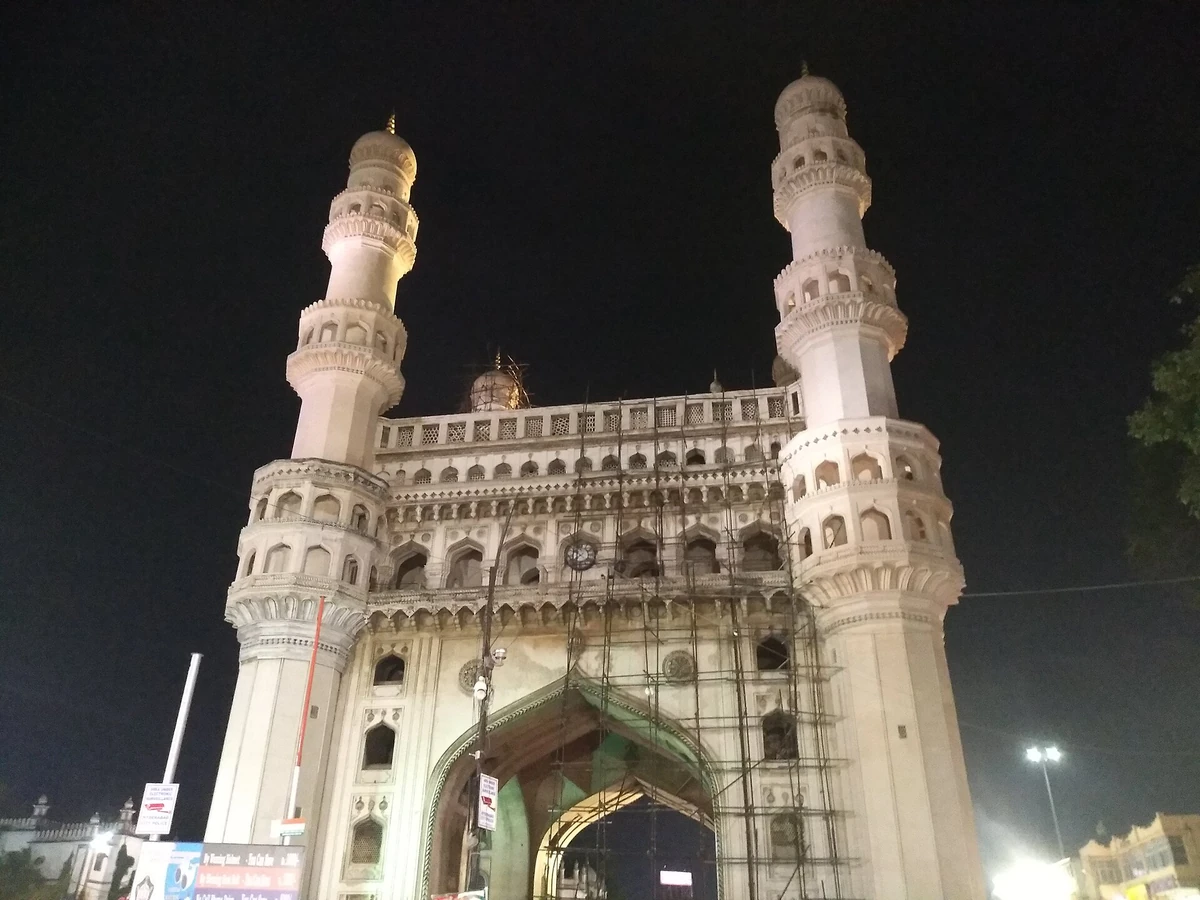
Image Source: Wikimedia
10.3 Golconda: diamonds and trade
- The fort: Golconda was a Kakatiya fort, given to the Bahmanis in 1363 and strengthened in granite by Ibrahim Quli; its acoustics carry a hand-clap from the gate to the hilltop.
- Diamonds: the mines of Kollur on the Krishna and other sites supplied stones such as the Koh-i-Noor and the Darya-i-Noor. Golconda was the great centre where they were cut and sold. The French jeweller Jean-Baptiste Tavernier described the diamond mines and the trade in detail, and is the answer to the UPSC Prelims 2018 question on the traveller who “elaborately discussed diamonds and diamond mines of India”: see UPSC Prelims Medieval History: Administration, Culture and Marathas PYQs.
- Ports and trade: Masulipatnam (Machilipatnam) was the main port, to which the Dutch (1605) and the English (1611) came for cotton cloth, steel and diamonds.
- People: the Sultans spoke Persian, Dakhni and Telugu and gave high office to Telugu Brahmins, such as Madanna and Akkanna.
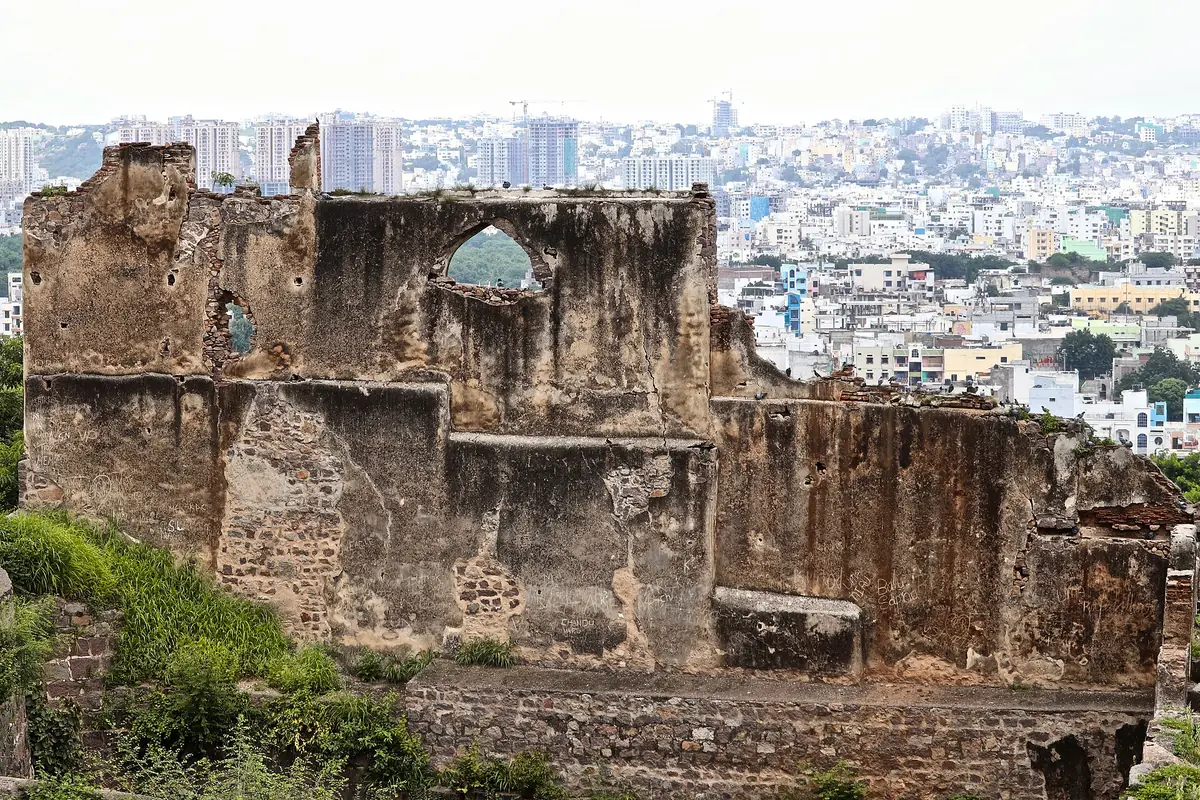
Image Source: Wikimedia
10.4 Mir Jumla
- Who: Muhammad Sayyid Ardestani, a Persian diamond merchant who rose to be the chief minister of Abdullah Qutb Shah, and conquered large parts of the Carnatic for Golconda.
- Change of side: after a quarrel with the Sultan, he joined Aurangzeb and the Mughals in 1656.
- The Koh-i-Noor: he presented the Koh-i-Noor diamond to Shah Jahan.
- Bengal: Aurangzeb made him governor of Bengal (1660) and he led the Assam expedition (1662–63) before dying on the return; see Medieval Bengal.
Exam point: Who presented the Kohinoor diamond to Shah Jahan? Mir Jumla (WBCS Prelims 2024). Golconda grew on the ruins of the old Hindu kingdom of Warangal (WBCS Mains 2019).
10.5 The end of Golconda
- Mughal pressure: in 1636 Golconda accepted Shah Jahan‘s overlordship, and in 1656 Aurangzeb attacked it and forced it to pay a large sum.
- Ministers: the Brahmin ministers Madanna and Akkanna ran the kingdom under Abul Hasan Tana Shah and were murdered in 1686. The Telugu saint Ramadasu (Kancherla Gopanna) was jailed at Golconda for spending state money on the Rama temple at Bhadrachalam.
- The siege: Aurangzeb besieged Golconda for about eight months and took it in 1687. Abul Hasan was imprisoned.
11. Ahmadnagar: The Nizam Shahis (1490–1636)
In simple words: Malik Ahmad, son of a Bahmani minister who had been born a Brahmin, made himself king at Ahmadnagar in 1490. His dynasty is remembered for two people: Chand Bibi, the queen who defended Ahmadnagar against Akbar’s army, and Malik Ambar, the Abyssinian regent who held off the Mughals for a generation and set up a famous revenue system.
11.1 The Nizam Shahi kings
| Sultan | Years | Main events |
|---|---|---|
| Malik Ahmad Nizam Shah I | 1490–1510 | Founder; son of Nizam-ul-Mulk Bahri; founded Ahmadnagar city (1494) |
| Burhan Nizam Shah I | 1510–53 | Made Shia faith the state faith (1537) |
| Hussain Nizam Shah I | 1553–65 | Led the Talikota alliance; beheaded Rama Raya |
| Murtaza Nizam Shah I | 1565–88 | Annexed Berar (1574) |
| Bahadur Nizam Shah | 1595–1600 | Under Chand Bibi‘s regency; taken to Gwalior after the fall of the fort (1600) |
| Murtaza Nizam Shah II and Burhan Nizam Shah III | 1600–31 | Puppets of Malik Ambar |
| Husain Nizam Shah | 1631–33 | Imprisoned at Gwalior by Shah Jahan (1633); end of the kingdom |
11.2 Chand Bibi (Chand Sultana)
- Family: daughter of Hussain Nizam Shah I and queen of Ali Adil Shah I of Bijapur (married 1564). After his death (1580) she ruled Bijapur for her young nephew Ibrahim Adil Shah II for a short time.
- Return to Ahmadnagar: she went back to Ahmadnagar and, in the troubles after Burhan Nizam Shah II, took charge of the infant king Bahadur Nizam Shah.
- 1595: she held the fort of Ahmadnagar against Prince Murad (Akbar’s son) and Abdur Rahim Khan-i-Khanan. The peace of 1596 gave Berar to the Mughals.
- Death: in 1599 her own nobles killed her on the charge of dealing with the Mughals.
- Fall of the fort: in 1600 Prince Daniyal and the Khan-i-Khanan took Ahmadnagar fort for Akbar. This was the first blow of the Mughals against the five Sultanates, though the Nizam Shahi kingdom lived on under Malik Ambar.
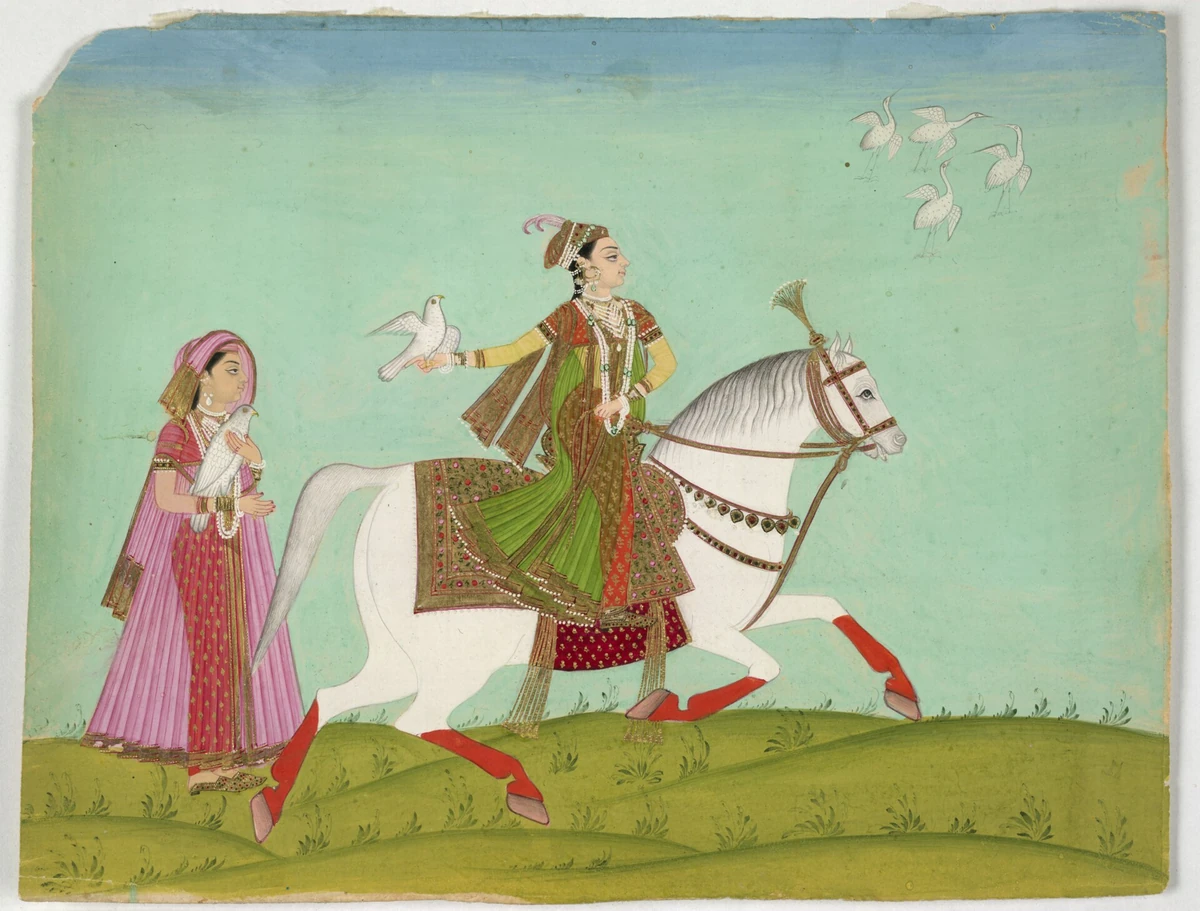
Image Source: Wikimedia
Exam point: Chand Bibi ruled over which of the Deccan Sultanates? Ahmadnagar (WBCS Prelims 2022). See WBCS Prelims Medieval Indian History PYQs.
11.3 Malik Ambar (c.1549–1626)
- Origin: an Abyssinian (Ethiopian) slave, bought and sold in Baghdad and brought to the Deccan, where he served the Ahmadnagar minister Chengiz Khan.
- Rise: after Ahmadnagar fort fell in 1600, he set up Murtaza Nizam Shah II as king and ruled as regent. He moved the capital to Khadki (1610); Aurangzeb later made it Aurangabad.
- Army and war: he hired Maratha horsemen (among them Shahji Bhonsle) and fought the Mughals by quick guerrilla raids, which the Marathas later copied. In 1624 he beat a combined Mughal and Bijapur army at Bhatvadi.
- Jahangir’s picture: the Mughal emperor Jahangir had himself painted shooting at the head of Malik Ambar, a painting that shows how much he wished to defeat his rival.
- Death: he died in 1626 and is buried at Khuldabad near Aurangabad. After his death the Nizam Shahi kingdom fell to the Mughals in 1633.
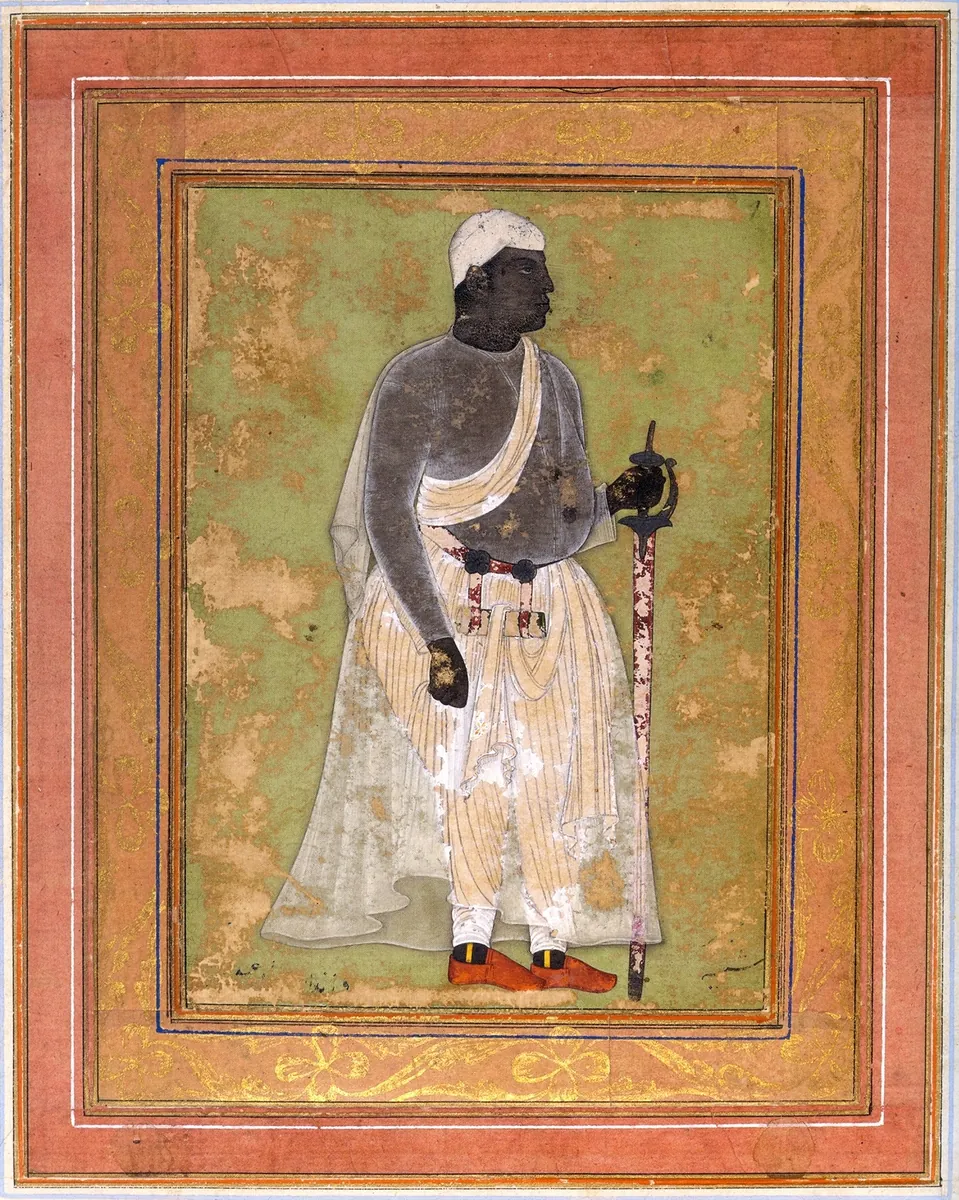
Image Source: Wikimedia
11.4 Malik Ambar’s revenue system
- Survey: he adopted Todar Mal‘s method: the land was measured and graded by its fertility.
- Share: the state took about one-third of the produce if paid in kind, or two-fifths if paid in cash.
- Collection: revenue was gathered through village officers, and the farming of revenue and large jagirs to nobles were stopped.
- Effect: the cultivator dealt directly with the state, an early form of the ryotwari system. It raised income, helped the peasants and paid for his army.
Exam point: Malik Ambar: Abyssinian regent of Ahmadnagar; capital Khadki; Todar Mal‘s survey; early ryotwari; used Maratha light horse.
11.5 The end of the Nizam Shahis
- Shah Jahan took Daulatabad in 1633 after Malik Ambar’s son Fateh Khan gave in; the child king Husain Nizam Shah III was sent to Gwalior.
- Shahji Bhonsle kept a puppet Nizam Shah, Murtaza III, on the throne until 1636, when Bijapur and Mughal forces ended it.
Exam point: How did the Nizam Shahi dynasty of Ahmadnagar come to an end? Ahmadnagar was annexed into the Mughal empire and Husain Shah was imprisoned for life (UPSC Prelims 2004). See UPSC Prelims Medieval History: Vijayanagara and Regional Kingdoms PYQs.
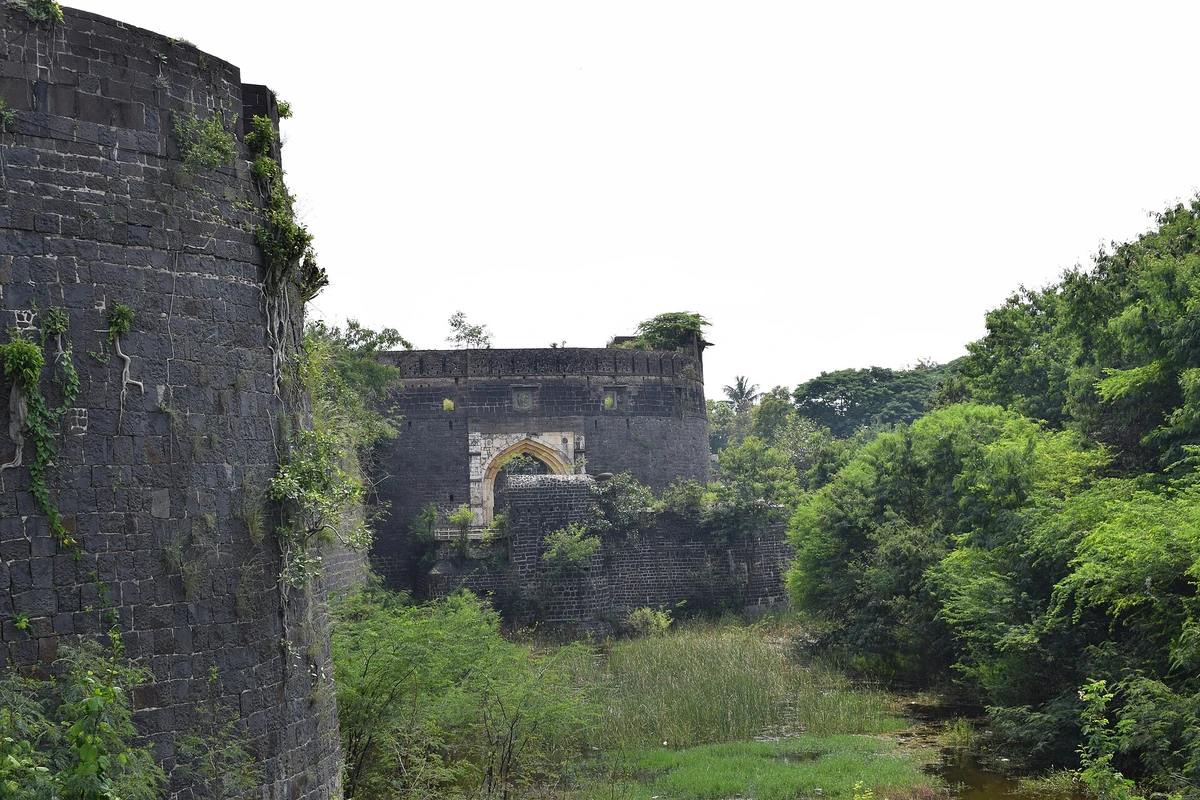
Image Source: Wikimedia
12. Berar and Bidar: The Smaller Sultanates
In simple words: Berar and Bidar were the two smallest of the five Sultanates. Berar was swallowed by Ahmadnagar in 1574, and Bidar by Bijapur in 1619; neither left a deep mark except for the famous craft of Bidriware.
12.1 Berar (Imad Shahi, 1490–1574)
- Founder: Fathullah Imad-ul-Mulk, a Hindu from the Kannada country who was taken young by the Bahmanis and became governor of Berar; he declared independence in 1490.
- Capital: Ellichpur (Achalpur), with the hill fort of Gawilgarh.
- Rulers: Fathullah, Alauddin, Darya and Burhan Imad Shah.
- End: the minister Tufal Khan seized the throne from Burhan Imad Shah, and Murtaza Nizam Shah I took Berar in 1574.
- Talikota: Berar did not join the 1565 alliance.
12.2 Bidar (Barid Shahi, 1489–1619)
- Founder: Qasim Barid, a slave of Turkic or Georgian origin who became chief minister of Mahmud Shah II and the real ruler of Bidar. His descendants took the title Barid Shahi.
- Amir Barid I (1504–42): the real power behind the last Bahmani puppets, known as the “Fox of the Deccan”.
- Ali Barid: the first to take the royal title Shah (1542); he joined the Talikota alliance.
- End: Ibrahim Adil Shah II annexed Bidar in 1619.
12.3 Bidar’s fame
- Bidar fort: a Bahmani fort with the Rangin Mahal, decorated with tiles and mother-of-pearl, which belongs to the Barid Shahi period.
- Bidriware: the craft in which silver is inlaid in a blackened zinc and copper alloy; it is named after Bidar and spread to Hyderabad.
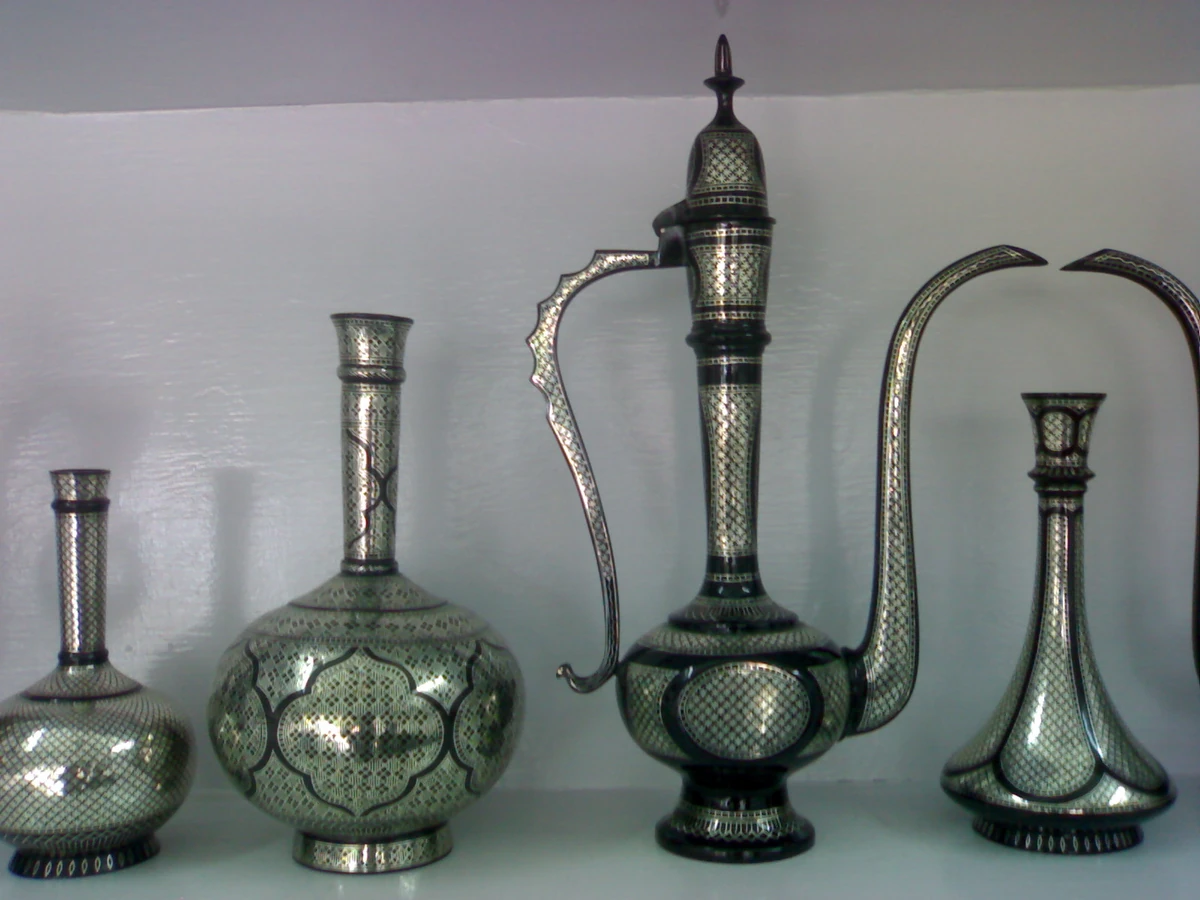
Image Source: Wikimedia
13. The Talikota Alliance and the Destruction of Vijayanagara (1565)
In simple words: In 1565 four Deccan Sultans, who had spent decades fighting each other, joined forces and destroyed Vijayanagara at the battle of Talikota (also called Rakshasi-Tangadi). It was the one time the Sultanates acted together.
13.1 The four allies
| Sultan | Kingdom |
|---|---|
| Ali Adil Shah I | Bijapur |
| Hussain Nizam Shah I | Ahmadnagar |
| Ibrahim Quli Qutb Shah | Golconda |
| Ali Barid Shah | Bidar |
Berar did not join.
13.2 Why the Sultans united
- Rama Raya’s interference: the regent Rama Raya had played one Sultan against another for years, allying with Bijapur against Ahmadnagar and then with Ahmadnagar and Golconda against Bijapur.
- Insults: in the joint campaign against Ahmadnagar (1560) his troops plundered the country and damaged mosques, which the Sultans never forgave.
- Marriage alliances: Ali Adil Shah I married Chand Bibi (1564), the daughter of Hussain Nizam Shah I, and Murtaza Nizam Shah married Ali Adil Shah’s sister; these marriages sealed peace.
- Fear: Vijayanagara had grown too strong to leave alone.
13.3 The battle
- Date: 23 January 1565, at Rakshasi-Tangadi near Talikota on the Krishna.
- Outcome: Rama Raya, about 96 years old, was captured and beheaded. His army broke up.
- Sack of Hampi: the allied armies plundered Hampi for months, and Tirumala Raya fled to Penukonda with the treasure.
13.4 Results for the Sultanates
- Gain: Bijapur took Raichur and Mudgal and the western Doab. The Sultans did not keep Vijayanagara for themselves.
- Quarrels: after the battle they fought each other again, which later let the Mughals divide and destroy them one by one.
- Vijayanagara: the empire survived only as the Aravidu kingdom at Penukonda and Chandragiri: see Vijayanagara Empire §7.
Exam point: Battle of Talikota: 1565 (WBCS Prelims 2005; PSC Miscellaneous 2006). The 96-year-old man captured and beheaded was Rama Raya (WBCS Mains 2017). See PSC Miscellaneous Prelims History PYQs.
14. The Mughal Conquest of the Deccan (1595–1687)
In simple words: Akbar began the Mughal push into the Deccan, Shah Jahan broke Ahmadnagar and made Bijapur and Golconda pay tribute, and Aurangzeb swallowed both in 1686–87. Each Sultanate fell after the others had refused to help it.
14.1 Step by step
| Year | Event |
|---|---|
| 1595–96 | Chand Bibi holds Ahmadnagar against Prince Murad; Berar is given to the Mughals |
| 1600 | Ahmadnagar fort taken by Prince Daniyal and the Khan-i-Khanan; Bahadur Nizam Shah sent to Gwalior |
| 1601 | Asirgarh (Khandesh) taken: Akbar‘s last conquest |
| 1600–26 | Malik Ambar keeps the Mughals out of the Nizam Shahi lands |
| 1633 | Daulatabad falls to Shah Jahan; Ahmadnagar ends |
| 1636 | Bijapur and Golconda accept Mughal overlordship and pay tribute |
| 1656–57 | Aurangzeb, with Mir Jumla‘s help, forces Golconda to pay; takes Bidar and Kalyani from Bijapur |
| 1665–66 | Mirza Raja Jai Singh fails to take Bijapur |
| 1686 | Bijapur falls to Aurangzeb |
| 1687 | Golconda falls after an eight-month siege |
14.2 Why the Mughals pushed south
- Wealth: Golconda’s diamonds and the Deccan ports.
- Security: the Sultanates helped Marathas and sheltered rebels.
- Shia Sultanates and the Sunni Mughal court: religious difference added to the political rivalry.
- Aurangzeb’s ambition: the Mughal empire reached its greatest size after 1687.
14.3 The cost: the “Deccan ulcer”
- The ulcer: the long war in the South (1681–1707) drained the Mughal treasury and army. The historian Jadunath Sarkar compared it to the Spanish ulcer that ruined Napoleon.
- Exam link: “Who was afflicted by the ‘Deccan Ulcer’?” Aurangzeb (WBCS Mains 2022); the PSC Miscellaneous Prelims History question of 2024 asks the same idea. See WBCS Mains Mughal Empire PYQs and PSC Miscellaneous Prelims History PYQs.
14.4 After the Sultanates
- Mughal Deccan: the old Sultanates became Mughal provinces; the Deccan Nizam of Hyderabad (Asaf Jah, 1724) belongs to a later age and is not a Qutb Shahi.
- Marathas: Shivaji‘s state, which began inside the Sultanate world, outlived all five Sultanates: see Marathas.
15. Society, Economy and Religion in the Deccan
In simple words: The Deccan Sultanates were rich, cosmopolitan states with Persian courts and Hindu officers, rich trade through the western ports and the diamond mines of Golconda. Muslims and Hindus lived side by side, and the Sultans spoke Persian, Dakhni, Telugu and Marathi.
15.1 People and faith
| Aspect | Deccan Sultanates |
|---|---|
| Court language | Persian |
| Local languages | Dakhni, Telugu, Marathi, Kannada |
| State faith | Shia (Bijapur at times, Ahmadnagar, Golconda); Sunni at other times |
| Hindus | Many officers and soldiers: Brahmins in revenue, Marathas in the cavalry |
| Abyssinians | Habshis served as soldiers and ministers (Malik Ambar) |
| Sufis | Khwaja Bande Nawaz Gesu Daraz (Gulbarga) and the Nimatullahi Sufis at Bidar |
| Women | Chand Bibi and Khunza Humayun (Ahmadnagar), Taj Sultana (Bijapur) |
15.2 Economy
- Agriculture: rice, millet and cotton in the black-soil Deccan; tanks and canals such as the Hussain Sagar at Hyderabad (1562) and the water works of Bijapur with underground channels.
- Industries: cotton cloth (Golconda chintz), steel, Bidriware and diamond cutting.
- Trade: horses came in from Arabia and Persia through Goa, Dabhol and Chaul; diamonds, cloth and steel went out through Masulipatnam.
15.3 The Portuguese
- Goa (1510): Albuquerque took Goa from the Bijapur Sultanate and made it the capital of the Portuguese in India.
- Horse trade: the Portuguese controlled the supply of Arabian horses and sold them to both Bijapur and Vijayanagara.
- Fort at Bhatkal: Krishnadevaraya gave permission for a Portuguese fort at Bhatkal, a point that UPSC Prelims asked in 2024, with Muhammad Shah III and Yusuf Adil Shah as wrong options. See UPSC Prelims Medieval History: Vijayanagara and Regional Kingdoms PYQs and WBCS Mains Advent of Europeans PYQs.
- Goa as the centre: the WBCS Prelims asked in 2014 that Goa was the centre of Portuguese power in India; see WBCS Prelims Modern Indian History PYQs.
15.4 Hindu–Muslim cultural meeting
- Language: Dakhni, a Hindi–Urdu speech mixed with Telugu, Marathi and Persian words, became a literary language.
- Music: Ibrahim Adil Shah II and Ali Adil Shah I supported Hindu and Muslim musicians alike.
- Faith: Sufi shrines drew both Hindu and Muslim pilgrims, and Hindu officers kept temples under the Sultans’ grants.
16. Architecture of the Deccan Sultanates
In simple words: The Deccan Sultans built in a style that mixes Persian forms (arches, domes, glazed tiles) with Indian ones (lotus petals, stone carving, brackets). Each Sultanate has its own landmark: Gulbarga’s mosque, Bidar’s madrasa, Bijapur’s Gol Gumbaz, Hyderabad’s Charminar.
16.1 Features of the Deccani style
- Domes: tall, bulbous domes on high drums, ringed at the base with lotus petals.
- Arches and minarets: pointed arches, slender corner minarets and kalash finials.
- Cornices: heavy projecting stone eaves (chhajjas) and rows of small battlements.
- Decoration: glazed tiles, stucco and fine stone carving, with Persian calligraphy.
- Defence: large forts with several walls and moats (Gulbarga, Bidar, Golconda, Ahmadnagar).
16.2 The main monuments
| Sultanate | Monument | Fact |
|---|---|---|
| Bahmani | Jama Masjid, Gulbarga (1367) | Designed by Rafi of Qazvin; a covered mosque without an open courtyard, with many small domes |
| Bahmani | Haft Gumbaz (Gulbarga) | The group of royal tombs, including Firuz Shah‘s |
| Bahmani | Gulbarga and Bidar forts | Ahmad Shah Wali built the Bidar fort |
| Bahmani | Mahmud Gawan Madrasa (Bidar, 1472) | Persian college with a tall minaret and tilework |
| Bahmani | Ashtur tombs (Bidar) | Painted royal tombs, including Ahmad Shah Wali‘s |
| Bijapur | Gol Gumbaz (1656) | Second-largest dome; whispering gallery |
| Bijapur | Ibrahim Rauza (1626–27) | Tomb and mosque on a platform; slender minarets |
| Bijapur | Jama Masjid, Mehtar Mahal, Asar Mahal | Large prayer hall; carved gateway; relic hall |
| Bijapur | Malik-i-Maidan cannon | 55 tonnes; cast at Ahmadnagar in 1549 |
| Golconda | Charminar (1591) | Four minarets; plague memorial |
| Golconda | Golconda fort; Qutb Shahi tombs | Granite fort; royal tombs with domes |
| Golconda | Mecca Masjid (begun 1617) | Finished by Aurangzeb (1694) |
| Ahmadnagar | Ahmadnagar fort | Round fort with a moat, taken in 1600 |
| Bidar | Rangin Mahal | Tiles and mother-of-pearl |
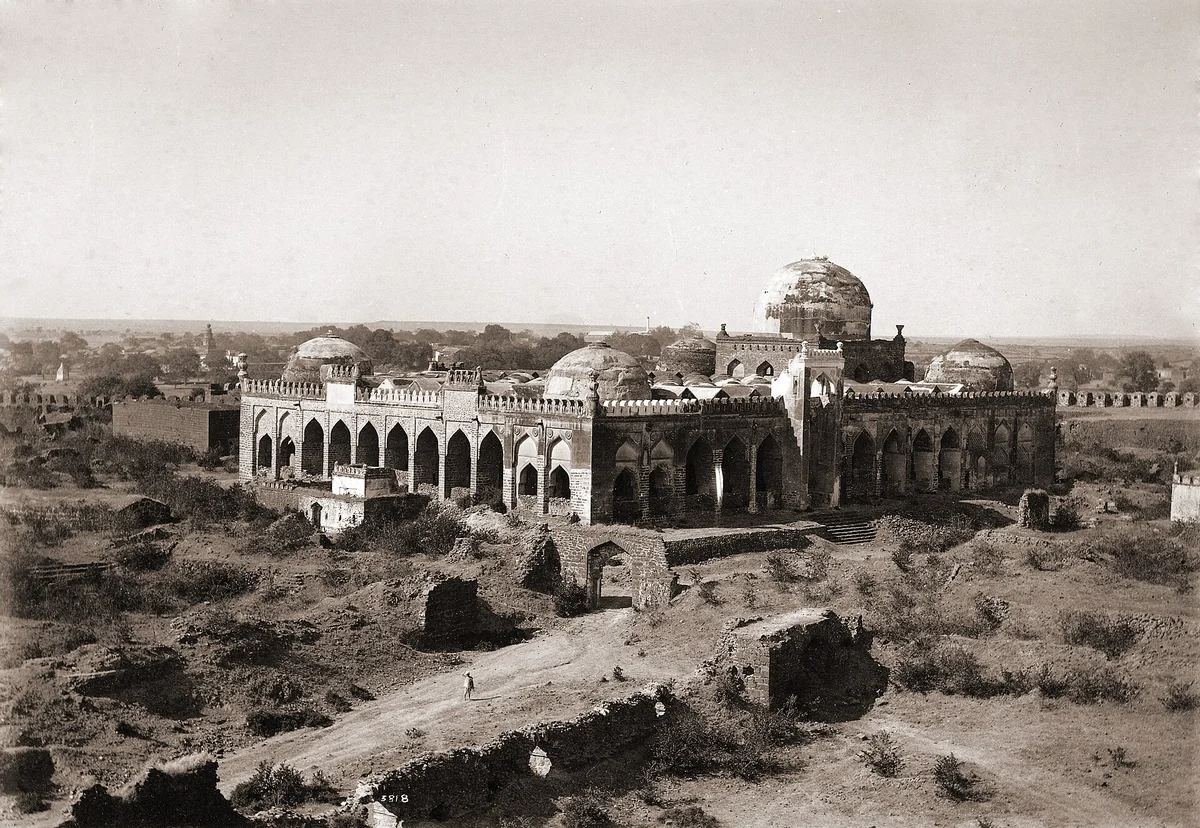
Image Source: Wikimedia
17. Deccani Painting
In simple words: The courts of Ahmadnagar, Bijapur and Golconda produced a rich school of miniature painting that mixed Persian, Turkish and Indian styles. It is known for deep colour, gold, and portraits of kings.
17.1 The three schools
| School | Patron | Examples |
|---|---|---|
| Ahmadnagar | Hussain Nizam Shah I and later kings | Tarif-i-Husain Shahi (c.1565), the earliest dated Deccani manuscript painting; Ragamala sets |
| Bijapur | Ali Adil Shah I and Ibrahim Adil Shah II | Nujum-ul-Ulum (1570); portraits of Ibrahim II; Ragamala; a famous Saraswati painting |
| Golconda | Qutb Shahis | Court portraits and festival scenes, with Persian and Telugu (Hindu) touches |
17.2 Features
- Colours: deep reds, greens, ultramarine and much gold and silver.
- Style: a Persian eye for design joined to Turkish costume and Indian subjects.
- Subjects: kings hunting or on elephants, Ragamala (pictures of musical modes), poems and scientific books.
- Court artists: Farrukh Beg, an artist who had worked at Akbar’s court, painted at Bijapur.
18. Dakhni and the Literature of the Deccan
In simple words: The Deccan Sultanates made Dakhni (an early form of Urdu) into a language of poetry, and their courts also supported Persian history-writing and Telugu verse. Their kings were poets themselves.
18.1 Dakhni authors and works
| Author | Work | Court |
|---|---|---|
| Fakhr-i-Din Nizami | Kadam Rao Padam Rao (early 15th century) | Bahmani (Bidar) |
| Ibrahim Adil Shah II | Kitab-i-Nauras (1599) | Bijapur |
| Muhammad Quli Qutb Shah | Kulliyat, the first collected diwan of Urdu verse | Golconda |
| Mulla Wajhi | Qutb Mushtari (1609) and Sab Ras (1635) | Golconda |
| Mulla Nusrati | Gulshan-i-Ishq (1657) and Ali Nama (1665) | Bijapur |
| Wali Deccani (Wali Aurangabadi) | Ghazals (c.1700) | Aurangabad |
18.2 Persian histories
| Book | Author | Subject |
|---|---|---|
| Tarikh-i-Firishta (Gulshan-i-Ibrahimi) | Muhammad Qasim Firishta | History of India and the Deccan, written at the court of Ibrahim Adil Shah II |
| Tazkirat-ul-Muluk | Rafiuddin Shirazi | Bijapur history |
| Burhan-i-Maasir | Sayyid Ali Tabataba | Bahmani and Ahmadnagar history |
18.3 Telugu and Marathi under the Sultans
- Telugu: the Qutb Shahis protected Telugu poets such as Addanki Gangadhara and Ponnaganti Telaganarya. Kshetrayya wrote padams (love songs) and Ramadasu sang to Rama in the Golconda period. The Telugu people called Ibrahim Quli Malki Bharama.
- Marathi: the Bhakti poets Eknath (Paithan) and Tukaram (Dehu) lived in the Ahmadnagar and Bijapur lands.
- Kannada: Bijapur kept revenue and village accounts in Kannada and Marathi.
18.4 Why Dakhni matters
- It was the first literary form of Urdu, written in the Deccan before Delhi’s poets took up the language.
- It joined Hindi, Persian and Telugu words.
- When Wali went to Delhi (c.1700), his verses started the Urdu school of Delhi.
19. Sources for Bahmani and Deccan History
In simple words: We know the Deccan Sultanates from Persian chronicles written at their own courts, from foreign visitors, from letters, inscriptions and coins, and from the buildings that still stand.
| Type | Source | What it gives |
|---|---|---|
| Persian chronicles | Firishta‘s Tarikh-i-Firishta; Rafiuddin Shirazi‘s Tazkirat-ul-Muluk; Sayyid Ali Tabataba‘s Burhan-i-Maasir | Kings, wars, courts of the Bahmanis and the five Sultanates |
| Letters | Mahmud Gawan‘s Riyaz-ul-Insha | Administration and diplomacy under Muhammad Shah III |
| Foreign accounts | Athanasius Nikitin (Bidar, 15th century); Abdur Razzaq; Barbosa; Tavernier (Golconda diamonds) | Court life, army, trade, markets |
| Inscriptions and coins | Persian, Telugu, Kannada and Marathi records | Grants, taxes, titles, religion |
| Monuments | Gulbarga, Bidar, Bijapur, Golconda, Ahmadnagar | Art, architecture, planning |
- Nikitin: the Russian merchant Athanasius Nikitin visited Bidar in the 15th century and wrote The Voyage Beyond Three Seas; he is the foreign eye on the Bahmani Sultanate. The WBCS Mains asked about Nikitin in 2020: see WBCS Mains Vijayanagar and Bahmani PYQs and Foreign Travellers in India.
20. Do Not Confuse
In simple words: The names in this chapter are easy to mix up. Learn these pairs.
| Do not confuse | Fact A | Fact B |
|---|---|---|
| Gulbarga vs Bidar | First Bahmani capital (1347) | Capital after Ahmad Shah Wali (1424–29) |
| Deccanis vs Afaqis | Local Muslims and Abyssinians | Foreign newcomers (Gharibs), led by Mahmud Gawan |
| Mahmud Gawan vs Mahmud of Ghazni | Persian minister of the Bahmani Sultanate | Turkish raider of the 11th century |
| Tarafdar vs taraf | Governor | Province |
| Adil Shahi vs Qutb Shahi | Bijapur; Gol Gumbaz | Golconda and Hyderabad; Charminar |
| Ibrahim Adil Shah I vs II | Sunni turn; Marathas in the army | Jagadguru; Kitab-i-Nauras |
| Quli Qutb Shah vs Muhammad Quli Qutb Shah | Founder of the dynasty (1518) | Founder of Hyderabad (1591) |
| Malik Ambar vs Malik Kafur | Ahmadnagar regent, Abyssinian | Alauddin Khalji‘s general (Delhi) |
| Nizam Shahi vs Nizam of Hyderabad | Ahmadnagar (1490–1636) | Asaf Jah (from 1724) |
| Mir Jumla vs Amir-i-Jumla | Persian noble who gave the Koh-i-Noor to Shah Jahan | Finance minister’s title in the Bahmani and later courts |
| Gol Gumbaz vs Ibrahim Rauza | Tomb of Muhammad Adil Shah | Tomb of Ibrahim Adil Shah II |
| Berar vs Bidar | Imad Shahi; Ellichpur | Barid Shahi; Bidar |
21. The Deccan Sultanates at a Glance
In simple words: One table, one chart: the Bahmani Sultanate and its five successors on a single page.
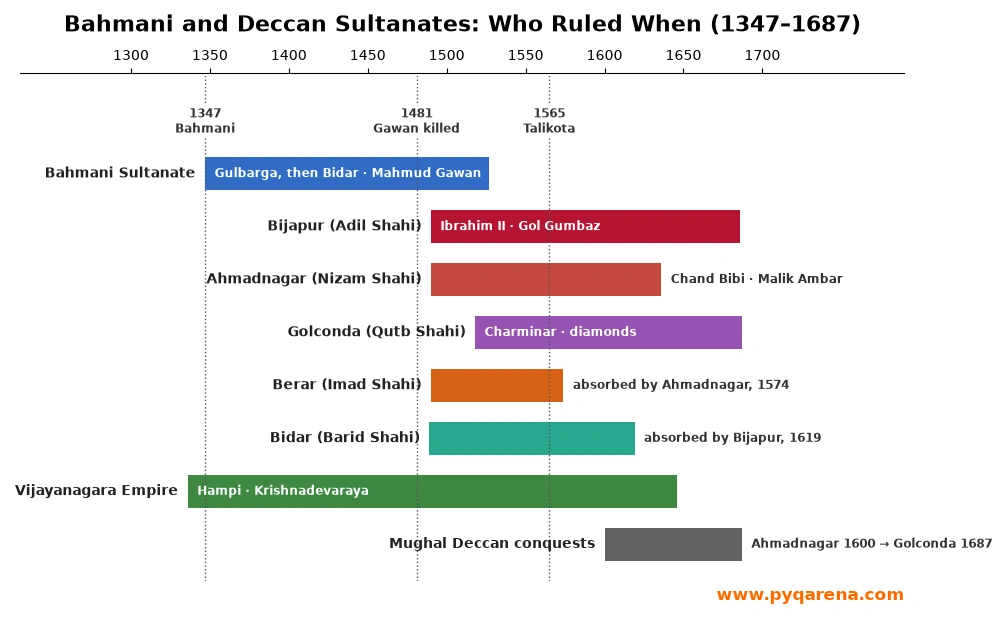
22. Timeline
In simple words: The key dates in order, from the Bahmani founding in 1347 to the fall of Golconda in 1687.
| Year | Event |
|---|---|
| 1323 | Kakatiyas fall to Delhi |
| 1347 | Alauddin Hasan Bahman Shah crowned at Gulbarga |
| 1363 | Golconda and the Turquoise Throne given to Muhammad Shah I |
| 1367 | Jama Masjid, Gulbarga |
| 1406 | Firuz Shah and Deva Raya I (daughter’s marriage) |
| 1417 | Deva Raya I defeats Firuz Shah |
| 1424–29 | Capital shifted to Bidar (Ahmad Shah Wali) |
| 1425 | Warangal taken |
| 1453 | Mahmud Gawan arrives in the Deccan |
| 1472 | Goa taken by Gawan; Bidar Madrasa |
| 1481 | Mahmud Gawan executed |
| 1489–90 | Bidar, Bijapur, Ahmadnagar, Berar become independent |
| 1510 | Albuquerque takes Goa from Bijapur |
| 1518 | Golconda independent; Bahmani puppet line continues to 1527 |
| 1520 | Krishnadevaraya takes Raichur |
| 1565 | Talikota: four Sultans destroy Vijayanagara |
| 1574 | Berar annexed by Ahmadnagar |
| 1591 | Hyderabad and the Charminar |
| 1595–1600 | Chand Bibi; fall of Ahmadnagar fort |
| 1599 | Kitab-i-Nauras |
| 1619 | Bidar annexed by Bijapur |
| 1626 | Malik Ambar dies |
| 1633 | Ahmadnagar ends |
| 1636 | Bijapur and Golconda accept Mughal overlordship |
| 1656 | Gol Gumbaz completed; Mir Jumla joins the Mughals |
| 1686 | Bijapur falls |
| 1687 | Golconda falls |
23. One-line facts
- Bahmani founder: Alauddin Hasan Bahman Shah (Hasan Gangu), 1347, Gulbarga.
- Capitals: Gulbarga then Bidar (Ahmad Shah Wali).
- Provinces: four tarafs, raised to eight by Mahmud Gawan; governor = tarafdar.
- Mahmud Gawan: Persian minister, Bidar madrasa (1472), executed 1481.
- Factions: Deccanis (local, with Abyssinians) vs Afaqis/Gharibs (foreigners).
- Wars: with Vijayanagara over the Raichur Doab.
- Five Sultanates: Bijapur (Adil Shahi), Ahmadnagar (Nizam Shahi), Berar (Imad Shahi), Golconda (Qutb Shahi), Bidar (Barid Shahi).
- Bijapur: Yusuf Adil Shah; Ibrahim Adil Shah II (Jagadguru, Kitab-i-Nauras); Gol Gumbaz (Muhammad Adil Shah).
- Golconda: Quli Qutb Shah; Muhammad Quli (Hyderabad, Charminar, 1591); diamonds; Mir Jumla.
- Ahmadnagar: Chand Bibi; Malik Ambar (Todar Mal’s revenue, Khadki).
- Berar: smallest; taken by Ahmadnagar (1574). Bidar: Amir Barid; taken by Bijapur (1619).
- Talikota: 1565; allies Bijapur, Ahmadnagar, Golconda, Bidar.
- Mughal end: Ahmadnagar 1600/1633; Bijapur 1686; Golconda 1687.
24. Frequently Asked Questions
Q1. Who founded the Bahmani Sultanate? Alauddin Hasan Bahman Shah (Hasan Gangu), in 1347 at Gulbarga.
Q2. Which Bahmani Sultan shifted the capital to Bidar? Ahmad Shah Wali, between 1424 and 1429.
Q3. Who was Mahmud Gawan? The Persian minister of Muhammad Shah III, who reformed the provinces, founded the Bidar madrasa, and was executed in 1481.
Q4. What were tarafs and tarafdars? Taraf is a Bahmani province; the tarafdar is its governor. Gawan raised the number of tarafs from four to eight.
Q5. Who were the Deccanis and Afaqis? Deccanis were Muslims settled in the Deccan, with Abyssinians; Afaqis (Gharibs) were newcomers from Persia, Turkey and Central Asia.
Q6. Which five Sultanates came from the Bahmani kingdom? Bijapur, Ahmadnagar, Berar, Golconda and Bidar.
Q7. Who was called Jagadguru? Ibrahim Adil Shah II of Bijapur, author of Kitab-i-Nauras.
Q8. Who built the Gol Gumbaz and the Charminar? Muhammad Adil Shah (Gol Gumbaz, Bijapur) and Muhammad Quli Qutb Shah (Charminar, Hyderabad, 1591).
Q9. Who were Chand Bibi and Malik Ambar? Chand Bibi defended Ahmadnagar against the Mughals (1595). Malik Ambar was the Abyssinian regent of Ahmadnagar who used Todar Mal‘s revenue system.
Q10. When did the Mughals conquer Bijapur and Golconda? Bijapur in 1686 and Golconda in 1687, both under Aurangzeb.
Q11. Which Sultans fought at Talikota? Bijapur, Ahmadnagar, Golconda and Bidar (not Berar) against Rama Raya of Vijayanagara.
Q12. Who presented the Koh-i-Noor to Shah Jahan? Mir Jumla, the former minister of Golconda.
Related Notes and Practice
- Notes:
- Practice:
- WBCS Mains Vijayanagar and Bahmani PYQs
- WBCS Prelims Medieval Indian History PYQs
- UPSC Prelims Medieval History: Vijayanagara and Regional Kingdoms PYQs
- UPSC Prelims Medieval History: Mughal Empire PYQs
- PSC Miscellaneous Prelims History PYQs
- WBCS Mains Mughal Empire PYQs
- WBCS Mains Advent of Europeans PYQs
- UPSC Prelims European Expansion PYQs
- WBCS Mains General Knowledge Art and Culture PYQs
- UPSC Prelims Art and Culture: Architecture PYQs
- UPSC Prelims Art and Culture: Music PYQs
- WBCS Mains General Knowledge Books and Literature PYQs
Leave a Comment