

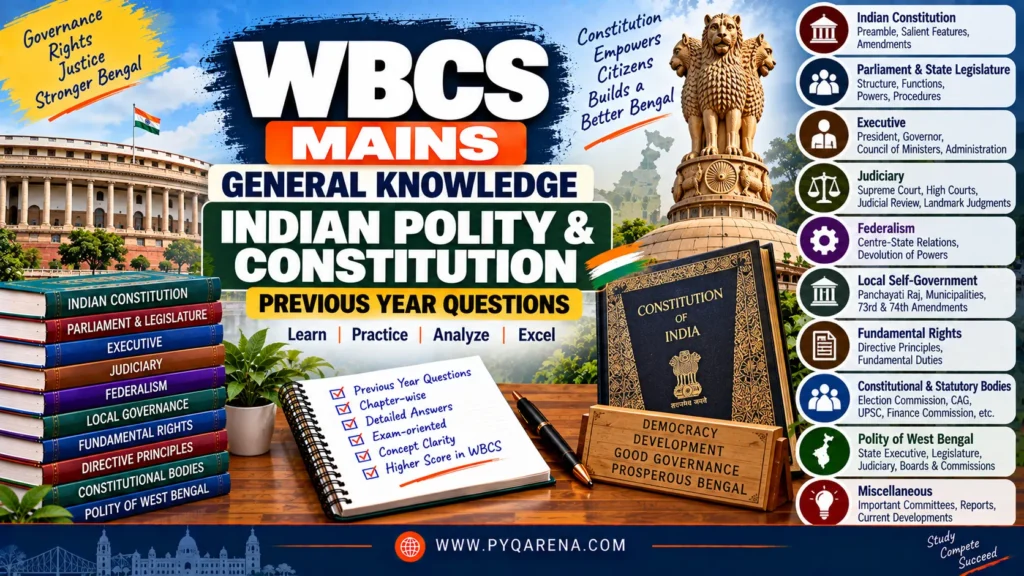
📘 PDF · 518 Questions · 10 Chapters
All WBCS Mains General Knowledge PYQs (2014–2023) in One PDF – ₹99 ₹49
Free sample available · Instant email delivery
🎯 Practice Indian Polity & Constitution as MCQ 3 free →
General Knowledge Indian Polity & Constitution Questions 2023
Q. The NDRF is under which Ministry?
(A) Ministry of Home Affairs
(B) Ministry of Environment and Forest
(C) Ministry of External Affairs
(D) Ministry of New and Renewable Energy
Answer & Explanation
Correct Answer: (A) Ministry of Home Affairs
Explanation
Why: The National Disaster Response Force (NDRF) works under the Ministry of Home Affairs. It is a specialised force set up under the Disaster Management Act, 2005.
Why not the others:
- (B) Ministry of Environment and Forest – this handles environmental policy and not disaster response.
- (C) Ministry of External Affairs – this handles foreign relations, not the NDRF.
- (D) Ministry of New and Renewable Energy – this handles renewable power projects, not disaster response.
Exam Facts
- The NDRF was constituted under the Disaster Management Act, 2005, and is headquartered in New Delhi.
- The National Disaster Management Authority (NDMA) is headed by the Prime Minister.
- NDRF battalions are drawn from central armed police forces such as the BSF, CRPF and CISF.
- The force was raised on 19 January 2006, which is observed as NDRF Raising Day.
- The National Institute of Disaster Management (NIDM) is the training and research body.
Q. Who launched the Krishi Vikas Yojana
(A) Indian Council for Agricultural Research
(B) National Development Council
(C) State Bank of India
(D) State Agricultural Research Board
Answer & Explanation
Correct Answer: (B) National Development Council
Explanation
Why: The Rashtriya Krishi Vikas Yojana was launched in 2007 on the advice of the National Development Council, as a state-plan scheme to raise investment in agriculture. It was not launched by ICAR, SBI or a state research board as the originating authority.
Why not the others:
- (A) Indian Council for Agricultural Research – ICAR is the research body for agriculture, but it did not launch this scheme as the NDC did.
- (C) State Bank of India – SBI is a bank and not the launching authority of this yojana.
- (D) State Agricultural Research Board – there is no such board as the originator of this national scheme.
Exam Facts
- The National Development Council approved the Rashtriya Krishi Vikas Yojana in 2007, during the Eleventh Plan.
- The scheme aimed to raise public investment and to let states plan agriculture according to local needs.
- It has since been restructured and is implemented under the Ministry of Agriculture and Farmers’ Welfare.
- ICAR remains the principal scientific body for agricultural research and education.
- Scheme-and-launching-authority questions should be answered from the original cabinet or NDC decision.
Q. Who is called the ‘Father of Election Science’?
(A) David Butler
(B) T. N. Seshan
(C) Abul Kalam Azad
(D) Sukumar Sen
Answer & Explanation
Correct Answer: (D) Sukumar Sen
Explanation
Why: The listed answer calls Sukumar Sen, India’s first Chief Election Commissioner, the Father of Election Science in the Indian context. He conducted the first general elections of 1951–52. David Butler is a British psephologist, and T. N. Seshan was a later, reformist CEC.
Why not the others:
- (A) David Butler – David Butler is a British pioneer of modern psephology, but he is not the listed answer’s Indian answer here.
- (B) T. N. Seshan – Seshan was a famous Chief Election Commissioner of the 1990s, known for enforcing the model code, not the first CEC.
- (C) Abul Kalam Azad – Maulana Azad was a national leader and educationist, not an election scientist or the first CEC. Note: Internationally, David Butler is often described as a founder of modern election studies or psephology.
Exam Facts
- Sukumar Sen was appointed the first Chief Election Commissioner and conducted the 1951–52 general elections.
- The Election Commission of India is a constitutional body under Article 324.
- T. N. Seshan, CEC from 1990 to 1996, is remembered for tightening election discipline.
- The first general election of independent India was a huge administrative exercise in a largely illiterate electorate.
- “Father of” titles in Indian papers often refer to Indian pioneers rather than to international academic founders.
Q. The Rowlatt Act was passed in
(A) 1905
(B) 1913
(C) 1919
(D) 1925
Answer & Explanation
Correct Answer: (C) 1919
Explanation
Why: The Rowlatt Act was passed in 1919, as in the identical 2023 History question.
Why not the others:
- (A) 1905 – 1905 is the year of the first Partition of Bengal, not of the Rowlatt Act.
- (B) 1913 – this is not the year of the Rowlatt Act.
- (D) 1925 – this is later than 1919 and is not the date of the Act. Related PYQ: this question was also asked in 2023 (Chapter 2: History).
Exam Facts
- The official name of the law was the Anarchical and Revolutionary Crimes Act, 1919.
- It was based on the recommendations of the Rowlatt Committee and was passed after the First World War.
- Gandhi called for a nationwide hartal against the Act, which became the Rowlatt Satyagraha.
- The Jallianwala Bagh massacre at Amritsar took place on 13 April 1919, in the same season of protest.
- The Act allowed the government to intern people without trial and was called a “Black Act”.
General Knowledge Indian Polity & Constitution Questions 2022
Q. On which date, Constituent Assembly of India met for the first time?
(A) June 3, 1946
(B) July 6, 1946
(C) July 25, 1946
(D) December 9, 1946
Answer & Explanation
Correct Answer: (D) December 9, 1946
Explanation
Why: The Constituent Assembly first met on 9 December 1946, as in the identical 2022 History question.
Why not the others:
- (A) June 3, 1946 – 3 June 1947 was the Mountbatten Plan, not the first sitting in 1946.
- (B) July 6, 1946 – this is not the date of the first meeting.
- (C) July 25, 1946 – this is not the date of the first meeting. Related PYQ: this question was also asked in 2022 (Chapter 2: History).
Want more exam facts on this question? Get the WBCS Mains General Knowledge PYQ PDF
Q. How many items are there in the 11th Schedule of the constitution of India?
(A) 27
(B) 28
(C) 29
(D) 33
Answer & Explanation
Correct Answer: (C) 29
Explanation
Why: The Eleventh Schedule, added by the 73rd Amendment, lists 29 subjects for panchayats. Twenty-seven, twenty-eight and thirty-three are incorrect counts; the Twelfth Schedule for municipalities has 18 items.
Why not the others:
- (A) 27 – this is short of the 29 subjects in the Eleventh Schedule.
- (B) 28 – this is also short of the correct total of 29.
- (D) 33 – this is more than the 29 items of the Eleventh Schedule.
Want more exam facts on this question? Get the WBCS Mains General Knowledge PYQ PDF
Q. Which article of the Constitution of India states that ‘no Citizen shall be denied admission into any educational institution maintained by the State or receiving aid out of State funds on grounds only of religion, race, caste, language or any of them’?
(A) Article 26
(B) Article 27
(C) Article 28
(D) Article 29
Answer & Explanation
Correct Answer: (D) Article 29
Explanation
Why: Article 29(2) says that no citizen shall be denied admission into any state-maintained or state-aided educational institution on grounds only of religion, race, caste, language or any of them. Articles 26 to 28 deal with other religious and educational rights.
Why not the others:
- (A) Article 26 – Article 26 protects the freedom of religious denominations to manage their own affairs, not this admission right.
- (B) Article 27 – Article 27 bars compulsory taxes for the promotion of any particular religion.
- (C) Article 28 – Article 28 deals with religious instruction in educational institutions wholly maintained by the state.
Want more exam facts on this question? Get the WBCS Mains General Knowledge PYQ PDF
Q. People and their culture that have existed continuously dating back to a time before their land was invaded or colonized by other societies are known as
(A) Endemic
(B) Indigenous
(C) Exotic
(D) Incurable
Answer & Explanation
Correct Answer: (B) Indigenous
Explanation
Why: Peoples and cultures that have lived continuously in a land from a time before later invasion or settlement are called indigenous. Endemic refers mainly to species native to a place, and exotic means foreign or introduced.
Why not the others:
- (A) Endemic – endemic is used chiefly in biology for a species confined to a particular area, not as the usual term for such peoples.
- (C) Exotic – exotic means foreign or introduced from outside, which is the opposite idea.
- (D) Incurable – incurable refers to a disease that cannot be cured and has no place here.
Want more exam facts on this question? Get the WBCS Mains General Knowledge PYQ PDF
Q. Which of the following amendments of the Indian Constitution is related to reservation of SC’s and ST’s and representation of Anglo Indians in the Lok Sabha and State Assembly?
(A) 54th Amendment
(B) 63th Amendment
(C) 111th Amendment
(D) 79th Amendment
Answer & Explanation
Correct Answer: (D) 79th Amendment
Explanation
Why: The 79th Amendment (1999) extended the reservation of seats for Scheduled Castes and Scheduled Tribes (and the then nomination of Anglo-Indians) in the Lok Sabha and the state assemblies. The other amendment numbers are not this reservation-extension amendment.
Why not the others:
- (A) 54th Amendment – the 54th Amendment dealt with official language matters of a north-eastern state, not with this reservation extension.
- (B) 63th Amendment – the 63rd Amendment is not the SC and ST reservation-extension amendment of 1999.
- (C) 111th Amendment – there is no 111th Amendment of this kind in the standard list.
Want more exam facts on this question? Get the WBCS Mains General Knowledge PYQ PDF
Q. Samvidhan Divas or Constitution Day is celebrated on
(A) 3rd December
(B) 25th October
(C) 5th January
(D) 26th November
Answer & Explanation
Correct Answer: (D) 26th November
Explanation
Why: Samvidhan Divas or Constitution Day is celebrated on 26 November, the day the Constituent Assembly adopted the Constitution in 1949. It is not 3 December, 25 October or 5 January.
Why not the others:
- (A) 3rd December – this is not Constitution Day; 3 December is observed as the International Day of Persons with Disabilities.
- (B) 25th October – this is not Constitution Day.
- (C) 5th January – this is not Constitution Day.
Want more exam facts on this question? Get the WBCS Mains General Knowledge PYQ PDF
Q. Which of the following Act provided for communal representation in British India?
(A) Indian Councils Act, 1892
(B) Minto-Morley Reforms, 1909
(C) Montague-Chelmsford Reforms, 1919
(D) Government of India Act, 1935
Answer & Explanation
Correct Answer: (B) Minto-Morley Reforms, 1909
Explanation
Why: Communal representation was first provided by the Morley–Minto Reforms of 1909, as in the identical 2022 History question.
Why not the others:
- (A) Indian Councils Act, 1892 – the 1892 Act did not introduce communal electorates.
- (C) Montague-Chelmsford Reforms, 1919 – the 1919 Act extended separate electorates but did not introduce them.
- (D) Government of India Act, 1935 – the 1935 Act continued and enlarged communal representation, rather than introducing it. Related PYQ: this question was also asked in 2022 (Chapter 2: History).
Want more exam facts on this question? Get the WBCS Mains General Knowledge PYQ PDF
General Knowledge Indian Polity & Constitution Questions 2021
Q. The main duty of the pro tem Speaker of Lok Sabha is
(A) to unite the Cabinet.
(B) to end the Session.
(C) to break the deadlock.
(D) to administer oath to the new Members.
Answer & Explanation
Correct Answer: (D) to administer oath to the new Members
Explanation
Why: The main duty of the pro tem Speaker of the Lok Sabha is to administer the oath to the newly elected members and to preside until a Speaker is elected. The other listed functions are not this office’s defined duty.
Why not the others:
- (A) to unite the Cabinet – the pro tem Speaker has no such duty; the Cabinet is a council of ministers, not a house to be united by this officer.
- (B) to end the Session – ending a session is a matter for the President, on advice, not the special duty of the pro tem Speaker.
- (C) to break the deadlock – breaking a deadlock is not the defined role of this temporary presiding officer.
Want more exam facts on this question? Get the WBCS Mains General Knowledge PYQ PDF
Q. By which amendment of Indian Constitution the voting age lowered from 21 years to 18 years?
(A) 61st Amendment
(B) 63rd Amendment
(C) 65th Amendment
(D) 67th Amendment
Answer & Explanation
Correct Answer: (A) 61st Amendment
Explanation
Why: The 61st Amendment, of 1988, lowered the voting age in elections to the Lok Sabha and the assemblies from 21 years to 18 years, by amending Article 326. The 63rd, 65th and 67th Amendments deal with other matters.
Why not the others:
- (B) 63rd Amendment – the 63rd Amendment is not the voting-age amendment.
- (C) 65th Amendment – the 65th Amendment is associated with the National Commission for Scheduled Castes and Scheduled Tribes, not with the voting age.
- (D) 67th Amendment – the 67th Amendment is not the voting-age amendment.
Want more exam facts on this question? Get the WBCS Mains General Knowledge PYQ PDF
General Knowledge Indian Polity & Constitution Questions 2020
Q. NITI Aayog was constituted on _________
(A) 01/01/2016
(B) 10/10/2015
(C) 10/10/2016
(D) 01/01/2015
Answer & Explanation
Correct Answer: (D) 01/01/2015
Explanation
Why: NITI Aayog was constituted on 1 January 2015, in place of the Planning Commission. The later 2015 and 2016 dates in the options are incorrect.
Why not the others:
- (A) 01/01/2016 – this is a year later than the actual constitution of NITI Aayog.
- (B) 10/10/2015 – this is not the date of constitution.
- (C) 10/10/2016 – this is not the date of constitution.
Want more exam facts on this question? Get the WBCS Mains General Knowledge PYQ PDF
Q. Technically, there are _________ Articles in the Constitution of India.
(A) 295
(B) 380
(C) 395
(D) 375
Answer & Explanation
Correct Answer: (C) 395
Explanation
Why: The Constitution of India, as originally enacted, had 395 Articles, which is the technical number usually asked in examinations. The present text has more articles because of later insertions, but the conventional answer remains 395.
Why not the others:
- (A) 295 – this is well short of the original number of articles.
- (B) 380 – this is not the conventional original total.
- (D) 375 – this is also not the original total of 395.
Want more exam facts on this question? Get the WBCS Mains General Knowledge PYQ PDF
Q. Dr. Zakir Hussain was the _________ President of India.
(A) 3rd
(B) 4th
(C) 2nd
(D) 5th
Answer & Explanation
Correct Answer: (A) 3rd
Explanation
Why: Dr Zakir Husain was the third President of India, as in the identical 2020 History question.
Why not the others:
- (B) 4th – the fourth President was V. V. Giri.
- (C) 2nd – the second President was S. Radhakrishnan.
- (D) 5th – the fifth President was Fakhruddin Ali Ahmed. Related PYQ: this question was also asked in 2020 (Chapter 2: History).
Want more exam facts on this question? Get the WBCS Mains General Knowledge PYQ PDF
Q. Right to Information came into force on _________
(A) 10/12/2005
(B) 12/10/2005
(C) 01/10/2005
(D) 10/01/2005
Answer & Explanation
Correct Answer: (B) 12/10/2005
Explanation
Why: The Right to Information Act, 2005, came into force on 12 October 2005, on the 120th day after its enactment. The other October and December dates in the options are incorrect.
Why not the others:
- (A) 10/12/2005 – 10 December is Human Rights Day and is not the commencement date of the RTI Act.
- (C) 01/10/2005 – this is earlier than the actual commencement date.
- (D) 10/01/2005 – January 2005 is before the Act was even passed.
Want more exam facts on this question? Get the WBCS Mains General Knowledge PYQ PDF
Q. Foundation Day of NDRF was observed on
(A) January 20
(B) January 15
(C) January 23
(D) January 22
Answer & Explanation
Correct Answer: (A) January 20
Explanation
Why: The listed answer for this paper gives 20 January as the date on which the Foundation Day of the NDRF was observed. Among the options, 20 January is therefore the answer to use; 15, 22 and 23 January are incorrect.
Why not the others:
- (B) January 15 – this is not the listed answer’s date, and it is not NDRF Raising Day either.
- (C) January 23 – 23 January is Netaji’s birth anniversary (Parakram Diwas), not NDRF Foundation Day.
- (D) January 22 – this is not the date used as the listed answer. Note: The NDRF was raised on 19 January 2006, and Raising Day is officially observed on 19 January. Related PYQ: the same question was also asked in 2020 (Chapter 10: Other Chapters /Miscellaneous).
Want more exam facts on this question? Get the WBCS Mains General Knowledge PYQ PDF
General Knowledge Indian Polity & Constitution Questions 2019
Q. Who was the first Chief Justice of the Calcutta High Court?
(A) Sir Richard Couch
(B) Sir Barnes Peacock
(C) Sir George Ranking
(D) Sir Harold Derbyshire
Answer & Explanation
Correct Answer: (B) Sir Barnes Peacock
Explanation
Why: The first Chief Justice of the Calcutta High Court, opened in 1862, was Sir Barnes Peacock. Sir Richard Couch was a later Chief Justice, and Ranking and Derbyshire were still later occupants of the office, not the first.
Why not the others:
- (A) Sir Richard Couch – Couch served as Chief Justice after Peacock and was not the first.
- (C) Sir George Ranking – this name does not belong to the first Chief Justice of 1862.
- (D) Sir Harold Derbyshire – Derbyshire was a twentieth-century Chief Justice, not the first. Related PYQ: the same question was also asked in 2019 (Chapter 2: History).
Want more exam facts on this question? Get the WBCS Mains General Knowledge PYQ PDF
General Knowledge Indian Polity & Constitution Questions 2018
Q. When did Pondicherry become a State of India?
(A) 1961
(B) 1962
(C) 1963
(D) 1964.
Answer & Explanation
Correct Answer: (C) 1963
Explanation
Why: Puducherry became a Union Territory in 1963, as in the identical 2018 History question on Pondicherry.
Why not the others:
- (A) 1961 – 1961 is the year of Goa’s liberation, not of Pondicherry’s formal status.
- (B) 1962 – 1962 is the year of the treaty of cession, but the Union Territory was established in 1963.
- (D) 1964 – this is later than the formal establishment of the Union Territory. Related PYQ: this question was also asked in 2018 (Chapter 2: History).
Want more exam facts on this question? Get the WBCS Mains General Knowledge PYQ PDF
Q. When did Goa become a State of India?
(A) 1947
(B) 1961
(C) 1962
(D) 1950.
Answer & Explanation
Correct Answer: (C) 1962
Explanation
Why: In this option set, 1962 is the year of Goa’s incorporation as a Union Territory, as in the identical 2018 History question.
Why not the others:
- (A) 1947 – in 1947 Goa remained under Portuguese rule.
- (B) 1961 – Goa was liberated in December 1961, but the constitutional incorporation is dated 1962.
- (D) 1950 – this is long before the end of Portuguese rule. Related PYQ: this question was also asked in 2018 (Chapter 2: History).
Want more exam facts on this question? Get the WBCS Mains General Knowledge PYQ PDF
Q. How many languages are recognised by Constitution of India?
(A) 20
(B) 21
(C) 22
(D) 23.
Answer & Explanation
Correct Answer: (C) 22
Explanation
Why: The Eighth Schedule of the Constitution recognises 22 languages, after the 92nd Amendment of 2003 added Bodo, Dogri, Maithili and Santhali to the earlier 18. The counts 20, 21 and 23 are incorrect for this 2018 paper, and the number is still 22.
Why not the others:
- (A) 20 – this is short of the present Eighth Schedule list.
- (B) 21 – this is also short of 22.
- (D) 23 – a 23rd language has been demanded, but it had not been added to the Schedule at the time of this paper, or since, as of 2026.
Want more exam facts on this question? Get the WBCS Mains General Knowledge PYQ PDF
General Knowledge Indian Polity & Constitution Questions 2017
Q. Who headed the Telangana Issue Committee?
(A) A. N. Rao
(B) B. Baradarajan
(C) U. Burman
(D) B. N. Srikrishna.
Answer & Explanation
Correct Answer: (D) B. N. Srikrishna
Explanation
Why: The committee on the Telangana issue was headed by Justice B. N. Srikrishna. The other names are not the chair of this 2010 committee.
Why not the others:
- (A) A. N. Rao – this is not the chairman of the Telangana committee.
- (B) B. Baradarajan – this is not the chairman of the Telangana committee.
- (C) U. Burman – this is not the chairman of the Telangana committee.
Want more exam facts on this question? Get the WBCS Mains General Knowledge PYQ PDF
Q. The UPA-II ‘Report to the People’ was released by
(A) Sonia Gandhi
(B) Manmohan Singh
(C) Pranab Mukherjee
(D) None of the above.
Answer & Explanation
Correct Answer: (B) Manmohan Singh
Explanation
Why: The UPA-II Report to the People was released by the then Prime Minister, Manmohan Singh, as the government’s account of its work. Sonia Gandhi led the party, and Pranab Mukherjee was a senior minister and later President, but they are not the listed answer’s releasing authority.
Why not the others:
- (A) Sonia Gandhi – she was the president of the Congress and chairperson of the UPA, but the official report was released by the Prime Minister.
- (C) Pranab Mukherjee – he was a leading UPA minister and later President, not the issuer of this report in the listed answer.
- (D) None of the above – this is wrong because Manmohan Singh is the official answer.
Want more exam facts on this question? Get the WBCS Mains General Knowledge PYQ PDF
Q. By which Constitutional Amendment Act the recognition of the rulers of the former Indian States was abolished?
(A) 20th
(B) 26th
(C) 27th
(D) 29th.
Answer & Explanation
Correct Answer: (B) 26th
Explanation
Why: The 26th Amendment abolished recognition of the former rulers and their privy purses, as in the identical 2017 History question.
Why not the others:
- (A) 20th – the 20th Amendment did not abolish privy purses.
- (C) 27th – the 27th Amendment is not the privy-purse amendment.
- (D) 29th – the 29th Amendment is not the privy-purse amendment. Related PYQ: this question was also asked in 2017 (Chapter 2: History).
Want more exam facts on this question? Get the WBCS Mains General Knowledge PYQ PDF
Q. The Union Public Service Commission may act for the State with the approval of
(A) Government of the State
(B) Union Government
(C) Governor of the State
(D) President of India.
Answer & Explanation
Correct Answer: (D) President of India
Explanation
Why: The Union Public Service Commission may act for a state, in place of a State Public Service Commission, with the approval of the President of India, as provided in the Constitution. Approval of the state government, the Union government as such, or the Governor alone is not the constitutional formula.
Why not the others:
- (A) Government of the State – the state’s government may request or agree, but the constitutional approval for UPSC to act for a state is the President’s.
- (B) Union Government – the Union Government as a political executive is not the formal authority named in this provision.
- (C) Governor of the State – the Governor is not the approving authority for this arrangement.
Want more exam facts on this question? Get the WBCS Mains General Knowledge PYQ PDF
Q. Article 51A of the Indian Constitution is included in
(A) Part III
(B) Part IV
(C) Part IVA
(D) Part V.
Answer & Explanation
Correct Answer: (C) Part IVA
Explanation
Why: Article 51A, which lists the Fundamental Duties, is in Part IVA of the Constitution, added by the 42nd Amendment. Part III is fundamental rights, Part IV is directive principles, and Part V is the Union government.
Why not the others:
- (A) Part III – Part III contains the Fundamental Rights, not the Fundamental Duties.
- (B) Part IV – Part IV contains the Directive Principles of State Policy.
- (D) Part V – Part V deals with the Union, including the President, Parliament and the Union judiciary.
Want more exam facts on this question? Get the WBCS Mains General Knowledge PYQ PDF
Q. The order of a superior court commanding a person or a public authority to do something in the nature of public duty is called
(A) Habeas Corpus
(B) Mandamus
(C) Prohibition
(D) Certiorari.
Answer & Explanation
Correct Answer: (B) Mandamus
Explanation
Why: A writ of mandamus is an order of a superior court commanding a person or a public authority to perform a public duty. Habeas corpus, prohibition and certiorari have different uses.
Why not the others:
- (A) Habeas Corpus – this writ is used to produce a detained person before the court and to challenge unlawful detention.
- (C) Prohibition – prohibition is issued by a higher court to stop a lower court or tribunal from exceeding its jurisdiction.
- (D) Certiorari – certiorari is used to quash an order of a lower court or tribunal already passed without or in excess of jurisdiction.
Want more exam facts on this question? Get the WBCS Mains General Knowledge PYQ PDF
Q. Find the incorrect match:
(A) Balwant Rai Mehta Committee Report : 1957
(B) Ashok Mehta Committee Report : 1977
(C) GVK Rao Committee Report : 1986
(D) LM Singhvi Committee Report : 1987.
Answer & Explanation
Correct Answer: (C) GVK Rao Committee Report : 1986
Explanation
Why: In the listed answer, the incorrect committee-year match is (C) the G.V.K. Rao Committee dated 1986, as in the identical 2017 History question, with the same caveat that the Singhvi year is also inaccurate.
Why not the others:
- (A) Balwant Rai Mehta Committee Report : 1957 – this is the standard year of that committee.
- (B) Ashok Mehta Committee Report : 1977 – this is the usual year given for the appointment of that committee.
- (D) LM Singhvi Committee Report : 1987 – the Singhvi Committee is generally dated to 1986, so this year is also inaccurate. Related PYQ: this question was also asked in 2017 (Chapter 2: History).
Want more exam facts on this question? Get the WBCS Mains General Knowledge PYQ PDF
Q. With reference to Lok Adalats which of the following statements is correct?
(A) Lok Adalat deals with pre-litigative cases and not those pending before any court.
(B) Lok Adalat deals only with civil cases.
(C) Lok Adalat consists only with serving or retired judicial officers.
(D) None of the above.
Answer & Explanation
Correct Answer: (D) None of the above
Explanation
Why: None of the first three statements about Lok Adalats is correct, so the answer is (D) None of the above. Lok Adalats can take pending cases as well as pre-litigation cases, they are not confined to civil cases, and they are not composed only of serving or retired judicial officers.
Why not the others:
- (A) Lok Adalat deals with pre-litigative cases and not those pending before any court – this is false, because Lok Adalats also settle cases already pending before courts.
- (B) Lok Adalat deals only with civil cases – this is false, because they can also deal with compoundable criminal cases and certain other matters.
- (C) Lok Adalat consists only with serving or retired judicial officers – this is false, because the benches also include other members, such as lawyers or social workers, as provided in the Act.
Want more exam facts on this question? Get the WBCS Mains General Knowledge PYQ PDF
Q. The Indian Constitution is described to have been adopted and enacted by the
(A) Constituent Assembly
(B) People of India
(C) Indian Parliament
(D) British Parliament.
Answer & Explanation
Correct Answer: (B) People of India
Explanation
Why: The Constitution is described as adopted and enacted by the people of India, as in the identical 2017 History question, following the words of the Preamble.
Why not the others:
- (A) Constituent Assembly – the Assembly adopted the Constitution, but the enacting words are in the name of the people.
- (C) Indian Parliament – Parliament is a creature of the Constitution and did not enact it.
- (D) British Parliament – the British Parliament did not enact the Constitution of India. Related PYQ: this question was also asked in 2017 (Chapter 2: History).
Want more exam facts on this question? Get the WBCS Mains General Knowledge PYQ PDF
Q. Who among the following was member of the Lok Sabha during his Prime Ministership?
(A) Deve Gowda
(B) IK Gujral
(C) Chandrasekhar
(D) Manmohan Singh.
Answer & Explanation
Correct Answer: (C) Chandrasekhar
Explanation
Why: Among the four, only Chandra Shekhar was a member of the Lok Sabha during his prime ministership. H. D. Deve Gowda, I. K. Gujral and Manmohan Singh were all members of the Rajya Sabha when they were Prime Minister.
Why not the others:
- (A) Deve Gowda – H. D. Deve Gowda was a Rajya Sabha member during his brief term as Prime Minister in 1996–97.
- (B) IK Gujral – I. K. Gujral was also a Rajya Sabha member when he was Prime Minister in 1997–98.
- (D) Manmohan Singh – Manmohan Singh was a Rajya Sabha member throughout both of his terms as Prime Minister, from 2004 to 2014. Exam trap: Deve Gowda and Manmohan Singh are often guessed because they are well-known Prime Ministers, but both sat in the Rajya Sabha, not the Lok Sabha, in that office.
Want more exam facts on this question? Get the WBCS Mains General Knowledge PYQ PDF
Q. Which Commission recommended the partition of Punjab into two states of Punjab and Haryana?
(A) Dhar Commission
(B) Dass Commission
(C) Shah Commission
(D) Mahajan Commission.
Answer & Explanation
Correct Answer: (C) Shah Commission
Explanation
Why: The Shah Commission recommended the reorganisation that created Haryana from Punjab, as in the identical 2017 History question.
Why not the others:
- (A) Dhar Commission – the Dhar Commission of 1948 advised against a purely linguistic reorganisation.
- (B) Dass Commission – this is not the Punjab–Haryana commission.
- (D) Mahajan Commission – the Mahajan Commission dealt with the Maharashtra–Mysore boundary, not with Punjab and Haryana. Related PYQ: this question was also asked in 2017 (Chapter 2: History).
Want more exam facts on this question? Get the WBCS Mains General Knowledge PYQ PDF
Q. Which article of the Constitution of India is the ‘heart and soul of the Constitution’, according to Dr. B.R. Ambedkar?
(A) Article 21
(B) Article 226
(C) Article 14
(D) Article 32.
Answer & Explanation
Correct Answer: (D) Article 32
Explanation
Why: Dr B. R. Ambedkar called Article 32, the right to move the Supreme Court for the enforcement of fundamental rights, the heart and soul of the Constitution. Articles 14, 21 and 226 are of great importance, but they are not the phrase he used in this famous remark.
Why not the others:
- (A) Article 21 – Article 21, the right to life and personal liberty, has become the most expanded right, but it is not the “heart and soul” phrase of Ambedkar.
- (B) Article 226 – Article 226 gives the High Courts a wide writ jurisdiction, but it is not the article of this remark.
- (C) Article 14 – Article 14 is the equality clause and is basic, but it is not the “heart and soul” article.
Want more exam facts on this question? Get the WBCS Mains General Knowledge PYQ PDF
Q. The Cabinet Mission Plan for India envisaged:
(A) Federation
(B) Confederation
(C) Unitary form of government
(D) Union of states.
Answer & Explanation
Correct Answer: (A) Federation
Explanation
Why: The Cabinet Mission Plan of 1946 envisaged a federation (a Union of British India and the states, with a three-tier structure and a weak centre confined to foreign affairs, defence and communications). It did not propose a unitary state, and “confederation” is not the usual textbook term.
Why not the others:
- (B) Confederation – a confederation is a looser league of sovereign units and is not the standard description of the Cabinet Mission scheme.
- (C) Unitary form of government – the plan was not unitary; it left wide powers with the provinces and groups.
- (D) Union of states – this phrase is close to the later language of Article 1, but the official and textbook description of the plan is a three-tier federation.
Want more exam facts on this question? Get the WBCS Mains General Knowledge PYQ PDF
General Knowledge Indian Polity & Constitution Questions 2016
Q. The maximum gap between two sessions of Parliament shall not be more than
(A) two months
(B) four months
(C) six months
(D) one year
Answer & Explanation
Correct Answer: (C) six months
Explanation
Why: The Constitution says that six months shall not intervene between the last sitting of one session of a House of Parliament and the first sitting of the next session. The gap cannot be as long as a year, and two or four months are not the constitutional maximum.
Why not the others:
- (A) two months – this is shorter than the permitted maximum gap.
- (B) four months – this is also shorter than the six-month limit.
- (D) one year – a gap of one year would violate the Constitution.
Want more exam facts on this question? Get the WBCS Mains General Knowledge PYQ PDF
Q. The High Court at Calcutta, formerly called High Court of Judicature at Fort William, was established in
(A) 1859
(B) 1860
(C) 1862
(D) 1900
Answer & Explanation
Correct Answer: (C) 1862
Explanation
Why: The High Court at Calcutta was established in 1862, as in the identical 2016 History question.
Why not the others:
- (A) 1859 – this is before the High Courts Act took effect for this Court.
- (B) 1860 – this is also before the Court was inaugurated.
- (D) 1900 – this is far too late for the founding of the Court. Related PYQ: this question was also asked in 2016 (Chapter 2: History).
Want more exam facts on this question? Get the WBCS Mains General Knowledge PYQ PDF
Q. Who, among the following, was the Prime Minister when Panchayats were given coustitutional status in India?
(A) Indira Gandhi
(B) V. P. Singh
(C) P. V. Narsimha Rao
(D) Rajiv Gandhi
Answer & Explanation
Correct Answer: (C) P. V. Narsimha Rao
Explanation
Why: Panchayats were given constitutional status by the 73rd Amendment, passed in 1992 when P. V. Narasimha Rao was Prime Minister. Rajiv Gandhi had earlier moved a similar bill, which lapsed, and that is the usual trap.
Why not the others:
- (A) Indira Gandhi – panchayati raj in her time was a statutory and policy matter, not yet a constitutional status of the 73rd Amendment kind.
- (B) V. P. Singh – his short government did not enact this amendment.
- (D) Rajiv Gandhi – Rajiv Gandhi’s government introduced the 64th Amendment Bill, but it was not passed, so he was not Prime Minister when status was finally given. Exam trap: Because Rajiv Gandhi is so closely associated with the panchayat bills of the late 1980s, he is often chosen, but the amendment that actually passed came under Narasimha Rao.
Want more exam facts on this question? Get the WBCS Mains General Knowledge PYQ PDF
Q. Sanjay Dutt, the noted film actor, had been detained under which Act?
(A) TADA
(B) IPC-Section 302
(C) Anti-Defection Act
(D) Narcotics Act
Answer & Explanation
Correct Answer: (A) TADA
Explanation
Why: The film actor Sanjay Dutt was detained under TADA (the Terrorist and Disruptive Activities (Prevention) Act) in the investigation of the 1993 Bombay blasts. He was not detained under a murder charge as the main stated Act, nor under the Anti-Defection Act or, in this key, the Narcotics Act.
Why not the others:
- (B) IPC-Section 302 – Section 302 is the offence of murder and is not the Act under which he was detained in this well-known case.
- (C) Anti-Defection Act – the Tenth Schedule concerns legislators, not this criminal detention.
- (D) Narcotics Act – narcotics law is not the listed answer for this detention.
Want more exam facts on this question? Get the WBCS Mains General Knowledge PYQ PDF
Q. Who was the first chairperson of the National Human Rights Commission?
(A) J. S. Verma
(B) A. S. Anand
(C) Ranganath Mishra
(D) H. L. Dattu
Answer & Explanation
Correct Answer: (C) Ranganath Mishra
Explanation
Why: The first chairperson of the National Human Rights Commission was Justice Ranganath Mishra, a former Chief Justice of India. J. S. Verma, A. S. Anand and H. L. Dattu were later CJIs and, in some cases, later NHRC chairpersons, but not the first.
Why not the others:
- (A) J. S. Verma – Justice Verma was a later Chief Justice and later associated with other important reports, not the first NHRC chairperson.
- (B) A. S. Anand – Justice Anand was a later Chief Justice and later NHRC chairperson, not the first.
- (D) H. L. Dattu – Justice Dattu was a much later Chief Justice and later NHRC chairperson.
Want more exam facts on this question? Get the WBCS Mains General Knowledge PYQ PDF
General Knowledge Indian Polity & Constitution Questions 2015
Q. Consider the following statements and find out which is not true
(A) The Constitution of India was adopted by the Constituent Assembly on 26th November, 1949
(B) It came into force on 26th January, 1950
(C) The Constitution has provisions for independence of Public Service Commission
(D) Residual powers have been vested with the Government of India
Answer & Explanation
Correct Answer: (D) Residual powers have been vested with the Government of India
Explanation
Why: The listed answer treats (D) as not true, namely that residual powers have been vested with the Government of India. In fact residual powers in India are vested in the Union under Article 248 and the Union List, so all four statements appear true, and the item is unsatisfactory.
Why not the others:
- (A) The Constitution of India was adopted by the Constituent Assembly on 26th November, 1949 – this statement is true.
- (B) It came into force on 26th January, 1950 – this statement is true.
- (C) The Constitution has provisions for independence of Public Service Commission – this statement is true; Articles 315 to 323 give the commissions independence and security of tenure. Note: Residual powers in India are vested in the Union Parliament under Article 248, so statement (D) is factually true and the “not true” key is doubtful.
Want more exam facts on this question? Get the WBCS Mains General Knowledge PYQ PDF
Q. Who among the following got the ‘Bharat Ratna’ Award before becoming the President of India?
(A) R. Venkataraman
(B) V.V. Giri
(C) Dr. Zakir Hussain
(D) Dr. Rajendra Prasad
Answer & Explanation
Correct Answer: (C) Dr. Zakir Hussain
Explanation
Why: Dr Zakir Husain received the Bharat Ratna in 1963, before he became President in 1967. Rajendra Prasad received the award in 1962 while he was already President, and the other two names do not fit this “before becoming President” test in the same way.
Why not the others:
- (A) R. Venkataraman – R. Venkataraman did not receive the Bharat Ratna before his presidency in the sense required by this key.
- (B) V.V. Giri – V. V. Giri received the Bharat Ratna in 1975, after he had already been President.
- (D) Dr. Rajendra Prasad – Rajendra Prasad received the Bharat Ratna in 1962, during his term as the first President, not before becoming President.
Want more exam facts on this question? Get the WBCS Mains General Knowledge PYQ PDF
Q. Which of the following statements is not true
(A) The President of India is the only authority to pardon a death sentence
(B) The President can pardon a death sentence under Article-72
(C) The President can grant pardon to sentence by a court-martial
(D) The Governor can pardon death sentence if the State law prescribes for death sentence
Answer & Explanation
Correct Answer: (D) The Governor can pardon death sentence if the State law prescribes for
Explanation
death sentence
Explanation
Why: The statement that is not true is (D): a Governor cannot pardon a death sentence, even if the sentence is under a state law. The President alone may pardon a death sentence, under Article 72. Statements (A), (B) and (C) correctly reflect the President’s power.
Why not the others:
- (A) The President of India is the only authority to pardon a death sentence – this is true, as against the Governor’s more limited power under Article 161.
- (B) The President can pardon a death sentence under Article-72 – this is true; Article 72 expressly includes sentences of death.
- (C) The President can grant pardon to sentence by a court-martial – this is true; Article 72 also covers court-martial sentences, which the Governor cannot pardon.
Want more exam facts on this question? Get the WBCS Mains General Knowledge PYQ PDF
Q. Birth is to be registered within
(A) 7 days
(B) 14 days
(C) 30 days
(D) 60 days
Answer & Explanation
Correct Answer: (C) 30 days
Explanation
Why: The listed answer requires registration of a birth within 30 days. The Registration of Births and Deaths Act, 1969, and the rules made under it, however, prescribe 21 days as the normal period, so 21 days is the statutory figure and is not among the options.
Why not the others:
- (A) 7 days – seven days is shorter than both the listed answer and the statutory period of 21 days.
- (B) 14 days – fourteen days is an older or alternative figure sometimes seen in textbooks, but it is not the present statutory period.
- (D) 60 days – sixty days is longer than the normal period and belongs to delayed-registration windows, not to the first limit. Note: Under the Registration of Births and Deaths Act, 1969, a birth is to be registered within 21 days, a period that is not among these options.
Want more exam facts on this question? Get the WBCS Mains General Knowledge PYQ PDF
General Knowledge Indian Polity & Constitution Questions 2014
Q. Article 280 of the constitution of India deals with
(A) Election Commission
(B) Planning Commission
(C) Finance Commission
(D) Comptroller and Auditor General
Answer & Explanation
Correct Answer: (C) Finance Commission
Explanation
Why: Article 280 of the Constitution deals with the Finance Commission. The Election Commission, the old Planning Commission and the Comptroller and Auditor-General are provided for elsewhere.
Why not the others:
- (A) Election Commission – the Election Commission is provided for in Article 324, not in Article 280.
- (B) Planning Commission – the Planning Commission was an executive body, not a constitutional body under Article 280, and has been replaced by NITI Aayog.
- (D) Comptroller and Auditor General – the CAG is provided for in Articles 148 to 151, not in Article 280.
Want more exam facts on this question? Get the WBCS Mains General Knowledge PYQ PDF
Q. President’s rule may be promulgated in an Indian state under
(A) Article 243
(B) Article 298
(C) Article 356
(D) Article 370
Answer & Explanation
Correct Answer: (C) Article 356
Explanation
Why: President’s rule in a state is promulgated under Article 356, when the President is satisfied that the government of the state cannot be carried on in accordance with the Constitution. Articles 243, 298 and 370 deal with other matters.
Why not the others:
- (A) Article 243 – Article 243 and the following articles, in Part IX, deal with panchayats, not with President’s rule.
- (B) Article 298 – Article 298 deals with the executive power of the Union and the states to carry on trade and business.
- (D) Article 370 – Article 370 was the special provision for Jammu and Kashmir, not the general President’s-rule article for the states.
Want more exam facts on this question? Get the WBCS Mains General Knowledge PYQ PDF
Q. The first Lok Sabha speaker in free India was
(A) S. Radhakrishnan
(B) Samar Sen
(C) Radhabinod Pal
(D) G. V. Mavalankar
Answer & Explanation
Correct Answer: (D) G. V. Mavalankar
Explanation
Why: The first Speaker of the Lok Sabha in free India was G. V. Mavalankar. S. Radhakrishnan was the first Vice-President and the second President, and the other two names are not Speakers of the first Lok Sabha.
Why not the others:
- (A) S. Radhakrishnan – S. Radhakrishnan was the first Vice-President and the Chairman of the Rajya Sabha, not the Speaker of the Lok Sabha.
- (B) Samar Sen – this is not the name of the first Lok Sabha Speaker.
- (C) Radhabinod Pal – Justice Radhabinod Pal was a judge at the Tokyo Tribunal, not the first Speaker.
Want more exam facts on this question? Get the WBCS Mains General Knowledge PYQ PDF
📘 PDF · 518 Questions · 10 Chapters
All WBCS Mains General Knowledge PYQs (2014–2023) in One PDF – ₹99 ₹49
Free sample available · Instant email delivery
🎯 MCQ Practice · 12,000+ Questions
These WBCS Mains General Knowledge PYQs + 12,000+ more – ₹299/year
One plan, the whole library: subject-wise & exam-wise MCQs for every exam, with 40,000+ more coming in the next few months.
✅ Try free – the first 5% of every exam-wise quiz, and the first 2 chapters of every subject-wise practice, are open.
Leave a Comment