

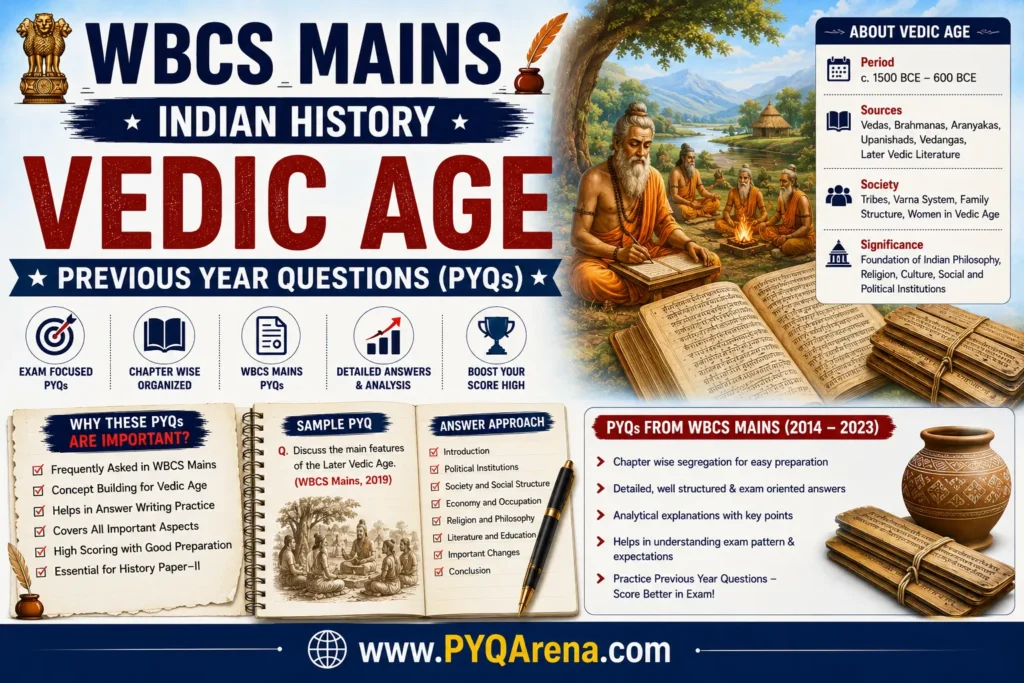
WBCS Mains Rig Vedic Period Questions 2023
Q. ‘Battle of Ten Kings’ was described in
(A) The Rig Veda.
(B) The Sama Veda.
(C) The Jajur Veda.
(D) The Atharva Veda.
Answer & Explanation
Correct Answer: (A) The Rig Veda
Explanation
The Battle of Ten Kings (Dasarajna Yuddha) is described in the Rig Veda, particularly in Mandala 7, Hymn 18 (7.18). It was fought on the banks of the Parushni River (modern Ravi) between King Sudas of the Bharata tribe and a confederation of ten kings or tribes. Sudas emerged victorious in the battle.
Exam Facts
- The Battle of Ten Kings is known as Dasarajna in Sanskrit.
- It was fought between Sudas, king of the Bharatas, and a confederation of opposing tribes.
- The battle took place near the Parushni River, identified with the modern Ravi River.
- Sudas’s priest was Vashishtha, who played an important role in the conflict.
- The account of the battle is found in Rig Veda, Mandala 7, Hymn 18.
- The Rig Veda is the oldest of the four Vedas and consists of 10 Mandalas and 1,028 Suktas (hymns).
- The other three Vedas are Sama Veda, Yajur Veda and Atharva Veda.
Q. Which God was known as ‘Purandar’ to the Vedic people?
(A) Lord Siva
(B) Indra
(C) Baruna
(D) Agni
Answer & Explanation
Correct Answer: (B) Indra
Explanation
Indra was known as Purandara in Vedic literature, meaning “destroyer of forts/cities” (pura = fort/city, dara = destroyer). He was one of the most important deities of the Rig Vedic period and was associated with war, rain, thunder and storms.
Exam Facts
- Indra → Purandara, meaning destroyer of forts.
- Indra is the most frequently mentioned deity in the Rig Veda.
- He is celebrated for killing the serpent/demon Vritra, thereby releasing the waters.
- Indra is associated with thunder and lightning and is described as wielding the Vajra (thunderbolt).
- Agni was the god of fire and served as an intermediary between humans and the gods.
- Varuna was associated with cosmic order (Rita), moral law and the waters.
- Rudra, rather than Shiva in his later classical form, was an important Vedic deity associated with storms, wild nature and healing.
WBCS Mains Rig Vedic Period Questions 2022
Q. The Central Asian theory of the home of the Aryans was propounded by
(A) Friedrich Max Muller
(B) Nirad Chaudhary
(C) Rakhaldas Banerjee
(D) Risley
Answer & Explanation
Correct Answer: (A) Friedrich Max Muller
Explanation
The Central Asian theory regarding the original homeland of the Aryans was associated with Friedrich Max Müller, a German-born philologist and scholar of Sanskrit. He proposed that the Aryans originated in Central Asia and subsequently migrated towards different regions, including the Indian subcontinent. His ideas were based mainly on linguistic and comparative studies.
Exam Facts
- Friedrich Max Müller was a prominent German-born Indologist and philologist who worked extensively on Sanskrit and Vedic literature.
- The Central Asian theory placed the original homeland of the Aryans in Central Asia.
- Max Müller associated the spread of Indo-European languages with the movement of peoples from an ancestral homeland.
- Max Müller later acknowledged that the exact geographical homeland of the Aryans could not be established with certainty.
- Aryan migration theories have been debated extensively, and modern research uses evidence from linguistics, archaeology and genetics rather than relying solely on nineteenth-century theories.
- H. H. Risley was a British colonial administrator and ethnographer known for his work on Indian ethnography and racial classification, not for proposing the Central Asian theory.
Q. The Vedas were
(A) Sacred Book of the Aryans
(B) Genealogical History
(C) Artefacts
(D) Language
Answer & Explanation
Correct Answer: (A) Sacred Books of the Aryans
Explanation
The Vedas are the oldest sacred texts of the Vedic Aryans and form the foundation of Vedic religion and literature. The word Veda means “knowledge.” The four Vedas are Rig Veda, Sama Veda, Yajur Veda and Atharva Veda.
Exam Facts
- Veda is derived from the Sanskrit root vid, meaning “to know”; hence, Veda means knowledge.
- The Rig Veda is the oldest Veda and contains hymns dedicated to various deities.
- The Sama Veda primarily contains verses meant to be sung during rituals.
- The Yajur Veda contains sacrificial formulas and ritual instructions.
- The Atharva Veda contains hymns, spells and prayers dealing with everyday life, healing and rituals.
- The Vedas were preserved for centuries through an elaborate oral tradition before being written down.
- The Vedic texts are regarded as Shruti (“that which is heard”) in the Hindu tradition.
Q. The oldest Veda was
(A) Rig Veda
(B) Sam Veda
(C) Atharva Veda
(D) Avesta
Answer & Explanation
Correct Answer: (A) Rig Veda
Explanation
The Rig Veda is the oldest of the four Vedas and is considered one of the earliest surviving Indo-Aryan literary works. It consists mainly of hymns (Suktas) addressed to Vedic deities such as Indra, Agni, Soma and Varuna.
Exam Facts
- Rig Veda → Oldest Veda and the oldest surviving Indo-Aryan literary text.
- The Rig Veda contains 10 Mandalas and 1,028 Suktas (hymns).
- It contains approximately 10,600 verses/mantras.
- The famous Gayatri Mantra occurs in Rig Veda, Mandala 3, Hymn 62, Verse 10.
- The Purusha Sukta, which describes the cosmic being Purusha and is associated with the four varnas, occurs in the 10th Mandala.
- Sama Veda is primarily associated with musical recitation, while Yajur Veda deals mainly with sacrificial formulas.
- Avesta is the sacred collection of Zoroastrianism, not a Veda.
WBCS Mains Rig Vedic Period Questions 2021
Q. The river mentioned most frequently in the Rig Vedic hymns was
(A) Ganga
(B) Yamuna
(C) Sutlej (Satadru)
(D) Saraswati
Answer & Explanation
Correct Answer: (D) Saraswati
Explanation
The Saraswati River is mentioned frequently in the Rig Veda and occupies an important position in early Vedic literature. It is praised as a powerful and sacred river and is described as flowing between the Yamuna and Sutlej. The Rig Vedic Saraswati is generally associated with the Ghaggar-Hakra river system, though its exact historical course remains debated.
Exam Facts
- Saraswati is one of the most frequently mentioned rivers in the Rig Veda.
- The Nadistuti Sukta (Rig Veda 10.75) provides an important list of rivers known to the Vedic people.
- The Sindhu (Indus) was also an extremely important river in the Rig Vedic geographical landscape.
- Ganga and Yamuna are mentioned in the Rig Veda, but much less frequently than Saraswati and the northwestern rivers.
- Saraswati is praised in the Rig Veda as a mighty and sacred river and is also associated with prosperity and nourishment.
- The Sapta-Sindhu (“Land of Seven Rivers”) region formed the principal geographical setting of the Early Vedic period.
Q. Which is our earliest source for the existence of untouchables in India?
(A) Atharva Veda
(B) Chandogya Upanishad
(C) Panini’s Ashtadhyayi
(D) Harshacharita
Answer & Explanation
Correct Answer: (B) Chandogya Upanishad
Explanation
The Chandogya Upanishad is considered an early textual source mentioning social groups that were treated as socially excluded or outside the accepted social order. It contains references to Chandala, a group that later came to be associated with those considered “untouchable” in the caste hierarchy. Therefore, among the given options, the Chandogya Upanishad is regarded as the earliest source for the existence of untouchables.
Exam Facts
- The Chandogya Upanishad is one of the principal Upanishads and is associated with the Sama Veda.
- It contains references to Chandala, a group placed outside the mainstream social hierarchy in later Indian social classification.
- Panini’s Ashtadhyayi is a major work of Sanskrit grammar, generally dated to around the 6th–5th century BCE.
- The Atharva Veda contains hymns, charms, prayers and material relating to everyday life, health and rituals.
- Harshacharita, written by Banabhatta, is a 7th-century CE biography of Harshavardhana and is much later than the Vedic and Upanishadic texts.
- The concept and terminology of untouchability developed historically over time, so early references should not automatically be equated with the fully developed caste-based system of later periods.
WBCS Mains Rig Vedic Period Questions 2020
Q. The learned lady who is said to have debated with the famous law-giver Yajnavalkya was
(A) Gargi
(B) Maitreyi
(C) Kamala
(D) Kalindi
Answer & Explanation
Correct Answer: (A) Gargi
Explanation
Gargi Vachaknavi was a renowned female philosopher of the Vedic period who participated in a philosophical debate with Yajnavalkya in the Brihadaranyaka Upanishad. She questioned him on profound subjects concerning the nature of Brahman, the universe and ultimate reality. Her participation reflects the intellectual status attained by some women in ancient Indian philosophical traditions.
Exam Facts
- Gargi Vachaknavi is mentioned in the Brihadaranyaka Upanishad.
- She participated in the famous philosophical debate at the court of King Janaka of Videha.
- Yajnavalkya was the principal philosopher with whom Gargi debated.
- Maitreyi, another learned woman mentioned in the Brihadaranyaka Upanishad, was associated with Yajnavalkya as his wife and engaged him in discussions about immortality and the nature of the Self.
- Gargi is particularly remembered for asking questions concerning the fundamental basis of the universe.
- King Janaka of Videha was renowned as a patron of philosophical discussions during the Upanishadic period.
- The Brihadaranyaka Upanishad is one of the oldest and most important Upanishads and is associated with the Shukla Yajur Veda.
Q. The river Chenab was known in the Vedic period by the name of
(A) Askini
(B) Purushni
(C) Vitasta
(D) Shutudri
Correct Answer: (A) Askini
Explanation
The Chenab River was known as Askini in the Vedic period. It is mentioned in the Rig Veda among the rivers of the northwestern region. The name Askini is associated with the dark or blackish appearance of its waters.
Exam Facts
- Chenab → Askini in Vedic literature.
- Ravi → Purushni in the Rig Veda.
- Jhelum → Vitasta in ancient Indian tradition.
- Sutlej → Shutudri (Shatadru) in the Rig Veda.
- Beas → Vipas (Vipasha) in the Rig Veda.
- These rivers formed part of the Sapta-Sindhu region associated with the Early Vedic period.
Q. The word ‘Veda’, derived from ‘Vid’ refers to
(A) Knowledge
(B) Energy
(C) Truth
(D) Karma
Answer & Explanation
Correct Answer: (A) Knowledge
Explanation
The word Veda is derived from the Sanskrit root “Vid”, meaning “to know”. Therefore, Veda literally means “knowledge”. The Vedas are the foundational sacred texts of the Vedic tradition.
Exam Facts
- Veda → Vid → Knowledge is an important etymological fact.
- The Sanskrit root Vid means “to know”.
- There are four Vedas: Rig Veda, Sama Veda, Yajur Veda and Atharva Veda.
- Rig Veda is the oldest of the four Vedas.
- Sama Veda is mainly associated with musical chanting.
- Yajur Veda contains sacrificial formulas and ritual instructions.
- Atharva Veda contains hymns, prayers, spells and material related to everyday life and healing.
Q. Vedic literature is also known as
(A) Shruti
(B) Smriti
(C) Sanhita
(D) Vedanga
Answer & Explanation
Correct Answer: (A) Shruti
Explanation
Vedic literature is traditionally known as Shruti, meaning “that which is heard.” It is believed to have been revealed to ancient sages (rishis) and transmitted orally from generation to generation. In contrast, Smriti means “that which is remembered” and includes later traditional texts.
Exam Facts
- Shruti → “That which is heard” and primarily refers to the Vedic corpus.
- Smriti → “That which is remembered”, including texts such as the Ramayana, Mahabharata, Puranas and Dharmashastras.
- The four Vedas are Rig Veda, Sama Veda, Yajur Veda and Atharva Veda.
- Each Veda traditionally includes Samhita, Brahmana, Aranyaka and Upanishad sections, though the arrangement varies among Vedas.
- Vedangas are six auxiliary disciplines developed to facilitate the study and correct interpretation of the Vedas.
- The six Vedangas are Shiksha, Kalpa, Vyakarana, Nirukta, Chandas and Jyotisha.
Q. Which of the following was the basic unit of Vedic society?
(A) Jana
(B) Vidatha
(C) Parivar
(D) Sangh
Answer & Explanation
Correct Answer: (A) Jana
Explanation
Jana was an important basic social and political unit of Early Vedic society. The Rig Vedic people were organized primarily into tribal groups or Janas, which were further composed of smaller social units such as Vish and Kula. The term Jana could refer to a tribe or the people belonging to it.
Exam Facts
- Jana → an important tribal/social unit in Early Vedic society.
- Vish was a subdivision of the Jana and generally referred to the clan or tribal group.
- Kula represented the family, the smallest social unit.
- Grama was originally associated with a group of families and later developed the meaning of a village.
- Vidatha was an important Early Vedic assembly/institution associated with social, religious and possibly military activities.
- Sabha and Samiti were two important assemblies of the Early Vedic period.
- During the Later Vedic period, the importance of territorial and political units increased, and the Jana gradually gave way to Janapada.
Q. Who among the following scholars declared that the ‘Saptsindhava’ region was the homeland of the Aryans?
(A) Dr. A. C. Das
(B) Prof. Max Muller
(C) Prof. Karl Penta
(D) Dr. K. K. Sharma
Answer & Explanation
Correct Answer: (A) Dr. A. C. Das
Explanation
Dr. A. C. Das proposed that the Sapta-Sindhu (Land of Seven Rivers) region was the original homeland of the Aryans. The Sapta-Sindhu region broadly corresponds to the northwestern part of the Indian subcontinent, particularly the Indus and its tributary region. His view was based largely on the geographical references found in the Rig Veda.
Exam Facts
- Sapta-Sindhu literally means the “Land of Seven Rivers.”
- The region formed the main geographical setting of the Early Vedic period.
- Sindhu (Indus) was the principal river of this region and was highly significant in Rig Vedic literature.
- The Rig Veda contains numerous references to rivers and places of the northwestern Indian subcontinent.
- A. C. Das supported the view that the Sapta-Sindhu region was the original homeland of the Aryans.
- Friedrich Max Müller is associated with the Central Asian theory of the Aryan homeland.
- The location of the original Indo-Aryan homeland remains a subject of scholarly debate, and different theories have been proposed on the basis of linguistic, archaeological and other evidence.
Q. Who was the most important God in the Rigveda?
(A) Agni
(B) Indra
(C) Varun
(D) Vishnu
Answer & Explanation
Correct Answer: (B) Indra
Explanation
Indra was the most important and prominent deity in the Rigveda. He is praised in a large number of hymns and is primarily associated with war, storms, rain and thunder. His most celebrated achievement was the defeat of Vritra, which released the waters and restored fertility to the land.
Exam Facts
- Indra is the most frequently mentioned deity in the Rigveda.
- He is known as Purandara, meaning “destroyer of forts.”
- Indra’s weapon was the Vajra (thunderbolt).
- He defeated the serpent/demon Vritra, earning the epithet Vritrahā (slayer of Vritra).
- Agni was another major Rig Vedic deity and is associated with fire and sacrificial rituals.
- Varuna was associated with Rita (cosmic and moral order) and the regulation of the universe.
- Vishnu was a relatively less prominent deity in the Rigvedic period; his importance increased significantly in later Hindu traditions.
Q. Who, of the following, opined that the original homeland of the Aryans was the Artic region?
(A) Bal Gangadhar Tilak
(B) Max Muller
(C) Dayanand Saraswati
(D) A. C. Das
Answer & Explanation
Correct Answer: (A) Bal Gangadhar Tilak
Explanation
Bal Gangadhar Tilak proposed the Arctic Home Theory, according to which the original homeland of the Aryans was located in the Arctic region. He developed this theory mainly from his interpretation of references to astronomical and climatic conditions found in Vedic literature.
Exam Facts
- Bal Gangadhar Tilak → Arctic Home Theory of the Aryans.
- Tilak discussed this theory in his book The Arctic Home in the Vedas, published in 1903.
- He interpreted certain Vedic references to long periods of dawn and unusual astronomical phenomena as evidence of an Arctic homeland.
- Friedrich Max Müller → Central Asian Theory of the Aryan homeland.
- A. C. Das → Sapta-Sindhu Theory, placing the Aryan homeland in the Sapta-Sindhu region.
- Dayanand Saraswati founded the Arya Samaj in 1875 and advocated a return to the authority of the Vedas.
- The question of the original homeland of the Indo-Aryans remains debated, and the theories of Tilak and other early scholars are not accepted as definitive by modern scholarship.
WBCS Mains Rig Vedic Period Questions 2017
Q. In which State of India Ataranjikheda is situated?
(A) Bihar
(B) Madhya Pradesh
(C) U.P.
(D) Gujarat
Answer & Explanation
Correct Answer: (C) Uttar Pradesh
Explanation
Atranjikhera (Atranjikheda) is an important archaeological site located in Etah district of Uttar Pradesh. It provides significant evidence for the transition from the Later Vedic period to the early historic period and is particularly associated with the Painted Grey Ware (PGW) culture.
Exam Facts
- Atranjikhera → Uttar Pradesh is an important location-based fact.
- The site is located in Etah district, near the Kali River.
- Atranjikhera is an important site associated with the Painted Grey Ware (PGW) culture.
- Archaeological evidence from the site includes iron objects, pottery and agricultural remains.
- The site provides evidence for the development of iron technology and settled agricultural communities in the Ganga-Yamuna region.
- Hastinapur and Ahichchhatra are other important archaeological sites associated with the Painted Grey Ware culture.
- PGW culture is generally associated with the Later Vedic period and the emergence of early settlements in the western Ganga-Yamuna Doab.
Q. The most celebrated river in the Rigveda was
(A) Ganga
(B) Saraswati
(C) Sindhu (Indus)
(D) Yamuna
Answer & Explanation
Correct Answer: (B) Saraswati
Explanation
Saraswati was one of the most celebrated rivers in the Rigveda. It is praised extensively in the hymns and is described as a mighty and sacred river. The Rigvedic Saraswati is generally associated with the Ghaggar-Hakra river system, although its exact ancient course remains a subject of scholarly debate.
Exam Facts
- Saraswati is one of the most prominently praised rivers in the Rigveda.
- The Rigveda describes Saraswati as a powerful and nourishing river.
- Sindhu (Indus) was also extremely important and is frequently mentioned in Rigvedic literature.
- The Nadistuti Sukta (Rigveda 10.75) contains a significant list of rivers known to the Vedic people.
- Ganga and Yamuna are mentioned in the Rigveda, but they were less prominent than the northwestern rivers during the Early Vedic period.
- The Sapta-Sindhu region, centred on the Indus and its tributaries, formed the principal geographical setting of Early Vedic society.
Q. The most prominent deity in the Rigveda was
(A) Agni
(B) Indra
(C) Vishnu
(D) Shiva
Answer & Explanation
Correct Answer: (B) Indra
Explanation
Indra was the most prominent deity in the Rigveda. He is praised in the largest number of hymns and is associated mainly with war, storms, rain and thunder. His famous victory over Vritra is a recurring theme in Rigvedic literature.
Exam Facts
- Indra is the most prominent and frequently praised deity in the Rigveda.
- He is known as Purandara, meaning “destroyer of forts.”
- His principal weapon was the Vajra (thunderbolt).
- Indra is famous for slaying Vritra, who had obstructed the waters.
- Agni is another major Rigvedic deity and is associated with fire and sacrificial rituals.
- Vishnu appears in the Rigveda but was less prominent than Indra and Agni during the Early Vedic period.
- Shiva does not appear as the major deity of the Rigvedic period; the related Vedic deity was Rudra, whose later traditions became associated with Shiva.
Q. There are Four Vedas and each Veda has ________ parts.
(A) two
(B) three
(C) four
(D) six
Answer & Explanation
Correct Answer: (C) Four
Explanation
Traditionally, each of the four Vedas is understood as having four parts: Samhita, Brahmana, Aranyaka and Upanishad. Together, these represent different layers of Vedic literature, ranging from hymns and ritual formulas to philosophical discussions.
Exam Facts
- Samhita contains the hymns, prayers, chants and sacrificial formulas.
- Brahmana texts explain the meaning and performance of Vedic rituals and sacrifices.
- Aranyaka means “forest texts” and deals with the symbolic and philosophical interpretation of rituals.
- Upanishads primarily discuss philosophical concepts such as Brahman, Atman, knowledge and liberation.
- The four Vedas are Rig Veda, Sama Veda, Yajur Veda and Atharva Veda.
- The Rig Veda is the oldest Veda and consists mainly of hymns dedicated to various Vedic deities.
Q. Which of the following areas were viewed as impure by the later Vedic authors?
(A) Anga
(B) Magadha
(C) Vanga
(D) All of the above
Answer & Explanation
Correct Answer: (D) All of the above
Explanation
In Later Vedic literature, regions lying beyond the core Vedic area were often viewed as culturally outside the orthodox Vedic sphere. Anga, Magadha and Vanga were associated with eastern regions and were regarded with a degree of ritual or cultural suspicion by later Vedic authors. These areas were outside the traditional Madhyadesha/Vedic heartland.
Exam Facts
- Anga → Eastern India, traditionally associated with parts of present-day Bihar and Jharkhand.
- Magadha → present-day Bihar, which later became one of the most powerful mahajanapadas.
- Vanga → eastern India, broadly associated with Bengal.
- The Later Vedic texts show an increasing geographical expansion of Vedic culture towards the Ganga-Yamuna plains.
- Magadha and Anga later became important political centres during the Mahajanapada period.
- The Magadha region eventually became the base of powerful empires such as the Mauryas and Guptas.
- The eastern regions were initially outside the traditional Vedic cultural heartland, but they gradually became deeply integrated into the political and cultural history of northern India.
Q. Which of the following is considered to be the earliest Indian text on music?
(A) Krishna Yajurveda
(B) Atharva Veda
(C) Sama Veda
(D) Purusha Shukta
Answer & Explanation
Correct Answer: (C) Sama Veda
Explanation
The Sama Veda is traditionally regarded as the earliest Indian text associated with music and musical chanting. Most of its verses are derived from the Rig Veda but are arranged specifically for singing during Vedic rituals. It forms an important foundation of the Indian musical tradition.
Exam Facts
- Sama Veda → earliest Indian text associated with music and singing.
- The word Saman refers to a melodious chant or song.
- Most verses of the Sama Veda are taken from the Rig Veda and adapted for musical recitation.
- The Udgata (Udgatri) priest was responsible for singing the Sama Vedic chants during sacrifices.
- The Rig Veda contains hymns, the Yajur Veda contains sacrificial formulas, and the Atharva Veda contains hymns, prayers, spells and material related to everyday life.
- Purusha Sukta is a hymn of the Rig Veda (10.90) and describes the cosmic being Purusha; it is not a separate Veda or a treatise on music.
WBCS Mains Rig Vedic Period Questions 2016
Q. Name the chief of the Rigvedic Bharata tribe who fought against a confederacy of ten tribes (in the battle of 10 kings)
(A) Sudas
(B) Divodasa
(C) Atri
(D) Gritsamada
Answer & Explanation
Correct Answer: (A) Sudas
Explanation
Sudas was the chief or king of the Bharata tribe who fought against a confederacy of tribes in the famous Battle of Ten Kings (Dasarajna). The battle is described in the Rig Veda, Mandala 7, Hymn 18. Sudas achieved victory over the opposing confederacy near the Parushni River, identified with the modern Ravi River.
Exam Facts
- Sudas → Bharata king associated with the Battle of Ten Kings.
- The Battle of Ten Kings (Dasarajna) is described in Rig Veda 7.18.
- The battle was fought on the banks of the Parushni (Ravi) River.
- Vashishtha was the priest and adviser of Sudas during the conflict.
- The opposing coalition included tribes such as the Purus, Anus, Druhyus, Alinas, Pakthas and Bhalanas.
- Divodasa, mentioned in the Rig Veda, was the father of Sudas and an important Bharata ruler, but Sudas was the king associated with the Battle of Ten Kings.
- The victory of Sudas strengthened the position of the Bharata tribe in the northwestern Vedic region.
Q. The earliest reference to the division of society into four strata occurs in which of the following texts?
(A) The Purusha-sukta of the Rig Veda Samhita
(B) Yajur Veda Samhita
(C) Kathopanishada
(D) Manu smriti
Answer & Explanation
Correct Answer: (A) The Purusha Sukta of the Rig Veda Samhita
Explanation
The earliest textual reference to the fourfold division of society (Varna system) is found in the Purusha Sukta, which occurs in the 10th Mandala of the Rig Veda (10.90). It describes the four varnas—Brahmana, Rajanya/Kshatriya, Vaishya and Shudra—as emerging symbolically from the cosmic being Purusha.
Exam Facts
- Purusha Sukta → Rig Veda, 10th Mandala, 90th Hymn (10.90).
- It is the earliest well-known textual reference to the fourfold Varna division.
- The four groups mentioned are Brahmana, Rajanya (Kshatriya), Vaishya and Shudra.
- According to the Purusha Sukta, the Brahmana emerged from the mouth, Rajanya/Kshatriya from the arms, Vaishya from the thighs and Shudra from the feet of Purusha.
- The Manusmriti provides a much more elaborate treatment of social duties, varna and social regulations and belongs to a much later period.
- The fourfold Varna scheme should not be automatically equated with the later, much more complex jati system.
Q. Which Rigvedic river is known as Ravi and also as Iravati?
(A) Vitasta
(B) Asikni
(C) Parushni
(D) Sutudri
Answer & Explanation
Correct Answer: (C) Parushni
Explanation
The Ravi River was known as Parushni in the Rigvedic period and as Iravati in later Sanskrit literature. The river is particularly important in Vedic history because the famous Battle of Ten Kings (Dasarajna) was fought on its banks. King Sudas of the Bharata tribe defeated a confederacy of opposing tribes in this battle.
Exam Facts
- Ravi → Parushni in the Rig Veda.
- Ravi → Iravati in later Sanskrit literature.
- Chenab → Asikni in the Rig Vedic period.
- Jhelum → Vitasta in ancient Indian tradition.
- Sutlej → Shutudri (Shatadru) in the Rig Veda.
- The Battle of Ten Kings was fought on the banks of the Parushni (Ravi) River.
- Sudas, king of the Bharata tribe, emerged victorious in the Battle of Ten Kings.
Q. Which of the following areas were viewed by the later vedic authors as impure and far away from the heartland of the Vedic culture?
(A) Anga (Eastern Bihar)
(B) Magadha (Southern Bihar)
(C) Vanga (in the Ganga delta)
(D) All of the above
Answer & Explanation
Correct Answer: (D) All of the above
Explanation
The Later Vedic authors regarded regions such as Anga, Magadha and Vanga as lying outside the traditional heartland of Vedic culture. These eastern areas were viewed as culturally and ritually distant from the established Vedic centres of northwestern and upper Gangetic India. Therefore, all three areas are included in the correct answer.
Exam Facts
- Anga was located in eastern Bihar, broadly around the Champa region.
- Magadha was situated in southern Bihar and later emerged as one of the most powerful Mahajanapadas.
- Vanga was associated with the Ganga delta and eastern Bengal.
- The traditional Vedic heartland was concentrated around the western Ganga-Yamuna region and the areas further northwest.
- The Later Vedic period witnessed the gradual expansion of Vedic culture towards the Ganga valley.
- Magadha and Anga later became important centres of political power during the Mahajanapada period.
- Vanga later became an important region of ancient eastern India and is mentioned in several early Indian literary sources.
Q. Which of the following statements is not correct?
(A) The Rigveda consists of 1028 hymns (Suktas).
(B) The Rigveda is divided into ten books (mandalas) of unequal sizes.
(C) The Rigveda is a monolithic text.
(D) The Rigveda is not a monolithic text and consists of several literary layers.
Answer & Explanation
Correct Answer: (C) The Rigveda is a monolithic text.
Explanation
The Rigveda is not a monolithic text. It is a collection of hymns composed and transmitted over a long period and contains different literary and chronological layers. It consists of 1,028 hymns arranged in 10 Mandalas, which are not all of the same size or character. Therefore, statement (C) is incorrect.
Exam Facts
- The Rigveda contains 1,028 Suktas (hymns) arranged into 10 Mandalas.
- The Mandalas are of unequal size and were composed over different periods.
- Mandalas 2–7 are often called the Family Books because they are associated with particular priestly families.
- Mandalas 1 and 10 contain many relatively later compositions and cover a wide range of religious and philosophical themes.
- The Purusha Sukta (10.90), which contains the famous reference to the four varnas, occurs in the 10th Mandala.
- The Nadistuti Sukta (10.75) provides an important list of rivers known to the Rigvedic people.
- The Rigveda was preserved primarily through a highly developed oral tradition before being committed to writing.
WBCS Mains Rig Vedic Period Questions 2015
Q. Which of the following Rig Vedic Gods is said to be the upholder of the Rita or Cosmic Order?
(A) Indra
(B) Agni
(C) Varuna
(D) Soma
Answer & Explanation
Correct Answer: (C) Varuna
Explanation
Varuna was regarded in the Rigveda as the upholder and guardian of Rita (Rta), the principle of cosmic, natural and moral order. He was believed to maintain the proper functioning of the universe and to punish those who violated the moral and cosmic order.
Exam Facts
- Varuna → Guardian of Rita (Rta) or cosmic order.
- Rita refers to the principle of cosmic and moral order that maintains harmony in the universe.
- Varuna was associated with truth, justice, moral law and the regulation of the cosmic order.
- Indra was primarily associated with war, thunder, rain and the defeat of Vritra.
- Agni was the god of fire and acted as an intermediary between humans and the gods during sacrifices.
- Soma was both a sacred ritual drink and a deity associated with the Soma plant and its ritual consumption.
- In later Hindu traditions, Varuna became particularly associated with the waters and the oceans.
Q. Which one of the following tribal assemblies has normally involved in the election of the tribal chief?
(A) Samiti
(B) Sabha
(C) Gora
(D) Vidata
Answer & Explanation
Correct Answer: (A) Samiti
Explanation
The Samiti was a major popular assembly of the Rig Vedic period and is traditionally associated with important political functions, including the selection or election of the tribal chief (Rajan). It represented a broader section of the tribe than the Sabha, which was a smaller and more select body.
Exam Facts
- Samiti → broader popular assembly of the Rig Vedic period.
- The Samiti is associated with important political and tribal affairs, including the selection of the Rajan.
- Sabha → smaller and more select assembly, probably consisting of prominent or elder members of the tribe.
- Vidatha was an early Vedic assembly associated with religious, social and military activities.
- The Rajan was the tribal chief or king in the Rig Vedic political system.
- Samiti and Sabha are frequently mentioned as important institutions of Rig Vedic society.
Leave a Comment