

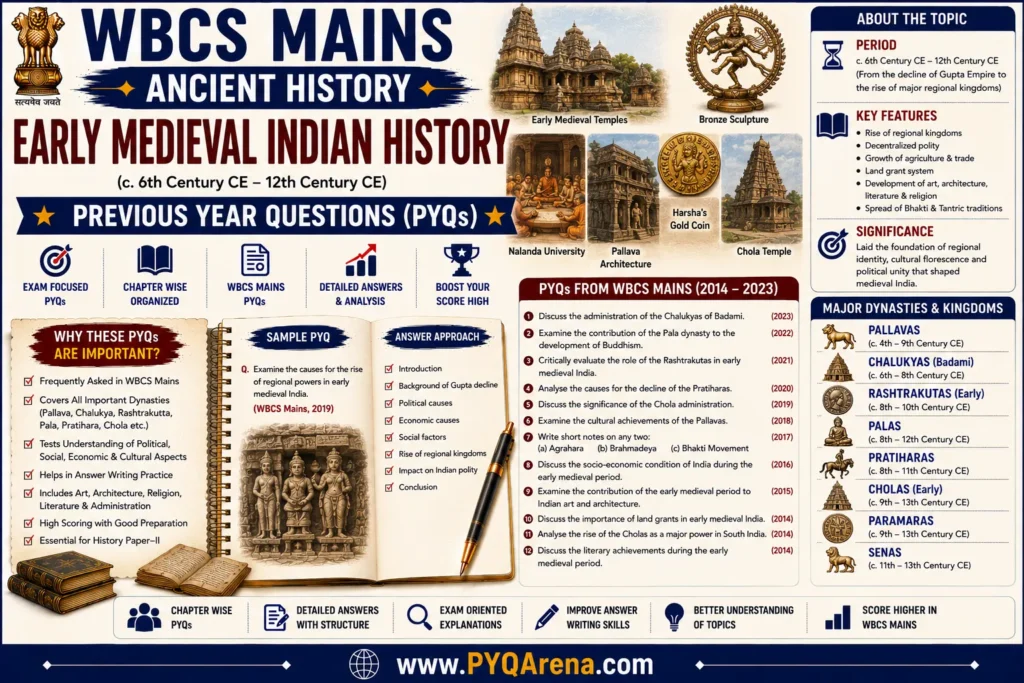
WBCS Mains Early Medieval Indian History Questions 2023
Q. During the Arab invasion in 712AD the ruler of Sind was defeated by whom?
(A) Sultan Mahmud of Gazni
(B) Muhammad Ghori
(C) Muhammad-bin-Qasim
(D) Tajuddin Yildiz
Answer & Explanation
Correct Answer: (C) Muhammad-bin-Qasim
Explanation
In 712 CE, the Arab general Muhammad-bin-Qasim invaded Sind and defeated its ruler Raja Dahir. This conquest established Arab rule in Sind and marked the beginning of a significant phase of political and cultural contact between the Indian subcontinent and the Arab world.
Exam Facts
- Muhammad-bin-Qasim led the Arab invasion of Sind in 712 CE.
- He defeated Raja Dahir, the ruler of Sind.
- Muhammad-bin-Qasim was a general of the Umayyad Caliphate.
- The conquest of Sind was carried out during the rule of the Umayyad Caliph Al-Walid I.
- Hajjaj bin Yusuf, the governor of Iraq, played an important role in organising the expedition.
- The conquest of Sind established Arab rule in north-western India.
- Mahmud of Ghazni invaded India repeatedly during the 11th century CE.
- Muhammad Ghori invaded northern India during the 12th century CE.
Q. Who composed the book ‘Tahqiq-i-Hind’?
(A) Al Beruni
(B) Al Masudi
(C) Khafi Khan
(D) Hasan Nizami
Answer & Explanation
Correct Answer: (A) Al Beruni
Explanation
Tahqiq-i-Hind, also known as Kitab-ul-Hind, was written by Al-Biruni (Al Beruni). The book provides a detailed account of Indian society, religion, philosophy, science, geography and customs during the early 11th century CE.
Exam Facts
- Tahqiq-i-Hind was written by Al-Biruni.
- The work is also popularly known as Kitab-ul-Hind.
- Al-Biruni came to India during the invasions of Mahmud of Ghazni.
- He studied Indian society, religion, philosophy, science and culture.
- Al-Biruni had knowledge of Sanskrit and studied several Indian texts.
- His work is an important source for the study of early medieval India.
- Al-Masudi was an Arab traveller and geographer who wrote about different regions and societies.
- Hasan Nizami wrote Taj-ul-Maasir, an important source for the early Delhi Sultanate.
Q. Who won the first battle of Tarain?
(A) Prithviraj Chauhan
(B) Muhammad Ghori
(C) Muhammad-bin-Qasim
(D) Sultan Mahmud of Ghazni
Answer & Explanation
Correct Answer: (A) Prithviraj Chauhan
Explanation
The First Battle of Tarain was fought in 1191 CE between Prithviraj Chauhan and Muhammad Ghori. Prithviraj Chauhan defeated Muhammad Ghori, forcing him to retreat.
Exam Facts
- The First Battle of Tarain was fought in 1191 CE.
- Prithviraj Chauhan defeated Muhammad Ghori in this battle.
- The battle was fought near Tarain (Taraori) in present-day Haryana.
- Muhammad Ghori returned the following year to fight the Second Battle of Tarain.
- The Second Battle of Tarain (1192 CE) was won by Muhammad Ghori.
- Prithviraj Chauhan was a ruler of the Chahamana (Chauhan) dynasty.
- The Second Battle of Tarain was an important event that facilitated the establishment of Turkish rule in northern India.
- Muhammad-bin-Qasim conquered Sind in 712 CE, while Mahmud of Ghazni invaded India during the 11th century CE.
Q. The duration of Tripartite Struggle was:
(A) 200 years
(B) 100 years
(C) 400 years
(D) 50 years
Answer & Explanation
Correct Answer: (A) 200 years
Explanation
The Tripartite Struggle for control over Kannauj was fought among the Gurjara-Pratiharas, Palas and Rashtrakutas. It lasted for approximately 200 years, from around the 8th century to the 10th century CE.
Exam Facts
- The Tripartite Struggle was fought for control of Kannauj.
- It involved the Gurjara-Pratiharas, Palas and Rashtrakutas.
- The struggle began in the 8th century CE.
- It continued for roughly 200 years.
- Kannauj was strategically important because of its location in the Gangetic Valley.
- The Palas mainly ruled over Bengal and Bihar.
- The Gurjara-Pratiharas were a major power in northern and western India.
- The Rashtrakutas were a powerful dynasty of the Deccan.
Q. Who composed ‘Rajatarangini’?
(A) Kalhana
(B) Bilhana
(C) Banabhatta
(D) Ashvaghosha
Answer & Explanation
Correct Answer: (A) Kalhana
Explanation
Rajatarangini was composed by Kalhana, a 12th-century Sanskrit poet and historian from Kashmir. The work presents a chronicle of the kings and history of Kashmir and is considered one of the most important historical works of ancient and early medieval India.
Exam Facts
- Rajatarangini was written by Kalhana.
- It was composed in Sanskrit during the 12th century CE.
- The title Rajatarangini literally means “River of Kings.”
- It presents a chronological account of the history and rulers of Kashmir.
- Kalhana is regarded as one of the earliest Indian writers to adopt a relatively critical and chronological approach to history.
- Vikramankadevacharita was written by Bilhana.
- Banabhatta was the author of Harshacharita.
- Ashvaghosha wrote important Buddhist works such as Buddhacharita.
Q. Who composed the ‘Vikramankadevacharita’?
(A) Bilhana
(B) Ravikirti
(C) Banabhatta
(D) Kalhana
Answer & Explanation
Correct Answer: (A) Bilhana
Explanation
Vikramankadevacharita was composed by Bilhana, an 11th-century Sanskrit poet. The work is a biographical eulogy (Prashasti) of the Western Chalukya ruler Vikramaditya VI, also known by the title Vikramanka.
Exam Facts
- Vikramankadevacharita was written by Bilhana.
- It is a Sanskrit work praising the Western Chalukya ruler Vikramaditya VI.
- Vikramaditya VI ruled from 1076 CE to 1126 CE.
- Bilhana was a renowned Sanskrit poet and scholar.
- Rajatarangini was written by Kalhana.
- The Aihole Inscription was composed by Ravikirti, the court poet of Pulakesin II.
- Harshacharita was written by Banabhatta, the court poet of Harshavardhana.
- Literary works and inscriptions are important sources for reconstructing the history of ancient and early medieval India.
WBCS Mains Early Medieval Indian History Questions 2022
Q. The Arab conquest of Sindh is depicted in:
(A) Akbar Namah
(B) Ain i Akbari
(C) Chach Namah
(D) Shah Namah
Answer & Explanation
Explanation
The Arab conquest of Sindh is described in the Chach Namah. It provides an account of the Arab invasion of Sindh led by Muhammad-bin-Qasim in 712 CE and the defeat of the Sindh ruler Raja Dahir.
Want more exam facts on this question? Get the WBCS Mains Indian History PYQ PDF
Q. The First Battle of Tarain took place in:
(A) 1191 AD
(B) 1176 AD
(C) 1105 AD
(D) 1155 AD
Answer & Explanation
Correct Answer: (A) 1191 AD
Explanation
The First Battle of Tarain was fought in 1191 CE (AD) between Prithviraj Chauhan and Muhammad Ghori. In this battle, Prithviraj Chauhan defeated Muhammad Ghori, who later returned and won the Second Battle of Tarain in 1192 CE.
Want more exam facts on this question? Get the WBCS Mains Indian History PYQ PDF
WBCS Mains Early Medieval Indian History Questions 2021
Q. Who was the author of Rajtarangini?
(A) Kalhana
(B) Jonaraja
(C) Srivara
(D) All of the above
Answer & Explanation
Correct Answer: (A) Kalhana
Explanation
The original Rajatarangini was written by Kalhana in the 12th century CE. It presents a chronicle of the rulers and history of Kashmir. Jonaraja and Srivara were later historians who continued the historical tradition of Kashmir and wrote continuations of Kalhana’s work, but they were not the authors of the original Rajatarangini.
Want more exam facts on this question? Get the WBCS Mains Indian History PYQ PDF
Q. Who was the author of the Prabandha Chintamani?
(A) Medhatithi
(B) Merutunga
(C) Shriharsha
(D) Soddhala
Answer & Explanation
Correct Answer: (B) Merutunga
Explanation
Prabandha Chintamani was written by Merutunga, a Jain scholar and chronicler. The work, composed in the 14th century CE, contains biographical narratives and historical accounts of various rulers, scholars and religious personalities.
Want more exam facts on this question? Get the WBCS Mains Indian History PYQ PDF
WBCS Mains Early Medieval Indian History Questions 2020
Q. King Jaypala, who faced Sultan Mahmud’s invasion belonged to the:
(A) Chalukya dynasty
(B) Hindushahi dynasty
(C) Pandya dynasty
(D) None of the above
Answer & Explanation
Correct Answer: (B) Hindushahi dynasty
Explanation
King Jayapala belonged to the Hindu Shahi (Hindushahi) dynasty, which ruled parts of present-day Afghanistan and north-western India. He faced the early invasions of Sultan Mahmud of Ghazni and was defeated by him in the early 11th century.
Want more exam facts on this question? Get the WBCS Mains Indian History PYQ PDF
Q. The Persian poet Firdausi who composed ‘Shah Namah’ was associated with the court of:
(A) Sultan Mahmud
(B) Muhammad Ghori
(C) Shah Tahmasp
(D) None of the above
Answer & Explanation
Correct Answer: (A) Sultan Mahmud
Explanation
The famous Persian poet Firdausi (Ferdowsi), who composed the Shah Namah, was associated with the court of Sultan Mahmud of Ghazni. The Shah Namah is one of the greatest works of Persian literature and narrates the legendary and historical past of Persia.
Want more exam facts on this question? Get the WBCS Mains Indian History PYQ PDF
Q. The Somnath Temple of Gujarat was destroyed by Sultan Mahmud in:
(A) 1015 AD
(B) 1020 AD
(C) 1025 AD
(D) 1027 AD
Answer & Explanation
Correct Answer: (C) 1025 AD
Explanation
Sultan Mahmud of Ghazni attacked the famous Somnath Temple in Gujarat in 1025 CE (AD). The raid on Somnath was one of the most well-known of Mahmud’s campaigns into the Indian subcontinent.
Want more exam facts on this question? Get the WBCS Mains Indian History PYQ PDF
Q. The name of Sultan Mahmud’s father is:
(A) Alptigin
(B) Sabuktigin
(C) Ulugh Khan
(D) Nove of the above
Answer & Explanation
Correct Answer: (B) Sabuktigin
Explanation
Sultan Mahmud of Ghazni was the son of Sabuktigin (Sebuktigin), the founder of the Ghaznavid dynasty’s ruling power at Ghazni. After Sabuktigin’s death, Mahmud succeeded in establishing himself as a powerful ruler and expanded the Ghaznavid Empire.
Want more exam facts on this question? Get the WBCS Mains Indian History PYQ PDF
Q. The popular name of Muizuddin Muhammad Bin Sam was:
(A) Sultan Mahmud
(B) Muhammad Ghori
(C) Timur
(D) None of the above
Answer & Explanation
Correct Answer: (B) Muhammad Ghori
Explanation
Muizuddin Muhammad bin Sam was popularly known as Muhammad Ghori or Muhammad of Ghor. He was a ruler of the Ghurid dynasty and played a major role in establishing Turkish political power in northern India.
Want more exam facts on this question? Get the WBCS Mains Indian History PYQ PDF
Q. Which of the following works refer to the History of Sind and its conquest by the Muslim?
(A) Taj-ul-Maathir
(B) Chach Namah
(C) Lubab-ul-Abab
(D) Kitab-i-Tahqiq
Answer & Explanation
Correct Answer: (B) Chach Namah
Explanation
Chach Namah is an important historical work dealing with the history of Sind and its conquest by the Arabs (Muslims). It contains an account of the invasion of Sind by Muhammad-bin-Qasim in 712 CE and the defeat of Raja Dahir.
Want more exam facts on this question? Get the WBCS Mains Indian History PYQ PDF
Q. Who faced defeat in the Battle of Chandawar in 1194 AD?
(A) Bhima II
(B) Jaichand
(C) Lakshman Sena
(D) Muhammad Ghori
Answer & Explanation
Correct Answer: (B) Jaichand
Explanation
The Battle of Chandawar (1194 CE) was fought between Muhammad Ghori and Jaichand (Jayachandra), the Gahadavala ruler of Kannauj. Jaichand was defeated and killed, and Muhammad Ghori’s victory helped strengthen Turkish control over northern India.
Want more exam facts on this question? Get the WBCS Mains Indian History PYQ PDF
Q. Who was the Hindu king at the time of Muhammad bin Qasim’s invasion of Sind?
(A) Dahir
(B) Hala
(C) Harsha
(D) Ananda Pala
Answer & Explanation
Correct Answer: (A) Dahir
Explanation
When Muhammad bin Qasim invaded Sind in 712 CE, the region was ruled by Raja Dahir. Muhammad bin Qasim defeated Raja Dahir and established Arab rule over Sind.
Want more exam facts on this question? Get the WBCS Mains Indian History PYQ PDF
WBCS Mains Early Medieval Indian History Questions 2016
Q. “The success of Muizzudin Muhammad Ghori in India was the consummation of a process which extended over the whole of 12th Century”. By whom this observation has been made?
(A) A.B.M. Habibullah
(B) Satish Chandra
(C) Irfan Habib
(D) A.K. Nizami
Answer & Explanation
Correct Answer: (A) A. B. M. Habibullah
Explanation
This observation was made by A. B. M. Habibullah, a noted historian of medieval Indian history. The statement emphasises that the success of Muizzuddin Muhammad Ghori in India was not an isolated event but the culmination of political and military developments that had continued throughout the 12th century.
Want more exam facts on this question? Get the WBCS Mains Indian History PYQ PDF
Q. Which of the following kingdoms was referred to as ‘Ruhmi’ by the Arab merchant Sulaiman?
(A) Rashtrakuta
(B) Chola
(C) Pala
(D) Pratihara
Answer & Explanation
Correct Answer: (A) Rashtrakuta
Explanation
The Arab merchant Sulaiman, who visited India during the 9th century CE, referred to the Rashtrakuta kingdom as “Ruhmi” (or Ruhmiya). In his account, he described the powerful Rashtrakuta ruler as one of the prominent rulers of India.
Want more exam facts on this question? Get the WBCS Mains Indian History PYQ PDF
Leave a Comment