

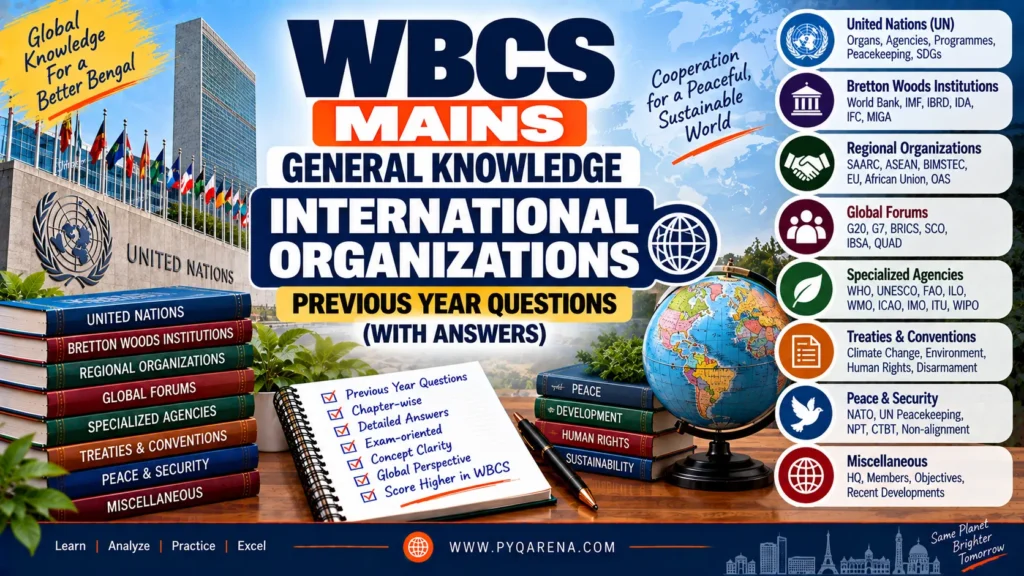
📘 PDF · 518 Questions · 10 Chapters
All WBCS Mains General Knowledge PYQs (2014–2023) in One PDF – ₹99 ₹49
Free sample available · Instant email delivery
🎯 Practice International Organizations as MCQ 2 free →
WBCS Mains General Knowledge International Organizations Questions 2023
Q. UNDP HeadQuarters is located in
(A) New York
(B) Geneva
(C) London
(D) Paris
Answer & Explanation
Correct Answer: (A) New York
Explanation
Why: The headquarters of the United Nations Development Programme (UNDP) is in New York. Geneva, London and Paris host other UN or international bodies, but not UNDP headquarters.
Why not the others:
- (B) Geneva – Geneva hosts many UN offices and specialised agencies, but not the headquarters of UNDP.
- (C) London – London is not the headquarters of UNDP.
- (D) Paris – Paris hosts UNESCO, not the headquarters of UNDP.
Exam Facts
- UNDP is the United Nations’ lead development agency and works in poverty reduction, governance and the Sustainable Development Goals.
- It is headquartered in New York, at the UN headquarters complex.
- The organisation is led by an Administrator, who is the third-highest official in the UN system.
- Headquarters-and-agency matching of UN bodies is a standard international-organisations question.
Q. IAEA looks after the safety for which type of pollution?
(A) Heavy Metals
(B) Hydro carbon
(C) Plastic
(D) Radio active elements
Answer & Explanation
Correct Answer: (D) Radio active elements
Explanation
Why: The International Atomic Energy Agency (IAEA) is concerned with the safety of radioactive materials and with nuclear safeguards. Heavy-metal, hydrocarbon and plastic pollution are not its special mandate.
Why not the others:
- (A) Heavy Metals – heavy-metal pollution is an environmental issue, but it is not the IAEA’s special field.
- (B) Hydro carbon – hydrocarbon pollution is not the IAEA’s special field.
- (C) Plastic – plastic pollution is not the IAEA’s special field.
Exam Facts
- The IAEA was set up in 1957 and is headquartered in Vienna.
- Its twin aims are to promote peaceful uses of nuclear energy and to inhibit its use for weapons.
- It reports to the UN General Assembly and to the Security Council, but it is an independent organisation.
- Agency-and-mandate questions should be answered from the specialised field, here nuclear and radioactive safety.
Q. GATT was introduced in
(A) 1947
(B) 1948
(C) 1954
(D) 1960
Answer & Explanation
Correct Answer: (A) 1947
Explanation
Why: GATT, the General Agreement on Tariffs and Trade, was concluded in 1947. It entered into force in 1948, but the standard examination year for its introduction is 1947. The later dates are incorrect.
Why not the others:
- (B) 1948 – 1948 is the year GATT entered into force, not the year it was signed and introduced.
- (C) 1954 – this is not the year of GATT.
- (D) 1960 – this is not the year of GATT.
Exam Facts
- GATT was signed by 23 countries in October 1947, at the Geneva trade conference.
- It provided the main rules of world trade until the World Trade Organization was established in 1995.
- The WTO absorbed and extended GATT, together with new agreements on services and on intellectual property.
- Introduction-year questions on GATT usually take the 1947 signing, not the 1948 commencement.
Q. The year in which WHO was established is
(A) 1940
(B) 1948
(C) 1952
(D) 1954
Answer & Explanation
Correct Answer: (B) 1948
Explanation
Why: The World Health Organization was established in 1948, when its Constitution came into force on 7 April, now marked as World Health Day. It was not founded in 1940, 1952 or 1954.
Why not the others:
- (A) 1940 – this is during the Second World War and is before the WHO was established.
- (C) 1952 – this is later than the establishment of the WHO.
- (D) 1954 – this is also later than 1948.
Exam Facts
- The WHO is a specialised agency of the United Nations and is headquartered in Geneva.
- 7 April 1948, the date its Constitution came into force, is observed as World Health Day.
- Its work covers international public health, including disease control, health systems and health emergencies.
- Foundation-year questions on the major UN specialised agencies are a regular set.
WBCS Mains General Knowledge International Organizations Questions 2022
Q. The headquarters of the International Court of Justice (ICJ) is situated in
(A) The Hague
(B) Vienna
(C) Washington D.C.
(D) Paris
Answer & Explanation
Correct Answer: (A) The Hague
Explanation
Why: The headquarters of the International Court of Justice is at The Hague, in the Netherlands. Vienna, Washington and Paris host other international bodies, not the ICJ.
Why not the others:
- (B) Vienna – Vienna hosts the IAEA and other UN offices, not the ICJ.
- (C) Washington D.C. – Washington hosts the World Bank and the IMF, not the ICJ.
- (D) Paris – Paris hosts UNESCO, not the ICJ.
Want more exam facts on this question? Get the WBCS Mains General Knowledge PYQ PDF
WBCS Mains General Knowledge International Organizations Questions 2021
Q. The total number of Judges of the International Court of Justice is
(A) 10
(B) 12
(C) 15
(D) 18
Answer & Explanation
Correct Answer: (C) 15
Explanation
Why: The International Court of Justice has 15 judges. Ten, twelve and eighteen are incorrect totals.
Why not the others:
- (A) 10 – this is short of the Court’s 15 judges.
- (B) 12 – this is also short of 15.
- (D) 18 – this is more than the 15 judges of the ICJ.
Want more exam facts on this question? Get the WBCS Mains General Knowledge PYQ PDF
Q. Which from the following countries does not have veto power?
(A) USA
(B) UK
(C) Canada
(D) China
Answer & Explanation
Correct Answer: (C) Canada
Explanation
Why: Among the four, Canada does not have a veto in the UN Security Council. The veto belongs to the five permanent members: the USA, the UK, France, Russia and China.
Why not the others:
- (A) USA – the United States is a permanent member and has the veto.
- (B) UK – the United Kingdom is a permanent member and has the veto.
- (D) China – China is a permanent member and has the veto.
Want more exam facts on this question? Get the WBCS Mains General Knowledge PYQ PDF
Q. The Office of the UN General Assembly is in
(A) Vienna
(B) New York
(C) Paris
(D) Zurich
Answer & Explanation
Correct Answer: (B) New York
Explanation
Why: The Office of the UN General Assembly is in New York, at United Nations Headquarters. Vienna and Paris host other UN offices; Zurich is not a UN headquarters city.
Why not the others:
- (A) Vienna – Vienna is a major UN duty station, but it is not the seat of the General Assembly.
- (C) Paris – Paris hosts UNESCO, not the General Assembly.
- (D) Zurich – Zurich is not a headquarters of the United Nations.
Want more exam facts on this question? Get the WBCS Mains General Knowledge PYQ PDF
Q. Headquarters of UNO are situated at
(A) Paris
(B) Geneva
(C) Los Angeles
(D) New York
Answer & Explanation
Correct Answer: (D) New York
Explanation
Why: The headquarters of the United Nations is in New York. Paris, Geneva and Los Angeles are not the seat of the UN Organization as a whole.
Why not the others:
- (A) Paris – Paris is the seat of UNESCO, not of the United Nations as a whole.
- (B) Geneva – Geneva is a major UN office and the seat of many specialised bodies, but not the UN headquarters.
- (C) Los Angeles – Los Angeles is not a UN headquarters city.
Want more exam facts on this question? Get the WBCS Mains General Knowledge PYQ PDF
Q. To which country did the first Secretary-General of the UN belong?
(A) Austria
(B) Sweden
(C) UK
(D) Norway
Answer & Explanation
Correct Answer: (D) Norway
Explanation
Why: The first Secretary-General of the United Nations, Trygve Lie, belonged to Norway. He was not from Austria, Sweden or the United Kingdom.
Why not the others:
- (A) Austria – Austria was the country of a later Secretary-General, Kurt Waldheim, not of the first.
- (B) Sweden – Sweden was the country of Dag Hammarskjöld, the second Secretary-General, not the first.
- (C) UK – no Secretary-General has been from the United Kingdom.
Want more exam facts on this question? Get the WBCS Mains General Knowledge PYQ PDF
Q. The motto of UNO is
(A) It’s your world
(B) Life for all
(C) Peace
(D) No war
Answer & Explanation
Correct Answer: (A) It’s your world
Explanation
Why: The listed answer gives It’s your world as the motto of the United Nations. “Life for all”, “Peace” and “No war” are slogans or ideas, but they are not the official answer here.
Why not the others:
- (B) Life for all – this is not the UN motto used as the listed answer.
- (C) Peace – peace is a purpose of the UN, but it is not the motto in this option set.
- (D) No war – this is a phrase of aim, not the official motto in the listed answer.
Want more exam facts on this question? Get the WBCS Mains General Knowledge PYQ PDF
WBCS Mains General Knowledge International Organizations Questions 2020
Q. When is the United Nations (UN)’s World Tsunami Awareness Day observed?
(A) November 1
(B) November 2
(C) November 3
(D) November 5
Answer & Explanation
Correct Answer: (D) November 5
Explanation
Why: The United Nations World Tsunami Awareness Day is observed on 5 November. The first, second and third of November are not this date.
Why not the others:
- (A) November 1 – this is not World Tsunami Awareness Day.
- (B) November 2 – this is not World Tsunami Awareness Day.
- (C) November 3 – this is not World Tsunami Awareness Day.
Want more exam facts on this question? Get the WBCS Mains General Knowledge PYQ PDF
Q. United Nations (UN)’s World Science Day for Peace and Development is observed on which date?
(A) November 7
(B) November 10
(C) November 8
(D) November 9
Answer & Explanation
Correct Answer: (B) November 10
Explanation
Why: The UN World Science Day for Peace and Development is observed on 10 November. The 7th, 8th and 9th of November are not this date.
Why not the others:
- (A) November 7 – this is not World Science Day for Peace and Development.
- (C) November 8 – this is not that observance.
- (D) November 9 – this is not that observance.
Want more exam facts on this question? Get the WBCS Mains General Knowledge PYQ PDF
Q. When was UN’s International Day of Older Persons observed annually?
(A) October 2
(B) September 29
(C) October 1
(D) September 30
Answer & Explanation
Correct Answer: (C) October 1
Explanation
Why: The UN International Day of Older Persons is observed annually on 1 October. The nearby dates in September and on 2 October are incorrect.
Why not the others:
- (A) October 2 – 2 October is Gandhi Jayanti and the International Day of Non-Violence, not this UN day.
- (B) September 29 – this is not the International Day of Older Persons.
- (D) September 30 – this is not the International Day of Older Persons.
Want more exam facts on this question? Get the WBCS Mains General Knowledge PYQ PDF
WBCS Mains General Knowledge International Organizations Questions 2018
Q. The Headquarter of ILO is situated at
(A) Rome
(B) Paris
(C) Geneva
(D) The Hague
Answer & Explanation
Correct Answer: (C) Geneva
Explanation
Why: The headquarters of the International Labour Organization is in Geneva. Rome, Paris and The Hague host other international bodies, not the ILO.
Why not the others:
- (A) Rome – Rome hosts the FAO, not the ILO.
- (B) Paris – Paris hosts UNESCO, not the ILO.
- (D) The Hague – The Hague hosts the ICJ and related courts, not the ILO.
Want more exam facts on this question? Get the WBCS Mains General Knowledge PYQ PDF
Q. How many official languages are there in UNO?
(A) 2
(B) 4
(C) 6
(D) 8.
Answer & Explanation
Correct Answer: (C) 6
Explanation
Why: The United Nations has six official languages: Arabic, Chinese, English, French, Russian and Spanish. Two, four and eight are incorrect counts.
Why not the others:
- (A) 2 – English and French are the working languages of the Secretariat, but there are six official languages in all.
- (B) 4 – this is short of the six official languages.
- (D) 8 – this is more than the official six.
Want more exam facts on this question? Get the WBCS Mains General Knowledge PYQ PDF
Q. The Headquarter of WHO is situated at
(A) Rome
(B) Paris
(C) Geneva
(D) The Hague.
Answer & Explanation
Correct Answer: (C) Geneva
Explanation
Why: The headquarters of the World Health Organization is in Geneva. Rome, Paris and The Hague are the seats of other organisations.
Why not the others:
- (A) Rome – Rome is the seat of the FAO, not of the WHO.
- (B) Paris – Paris is the seat of UNESCO, not of the WHO.
- (D) The Hague – The Hague is not the WHO headquarters.
Want more exam facts on this question? Get the WBCS Mains General Knowledge PYQ PDF
WBCS Mains General Knowledge International Organizations Questions 2017
Q. The city named by UNESCO under Creative Cities Network for city of music is
(A) Kolkata
(B) Varanasi
(C) Jaipur
(D) Lucknow
Answer & Explanation
Correct Answer: (B) Varanasi
Explanation
Why: Varanasi was named a UNESCO Creative City of Music, as in the identical 2018 Art and Culture question.
Why not the others:
- (A) Kolkata – Kolkata is not the Indian city designated in this UNESCO list as a City of Music.
- (C) Jaipur – Jaipur is a UNESCO Creative City of Crafts and Folk Art, not of music.
- (D) Lucknow – Lucknow is not the Indian City of Music on this list. Related PYQ: this question was also asked in 2017 (Chapter 3: Art & Culture).
Want more exam facts on this question? Get the WBCS Mains General Knowledge PYQ PDF
Q. Which is the highest judicial authority in the settlement of disputes in European Union?
(A) European Court of Justice
(B) European Tribunal of Arbitration
(C) Inter-European States of Justice
(D) European Court of Law
Answer & Explanation
Correct Answer: (A) European Court of Justice
Explanation
Why: The highest judicial authority for the settlement of disputes in the European Union is the European Court of Justice, now formally the Court of Justice of the European Union, sitting in Luxembourg. The other court names in the options are not this institution.
Why not the others:
- (B) European Tribunal of Arbitration – this is not the name of the EU’s highest court.
- (C) Inter-European States of Justice – this is not the name of any EU court.
- (D) European Court of Law – this is not the official name of the Court of Justice. Note: The original options name European courts; the commonly circulated copy had country names in their place.
Want more exam facts on this question? Get the WBCS Mains General Knowledge PYQ PDF
Q. NAFTA was set up by
(A) George Bush
(B) Bill Clinton
(C) Barack Obama
(D) Donald Trump
Answer & Explanation
Correct Answer: (B) Bill Clinton
Explanation
Why: NAFTA came into force on 1 January 1994, during the presidency of Bill Clinton, which is why the listed answer names him as the President who set it up. George H. W. Bush had signed the agreement in 1992.
Why not the others:
- (A) George Bush – George H. W. Bush signed NAFTA in 1992, but the listed answer treats the 1994 launch under Clinton as the “set up” date.
- (C) Barack Obama – Obama was President much later and later sought a successor agreement, but he did not set up NAFTA.
- (D) Donald Trump – Trump was a later President who pressed for a replacement of NAFTA, not its founder. Note: The NAFTA agreement was signed in 1992 under George H. W. Bush and entered into force on 1 January 1994 under Bill Clinton.
Want more exam facts on this question? Get the WBCS Mains General Knowledge PYQ PDF
Q. Choose the correct statement about WTO.
(A) Afghanistan became the 164th member of WTO.
(B) General Robert Azevedo is WTO Director.
(C) WTO ministers met at Nairobi in Kenya for its last meeting.
(D) All of the above.
Answer & Explanation
Correct Answer: (D) All of the above
Explanation
Why: For a 2017 paper, all three statements were accepted as correct: Afghanistan had become the 164th WTO member in 2015; Roberto Azevêdo was the Director-General; and the last ministerial meeting by then had been at Nairobi in 2015. The official answer is therefore all of the above.
Why not the others:
- (A) Afghanistan became the 164th member of WTO – this was true in December 2015, and is not wrong by itself.
- (B) General Robert Azevedo is WTO Director – this refers to Roberto Azevêdo, who was Director-General from 2013 to 2021; the wording is loose, but the listed answer treats the statement as correct.
- (C) WTO ministers met at Nairobi in Kenya for its last meeting – the Tenth Ministerial Conference was at Nairobi in December 2015, and it was the latest such meeting at the time of this paper. Note: As of November 2026, the WTO Director-General is Ngozi Okonjo-Iweala, and membership has risen further, including the accessions of Comoros and Timor-Leste in 2024.
Want more exam facts on this question? Get the WBCS Mains General Knowledge PYQ PDF
Q. Which of the following agencies of the UN existed since World War I?
(A) ILO
(B) WHO
(C) FAO
(D) UNESCO
Answer & Explanation
Correct Answer: (A) ILO
Explanation
Why: Among these UN agencies, only the International Labour Organization has existed since the time of the First World War: it was founded in 1919 with the League of Nations. The WHO, the FAO and UNESCO were created after the Second World War.
Why not the others:
- (B) WHO – the World Health Organization was established in 1948, after the Second World War.
- (C) FAO – the Food and Agriculture Organization was founded in 1945, after the Second World War.
- (D) UNESCO – UNESCO was founded in 1945, after the Second World War.
Want more exam facts on this question? Get the WBCS Mains General Knowledge PYQ PDF
Q. Which organ of the UN has ceased to be functional?
(A) Trusteeship Council
(B) Secretariat
(C) International Court of Justice
(D) Economic and Social Council
Answer & Explanation
Correct Answer: (A) Trusteeship Council
Explanation
Why: The Trusteeship Council has ceased to be functional, after the last trust territory, Palau, became independent in 1994. The Secretariat, the International Court of Justice and the Economic and Social Council continue to work as principal organs.
Why not the others:
- (B) Secretariat – the Secretariat, headed by the Secretary-General, remains a working principal organ.
- (C) International Court of Justice – the ICJ remains the principal judicial organ and continues to sit at The Hague.
- (D) Economic and Social Council – ECOSOC remains a working principal organ of the United Nations.
Want more exam facts on this question? Get the WBCS Mains General Knowledge PYQ PDF
Q. Which one of the following is the major constituent of the Indian Foreign Exchange Reserve?
(A) Gold
(B) SDRs
(C) Foreign Currency Assets
(D) Reserve Tranche Position of India in IMF.
Answer & Explanation
Correct Answer: (C) Foreign Currency Assets
Explanation
Why: The major constituent of India’s foreign-exchange reserves is Foreign Currency Assets. Gold, SDRs and the reserve tranche position in the IMF are also parts of the reserves, but they are much smaller than the currency-asset component.
Why not the others:
- (A) Gold – gold is a part of the reserves, but it is not the largest constituent.
- (B) SDRs – Special Drawing Rights are a small part of the reserves, not the major constituent.
- (D) Reserve Tranche Position of India in IMF – this is also a small component, not the major one.
Want more exam facts on this question? Get the WBCS Mains General Knowledge PYQ PDF
WBCS Mains General Knowledge International Organizations Questions 2016
Q. The Rome Statute of the International Criminal Court came into force in
(A) 2002
(B) 2005
(C) 2013
(D) 2014
Answer & Explanation
Correct Answer: (A) 2002
Explanation
Why: The Rome Statute of the International Criminal Court came into force on 1 July 2002. It was adopted in 1998, but the year of entry into force, which the question asks, is 2002.
Why not the others:
- (B) 2005 – this is later than the entry into force of the Statute.
- (C) 2013 – this is not the year the Statute came into force.
- (D) 2014 – this is not the year the Statute came into force.
Want more exam facts on this question? Get the WBCS Mains General Knowledge PYQ PDF
Q. The UN Security Council has how many members?
(A) 10
(B) 12
(C) 15
(D) 18
Answer & Explanation
Correct Answer: (C) 15
Explanation
Why: The UN Security Council has 15 members: five permanent and ten non-permanent. Ten, twelve and eighteen are incorrect totals.
Why not the others:
- (A) 10 – ten is the number of non-permanent members, not the total membership.
- (B) 12 – this is not the membership of the Council.
- (D) 18 – this is more than the Council’s 15 members.
Want more exam facts on this question? Get the WBCS Mains General Knowledge PYQ PDF
Q. East Timor, which is the 191st member of the UN, is located in the continent of
(A) Asia
(B) Africa
(C) Europe
(D) South America
Answer & Explanation
Correct Answer: (A) Asia
Explanation
Why: East Timor (Timor-Leste) is in Asia, as in the identical Geography question, and it became the 191st member of the UN in 2002.
Why not the others:
- (B) Africa – East Timor is not in Africa.
- (C) Europe – East Timor is not in Europe.
- (D) South America – East Timor is not in South America. Related PYQ: this question was also asked in 2016 (Chapter 1: Geography).
Want more exam facts on this question? Get the WBCS Mains General Knowledge PYQ PDF
Q. Which of the following is not a main organ of the U.N.?
(A) General Assembly
(B) Security Council
(C) International Court of Justice
(D) International Labour Organization
Answer & Explanation
Correct Answer: (D) International Labour Organization
Explanation
Why: The International Labour Organization is a specialised agency, not one of the six main organs of the United Nations. The General Assembly, the Security Council and the International Court of Justice are main organs.
Why not the others:
- (A) General Assembly – the General Assembly is a principal organ of the UN.
- (B) Security Council – the Security Council is a principal organ of the UN.
- (C) International Court of Justice – the ICJ is a principal organ of the UN.
Want more exam facts on this question? Get the WBCS Mains General Knowledge PYQ PDF
Q. How many member states does the European Union have?
(A) 28
(B) 30
(C) 32
(D) 34
Answer & Explanation
Correct Answer: (A) 28
Explanation
Why: At the time of this 2016 paper, the European Union had 28 member states, after Croatia joined in 2013. The higher figures were incorrect then, and they are still incorrect.
Why not the others:
- (B) 30 – the Union has not had 30 members.
- (C) 32 – this is more than the Union’s membership.
- (D) 34 – this is more than the Union’s membership. Note: The United Kingdom left the European Union on 31 January 2020, and as of November 2026 the Union has 27 member states.
Want more exam facts on this question? Get the WBCS Mains General Knowledge PYQ PDF
Q. In which year did the Euro, the currency of the European Union, come into existence?
(A) 1999
(B) 2000
(C) 2003
(D) 2005
Answer & Explanation
Correct Answer: (A) 1999
Explanation
Why: The euro came into existence on 1 January 1999, when it became the official currency, at first in electronic and accounting form, of the first euro-area countries. Notes and coins followed in 2002, but the currency itself dates from 1999.
Why not the others:
- (B) 2000 – this is later than the launch of the euro as a currency.
- (C) 2003 – this is after both the 1999 launch and the 2002 cash changeover.
- (D) 2005 – this is not the year the euro came into existence. Note: Euro notes and coins were introduced on 1 January 2002; the currency had already existed for electronic and accounting use since 1999.
Want more exam facts on this question? Get the WBCS Mains General Knowledge PYQ PDF
WBCS Mains General Knowledge International Organizations Questions 2015
Q. Each year World Red Cross and Red Crescent Day is celebrated on ………………………………..
(A) May 8
(B) May 18
(C) June 8
(D) June 18
Answer & Explanation
Correct Answer: (A) May 8
Explanation
Why: World Red Cross and Red Crescent Day is celebrated each year on 8 May, the birthday of Henry Dunant. The 18th of May and the June dates are incorrect.
Why not the others:
- (B) May 18 – this is not World Red Cross and Red Crescent Day.
- (C) June 8 – this is not that observance.
- (D) June 18 – this is not that observance.
Want more exam facts on this question? Get the WBCS Mains General Knowledge PYQ PDF
Q. Who was the first Indian to be the President of United Nations General Assembly?
(A) Smt. Vijay Lakshmi Pandit
(B) Ramesh Bhandari
(C) Natwar Singh
(D) Krishna Menon
Answer & Explanation
Correct Answer: (A) Smt. Vijay Lakshmi Pandit
Explanation
Why: The first Indian to be President of the UN General Assembly was Vijaya Lakshmi Pandit, who presided over the eighth session in 1953. The other names, though associated with Indian diplomacy, did not hold this office first, or at all in the same way.
Why not the others:
- (B) Ramesh Bhandari – this diplomat is not the first Indian President of the General Assembly.
- (C) Natwar Singh – Natwar Singh was a later diplomat and minister, not the first Indian to hold this office.
- (D) Krishna Menon – V. K. Krishna Menon was a prominent Indian representative at the UN, but he was not President of the General Assembly.
Want more exam facts on this question? Get the WBCS Mains General Knowledge PYQ PDF
Q. Kalinga Award was instituted by ………..
(A) UNESCO for exceptional contribution of efforts to popularize Science
(B) Indian Military
(C) Jnanpith for encouraging creative writings in modern languages
(D) Indian Audit Association for outstanding contribution to adult literacy in India
Answer & Explanation
Correct Answer: (A) UNESCO for exceptional contribution of efforts to popularize Science
Explanation
Why: The Kalinga Prize was instituted with a grant from Biju Patnaik and is awarded by UNESCO for outstanding efforts to popularise science. It is not an Indian military, Jnanpith or audit-association award of the other options.
Why not the others:
- (B) Indian Military – the Kalinga Prize is not a military award.
- (C) Jnanpith for encouraging creative writings in modern languages – the Jnanpith Award is a literary prize and is not the Kalinga Prize.
- (D) Indian Audit Association for outstanding contribution to adult literacy in India – this is not what the Kalinga Prize is.
Want more exam facts on this question? Get the WBCS Mains General Knowledge PYQ PDF
WBCS Mains General Knowledge International Organizations Questions 2014
Q. The European Union Parliament holds its sessions in
(A) Brussels and Strasbourg
(B) Brussels
(C) Strasbourg
(D) Strasbourg and Paris
Answer & Explanation
Correct Answer: (A) Brussels and Strasbourg
Explanation
Why: The European Parliament holds its sessions in Brussels and Strasbourg: the main plenary sittings are in Strasbourg, and additional plenary and committee work is in Brussels. Paris is not a seat of the Parliament.
Why not the others:
- (B) Brussels – Brussels is an important workplace of the Parliament, but it is not the only seat; Strasbourg is also used.
- (C) Strasbourg – Strasbourg is the official seat for ordinary plenary sessions, but Brussels is also used.
- (D) Strasbourg and Paris – Paris is not a seat of the European Parliament.
Want more exam facts on this question? Get the WBCS Mains General Knowledge PYQ PDF
Q. Warsaw convention (1929) is related to
(A) Expansion of trade and commerce among erstwhile communist states
(B) Aviation sector
(C) Sports and games
(D) Sea transport
Answer & Explanation
Correct Answer: (B) Aviation sector
Explanation
Why: The Warsaw Convention of 1929 is a treaty on international carriage by air, including the liability of air carriers, so it is related to the aviation sector. It is not a trade pact of communist states, a sports convention, or a sea-transport treaty.
Why not the others:
- (A) Expansion of trade and commerce among erstwhile communist states – that description fits later Eastern-bloc economic arrangements, not the 1929 Warsaw Convention.
- (C) Sports and games – the convention is not a sports treaty.
- (D) Sea transport – carriage by sea is governed by other conventions, not by this air-law treaty.
Want more exam facts on this question? Get the WBCS Mains General Knowledge PYQ PDF
Q. Association of South East Asian Nations (ASEAN) was formed in
(A) 1960
(B) 1967
(C) 1979
(D) 1991
Answer & Explanation
Correct Answer: (B) 1967
Explanation
Why: The Association of Southeast Asian Nations (ASEAN) was formed in 1967, by the Bangkok Declaration, with five founding members. It was not formed in 1960, 1979 or 1991.
Why not the others:
- (A) 1960 – this is earlier than the founding of ASEAN.
- (C) 1979 – this is later than 1967; it is not the founding year.
- (D) 1991 – this is much later than the founding of ASEAN.
Want more exam facts on this question? Get the WBCS Mains General Knowledge PYQ PDF
📘 PDF · 518 Questions · 10 Chapters
All WBCS Mains General Knowledge PYQs (2014–2023) in One PDF – ₹99 ₹49
Free sample available · Instant email delivery
🎯 MCQ Practice · 12,000+ Questions
These WBCS Mains General Knowledge PYQs + 12,000+ more – ₹299/year
One plan, the whole library: subject-wise & exam-wise MCQs for every exam, with 40,000+ more coming in the next few months.
✅ Try free – the first 5% of every exam-wise quiz, and the first 2 chapters of every subject-wise practice, are open.
Leave a Comment