

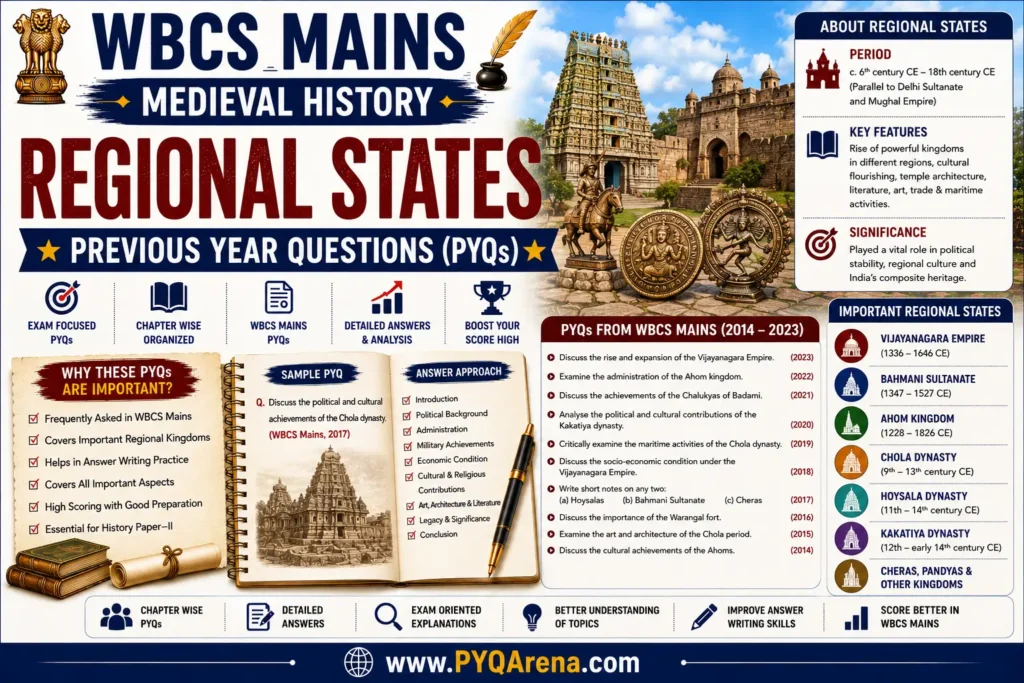
WBCS Mains Vijayanagar & Bahmani Kingdoms Questions 2022
Q. The Vijaynagar State was founded by
(A) Harihara and Bukka
(B) Chenna and Pedanna
(C) Tiruvalluvar
(D) Malik Ambar
Answer & Explanation
Correct Answer: (A) Harihara and Bukka
Explanation
The Vijayanagar Empire was founded in 1336 CE by the brothers Harihara I and Bukka Raya I. They belonged to the Sangama dynasty and established the empire in the Deccan, with Vijayanagara (Hampi) as its capital. The foundation is traditionally associated with the guidance of Vidyaranya, a scholar and spiritual figure.
Want more exam facts on this question? Get the WBCS Mains Indian History PYQ PDF
WBCS Mains Vijayanagar & Bahmani Kingdoms Questions 2020
Q. The Russian merchant traveller Nikitin visited South India in
(A) 14th Century
(B) 15th Century
(C) 16th Century
(D) None of the above
Answer & Explanation
Correct Answer: (B) 15th Century
Explanation
Afanasy Nikitin, a Russian merchant and traveller, visited India during the 15th century, approximately between 1469 and 1472 CE. He travelled through parts of the Deccan, including the Bahmani Sultanate, and recorded his observations in his famous travel account The Journey Beyond the Three Seas (Khozhdenie za tri morya).
Want more exam facts on this question? Get the WBCS Mains Indian History PYQ PDF
Q. Which of the following systems were the backbones of the Vijaynagar administration?
(A) Nitinirdesha and Dandniti
(B) Karyapalika and Nayankara
(C) Nayankara and Ayagar
(D) Dandniti and Spy system
Answer & Explanation
Correct Answer: (C) Nayankara and Ayagar
Explanation
The Nayankara and Ayagar systems were important pillars of the Vijayanagar administrative system. Under the Nayankara system, military chiefs or Nayakas were assigned territories called Amarams and were responsible for revenue collection and maintaining troops. The Ayagar system involved village administration through hereditary village officials responsible for various administrative functions.
Want more exam facts on this question? Get the WBCS Mains Indian History PYQ PDF
WBCS Mains Vijayanagar & Bahmani Kingdoms Questions 2019
Q. The Muslim kingdom of Golconda grew up on the ruins of the old Hindu kingdom of
(A) Devagiri
(B) Dwarsamudra
(C) Warrangal
(D) Kanchi
Answer & Explanation
Correct Answer: (C) Warrangal
Explanation
The Golconda Sultanate developed in the region that had previously been ruled by the Kakatiyas, whose capital was Warangal (Warrangal) in present-day Telangana. After the decline of the Kakatiya kingdom in the 14th century, the region came under various Muslim rulers and eventually became the Golconda Sultanate, established by the Qutb Shahi dynasty.
Want more exam facts on this question? Get the WBCS Mains Indian History PYQ PDF
WBCS Mains Vijayanagar & Bahmani Kingdoms Questions 2018
Q. The foreign traveller named one of the famous Vijayanagara coins as pagoda. Originally it was
(A) Pan
(B) Varaha
(C) Hun
(D) Panam
Answer & Explanation
Correct Answer: (B) Varaha
Explanation
The Varaha was one of the most important gold coins of the Vijayanagara Empire. Foreign travellers referred to this gold coin as the “Pagoda.” The coin was also known as Gadyana or Pon in different contexts. The term Varaha is associated with the boar incarnation of Vishnu, which appeared on several Vijayanagara gold coins.
Want more exam facts on this question? Get the WBCS Mains Indian History PYQ PDF
WBCS Mains Vijayanagar & Bahmani Kingdoms Questions 2017
Q. Policemen of Vijaynagar were paid out of taxes collected from
(A) Wine shops
(B) Land revenue
(C) Taxes on goods
(D) Prostitutes
Answer & Explanation
Correct Answer: (D) Prostitutes
Explanation
In the Vijayanagar Empire, certain taxes were earmarked for specific administrative and public services. Historical accounts mention that policemen were paid from taxes collected from prostitutes. This reflects the diverse and specialised nature of taxation under the Vijayanagar administration.
Want more exam facts on this question? Get the WBCS Mains Indian History PYQ PDF
Q. The 96 years old man who was captured and beheaded at Talikota (Bannihatti) in 1565 was
(A) Rama Raya
(B) Krishna Deva Raya
(C) Bukka I
(D) Saluva Narsimha
Answer & Explanation
Correct Answer: (A) Rama Raya
Explanation
Aliya Rama Raya, the de facto ruler and chief minister of the Vijayanagara Empire, was captured and beheaded after the Battle of Talikota (Bannihatti) in 1565 CE. His death marked a major turning point in Vijayanagara history and was followed by the sack of Vijayanagara (Hampi) by the victorious Deccan Sultanates.
Want more exam facts on this question? Get the WBCS Mains Indian History PYQ PDF
Q. Which Bahamani ruler shifted the capital from Gulbarga to Bidar?
(A) Ala-ud-din II
(B) Ahmad Shah Wali
(C) Muhammad Shah I
(D) Muhammad III
Answer & Explanation
Correct Answer: (B) Ahmad Shah Wali
Explanation
Ahmad Shah Wali Bahmani shifted the capital of the Bahmani Sultanate from Gulbarga to Bidar in 1425 CE. Bidar subsequently became the political and cultural centre of the Bahmani kingdom. Ahmad Shah Wali is also remembered for his military campaigns and patronage of Sufi traditions.
Want more exam facts on this question? Get the WBCS Mains Indian History PYQ PDF
WBCS Mains Vijayanagar & Bahmani Kingdoms Questions 2016
Q. According to Abdur Razzaq, the policemen of Vijayanagar were paid out of taxes collected from
(A) Wine shops
(B) Brothels (prostitutes)
(C) Land revenue
(D) Taxes on goods
Answer & Explanation
Correct Answer: (B) Brothels (prostitutes)
Explanation
According to the account of the Persian traveller Abdur Razzaq, who visited Vijayanagar during the reign of Devaraya II, the policemen were paid from the taxes levied on prostitutes. This is an interesting detail about the specialised taxation and administrative arrangements of the Vijayanagar Empire.
Want more exam facts on this question? Get the WBCS Mains Indian History PYQ PDF
Q. By whom was the most significant commentary on the Rigveda composed in the medieval period in the Vijayanagar realm?
(A) Chakrapanidatta
(B) Sayana
(C) Kannada
(D) Sagarnandin
Answer & Explanation
Correct Answer: (B) Sayana
Explanation
The famous medieval commentary on the Rigveda was composed by Sayana (Sayana), a renowned Sanskrit scholar associated with the Vijayanagara Empire. He served as a minister and scholar during the reigns of Harihara I and Bukka I, and his extensive Vedic commentaries remain important sources for the study of Vedic literature.
Want more exam facts on this question? Get the WBCS Mains Indian History PYQ PDF
Q. Nicolo de Conti, an Italian visitor, came to Vijaynagar during the reign of
(A) Harihara I
(B) Bukka I
(C) Deva Raya II
(D) Deva Raya I
Answer & Explanation
Correct Answer: (D) Deva Raya I
Explanation
The Italian traveller Nicolo de Conti visited Vijayanagar around 1420, during the reign of Deva Raya I (c. 1406–1422). He described the great size of the capital, the wealth of the king and his large household, and festivals such as Deepavali. His account is one of the earliest foreign descriptions of the Vijayanagar capital.
Want more exam facts on this question? Get the WBCS Mains Indian History PYQ PDF
WBCS Mains Vijayanagar & Bahmani Kingdoms Questions 2015
Q. City of Nagalapura was built by
(A) Bukka-I
(B) Deva Raya-I
(C) Krishnadevaraya
(D) Virupaksha
Answer & Explanation
Correct Answer: (C) Krishnadevaraya
Explanation
Nagalapura was a city built by Krishnadevaraya, the most famous ruler of the Vijayanagara Empire. He named it after his mother, Nagalamba (Nagala Devi). Nagalapura was located near Vijayanagara (Hampi) and became an important settlement during his reign.
Want more exam facts on this question? Get the WBCS Mains Indian History PYQ PDF
Q. During whose reign did Vijayanagara come into conflict with Orissa for the first time?
(A) Bukka-II
(B) Devaraya-I
(C) Devaraya-II
(D) Virupaksha-II
Answer & Explanation
Correct Answer: (B) Devaraya-I
Explanation
The first conflict between the Vijayanagara Empire and the Gajapati rulers of Orissa occurred during the reign of Devaraya I (1406-1422 CE). Vijayanagara’s expansion into coastal Andhra brought it into contact with the Gajapati kingdom of Orissa. The Gajapati ruler Bhanudeva IV invaded the Rajahmundry region, prompting Devaraya I to intervene.
Want more exam facts on this question? Get the WBCS Mains Indian History PYQ PDF
Q. What is ‘Asthavana’?
(A) Land revenue department
(B) A type of rice
(C) One third of the produce of the land
(D) House-tax
Answer & Explanation
Correct Answer: (A) Land revenue department
Explanation
Asthavana (Ashtavana) refers to the land revenue department in the administrative system of the Vijayanagara Empire. It was concerned with the assessment and collection of revenue from land. Land revenue was an important source of income for the Vijayanagara state.
Want more exam facts on this question? Get the WBCS Mains Indian History PYQ PDF
Q. Which Vijayanagara ruler sent an embassy to China?
(A) Harihara-I
(B) Krishna Deva Raya
(C) Bukka-I
(D) Saluva Narasimha
Answer & Explanation
Correct Answer: (C) Bukka-I
Explanation
Bukka-I, one of the founders of the Vijayanagara Empire, maintained diplomatic relations with China. During his reign, a Vijayanagara embassy was sent to the court of the Ming emperor in China. This reflects the empire’s participation in wider diplomatic and commercial networks across the Indian Ocean and Southeast Asia.
Want more exam facts on this question? Get the WBCS Mains Indian History PYQ PDF
Q. Who built the ‘Gol-Gumbaj’ at Bijapur famous for the world’s second largest dome and the whispering gallery?
(A) Mahmud Gawan
(B) Yusuf Adil Shah
(C) Ismail Adil Shah
(D) Muhammed Adil Shah
Answer & Explanation
Correct Answer: (D) Muhammed Adil Shah
Explanation
The Gol Gumbaz at Bijapur (Vijayapura), Karnataka was built as the mausoleum of Muhammad Adil Shah, the ruler of the Adil Shahi dynasty of Bijapur. Construction began during his reign and the monument was completed after his death. It is famous for its enormous dome and the Whispering Gallery, where faint sounds can be heard across the gallery.
Want more exam facts on this question? Get the WBCS Mains Indian History PYQ PDF
Leave a Comment