

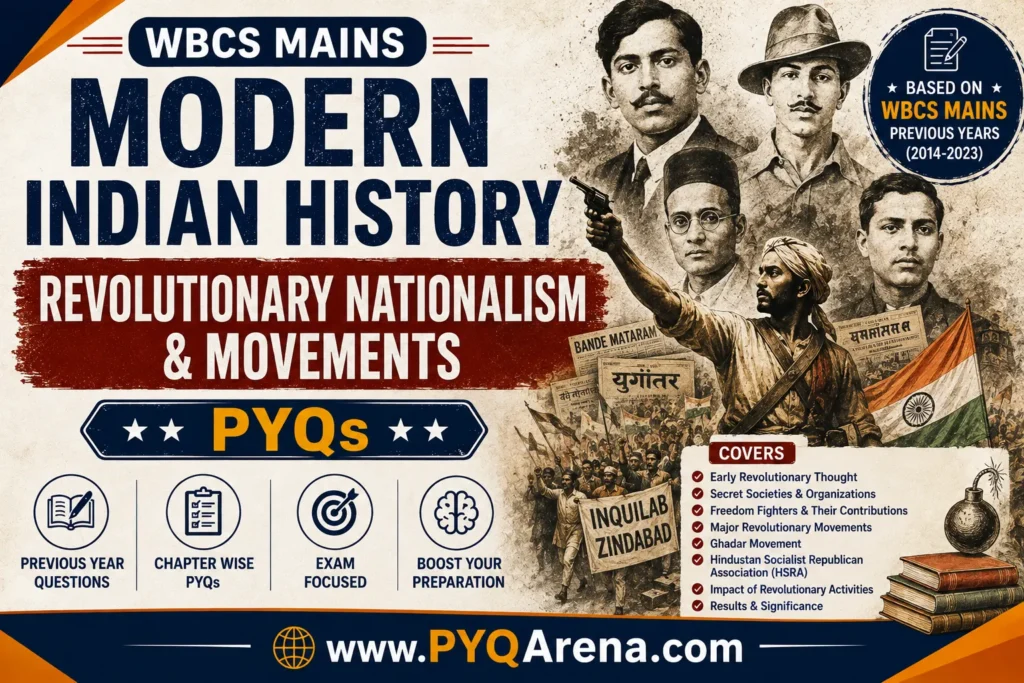
This compilation contains all the multiple-choice questions from the West Bengal Civil Service (WBCS) Mains History examinations (2014-2023) that focus on early secret societies (Abhinava Bharat, Anushilan Samiti, Mitramela), Gadar Party, revolutionary actions in India and abroad (Alipore, Hardinge bomb attack, Kakori Conspiracy, Bhagat Singh, Jatin Das, Central Assembly bombing, Chittagong Armoury Raid, and the Indian National Army / INA and Subhas Chandra Bose).
WBCS Mains Revolutionary Nationalism & Movements Questions 2023
Q. Which was the nerve centre of the Quit India Movement in Medinipur of Bengal?
(A) Garbeta
(B) Tamluk
(C) Kanthi
(D) Haldia
Answer & Explanation
Correct Answer: (B) Tamluk
Explanation
Tamluk, the old port town of Tamralipta in Medinipur district, was the nerve centre of the Quit India Movement (1942) in Bengal. Here the rebels set up the Tamralipta Jatiya Sarkar, a parallel national government, on 17 December 1942, which worked until 1944.
Exam Facts
- The parallel government’s first Sarbadhinayak (supreme head) was Satish Chandra Samanta; Ajoy Mukherjee and Sushil Kumar Dhara were other key leaders.
- Its armed volunteer corps was the Vidyut Vahini, and its women’s wing was the Bhagini Sena.
- Matangini Hazra, popularly called “Gandhi Buri“, was shot dead on 29 September 1942 while leading a procession to capture the Tamluk police station.
- On the same day there were coordinated attacks on police stations and government offices across Tamluk and Contai subdivisions.
- The Jatiya Sarkar ran its own courts, relief, schools and health work, especially after the October 1942 cyclone and during the Bengal Famine of 1943.
- It was wound up in 1944 on the advice of Gandhi.
- Kanthi (Contai) (option C) was another active centre in Medinipur, famous for the salt satyagraha of 1930, but not the seat of the parallel government.
- Garbeta (option A) is in the western part of the old Medinipur district and was not the hub of the 1942 rising.
- Haldia (option D) grew into a port and industrial town only after independence.
- Other parallel governments of 1942 were at Ballia (UP, under Chittu Pandey) and Satara (Maharashtra, the Prati Sarkar of Nana Patil).
Q. Who founded the ‘Khudai Khidmatgar’?
(A) Md. Ali Jinnah
(B) Salimullah
(C) Saiyad Brothers
(D) Khan Abdul Ghaffar Khan
Answer & Explanation
Correct Answer: (D) Khan Abdul Ghaffar Khan
Explanation
Khan Abdul Ghaffar Khan founded the Khudai Khidmatgar (“Servants of God“) in 1929 among the Pathans of the North-West Frontier Province. Its volunteers were pledged to non-violence and wore red-dyed shirts, so they were popularly called the Red Shirts (Surkh Posh).
Exam Facts
- Ghaffar Khan is remembered as the Frontier Gandhi (Sarhadi Gandhi) and Badshah Khan.
- The Khudai Khidmatgars played a major role in the Civil Disobedience Movement (1930) in the Frontier.
- The Qissa Khwani Bazaar firing at Peshawar on 23 April 1930 was directed against unarmed Khudai Khidmatgars.
- Soldiers of the Garhwal Rifles led by Chandra Singh Garhwali refused to fire on the crowd at Peshawar.
- Ghaffar Khan earlier founded the reformist Anjuman-e-Islah-e-Afghania (1921) and started the Pashto journal Pakhtun (1928).
- His brother Dr. Khan Sahib led the Congress ministry in the NWFP from 1937.
- He opposed Partition and received the Bharat Ratna in 1987, the first non-Indian to receive it.
- Md. Ali Jinnah (option A) led the Muslim League and the demand for Pakistan.
- Nawab Salimullah (option B) of Dhaka was a leading founder of the All-India Muslim League (1906).
- The Saiyad Brothers (option C) were 18th-century Mughal kingmakers; the Khilafat leaders were the Ali Brothers (Muhammad Ali and Shaukat Ali).
Q. Who was associated with the Home Rule Movement in India?
(A) Aurobindo
(B) Bal Gangadhar Tilak
(C) Madanmohan Malavya
(D) Mahatma Gandhi
Answer & Explanation
Correct Answer: (B) Bal Gangadhar Tilak
Explanation
Bal Gangadhar Tilak led the Home Rule Movement along with Annie Besant. Tilak founded the Indian Home Rule League at Belgaum in April 1916, and Besant founded the All India Home Rule League at Madras in September 1916.
Exam Facts
- Tilak’s league worked in Maharashtra (except Bombay city), Karnataka, the Central Provinces and Berar; Besant’s league covered the rest of India.
- Tilak’s famous slogan was “Swaraj is my birthright and I shall have it“.
- The two leagues worked in coordination and popularised self-government within the Empire through meetings, pamphlets and reading rooms.
- Besant’s arrest in June 1917 sparked nationwide protests, and she was elected Congress president at the Calcutta session (1917).
- The movement prepared the ground for the Montagu Declaration of August 1917.
- The movement faded after 1918, when Tilak went to England for his libel case against Valentine Chirol and Besant wavered over the reforms.
- Aurobindo (option A) had withdrawn from politics to Pondicherry in 1910.
- Madan Mohan Malaviya (option C) founded the Banaras Hindu University (1916) and was a leader of the Hindu Mahasabha.
- Mahatma Gandhi (option D) stayed away from the Home Rule agitation of 1916–18; he became president of the All India Home Rule League only in 1920, renaming it Swarajya Sabha.
- Home Rule leagues drew in many new workers, such as Jawaharlal Nehru, Jamnadas Dwarkadas, Shankarlal Banker and Indulal Yagnik.
WBCS Mains Revolutionary Nationalism & Movements Questions 2022
Q. The theory of Radical Humanism was put forth by
(A) Subhas Chandra Bose
(B) M. N. Roy
(C) Karl Marx
(D) Nehru
Answer & Explanation
Correct Answer: (B) M. N. Roy
Explanation
M. N. Roy (Manabendra Nath Roy) put forward Radical Humanism, also called New Humanism, in the 1940s after breaking with orthodox communism. He set it out in the 22 Theses (1946) of the Radical Democratic Party and in New Humanism: A Manifesto (1947).
Want more exam facts on this question? Get the WBCS Mains Indian History PYQ PDF
Q. The Tamralipta Jatiyo Sarkar was set up in
(A) Bankura
(B) Birbhum
(C) Malda
(D) Medinipur
Answer & Explanation
Correct Answer: (D) Medinipur
Explanation
The Tamralipta Jatiya Sarkar was set up at Tamluk in Medinipur district on 17 December 1942 during the Quit India Movement. It was a parallel national government that functioned until it was dissolved in 1944 on Gandhi’s advice.
Want more exam facts on this question? Get the WBCS Mains Indian History PYQ PDF
WBCS Mains Revolutionary Nationalism & Movements Questions 2021
Q. Who was the founder of the Secret Society Abhinava Bharat?
(A) Naren
(B) Jatin Mukherjee
(C) Damodar Chapekar
(D) Ganesh Savarkar
Answer & Explanation
Correct Answer: (D) Ganesh Savarkar
Explanation
Ganesh Damodar Savarkar (Babarao), together with his younger brother Vinayak Damodar Savarkar, founded the secret society Abhinav Bharat in 1904. It grew out of the Mitra Mela, which the Savarkar brothers had started at Nasik in 1899. Standard books usually credit V. D. Savarkar, but he is not an option here, and Ganesh Savarkar was a co-founder and its chief organiser.
Want more exam facts on this question? Get the WBCS Mains Indian History PYQ PDF
Q. The Chittagong Armoury Raid had been planned by
(A) Surya Sen
(B) Chandra Dutta
(C) Vidhan Ghosh
(D) Jatin Das
Answer & Explanation
Correct Answer: (A) Surya Sen
Explanation
Surya Sen (“Masterda“), a school teacher, planned and led the Chittagong Armoury Raid of 18 April 1930. His group, the Indian Republican Army, Chittagong Branch, seized the police and auxiliary force armouries and proclaimed a Provisional Revolutionary Government.
Want more exam facts on this question? Get the WBCS Mains Indian History PYQ PDF
Q. The two greatest women revolutionaries of the National Movement—Pritilata Waddedar and Kalpana Dutta—were the revolutionary co-workers of
(A) Surya Sen
(B) Bhagat Singh
(C) Batokeshwar Dutt
(D) Chapekar brothers
Answer & Explanation
Correct Answer: (A) Surya Sen
Explanation
Pritilata Waddedar and Kalpana Dutta were members of Surya Sen’s Indian Republican Army (Chittagong Branch). Surya Sen drew many young women into armed revolutionary work, which was a new feature of the movement in Bengal in the 1930s.
Want more exam facts on this question? Get the WBCS Mains Indian History PYQ PDF
Q. Which of the following revolutionary and terrorist organizations had a large number of young women revolutionaries?
(A) Yugantor
(B) Anushilan Samiti
(C) Bharat Mata Society
(D) Indian Republican Army
Answer & Explanation
Correct Answer: (D) Indian Republican Army
Explanation
Surya Sen’s Indian Republican Army in Chittagong is the group known for a large number of young women revolutionaries, such as Pritilata Waddedar and Kalpana Dutta; Bipan Chandra treats the large-scale participation of young women as a notable feature of this phase.
Want more exam facts on this question? Get the WBCS Mains Indian History PYQ PDF
Q. Who murdered Saunders, Assistant Superintendent of Police, Lahore, for assaulting Lala Lajpat Rai?
(A) Bhagat Singh
(B) Batukeshwar Dutt
(C) Sukh Dev
(D) Raj Guru
Answer & Explanation
Correct Answer: (A) Bhagat Singh
Explanation
Bhagat Singh and Shivaram Rajguru shot J. P. Saunders, Assistant Superintendent of Police, at Lahore on 17 December 1928 to avenge the death of Lala Lajpat Rai.
Want more exam facts on this question? Get the WBCS Mains Indian History PYQ PDF
WBCS Mains Revolutionary Nationalism & Movements Questions 2020
Q. The Ghadar Party was founded (November 1913) at San Francisco, USA by
(A) Madam Bhikaji Cama
(B) Lala Har Dayal
(C) Shyamji Krishna Verma
(D) Both (A) and (B)
Answer & Explanation
Correct Answer: (B) Lala Har Dayal
Explanation
Lala Har Dayal was the moving spirit behind the Ghadar Party, founded in 1913 by Indian immigrants on the Pacific coast of the USA, with its headquarters at the Yugantar Ashram in San Francisco. Sohan Singh Bhakna was its president and Har Dayal its general secretary and main ideologue.
Want more exam facts on this question? Get the WBCS Mains Indian History PYQ PDF
Q. Who founded the Indian Independence League (1942) in Tokyo?
(A) Taraknath Das
(B) Raja Mahendra Pratap
(C) Subhas Chandra Bose
(D) Rash Bihari Bose
Answer & Explanation
Correct Answer: (D) Rash Bihari Bose
Explanation
Rash Behari Bose, who had lived in Japan since 1915, founded the Indian Independence League at the Tokyo Conference of March 1942. The Bangkok Conference of June 1942 expanded the League and decided to raise the Indian National Army.
Want more exam facts on this question? Get the WBCS Mains Indian History PYQ PDF
Q. Who killed Michael O’ Dyer, the Governor of Punjab, who had ordered the brutal firing on the innocent people at Jallianwala Bagh?
(A) Madan Lal Dhingra
(B) Sardar Udham Singh
(C) Sohan Singh Bhakna
(D) Kanai Lal Dutt
Answer & Explanation
Correct Answer: (B) Sardar Udham Singh
Explanation
Sardar Udham Singh shot Sir Michael O’Dwyer, Lieutenant-Governor of Punjab at the time of the Jallianwala Bagh massacre (13 April 1919), at Caxton Hall, London, on 13 March 1940. He was hanged at Pentonville Prison on 31 July 1940.
Want more exam facts on this question? Get the WBCS Mains Indian History PYQ PDF
Q. Who among the following was not involved with the foundation of the Anushilan Samiti of Calcutta in 1902?
(A) Promotha Mitter
(B) Abani Mukherjee
(C) Barindra Kumar Ghosh
(D) Jotindra Nath Banerjee
Answer & Explanation
Correct Answer: (B) Abani Mukherjee
Explanation
Abani Mukherjee was not involved in founding the Anushilan Samiti in Calcutta in 1902; he was born in 1891 and was only a child then. The Samiti was founded on 24 March 1902 by Satish Chandra Basu, with barrister Pramatha Nath Mitra (P. Mitra) as its president. Jatindranath Banerjee and Barindra Kumar Ghosh, sent by Aurobindo Ghosh from Baroda, helped build it up.
Want more exam facts on this question? Get the WBCS Mains Indian History PYQ PDF
WBCS Mains Revolutionary Nationalism & Movements Questions 2019
Q. Match the founders of the following revolutionary organisations:
(a) Mitramela
(b) Anushilan Samiti
(c) Abhinav Bharat
(d) Swadesh Bandhab Samity
(i) G. D. Savarkar
(ii) Satishchandra Bose
(iii) V. D. Savarkar
(iv) Aswini Kumar Dutta
(A) (a)-(ii), (b)-(i), (c)-(iii), (d)-(iv)
(B) (a)-(i), (b)-(ii), (c)-(iii), (d)-(iv)
(C) (a)-(ii), (b)-(iii), (c)-(i), (d)-(iv)
(D) (a)-(i), (b)-(iii), (c)-(ii), (d)-(iv)
Answer & Explanation
Correct Answer: (B) (a)-(i), (b)-(ii), (c)-(iii), (d)-(iv)
Explanation
The correct matching is Mitramela – G. D. Savarkar, Anushilan Samiti – Satishchandra Bose, Abhinav Bharat – V. D. Savarkar, Swadesh Bandhab Samity – Aswini Kumar Dutta. The Savarkar brothers founded Mitra Mela at Nasik in 1899 and turned it into Abhinav Bharat in 1904. Option B is also the only option that gives Anushilan Samiti to Satish Bose.
Want more exam facts on this question? Get the WBCS Mains Indian History PYQ PDF
Q. He was a great Indian revolutionary who was a Professor of Sanskrit and Philosophy in the Universities of Berkeley and Stanford and died as a sanyasi in Philadelphia. He was
(A) Shyamji Krishna Verma
(B) Lala Hardayal
(C) Bhai Parmanand
(D) Ram Chandra Bhardwaj
Answer & Explanation
Correct Answer: (B) Lala Hardayal
Explanation
Lala Har Dayal (1884–1939) was the revolutionary scholar who taught Indian philosophy and Sanskrit at Stanford University and lectured at Berkeley in California. He founded the Ghadar Party in 1913, and he died in Philadelphia on 4 March 1939. He lived a simple, ascetic life, which is why the question calls him a sanyasi.
Want more exam facts on this question? Get the WBCS Mains Indian History PYQ PDF
Q. Madan Lal Dhingra murdered Curzon Wylie in London, who was a/an
(A) Adviser to the Secretary of State for India
(B) Secretary of State for India
(C) Former Governor of the Punjab
(D) Law Member of the Viceroy’s Executive Council
Answer & Explanation
Correct Answer: (A) Adviser to the Secretary of State for India
Explanation
Sir William Hutt Curzon Wyllie was political aide-de-camp (adviser) to the Secretary of State for India. Madan Lal Dhingra shot him at the Imperial Institute in London on 1 July 1909.
Want more exam facts on this question? Get the WBCS Mains Indian History PYQ PDF
Q. The brain behind the bomb attack on Viceroy Lord Hardinge at Chandni Chowk, Delhi in December 1912, was
(A) Rasbehari Basu
(B) Bhai Parmanand
(C) Sachindranath Sanyal
(D) Shobhan Lal Pathak
Answer & Explanation
Correct Answer: (A) Rasbehari Basu
Explanation
Rash Behari Bose was the brain behind the bomb attack on Viceroy Lord Hardinge at Chandni Chowk, Delhi, on 23 December 1912, during the state entry marking the shift of the capital to Delhi. The bomb was thrown by Basanta Kumar Biswas, and Hardinge was wounded.
Want more exam facts on this question? Get the WBCS Mains Indian History PYQ PDF
Q. Who edited a Bengali weekly the ‘Jugantor’ and ‘Basumati’?
(A) Barindra Ghosh
(B) Aurobindo Ghosh
(C) Ganesh Ghosh
(D) Anand Mohan Bose
Answer & Explanation
Correct Answer: (A) Barindra Ghosh
Explanation
Barindra Kumar Ghosh, Aurobindo’s younger brother, was a founder of the revolutionary Bengali weekly Jugantar (1906). After his release from the Andamans he returned to journalism and in 1950 became editor of the Bengali daily Dainik Basumati.
Want more exam facts on this question? Get the WBCS Mains Indian History PYQ PDF
Q. Who is regarded as ‘the Mother of Indian Revolution’?
(A) Mrs. Annie Besant
(B) Snehlata Wadkar
(C) Sarojini Naidu
(D) Madam Bhikaiji Rustom Cama
Answer & Explanation
Correct Answer: (D) Madam Bhikaiji Rustom Cama
Explanation
Madam Bhikaiji Rustom Cama (1861–1936) is regarded as the “Mother of Indian Revolution“. A Parsi from Bombay, she worked for Indian freedom from Paris for over three decades and is best remembered for unfurling an Indian national flag at Stuttgart in 1907.
Want more exam facts on this question? Get the WBCS Mains Indian History PYQ PDF
Q. Who was the first to unfurl the first Indian National Flag, the parent and precursor of the Flag of Independent India?
(A) Madam Bhikaiji Cama
(B) Dadabhai Naoroji
(C) Raja Mahendra Pratap
(D) Taraknath Das
Answer & Explanation
Correct Answer: (A) Madam Bhikaiji Cama
Explanation
Madam Bhikaiji Cama was the first to unfurl an Indian national flag abroad, at the International Socialist Congress at Stuttgart, Germany, on 22 August 1907.
Want more exam facts on this question? Get the WBCS Mains Indian History PYQ PDF
Q. The only Indian prince who actively participated in the revolutionary movement within and outside India was
(A) Raja Mahendra Pratap
(B) Kunwar Singh
(C) Chhatrapati Sahu
(D) Raja Ripudaman Singh
Answer & Explanation
Correct Answer: (A) Raja Mahendra Pratap
Explanation
Raja Mahendra Pratap (1886–1979), the ruler of Mursan in Aligarh district, is the only Indian prince known for taking an active part in the revolutionary movement both inside and outside India. He headed the Provisional Government of India set up at Kabul on 1 December 1915.
Want more exam facts on this question? Get the WBCS Mains Indian History PYQ PDF
Q. Jatin Das, an accused in the Lahore Conspiracy Case, died after undertaking a fast of ______ days.
(A) Fifty-six
(B) Sixty-three
(C) Seventy-two
(D) Eighty-one
Answer & Explanation
Correct Answer: (B) Sixty-three
Explanation
Jatindra Nath Das (Jatin Das), an accused in the Lahore Conspiracy Case, died in Lahore Jail on 13 September 1929 after a hunger strike of 63 days. He was demanding better treatment for political prisoners, equal to that given to European prisoners.
Want more exam facts on this question? Get the WBCS Mains Indian History PYQ PDF
Q. The Hindustan Socialist Republican Association movement ended with the death of
(A) Bhagat Singh
(B) Ram Prasad Bismil
(C) Chandra Sekhar Azad
(D) Jogesh Chandra Chatterji
Answer & Explanation
Correct Answer: (C) Chandra Sekhar Azad
Explanation
The Hindustan Socialist Republican Association (HSRA) effectively came to an end with the death of its commander-in-chief, Chandrashekhar Azad, in a shoot-out with police at Alfred Park, Allahabad, on 27 February 1931. With Bhagat Singh, Sukhdev and Rajguru already in prison and hanged soon after (23 March 1931), the organisation fell apart.
Want more exam facts on this question? Get the WBCS Mains Indian History PYQ PDF
WBCS Mains Revolutionary Nationalism & Movements Questions 2018
Q. Indian Sociologist was published by
(A) Shyamji Krishnavarma
(B) Madam Vikhaji Kama
(C) Lala Hardayal
(D) Pandurang Kankhoje
Answer & Explanation
Correct Answer: (A) Shyamji Krishnavarma
Explanation
The Indian Sociologist, a monthly “organ of freedom and of political, social and religious reform”, was started by Shyamji Krishnavarma in London in January 1905. It became the mouthpiece of the Indian Home Rule Society and India House, the first centre of Indian revolutionaries abroad.
Want more exam facts on this question? Get the WBCS Mains Indian History PYQ PDF
Q. The first woman state prisoner under Regulation III of 1818 was
(A) Nanibala Devi
(B) Dukoribala Debi
(C) Kalpana Dutta
(D) Bina Das
Answer & Explanation
Correct Answer: (A) Nanibala Devi
Explanation
Nanibala Devi (1888–1967) of Howrah is remembered as the first woman state prisoner detained under Bengal State Prisoners Regulation III of 1818. She helped the Jugantar revolutionaries during the First World War and was held in Benares jail and Presidency Jail, Calcutta, until 1919.
Want more exam facts on this question? Get the WBCS Mains Indian History PYQ PDF
Q. Who played a prominent role in smuggling arms needed for the deadly attack on Bengal Governor Sir John Anderson at Lebong Race Course, Darjeeling?
(A) Shanti Ghosh
(B) Suniti Chowdhury
(C) Vina Das
(D) Ujjwala Majumdar
Answer & Explanation
Correct Answer: (D) Ujjwala Majumdar
Explanation
Ujjwala Majumdar took a leading part in carrying the revolvers to Darjeeling for the attempt on Sir John Anderson, Governor of Bengal, at the Lebong Race Course on 8 May 1934. The Governor escaped, and she was arrested and sentenced to long imprisonment along with the attackers.
Want more exam facts on this question? Get the WBCS Mains Indian History PYQ PDF
Q. Arrange the following armed resistance in the nineteenth century against colonial rule in chronological order:
(i) Satara disturbance
(ii) Gadkari rebellion
(iii) Revolt of Rao Bharamal
(iv) Rebellion of Birabhadra Raju
(A) (i), (ii), (iii), (iv)
(B) (iv), (iii), (ii), (i)
(C) (iv), (ii), (i), (iii)
(D) (i), (iv), (iii), (ii)
Answer & Explanation
Correct Answer: (B) (iv), (iii), (i), (ii)
Explanation
The real dates are: Revolt of Rao Bharamal of Kutch (1816–19), Rebellion of Birabhadra Raju in Visakhapatnam (1827–33), Satara disturbances (1840–41) and Gadkari rebellion in Kolhapur (1844–45). The exact order is therefore (iii), (iv), (i), (ii). None of the options gives this exact order; (B) is the closest, as it is the only option that places both early revolts before both 1840s revolts.
Want more exam facts on this question? Get the WBCS Mains Indian History PYQ PDF
Q. Jatin Das, who died on September 13, 1929 after a long hunger strike in prison, had been arrested in connection with
(A) Murder of Saunders
(B) Throwing of bombs in the Assembly at Delhi
(C) Lahore Conspiracy Case
(D) Meerut Conspiracy Case
Answer & Explanation
Correct Answer: (C) Lahore Conspiracy Case
Explanation
Jatindra Nath (Jatin) Das was arrested in Calcutta on 14 June 1929 and tried in the Lahore Conspiracy Case along with Bhagat Singh and other HSRA members. He went on hunger strike on 13 July 1929 for better treatment of political prisoners and died in Lahore jail on 13 September 1929, after 63 days.
Want more exam facts on this question? Get the WBCS Mains Indian History PYQ PDF
Q. Who was the founder of the secret society Abhinava Bharat?
(A) Naren Bhattacharji
(B) Jatin Mukherji
(C) Ganesh Savarkar
(D) Damodar Chapekar
Answer & Explanation
Correct Answer: (C) Ganesh Savarkar
Explanation
Abhinava Bharat was a secret revolutionary society of Maharashtra that grew out of the Mitra Mela (1899) at Nasik and took this name in 1904. It was founded by the Savarkar brothers, Vinayak Damodar Savarkar and Ganesh Damodar (Babarao) Savarkar; of the options, only Ganesh Savarkar was a founder.
Want more exam facts on this question? Get the WBCS Mains Indian History PYQ PDF
Q. Subhash Chandra Bose became the supreme leader of the Indian National Army in
(A) 1940
(B) 1941
(C) 1942
(D) 1943
Answer & Explanation
Correct Answer: (D) 1943
Explanation
Subhas Chandra Bose reached Singapore on 2 July 1943, took over the Indian Independence League from Rash Behari Bose on 4 July 1943, and became Supreme Commander of the Indian National Army on 25 August 1943. On 21 October 1943 he set up the Provisional Government of Free India (Azad Hind).
Want more exam facts on this question? Get the WBCS Mains Indian History PYQ PDF
Q. Who founded the Indian Independence League (1942) in Tokyo?
(A) Taraknath Das
(B) Raja Mahendra Pratap
(C) Subhas Chandra Bose
(D) Rash Bihari Bose
Answer & Explanation
Correct Answer: (D) Rash Bihari Bose
Explanation
Rash Behari Bose, who had lived in Japan since 1915, founded the Indian Independence League (IIL) at a conference of Indians in Tokyo in March 1942; its constitution was adopted at the Bangkok Conference in June 1942. He handed over the League to Subhas Chandra Bose in Singapore on 4 July 1943.
Want more exam facts on this question? Get the WBCS Mains Indian History PYQ PDF
WBCS Mains Revolutionary Nationalism & Movements Questions 2017
Q. The founder president of the Gadar Party in USA was
(A) Lala Hardayal
(B) Bhai Parmanand
(C) Sohan Singh Bakhna
(D) Ramchandra Bharadwaj
Answer & Explanation
Correct Answer: (C) Sohan Singh Bakhna
Explanation
The Ghadar Party (originally the Hindi Association of the Pacific Coast) was formed in 1913 by Indian immigrants, mostly Punjabi Sikh farmers and workers, on the US Pacific coast. Baba Sohan Singh Bhakna was its founder president, Lala Har Dayal its general secretary and the main ideologue, and Pandit Kanshi Ram its treasurer.
Want more exam facts on this question? Get the WBCS Mains Indian History PYQ PDF
Q. “The Indian Struggle” is the autobiography of
(A) Maulana Abul Kalam Azad
(B) Chittaranjan Das
(C) Jawaharlal Nehru
(D) Subhas Chandra Bose
Answer & Explanation
Correct Answer: (D) Subhas Chandra Bose
Explanation
The Indian Struggle is the political autobiography and history of the national movement written by Subhas Chandra Bose. Part I, covering 1920–1934, was written in Europe during his exile for treatment and published in London in 1935; the British banned it in India.
Want more exam facts on this question? Get the WBCS Mains Indian History PYQ PDF
Q. Who wrote to the Governor from prison: “The individual must die so that the nation may live. Today I must die so that India may win Freedom and glory.”?
(A) Jatin Das
(B) Bhagat Singh
(C) Subhas Bose
(D) Ram Prasad ‘Bismil’
Answer & Explanation
Correct Answer: (C) Subhas Bose
Explanation
The words “The individual must die, so that the nation may live. Today I must die, so that India may live and win freedom and glory” come from the letter Subhas Chandra Bose wrote to the Governor of Bengal in November 1940, when he began a fast unto death in Presidency Jail, Calcutta.
Want more exam facts on this question? Get the WBCS Mains Indian History PYQ PDF
WBCS Mains Revolutionary Nationalism & Movements Questions 2016
Q. Name the European who worked ardently for the Indian national movement and criticized the British rule by saying: “The British empire is rotten to the core, corrupt in every direction, and tyrannical and mean”:
(A) Sister Nivedita
(B) A. O. Hume
(C) William Wedderburn
(D) Mrs. Annie Besant
Answer & Explanation
Correct Answer: (A) Sister Nivedita
Explanation
The words “The British empire is rotten to the core, corrupt in every direction, and tyrannical and mean” were written by Sister Nivedita (Margaret Elizabeth Noble), the Irish disciple of Swami Vivekananda, in a letter to her friend Josephine MacLeod in the early 1900s.
Want more exam facts on this question? Get the WBCS Mains Indian History PYQ PDF
Q. When did the British pass a law making it an offence to preach nationalism?
(A) 1890
(B) 1895
(C) 1898
(D) 1904
Answer & Explanation
Correct Answer: (C) 1898
Explanation
In 1898 the government passed the Indian Penal Code (Amendment) Act (Act IV of 1898), which widened Section 124A (sedition) and added Section 153A (promoting enmity between classes) and Section 505, making it an offence to spread nationalist “disaffection”. It followed Tilak‘s sedition trial and the Chapekar murders of 1897.
Want more exam facts on this question? Get the WBCS Mains Indian History PYQ PDF
Q. Who raised patriotism to the pedestal of mother worship and said: “I know my country as my mother. I adore her. I worship her”?
(A) Swami Vivekananda
(B) Bankim Chandra Chatterjee
(C) Aurobindo Ghosh
(D) Bal Gangadhar Tilak
Answer & Explanation
Correct Answer: (C) Aurobindo Ghosh
Explanation
Aurobindo Ghosh wrote “I know my country as the Mother, I worship her and adore her” in a Bengali letter to his wife Mrinalini Devi dated 30 August 1905. In it he described his “three madnesses“, the third being his worship of the country as Mother, which raised patriotism to the level of mother worship.
Want more exam facts on this question? Get the WBCS Mains Indian History PYQ PDF
Q. During the course of which movement did the incident of Chittagong Armoury Raid take place?
(A) Non-Cooperation Movement
(B) Bardoli Satyagraha
(C) Civil Disobedience Movement
(D) Quit India Movement
Answer & Explanation
Correct Answer: (C) Civil Disobedience Movement
Explanation
The Chittagong Armoury Raid took place on 18 April 1930, during the Civil Disobedience Movement, which Gandhi had launched with the Dandi March (12 March–6 April 1930). Surya Sen (“Masterda“) and his Indian Republican Army seized the police and auxiliary force armouries at Chittagong.
Want more exam facts on this question? Get the WBCS Mains Indian History PYQ PDF
WBCS Mains Revolutionary Nationalism & Movements Questions 2015
Q. Who was the founder of the secret society Abhinava Bharat?
(A) Naren Bhattacharji
(B) Jatin Mukherji
(C) Ganesh Savarkar
(D) Damodar Chapekar
Answer & Explanation
Correct Answer: (C) Ganesh Savarkar
Explanation
Abhinava Bharat was a secret revolutionary society of Maharashtra that grew out of the Mitra Mela (1899) at Nasik and took this name in 1904. It was founded by the Savarkar brothers, Vinayak Damodar Savarkar and Ganesh Damodar (Babarao) Savarkar; of the options, only Ganesh Savarkar was a founder.
Want more exam facts on this question? Get the WBCS Mains Indian History PYQ PDF
WBCS Mains Revolutionary Nationalism & Movements Questions 2014
Q. ‘Gadar’ Party was founded in 1913 at
(A) Bombay
(B) Punjab
(C) Calcutta
(D) San Francisco
Answer & Explanation
Correct Answer: (D) San Francisco
Explanation
The Ghadar Party was founded in 1913 by Indians on the Pacific coast of the USA, with its headquarters, the Yugantar Ashram, in San Francisco. Its founding meeting was held at Astoria, Oregon, but San Francisco was the party’s centre and the base of its paper Ghadar.
Want more exam facts on this question? Get the WBCS Mains Indian History PYQ PDF
Leave a Comment