

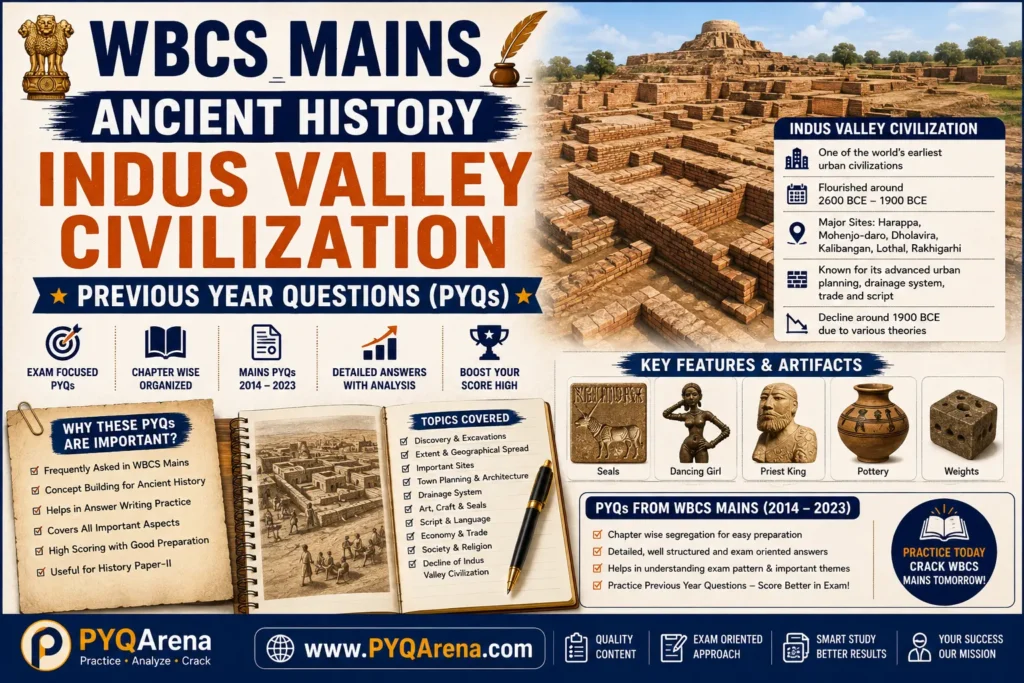
WBCS Mains Indus Valley Civilization Questions 2023
Q. Lothal is located at
(A) Rajasthan
(B) Uttar Pradesh
(C) Gujarat
(D) Hariyana
Answer & Explanation
Correct Answer: (C) Gujarat
Explanation
Lothal is an important Harappan Civilization (Indus Valley Civilization) site located in Gujarat, near the Gulf of Khambhat. It is particularly famous for its ancient dockyard, which indicates the importance of maritime trade during the Harappan period.
Exam Facts
- Lothal is located in Gujarat, near the village of Saragwala in Ahmedabad district.
- It was excavated by S. R. Rao during the 1950s.
- Lothal is famous for its ancient dockyard, considered evidence of Harappan maritime trade.
- The site was an important centre of trade and commerce, with links to regions outside the Indus Valley.
- Lothal had a bead-making industry, and objects made of copper, bronze, ivory and semi-precious stones have been found there.
- Other important Harappan sites in Gujarat include Dholavira, Surkotada and Rangpur.
WBCS Mains Indus Valley Civilization Questions 2022
Q. Mohenjodaro and Harappa belong to
(A) Egyptian civilization
(B) Sumerian civilization
(C) Mesopotamian civilization
(D) Indus valley civilization
Answer & Explanation
Correct Answer: (D) Indus Valley Civilization
Explanation
Mohenjodaro and Harappa were two major urban centres of the Indus Valley Civilization (Harappan Civilization). Harappa is located in present-day Pakistan’s Punjab region, while Mohenjodaro is located in Sindh. Both sites are known for their advanced urban planning, drainage systems, standardized weights and measures, and craft production.
Want more exam facts on this question? Get the WBCS Mains Indian History PYQ PDF
Q. What was importance of Lothal?
(A) Port
(B) Granary
(C) Zoo
(D) Market
Answer & Explanation
Correct Answer: (A) Port
Explanation
Lothal was an important maritime trade centre and port town of the Indus Valley Civilization. It is especially famous for its ancient dockyard, which provides evidence of the Harappans’ advanced knowledge of maritime trade and water management.
Want more exam facts on this question? Get the WBCS Mains Indian History PYQ PDF
Q. Where was the figure of the dancing girl to be found?
(A) Indus valley
(B) Araku valley
(C) Kashmir valley
(D) Nubra valley
Answer & Explanation
Correct Answer: (A) Indus Valley
Explanation
The famous Dancing Girl was discovered at Mohenjodaro, an important site of the Indus Valley (Harappan) Civilization. It is a small bronze statue, made using the lost-wax casting technique, and represents the advanced metalworking skills of the Harappans.
Want more exam facts on this question? Get the WBCS Mains Indian History PYQ PDF
WBCS Mains Indus Valley Civilization Questions 2021
Q. Which of the following statements is true of the Harappan civilisation? (i) Harappan civilisation comprised of a network of urban constellations drawing on the agricultural surplus generated by the surrounding countryside. (ii) The Harappans seem to have flourishing trade relation with Sumeria and Egypt. (iii) The seals are suspected to be connected with trading activities of the Harappans. (iv) Overland trade rested primarily on bullock and horse-drawn carriages. (v) Some deities akin to the mother-goddess and Pashupati seem to have been popular.
(A) (i), (ii), (iii)
(B) (i), (ii), (iii), (v)
(C) (ii), (iv), (v)
(D) (iii), (iv)
Answer & Explanation
Correct Answer: (B) (i), (ii), (iii), (v)
Explanation
Statements (i), (ii), (iii), and (v) are correct. The Harappan Civilization developed a network of urban settlements supported by agricultural production in the surrounding countryside. The Harappans maintained long-distance trade, particularly with Mesopotamia/Sumer, while their seals were probably associated with trade, identification and the movement of goods. Archaeological evidence also suggests the popularity of religious figures or cults resembling the Mother Goddess and Pashupati.
Statement (iv) is incorrect because bullock carts and pack animals were important for land transport, but the evidence does not support the claim that overland trade rested primarily on horse-drawn carriages. Horse evidence in the Harappan context is limited and debated.
Want more exam facts on this question? Get the WBCS Mains Indian History PYQ PDF
WBCS Mains Indus Valley Civilization Questions 2020
Q. “The most unique feature of this site is its dockyard; the world’s first tidal port, which served as a main seaport for the Indus people”. The above statement holds true for which site?
(A) Ropar
(B) Lothal
(C) Rakhigarhi
(D) Banawali
Answer & Explanation
Correct Answer: (B) Lothal
Explanation
Lothal, located in Gujarat, was an important maritime centre of the Harappan Civilization. It is particularly famous for its dockyard, which is widely regarded as evidence of the Harappans’ advanced maritime and hydraulic engineering and their involvement in long-distance trade.
Want more exam facts on this question? Get the WBCS Mains Indian History PYQ PDF
Q. Kalibangan is located at
(A) Gujarat
(B) Rajasthan
(C) Himachal Pradesh
(D) Punjab
Answer & Explanation
Correct Answer: (B) Rajasthan
Explanation
Kalibangan is an important archaeological site of the Indus Valley (Harappan) Civilization, located in Hanumangarh district of Rajasthan, on the banks of the Ghaggar River. The site is particularly famous for evidence of an early ploughed agricultural field and fire altars.
Want more exam facts on this question? Get the WBCS Mains Indian History PYQ PDF
Q. The Indian who was involved in the excavations of Harappa and Mohenjodaro is
(A) S. D. Rathore
(B) K. K. Menon
(C) R. D. Banerjee
(D) R. D. Sharma
Answer & Explanation
Correct Answer: (C) R. D. Banerjee
Explanation
Rakhal Das Banerjee (R. D. Banerji) was a prominent Indian archaeologist of the Archaeological Survey of India (ASI). He is credited with identifying and excavating the remains of Mohenjodaro in 1922, which played a crucial role in the recognition of the Indus Valley Civilization. He also worked at Harappa during his archaeological career.
Want more exam facts on this question? Get the WBCS Mains Indian History PYQ PDF
Q. Which of the following is the biggest Harappan civilization site?
(A) Ropar
(B) Lothal
(C) Kalibangan
(D) Rakhigarhi
Answer & Explanation
Correct Answer: (D) Rakhigarhi
Explanation
Rakhigarhi, located in Hisar district of Haryana, is regarded as the largest known Harappan Civilization site in India and one of the largest settlements of the entire Harappan cultural sphere. Excavations have revealed extensive remains of planned habitation, drainage systems, streets, craft-production areas and burials.
Want more exam facts on this question? Get the WBCS Mains Indian History PYQ PDF
WBCS Mains Indus Valley Civilization Questions 2019
Q. Which of the following is not a feature of Lothal?
(A) Discovery of a dockyard
(B) Rectangular and circular fire alters for animal sacrifice
(C) Depiction of a ship on a seal
(D) Evidence of the use of the plough
Answer & Explanation
Correct Answer: (D) Evidence of the use of the plough
Explanation
Evidence of the use of the plough is particularly associated with Kalibangan in Rajasthan, where archaeologists discovered the remains of a ploughed agricultural field. Lothal, in contrast, is famous for its dockyard, maritime trade, and evidence of craft and commercial activities. A ship depiction on a seal has also been found at Lothal.
Want more exam facts on this question? Get the WBCS Mains Indian History PYQ PDF
WBCS Mains Indus Valley Civilization Questions 2018
Q. Which one among the Harappan sites was probably a trading outpost meant for procuring lapis-lazuli?
(A) Shortugai
(B) Musa Khel
(C) Mundigak
(D) Damb Sadat
Answer & Explanation
Correct Answer: (A) Shortugai
Explanation
Shortugai was a Harappan trading settlement located in northern Afghanistan, near the Oxus (Amu Darya) region. It is believed to have served as a trading outpost that helped the Harappans obtain valuable raw materials, particularly lapis lazuli, from the mines of Badakhshan.
Want more exam facts on this question? Get the WBCS Mains Indian History PYQ PDF
WBCS Mains Indus Valley Civilization Questions 2017
Q. Among the Bronze Age Civilizations which one was undoubtedly the largest in extent?
(A) Egyptian
(B) Mesopotamian
(C) Harappan
(D) Mehargarh
Answer & Explanation
Correct Answer: (C) Harappan
Explanation
The Harappan Civilization was the most extensive of the major Bronze Age civilizations in terms of geographical spread. At its mature phase, it covered a vast area extending from Afghanistan in the northwest to western Uttar Pradesh in the east, and from Jammu in the north to Gujarat in the south. Its estimated area was around 1.3 million square kilometres.
Want more exam facts on this question? Get the WBCS Mains Indian History PYQ PDF
Q. The ruins of Harappa were first noticed by
(A) M.S. Vats
(B) M. Wheeler
(C) B.B. Lal
(D) Charles Mason
Answer & Explanation
Correct Answer: (D) Charles Masson
Explanation
The ruins of Harappa were first noticed by Charles Masson, an English traveller and antiquarian, during his travels in the 1830s. He described the ancient ruins and mounds at Harappa in his writings. However, systematic archaeological excavation at Harappa began much later under Daya Ram Sahni in 1921, which helped establish the importance of the site.
Want more exam facts on this question? Get the WBCS Mains Indian History PYQ PDF
Q. The urban centres of the Harappan Civilisation faded out around
(A) 2200 BC
(B) 2100–2000 BC
(C) 2000–1900 BC
(D) 1800–1750 BC
Answer & Explanation
Correct Answer: (C) 2000–1900 BC
Explanation
The major urban centres of the Harappan Civilization began to decline and fade out around 2000–1900 BCE. This marked the end of the Mature Harappan urban phase, although Harappan cultural traditions continued in several regions for centuries afterward. The decline was gradual rather than a sudden disappearance of the civilization.
Want more exam facts on this question? Get the WBCS Mains Indian History PYQ PDF
WBCS Mains Indus Valley Civilization Questions 2016
Q. Which archaeologist has recently contested the identification of impressive brick-built structure at Harappa as a ‘Granary’?
(A) R.E.M. Wheeler
(B) Bridget Allchin
(C) Raymond Allchin
(D) J.M. Kenoyer
Answer & Explanation
Correct Answer: (D) J. M. Kenoyer
Explanation
J. M. Kenoyer (Jonathan Mark Kenoyer) has questioned the traditional identification of the large brick-built structure at Harappa as a “Granary.” Excavations and subsequent analysis did not reveal convincing evidence such as stored grain or storage vessels. Kenoyer and other researchers therefore suggest that it may have been a large public or monumental building, rather than a granary.
Want more exam facts on this question? Get the WBCS Mains Indian History PYQ PDF
Q. Which civilization was undoubtedly the largest in extent among the Bronze age civilizations?
(A) The Harappan civilization
(B) Egyptian civilization
(C) Mesopotamian civilization
(D) Roman civilization
Answer & Explanation
Correct Answer: (A) The Harappan Civilization
Explanation
The Harappan Civilization was the most extensive in geographical spread among the major Bronze Age civilizations. At its mature stage, it covered approximately 1.3 million square kilometres, extending across parts of present-day Pakistan and northwestern and western India. Its enormous geographical extent makes it one of the largest known Bronze Age cultural regions.
Want more exam facts on this question? Get the WBCS Mains Indian History PYQ PDF
Q. Who considered the Harappan crafts “technically the peer of the rest” among products of the Bronze Age?
(A) Gordon Childe
(B) Shereen Ratnagar
(C) R.S. Bisht
(D) Asco Parpola
Answer & Explanation
Correct Answer: (B) Shereen Ratnagar
Explanation
Shereen Ratnagar, an eminent Indian archaeologist and historian of the Harappan Civilization, described Harappan crafts as “technically the peer of the rest” among the products of the Bronze Age. Her observation highlights the high level of technical skill and craftsmanship achieved by the Harappans in metallurgy, pottery, bead-making, jewellery and other specialized crafts.
Want more exam facts on this question? Get the WBCS Mains Indian History PYQ PDF
WBCS Mains Indus Valley Civilization Questions 2015
Q. According to the latest excavations, Manda is the __________ site of the Indus civilization?
(A) Northernmost
(B) Southernmost
(C) Easternmost
(D) Westernmost
Answer & Explanation
Correct Answer: (A) Northernmost
Explanation
Manda is considered the northernmost site of the Harappan (Indus) Civilization. It is located near the Chenab River in Jammu and Kashmir, and represents the northern extension of the Harappan cultural zone.
Want more exam facts on this question? Get the WBCS Mains Indian History PYQ PDF
Q. The Harappan bricks were mainly
(A) Sawn with the help of a saw-like instrument
(B) Made in an open mould
(C) Hand-made
(D) Cut with the help of a chisel
Answer & Explanation
Correct Answer: (B) Made in an open mould
Explanation
Harappan bricks were generally standardized and mould-made, rather than individually shaped by hand or cut using tools. The use of moulds enabled the Harappans to produce bricks of uniform size and shape, which contributed to their well-planned urban architecture.
Want more exam facts on this question? Get the WBCS Mains Indian History PYQ PDF
Q. Which of the following is the main reason for the development of towns in the Harappan period?
(A) Development of Science and technology
(B) Development of Arts and crafts
(C) Growth of Trade and commerce
(D) Increase in Agrarian surplus
Answer & Explanation
Correct Answer: (D) Increase in Agrarian Surplus
Explanation
The development of urban centres during the Harappan period was closely linked to the production of an agricultural surplus. Surplus food production supported people engaged in non-agricultural occupations such as craft production, trade, administration and other specialized activities. This economic foundation helped sustain large and well-planned urban settlements.
Want more exam facts on this question? Get the WBCS Mains Indian History PYQ PDF
Q. Which of the following were the main items of export of the Indus people? (i) Gold and Silver (ii) Cotton goods (iii) Terracottas (iv) Seals (v) Pottery
(A) ii, iii and v
(B) i, iii and iv
(C) i, ii, iv and v
(D) All of them
Answer & Explanation
Correct Answer: (A) ii, iii and v
Explanation
The major export items associated with the Indus/Harappan people included cotton goods, terracotta objects and pottery. The Harappans maintained extensive trade networks with Mesopotamia, Oman, Bahrain and other regions. Gold and silver were valuable materials that the Harappans generally obtained through trade rather than exporting as major finished commodities. Seals were primarily associated with identification, administration and trade-related activities, rather than being a major export commodity.
Want more exam facts on this question? Get the WBCS Mains Indian History PYQ PDF
Q. Which one of the following types of Harappan pottery is said to be the earliest example of its kind in the world?
(A) Polychrome
(B) Glazed
(C) Perforated
(D) Knobbed
Answer & Explanation
Correct Answer: (B) Glazed
Explanation
Glazed pottery found in the Harappan Civilization is considered one of the earliest known examples of glazed pottery in the world. Harappan craftsmen developed a primitive form of glazing using materials such as alkaline salts and mineral pigments, producing a coloured, glass-like surface on pottery and other objects.
Want more exam facts on this question? Get the WBCS Mains Indian History PYQ PDF
Q. Who among the following archeologists has been claiming that he was successfully deciphered the Indus script, though others have not accepted the claim?
(A) M.E.M. Wheeler
(B) Gordon Childe
(C) K.M. Srivastava
(D) S.R. Rao
Answer & Explanation
Correct Answer: (D) S. R. Rao
Explanation
S. R. Rao (Seshadri R. Rao) was a prominent Indian archaeologist who claimed to have deciphered the Indus script. He proposed that the script represented an early form of an Indo-Aryan language and attempted to relate it to later Indian scripts. However, his proposed decipherment has not been generally accepted by other scholars, and the Indus script remains undeciphered.
Want more exam facts on this question? Get the WBCS Mains Indian History PYQ PDF
Leave a Comment