

Who is this for? Beginners starting from zero, and aspirants for UPSC Prelims, WBCS, other State PSCs and SSC. Every section starts with an “In simple words” explanation and then gives exam-level detail. Practise alongside: WBCS Mains Indus Valley Civilization PYQs | WBCS Prelims Ancient Indian History PYQs | Previous chapter: Prehistoric India Notes
1. What is the Indus Valley (Harappan) Civilization?
In simple words: About 4,500 years ago, people in the north-west of the subcontinent built planned cities with brick houses, straight roads and covered drains. They traded as far away as Iraq. This was India’s first urban (city) civilisation.
- It is called the Indus Valley Civilization because the first sites were found along the Indus river system.
- It is called the Harappan Civilization after Harappa, the first site to be excavated. Archaeologists name a culture after its first-discovered site. “Harappan” is the term preferred today because the civilisation spread far beyond the Indus valley.
- It is also called the Sindhu–Sarasvati Civilization, because many sites lie along the Ghaggar–Hakra river, identified with the Vedic Sarasvati.
- Age: It belongs to the Bronze Age. It is also classed as Chalcolithic, meaning copper and stone were used together. → PYQ: WBCS Prelims 2002
- It was urban, not rural. → PYQ: WBCS Prelims 2006
- It was the largest in area among the Bronze Age civilisations, bigger than Egypt and Mesopotamia combined. → PYQ: WBCS Mains 2016, 2017
- Mohenjo-daro and Harappa belong to the Indus Valley Civilization, not to the Egyptian, Sumerian or Mesopotamian civilisations. → PYQ: WBCS Mains 2022
- The history of organised trade in India begins with the Harappans. → PYQ: WBCS Mains 2016
2. Discovery & Naming
In simple words: British travellers noticed the ruins in the 1800s. Indian archaeologists excavated the two big cities in 1921–22. John Marshall then told the world about a “new” ancient civilisation.
| Year | Event |
|---|---|
| 1826 | Charles Masson is the first person known to have noticed the ruins of Harappa. → PYQ: WBCS Mains 2017 |
| 1853, 1856, 1872–73 | Alexander Cunningham, the “Father of Indian Archaeology” and first DG of the ASI, visits Harappa and publishes the first Harappan seal (1875). → PYQ: WBCS Prelims 2016 |
| 1856 | Railway engineers (the Brunton brothers) use Harappan bricks as ballast for the Lahore–Multan railway line. |
| 1921 | Daya Ram Sahni excavates Harappa (on the Ravi, Sahiwal/Montgomery district, Pakistani Punjab). |
| 1922 | R.D. Banerji (Rakhal Das Bandyopadhyay), a Bengali archaeologist, excavates Mohenjo-daro (on the Indus, Larkana district, Sindh). → PYQ: WBCS Mains 2020 |
| 1924 | Sir John Marshall, DG of the ASI, announces the discovery to the world in the Illustrated London News (20 Sept 1924). |
- Discoverers to remember: Daya Ram Sahni excavated Harappa (1921) and Rakhal Das Banerji excavated Mohenjo-daro (1922). → PYQ: WBCS Prelims 2009
- atch-the-following favourite → PYQ: WBCS Prelims 2022:
- Kot Diji: G.S. Ghurye (1935) and F.A. Khan (1955).
- Harappa: Daya Ram Sahni.
- Kalibangan: first noticed by the Italian Indologist Luigi Pio Tessitori, then excavated by A. Ghosh, B.B. Lal and B.K. Thapar.
- Mohenjo-daro: R.D. Banerji.
- Other names to know:
- Ernest Mackay excavated Mohenjo-daro and Chanhudaro.
- M.S. Vats excavated Harappa.
- Mortimer Wheeler excavated Harappa in 1946.
- S.R. Rao excavated Lothal.
- R.S. Bisht excavated Dholavira and Banawali.
- J.P. Joshi discovered Dholavira, Surkotada and Manda.
3. Chronology & Phases
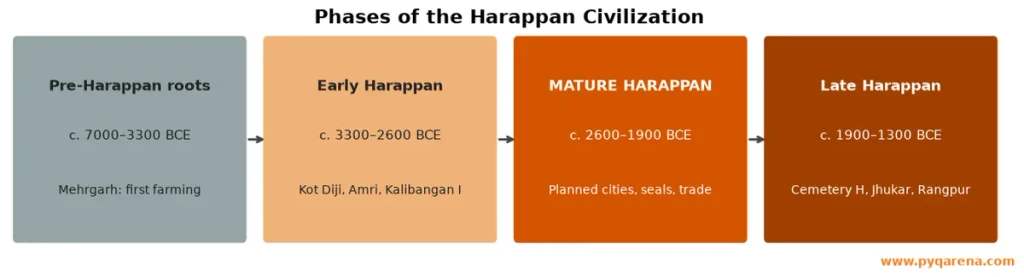
In simple words: The civilisation grew slowly (Early phase), reached its peak (Mature phase), and then its cities faded into village cultures (Late phase).
| Phase | Approx. date | What happened |
|---|---|---|
| Pre-Harappan / Neolithic roots | c. 7000–3300 BCE | Farming villages such as Mehrgarh (Balochistan), the earliest farming site in the subcontinent. → PYQs |
| Early Harappan | c. 3300–2600 BCE | Fortified towns: Kot Diji, Amri, Kalibangan I, Rehman Dheri, Banawali I, Kunal |
| Mature Harappan (urban peak) | c. 2600–1900 BCE | Planned cities, seals, script, long-distance trade |
| Late Harappan | c. 1900–1300 BCE | Cities decline; regional village cultures (Cemetery H, Jhukar, Rangpur) |
- Different dates proposed over time (a favourite UPSC/WBCS point):
- John Marshall: 3250–2750 BCE.
- Mortimer Wheeler: 2500–1500 BCE.
- D.P. Agrawal (radiocarbon, C-14): about 2300–1750 BCE.
- Current dating: 2600–1900 BCE for the Mature phase.
- The urban centres faded out around 2000–1900 BC. → PYQ: WBCS Mains 2017
- Bhirrana (Haryana): a 2016 IIT-Kharagpur/ASI study dated its earliest levels to about 8,000 years ago.
- Mehrgarh is often called the “oldest civilisation of India” in State PSC papers. It is a pre-Harappan farming culture. → PYQ: WBPSC Clerkship 2009
4. Geographical Extent & Boundary Sites
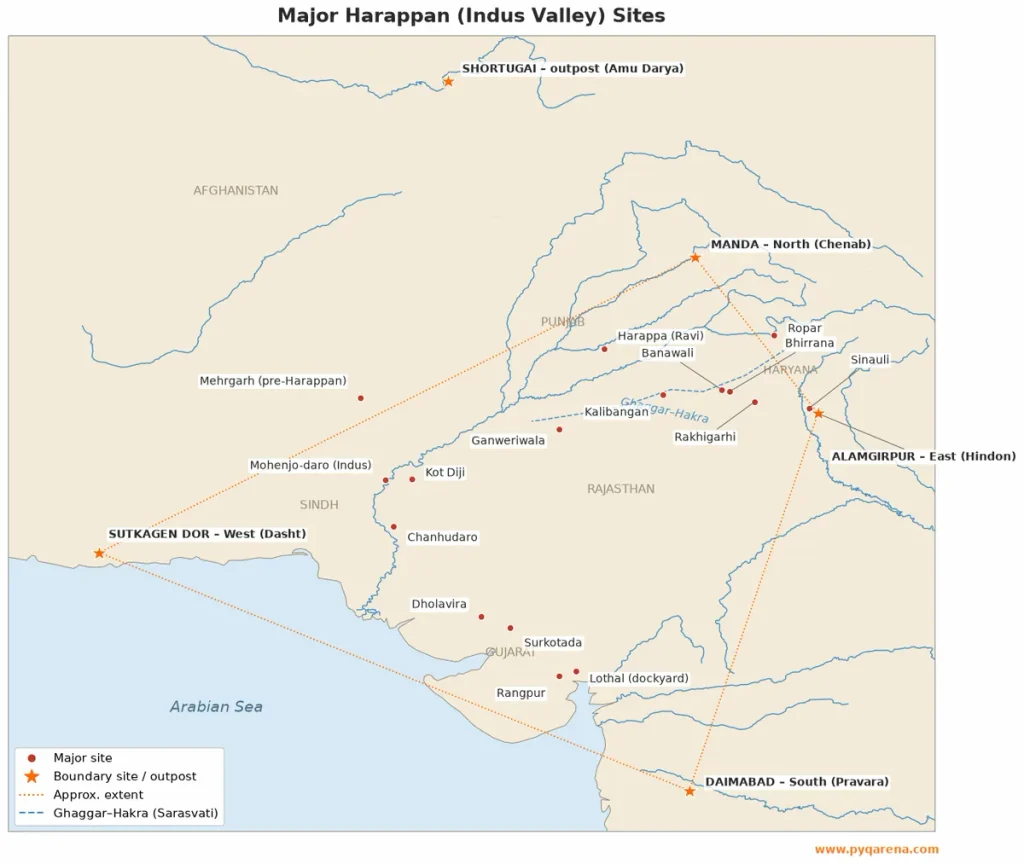
In simple words: The civilisation covered a huge triangle-shaped area. It stretched from Jammu in the north to Maharashtra in the south, and from the Iran border in the west to Meerut in the east.
- Area: about 1.3 million sq km. That is larger than ancient Egypt and Mesopotamia put together.
- Countries today: India, Pakistan and Afghanistan (Shortugai). Most of the sites are now in India, especially in the Ghaggar–Hakra basin (Haryana, Rajasthan, Punjab) and Gujarat.
- Number of sites: more than 1,500 (some estimates exceed 2,000). Only a few were true cities.
| Direction | Site | River | Present location |
|---|---|---|---|
| Northernmost | Manda | Chenab | Akhnoor, Jammu (J&K). → PYQ: WBCS Mains 2015 |
| Southernmost | Daimabad | Pravara (Godavari tributary) | Ahmednagar, Maharashtra |
| Easternmost | Alamgirpur | Hindon (Yamuna tributary) | Meerut, Uttar Pradesh |
| Westernmost | Sutkagen Dor | Dasht | Makran coast, Balochistan (near the Iran border) |
| Outpost far north | Shortugai | Amu Darya (Oxus) | Afghanistan. Trading post for lapis lazuli. → PYQ: WBCS Mains 2018 |
Memory trick: “My Dear Aunt Sita”. This gives Manda (North), Daimabad (South), Alamgirpur (East) and Sutkagen Dor (West), in the order N–S–E–W.
5. Major Sites: The Master Table
| Site | River | State / Country | Discovered / excavated by (year) | Key findings |
|---|---|---|---|---|
| Harappa | Ravi | Punjab (Pakistan) | Daya Ram Sahni (1921); later M.S. Vats, Wheeler | Two rows of 6 “granaries” (J.M. Kenoyer questioned their use as granaries; PYQ 2016), working floors, Cemetery R-37, Cemetery H (late), coffin burial, red sandstone male torso |
| Mohenjo-daro (“Mound of the Dead”) | Indus | Sindh (Pakistan) | R.D. Banerji (1922) | Great Bath, Great Granary (largest building), assembly hall, Dancing Girl, Priest-King, Pashupati seal, woven cotton fragment, bronze buffalo. UNESCO World Heritage Site 1980. → PYQ: Great Bath, WBCS Prelims 2013 |
| Chanhudaro | Indus | Sindh (Pakistan) | N.G. Majumdar (1931); E. Mackay (1935) | Bead-making factory, the only city without a citadel, ink-pot, footprints of a dog chasing a cat |
| Kalibangan (“black bangles”) | Ghaggar | Hanumangarh, Rajasthan | Tessitori noticed it; A. Ghosh (1953); B.B. Lal & B.K. Thapar (1961–69) | Ploughed field (Early Harappan), fire altars, both citadel and lower town fortified, evidence of an earthquake. → PYQ: WBCS Mains 2020; Prelims 2017 |
| Lothal | Bhogavo (near Sabarmati, Gulf of Khambhat) | Ahmedabad, Gujarat | S.R. Rao (1954–57) | Dockyard (the world’s earliest known tidal dock), rice husk, bead factory, fire altars, ship depicted on a seal/terracotta, Persian Gulf seal, double (joint) burial, doors opening onto the main street. → PYQs: WBCS Mains 2019–2023 |
| Dholavira | Between the Mansar and Manhar streams, Khadir Bet island, Rann of Kutch | Kutch, Gujarat | J.P. Joshi (1967–68); R.S. Bisht (1989–2005) | Three-part city (citadel, middle town, lower town), water reservoirs, a “stadium”/ceremonial ground, the largest Harappan inscription (a “signboard” of 10 signs). UNESCO 2021. → PYQ: PSC Misc 2019 |
| Surkotada | — | Kutch, Gujarat | J.P. Joshi (1964) | Horse remains; fortified settlement |
| Rakhigarhi | Ghaggar/Chautang (Drishadvati) basin | Hisar, Haryana | Suraj Bhan (1963); Amarendra Nath (1997–2000); Vasant Shinde (2015–) | Largest Harappan site in India (also among the largest overall), ancient DNA study 2019. → PYQ: WBCS Mains 2020 |
| Banawali | Ghaggar (Sarasvati) | Fatehabad, Haryana | R.S. Bisht (1974) | Terracotta toy plough, good quality barley, radial streets |
| Bhirrana | Ghaggar | Fatehabad, Haryana | L.S. Rao (2003–06) | A dancing-girl-like figure drawn on pottery; very early dates |
| Ropar (Rupnagar) | Sutlej | Punjab (India) | Y.D. Sharma (1953–56) | First Harappan site excavated after Independence; a dog buried with a human |
| Kot Diji | Indus | Sindh (Pakistan) | G.S. Ghurye (1935); F.A. Khan (1955) | Early Harappan fortified town |
| Amri | Indus | Sindh (Pakistan) | N.G. Majumdar (1929) | Pre-/Early Harappan to Harappan transition; rhinoceros evidence |
| Sutkagen Dor | Dasht | Balochistan (Pakistan) | Aurel Stein (1927); G. Dales (1962) | Westernmost; coastal trading post |
| Alamgirpur | Hindon | Meerut, UP | Y.D. Sharma (1958) | Easternmost; late Harappan |
| Manda | Chenab | Jammu, J&K | J.P. Joshi (1976–77) | Northernmost |
| Daimabad | Pravara | Ahmednagar, Maharashtra | B.P. Bopardikar (1958); S.A. Sali (1976–79) | Southernmost; bronze hoard (chariot with rider, elephant, rhinoceros, buffalo) |
| Rangpur | Bhadar | Gujarat | M.S. Vats (1931); S.R. Rao (1953–54) | Rice husk; Late Harappan |
| Shortugai | Amu Darya | Afghanistan | French mission, H.-P. Francfort (1975–77) | Lapis lazuli trading outpost; canal irrigation |
| Sinauli | Near the Yamuna / Hindon | Baghpat, UP | ASI (2005–06; 2018) | Copper-covered “chariots”, swords and coffin burials, c. 2000–1800 BCE. These are contemporary with the Late Harappan/OCP phase |
| Ganweriwala | Ghaggar–Hakra | Cholistan, Punjab (Pakistan) | M.R. Mughal (1970s) | One of the five largest cities; not yet excavated |
Rivers and sites (often asked): – Harappa sits on the Ravi. Remember “HaRa = Harappa–Ravi”. – Mohenjo-daro and Chanhudaro are on the Indus. – Kalibangan and Banawali are on the Ghaggar. – Ropar is on the Sutlej. Lothal is on the Bhogavo. – Exam trap: Harappa and Mohenjo-daro are not both on the Ravi. Chanhudaro is in Sindh, not Rajasthan. Lothal is not on the Narmada. Surkotada and Dholavira are both in Kutch, Gujarat (this is the correct statement). → PYQ: WBCS Prelims 2020
Sites by present state (asked very often): – Gujarat: Lothal, Dholavira, Surkotada, Rangpur, Rojdi, Desalpur, Kuntasi, Bagasra. Banawali is NOT in Gujarat; it is in Haryana. → PYQ: WBCS Prelims 2018 | Lothal is in Gujarat. → PYQ: WBCS Mains 2023 – Rajasthan: Kalibangan, Balathal, Karanpura. → PYQ: WBCS Prelims 2017; Mains 2020 – Haryana: Rakhigarhi, Banawali, Bhirrana, Kunal, Mitathal, Farmana. – Punjab (India): Ropar, Sanghol. UP: Alamgirpur, Sinauli, Hulas. J&K: Manda. Maharashtra: Daimabad. – Pakistan: Harappa, Mohenjo-daro, Chanhudaro, Kot Diji, Amri, Sutkagen Dor, Ganweriwala.
6. Town Planning & Drainage
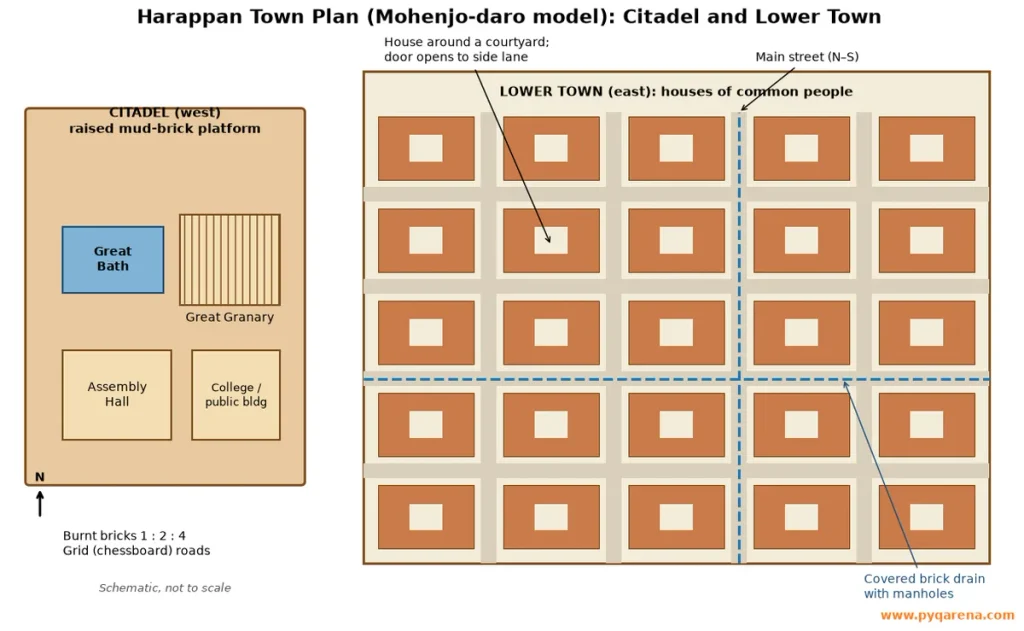
In simple words: The cities were planned before they were built. Streets ran in straight lines and crossed at right angles, like a chessboard. Every house had a bathroom connected to covered drains. No other civilisation of that time had drainage this good.
- Grid (chessboard) pattern: the main streets run north–south and east–west and cut each other at right angles.
- Two parts:
- A raised Citadel (acropolis) on the west, which held public buildings and possibly the rulers’ quarters.
- A larger Lower Town on the east, where the common people lived.
- Exceptions:
- Dholavira had three parts.
- Chanhudaro had no citadel.
- At Kalibangan both parts were fortified.
- At Lothal the citadel and the lower town were inside one fortification.
- Bricks: burnt (baked) bricks of a standard 1 : 2 : 4 ratio (thickness : width : length). They were made in open moulds, not hand-made or cut. → PYQ: WBCS Mains 2015 Sun-dried mud bricks were also used, especially in Gujarat and Rajasthan. Dholavira used stone.
- Houses: built around a courtyard. Doors and windows opened onto side lanes, not the main road; Lothal is the exception. Many houses had wells, and Mohenjo-daro had about 700 wells. Some houses had two storeys.
- Drainage: covered brick drains with manholes (inspection holes) and soak-pits. Drains from houses joined the street drains. This is seen as the civilisation’s most remarkable feature.
- No temples, no palaces have been clearly identified.
7. Great Bath, Granary & Dockyard (the big three structures)
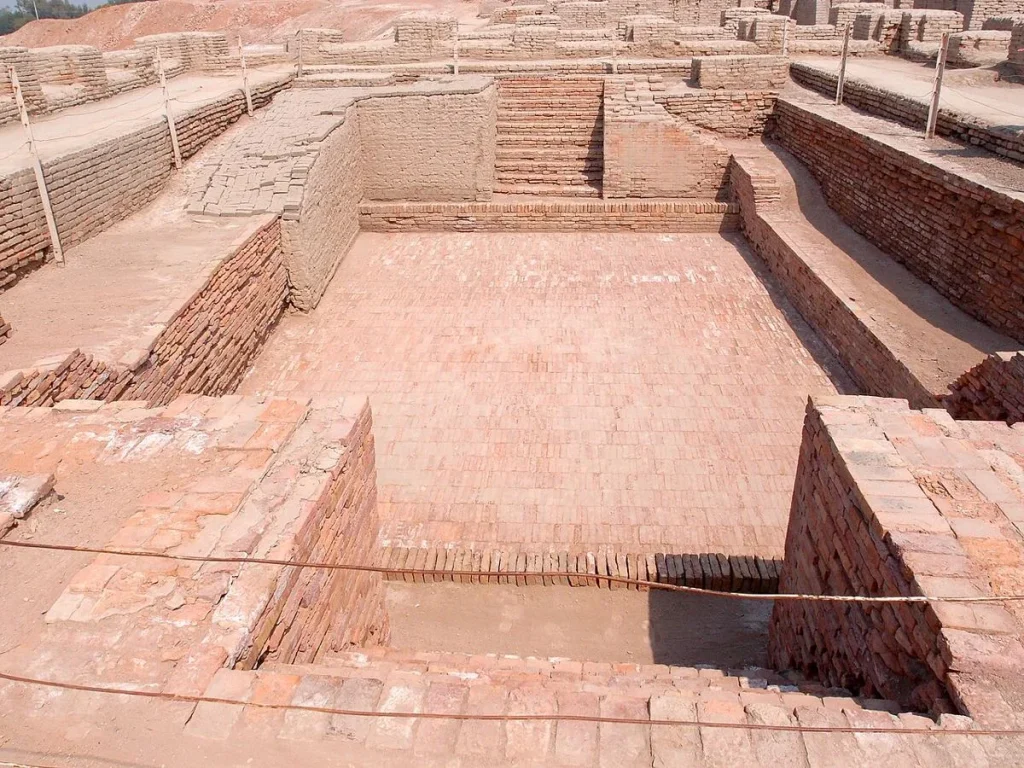
Image Source: Wikimedia
| Structure | Site | Facts |
|---|---|---|
| Great Bath | Mohenjo-daro (citadel) | About 11.88 m × 7.01 m, 2.43 m deep. Burnt bricks sealed with gypsum mortar and a layer of bitumen. Steps lead down at the north and south ends, with rooms on the sides. Probably used for ritual bathing. Marshall called it “the most imposing structure”. → PYQ: WBCS Prelims 2013 |
| Great Granary | Mohenjo-daro (largest building there); Harappa (two rows of 6 units) | Wheeler identified these buildings as granaries. J.M. Kenoyer and others have challenged this; they may have been halls or warehouses. → PYQ: WBCS Mains 2016 |
| Dockyard | Lothal (Gujarat) | A large brick basin of about 219 m × 37 m (figures from its excavator, S.R. Rao) with a sluice gate. It is called the world’s earliest known tidal dock/port. → PYQs: WBCS Mains 2020, 2022; Prelims 2014, 2015 |
- Lothal’s importance was as a port. → PYQ: WBCS Mains 2022
- Lothal: what it is NOT known for. There is no ploughed field at Lothal; the ploughed field is at Kalibangan. Lothal does have a dockyard, fire altars and a ship on a seal. → PYQ: WBCS Mains 2019
8. Economy: Agriculture, Animals, Trade, Weights
8.1 Agriculture
In simple words: The cities lived on the surplus grain grown by the villages around them. Without that extra food, towns could not have existed. → PYQ: WBCS Mains 2015, 2021
- Main crops: wheat and barley. Others were peas, sesame, mustard, lentils, dates and millets (especially in Gujarat).
- Rice: husks found at Lothal and Rangpur (Gujarat). → PYQ: WBCS Prelims 2016
- Cotton: the Harappans were among the earliest people in the world to grow cotton; the earliest evidence is at Mehrgarh. The Greeks later called cotton “Sindon”, from Sindh. A piece of woven cotton cloth was found at Mohenjo-daro.
- Plough: a ploughed field at Kalibangan (Early Harappan) and terracotta toy ploughs at Banawali and in Cholistan.
- Irrigation: no large canals have been found. They relied on floods and wells, and on small canals at Shortugai. Dholavira had reservoirs.
- Seeds were sown in November after the floods and harvested in April.
8.2 Animals
- Domesticated: humped bull (zebu), buffalo, sheep, goat, pig, dog, cat and camel. They also knew the elephant and rhinoceros.
- Horse: rare. A few remains come from Surkotada, but the horse is not depicted on Harappan seals. → PYQ: WBCS Prelims 2024
- Overland trade used bullock carts and pack animals, not horse-drawn carriages. → PYQ: WBCS Mains 2021
8.3 Metals & Materials
- They knew copper, bronze, tin, lead, gold and silver. Iron was UNKNOWN. → PYQ: WBCS Prelims 2009 | WBPSC Clerkship 2023
- Where materials came from:
- Copper: Khetri (Rajasthan) and Oman.
- Tin: Afghanistan and Iran.
- Gold: Karnataka (Kolar region) and Afghanistan.
- Silver: Afghanistan and Iran.
- Lapis lazuli: Badakhshan (Afghanistan), through Shortugai.
- Turquoise: Iran. Jade: Central Asia.
8.4 Trade
In simple words: Harappans exchanged goods (barter, with no coins) inside India and with Mesopotamia (Sumer, in today’s Iraq), using ships and bullock carts.
- Mesopotamian texts mention “Meluhha”, generally identified with the Harappan region. They also mention Dilmun (Bahrain) and Magan (Oman/Makran) as stops in between.
- Sargon of Akkad (c. 2350 BCE) boasted that ships from Meluhha docked at his capital.
- Harappan seals have been found at Ur, Kish and other Mesopotamian cities, and a Persian Gulf seal was found at Lothal.
- Main foreign trade partner: Sumer, not China or Russia. → PYQ: WBCS Prelims 2010. Trade with Sumer and Egypt is mentioned in a correct statement. → PYQ: WBCS Mains 2021
- Main exports: cotton goods, terracotta items, pottery, beads, ivory and carnelian. Gold and silver were imports, not exports. → PYQ: WBCS Mains 2015
- No coins: trade was by barter.
8.5 Weights & Measures
- Cubical chert weights, standardised across all the sites.
- Binary for small weights (1, 2, 4, 8, 16, 32, 64) and decimal for large ones (160, 320, 640…). 16 was a basic unit; the basic weight was about 13.6–14 g.
- Measuring scales: a shell scale at Mohenjo-daro, an ivory scale at Lothal and a bronze rod at Harappa.
9. Crafts & Technology
- Bronze-making (copper + tin). Statues were made by the lost-wax (cire perdue) method; the Dancing Girl is the best example.
- Bead-making: carnelian, steatite and faience. The main centres were Chanhudaro and Lothal.
- Pottery: wheel-made red pottery with black painted designs (pipal leaves, fish-scale, circles). The site’s PYQ calls glazed pottery the earliest example of its kind in the world. → PYQ: WBCS Mains 2015
- Faience (a glazed paste), shell-working (Balakot, Nageshwar), boat-making, cotton weaving, seal cutting and brick making.
- Shereen Ratnagar described Harappan crafts as “technically the peer of the rest” of the Bronze Age world. → PYQ: WBCS Mains 2016
10. Seals & Script
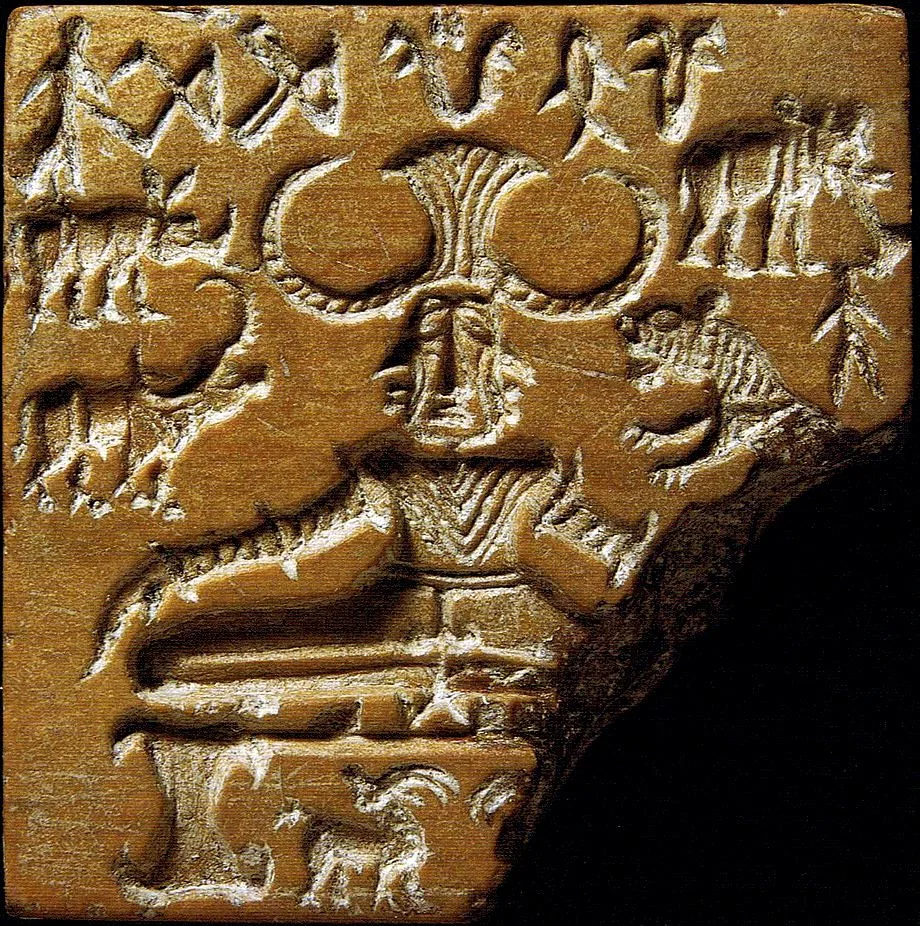
Image Source: Wikimedia
In simple words: Harappans used small stamped stone seals, a bit like company stamps, probably to mark the owner of goods. They also had a writing system that nobody has been able to read yet.
Seals
- More than 2,000 seals have been found. Most are square, made of steatite (soapstone), and carry an animal and a short inscription.
- Most common animal: the unicorn (a one-horned bull). Others include the humped bull, elephant, tiger, rhinoceros, buffalo and goat. The horse is not depicted → PYQ: WBCS Prelims 2024. The cow is also absent.
- Pashupati seal (Mohenjo-daro): a figure sits in a yogic posture, surrounded by an elephant, tiger, rhinoceros and buffalo, with two deer below. Marshall called him “Proto-Shiva”.
- Use: marking goods and trade, identification and possibly religious amulets. → PYQ: WBCS Mains 2021
Script
- It is pictographic, with about 400 signs (Mahadevan listed 417), and is written right to left. Some lines run in alternate directions (“boustrophedon“).
- It is still undeciphered. S.R. Rao attempted a decipherment. → PYQ: WBCS Mains 2015. Asko Parpola and Iravatham Mahadevan argue it records a Dravidian language.
- Largest inscription: the Dholavira “signboard”. → PYQ: PSC Misc 2019
- Oldest deciphered script of the subcontinent is Brahmi, not Harappan. → PYQ: WBCS Mains 2017
11. Religion & Burial
In simple words: No temples have been found. Harappans seem to have worshipped a mother goddess, a male god like Shiva, animals, trees and possibly fire.
- Mother Goddess: many terracotta female figurines. A seal from Harappa shows a plant growing out of a woman’s womb, read as a fertility goddess.
- Pashupati / Proto-Shiva (see above). Mother-goddess and Pashupati-like cults were popular. → PYQ: WBCS Mains 2021
- Linga and yoni-shaped stones, tree worship (pipal), animal worship (humped bull, unicorn), and amulets, which suggest belief in ghosts or evil forces.
- Fire altars: Kalibangan and Lothal.
- Burials:
- Bodies were mostly laid out full length, aligned north–south, with pots.
- Harappa: Cemetery R-37, a coffin burial and Cemetery H (late).
- Lothal: joint (double) burial. Ropar: a dog buried with a human.
- Cremation and fractional burial have also been reported.
12. Art
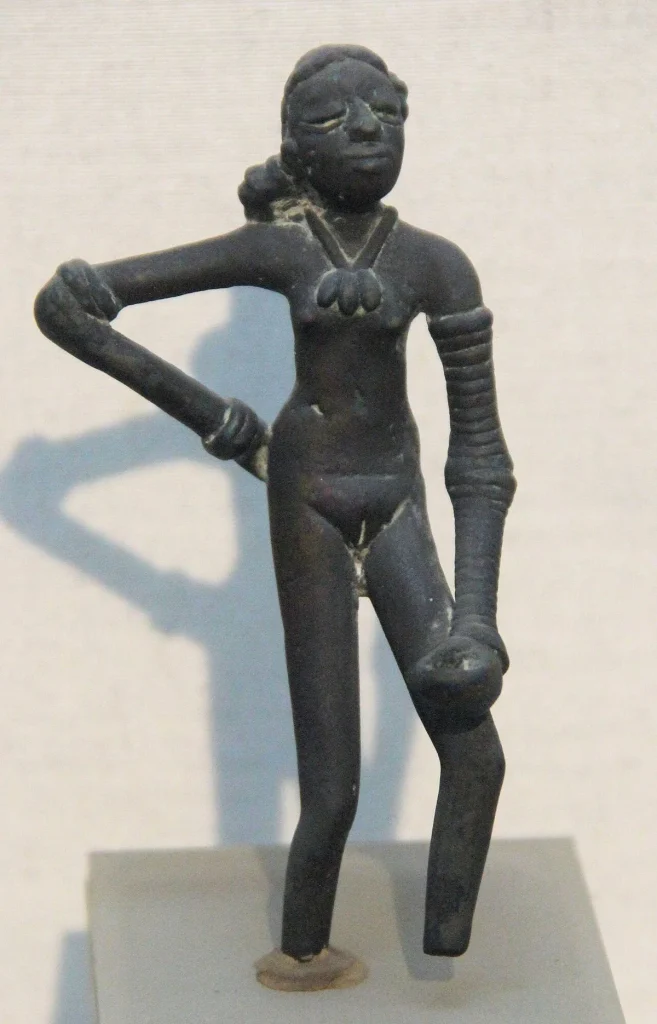
Image Source: Wikimedia
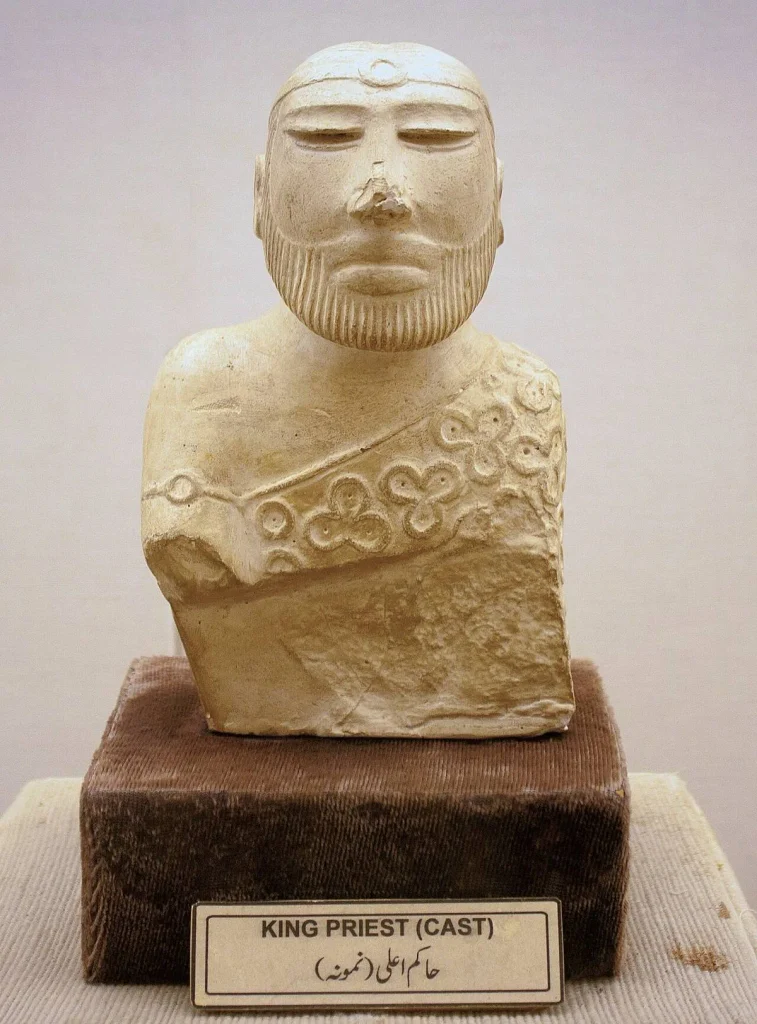
Image Source: Wikimedia
| Artwork | Material | Site | Notes |
|---|---|---|---|
| Dancing Girl | Bronze (lost-wax) | Mohenjo-daro | About 10.5 cm tall; bangles on the left arm, hand on hip. Now in the National Museum, New Delhi. → PYQ: WBCS Mains 2022 |
| Priest-King | Steatite | Mohenjo-daro | Bearded man with a trefoil-patterned shawl and a headband. In the Karachi Museum. |
| Male torso | Red sandstone | Harappa | A realistic nude torso |
| Bronze buffalo, bronze goat | Bronze | Mohenjo-daro | — |
| Bronze chariot/rider, elephant, rhino, buffalo | Bronze | Daimabad | Late Harappan hoard |
| Terracotta figurines and toys | Terracotta | Many sites | Mother goddess, carts with wheels, whistles, animals with moving heads |
13. Society & Polity
- Society: urban, with merchants, artisans and farmers. The uniform weights, bricks and town plans suggest strong central control.
- Polity: No palace or royal tomb has been found.
- Theories:
- Priests ruled (Wheeler; hence the “Priest-King”).
- Merchants ruled.
- The cities were independent city-states.
- There was one empire, suggested by the uniformity.
- Theories:
- Very few weapons have been found. Most scholars see it as a fairly peaceful society.
- Language/people: unknown, because the script is undeciphered. The Rakhigarhi DNA study (see section 16) suggests they descended mainly from local South Asian hunter-gatherers and Iranian-related farmers.
- Sabha and Samiti were Rigvedic (Aryan) institutions, not Harappan. → PYQ: WBCS Prelims 2000
14. Decline (c. 1900 BCE): Theories
In simple words: The cities did not end overnight. Over a few centuries, people left the big cities and went back to village life. Many reasons have been suggested.
| Theory | Proposed by |
|---|---|
| Aryan invasion (“Indra stands accused”) | Mortimer Wheeler. Now rejected: there is no evidence of a massacre |
| Floods | John Marshall, Ernest Mackay, S.R. Rao |
| Tectonic uplift dammed the Indus and flooded Mohenjo-daro | R.L. Raikes, M.R. Sahni |
| Shift or drying of rivers (Ghaggar–Hakra) | H.T. Lambrick (shift of the Indus), D.P. Agrawal & Sood (aridity) |
| Climate change / weaker monsoon (the “4.2 ka event”) | Recent studies, e.g. Liviu Giosan et al. (2012) |
| Ecological imbalance (deforestation, overuse of land) | W.A. Fairservis |
| Decline of trade with Mesopotamia | Shereen Ratnagar and others |
| Epidemic (malaria) | K.V.R. Kennedy |
| Earthquake | Evidence at Kalibangan |
15. Post-Harappan Link to Chalcolithic Cultures
- The Late Harappan phase broke up into regional cultures:
- Cemetery H (Punjab).
- Jhukar (Sindh).
- Rangpur / Lustrous Red Ware (Gujarat).
- OCP (Ochre Coloured Pottery) and the Copper Hoards in the Ganga–Yamuna doab.
- These overlap with the non-Harappan Chalcolithic cultures: Ahar–Banas, Kayatha, Malwa and Jorwe (Daimabad, Inamgaon). They are rural cultures using copper and stone. The Vedic period follows.
- Read more: Prehistoric India Notes (Chalcolithic section)
16. Recent Discoveries & Current Affairs (UPSC favourite)
- Dholavira became a UNESCO World Heritage Site on 27 July 2021. It was India’s 40th World Heritage Site and the first Harappan site in India on the list. Mohenjo-daro in Pakistan has been a UNESCO site since 1980.
- Rakhigarhi DNA (published in Cell, Sept 2019):
- The team included Vasant Shinde, Niraj Rai and David Reich.
- They sequenced ancient DNA from a woman’s skeleton.
- She had no Steppe (Central Asian “Aryan”) ancestry. Her ancestry was a mix of ancient Iranian-related and South Asian hunter-gatherer lineages.
- The study also suggested that farming developed locally.
- Rakhigarhi has been announced as one of five “iconic” archaeological sites (Union Budget 2020).
- Sinauli (Baghpat, UP), 2018: copper-covered wooden “chariots”, swords, shields and coffin burials, dated to about 2000–1800 BCE. They point to a warrior elite.
- Bhirrana dating (2016): about 8,000 years old.
- National Maritime Heritage Complex at Lothal is being developed by the Government of India.
- Biggest Harappan site in India: Rakhigarhi. → PYQ: WBCS Mains 2020
17. Firsts & Frequently Asked Facts
| Question | Answer |
|---|---|
| First Harappan site excavated | Harappa (1921, Daya Ram Sahni) |
| First noticed Harappa ruins | Charles Masson (1826) |
| Indian (Bengali) who excavated Mohenjo-daro | R.D. Banerji (1922) |
| Announced discovery | John Marshall (1924) |
| First site excavated after Independence | Ropar (Punjab) |
| Largest site in India | Rakhigarhi (Haryana) |
| Largest Bronze Age civilisation by area | Harappan |
| Earliest dockyard / port | Lothal |
| Ploughed field | Kalibangan |
| Toy plough | Banawali |
| Rice husk | Lothal, Rangpur |
| Bead factory | Chanhudaro, Lothal |
| Only city without a citadel | Chanhudaro |
| Three-part city; reservoirs; signboard | Dholavira |
| Fire altars | Kalibangan, Lothal |
| Great Bath, Dancing Girl, Priest-King, Pashupati seal | Mohenjo-daro |
| Lapis lazuli outpost | Shortugai (Afghanistan) |
| Metal unknown | Iron |
| Animal not on seals | Horse (also cow) |
| Most common seal animal | Unicorn |
| Script | Pictographic, right to left, undeciphered |
| Brick ratio | 1 : 2 : 4, open-mould, burnt |
| Mesopotamian name for Harappan region | Meluhha |
| Questioned the Harappa “granary” | J.M. Kenoyer |
| “Technically the peer of the rest” | Shereen Ratnagar |
| Attempted decipherment | S.R. Rao |
| Aryan invasion theory of decline | Mortimer Wheeler |
| Earliest farming in the subcontinent (pre-Harappan) | Mehrgarh. → PYQs: WBCS Prelims 2019, 2020, 2022 |
18. Quick-Revision Sheet (read the night before)
- Name: Indus Valley = Harappan (after the first site) = Sindhu–Sarasvati. It was a Bronze Age / Chalcolithic, urban civilisation.
- Dates: Early 3300–2600, Mature 2600–1900, Late 1900–1300 BCE.
- Discovery: Masson (1826), then Cunningham, then Sahni – Harappa 1921, then Banerji – Mohenjo-daro 1922, then Marshall announced 1924.
- Boundaries: “My Dear Aunt Sita” gives Manda (N), Daimabad (S), Alamgirpur (E), Sutkagen Dor (W). The outpost is Shortugai.
- Rivers: Harappa–Ravi; Mohenjo-daro and Chanhudaro–Indus; Kalibangan and Banawali–Ghaggar; Ropar–Sutlej; Lothal–Bhogavo; Manda–Chenab; Daimabad–Pravara; Alamgirpur–Hindon.
- States: Gujarat (Lothal, Dholavira, Surkotada, Rangpur); Rajasthan (Kalibangan); Haryana (Rakhigarhi, Banawali, Bhirrana).
- Town planning: grid, citadel (west) and lower town (east), 1:2:4 burnt bricks, covered drains.
- Economy: wheat and barley; rice at Lothal; cotton; no iron; barter; Meluhha–Sumer trade; binary/decimal weights; 16 as the unit.
- Art: Dancing Girl (bronze), Priest-King (steatite), Pashupati seal, all from Mohenjo-daro.
- Religion: Mother Goddess, Proto-Shiva, trees, animals, fire altars; no temples.
- Decline: many causes. Wheeler’s Aryan invasion theory has been rejected.
- Recent: Dholavira UNESCO 2021; Rakhigarhi DNA 2019; Sinauli 2018.
19. Related PYQs on PYQ Arena
- WBCS Mains Ancient History – Indus Valley Civilization PYQs
- WBCS Prelims Ancient Indian History Previous Year Questions (1999–2024)
- WBCS Mains Ancient History – Stone Age & Miscellaneous PYQs
- WBPSC Miscellaneous Prelims History Questions Year Wise
- WBPSC Clerkship History Previous Year Questions with Answers
- Previous chapter: Prehistoric India Notes
Leave a Comment