

Why it matters: WBCS Prelims, WBCS Mains (Paper V/VI – History) and other PSC papers regularly ask about Stone Age periods, key sites, rock art, early farming and Chalcolithic cultures. Practise as you read: WBCS Mains Stone Age & Miscellaneous PYQs | WBCS Prelims Ancient Indian History PYQs (1999–2024)
1. Introduction & Sources
- Prehistory: the period before writing. All evidence is archaeological (tools, bones, pottery, burials, rock art).
- Protohistory: cultures that had writing nobody can read yet (e.g., Harappan), or that are known from other people’s records. The Chalcolithic cultures are usually put in this group.
- Stone Age divisions: Palaeolithic (Old), Mesolithic (Middle) and Neolithic (New) Stone Age. Then come the Chalcolithic (copper–stone) and Iron Age/Megalithic phases.
- Robert Bruce Foote (Geological Survey of India) found the first Palaeolithic tool in India at Pallavaram, near Chennai (1863). He is called the “Father of Indian Prehistory”.
- Dating methods: radiocarbon (C-14), stratigraphy and typology of tools.
- Alexander Cunningham was the first Director-General of the ASI (founded 1861). He is called the “Father of Indian Archaeology”. Don’t confuse him with Foote, the “Father of Indian Prehistory”. → PYQ: WBCS Prelims 2016
- Historians often asked about: V. Gordon Childe wrote Man Makes Himself (1936) and coined “Neolithic Revolution” (PYQ). D.D. Kosambi (1907–66) pioneered Marxist historiography in India (PYQ).
2. Chronology at a Glance
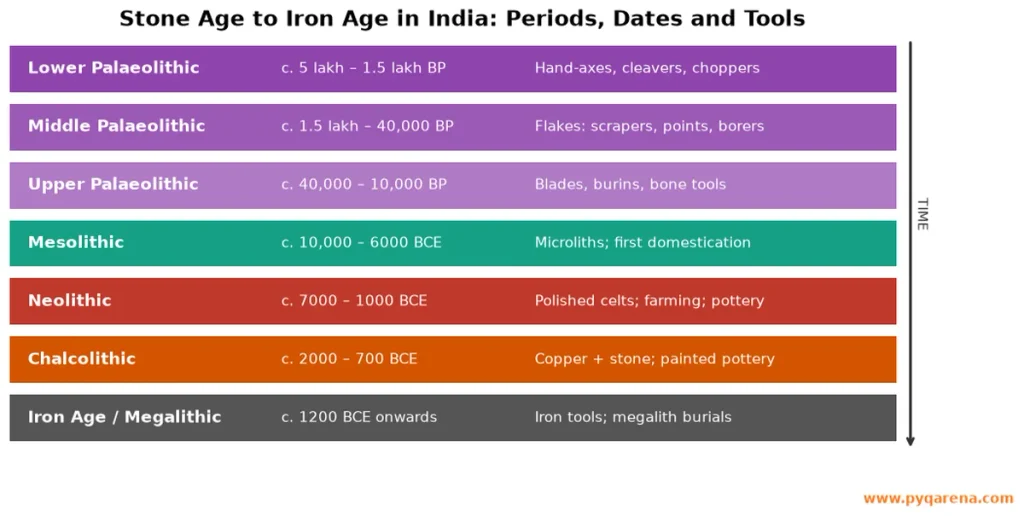
| Age | Approx. time span in India | Key feature |
|---|---|---|
| Lower Palaeolithic | c. 6 lakh/5 lakh – 1.5 lakh BP | Hand-axes, cleavers, choppers; hunting-gathering |
| Middle Palaeolithic | c. 1.5 lakh – 40,000 BP | Flake tools (scrapers, points, borers) |
| Upper Palaeolithic | c. 40,000 – 10,000 BP | Blades, burins; Homo sapiens; early art |
| Mesolithic | c. 10,000 – 6,000 BCE | Microliths; animal domestication begins; rock art |
| Neolithic | c. 7000 BCE (Mehrgarh) onwards; c. 2500–1000 BCE in south & east | Polished stone tools, farming, settled life, pottery |
| Chalcolithic | c. 2000/1800 – 700 BCE (non-Harappan) | Copper + stone, painted pottery, village cultures |
| Iron Age / Megalithic | c. 1200/1000 BCE onwards | Iron tools; megalithic burials (mainly South India) |
BP = Before Present (taken as 1950).
3. Palaeolithic Age (Old Stone Age)
Economy: Food gathering and hunting, nomadic life, no farming, no pottery. People lived in caves and rock shelters and near rivers. Most of the Palaeolithic falls in the Pleistocene (Ice Age).
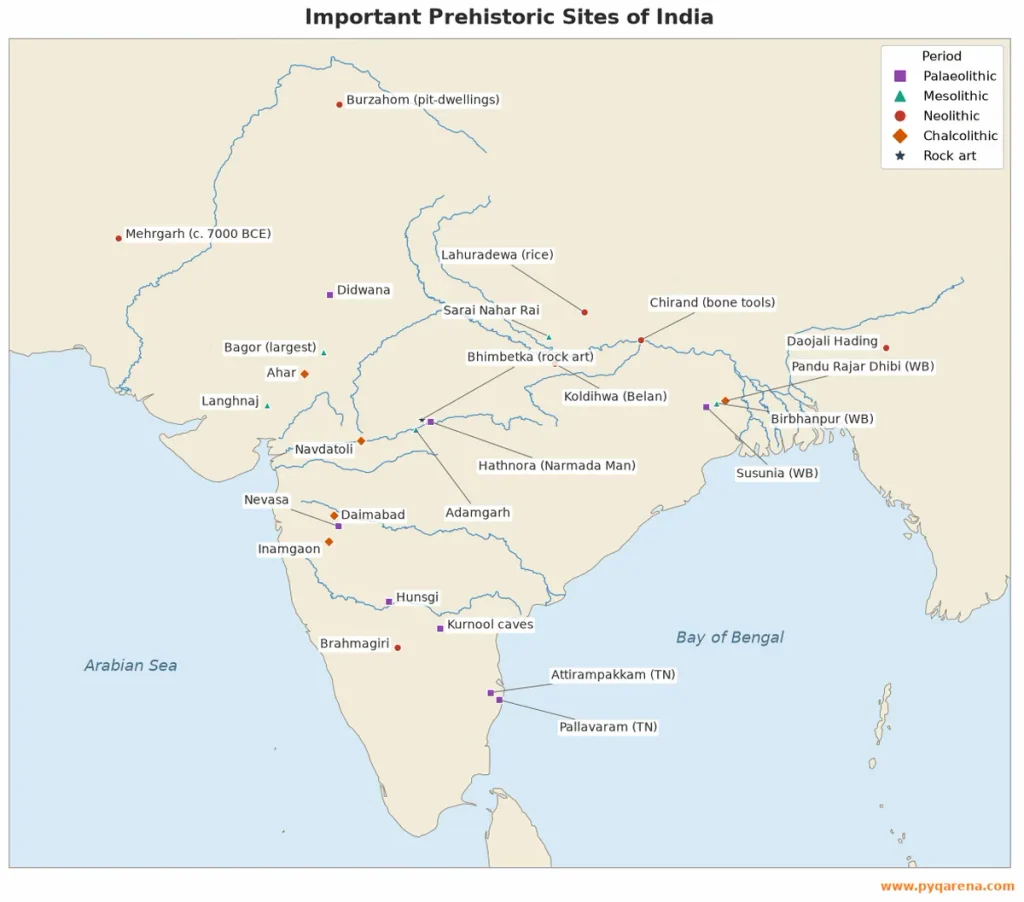
- Earliest known stone tools in the subcontinent come from the Potwar plateau (Pakistan), at Riwat in the Soan region. They are about 1.9 million years old. In India, Attirampakkam (TN) has Acheulian tools dated to about 1.5 million years. → PYQ: WBCS Mains 2017
- Belan valley (Prayagraj/Mirzapur, UP) shows Palaeolithic, Mesolithic and Neolithic in sequence. It was excavated by G.R. Sharma (Allahabad University). → PYQ: WBCS Mains 2015
3.1 Lower Palaeolithic
- Tools: hand-axes, cleavers, choppers. Made from quartzite. Scrapers are not a principal Early Stone Age tool. They are typical of the Middle Palaeolithic (PYQ: WBCS Mains 2015).
- Two traditions:
- Sohan (Soan) culture (pebble-chopper industry), in the Soan valley, now in Pakistan.
- Madrasian/Acheulian culture (hand-axe industry). Type sites are Attirampakkam and Pallavaram (Tamil Nadu).
- Key sites: Attirampakkam (TN), Pallavaram (TN), Didwana (Rajasthan), Bhimbetka (MP), Belan valley (UP), Hunsgi and Isampur (Karnataka), Nevasa (Maharashtra).
- Hathnora (Narmada valley, MP): Narmada Man (Homo erectus / archaic Homo sapiens skull cap), found by Arun Sonakia in 1982. It is the only hominid fossil of this antiquity found in India.
3.2 Middle Palaeolithic
- Tools: flakes, such as scrapers, points and borers. This is the “flake tool industry”.
- H.D. Sankalia named it the Nevasan industry, after Nevasa on the Pravara river (Maharashtra).
- Sites: Nevasa, Bhimbetka, the Luni valley (Rajasthan), the Belan valley, and the Narmada and Son valleys.
3.3 Upper Palaeolithic
- Tools: blades and burins. Bone tools are found at Kurnool caves (AP).
- Linked with Homo sapiens. The climate became relatively warm and humid.
- Sites: Belan valley, Son valley (Baghor), Bhimbetka, Renigunta (AP), Kurnool caves, Patne (Maharashtra; ostrich eggshell engravings).
- Baghor I (Son valley, MP): a stone shrine/Mother-goddess-like stone, regarded as among the earliest evidence of worship.
📝 Practise: WBCS Mains Stone Age PYQs | WBCS Prelims Ancient History PYQs
4. Mesolithic Age (Middle Stone Age)
- Transitional phase. The Holocene begins (c. 10,000 BP) and the climate grows warmer.
- Tools: microliths. These are tiny tools, usually 1–5 cm long, made of chert, chalcedony and jasper. They include lunates, triangles, trapezes and points, set into wooden or bone hafts to make composite tools (arrows, sickles).
- Economy: hunting, fishing and food gathering. The earliest evidence of animal domestication comes from Adamgarh (MP) and Bagor (Rajasthan), c. 5000 BCE.
- Burials: the dead were buried, often with grave goods. Examples are Sarai Nahar Rai and Mahadaha (Pratapgarh, UP) and Langhnaj (Gujarat).
- Rock art flourishes at Bhimbetka and elsewhere.
| Site | State | Significance |
|---|---|---|
| Bagor | Rajasthan | Largest Mesolithic site in India (on the Kothari river); domestication of animals |
| Adamgarh | Madhya Pradesh | Early animal domestication |
| Langhnaj | Gujarat | Microliths, burials, animal bones |
| Sarai Nahar Rai, Mahadaha, Damdama | Uttar Pradesh (Pratapgarh) | Burials, hearths, bone ornaments |
| Bhimbetka | Madhya Pradesh | Rock shelters and paintings |
| Birbhanpur | West Bengal (Paschim Bardhaman, Damodar valley) | Microlithic site; evidence of huts/floors |
| Chopani Mando | UP (Belan valley) | Mesolithic to Neolithic transition; early hand-made pottery |
5. Neolithic Age (New Stone Age)
- The term “Neolithic” was coined by John Lubbock (1865). V. Gordon Childe called the shift to farming the “Neolithic Revolution”.
- Features: polished/ground stone tools (celts and axes), agriculture, animal domestication, pottery, settled village life, mud-brick and wattle-and-daub houses, and the potter’s wheel in later stages.
- Earliest Neolithic in the subcontinent: Mehrgarh (Bolan pass region, Balochistan, Pakistan), c. 7000 BCE. It has the earliest evidence of wheat and barley farming, cotton (later phases) and mud-brick houses. → Mehrgarh-related PYQs
- It was excavated by a French team under Jean-François Jarrige (from 1974). Sheep and goats were domesticated there.
- It is often called the oldest farming culture/”civilisation” of the subcontinent and the forerunner of the Harappan (PYQ: WBPSC Clerkship 2009; WBCS Prelims 2019, 2020, 2022).
- Earliest rice evidence: Lahuradewa (Sant Kabir Nagar, UP), about 7th–6th millennium BCE. Koldihwa (Belan valley, UP) is another early rice site.
5.1 Regional Neolithic Cultures
| Region | Key sites | Special features |
|---|---|---|
| North-West | Mehrgarh, Kili Ghul Muhammad | Wheat/barley, mud-brick houses |
| Kashmir | Burzahom, Gufkral | Pit-dwellings; dogs buried with masters (Burzahom); bone tools; Gufkral = “cave of the potter”, known for house burials (PYQ) |
| Vindhya / Ganga valley | Koldihwa, Mahagara, Chopani Mando (UP); Chirand (Bihar) | Early rice; Chirand known for bone tools |
| South India | Utnur, Piklihal, Maski, Brahmagiri, Tekkalakota, Sanganakallu (Karnataka/AP), Paiyampalli (TN) | Ash mounds (from burning cattle dung), cattle pastoralism |
| North-East | Daojali Hading (Assam), Sarutaru (Assam), Garo Hills (Meghalaya) | Shouldered celts; cord-marked pottery; links with Southeast Asia |
| Eastern India | Kuchai (Odisha), Golbai Sasan (Odisha), Chirand, West Bengal sites | Rice, cord-impressed pottery |
📝 Practise: WBPSC Clerkship History PYQs | WBPSC Miscellaneous Prelims History Questions
6. Chalcolithic Age (Copper–Stone Age)
- People used copper and stone tools together. These were mostly rural, non-urban cultures, with painted pottery (black-on-red is common).
- Some were pre-Harappan or contemporary with the Harappans; most non-Harappan Chalcolithic cultures are post-Harappan.
- They practised burial of the dead under house floors, especially in Maharashtra and with children in urns. They worshipped a mother goddess and the bull. Most people did not know writing.
| Culture | Approx. date | Region / Type site | Features |
|---|---|---|---|
| Ahar–Banas | c. 2800/2100 – 1500 BCE | Ahar (Tambavati), Gilund (Rajasthan) | Copper smelting; black-and-red ware |
| Kayatha | c. 2000 – 1800 BCE | Kayatha (MP) | Copper axes, beads |
| Malwa | c. 1700 – 1200 BCE | Navdatoli, Eran, Nagda (MP) | Finest Chalcolithic ceramics; Navdatoli was one of the largest settlements |
| Jorwe | c. 1400 – 700 BCE | Jorwe, Inamgaon, Daimabad, Nevasa, Chandoli (Maharashtra) | Inamgaon: fortified, proto-urban, chief’s house; Daimabad: bronze chariot, rhinoceros, elephant and buffalo; urn burials |
| Savalda | c. 2000 – 1800 BCE | Savalda (Maharashtra) | — |
| Prabhas / Rangpur | Late/post-Harappan | Gujarat | Lustrous red ware |
| Eastern Chalcolithic | c. 1500 – 700 BCE | Pandu Rajar Dhibi, Mahishadal (WB), Chirand, Senuwar (Bihar) | Black-and-red ware, rice |
- Ochre Coloured Pottery (OCP) and the Copper Hoard culture belong to the Ganga–Yamuna doab. Examples are Gungeria (MP; largest copper hoard), Saipai and Atranjikhera.
- The Harappan (Indus Valley) Civilization is classed as a Chalcolithic/Bronze Age culture. Its key features are that it was urban and that it did not know iron. (PYQ: WBCS Prelims 2002, 2006)
📝 Practise: WBCS Mains Indus Valley Civilization PYQs (Chalcolithic and Harappan overlaps) | WBCS Prelims Ancient History PYQs
7. West Bengal & Eastern India – Special Focus (WBCS)
| Site | District | Period | Significance |
|---|---|---|---|
| Pandu Rajar Dhibi | Purba Bardhaman (Ajay river, near Bhedia/Ausgram) | Chalcolithic, c. 1600 BCE onwards (layers run into the Iron Age) | First excavated Chalcolithic site of West Bengal. Excavated by B.B. Lal (1962–65), then by Paresh Chandra Dasgupta. Black-and-red ware, rice, copper objects, burials. |
| Mahishadal | Birbhum (Kopai river) | Neolithic to Chalcolithic to Iron Age | Excavated by ASI (S.K. Mukherjee, 1960s). Rice, copper flat celt, iron. C-14 dates around c. 1380–850 BCE for the Chalcolithic phase. |
| Bharatpur | Paschim Bardhaman (Damodar river) | Chalcolithic (and later Buddhist stupa) | Black-and-red ware, Chalcolithic remains |
| Mangalkot | Purba Bardhaman (Kunur–Ajay) | Chalcolithic to medieval | Continuous occupation; excavated by Calcutta University (1986–90) |
| Susunia Hill | Bankura | Palaeolithic | Stone Age tools, fossils. (Also known for the Chandravarman rock inscription, 4th c. CE.) |
| Birbhanpur | Paschim Bardhaman (Durgapur, near Damodar) | Mesolithic | B.B. Lal (1957); microliths, floors/post-holes of huts |
| Dihar | Bankura (Dwarakeswar river) | Chalcolithic | Black-and-red ware |
| Tulsipur, Hatikra | Bankura, Purulia | Stone Age | Palaeolithic/microlith finds |
| Chandraketugarh, Tamralipta | N 24 Parganas, Purba Medinipur | Early historic (not prehistoric) | Often confused in options. See Tamralipta PYQ |
- Other eastern sites: Chirand (Saran, Bihar; Neolithic bone tools), Senuwar (Bihar), Golbai Sasan (Odisha), Sankarjang (Odisha) and Kuchai (Odisha).
- Exam tip: “First Chalcolithic site of West Bengal excavated” = Pandu Rajar Dhibi. “Mesolithic site of West Bengal” = Birbhanpur.
📝 Practise: WBCS Prelims Ancient History PYQs | WBP SI Prelims History PYQs
8. Prehistoric Rock Art
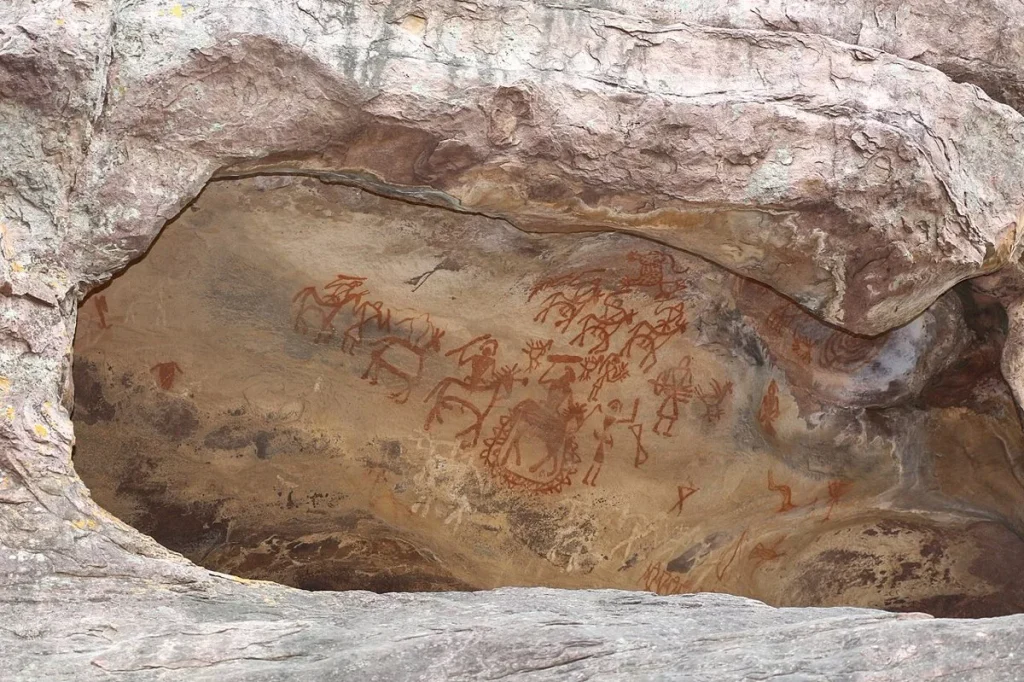
Image Source: Wikimedia
- Bhimbetka (Raisen district, MP) has over 700 rock shelters, about 400 of them painted. It was discovered by V.S. Wakankar (1957) and became a UNESCO World Heritage Site in 2003. The paintings run from the Upper Palaeolithic through the Mesolithic to historic times.
- Colours: mainly red (haematite/ochre), white and green.
- Themes: hunting, dancing, animals (bison, deer, tiger, elephant, rhino), honey collection, and “Zoo Rock”.
- Other rock art sites: Jogimara caves (Chhattisgarh), Lakhudiyar (Uttarakhand), Kupgal (Karnataka; petroglyphs), Edakkal caves (Kerala; petroglyphs), Adamgarh and Pachmarhi (MP), Mirzapur (UP), Sitabenga caves (Chhattisgarh). Note that Jogimara and Sitabenga have historic-period links too.
- Mesolithic paintings were the most common. They show group hunting and community life.
📝 Practise: WBCS Mains Stone Age PYQs | WBCS Mains GK – Art & Culture PYQs
9. Megalithic Culture
- Megalith means “big stone”. The term covers burial monuments built with large stones, mostly in South India (Deccan, Tamil Nadu, Kerala). They are also found in Vidarbha, Kashmir (Burzahom), the North-East (living tradition among the Khasi) and Jharkhand.
- They date from roughly 1000 BCE – 300 BCE/CE, broadly linked with the Iron Age.
- Types: cists, dolmens, menhirs, cairn circles, urn burials and topikals/umbrella stones (Kerala).
- Pottery: Black-and-Red Ware (BRW).
- Sites: Brahmagiri, Maski, Hallur (Karnataka); Adichanallur (TN; urn burials); Junapani (Maharashtra, Vidarbha); Nagarjunakonda (AP).
- Megalithic people were the forerunners of the Sangam age society. → WBCS Mains South Indian Dynasties PYQs
10. Important Discoverers & “Firsts”
| Fact | Answer |
|---|---|
| First Palaeolithic tool found in India | Pallavaram, near Chennai, by Robert Bruce Foote (1863) |
| Father of Indian Prehistory | Robert Bruce Foote |
| Narmada Man (Hathnora) | Arun Sonakia, 1982 |
| Bhimbetka discovered | V.S. Wakankar, 1957 |
| Earliest farming in the subcontinent | Mehrgarh, c. 7000 BCE |
| Earliest rice | Lahuradewa (UP) |
| Earliest animal domestication | Adamgarh (MP), Bagor (Rajasthan) |
| Earliest domesticated animal | Dog (see PYQ: Wenke – earliest domesticated animal) |
| Pit-dwellings; dog burials | Burzahom (Kashmir) |
| Ash mounds | South Indian Neolithic (Utnur, Sanganakallu) |
| Largest Mesolithic site | Bagor |
| Bronze chariot (Chalcolithic) | Daimabad (Maharashtra) |
| Nevasan (Middle Palaeolithic) industry | H.D. Sankalia |
| First Chalcolithic site excavated in WB | Pandu Rajar Dhibi (B.B. Lal) |
| Mesolithic site in WB | Birbhanpur (B.B. Lal) |
| Term “Neolithic Revolution” | V. Gordon Childe |
| Man Makes Himself (author) | V. Gordon Childe |
| Father of Indian Archaeology | Alexander Cunningham |
| Earliest stone tools in the subcontinent | Potwar plateau (Riwat), Pakistan |
| Palaeolithic to Mesolithic to Neolithic in sequence | Belan valley (UP) |
| House burials (Neolithic) | Gufkral (Kashmir) |
| Largest belt of painted rock shelters | Bhimbetka (MP) |
| Harappan civilisation, by age | Chalcolithic / Bronze Age (urban; no iron) |
11. Frequently Asked Facts (PYQ trends)
- Microliths are the characteristic tools of the Mesolithic.
- Polished stone tools and agriculture belong to the Neolithic.
- Copper was the first metal used by humans.
- Fire was known in the Palaeolithic. The wheel and pottery came in the Neolithic.
- Burzahom is famous for pit-dwellings. Chirand is famous for bone tools.
- Inamgaon (Jorwe culture) was a large, fortified, proto-urban Chalcolithic settlement.
- Pandu Rajar Dhibi sits on the Ajay river in Bardhaman.
- Bhimbetka is in MP and has been a UNESCO site since 2003.
- Black-and-Red Ware is associated with Megalithic and Chalcolithic cultures.
- The dog was the earliest animal to be domesticated.
- The Belan valley shows all three Stone Age phases in sequence.
- Scraper is the odd one out among Early Stone Age tools (hand-axe, cleaver and chopper are the principal ones).
- The Narmada valley (Hathnora) has the earliest archaic Homo sapiens / Homo erectus fossil in India.
- Mehrgarh is the oldest farming settlement in the subcontinent (c. 7000 BCE).
- Iron was unknown to the Harappans. The Harappan civilisation was urban and belongs to the Chalcolithic/Bronze Age.
- Inamgaon has a pot burial of a man in a four-legged jar placed under a house floor (Jorwe culture).
12. Quick Revision Sheet
- Palaeolithic: quartzite; hand-axes, then flakes, then blades; hunting-gathering; Pallavaram, Attirampakkam, Hathnora, Nevasa, Belan, Bhimbetka, Kurnool; WB: Susunia.
- Mesolithic: microliths; first domestication (Bagor, Adamgarh); burials (Sarai Nahar Rai, Mahadaha); rock art; WB: Birbhanpur.
- Neolithic: polished tools, farming, pottery; Mehrgarh (7000 BCE), Burzahom (pit-dwellings), Chirand (bone tools), Utnur (ash mounds), Daojali Hading (NE), Lahuradewa (rice).
- Chalcolithic: copper + stone; Ahar, Kayatha, Malwa, Jorwe (Inamgaon, Daimabad); WB: Pandu Rajar Dhibi, Mahishadal, Bharatpur, Mangalkot, Dihar.
- Megaliths: Iron Age burials; BRW; Brahmagiri, Adichanallur, Junapani, Hallur.
- People: Foote (1863), Sankalia, Wakankar (1957), Sonakia (1982), B.B. Lal (WB sites), Childe. Also: Childe (Man Makes Himself), Cunningham (Father of Indian Archaeology), Kosambi (Marxist historiography), G.R. Sharma (Belan), Jarrige (Mehrgarh).
13. Related PYQs on PYQ Arena
- WBCS Mains Ancient History – Stone Age & Miscellaneous PYQs
- WBCS Prelims Ancient Indian History Previous Year Questions (1999–2024)
- WBCS Mains Ancient History – Indus Valley Civilization PYQs
- WBPSC Miscellaneous Prelims History Questions Year Wise
- WBPSC Clerkship History Previous Year Questions with Answers
- WBP SI Prelims History Previous Year Questions
- WBCS Mains South Indian Dynasties PYQs (Megaliths / Sangam background)
- WBCS Mains General Knowledge – Art & Culture PYQs (rock art)
- WBCS History Previous Year Questions – All Chapters
Leave a Comment