

Who is this for? Beginners and aspirants for UPSC Prelims, WBCS, other State PSCs and SSC. This is Chapter 2 of Medieval Indian History. Each section opens with an “In simple words” explanation and then goes to exam-level detail on the five dynasties of Delhi (1206–1526), their rulers and reforms, administration, economy, society, architecture and literature. 🔗 Practise alongside: WBCS Mains Delhi Sultanate PYQs | WBCS Prelims Medieval Indian History PYQs | PSC Miscellaneous Prelims History PYQs | WBPSC Clerkship History PYQs | WBPSC IDO History PYQs 📖 Read first: Early Medieval India and Rajput Kingdoms (Chapter 1: Mahmud of Ghazni, Muhammad Ghori, Tarain and Bakhtiyar Khalji) | Foreign Travellers in India | Ancient Bengal | Ancient Indian Economy, Society and Coinage
1. The Delhi Sultanate: An Overview (1206–1526)
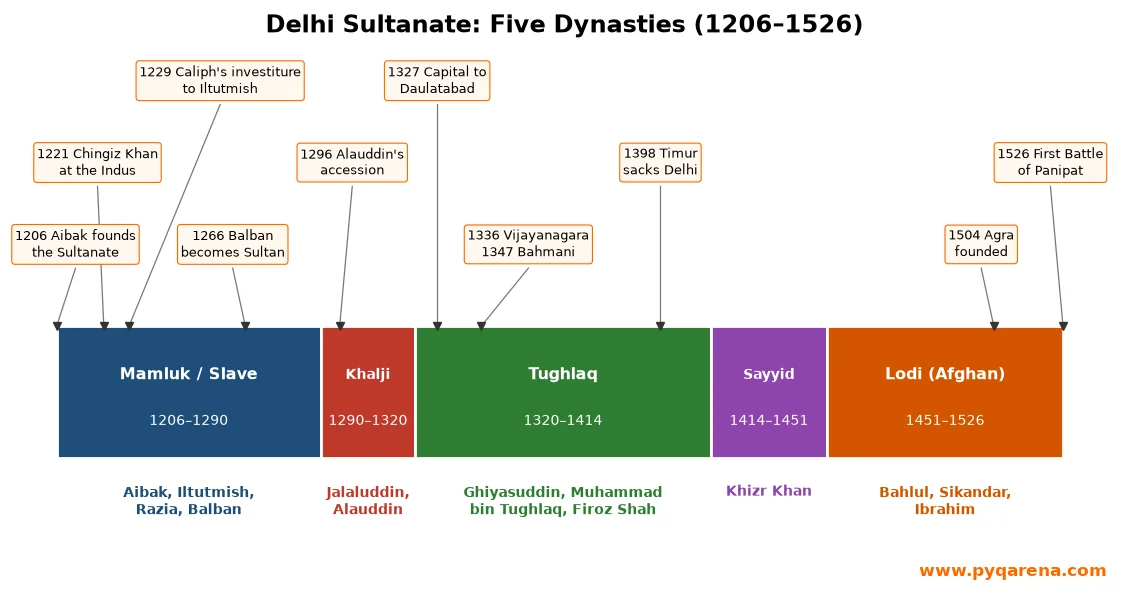
In simple words: When Muhammad Ghori was killed in 1206, his Turkish slave-general Qutbuddin Aibak became the ruler of his Indian lands. This began the Delhi Sultanate, a Muslim kingdom ruled from Delhi by a Sultan. For 320 years, five families (dynasties) ruled one after another: the Mamluks (Slave dynasty), the Khaljis, the Tughlaqs, the Sayyids and the Lodis. The Sultanate reached its largest size under Muhammad bin Tughlaq, broke up after him, and ended when Babur defeated Ibrahim Lodi at Panipat in 1526. → How the Turks got here: Early Medieval India and Rajput Kingdoms
1.1 The five dynasties
| Dynasty | Years | Founder | Origin | Last ruler |
|---|---|---|---|---|
| Mamluk / Slave (Ilbari) | 1206–1290 | Qutbuddin Aibak | Turkish slaves | Kayumars |
| Khalji | 1290–1320 | Jalaluddin Firoz Khalji | Turks long settled in Afghanistan | Khusrau Khan |
| Tughlaq | 1320–1414 | Ghiyasuddin Tughlaq (Ghazi Malik) | Qarauna Turks | Nasiruddin Mahmud (then Daulat Khan Lodi, 1412–14) |
| Sayyid | 1414–1451 | Khizr Khan | Claimed descent from the Prophet | Alam Shah |
| Lodi | 1451–1526 | Bahlul Lodi | Afghans | Ibrahim Lodi |
- Year of foundation: the Delhi Sultanate was established in 1206. → PYQ: WBCS Mains 2022
- Founder: Qutbuddin Aibak, who also founded the Slave dynasty. → PYQ: WBCS Prelims 2014, 2013, 2006 | PYQ: PSC Misc 2008 | PYQ: WBCS Mains 2023
- Correct order of dynasties: Ilbari Turks (Slave) → Khalji → Tughlaq → Sayyid → Lodi. Memory trick: “S-K-T-S-L” = “Some Kings Took Seven Lands”. → PYQ: WBCS Prelims 2022
- Last Sultan: Ibrahim Lodi, killed at the First Battle of Panipat (1526). → PYQ: WBCS Prelims 2024, 2023 | PYQ: WBCS Mains 2023
- The Lodis were Afghans: the only Afghan dynasty of the Sultanate; the first four were Turkish (the Sayyids were of Arab claim). → PYQ: WBCS Prelims 2001
1.2 Why the “Slave” dynasty is also called Mamluk or Ilbari
- Mamluk is the Arabic word for a slave who was owned and then trained as a soldier. Aibak, Iltutmish and Balban all began life as slaves.
- Ilbari was the Turkish tribe of Iltutmish and Balban. Historians therefore speak of the “Ilbari Turks” or of three dynasties: Aibak’s (Qutbi), Iltutmish’s (first Ilbari or Shamsi) and Balban’s (second Ilbari or Balbani).
- Not all rulers of this line were slaves: Razia, Iltutmish’s daughter, was born free. → PYQ: WBCS Prelims 2015
- Balban was a slave in his early life. Alauddin Khalji was never a slave: he was the nephew and son-in-law of Sultan Jalaluddin. → PYQ: WBCS Prelims 2003, 2021
1.3 Size of the Sultanate at different times
| Period | Approximate extent |
|---|---|
| Aibak and Iltutmish | Punjab, Ganga–Yamuna Doab, Rajasthan forts, Bihar and Bengal (loosely) |
| Balban | Same area, held more firmly; defence of the north-west against the Mongols |
| Alauddin Khalji | All of North India; Deccan and South Indian kingdoms paid tribute |
| Muhammad bin Tughlaq | Largest extent: from Peshawar to Madurai, from Sind to Bengal |
| Firoz Shah Tughlaq | Bengal and the South lost; North India held |
| Sayyids and Lodis | Delhi, Punjab, the Doab, later Jaunpur and Bihar |
2. Sources for the History of the Delhi Sultanate
In simple words: Unlike ancient India, the Sultanate period has many written histories. Court historians wrote in Persian about the Sultans’ wars and reforms. Foreign travellers such as Ibn Battuta described what they saw. Some Sultans even wrote about themselves. Exams ask “who wrote which book” every year, so learn this table well.
2.1 Persian chronicles
| Book | Author | What it covers |
|---|---|---|
| Taj-ul-Maasir | Hasan Nizami | First official history of the Sultanate: Ghori and Aibak, up to Iltutmish’s early years |
| Tabaqat-i-Nasiri | Minhaj-us-Siraj | General history up to 1260; dedicated to Sultan Nasiruddin Mahmud |
| Tarikh-i-Firuz Shahi | Ziauddin Barani | From Balban’s accession (1266) to the early years of Firoz Tughlaq; best source on Alauddin’s reforms and MBT’s projects |
| Fatawa-i-Jahandari | Ziauddin Barani | Barani’s book on political theory: how a Sultan should rule |
| Futuh-us-Salatin | Isami | A verse history in the style of the Shahnama, up to MBT; written at the Bahmani court |
| Tarikh-i-Firuz Shahi | Shams Siraj Afif | Life and reign of Firoz Tughlaq |
| Futuhat-i-Firuz Shahi | Firoz Shah Tughlaq | The Sultan’s own account of his reforms and good works |
| Tarikh-i-Mubarak Shahi | Yahya bin Ahmad Sirhindi | Late Tughlaqs and Sayyids |
| Khazain-ul-Futuh | Amir Khusrau | Alauddin Khalji’s conquests (prose) |
| Malfuzat-i-Timuri (Tuzuk-i-Timuri) | Timur | Timur’s own memoirs, including the sack of Delhi (1398) |
- Minhaj-us-Siraj wrote the Tabaqat-i-Nasiri. → PYQ: WBCS Mains 2022, 2020
- Ziauddin Barani wrote the Tarikh-i-Firuz Shahi, which begins with the reign of Balban. So the book that gives an account of the Balban period is the Tarikh-i-Firuz Shahi. → PYQ: WBCS Mains 2022 | PYQ: WBCS Prelims 2012, 2016
- Isami wrote the Futuh-us-Salatin. → PYQ: WBCS Prelims 2006
- Firoz Tughlaq — Futuhat-i-Firuz Shahi is a correct pair; Barani — Kitab-ul-Rehla is wrong, because the Rehla is Ibn Battuta’s book. → PYQ: WBCS Mains 2016
- Tuzuk-i-Timuri is Timur’s memoir, not a work of Amir Khusrau. → PYQ: WBCS Mains 2014
2.2 Foreign travellers
- Ibn Battuta (1304–1369), a Moroccan from Tangier, reached India in 1333 during the reign of Muhammad bin Tughlaq. The Sultan made him the qazi (judge) of Delhi and in 1342 sent him as his envoy to China. → PYQ: WBCS Prelims 2021, 2011, 2004 | PYQ: WBPSC IDO 2001
- His travel book is the Rehla (Rihla, Kitab-ul-Rehla), written in Arabic. It describes MBT’s court, the postal system (uluq horse post and dawa foot post), Delhi, Bengal, Malabar and the Maldives. → PYQ: WBCS Mains 2022 | PYQ: WBCS Prelims 2005, 2000
- Marco Polo (Venetian) visited the Pandya kingdom of the far south around 1292–93, in the time of the Khaljis.
- → All travellers in one place: Foreign Travellers in India
2.3 Other sources
- Coins of the Sultans (titles, mints, dates), inscriptions on mosques and tombs, Sufi conversation records (malfuzat, such as Amir Hasan Dehlavi’s Fawaid-ul-Fuad of Nizamuddin Auliya), and Sanskrit and regional texts such as the Jain chronicles and Rajput bardic poems.
3. The Mamluk or Slave Dynasty (1206–1290)
In simple words: The first Sultans were Turkish slave-soldiers who rose to the top. Aibak started the kingdom, Iltutmish gave it a capital, coins, a governing system and the Caliph’s blessing, Razia became the only woman to sit on the throne of Delhi, and Balban made the Sultan feared by crushing the nobles and guarding the frontier against the Mongols.
3.1 Qutbuddin Aibak (1206–1210)
- Background: a Turkish slave bought by Muhammad Ghori; rose to be his general and successor in India. → PYQ: WBCS Mains 2023
- Ruled from Lahore, not Delhi. He was busy fighting rivals Tajuddin Yildiz (Ghazni) and Nasiruddin Qubacha (Multan), and made marriage alliances with both (he married Yildiz’s daughter, gave his sister to Qubacha and his daughter to Iltutmish).
- Title “Lakh Bakhsh” (giver of lakhs) for his generosity. → PYQ: WBCS Mains 2022, 2017
- Buildings: the Quwwat-ul-Islam mosque at Delhi (the first mosque of the Sultanate), the Adhai Din Ka Jhonpra at Ajmer, and the first storey of the Qutb Minar. → PYQ: WBCS Prelims 2011
- Earliest seat of Turkish power in Delhi: Qila Rai Pithora, the old Chauhan fort of Prithviraj, where Aibak built the Quwwat-ul-Islam mosque. → PYQ: WBCS Mains 2021
- Patron of learning: Hasan Nizami (Taj-ul-Maasir) and Fakhr-i-Mudabbir wrote at his court.
- Death: fell from his horse while playing chaugan (polo) at Lahore in 1210; buried at Lahore.
- Aram Shah (1210–11), a weak successor, was removed by the nobles of Delhi, who invited Iltutmish.
3.2 Shamsuddin Iltutmish (1211–1236): the real founder
- Background: an Ilbari Turk, a slave of Aibak who became his son-in-law and governor of Badaun.
- “First real king” / real founder of the Sultanate: he made it an independent state with a fixed capital, coinage and system of government. → PYQ: WBCS Prelims 2007
- Capital: shifted from Lahore to Delhi.
- Defeated rivals: Yildiz at Tarain (1216) and Qubacha (1228), and won back Bengal from the Khalji chiefs (1225–29).
- The Mongol danger, 1221: Chingiz Khan reached the Indus while chasing Jalaluddin Mangbarni, the prince of Khwarizm (Khiva, Central Asia). Mangbarni asked Iltutmish for shelter; Iltutmish politely refused, and the Mongols turned back. So Chingiz Khan came to India’s border during Iltutmish’s reign. → PYQ: WBCS Prelims 2011, 2005, 2010, 2013
- Caliph’s investiture (1229): the Abbasid Caliph al-Mustansir of Baghdad sent him a robe of honour and a letter recognising him as Sultan. He was the first Sultan of Delhi to obtain investiture from the Caliph. → PYQ: WBPSC IDO 1996
- Turkan-i-Chahalgani (the “Forty”, Chalisa): a group of forty loyal Turkish slave-officers who formed the core of the nobility. The Chahalgani came into existence under Iltutmish. → PYQ: WBCS Mains 2017, 2016
- Iqta system: he organised the iqta (assignment of land revenue to officers in place of salary) as the basis of administration. → PYQ: WBCS Prelims 2021, 2024
- Coins: introduced the standard silver tanka (about 175 grains) and copper jital, the two basic coins of the Sultanate. → PYQ: WBCS Mains 2020
- Iltutmish thus organised the iqta, the army, the currency and the other main organs of the Sultanate. → PYQ: WBCS Prelims 2024
- Buildings: completed the Qutb Minar (added three storeys), built the Hauz-i-Shamsi tank and the Sultan Ghari tomb for his son, the first Islamic tomb in India. → PYQ: WBCS Prelims 2018
- Successor: he nominated his daughter Razia instead of his sons.
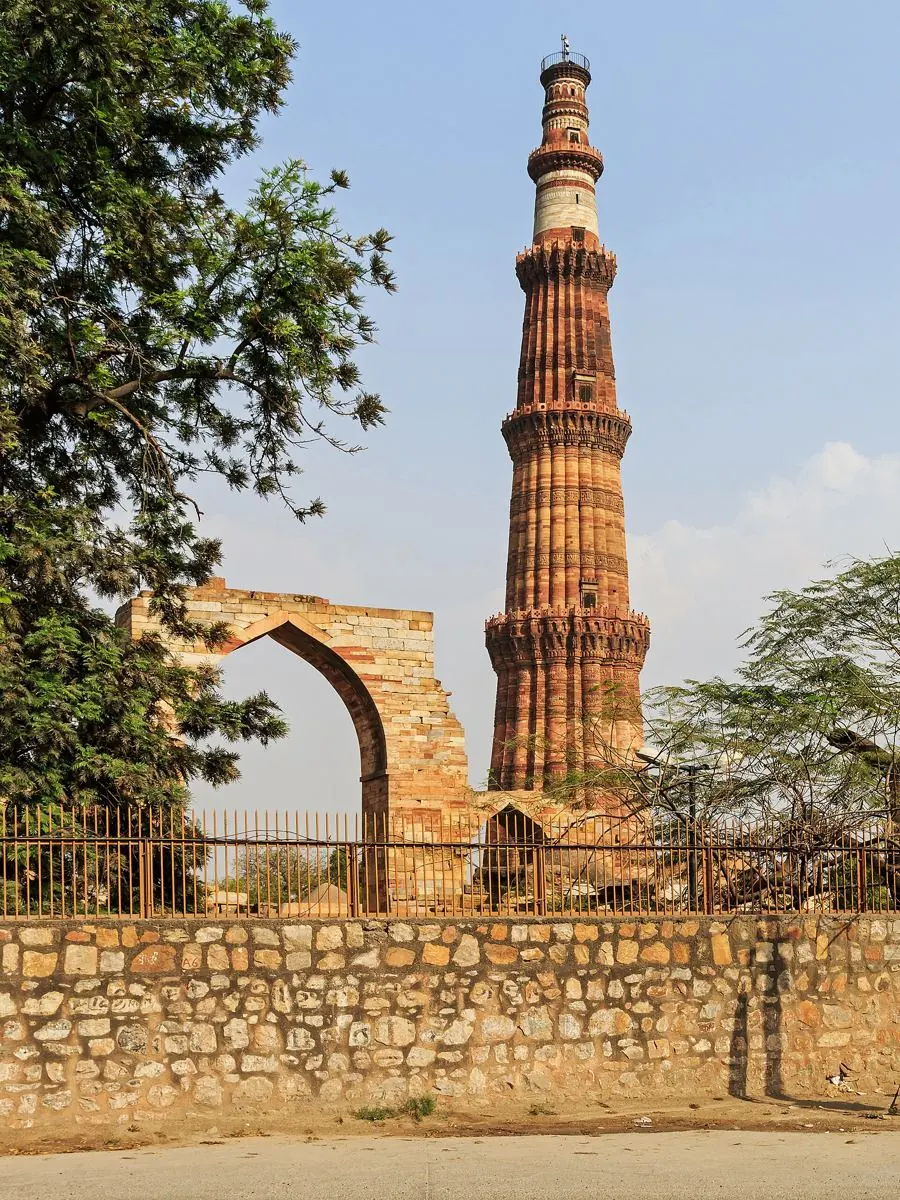
Image Source: Wikimedia
3.3 Razia Sultan (1236–1240)
- First and only woman ruler of the Delhi Sultanate. → PYQ: WBCS Mains 2022
- Came to power after her brother Ruknuddin Firoz (1236) proved worthless; the people of Delhi supported her.
- Ruled like a man: discarded the veil, wore the qaba (coat) and kulah (cap), rode an elephant in public and held court openly.
- Promoted non-Turks: made the Abyssinian (Habshi) Jamaluddin Yaqut her amir-i-akhur (master of the stables). This angered the Turkish nobles of the Forty.
- Fall: Altunia, governor of Bhatinda, revolted; Razia married him to regain the throne, but both were defeated and killed near Kaithal in 1240.
- Razia was not a slave; she was born a princess. → PYQ: WBCS Prelims 2015
3.4 The weak successors and Nasiruddin Mahmud (1240–1266)
- Bahram Shah (1240–42) and Masud Shah (1242–46) were puppets of the Forty, who created the post of naib-i-mamlakat (regent) to control the Sultan.
- Nasiruddin Mahmud (1246–66), a grandson of Iltutmish, was pious and gentle. Real power lay with his naib and father-in-law Ulugh Khan, later Balban.
- Minhaj-us-Siraj dedicated the Tabaqat-i-Nasiri to him.
3.5 Ghiyasuddin Balban (1266–1287): blood and iron
- Background: an Ilbari Turk sold as a slave to Iltutmish; a member of the Forty; naib under Nasiruddin. → PYQ: WBCS Prelims 2003
- Theory of kingship:
- The king is Zil-i-Ilahi (shadow of God) and his office is Niyabat-i-Khudai (deputy of God on earth).
- He claimed descent from the Persian hero Afrasiyab and kept only nobles of high birth in office.
- Court etiquette: sijda (prostration) and paibos (kissing the Sultan’s feet). → PYQ: WBCS Mains 2022
- He introduced the Persian new-year festival of Nauroz at court. → PYQ: WBCS Mains 2015
- Never laughed or joked in court; demanded total discipline.
- Policy of “blood and iron”: ruthless punishment of rebels and robbers; the Mewati robbers near Delhi were crushed and forests cleared.
- Broke the power of the Chahalgani: poisoned or punished leading members such as Sher Khan, his cousin. → PYQ: WBCS Prelims 2018
- Spy system: secret news-writers (barids) in every province.
- Army: reorganised the military department, the Diwan-i-Arz, under an ariz-i-mumalik.
- North-West Frontier policy: built and garrisoned forts along the Mongol route and posted his son Prince Muhammad at Multan. He was the first Sultan to frame a North-West Frontier policy. Prince Muhammad was killed fighting the Mongols in 1285. → PYQ: WBCS Prelims 2023
- Bengal: crushed the revolt of Tughril Khan (1280–81) and made his son Bughra Khan governor.
- End of the line: his grandson Kaiqubad (1287–90) was a pleasure-lover; the infant Kayumars followed. Jalaluddin Firoz Khalji seized the throne in 1290.
3.6 Iltutmish vs Balban
| Point | Iltutmish | Balban |
|---|---|---|
| Role of the Forty | Created the Chahalgani | Destroyed the Chahalgani |
| Main work | Iqta, tanka and jital, Caliph’s investiture | Theory of kingship, sijda and paibos, Nauroz |
| Mongols | Kept out of Chingiz Khan’s way (1221) | Built a frontier defence line |
| Title | Real founder of the Sultanate | Restorer of the Sultan’s prestige |
4. The Khalji Dynasty (1290–1320)
In simple words: The Khaljis were Turks who had lived long among the Afghans. Their rise in 1290 is called the “Khalji Revolution” because power passed from the old Turkish slave-nobles to men of humbler birth, including Indian Muslims. The great Khalji ruler, Alauddin, beat back the Mongols, raided the Deccan and the far South, and ran the most tightly controlled economy of medieval India: fixed prices, a cash-paid army and strict collection of land tax.
4.1 Jalaluddin Firoz Khalji (1290–1296)
- Became Sultan at about 70; mild and forgiving, which the nobles took as weakness.
- Defeated a Mongol attack (1292); some Mongols who embraced Islam settled near Delhi as “New Muslims“.
- First Muslim raid on the Deccan: in 1296 his nephew Alauddin, governor of Kara, marched secretly to Devagiri and forced the Yadava king Ramachandra to pay a huge ransom. So the first Muslim incursion into the Deccan happened during Jalaluddin’s reign. → PYQ: WBCS Prelims 2016
- Alauddin then murdered Jalaluddin at Kara (1296) and seized the throne with the Devagiri gold.
4.2 Alauddin Khalji (1296–1316): conquests
- Not a slave: nephew and son-in-law of Jalaluddin. → PYQ: WBCS Prelims 2021
- Ambition: he planned to found a new religion and to conquer the world like Alexander. His friend, the kotwal Alaul Mulk, talked him out of both. He still called himself Sikandar-i-Sani (“the Second Alexander”) on his coins. → PYQ: WBCS Mains 2018, 2017 | PYQ: WBCS Prelims 2010
North India
| Year | Campaign | Result |
|---|---|---|
| 1299 | Gujarat (Rai Karna Vaghela) | Somnath sacked; Malik Kafur, a slave, bought at Cambay for 1,000 dinars (hazar-dinari) |
| 1301 | Ranthambhore (Hammir Deva Chauhan) | Fort captured; the Rajput women performed jauhar |
| 1303 | Chittor (Rana Ratan Singh) | Fort captured, renamed Khizrabad after his son Khizr Khan |
| 1305 | Malwa (Mandu, Ujjain, Dhar) | Annexed |
| 1308–11 | Siwana and Jalor | Conquered |
- Padmini legend: the story that Alauddin attacked Chittor to win Rani Padmini comes from Padmavat, written by Malik Muhammad Jayasi in 1540, more than 200 years later, during the reign of Sher Shah. → PYQ: WBCS Prelims 2024
Deccan and the far South
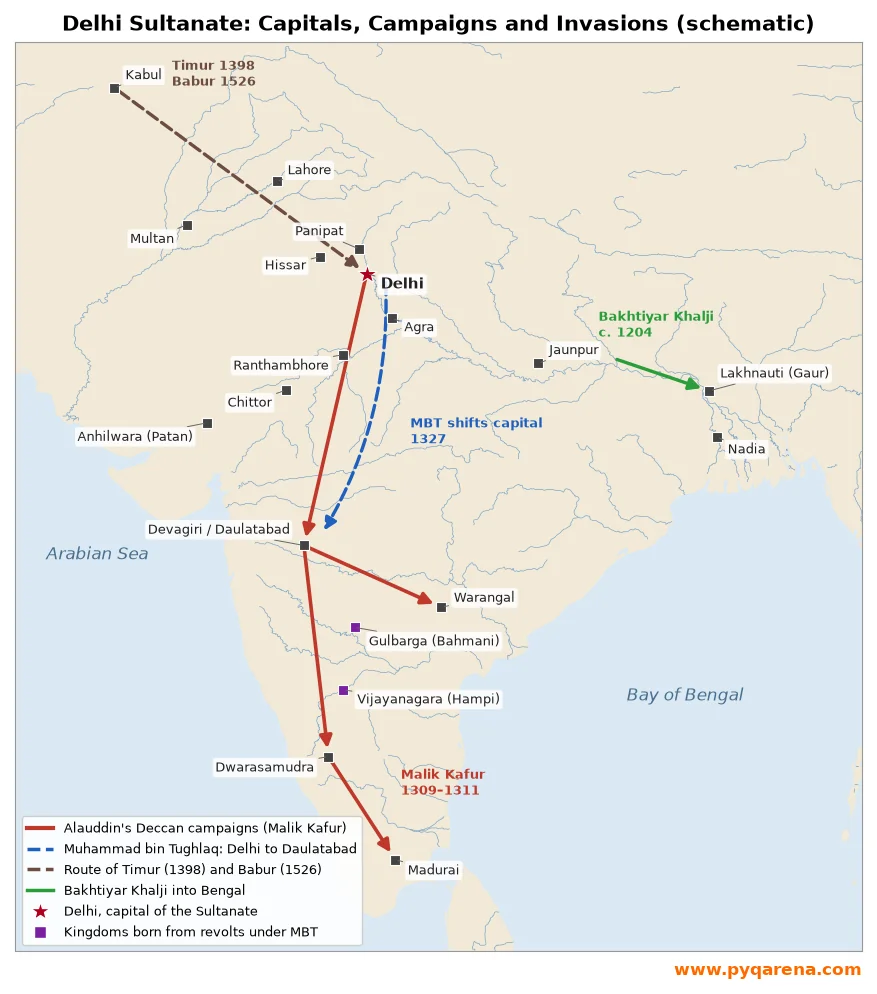
- Alauddin was the first Sultan to send expeditions to conquer the Deccan and to invade South India. His commander was Malik Kafur. → PYQ: WBCS Prelims 2023, 2020, 2019 | PYQ: WBCS Mains 2023
| Year | Kingdom (dynasty) | King | Capital |
|---|---|---|---|
| 1307 | Devagiri (Yadavas) | Ramachandra (given the title Rai Rayan) | Devagiri |
| 1309–10 | Telangana (Kakatiyas) | Prataparudra II | Warangal |
| 1311 | Dwarasamudra (Hoysalas) | Ballala III | Dwarasamudra (Halebidu) |
| 1311 | Madurai (Pandyas) | Vira Pandya and Sundara Pandya (rival brothers) | Madurai |
- Ramachandra Yadav, who faced Alauddin’s invasions, was the ruler of Devagiri. → PYQ: WBCS Mains 2020
- Policy: the southern kings were made to pay tribute and accept overlordship; they were not annexed. Alauddin wanted wealth for his army, not distant provinces he could not hold.
4.3 Alauddin’s Mongol policy
- The Mongols (Chaghatai Khanate of Central Asia) attacked again and again: Jalandhar (1298), Kili near Delhi (1299, under Qutlugh Khwaja; general Zafar Khan died a hero), Targhi‘s siege of Delhi (1303), Amroha (1305) and the Ravi (1306).
- Defence measures: built the new fort-city of Siri (1303); repaired old forts and built new ones on the Mongol route; posted strong garrisons under Ghazi Malik (the future Ghiyasuddin Tughlaq) at Dipalpur; and above all raised a huge permanent army.
- Result: after 1306 the Mongols never again threatened Delhi seriously.
4.4 Measures against rebellion: the four ordinances
After several revolts early in his reign, Alauddin issued four orders:
- Confiscated religious grants and tax-free lands (milk, inam, waqf) to take away surplus wealth.
- Set up a spy network to report on nobles and markets.
- Banned liquor and drugs in Delhi.
- Nobles could not hold social gatherings or marry among themselves without the Sultan’s permission.
4.5 Alauddin’s military reforms
- Created the largest standing army of the Sultanate, recruited, paid and controlled directly by the state. → PYQ: WBCS Mains 2019
- Paid his soldiers in cash instead of iqtas: 234 tankas a year for a cavalryman with one horse, plus 78 tankas for an extra horse (Barani’s figures). → PYQ: WBCS Prelims 2024
- Dagh: branding of horses so that a soldier could not bring a poor horse to the muster.
- Huliya (chehra): a descriptive roll of each soldier, kept by the Diwan-i-Arz.
4.6 Market control: the price-control system
Why? A cash-paid army of about 4,75,000 horsemen (Firishta’s figure) could live on 234 tankas only if prices were low. Barani also gives the motive of easing the life of the people of Delhi.
- Market Control Policy was introduced by Alauddin Khalji, the first ruler in medieval India to do so. → PYQ: WBCS Mains 2022 | PYQ: WBCS Prelims 2018 | PYQ: WBPSC Clerkship
- Three markets in Delhi:
- Mandi for grain;
- Sarai-i-Adl for cloth, sugar, dry fruits, oil and other costly goods;
- a market for horses, slaves and cattle.
- Officers: the Shahna-i-Mandi (market superintendent, Malik Qabul) and the Diwan-i-Riyasat (department of commerce under Yaqub); barids and munhiyan (spies) reported every day.
- Price fixed for every item; merchants were registered.
- State granaries stored grain collected as land tax in kind from the Doab.
- Rationing during droughts: each family got a fixed quantity of grain. Alauddin was the first Sultan to introduce rationing in India. → PYQ: WBCS Prelims 2024, 2005
- Hoarding was banned and punished severely; short weight was punished by cutting the same weight of flesh from the shopkeeper. → PYQ: PSC Misc 2023
- Alauddin adopted measures to control both market and prices. → PYQ: WBPSC Clerkship
- The system ended with his death in 1316.
4.7 Alauddin’s land revenue reforms
- First Sultan to measure land (masahat); the unit was the biswa. Tax was fixed on the measured area and estimated yield.
- Land tax (kharaj) = one-half of the produce, the highest rate of the Sultanate period, collected mostly in kind in the Doab.
- New taxes: charai (grazing tax on milch cattle) and ghari (house tax).
- Middlemen curbed: the privileges of the village headmen (khuts, muqaddams, chaudhuris) were taken away; they paid tax like everyone else.
- Diwan-i-Mustakhraj: a department to recover arrears from revenue officials.
- Khams: the state took four-fifths of war booty, leaving one-fifth to the soldiers.
4.8 Alauddin’s buildings and court
- Alai Darwaza (1311), the southern gateway of the Quwwat-ul-Islam mosque: the first building in India with a true arch and a true dome built on scientific principles. → PYQ: WBCS Mains 2022 | PYQ: WBCS Prelims 2020
- Siri Fort (the second city of Delhi), the Hauz-i-Alai (Hauz Khas tank), the unfinished Alai Minar and the Jamaat Khana mosque at Nizamuddin.
- Court poets: Amir Khusrau was his court poet, along with Amir Hasan Dehlavi. → PYQ: WBCS Prelims 2008
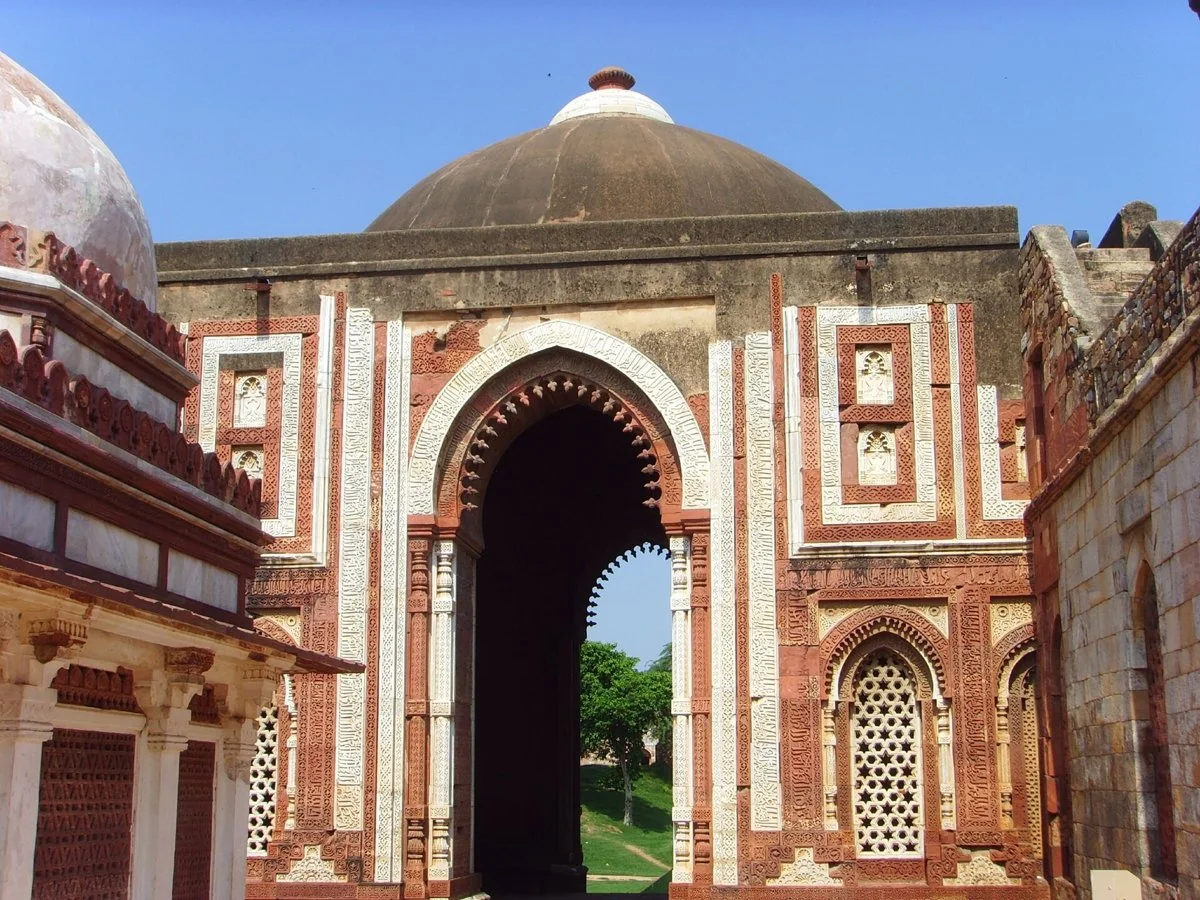
Image Source: Wikimedia
4.9 The last Khaljis
- Malik Kafur ruled as regent after Alauddin’s death but was killed within weeks.
- Qutbuddin Mubarak Shah (1316–20) annexed Devagiri and declared himself Caliph, the only Delhi Sultan to do so.
- Khusrau Khan (Nasiruddin), a Gujarati convert, killed Mubarak Shah and ruled briefly (1320). Ghazi Malik, warden of the frontier at Dipalpur, defeated and killed him and founded the Tughlaq dynasty.
5. The Tughlaq Dynasty (1320–1414)
In simple words: The Tughlaqs ruled the longest of the five dynasties. The founder Ghiyasuddin was a tough frontier soldier. His son Muhammad bin Tughlaq (MBT) was brilliant but impatient: his bold experiments, such as moving the capital and issuing copper coins, failed, and provinces broke away. Firoz Shah Tughlaq turned to welfare and building, but made posts hereditary and weakened the army. After him the Sultanate crumbled, and Timur sacked Delhi in 1398.
5.1 Ghiyasuddin Tughlaq (1320–1325)
- Real name: Ghazi Malik, a Qarauna Turk who had fought the Mongols 29 times as warden of the marches at Dipalpur. → PYQ: WBCS Mains 2020
- Policy of moderation (rasm-i-miyana): the land tax was not to be raised by more than one-tenth or one-eleventh in a single year; interest in irrigation canals and agriculture.
- Postal system improved with runners and horse relays.
- Conquests: his son Ulugh Khan (Jauna Khan) took Warangal (1323) and annexed Telangana; the Sultan himself marched into Bengal (1324) and divided it into three parts.
- Tughlaqabad, the third city of Delhi, with massive sloping walls; his tomb, with sloping walls and a white marble dome, once stood in an artificial lake.
- Death (1325): killed when a wooden welcome pavilion built by Ulugh Khan at Afghanpur collapsed. He had quarrelled with the Sufi Nizamuddin Auliya, who is remembered for the saying “Hunuz Dilli dur ast” (“Delhi is still far away”).
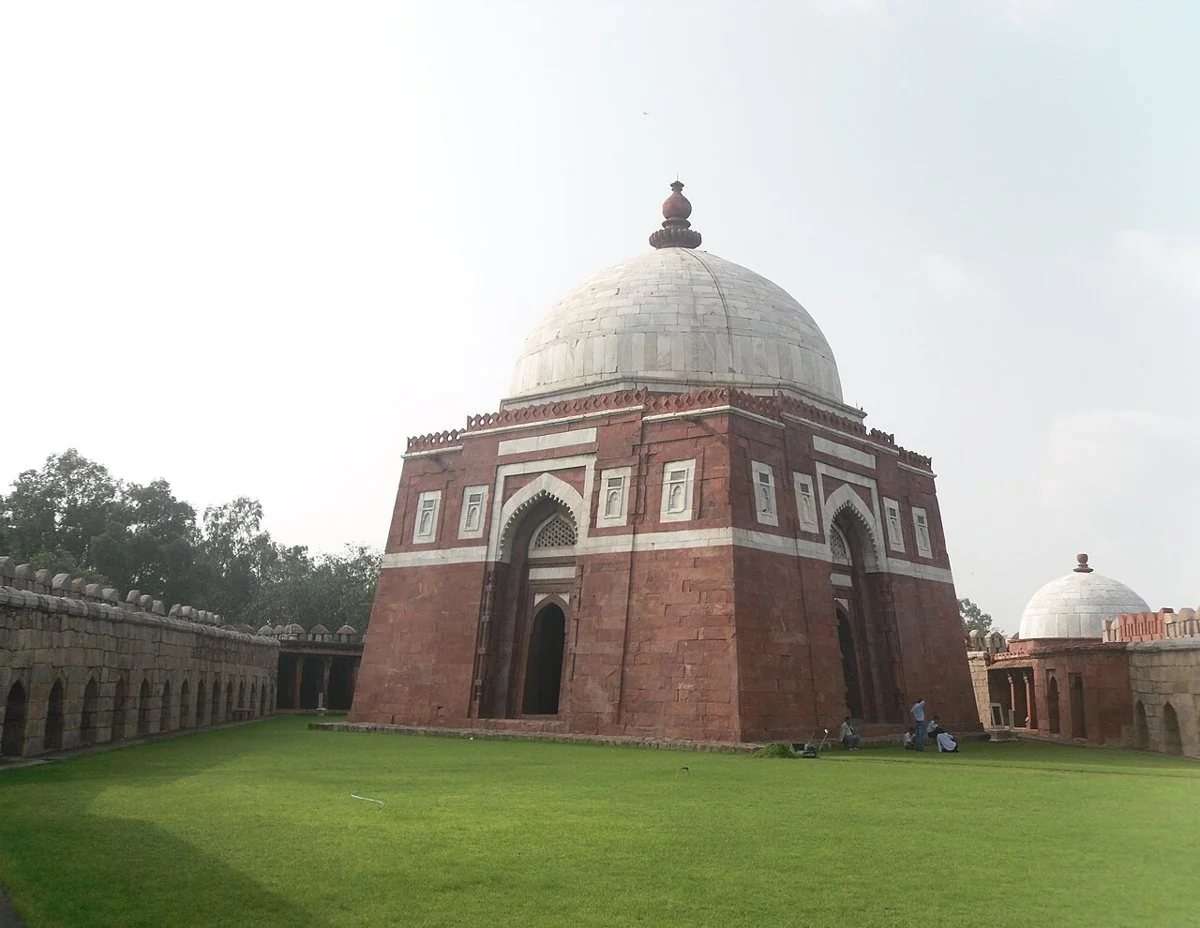
Image Source: Wikimedia
5.2 Muhammad bin Tughlaq (1325–1351): the man and his experiments
- The man: Prince Jauna Khan (Ulugh Khan). Learned in Persian poetry, philosophy, logic, mathematics, astronomy and medicine; a skilled calligrapher; open to talks with yogis and Jain monks (he honoured the Jain scholar Jinaprabha Suri). Barani calls him a mixture of opposites.
- Largest empire: under him the Sultanate reached its greatest extent, with 23 provinces (Ibn Battuta).
- Ibn Battuta came to his court in 1333. → PYQ: WBCS Prelims 2021, 2011, 2004 | PYQ: WBPSC IDO 2001
The five “experiments”
| No. | Project | Year | What happened |
|---|---|---|---|
| 1 | Taxation in the Doab | 1326–27 | Land tax raised just when a famine struck; peasants fled, revolts broke out. Relief came too late |
| 2 | Transfer of capital to Daulatabad (Devagiri) | 1327 | A central capital to control the South; the people of Delhi were ordered to move 1,500 km; many died. Capital moved back to Delhi in about 1335 |
| 3 | Token currency | 1329–30 | Copper coins given the value of the silver tanka; people forged them at home (“every Hindu house became a mint”). Coins withdrawn and exchanged for silver from the treasury |
| 4 | Khurasan expedition | 1329 | A huge army raised to conquer Khurasan (Persia), paid for a year and then disbanded without fighting |
| 5 | Qarachil expedition | 1333 | Army sent into the Kumaon–Garhwal Himalaya; almost wiped out by rain, disease and hill tribes |
- Daulatabad: the Sultan who transferred the capital from Delhi to Daulatabad (Devagiri) was MBT. → PYQ: WBCS Mains 2022 | PYQ: WBCS Prelims 2017
- Token currency of copper: → PYQ: WBPSC IDO 1996
- Why token currency? A world-wide shortage of silver, the empty treasury after wars and famine, and the example of paper money in China (Kublai Khan) and Persia.
- Why did it fail? The coins were plain copper with no state monopoly over minting, so forgery was easy.
- Other coins of MBT: the gold dinar (about 200 grains), the silver adli and the mixed-metal dokani. He issued more kinds of coins than any other Sultan and is called the “Prince of Moneyers”. → PYQ: WBCS Prelims 2006
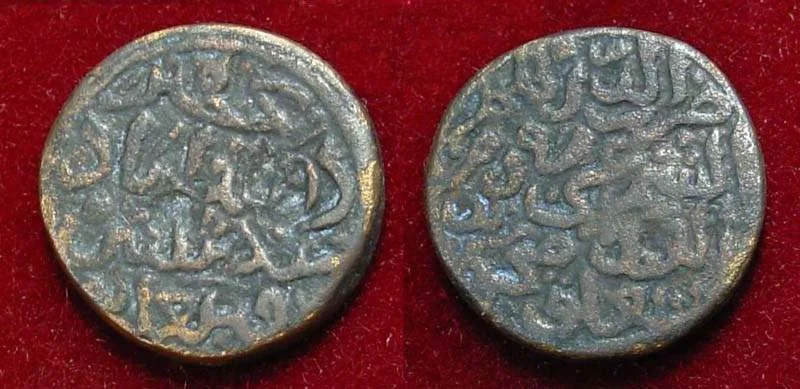
Image Source: Wikimedia
5.3 MBT: agriculture and famine relief
- Diwan-i-Kohi: a new department of agriculture to bring waste land under cultivation through state farms; sondhar (taccavi) loans were given to peasants for seed and wells.
- Svargadvari: during the long famine (1338–41) the Sultan lived for about two and a half years in a camp called Svargadvari (“Gate of Heaven”) on the bank of the Ganges near Kannauj, where grain could reach him from Awadh. → PYQ: WBCS Mains 2017
5.4 Revolts and the breakup of the empire under MBT
More than twenty revolts broke out in his reign. Several new kingdoms were born:
| Year | Region | Founder | New state |
|---|---|---|---|
| 1335 | Ma’bar (Madurai) | Jalaluddin Ahsan Shah | Madurai Sultanate |
| 1336 | Tungabhadra region | Harihara I and Bukka I (Sangama brothers) | Vijayanagara Empire |
| 1336 | Warangal | Kapaya Nayaka | Telangana freed |
| 1338–42 | Bengal | Fakhruddin Mubarak Shah, then Shamsuddin Ilyas Shah | Independent Bengal Sultanate |
| 1347 | Deccan (Gulbarga) | Alauddin Hasan Bahman Shah (Hasan Gangu) | Bahmani Kingdom |
- Madurai Sultanate founder: Jalaluddin Ahsan (Shah). → PYQ: WBCS Mains RM 2015
- Bahmani founder: Alauddin Hasan Bahman Shah. → PYQ: WBCS Prelims 2014, 2008 | Practise: WBCS Mains Vijayanagar and Bahmani PYQs
- Death: MBT died in 1351 at Thatta in Sind while chasing the rebel Taghi. The historian Badauni wrote: “The Sultan was freed from his people and they from their Sultan.”
5.5 Firoz Shah Tughlaq (1351–1388)
- Background: cousin of MBT; his mother was a Bhatti Rajput princess. Chosen by the nobles and ulema in the camp at Thatta.
- Campaigns: two failed attacks on Bengal (against Ilyas Shah, siege of Ekdala, 1353–54; and against Sikandar Shah, 1359); Jajnagar (Orissa, 1360); Nagarkot (Kangra, 1361), where Sanskrit books from the Jwalamukhi temple were translated into Persian as the Dalail-i-Firuz Shahi; and Thatta (Sind).
Taxation according to Islamic law
- Abolished 24 vexatious taxes and kept only the four allowed by Islamic law: kharaj (land tax), jizya (on non-Muslims), zakat (on Muslims) and khams (one-fifth of war booty to the state, four-fifths to soldiers). → PYQ: PSC Misc 2007
- Jizya was made a separate tax and collected even from Brahmins, who had been exempt before. → PYQ: WBCS Mains 2017
- Haq-i-sharb: an irrigation tax of one-tenth of the produce on lands watered by state canals.
Welfare departments
- Diwan-i-Khairat: a department of charity that helped poor Muslims marry off their daughters. → PYQ: WBCS Mains 2020
- Diwan-i-Bandagan: a separate department of slaves; Firoz had about 1,80,000 slaves, trained in crafts and posted in service. → PYQ: WBCS Prelims 2011
- Dar-ul-Shifa: a free hospital at Delhi; an employment bureau for the jobless; Diwan-i-Istihqaq for pensions.
Public works
- Canals: five big irrigation canals, including the Western Yamuna Canal (Rajwah) from the Yamuna to Hissar.
- New towns: Firozabad (the fifth city of Delhi, with the Kotla palace), Hissar (Hissar-Firoza), Fatehabad, Jaunpur (named after MBT, whose name was Jauna Khan) and Firozpur. Fatehpur (Sikri) was not his city; Akbar built it. → PYQ: WBCS Prelims 2024
- Ashokan pillars: brought two Ashokan pillars from Topra (near Ambala) and Meerut to Delhi. The Topra pillar stands on the Firoz Shah Kotla palace; the Meerut pillar stands on the Ridge. → PYQ: WBCS Prelims 2011 | Mauryan Empire
- Repairs: the Qutb Minar (after lightning in 1368, he rebuilt the top storeys), Hauz Khas tank (with a madrasa on its bank) and many old monuments.
Weak points
- Made army posts and iqtas hereditary; soldiers were paid by assignments of land revenue (wajh) rather than cash.
- Religious orthodoxy: temples destroyed at Puri and elsewhere; heavy dependence on the ulema.
- “Akbar of the Sultanate”: the British historian Henry Elliot called him so for his welfare work. → PYQ: WBCS Prelims 2007, 2000
- Coins: introduced the silver shashgani (worth 6 jitals), the adha (half jital) and the bikh (quarter jital).
- Patronage: Barani and Shams Siraj Afif wrote at his court; he wrote his own Futuhat-i-Firuz Shahi.
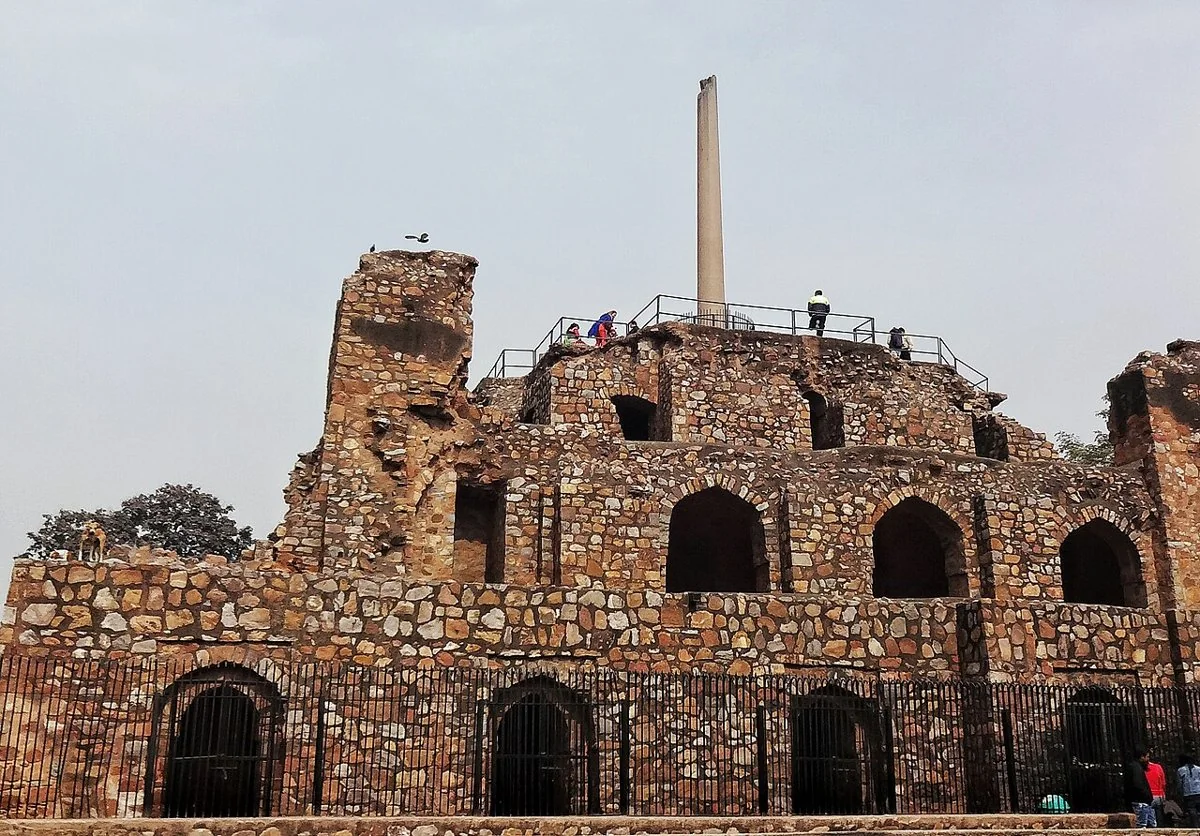
Image Source: Wikimedia
5.6 The later Tughlaqs and Timur’s invasion (1398)
- After 1388 weak Sultans and court factions followed. Provinces such as Gujarat, Malwa, Khandesh and Jaunpur (under the Sharqi dynasty, founded by Malik Sarwar in 1394) became independent.
- Timur (Tamerlane), the Turkish conqueror of Samarkand, invaded India in 1398 during the reign of Nasiruddin Mahmud Tughlaq. He defeated the Sultan’s army near Delhi in December 1398, sacked Delhi for days, and left in 1399 with huge booty and craftsmen.
- He left Khizr Khan as his governor of Multan, who later founded the Sayyid dynasty.
- Timur described the campaign in his memoirs, the Malfuzat-i-Timuri (Tuzuk-i-Timuri).
- Babur, founder of the Mughal Empire, was a descendant of Timur, and the Mughals claimed India as part of Timur’s inheritance.
6. The Sayyid and Lodi Dynasties (1414–1526)
In simple words: After Timur, Delhi ruled only a small area. The Sayyids were weak rulers who governed in the name of Timur’s family. The Lodis, the first Afghan rulers of Delhi, revived the Sultanate: Bahlul won back Jaunpur, Sikandar founded Agra, but Ibrahim angered his own nobles, who invited Babur. Babur’s victory at Panipat in 1526 ended the Sultanate and began the Mughal Empire.
6.1 The Sayyids (1414–1451)
- Khizr Khan (1414–21) did not take the title of Sultan; he called himself Rayat-i-Ala (Exalted Banners) and ruled in the name of Timur’s son Shah Rukh.
- Mubarak Shah (1421–34) took the title of Shah; Yahya Sirhindi dedicated the Tarikh-i-Mubarak Shahi to him.
- Muhammad Shah (1434–45) and Alam Shah (1445–51). Alam Shah retired to Badaun and handed Delhi to Bahlul Lodi.
6.2 Bahlul Lodi (1451–1489)
- Founder of the Lodi dynasty and the first Afghan Sultan of Delhi. → PYQ: WBCS Mains 2020 | PYQ: WBCS Prelims 2001
- Treated the Afghan nobles as equals, sat with them on a carpet rather than a throne.
- Annexed the Sharqi kingdom of Jaunpur after a long war; issued the copper Bahluli coin, which stayed in use until Akbar’s time.
6.3 Sikandar Lodi (1489–1517)
- The ablest Lodi. Annexed Bihar; founded Agra in 1504 and made it his capital.
- Gaz-i-Sikandari: a measuring yard of 32 digits used for land measurement until the Mughals.
- Wrote Persian poetry under the pen-name Gulrukhi; the music book Lahjat-i-Sikandar Shahi was written in his reign.
- An orthodox Sunni; destroyed temples, including at Mathura, and reimposed jizya.
- Kabir legend: according to a well-known legend, Sikandar Lodi tried to kill the saint Kabir by drowning, burning and other means, but Kabir survived each time. → PYQ: WBCS Mains 2017
- Buried in the Lodi Garden, Delhi, in an octagonal tomb with a double dome, set in a walled garden.
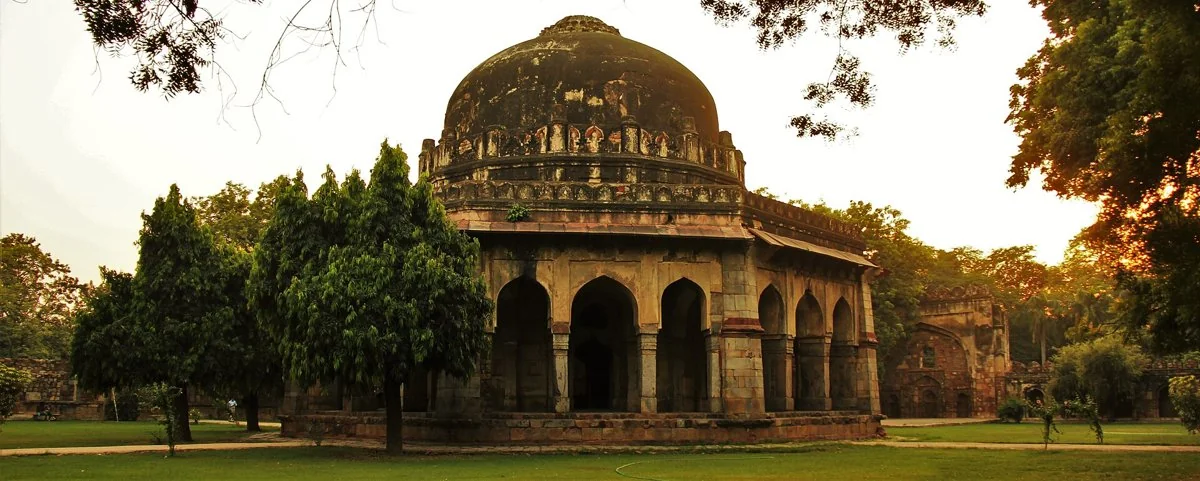
Image Source: Wikimedia
6.4 Ibrahim Lodi (1517–1526) and the end of the Sultanate
- Tried to rule as an absolute king like the Turks; insulted and jailed Afghan nobles.
- Lost to Rana Sanga of Mewar at Khatoli (1518).
- Daulat Khan Lodi, governor of Punjab, and Ibrahim’s uncle Alam Khan invited Babur to invade India. → PYQ: WBCS Prelims 2013
- First Battle of Panipat (21 April 1526): Babur defeated Ibrahim Lodi. Babur used field artillery (gunners Ustad Ali and Mustafa) and the tulughma flanking tactic against a much larger Afghan army with about 1,000 elephants. → PYQ: WBCS Prelims 2023, 2006, 2005
- Ibrahim Lodi was killed on the battlefield, the only Sultan of Delhi to die in battle; he was the last ruler of the Delhi Sultanate. → PYQ: WBCS Prelims 2024, 2023 | PYQ: WBCS Mains 2023
- → Babur, Humayun and the Mughals come in the next chapter on the Mughal Empire.
6.5 The three Battles of Panipat at a glance
| Battle | Year | Winner | Loser |
|---|---|---|---|
| First | 1526 | Babur | Ibrahim Lodi |
| Second | 1556 | Akbar (under Bairam Khan) | Hemu |
| Third | 1761 | Ahmad Shah Abdali | Marathas (Sadashivrao Bhau) |
7. Bengal and the Regional Kingdoms under the Sultanate
In simple words: Bengal was far from Delhi, rich, and hard to reach in the rainy season, so its governors kept rebelling. Barani called it Bulghakpur, “the land of revolt”. From 1342 it became a separate Bengal Sultanate under Ilyas Shah. In the same way, as Delhi weakened, new kingdoms rose in Kashmir, Jaunpur, Malwa, Gujarat and the Deccan. Only the main exam facts are given here; the full story of Bengal comes in the chapter on Medieval Bengal.
7.1 Bengal as a province of Delhi (1204–1338)
- Ikhtiyaruddin Muhammad bin Bakhtiyar Khalji conquered Bengal from the Sena king Lakshmana Sena (c. 1202–04) and set up his capital at Lakhnauti (Gaur). → PYQ: WBCS Prelims 2021, 2011, 2009, 2007, 2001 | Full story: Early Medieval India and Rajput Kingdoms | Ancient Bengal
- Iwaz Khalji (Ghiyasuddin) ruled Bengal independently until Iltutmish brought it back (1225–27).
- Tughril Khan‘s revolt was crushed by Balban (1280–81); Balban’s son Bughra Khan then ruled Bengal and soon became independent. The meeting of Bughra Khan and his son, Sultan Kaiqubad, is the subject of Amir Khusrau’s Qiran-us-Sadain.
- Ghiyasuddin Tughlaq divided Bengal into Lakhnauti, Sonargaon and Satgaon (1324).
7.2 The independent Bengal Sultanate (1338–1538): key facts
- Shamsuddin Ilyas Shah founded the independent Bengal Sultanate and the Ilyas Shahi dynasty (1342); he united all Bengal by 1352 and took the title Shah-i-Bangalah. He was the first Sultan of all Bengal. Firoz Tughlaq besieged him at Ekdala (1353–54) but failed. → PYQ: WBCS Prelims 2007 | PYQ: PSC Misc 2010 | PYQ: WBCS Mains GK History 2019
- Sikandar Shah (1358–90) built the Adina Mosque at Pandua (1375), then the largest mosque in the subcontinent. → PYQ: WBCS Prelims 2023, 2024 | PYQ: WBPSC Clerkship
- Ghiyasuddin Azam Shah (1390–1410) wrote to the Persian poet Hafiz and built madrasas at Mecca and Medina. → PYQ: WBCS Mains RM 2014
- Rukunuddin Barbak Shah (1459–74) gave the title “Gunaraj Khan” to the Bengali poet Maladhar Basu, author of the Sri Krishna Vijaya. → PYQ: WBCS Prelims 2024
- Alauddin Husain Shah (1493–1519), founder of the Husain Shahi dynasty, was the contemporary of Sri Chaitanya; the Vaishnava brothers Rup and Sanatan (Gosvamis) held high posts at his court before becoming Chaitanya’s disciples; under him the Mahabharata was translated into Bengali (by Kavindra Parameshvara, for his general Paragal Khan). → PYQ: WBCS Prelims 2022, 2005, 2003 | PYQ: WBCS Prelims Ancient 2024 | PYQ: WBPSC Clerkship
- Nusrat Shah (1519–33) completed the Bara Sona Masjid at Gaur (1526). → PYQ: WBCS Mains RM 2022
- Ghiyasuddin Mahmud Shah (1533–38) was the last independent Sultan of Bengal; he lost Bengal to Sher Shah in 1538. → PYQ: WBCS Prelims 2011
7.3 Other kingdoms that rose as the Sultanate weakened
| Kingdom | Founder / famous ruler | Exam fact |
|---|---|---|
| Kashmir | Zain-ul-Abidin (1420–70) | Called the “Akbar of Kashmir” for his tolerance; known as Budshah (great king) → PYQ: WBCS Prelims 2007 |
| Jaunpur (Sharqi) | Malik Sarwar (1394); Ibrahim Shah Sharqi | Atala Mosque (1408); Jaunpur called the “Shiraz of India” |
| Malwa (Mandu) | Dilawar Khan Ghuri; Hoshang Shah | Jahaz Mahal, Hoshang Shah’s tomb at Mandu |
| Gujarat | Zafar Khan (Muzaffar Shah); Ahmad Shah I | Founded Ahmedabad (1411); Jama Masjid of Ahmedabad |
| Bahmani (Gulbarga, later Bidar) | Alauddin Hasan Bahman Shah (1347) | Born from revolt against MBT |
| Vijayanagara (Hampi) | Harihara I and Bukka I (1336) | Born from revolt against MBT |
- Correct pairs of provincial monuments: Jaunpur — Atala Mosque; Malwa — Jahaz Mahal; Gaur — Bara Sona Masjid. The Quwwat-ul-Islam mosque is at Delhi, not Ajmer, so “Ajmer — Quwwat-ul-Islam” is the wrong pair (Ajmer has the Adhai Din Ka Jhonpra). → PYQ: WBCS Prelims 2022
8. Administration of the Delhi Sultanate
In simple words: The Sultan held all power, but he ruled through ministers at the centre, governors (muqtis) in the provinces, and village headmen at the bottom. The key idea was the iqta: instead of paying officers a salary, the Sultan gave them the right to collect land revenue from an area, and they had to keep troops and send the surplus to Delhi. Taxes followed Islamic law, with kharaj on land and jizya on non-Muslims as the main ones.
8.1 Nature of the state
- In theory the Sultanate was an Islamic state; the Sultan ruled as the deputy of the Caliph and followed the Sharia with the advice of the ulema.
- In practice the Sultans made their own laws (zawabit), as Alauddin did with his market rules. Alauddin told the qazi that he did whatever he thought good for the state.
- Succession: no fixed law; the strongest son or noble usually won, which caused frequent civil war.
8.2 Central government
| Department | Head | Work |
|---|---|---|
| Diwan-i-Wizarat | Wazir (prime minister) | Finance and revenue; the most important department |
| Diwan-i-Arz | Ariz-i-Mumalik | Army: recruitment, muster, dagh and huliya; reorganised by Balban |
| Diwan-i-Insha | Dabir-i-Mumalik | Royal correspondence and orders |
| Diwan-i-Risalat | Sadr-us-Sudur | Religious affairs, grants to scholars and saints |
| Diwan-i-Qaza | Qazi-ul-Quzat | Justice |
| Barid-i-Mumalik | Chief news-writer | Intelligence and posts |
Household and court officers: wakil-i-dar (royal household), amir-i-hajib (court ceremonies), amir-i-akhur (stables), sar-i-jandar (royal bodyguard).
Departments created by individual Sultans (frequently asked):
| Department | Meaning | Sultan |
|---|---|---|
| Diwan-i-Mustakhraj | Recovery of revenue arrears | Alauddin Khalji |
| Diwan-i-Riyasat | Commerce / market control | Alauddin Khalji |
| Diwan-i-Kohi | Agriculture | Muhammad bin Tughlaq |
| Diwan-i-Khairat | Charity | Firoz Tughlaq |
| Diwan-i-Bandagan | Slaves | Firoz Tughlaq |
| Diwan-i-Istihqaq | Pensions | Firoz Tughlaq |
8.3 Provincial and local government
- Provinces (iqtas, later wilayats) under a muqti or wali (governor).
- Shiqs (districts) under a shiqdar; parganas under an amil, with the chaudhuri as the leading local headman.
- Villages: the khut and muqaddam (headmen) collected revenue; the patwari kept the land records.
- Hindu chiefs (rais, ranas, rawats) kept their lands in many areas by paying tribute.
8.4 The iqta system
- Meaning: an iqta was the assignment of land revenue from a territory to an officer in place of a salary, with the duty of keeping troops for the Sultan. It was not ownership of land. → PYQ: WBCS Prelims 2010, 2002
- Holder: the iqtadar was also called the muqti. → PYQ: WBCS Mains 2017
- Introduced as a system by Iltutmish. → PYQ: WBCS Prelims 2021, 2024
- Changes over time:
- Balban: checked the accounts of iqtadars and resumed iqtas of those who no longer served.
- Alauddin: frequent transfers, strict audits, and cash salaries for the army in place of iqtas.
- MBT: separated the collection of revenue from the duty of keeping troops.
- Firoz: made iqtas hereditary, which weakened central control.
- The Mughal jagir is the later form of the Sultanate iqta. → PYQ: WBCS Mains 2017
- Khalisa: land whose revenue went directly to the Sultan’s treasury.
8.5 Taxes of the Sultanate
| Tax | Paid by | Rate / note |
|---|---|---|
| Kharaj | Non-Muslim (and later all) cultivators | Land tax, one-third to one-half (Alauddin) of produce |
| Ushr | Muslim landholders | 5–10% of produce |
| Jizya | Non-Muslims | Poll tax; women, children, the old and (until Firoz) Brahmins exempt |
| Zakat | Muslims | 2.5% of wealth, for religious charity |
| Khams | — | Share of war booty: one-fifth to the state by law; Alauddin and MBT took four-fifths |
8.6 Army
- Core: the Sultan’s own troops (hasham-i-qalb, khassa-khail) at Delhi, plus troops of the iqtadars.
- Cavalry was the main arm; elephants were kept as a royal monopoly; infantry (payaks) were mostly Indians.
- Ranks (decimal system): Khan > Malik > Amir > Sipahsalar > Sar-i-khail.
- Horses were imported from Arabia, Persia and Central Asia; the Mongol threat made a large cavalry essential.
8.7 Justice
- The Sultan was the highest court; the Qazi-ul-Quzat headed the qazis in towns; muftis explained the law.
- Hindus settled civil disputes by their own customs and panchayats.
9. Economy under the Sultanate
In simple words: The Sultanate drew its wealth from agriculture. With peace in the Ganga plain, new towns and markets grew. Turks brought new tools and crafts such as the Persian wheel, paper and the spinning wheel. Delhi became one of the largest cities in the Islamic world, and Indian cloth, especially from Bengal and Gujarat, sold across Asia.
9.1 Agriculture and the village
- Main crops: wheat, rice, barley, pulses, sugarcane, cotton, oilseeds and indigo; two harvests a year in fertile areas.
- The Persian wheel (saqiya, rahat) spread in Punjab for lifting water from wells.
- Peasants paid tax through the khuts and muqaddams; Alauddin squeezed these headmen, and MBT and Firoz tried to expand cultivation through loans and canals.
9.2 Crafts and new technology
- Textiles: the biggest industry; Bengal muslin, Gujarat cotton and silk. The spinning wheel (charkha) and the carder’s bow came with the Turks and raised output.
- Paper came into common use in the 13th–14th centuries.
- Royal workshops (karkhanas) produced cloth, weapons and luxury goods for the court; Firoz’s karkhanas employed thousands of slaves.
- Other crafts: metalwork, leather, sugar, building and stone-cutting.
9.3 Trade and towns
- Inland trade: grain, cloth and horses moved along routes linking Delhi, Multan, Lahore, Lakhnauti, Cambay and Devagiri. The Banjaras carried grain on bullocks; the Multanis (Hindu merchants) and Khurasanis dealt in money-lending and long-distance trade.
- Foreign trade: horses imported from Arabia, Persia and Central Asia; textiles, indigo and spices exported. Ports: Cambay (Gujarat), Satgaon and Sonargaon (Bengal), Calicut and Quilon (Malabar).
- Towns: Delhi, Lahore, Multan, Lakhnauti, Cambay, Daulatabad and Jaunpur were major centres. Ibn Battuta called Delhi the largest city of the Islamic East.
9.4 Coins of the Sultanate
| Coin | Metal | Issued by | Note |
|---|---|---|---|
| Tanka | Silver (about 175 grains) | Iltutmish | Standard coin; ancestor of the rupee |
| Jital | Copper | Iltutmish | Small coin; 48 jitals = 1 tanka in Alauddin’s time |
| Shashgani | Silver | Firoz Tughlaq | Worth 6 jitals (shash = six) |
| Gold dinar, silver adli, dokani | Gold, silver, billon | MBT | MBT issued the largest variety of coins |
| Token coins | Copper (and brass) | MBT | 1329–30, given the value of silver |
| Bahluli | Copper | Bahlul Lodi | Used until Akbar’s time |
- Silver tanka and copper jital were introduced by Iltutmish. → PYQ: WBCS Mains 2020
- Jital, Shashgani and Tanka were made of copper, silver and silver. Read the other way round, tanka, shashgani and jital are silver, silver and copper. → PYQ: WBCS Prelims 2002 | PYQ: WBCS Mains 2016
- → Coins of ancient India for comparison: Ancient Indian Economy, Society and Coinage
10. Society and Religion
In simple words: Society under the Sultans had a small ruling class of Turks, Afghans and Persians at the top, Indian Muslims and Hindu chiefs below them, and the vast mass of peasants and artisans at the bottom. Hindus and Muslims lived side by side and slowly learnt from each other. The Sufi saints and the Bhakti saints such as Kabir preached love of God above ritual and caste, and helped bring the two communities closer.
10.1 Social groups
- Nobility: Turkish nobles dominated until 1290; the Khaljis and Tughlaqs opened offices to Indian Muslims and others; under the Lodis, Afghans dominated.
- Ulema: Muslim scholars who advised the Sultan, ran madrasas and served as qazis.
- Hindu chiefs and village headmen: rais, ranas, rawats, khuts, muqaddams and chaudhuris.
- Peasants, artisans and traders: the majority; caste rules remained strong among Hindus.
- Slaves (bandagan): bought and sold in markets; some rose to the throne. Firoz kept about 1,80,000.
10.2 Women
- Purdah spread among upper-class Hindu and Muslim women.
- Sati was practised among higher castes; Ibn Battuta describes it. Jauhar (mass self-immolation) took place at Ranthambhore and Chittor.
- Women of royal families could hold power: Razia ruled as Sultan.
10.3 Sufism in the Sultanate (exam box)
- Arrival: Sufism reached India in the 11th century; Al-Hujwiri (Data Ganj Bakhsh) of Lahore wrote the Kashf-ul-Mahjub, the first Persian book on Sufism. → PYQ: WBCS Prelims 2014
- Orders were called silsilahs; a saint’s hospice was a khanqah; the teacher was the pir (shaikh) and the disciple the murid. → PYQ: WBCS Mains RM 2022
- The Chishti order:
- Khwaja Muinuddin Chishti (Ajmer, came about 1192).
- Qutbuddin Bakhtiyar Kaki (Delhi, under Iltutmish).
- Fariduddin Ganj-i-Shakar (Baba Farid, Pakpattan); his verses are in the Guru Granth Sahib.
- Nizamuddin Auliya (Delhi, 1238–1325): saw seven Sultans and kept away from all of them; adopted yogic breathing and was called Sidh (perfect) by the yogis; his disciple was Amir Khusrau. His dargah in Delhi is still famous for qawwali singing. → PYQ: WBCS Mains RM 2015 | PYQ: PSC Misc GK 2019
- Nasiruddin Chiragh-i-Delhi (“Lamp of Delhi”), a Chishti saint and successor of Nizamuddin. → PYQ: WBCS Prelims 2024, 2001
- The Suhrawardi order: Bahauddin Zakariya at Multan; unlike the Chishtis, they accepted state grants and posts.
- → Full chapter on Sufi and Bhakti movements comes later. Background: Religious Movements of Ancient India | Practise: WBCS Mains Religious Movements PYQs
10.4 Bhakti saints of the Sultanate period
- Ramananda (14th–15th century) took Rama bhakti to North India and accepted disciples from all castes.
- Kabir (15th century), a weaver of Banaras, taught that God is one, whether called Ram or Rahim: “Ram Rahim ek hai, nam dhara hai do”. He attacked idol worship, caste and empty ritual in both religions, and is revered by Hindus and Muslims alike. He said that Hindus and Muslims are pots of the same clay. He was a contemporary of Sikandar Lodi. → PYQ: WBCS Prelims 2004, 2000 | PYQ: WBCS Mains 2017
- Guru Nanak (1469–1539) founded Sikhism in the last years of the Lodis.
- Sri Chaitanya (1486–1533) preached Krishna bhakti in Bengal in the reign of Alauddin Husain Shah.
11. Architecture of the Delhi Sultanate
In simple words: The Turks brought a new way of building. Indian builders had used flat beams and corbelled (step-by-step) arches. The Turks used the true arch, the dome, lime mortar and tall minarets, and decorated walls with Arabic calligraphy, geometric patterns and arabesques (no human or animal figures). The mixture of Islamic plans and Indian craftsmanship is called Indo-Islamic architecture.
11.1 Features
- True arch (with a keystone) and true dome, first used scientifically in the Alai Darwaza (1311).
- Lime mortar as the binding material.
- Decoration: calligraphy of Quranic verses, geometric designs, arabesque (scroll and leaf patterns); Indian motifs such as the lotus, bell and kalash were used too.
- Materials: red and buff sandstone, with white marble for contrast under the Khaljis; rough grey stone under the Tughlaqs.
11.2 Styles by dynasty
| Dynasty | Style | Key monuments |
|---|---|---|
| Mamluk | Corbelled arches, temple pillars reused | Quwwat-ul-Islam mosque, Qutb Minar, Adhai Din Ka Jhonpra, Sultan Ghari, Iltutmish’s tomb |
| Khalji | True arch and dome; red sandstone and marble | Alai Darwaza, Siri Fort, Hauz-i-Alai, Jamaat Khana mosque |
| Tughlaq | Sloping (battered) walls, plain grey stone, little decoration | Tughlaqabad, Ghiyasuddin Tughlaq’s tomb, Adilabad, Jahanpanah, Firoz Shah Kotla, Hauz Khas madrasa |
| Sayyid and Lodi | Octagonal tombs, double domes, garden settings | Tombs of Mubarak Shah and Muhammad Shah Sayyid, Sikandar Lodi’s tomb, Bara Gumbad, Moth ki Masjid |
11.3 The Qutb complex
- Qutb Minar: begun by Aibak (first storey, c. 1199) and completed by Iltutmish; its name honours the Sufi saint Qutbuddin Bakhtiyar Kaki. It is about 72.5 m tall with five storeys. Firoz Tughlaq rebuilt the top storeys after lightning in 1368, and Sikandar Lodi repaired it in 1503. A UNESCO World Heritage Site (1993). → PYQ: WBCS Prelims 2011, 2018
- Quwwat-ul-Islam (“Might of Islam”) mosque at Delhi, built by Aibak (1193–97) on the site of a temple with reused temple pillars; its stone screen of corbelled arches was added in 1199. → PYQ: WBCS Prelims 2022
- Alai Darwaza (1311) by Alauddin Khalji.
- Tomb of Iltutmish and the unfinished Alai Minar.
- → Earlier Indian temple styles for comparison: Ancient Art and Architecture
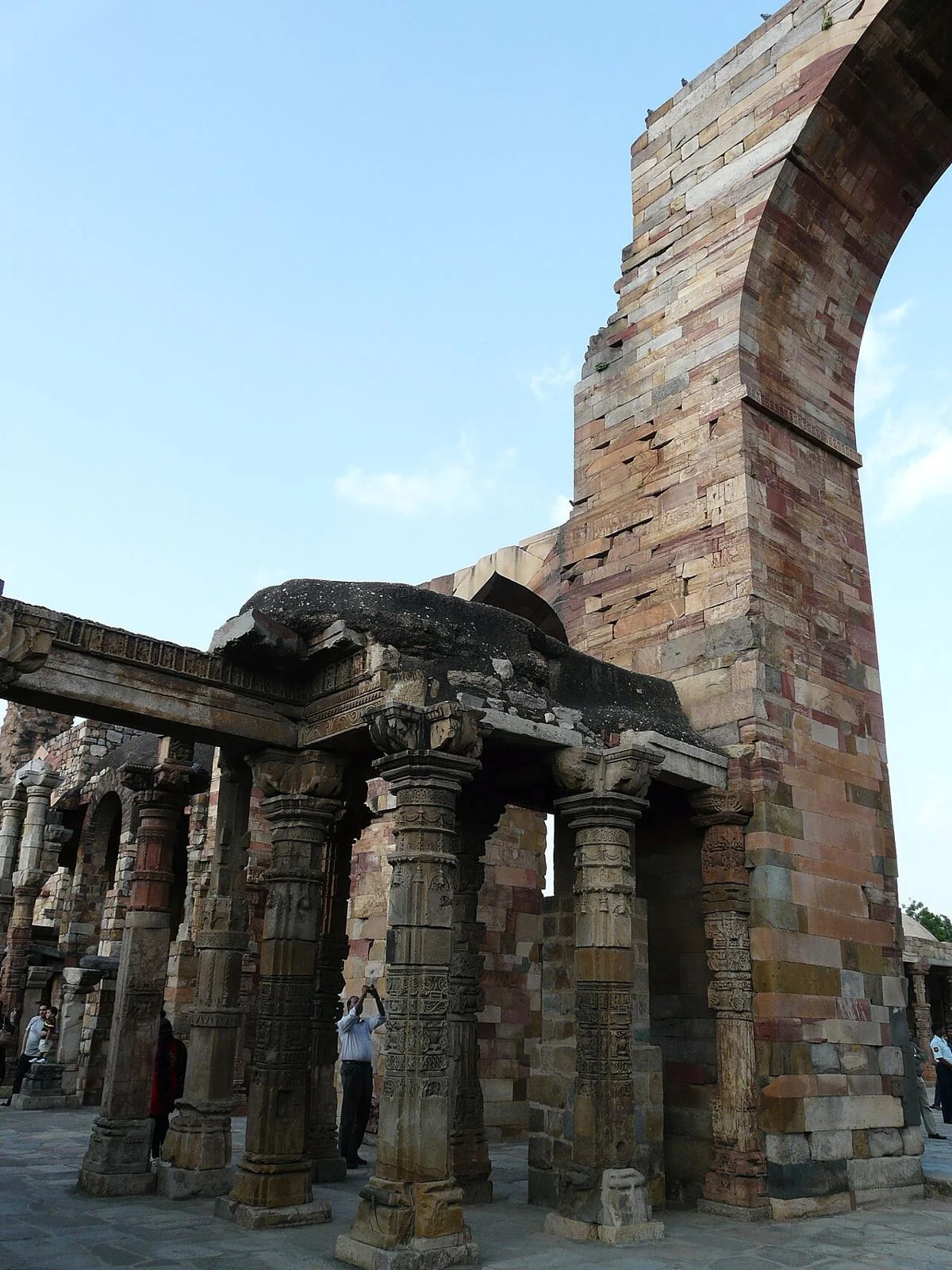
Image Source: Wikimedia
11.4 The “seven cities” of Delhi
| No. | City | Builder |
|---|---|---|
| 1 | Qila Rai Pithora / Mehrauli | Prithviraj Chauhan; first seat of the Turks |
| 2 | Siri | Alauddin Khalji |
| 3 | Tughlaqabad | Ghiyasuddin Tughlaq |
| 4 | Jahanpanah | Muhammad bin Tughlaq |
| 5 | Firozabad (Kotla) | Firoz Shah Tughlaq |
| 6 | Dinpanah / Purana Qila | Humayun and Sher Shah |
| 7 | Shahjahanabad | Shah Jahan |
12. Literature, Language and Music
In simple words: Persian was the language of the court, and Persian poetry and history flowered in Delhi. The star of the age was Amir Khusrau, poet, historian and musician, who loved India and wrote in both Persian and the local language, Hindavi. In the regions, Sanskrit, Bengali, Hindi and other languages kept growing with the support of local Sultans.
12.1 Amir Khusrau (1253–1325)
- Born at Patiali (Etah, Uttar Pradesh) to a Turkish father and an Indian mother; disciple of Nizamuddin Auliya; served several Sultans from Balban’s son Prince Muhammad to Ghiyasuddin Tughlaq, and was the court poet of Alauddin Khalji. → PYQ: WBCS Prelims 2008
- Called Tuti-i-Hind, the “Parrot of India (Hindustan)”, for the sweetness of his verse. → PYQ: WBCS Prelims 2023, 2009, 2007 | PYQ: WBCS Mains 2023 | PYQ: PSC Misc 2018
- Main works:
| Work | Subject |
|---|---|
| Qiran-us-Sadain | Meeting of Bughra Khan and his son Sultan Kaiqubad |
| Miftah-ul-Futuh | Victories of Jalaluddin Khalji |
| Khazain-ul-Futuh (Tarikh-i-Alai) | Alauddin Khalji’s conquests, in prose |
| Ashiqa (Dewal Rani Khizr Khan) | Love story of Alauddin’s son Khizr Khan and the Gujarat princess Dewal Rani |
| Nuh Sipihr (“Nine Skies”) | Reign of Mubarak Shah Khalji; praise of India, its people and languages |
| Tughlaq Nama | Rise of Ghiyasuddin Tughlaq |
| Khamsa | Five romantic poems in reply to the Persian poet Nizami |
- Khazain-ul-Futuh was composed by Amir Khusrau. → PYQ: WBCS Mains 2023
- Dewal Rani, Nuh Sipihr and Qiran-us-Sadain are his; Tuzuk-i-Timuri is not. → PYQ: WBCS Mains 2014
- On the peasants: Amir Khusrau wrote, “Every pearl in the royal crown is but the crystallised drop of blood fallen from the tearful eyes of the poor peasant.” → PYQ: WBCS Mains 2015
- Music: he is credited with creating qawwali, khayal (kheyal) and tarana, and with inventing the sitar (and the tabla) by adapting older instruments. → PYQ: PSC Misc 2010 | PYQ: PSC Misc GK 2006 | PYQ: WBPSC Clerkship
- Language: wrote riddles and verses in Hindavi (early Hindi-Urdu) and developed the Indian style of Persian (sabk-i-Hindi).
12.2 Other writers and books
| Author | Work | Note |
|---|---|---|
| Ziauddin Barani | Tarikh-i-Firuz Shahi, Fatawa-i-Jahandari | Historian of Balban to Firoz |
| Minhaj-us-Siraj | Tabaqat-i-Nasiri | Dedicated to Nasiruddin Mahmud |
| Hasan Nizami | Taj-ul-Maasir | Aibak’s reign |
| Isami | Futuh-us-Salatin | Verse history |
| Shams Siraj Afif | Tarikh-i-Firuz Shahi | Firoz’s reign |
| Amir Hasan Dehlavi | Fawaid-ul-Fuad | Sayings of Nizamuddin Auliya; called the “Sadi of India” |
| Ibn Battuta | Rehla (Arabic) | MBT’s India |
| Zia Nakhshabi | Tuti Nama | Persian version of the Sanskrit Shukasaptati (tales of a parrot) |
| Firoz Tughlaq | Futuhat-i-Firuz Shahi | Autobiography |
| Malik Muhammad Jayasi | Padmavat (Awadhi) | Completed in 1540 under Sher Shah |
12.3 Regional and Sanskrit literature
- Sanskrit: remained the language of learning in the Hindu kingdoms and temples; Firoz Tughlaq had Sanskrit works on science and philosophy from Jwalamukhi translated into Persian, and Zia Nakhshabi rendered the Shukasaptati as the Tuti Nama.
- Bengali: Krittivas‘s Ramayana, Maladhar Basu‘s Sri Krishna Vijaya, and the Bengali Mahabharata under Husain Shah, with the support of the Bengal Sultans.
- Hindi: Kabir’s dohas; Chand Bardai‘s Prithviraj Raso came earlier (Chapter 1). → Early Medieval India and Rajput Kingdoms
- → Practise book–author questions: WBCS Mains Books and Literature PYQs
13. Decline of the Delhi Sultanate
In simple words: The Sultanate fell for many reasons working together: no fixed rule of succession, greedy nobles, MBT’s failed experiments, Firoz’s hereditary system, the loss of rich provinces, Timur’s raid, and finally Babur’s guns at Panipat.
- No law of succession: every death led to plots and murders; many Sultans were puppets.
- Despotic, personal rule: the state was only as strong as the Sultan; weak rulers meant weak government.
- Nobles and factions: the Forty under the Mamluks, rival Turkish, Afghan and Indian groups later.
- Muhammad bin Tughlaq’s projects: wasted money, angered people and set off revolts across the empire.
- Firoz Tughlaq’s policies: hereditary iqtas and army posts, a huge slave establishment, and a weaker army.
- Too large an empire: poor communications made distant provinces such as Bengal and the Deccan hard to hold.
- Rise of provincial kingdoms: Bengal, Vijayanagara, Bahmani, Jaunpur, Malwa and Gujarat took away revenue and soldiers.
- Timur’s invasion (1398): destroyed Delhi’s wealth and prestige.
- Ibrahim Lodi’s quarrel with the Afghan nobles, who invited Babur.
- Military backwardness: the Lodi army had no answer to Babur’s artillery and tulughma at Panipat (1526).
14. The Delhi Sultanate at a Glance
In simple words: The tables below put the whole chapter on one page. Revise them the night before the exam.
14.1 Rulers and their famous facts
| Ruler | Years | Remember for |
|---|---|---|
| Qutbuddin Aibak | 1206–10 | Founder; Lakh Bakhsh; Quwwat-ul-Islam; began Qutb Minar; died playing polo |
| Iltutmish | 1211–36 | Real founder; Delhi capital; iqta; tanka and jital; Chahalgani; Caliph’s investiture (1229); completed Qutb Minar |
| Razia | 1236–40 | Only woman Sultan; Yaqut; Altunia |
| Nasiruddin Mahmud | 1246–66 | Tabaqat-i-Nasiri dedicated to him |
| Balban | 1266–87 | Zil-i-Ilahi; sijda, paibos, Nauroz; blood and iron; broke the Forty; NW frontier |
| Jalaluddin Khalji | 1290–96 | Khalji Revolution; first Deccan raid (by Alauddin, 1296) |
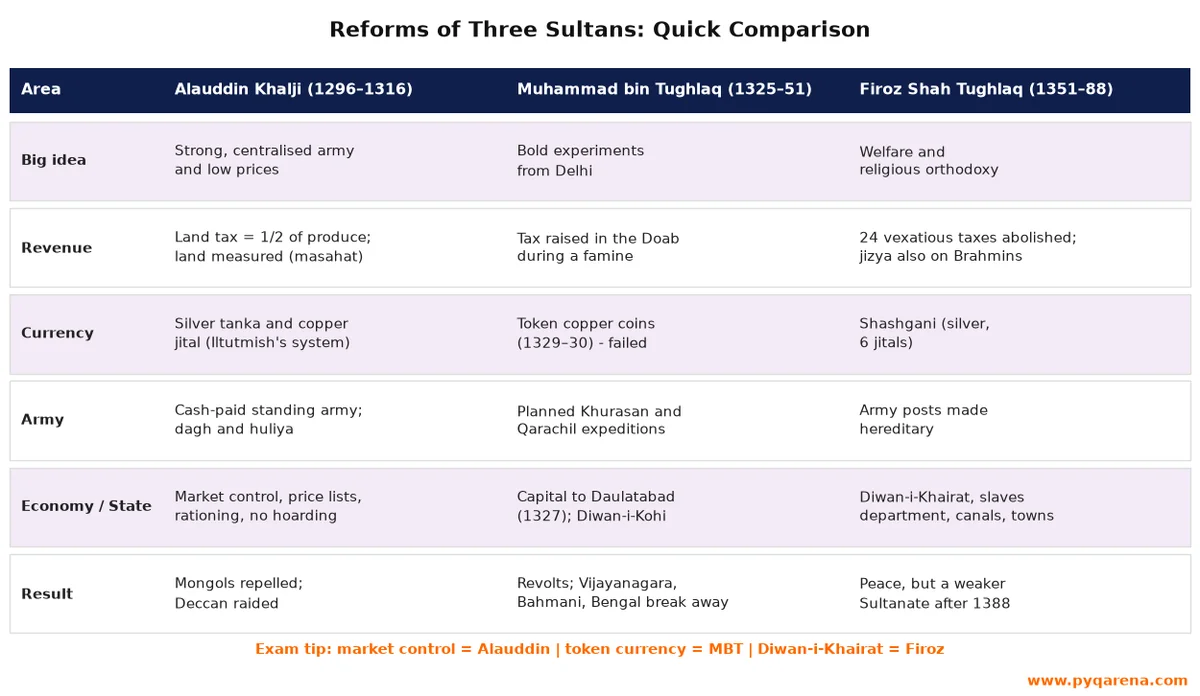
| Alauddin Khalji | 1296–1316 | Sikandar-i-Sani; market control; rationing; cash-paid army; dagh and huliya; Malik Kafur; Alai Darwaza; Siri |
| Mubarak Shah Khalji | 1316–20 | Declared himself Caliph |
| Ghiyasuddin Tughlaq | 1320–25 | Ghazi Malik; Tughlaqabad; died at Afghanpur |
| Muhammad bin Tughlaq | 1325–51 | Daulatabad; token currency; Doab tax; Khurasan and Qarachil; Diwan-i-Kohi; Ibn Battuta |
| Firoz Shah Tughlaq | 1351–88 | 24 taxes abolished; jizya on Brahmins; Diwan-i-Khairat; slaves department; canals; Ashokan pillars; “Akbar of the Sultanate” |
| Nasiruddin Mahmud Tughlaq | 1394–1412 | Timur’s invasion (1398) |
| Khizr Khan | 1414–21 | Founder of the Sayyids; Rayat-i-Ala |
| Bahlul Lodi | 1451–89 | Founder of the Lodis; first Afghan Sultan; Bahluli coin |
| Sikandar Lodi | 1489–1517 | Founded Agra (1504); Gaz-i-Sikandari; Kabir legend |
| Ibrahim Lodi | 1517–26 | Last Sultan; killed at First Panipat |
14.2 Titles and nicknames
| Title | Person |
|---|---|
| Lakh Bakhsh | Qutbuddin Aibak |
| Sikandar-i-Sani (Second Alexander) | Alauddin Khalji |
| Zil-i-Ilahi (Shadow of God) | Balban’s idea of the Sultan |
| Prince of Moneyers | Muhammad bin Tughlaq |
| Akbar of the Sultanate | Firoz Shah Tughlaq (Elliot) |
| Tuti-i-Hind (Parrot of India) | Amir Khusrau |
| Hazar-dinari | Malik Kafur |
| Rai Rayan | Ramachandra of Devagiri (given by Alauddin) |
| Shah-i-Bangalah | Shamsuddin Ilyas Shah |
| Akbar of Kashmir | Zain-ul-Abidin |
| Gulrukhi (pen-name) | Sikandar Lodi |
| Chiragh-i-Delhi | Shaikh Nasiruddin (Chishti) |
14.3 “Firsts” of the Sultanate
| First | Answer |
|---|---|
| First Sultan / founder | Qutbuddin Aibak |
| First Sultan with the Caliph’s investiture | Iltutmish |
| First and only woman ruler | Razia |
| First to frame a North-West Frontier policy | Balban |
| First Muslim raid on the Deccan | 1296, by Alauddin under Jalaluddin |
| First to send expeditions to conquer the Deccan / South | Alauddin Khalji |
| First to introduce market control and rationing | Alauddin Khalji |
| First to measure land for revenue | Alauddin Khalji |
| First true arch and dome | Alai Darwaza |
| First Afghan Sultan | Bahlul Lodi |
| First Islamic tomb in India | Sultan Ghari (Iltutmish) |
15. Do Not Confuse
In simple words: These pairs look alike and trap students every year.
| Confusing pair | The difference |
|---|---|
| Chahalgani created vs destroyed | Created by Iltutmish; destroyed by Balban |
| Tarikh-i-Firuz Shahi (Barani) vs Tarikh-i-Firuz Shahi (Afif) | Same name, two authors: Barani covers Balban to early Firoz; Afif covers Firoz’s reign |
| Futuh-us-Salatin vs Futuhat-i-Firuz Shahi | Futuh-us-Salatin by Isami; Futuhat-i-Firuz Shahi by Firoz Tughlaq |
| Khazain-ul-Futuh vs Miftah-ul-Futuh | Khazain = Alauddin’s conquests; Miftah = Jalaluddin’s victories (both by Amir Khusrau) |
| Tabaqat-i-Nasiri vs Taj-ul-Maasir | Tabaqat by Minhaj-us-Siraj; Taj-ul-Maasir by Hasan Nizami |
| Rehla vs Tuzuk-i-Timuri | Rehla by Ibn Battuta; Tuzuk-i-Timuri by Timur |
| Quwwat-ul-Islam vs Adhai Din Ka Jhonpra | Quwwat-ul-Islam at Delhi; Adhai Din Ka Jhonpra at Ajmer; both by Aibak |
| Qutb Minar begun vs completed | Begun by Aibak; completed by Iltutmish; repaired by Firoz |
| Siri vs Jahanpanah vs Firozabad | Siri = Alauddin; Jahanpanah = MBT; Firozabad = Firoz |
| Shashgani vs jital | Shashgani = silver (6 jitals, Firoz); jital = copper (Iltutmish) |
| Token currency vs paper money | MBT’s token coins were copper; paper money was used in China, not by MBT |
| Jalaluddin Khalji vs Jalaluddin Mangbarni vs Jalaluddin Ahsan Shah | Khalji = Sultan of Delhi (1290); Mangbarni = prince of Khwarizm chased by Chingiz Khan (1221); Ahsan Shah = founder of the Madurai Sultanate (1335) |
| Ghiyasuddin Tughlaq vs Ghiyasuddin Balban | Tughlaq = Ghazi Malik, founder of the Tughlaqs; Balban = Mamluk Sultan |
| Nasiruddin Mahmud (Mamluk) vs Nasiruddin Mahmud (Tughlaq) | Mamluk ruler 1246–66 (Balban’s master); Tughlaq ruler at the time of Timur |
| Bakhtiyar Khalji vs Bakhtiyar Kaki | Bakhtiyar Khalji = conqueror of Bengal; Qutbuddin Bakhtiyar Kaki = Chishti saint of Delhi |
| Fatehabad vs Fatehpur Sikri | Fatehabad = Firoz Tughlaq; Fatehpur Sikri = Akbar |
| Daulat Khan Lodi (1412–14) vs Daulat Khan Lodi (1520s) | The first ruled Delhi after the Tughlaqs; the second, governor of Punjab, invited Babur |
16. Timeline (1206–1526)
In simple words: The main dates of the chapter in order.
| Year | Event |
|---|---|
| 1206 | Qutbuddin Aibak founds the Delhi Sultanate at Lahore |
| 1210 | Aibak dies; Iltutmish becomes Sultan (1211) |
| 1221 | Chingiz Khan reaches the Indus chasing Jalaluddin Mangbarni |
| 1229 | Iltutmish receives the Caliph’s investiture |
| 1236 | Razia becomes Sultan |
| 1260 | Minhaj completes the Tabaqat-i-Nasiri |
| 1266 | Balban becomes Sultan |
| 1290 | Jalaluddin Khalji founds the Khalji dynasty |
| 1296 | Alauddin raids Devagiri, kills Jalaluddin and becomes Sultan |
| 1299–1311 | Conquest of Gujarat, Ranthambhore (1301), Chittor (1303), Malwa (1305) |
| 1303 | Siri fort built; Mongol siege of Delhi |
| 1307–11 | Malik Kafur’s campaigns: Devagiri, Warangal, Dwarasamudra, Madurai |
| 1311 | Alai Darwaza built |
| 1320 | Ghiyasuddin Tughlaq founds the Tughlaq dynasty |
| 1325 | Muhammad bin Tughlaq becomes Sultan |
| 1327 | Capital shifted to Daulatabad |
| 1329–30 | Token currency |
| 1333 | Ibn Battuta reaches Delhi |
| 1335 | Madurai Sultanate (Jalaluddin Ahsan Shah) |
| 1336 | Vijayanagara Empire founded |
| 1342 | Ilyas Shah founds the independent Bengal Sultanate |
| 1347 | Bahmani Kingdom founded |
| 1351 | Firoz Shah Tughlaq becomes Sultan |
| 1375 | Adina Mosque at Pandua |
| 1398 | Timur sacks Delhi |
| 1414 | Khizr Khan founds the Sayyid dynasty |
| 1451 | Bahlul Lodi founds the Lodi dynasty |
| 1504 | Sikandar Lodi founds Agra |
| 1526 | First Battle of Panipat: Babur defeats Ibrahim Lodi; end of the Sultanate |
17. Quick Revision and Memory Tricks
In simple words: Short lines and tricks to fix the most-asked facts in memory.
17.1 One-line facts
- Delhi Sultanate: 1206–1526, five dynasties, last Sultan Ibrahim Lodi.
- Iltutmish: iqta, tanka (silver), jital (copper), Chahalgani, Caliph’s robe (1229), Qutb Minar completed.
- Balban: sijda, paibos, Nauroz, Zil-i-Ilahi, broke the Forty, NW frontier.
- Alauddin: not a slave, Sikandar-i-Sani, market control, rationing, anti-hoarding, cash army, dagh-huliya, kharaj = half, Malik Kafur, Alai Darwaza.
- MBT: Daulatabad (1327), copper token currency (1329–30), Svargadvari on the Ganges, Diwan-i-Kohi, Ibn Battuta.
- Firoz: 24 taxes gone, jizya on Brahmins, Diwan-i-Khairat, slaves department, Hissar–Fatehabad–Jaunpur–Firozabad, Ashokan pillars, shashgani.
- Lodis: Afghans; Bahlul founder; Sikandar founded Agra; Ibrahim lost Panipat (1526) after Daulat Khan Lodi invited Babur.
- Books: Minhaj — Tabaqat-i-Nasiri; Barani — Tarikh-i-Firuz Shahi; Isami — Futuh-us-Salatin; Ibn Battuta — Rehla; Amir Khusrau — Khazain-ul-Futuh; Timur — Tuzuk-i-Timuri.
- Bengal: Bakhtiyar Khalji (Lakhnauti); Ilyas Shah (independent Sultanate, 1342); Sikandar Shah (Adina Mosque).
18. Frequently Asked Questions
In simple words: Short answers to the questions students ask most.
Q1. Who founded the Delhi Sultanate and when? Qutbuddin Aibak, in 1206, after the death of Muhammad Ghori.
Q2. Why is Iltutmish called the real founder of the Delhi Sultanate? He made Delhi the capital, set up the iqta system, issued the silver tanka and copper jital, formed the Chahalgani, and won recognition from the Caliph in 1229.
Q3. What was Balban’s theory of kingship? The Sultan was the shadow of God (Zil-i-Ilahi) whose word was law; he enforced it through sijda, paibos, a grand Persian court and harsh punishment.
Q4. Why did Alauddin Khalji introduce market control? To maintain a huge cash-paid army against the Mongols on low salaries, prices of all goods in Delhi had to stay low.
Q5. Why did Muhammad bin Tughlaq’s token currency fail? The copper coins were easy to copy and the state had no control over minting, so forged coins flooded the market and the value collapsed.
Q6. Why is Firoz Shah Tughlaq called the “Akbar of the Sultanate”? Henry Elliot gave him this title for his welfare work: charity, hospitals, canals, new towns and lighter taxes.
Q7. What was the iqta system? The assignment of land revenue from an area to an officer in place of a salary, with the duty to keep troops; the iqta holder was called a muqti.
Q8. Which kingdoms arose from revolts against Muhammad bin Tughlaq? The Madurai Sultanate (1335), Vijayanagara (1336), the independent Bengal Sultanate (1342) and the Bahmani Kingdom (1347).
Q9. Who invited Babur to India? Daulat Khan Lodi, governor of Punjab, together with Alam Khan Lodi.
Q10. Why is Amir Khusrau important? He was a great Persian poet and historian, the “Parrot of India”, the author of Khazain-ul-Futuh and Nuh Sipihr, a pioneer of Hindavi, and the creator of qawwali and khayal.
Related Notes and Practice
- Notes:
- Practice:
- WBCS Mains Delhi Sultanate PYQs
- WBCS Prelims Medieval Indian History PYQs
- WBCS Mains Early Medieval Indian History PYQs
- WBCS Mains Religious Movements PYQs
- WBCS Mains Vijayanagar and Bahmani PYQs
- WBCS Mains General Knowledge History PYQs
- WBCS Mains Books and Literature PYQs
- PSC Miscellaneous Prelims History PYQs
- WBPSC Clerkship History PYQs
- WBPSC IDO History PYQs
Leave a Comment