

Who is this for? Beginners and aspirants for UPSC Prelims, WBCS, other State PSCs and SSC. Each section opens with an “In simple words” explanation and then goes to exam-level detail. Practise alongside: WBCS Mains Pre-Mauryan & Mauryan PYQs | WBCS Prelims Ancient Indian History PYQs Previous chapters: Prehistoric India Notes → Indus Valley Civilization Notes → Vedic Age Notes → Mahajanapadas & Rise of Magadha Notes → Buddhism and Jainism → Schools of Indian Philosophy
1. Introduction: India’s First Great Empire
In simple words: In 321 BCE a young man named Chandragupta Maurya, guided by his teacher Chanakya (Kautilya), overthrew the Nanda king of Magadha. He and his successors built the first empire that covered almost all of India, from Afghanistan in the north-west to Karnataka in the south. Its most famous ruler, Ashoka, gave up war and spread a message of morality called Dhamma.
- Period: 321–185 BCE (about 137 years).
- Capital: Pataliputra (modern Patna), from Chandragupta onwards. → PYQ: WBCS Mains 2023
- Before the Mauryas: the Nanda dynasty ruled Magadha. Dhanananda was king during Alexander’s invasion. → PYQ: WBCS Mains 2023 (See the Mahajanapadas & Rise of Magadha Notes.)
- After the Mauryas: the Shunga dynasty (from 185 BCE). → PYQ: WBCS Mains 2020
- Oldest of the big dynasties: of Maurya, Kanva, Kushana and Gupta, the Maurya is the oldest. → PYQ: WBCS Mains GK 2021
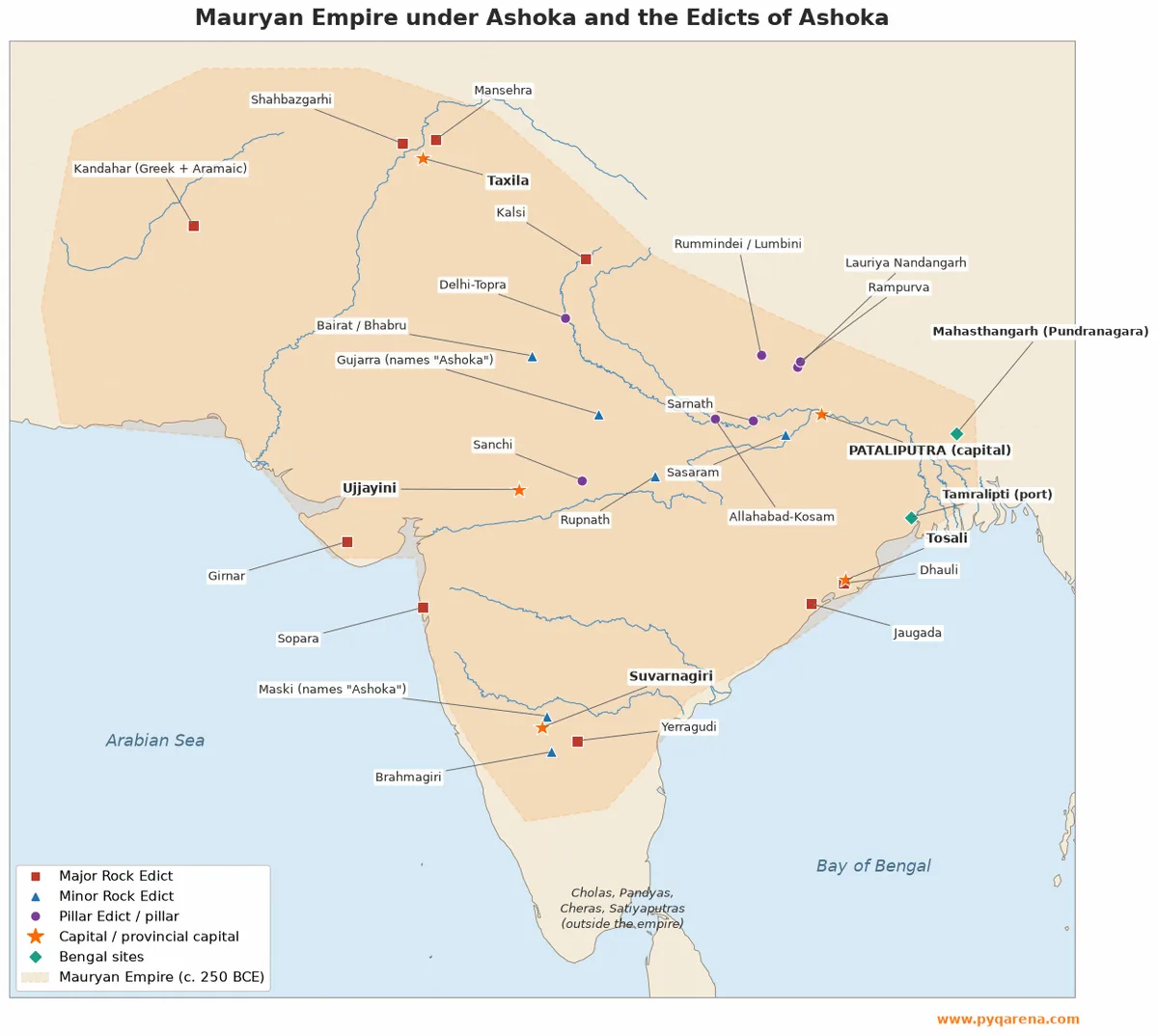
The Mauryan Empire under Ashoka (c. 250 BCE): edict sites, provincial capitals and the Bengal sites of Mahasthangarh and Tamralipti.
2. Sources of Mauryan History
In simple words: We know more about the Mauryas than about any earlier Indian dynasty, because we have a political handbook (Arthashastra), a Greek eyewitness account (Indica), a play (Mudrarakshasa), Buddhist and Jain stories, and above all Ashoka’s own inscriptions carved on rocks and pillars.
| Type | Source | Author / date | What it tells us |
|---|---|---|---|
| Literary (Indian) | Arthashastra | Kautilya (Chanakya / Vishnugupta) | Statecraft, administration, economy, spies |
| Mudrarakshasa | Vishakhadatta (Gupta age) | How Chandragupta and Chanakya overthrew the Nandas | |
| Puranas (Vishnu Purana) | — | Mauryan king-list; describe the Mauryas as Shudras | |
| Buddhist: Dipavamsa, Mahavamsa, Divyavadana, Ashokavadana | Sri Lankan and north Indian | Ashoka’s conversion and Buddhist missions; call the Mauryas Kshatriyas of the Moriya clan | |
| Jain: Parishishtaparvan | Hemachandra (12th century) | Chandragupta’s Jainism and his death at Shravanabelagola | |
| Rajatarangini | Kalhana (12th century) | Ashoka built Srinagar; his favourite deity was Shiva | |
| Foreign | Indica | Megasthenes | Pataliputra, society, administration |
| Later Greek and Roman writers | Strabo, Arrian, Diodorus, Pliny, Justin | Quote the lost Indica; call Chandragupta Sandrocottus | |
| Archaeological | Edicts of Ashoka | Ashoka | Dhamma, Kalinga war, extent of empire |
| Junagadh inscription of Rudradaman (150 CE) | Saka ruler | Sudarshana lake built by Chandragupta’s governor Pushyagupta; repaired under Ashoka by Tushaspha | |
| Sohgaura (UP) and Mahasthan (Bangladesh) inscriptions | Mauryan | Famine relief and granaries | |
| NBPW pottery, punch-marked coins | — | Material culture |
- Exam facts:
- The Puranas describe the Mauryas as belonging to the Shudra varna. → PYQ: WBCS Mains 2015
- Buddhist texts call Chandragupta a Kshatriya of the Moriya clan of Pippalivana. → PYQ: WBCS Prelims 2022, 2002
- Kalhana’s Rajatarangini states that Ashoka built Srinagar and that his favourite deity was Shiva. → PYQ: WBCS Mains 2015, 2014
- Kalhana wrote the Rajatarangini (12th century CE), a history of Kashmir. → PYQ: WBCS Prelims 2020, 2010, 2006 | PYQ: WBCS Mains 2023 | PYQ: WBPSC Clerkship
- Arrian wrote an Indica, Strabo wrote Geography and Diodorus Siculus wrote Bibliotheca Historica. Naturalis Historia is by Pliny the Elder, not Claudius Aelianus. → PYQ: WBCS Mains 2016
- Romila Thapar wrote Asoka and the Decline of the Mauryas (1961). → PYQ: WBCS Mains 2017
3. Chandragupta Maurya (321–297 BCE)
In simple words: Chandragupta was a brave youth of humble origin. Chanakya, insulted by the Nanda king, trained him. Together they defeated the Nandas, drove out the Greek garrisons left by Alexander, beat the Greek general Seleucus, and built an empire stretching from Afghanistan to the Deccan. In old age Chandragupta became a Jain monk.
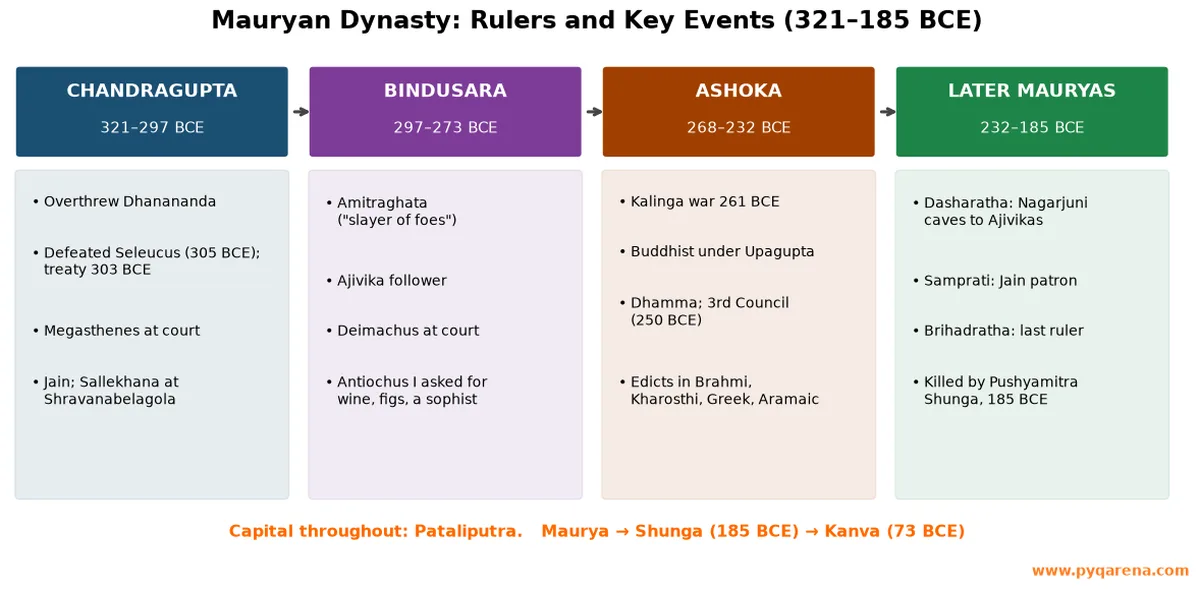
The Mauryan rulers in order, with key events (321–185 BCE).
- Founder and first ruler of the Maurya dynasty. → PYQ: WBCS Mains 2022
- First historical emperor of India, the first to unite most of the subcontinent. → PYQ: WBCS Prelims 2023, 2000
- Greek name:Sandrocottus (Strabo, Justin) or Androcottus (Plutarch). → PYQ: WBCS Prelims 2018
- Sir William Jones identified Sandrocottus with Chandragupta. This fixed the first firm date of Indian history.
- Guide and mentor: Kautilya (Chanakya), a Brahmin teacher of Taxila. The play Mudrarakshasa by Vishakhadatta shows their fall-of-the-Nandas story. → PYQ: WBCS Prelims 2016
- War with Seleucus Nicator (305 BCE):
- Chandragupta defeated Seleucus, Alexander’s general who ruled West Asia. → PYQ: WBCS Prelims 2008
- Treaty of 303 BCE, the first known international treaty in Indian history. → PYQ: WBCS Mains 2016
- Seleucus gave up Arachosia (Kandahar), Gedrosia (Baluchistan), Paropamisadae (Kabul) and Aria (Herat).
- Chandragupta gave 500 war elephants.
- Epigamia (marriage) clause: the treaty had a marriage agreement. Historians B. N. Mukherjee and Romila Thapar rejected the idea that Chandragupta married Seleucus’s daughter. → PYQ: WBCS Mains 2016
- Megasthenes came to Pataliputra as Seleucus’s ambassador. → PYQ: WBCS Prelims 2018, 2010 | PYQ: WBCS Mains GK
- Extent: Afghanistan and Baluchistan to Bengal; Saurashtra (governor Pushyagupta built the Sudarshana lake at Girnar); south up to Karnataka.
- Religion and death:
- In his last years he became a Jain and went south with Bhadrabahu during a 12-year famine. → PYQ: WBCS Mains 2023
- He died by Sallekhana (fasting) at Shravanabelagola (Chandragiri hill), Karnataka.
- Successor: his son Bindusara. → PYQ: WBCS Prelims 2000
4. Bindusara (297–273 BCE)
In simple words: Chandragupta’s son Bindusara kept the empire safe and pushed it further south. The Greeks called him Amitrochates, from the Sanskrit Amitraghata, “slayer of enemies”.
- Title:Amitraghata (Greek Amitrochates). → PYQ: WBCS Mains 2021 | PYQ: WBCS Prelims 2011, 2009, 2005
- Not Chandragupta: a statement that “Chandragupta was known to the Greeks as Amitrochates” is incorrect. → PYQ: WBCS Mains 2015
- Other names: Simhasena; Bhadrasara in the Vayu Purana.
- Greek contact:
- Deimachus came as ambassador of Antiochus I of Syria.
- Dionysius came from Ptolemy II of Egypt.
- Bindusara asked Antiochus for sweet wine, dried figs and a sophist. He got the wine and figs, but not the philosopher.
- Greek ambassadors at the Mauryan court: Megasthenes, Deimachus and Dionysius. Diodorus was a historian, not an ambassador. → PYQ: WBCS Mains 2015
- Religion: a follower of the Ajivika sect.
- Revolt at Taxila: his son Ashoka (then governor of Ujjayini) was sent to put it down.
- Conquests: Taranatha credits him with conquering “the land between the two seas”, which extended the empire into the Deccan.
5. Ashoka (268–232 BCE)
In simple words: Ashoka was Bindusara’s son. He began as a strong and harsh king. After the bloody Kalinga war, he felt deep regret, turned to Buddhism, and gave up conquest by the sword for “conquest by Dhamma”. He carved his messages on rocks and pillars all over India. These are the Edicts of Ashoka, the oldest readable written records of Indian history.
5.1 Early life and accession
- Parents: Bindusara and Subhadrangi (Dharma), a Brahmin woman from Champa.
- Viceroy: of Ujjayini (Avanti) and later sent to Taxila to crush a revolt.
- Accession: 273 BCE, after a war of succession with his brothers. Coronation: 269 BCE.
- Wives:
- Devi of Vidisha: mother of Mahendra and Sanghamitra.
- Karuvaki: mother of Tivara; named in the Queen’s Edict on the Allahabad pillar.
- Asandhimitra and Tishyarakshita.
5.2 Names and titles
- Devanampiya Piyadasi (“Beloved of the Gods, of pleasing appearance”): his usual title in the edicts. → PYQ: WBCS Mains 2022 | PYQ: WBCS Prelims 2017, 2013
- Inscriptions that name him “Ashoka”:
- Maski (Raichur, Karnataka; found by C. Beadon, 1915): the first to name him; it proved that “Piyadasi” was Ashoka. → PYQ: WBP SI
- Gujarra (Datia, Madhya Pradesh).
- Udegolam and Nittur (Bellary, Karnataka).
- The Junagadh inscription of Rudradaman (150 CE) also names “Ashoka Maurya”.
- Dharmashoka (after conversion) and Chandashoka (“Ashoka the fierce”, before conversion) in Buddhist texts.
5.3 The Kalinga War (261 BCE)
- When: in the 8th year after his coronation, 261 BCE. → PYQ: WBCS Mains GK
- Source: Major Rock Edict XIII. → PYQ: WBCS Prelims 2002
- Toll: 1,50,000 people deported, 1,00,000 killed, and many more died later.
- Result:
- Ashoka felt deep remorse.
- He replaced bherighosha (sound of war drums) with dhammaghosha (sound of Dhamma).
- He adopted Dhamma-vijaya (conquest by righteousness) instead of war.
- Kalinga after the war:
- It was ruled from Tosali (near Dhauli) and Samapa (Jaugada).
- Here the Separate Kalinga Edicts replace RE XI–XIII. They contain the famous line “Sabe munise paja mama” (“All men are my children”). → PYQ: WBCS Mains 2015 | PYQ: WBPSC Misc
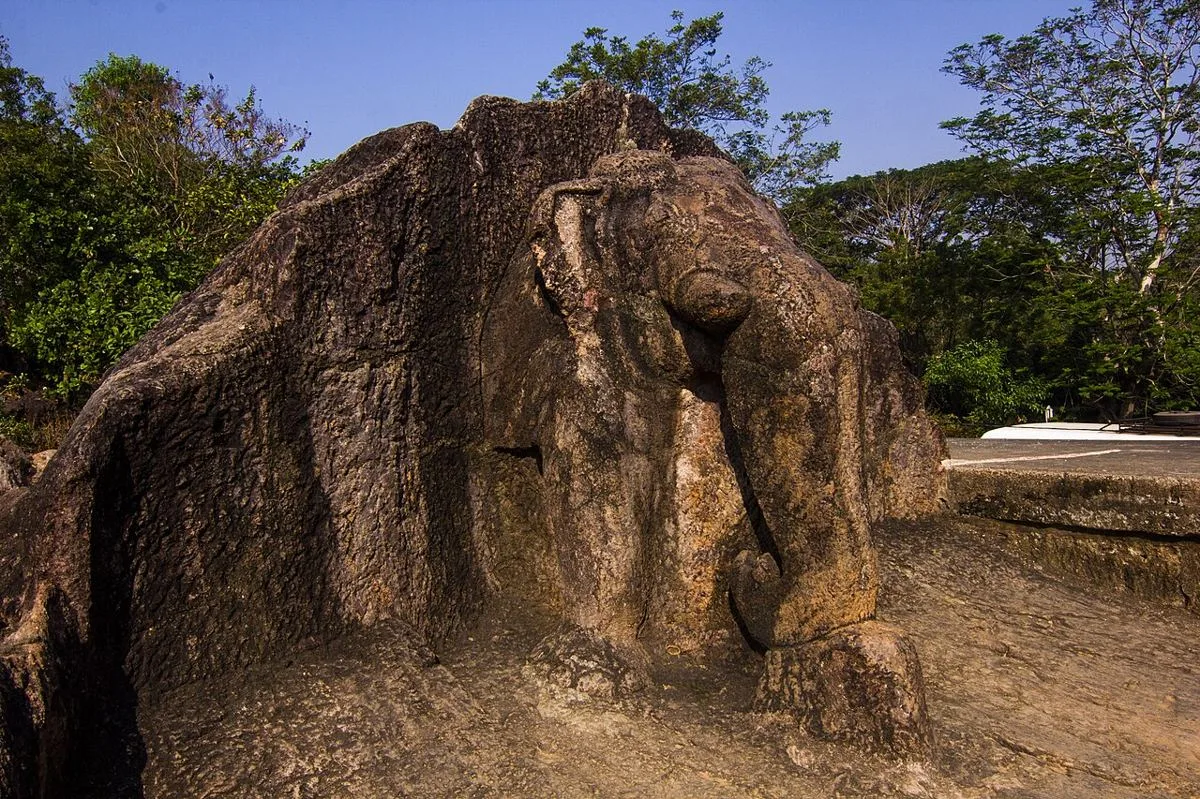
The rock-cut elephant at Dhauli, Odisha, above Ashoka’s edict near the Kalinga battlefield.
Image Source: Wikimedia
5.4 Ashoka and Buddhism
- Conversion: he became a lay Buddhist (upasaka) under the monk Upagupta. The Sri Lankan chronicles name the novice Nigrodha.
- Pilgrimages (Dhamma-yatras): he visited Bodh Gaya (RE VIII), Lumbini and Nigali Sagar.
- Third Buddhist Council (250 BCE): held at Pataliputra, presided over by Moggaliputta Tissa.
- Missions: sent to many lands.
- Mahendra and Sanghamitra went to Sri Lanka, where they converted King Devanampiya Tissa. Sanghamitra carried a sapling of the Bodhi tree.
- Majjhantika went to Kashmir and Gandhara.
- Sona and Uttara went to Suvarnabhumi (Myanmar / Thailand).
- Mahadeva went to Mahishamandala (Mysore).
- Bhabru (Bairat) edict:
- It is the clearest proof of his Buddhism. He calls himself a follower of the Buddha, Dhamma and Sangha and names seven Buddhist texts.
- It is now in the Asiatic Society, Kolkata.
- Respect for other sects:
- He gifted the Barabar caves (Sudama, Karna Chaupar, Lomas Rishi) to the Ajivikas. → PYQ: WBCS Mains 2016
- RE XII asks people to respect all sects.
5.5 Dhamma: Ashoka’s moral code
In simple words: Dhamma (Prakrit for Sanskrit dharma) was not a new religion and not simply Buddhism. It was a set of moral rules for everyone: be kind, honest and tolerant; respect elders, teachers and Brahmanas and shramanas; treat slaves and servants well; do not kill animals needlessly.
- Who propounded it: Ashoka. → PYQ: WBCS Mains 2022
- Main principles:
- Ahimsa: ban on animal sacrifice at festivals (RE I); the royal kitchen cut down meat.
- Tolerance (samavaya): “concord is good”, and people should honour other sects (RE XII).
- Social welfare: hospitals for men and animals, roads, wells, shade trees and rest houses (RE II, PE VII).
- Good conduct: obedience to parents, generosity to friends and the poor, kindness to slaves.
- Dhamma officials:
- Dhamma-mahamattas were appointed in the 13th year after the coronation (RE V).
- Rajukas, Pradeshikas and Yuktas toured every 5 years (RE III).
- Five passions to avoid (asinava, Pillar Edict III): chandiye (rage / ferocity), nithuliye (cruelty), kodhe (anger), mane (pride) and isya (envy). → PYQ: WBCS Mains 2015
- Dhamma-vijaya abroad: RE XIII names five Greek kings.
- Antiochus II Theos of Syria. → PYQ: WBCS Prelims 2022
- Ptolemy II Philadelphus of Egypt.
- Antigonus Gonatas of Macedonia.
- Magas of Cyrene.
- Alexander of Epirus.
6. Edicts of Ashoka: The Complete List
In simple words: Ashoka’s edicts are royal messages carved on rocks, pillars and cave walls. Most are in the Prakrit language and Brahmi script. In the north-west they are in Kharosthi, and in Afghanistan in Greek and Aramaic. They were read for the first time by James Prinsep in 1837.
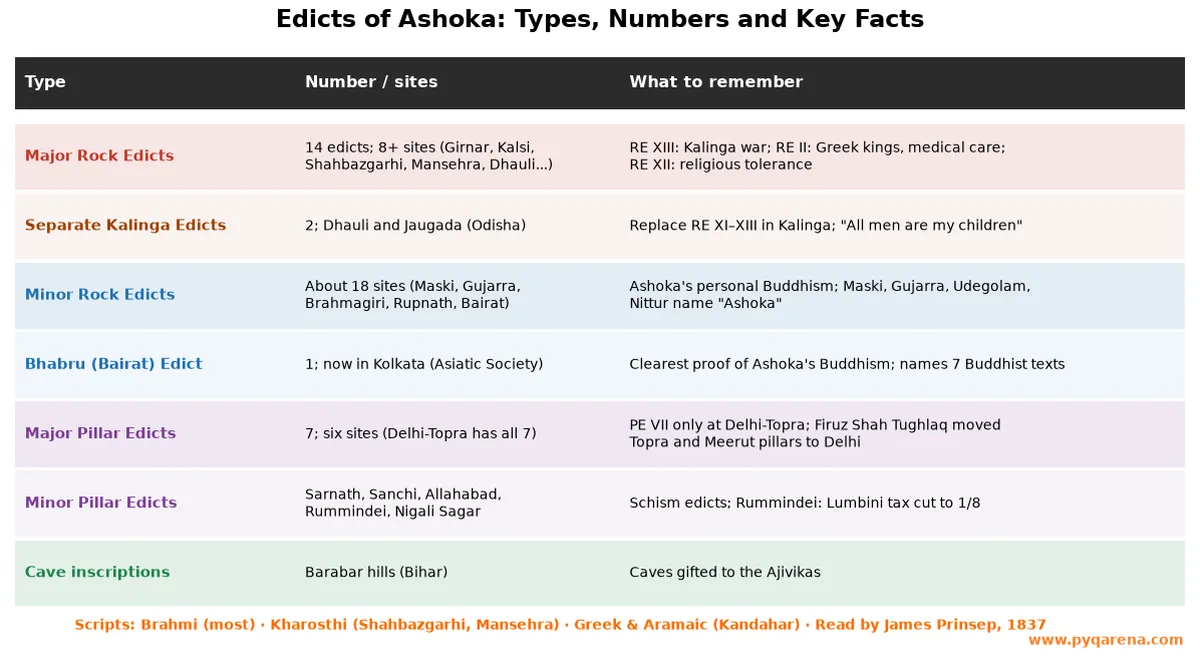
The types of Ashokan edicts at a glance.
6.1 Decipherment and scripts
- James Prinsep, secretary of the Asiatic Society of Bengal, deciphered Brahmi and Ashoka’s inscriptions in 1837. → PYQ: WBCS Mains 2020 | PYQ: WBCS Prelims 2019 | PYQ: WBPSC Clerkship
- Brahmi is the oldest deciphered script of the Indian subcontinent; the Harappan script is still undeciphered. → PYQ: WBCS Mains 2017
- Kharosthi: written right to left and derived from Aramaic. → PYQ: WBCS Mains 2014
- Used at Shahbazgarhi and Mansehra, near Peshawar in the north-west. → PYQ: WBCS Mains 2016 | PYQ: WBCS Mains GK
- Greek and Aramaic: the Kandahar bilingual edict (Shar-i-Kuna, found in 1958) is in both Greek and Aramaic. → PYQ: WBCS Mains 2018
- Aramaic only: Laghman and Taxila.
- Language: Prakrit (mostly the eastern Magadhi dialect).
6.2 Fourteen Major Rock Edicts
Sites:
| Site | State / country | Script / note |
|---|---|---|
| Shahbazgarhi | Peshawar, Pakistan | Kharosthi |
| Mansehra | Hazara, Pakistan | Kharosthi |
| Kalsi | Dehradun, Uttarakhand | Brahmi |
| Girnar | Junagadh, Gujarat | Brahmi; same rock has Rudradaman’s inscription |
| Sopara | Thane, Maharashtra | Brahmi (fragments) |
| Dhauli | Puri, Odisha | Separate Kalinga Edicts instead of XI–XIII |
| Jaugada | Ganjam, Odisha | Separate Kalinga Edicts |
| Yerragudi | Kurnool, Andhra Pradesh | Brahmi (also has a minor rock edict) |
| Sannati | Kalaburagi, Karnataka | Brahmi; separate edicts |
| Kandahar | Afghanistan | Greek version of XII and XIII |
What each edict says:
| No. | Theme |
|---|---|
| I | Ban on animal sacrifice and festive gatherings (samaja) |
| II | Medical care for humans and animals; names the Cholas, Pandyas, Satiyaputras, Keralaputras, Tamraparni and Antiochus |
| III | Rajukas, Pradeshikas, Yuktas to tour every 5 years; liberality to Brahmanas and shramanas |
| IV | Dhammaghosha replaces bherighosha |
| V | Appointment of Dhamma-mahamattas (13th regnal year) |
| VI | King available for public business at all times (prativedakas, reporters) |
| VII | Tolerance among all sects |
| VIII | Dhamma-yatras replace hunting trips; visit to Bodh Gaya |
| IX | Dhamma-mangala (moral ceremonies) better than useless rituals |
| X | True glory lies in Dhamma |
| XI | Dhamma-dana (gift of Dhamma) is the best gift |
| XII | Respect for all sects; “concord is good” |
| XIII | Kalinga war, remorse, Dhamma-vijaya, the five Greek kings |
| XIV | Purpose of the inscriptions |
Memory trick: “1-Sacrifice, 2-Medicine, 3-Rajuka, 5-Mahamatta, 8-Yatra, 12-Tolerance, 13-Kalinga”.
6.3 Minor Rock Edicts
- Content: they describe Ashoka’s personal journey in Buddhism.
- Main sites:
- Karnataka: Maski, Brahmagiri, Siddapur, Jatinga-Rameshwar, Udegolam, Nittur.
- Madhya Pradesh: Gujarra, Rupnath, Panguraria.
- Bihar and Uttar Pradesh: Sasaram (Bihar), Ahraura (UP).
- Rajasthan: Bairat.
- Delhi: Bahapur (Srinivaspuri).
- Andhra Pradesh: Yerragudi, Rajula-Mandagiri.
- Afghanistan: Kandahar (Greek and Aramaic).
- Bhabru edict: found at Bairat (Rajasthan).
6.4 Pillar Edicts
Seven Major Pillar Edicts:
- Delhi-Topra: the only pillar with all seven edicts, including PE VII. Firuz Shah Tughlaq brought it from Topra (Haryana) to Delhi (Firoz Shah Kotla). → PYQ: WBCS Prelims 2011
- Delhi-Meerut: also moved to Delhi (the Ridge) by Firuz Shah.
- Allahabad-Kosam: it also carries the Queen’s Edict, the Schism Edict, Samudragupta’s Prayag Prashasti and an inscription of Jahangir.
- Lauriya-Araraj, Lauriya-Nandangarh (lion capital) and Rampurva (bull and lion pillars): all in Champaran, Bihar.
Minor Pillar Edicts:
- Sarnath, Sanchi, Allahabad: Schism Edicts, warning monks against splitting the Sangha.
- Rummindei (Lumbini, Nepal): marks the Buddha’s birthplace. Ashoka exempted the village from bali and reduced the bhaga tax to 1/8. → PYQ: WBCS Mains 2017
- Nigali Sagar (Nepal): records the enlargement of the stupa of the past Buddha Konakamana.
6.5 Cave inscriptions
- Barabar hills (Bihar): Ashoka gifted the Sudama and Karna Chaupar caves to the Ajivikas.
- Nagarjuni hills: his grandson Dasharatha gifted the Nagarjuni caves to the Ajivikas.
7. Mauryan Administration
In simple words: The Mauryas ran a highly centralised government. The king was at the top, helped by ministers and a large staff of paid officials. The empire was divided into provinces, districts and villages. A big army and a network of spies kept the king informed. Most details come from the Arthashastra and Megasthenes.
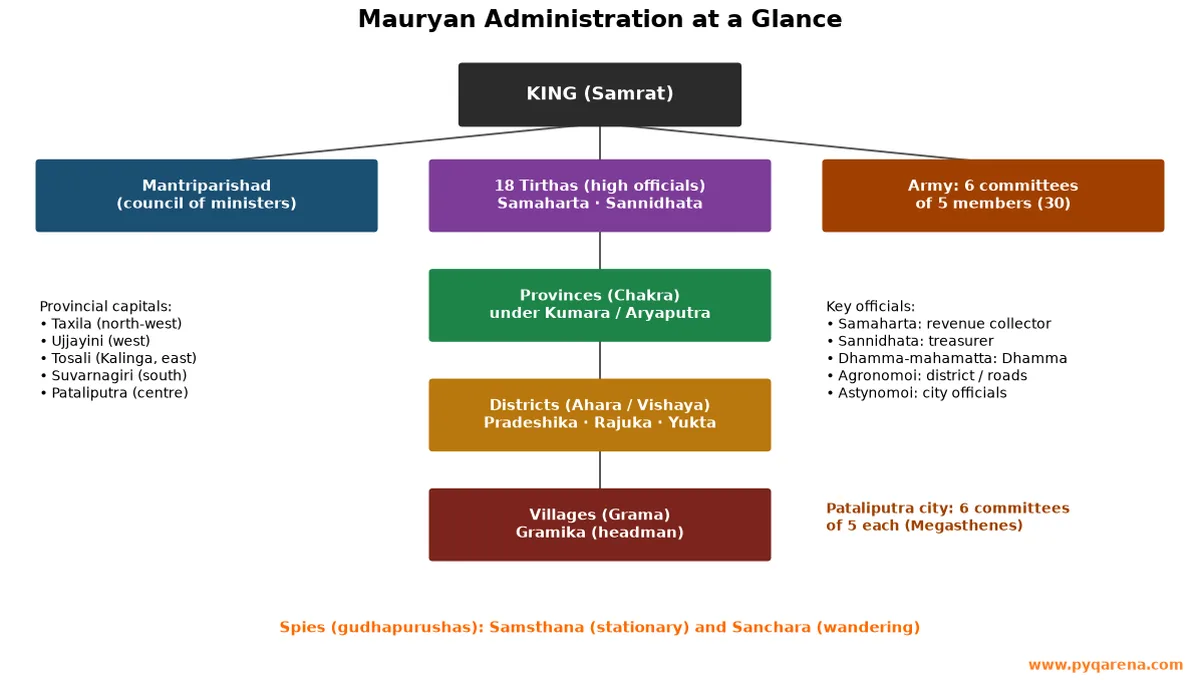
Mauryan administration from the king down to the village.
7.1 Central government
- King: the supreme authority. Kautilya’s ideal king works for the welfare of the people: “In the happiness of his subjects lies the king’s happiness.”
- Mantriparishad: the council of ministers. The inner council of mantrins included the purohita, senapati and yuvaraja.
- 18 Tirthas: the top officials (Arthashastra), such as the Samaharta (chief collector of revenue) and the Sannidhata (chief treasurer, in charge of stores).
- Adhyakshas (superintendents): about 27 departments: Panyadhyaksha (trade), Sitadhyaksha (crown lands), Lakshanadhyaksha (mint), Akaradhyaksha (mines), Sulkadhyaksha (customs), Navadhyaksha (ships), Ganikadhyaksha (courtesans) and others.
7.2 Provinces, districts and villages
- Provinces (chakras): ruled by princes (Kumaras / Aryaputras).
- Provincial capitals:
- Taxila (north-west).
- Ujjayini (west).
- Tosali (Kalinga).
- Suvarnagiri (south).
- Pataliputra (centre).
- Tambapanni (Sri Lanka) was not a Mauryan regional headquarters. → PYQ: WBCS Mains 2016
- District (ahara / vishaya): under the Pradeshika (overall charge), the Rajuka (land and justice) and the Yukta (accounts).
- Village: the Gramika (headman), with the Gopa (in charge of 5–10 villages) and the Sthanika (a quarter of a district).
7.3 Justice, army and spies
- Courts:
- Dharmasthiya: civil courts.
- Kantakashodhana: criminal courts (“removal of thorns”). → PYQ: WBCS Mains 2015
- Army (Megasthenes):
- 6 boards of 5 members: navy, transport and supply, infantry, cavalry, chariots and elephants.
- Size: Pliny gives Chandragupta 6,00,000 infantry, 30,000 cavalry and 9,000 elephants.
- Types of soldiers (Arthashastra):
- Maula: hereditary soldiers. → PYQ: WBCS Mains 2015
- Bhritaka: mercenaries.
- Shreni: guild levies.
- Atavika: forest tribes.
- Spies (gudhapurushas):
- Samsthana: stationary.
- Sanchara: wandering.
- Senapati: commander-in-chief.
7.4 City administration of Pataliputra (Megasthenes)
- Six committees of five members each, 30 officers in all:
- Industry and crafts.
- Foreigners.
- Registration of births and deaths.
- Trade and commerce, weights and measures.
- Sale of manufactured goods.
- Collection of a sales tax of 1/10.
- Nagaraka: the city chief. Astynomoi were city officials and Agronomoi were district officials (Megasthenes’ Greek terms).
- Main source: Megasthenes’ Indica is the most important source for the municipal administration of Pataliputra. → PYQ: WBCS Prelims 2001
8. Arthashastra and Indica
8.1 Kautilya’s Arthashastra
In simple words: The Arthashastra is a handbook for kings. It explains how to collect taxes, run departments, keep spies, fight wars and make treaties, all to keep the state strong and the people prosperous.
- Author: Kautilya, also called Chanakya or Vishnugupta. → PYQ: WBCS Mains 2023, 2022 | PYQ: WBPSC Misc 2010
- Structure: 15 books (adhikaranas), 180 sections and about 6,000 verses, in Sanskrit prose.
- Discovery: R. Shamasastry found the manuscript in 1905 (Mysore Oriental Library). It was published in 1909 and translated into English in 1915.
- Key ideas:
- Saptanga theory: the state has seven limbs:
- Swami (king).
- Amatya (ministers).
- Janapada (territory and people).
- Durga (fort).
- Kosha (treasury).
- Danda (army).
- Mitra (ally).
- Mandala theory: your neighbour is your natural enemy, and your neighbour’s neighbour is your friend.
- Shadgunya: six types of foreign policy (sandhi, vigraha, asana, yana, samshraya, dvaidhibhava).
- Four upayas: sama, dana, danda, bheda.
- Saptanga theory: the state has seven limbs:
- Other names for Chanakya’s works: Chanakya Niti. Kautilya is compared with Machiavelli (The Prince).
8.2 Megasthenes’ Indica
In simple words: Megasthenes was a Greek ambassador who lived at Chandragupta’s court. He wrote a book called Indica about India. The book is lost, but parts survive as quotations in later Greek writers.
- Who: the ambassador of Seleucus Nicator at the court of Chandragupta Maurya. → PYQ: WBCS Prelims 2010, 2018
- Book:Indica. → PYQ: WBCS Prelims 2014, 2000
- It survives through Strabo, Arrian, Diodorus and Pliny.
- Pataliputra (Palibothra):
- A city on the Ganga–Son confluence.
- It was surrounded by a wooden wall with 64 gates and 570 towers and a moat.
- Seven classes of society:
- Philosophers.
- Farmers (the largest).
- Herdsmen and hunters.
- Artisans.
- Soldiers.
- Overseers (spies).
- Councillors.
- Traders are not listed as a separate class. → PYQ: WBCS Mains 2014
- No slavery: Megasthenes wrote that there was no slavery in India. → PYQ: WBCS Prelims 2022
- Other observations: no famines, rare theft, people honest, writing little used.
- Foreign travellers in order: Megasthenes → Fa-Hien → Xuanzang (Hiuen Tsang) → I-tsing. → PYQ: WBCS Prelims 2022
- Do not confuse:Herodotus is the “Father of History”; he wrote about Persian India, not the Mauryas. → PYQ: WBCS Mains GK
- Herodotus records that “India” (the Indus region) was the 20th and richest satrapy of the Persian empire. → PYQ: WBCS Mains 2016
9. Economy and Society
In simple words: The Mauryan state was the biggest landlord, employer and trader of its time. Agriculture was the backbone. The state collected many taxes and ran mines, forests and workshops. Trade moved along great roads and rivers to ports such as Tamralipti. People used punch-marked silver coins.
9.1 Agriculture and land revenue
- Sita land: crown land cultivated directly under the Sitadhyaksha, with slaves, hired labourers and prisoners.
- Main taxes:
- Bhaga: the king’s share of produce, normally 1/6. It was raised to 1/4 in fertile areas and cut to 1/8 at Lumbini.
- Bali: an extra tax (Lumbini was exempted).
- Pindakara: paid by a group of villages.
- Hiranya: paid in cash.
- Udakabhaga: water tax for irrigation (1/5 to 1/3).
- Senabhakta: for feeding the army on the march.
- Irrigation: the Sudarshana lake in Saurashtra was built by Chandragupta’s governor Pushyagupta, and Ashoka’s governor Tushaspha added canals (Junagadh inscription of Rudradaman).
9.2 Crafts, trade and coins
- State monopolies: mines, salt, liquor, weapons and shipbuilding.
- Guilds (shrenis): guilds of craftsmen and merchants headed by a jetthaka.
- Coins:
- Punch-marked coins: silver karshapana / pana and copper mashaka. Common symbols were the hill with crescent (the Mauryan symbol), the peacock and the tree.
- Lakshanadhyaksha: head of the mint.
- The Indo-Greeks issued the first gold coins in India in small numbers, and the Kushanas issued gold coins on a large scale. The Mauryas did not issue gold coins. → PYQ: WBCS Mains 2017, 2014 | PYQ: WBCS Prelims 2007
- Trade routes:
- Uttarapatha (northern high road): linked Taxila → Mathura → Pataliputra → Tamralipti.
- Dakshinapatha: linked the Ganga plains to the Deccan.
- Ports:
- Tamralipti (Bengal) on the east coast. → PYQ: WBCS Mains 2022
- Bharukachchha (Broach) and Sopara on the west coast. Sopara was also a major port of the Satavahanas. → PYQ: WBCS Prelims 2011
- Pottery: Northern Black Polished Ware (NBPW) is the typical pottery of the Mauryan age.
- Writing: the spread of Brahmi across the empire.
9.3 Society
- Varna system: continued, with Brahmanas and shramanas both respected.
- Slaves (dasas): they existed. The Arthashastra lays down rules for them, and Ashoka asked people to treat slaves kindly.
- Women:
- They had some property rights (stridhana).
- Women spies and bodyguards served the king.
- Ashoka appointed stryadhyaksha-mahamattas for women’s welfare.
- Ganikas (courtesans): under state control, supervised by the Ganikadhyaksha.
- Religion: Brahmanism, Buddhism, Jainism and the Ajivikas existed side by side.
10. Mauryan Art and Architecture
In simple words: Mauryan art has two streams:
- Court art: made for the king, such as pillars and capitals, the palace at Pataliputra and the Barabar caves.
- Popular art: made by ordinary people, such as Yaksha and Yakshi statues, terracotta figures and pottery.
The trademark of court art is the shiny “Mauryan polish” on stone.
10.1 Use of stone
- Main change: monuments were built in stone on a large scale for the first time in India under Ashoka. Before him, buildings were mainly of wood. → PYQ: WBCS Mains 2015
- Palace at Pataliputra:
- The remains of an 80-pillared hall have been found at Kumrahar (Patna).
- Megasthenes compared the palace to the palaces of Susa and Ecbatana in Persia.
10.2 Ashokan pillars
- Material: monolithic shafts of Chunar sandstone (near Varanasi) with a glassy Mauryan polish.
- Shape: no base. The capital has an inverted lotus (bell), an abacus and an animal figure on top.
- Main capitals:
| Pillar | Animal on top |
|---|---|
| Sarnath (UP) | Four lions back to back; abacus with elephant, bull, horse, lion and the 24-spoked Dhamma-chakra |
| Rampurva (Bihar) | Bull (now at Rashtrapati Bhavan) and a lion |
| Lauriya Nandangarh (Bihar) | Single lion |
| Vaishali / Kolhua (Bihar) | Single lion facing north; no edict |
| Sankissa (UP) | Elephant |
| Sanchi (MP) | Four lions (similar to Sarnath) |
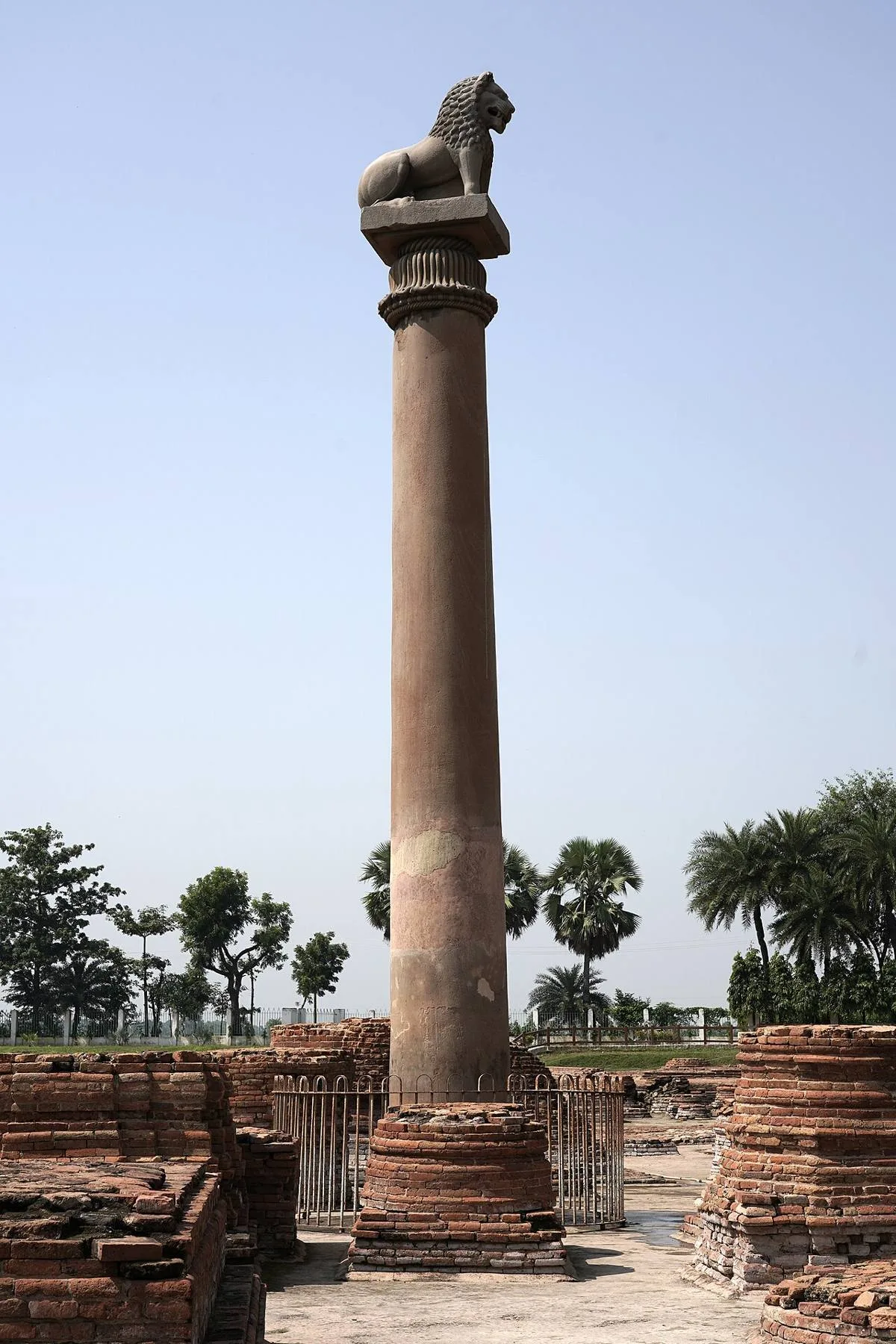
The Ashokan pillar at Kolhua, Vaishali: a single lion on top of a polished sandstone shaft.
Image Source: Wikimedia
10.3 The Sarnath Lion Capital: India’s National Emblem
- Where found: Sarnath, where the Buddha gave his first sermon. It is the Lion Capital seen on Indian currency notes. → PYQ: WBCS Prelims 2011, 2003
- Excavated: by F. O. Oertel in 1904–05. It is kept in the Sarnath Museum.
- Design:
- Four lions stand on a round abacus.
- The abacus carries four animals separated by four wheels.
- Below them is a bell-shaped lotus.
- National Emblem:
- Adopted on 26 January 1950.
- It shows three lions (the fourth is hidden), with the wheel in the middle, a bull on the right and a horse on the left.
- The motto Satyameva Jayate is taken from the Mundaka Upanishad.
- Dhamma-chakra: the wheel with 24 spokes is on the National Flag.
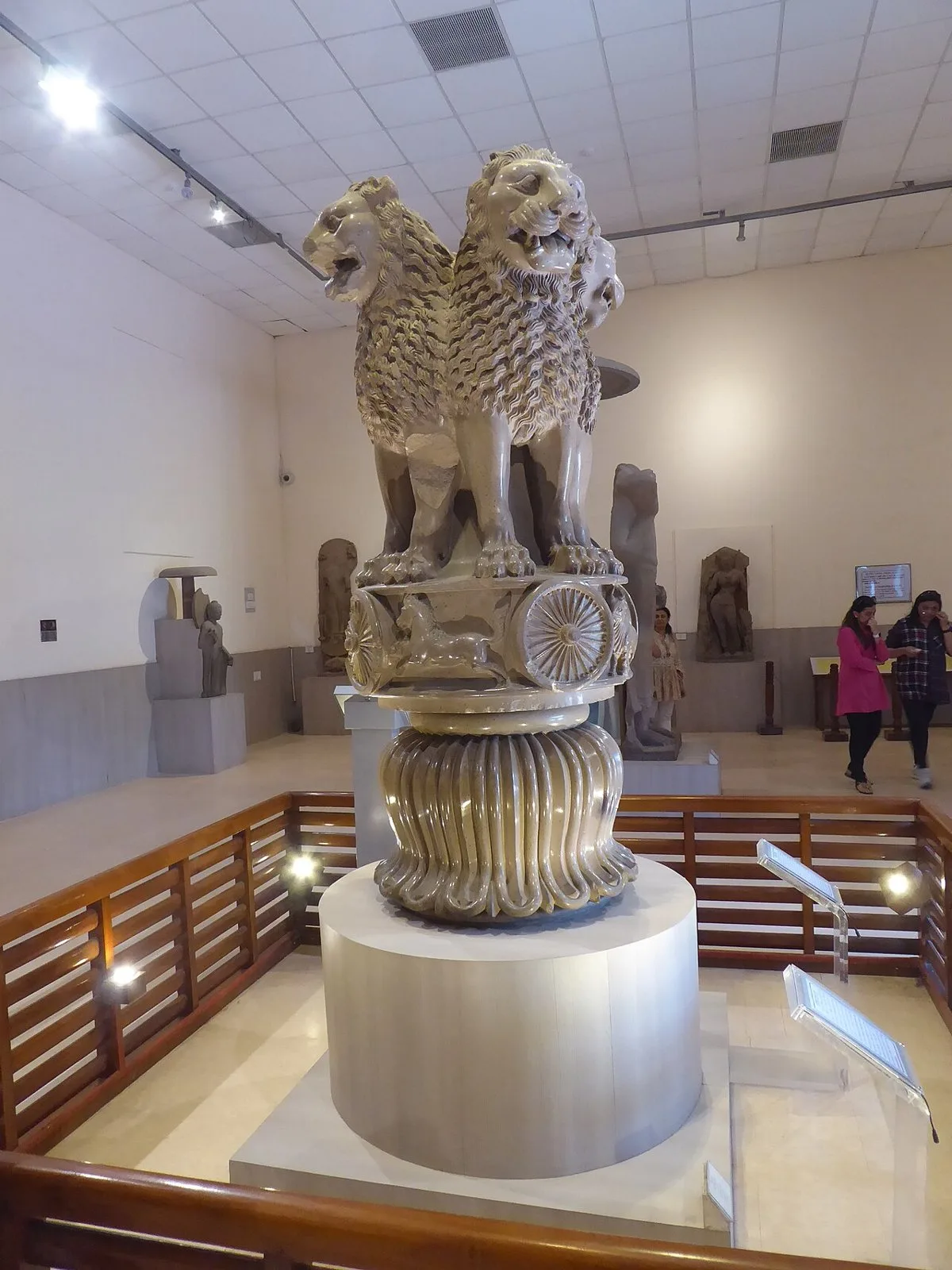
The Sarnath Lion Capital, the source of India’s National Emblem.
Image Source: Wikimedia
10.4 Stupas
- What a stupa is: a solid dome (anda) over relics. Its parts are the harmika, chhatra, railing (vedika) and gateways (torana).
- Ashoka’s stupas: Buddhist texts credit him with 84,000 stupas. He redistributed the Buddha’s relics.
- Main stupas:
- Sanchi (MP): the core brick stupa is by Ashoka. It was enlarged in stone under the Shungas, and its gateways were added under the Satavahanas.
- Bharhut (MP): its railings date to the Shunga period.
- Dharmarajika at Taxila and Sarnath.
10.5 Rock-cut caves
- Barabar hills (Gaya, Bihar): Lomas Rishi, Sudama, Karna Chaupar and Vishwa Zopri.
- These are the oldest rock-cut caves in India. They were gifted to the Ajivikas. → PYQ: WBCS Mains 2016
- Lomas Rishi has a carved doorway with an ogee arch and a frieze of elephants. It copies a wooden hut in stone.
- Nagarjuni hills: three caves gifted to the Ajivikas by Ashoka’s grandson Dasharatha.
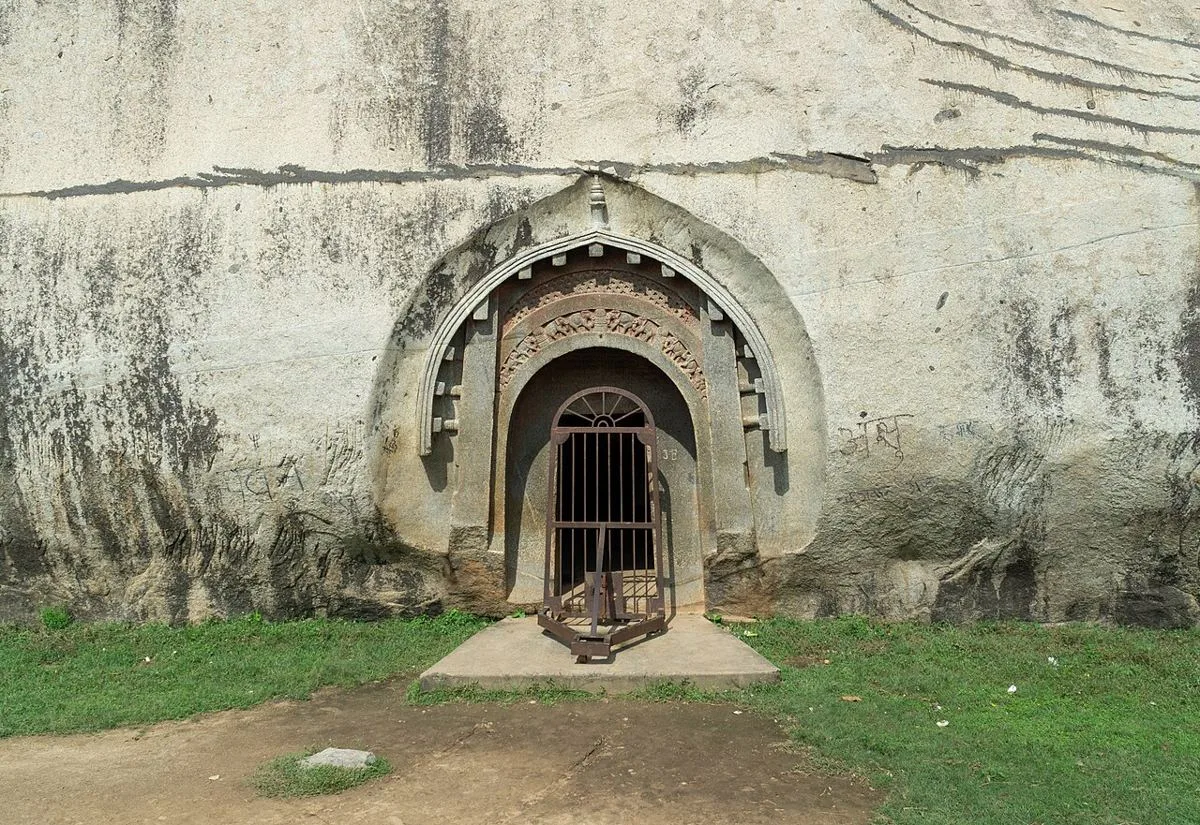
The Lomas Rishi cave entrance in the Barabar hills, a Mauryan cave gifted to the Ajivikas.
Image Source: Wikimedia
10.6 Popular art
- Didarganj Yakshi (Patna): a life-size chauri-bearer in polished Chunar sandstone. Found in 1917, now in the Bihar Museum.
- Parkham Yaksha (Mathura) and Besnagar Yakshi: other large folk figures.
- Dhauli elephant (Odisha): the earliest rock-cut sculpture of India.
- Terracotta: figures from Pataliputra, Mathura and Chandraketugarh (Bengal).
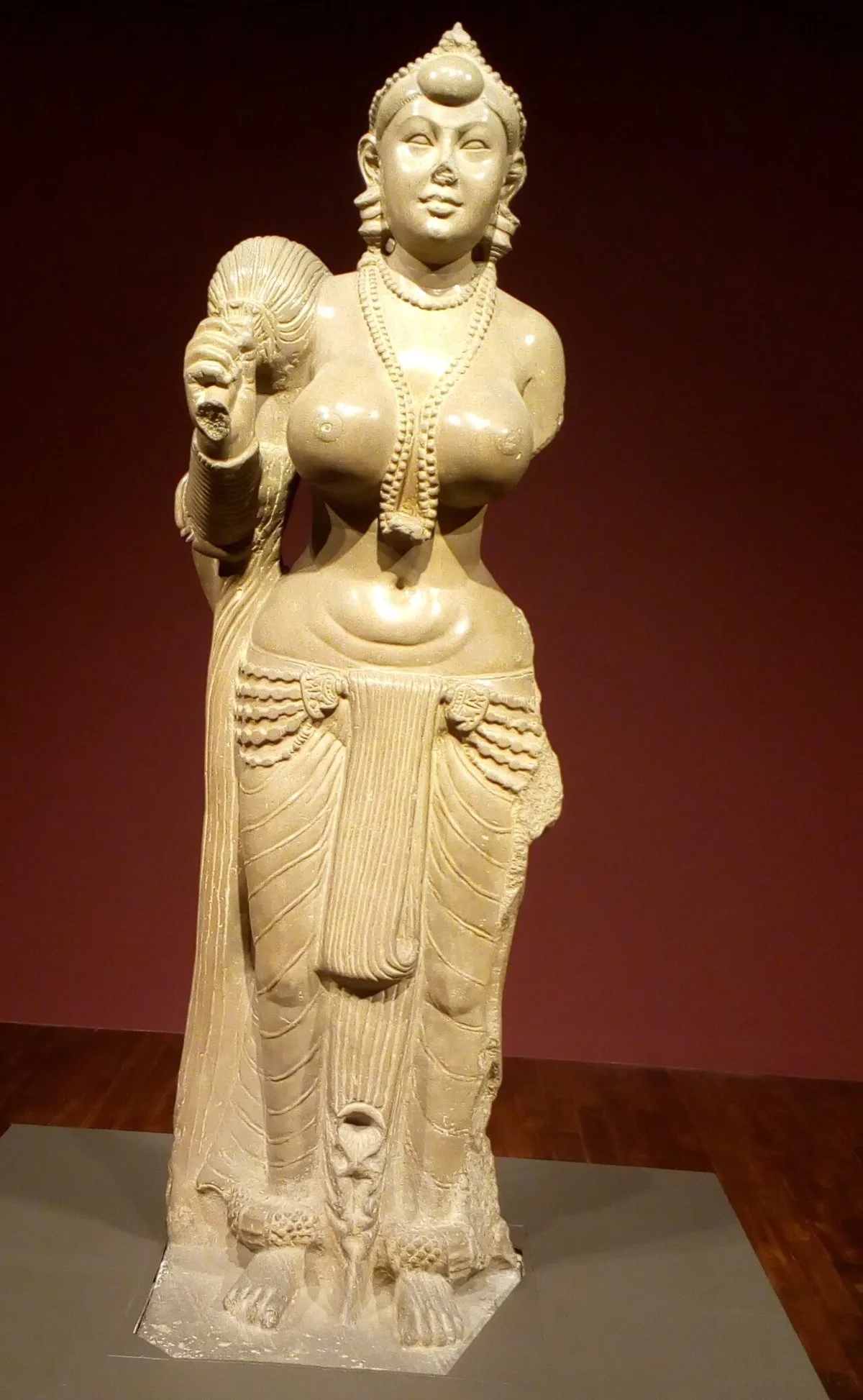
The Didarganj Yakshi in the Bihar Museum, Patna, an example of Mauryan polish.
Image Source: Wikimedia
11. Decline of the Mauryan Empire
In simple words: The empire broke up within about 50 years of Ashoka’s death. Weak kings, division of the empire, an empty treasury, a loose army and attacks from the north-west all played a part. In 185 BCE the general Pushyamitra Shunga killed the last king, Brihadratha, and founded the Shunga dynasty.
11.1 Later Mauryas
- Kunala: ruled in the north-west (Gandhara).
- Dasharatha: in Magadha; gifted the Nagarjuni caves.
- Samprati: a Jain ruler at Ujjayini.
- Shalishuka, Devavarman and Shatadhanvan.
- Brihadratha: the last Mauryan king. → PYQ: WBCS Mains 2022
- Kashmir: under Jalauka, according to Kalhana.
11.2 Causes of decline
| Cause | Historian / idea |
|---|---|
| Brahmanical reaction against Ashoka’s pro-Buddhist policies and his ban on sacrifices | H. P. Shastri |
| Pacifism of Ashoka weakened the army | H. C. Raychaudhuri |
| Financial crisis: huge army and bureaucracy, heavy taxes | D. D. Kosambi |
| Over-centralised administration that depended on the king; no national unity | Romila Thapar |
| Oppressive provincial rule: Taxila revolted twice | Divyavadana |
| Partition of the empire after Ashoka; weak successors | General cause |
| Greek invasions in the north-west (Bactrian Greeks under Demetrius) | External cause |
- Romila Thapar’s book: Asoka and the Decline of the Mauryas (1961). → PYQ: WBCS Mains 2017
11.3 End of the dynasty
- What happened: Pushyamitra Shunga, the commander-in-chief, killed Brihadratha at an army parade in 185 BCE. Bana’s Harshacharita records this.
- Who came next: the Shunga dynasty ruled Magadha after the Mauryas. → PYQ: WBCS Mains 2020
- It was followed by the Kanvas (73 BCE).
- The grammarian Patanjali was a contemporary of Pushyamitra Shunga. → PYQ: WBCS Prelims 2001
12. The Bengal Angle: Mauryan Bengal
In simple words: Bengal was part of the Mauryan Empire. North Bengal (Pundravardhana) was ruled from Pundranagara (Mahasthangarh), and the south-west had the great sea-port of Tamralipti. This makes Mauryan history important for WBCS.
12.1 Mahasthangarh and the Mahasthan Brahmi Inscription
- Where: Mahasthangarh, Bogra district, Bangladesh, on the bank of the Karatoya river. This is ancient Pundranagara, capital of Pundravardhana.
- Inscription:
- Found in 1931 by a labourer, Baru Fakir. It is a Brahmi inscription in Prakrit of the Mauryan period (3rd century BCE).
- It is the oldest inscription found in Bengal and proves Mauryan rule in north Bengal.
- Content: a royal order to the Mahamatra of Pudanagala (Pundranagara) to help people of the Samvangiya community during a famine.
- It mentions the distribution of paddy (dhanya) and gandaka coins from the state granary.
- The granary would be refilled when times improved.
- It is an early example of famine relief by the state.
- Similar inscription: the Sohgaura copper plate (Gorakhpur, UP), also about state granaries for famine relief.
- PYQ link: Mahasthan appears as an option in the PYQ on the inscription that names Ashoka in person; the answer is Maski. → PYQ: WBP SI
12.2 Tamralipti (Tamluk)
- Where: modern Tamluk, Purba Medinipur, West Bengal, near the mouth of the Rupnarayan river.
- Role: the main port of eastern India. → PYQ: WBCS Mains 2022
- It was the end point of the Uttarapatha from Taxila and Pataliputra.
- It traded with Sri Lanka, Suvarnabhumi (South-east Asia) and the Ganga valley.
- Buddhist link:
- Sanghamitra sailed from Tamralipti to Sri Lanka with the Bodhi tree sapling.
- Ashoka’s envoys to Sri Lanka also used this port (Mahavamsa).
- Later fame:
- Fa-Hien stayed here for two years (5th century CE) and sailed to Sri Lanka.
- I-tsing landed here (7th century CE).
- Do not confuse: the Tamralipta Jatiya Sarkar (1942) was a parallel government of the Quit India Movement in Medinipur.
12.3 Other Bengal sites
- Chandraketugarh (North 24 Parganas): an urban site of the Mauryan–Shunga period. It is known for terracotta figures, NBPW pottery and punch-marked coins.
- Bangarh (Dakshin Dinajpur) and Pakur–Rajmahal area: also yield Mauryan-period NBPW and coins.
- Gangaridai: the Greek writers’ name for the people of the lower Ganga delta.
- Asiatic Society, Kolkata:
- James Prinsep deciphered Ashoka’s edicts here in 1837.
- The Bhabru edict is preserved here.
13. FAQ: Quick Questions
| Question | Answer |
|---|---|
| Founder of the Mauryan dynasty? | Chandragupta Maurya (321 BCE) |
| Dynasty before the Mauryas? | Nanda (last king Dhanananda) |
| Mauryan capital? | Pataliputra |
| Greek name of Chandragupta? | Sandrocottus |
| Greek name of Bindusara? | Amitrochates (Amitraghata) |
| Who was “Devanampiya Piyadasi”? | Ashoka |
| Year of the Kalinga war? | 261 BCE |
| Edict on the Kalinga war? | Major Rock Edict XIII |
| “All men are my children” is in? | Separate Kalinga Edicts (Dhauli, Jaugada) |
| Inscription naming “Ashoka” first? | Maski |
| Who deciphered Brahmi? | James Prinsep, 1837 |
| Kharosthi edicts? | Shahbazgarhi, Mansehra |
| Greek + Aramaic edict? | Kandahar |
| Pillar with all 7 pillar edicts? | Delhi-Topra (brought by Firuz Shah Tughlaq) |
| Pillar at Buddha’s birthplace? | Rummindei (Lumbini) |
| Author of Arthashastra? | Kautilya |
| Author of Indica? | Megasthenes |
| Barabar caves gifted to? | Ajivikas |
| National Emblem from? | Sarnath Lion Capital |
| Last Mauryan king? | Brihadratha (killed 185 BCE) |
| Dynasty after the Mauryas? | Shunga |
| Mauryan inscription in Bengal? | Mahasthan Brahmi inscription |
| Mauryan port in Bengal? | Tamralipti |
14. One-Page Revision Sheet
- Rulers:
- Chandragupta: 321–297 BCE.
- Bindusara: 297–273 BCE.
- Ashoka: 268–232 BCE (accession 273 BCE).
- Brihadratha: the last king, killed 185 BCE.
- Chandragupta: Sandrocottus; Mudrarakshasa; defeated Seleucus (303 BCE); 500 elephants; Megasthenes; Jain; Shravanabelagola.
- Bindusara: Amitraghata; Deimachus and Dionysius; Ajivika.
- Ashoka:
- Life: Kalinga 261 BCE (RE XIII); Upagupta; Third Council (250 BCE); Mahendra and Sanghamitra.
- Dhamma: Dhamma-mahamattas (RE V); five asinavas (PE III).
- Edicts:
- 14 MRE; Separate Kalinga Edicts (Dhauli, Jaugada); MiRE (Maski, Gujarra, Udegolam, Nittur name “Ashoka”); Bhabru.
- 7 PE (Delhi-Topra all 7); Rummindei (bhaga 1/8); Barabar caves.
- Scripts: Brahmi; Kharosthi (Shahbazgarhi, Mansehra); Greek + Aramaic (Kandahar). Prinsep 1837.
- Administration:
- Mantriparishad; 18 Tirthas; Samaharta (revenue), Sannidhata (treasury).
- Provinces: Taxila, Ujjayini, Tosali, Suvarnagiri.
- Courts: Dharmasthiya (civil), Kantakashodhana (criminal). Maula = hereditary troops.
- Arthashastra: 15 books; Saptanga; Mandala; found by R. Shamasastry (1905).
- Indica: 7 classes (no separate trader class); no slavery; 6 city committees of 5; 64 gates, 570 towers.
- Economy: bhaga 1/6; sita land; punch-marked karshapana; NBPW; Uttarapatha to Tamralipti.
- Art:
- Chunar sandstone, Mauryan polish; Sarnath Lion Capital (Emblem, 26 Jan 1950); Rampurva bull.
- Lomas Rishi; Didarganj Yakshi; Dhauli elephant.
- Decline: H. P. Shastri (Brahmanical reaction), Raychaudhuri (pacifism), Kosambi (finance), Thapar (centralisation).
- Bengal: Mahasthan Brahmi inscription (Pundranagara, famine relief, paddy and gandaka coins); Tamralipti port; Chandraketugarh.
15. Related PYQ Collections on PYQ Arena
- WBCS Mains: Mauryan Empire PYQs
- WBCS Prelims: Ancient Indian History PYQs
- WBCS Mains: Post-Mauryan Empire PYQs
- WBCS Mains: General Knowledge (History)
- WBCS Mains: Stone Age and Ancient Sources PYQs
- WBCS Mains: Buddhism and Jainism PYQs
- WBCS Prelims: Medieval Indian History PYQs
- WBP SI Prelims: History PYQs
- WBPSC Clerkship: History PYQs
- WBPSC Miscellaneous: History PYQs
Previous chapters: Prehistoric India · Indus Valley Civilization · Vedic Age · Mahajanapadas and Rise of Magadha · Buddhism and Jainism · Schools of Indian Philosophy
Leave a Comment