

Who is this for? Beginners and aspirants for UPSC Prelims, WBCS, other State PSCs and SSC. This is Chapter 3 of Medieval Indian History. Each section opens with an “In simple words” explanation and then goes to exam-level detail on the regional kingdoms that broke away from, or grew up beside, the Delhi Sultanate between about 1300 and 1600.
🔗 Practise alongside: WBCS Prelims Medieval Indian History PYQs | WBCS Mains Religious Movements PYQs | WBCS Mains Delhi Sultanate PYQs | PSC Miscellaneous Prelims History PYQs | WBPSC Clerkship History PYQs
📖 Read first: Delhi Sultanate (Chapter 2) | Early Medieval India and Rajput Kingdoms (Chapter 1) | Ancient Bengal | Ancient Art and Architecture
1. Why Provincial Kingdoms Arose
In simple words: The Delhi Sultanate was too big to be ruled from one city on horseback. Whenever Delhi grew weak, its governors in far-off provinces stopped sending money and crowned themselves Sultans. Hindu chiefs who had never fully surrendered also rose again. This happened most after Muhammad bin Tughlaq‘s failures, after Firoz Tughlaq‘s death (1388) and after Timur‘s sack of Delhi (1398). By 1400 India was a patchwork of regional kingdoms: Jaunpur, Malwa, Gujarat, Khandesh, Kashmir, Bengal, Sindh and Multan under Muslim rulers; Mewar, Marwar, Odisha and the Ahom kingdom under Hindu or tribal rulers; and the Bahmani and Vijayanagara kingdoms in the Deccan. Most of them were absorbed by Akbar in the second half of the 16th century. → Background: Delhi Sultanate
1.1 Causes
- Distance and poor communications: Bengal, Gujarat and the Deccan were weeks away from Delhi; governors held their own armies and treasuries.
- The iqta system gave governors (muqtis) both revenue and troops; under Firoz Tughlaq iqtas became hereditary.
- Revolts under Muhammad bin Tughlaq: the Madurai Sultanate (1335), Vijayanagara (1336), the Bengal Sultanate (1342) and the Bahmani Kingdom (1347).
- Timur’s invasion (1398) wrecked Delhi’s army and treasury. Gujarat, Malwa and Jaunpur became independent within ten years.
- Regional pride and wealth: rich trade (Gujarat), fertile land (Bengal, Jaunpur) and strong local identities (Rajputs, Ahoms, Odias, Kashmiris).
1.2 The provincial kingdoms at a glance
| Kingdom | Capital | Dynasty / founder | Became independent | Absorbed by |
|---|---|---|---|---|
| Jaunpur | Jaunpur | Sharqi: Malik Sarwar | 1394 | Bahlul Lodi (1479) |
| Malwa | Dhar, then Mandu | Ghuri: Dilawar Khan; then Khalji: Mahmud Khalji | 1401 | Gujarat (1531); Akbar (1561–62) |
| Gujarat | Patan, then Ahmedabad | Muzaffar Shah (Zafar Khan) | 1407 | Akbar (1572–73) |
| Khandesh | Thalner, then Burhanpur | Faruqi: Malik Raja | 1382 | Akbar (1601) |
| Kashmir | Srinagar | Shah Mir | 1339 | Akbar (1586) |
| Bengal | Pandua, then Gaur | Ilyas Shahi, Husain Shahi | 1342 | Sher Shah (1538); Akbar (1576) |
| Sindh | Thatta | Samma | 1351 | Arghuns (1520); Akbar (1591) |
| Multan | Multan | Langah | 1445 | Arghuns (1528) |
| Mewar | Chittor, later Udaipur | Sisodia: Hammir | 1326 | Treaty with Jahangir (1615) |
| Marwar | Mandore, then Jodhpur | Rathor: Rao Jodha | Jodhpur founded 1459 | Accepted Mughal rule under Akbar |
| Ahom kingdom | Charaideo, later Garhgaon | Sukapha | 1228 | British (1826) |
| Odisha | Cuttack, Puri | Eastern Gangas; Gajapatis (Kapilendra) | — | Afghans of Bengal (1568); Akbar (1592) |
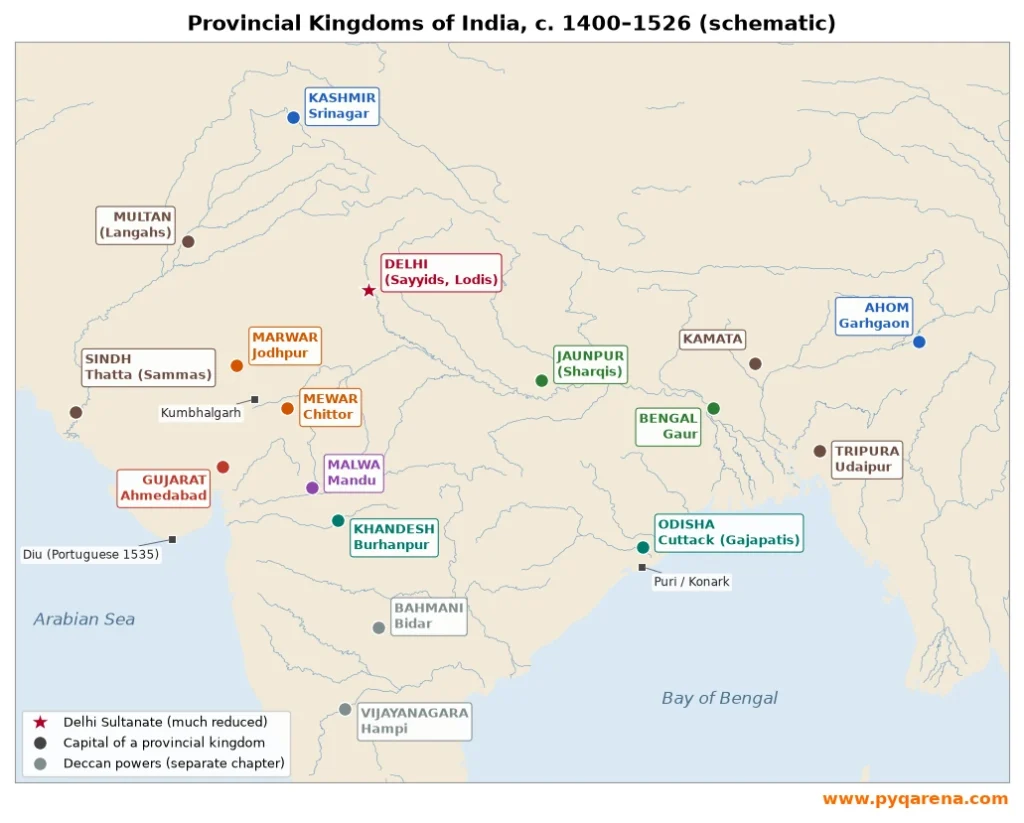
 Map of India showing the provincial kingdoms between 1400 and 1526 with their capitalsProvincial kingdoms of India, c. 1400–1526: capitals of the regional sultanates and Hindu kingdoms around a much-reduced Delhi.
1.3 Common features of the provincial kingdoms
- Copies of Delhi: the Sultans kept Delhi’s titles (Sultan, wazir, ariz), the iqta system and Persian as the court language, and read the khutba and struck coins in their own names, the two public signs of independence.
- Local partners: they relied on local Hindu chiefs, Rajput soldiers, Brahmin and Kayastha clerks and merchants. Medini Rai in Malwa, the Brahmin officials of Zain-ul-Abidin and Rup and Sanatan in Bengal are examples.
- Constant warfare: neighbours fought over border forts and trade routes: Gujarat against Malwa, Malwa against Mewar, Jaunpur against Delhi, Bengal against Odisha and the Ahoms, the Bahmanis against Vijayanagara.
- Short-lived dynasties: succession was decided by force, so nobles, slave-commanders and palace guards (such as Bengal’s Habshis) repeatedly seized the throne.
- Regional culture: each court became a centre of building, music and literature in the local language. This regional flowering is the main legacy of the period.
1.4 Why this chapter matters for exams
- Exams ask about titles (Akbar of Kashmir, Begarha, Budshah), monuments (Atala Masjid, Jahaz Mahal, Vijay Stambha, Adina Mosque), founders (Ilyas Shah, Kapilendra, Sukapha) and links with the Mughals (Rana Sanga at Khanwa, Akbar’s failure in Assam). | Kingdom | What exams usually ask | |—|—| | Jaunpur | Atala Masjid; Sharqi meaning “eastern”; Bahlul Lodi’s annexation | | Malwa | Jahaz Mahal; Mandu; Baz Bahadur and Rupmati | | Gujarat | Ahmedabad; Mahmud Begarha; Portuguese at Diu; Buland Darwaza | | Kashmir | “Akbar of Kashmir”; Sikandar Butshikan; Jonaraja and Srivara | | Mewar and Marwar | Vijay Stambha; Kumbhalgarh; Khanwa; Haldighati; Jodhpur | | Bengal | Ilyas Shah; Adina Mosque; Husain Shah and Chaitanya; Bara Sona Masjid | | Assam and Odisha | Sukapha; buranjis; Akbar’s failure in Assam; Kapilendra; Konark |
- The pair question of WBCS Prelims 2022 is typical: Jaunpur — Atala Masjid, Malwa — Jahaz Mahal and Gaur — Bara Sona Masjid are correct pairs; “Ajmer — Quwwat-ul-Islam” is wrong because the Quwwat-ul-Islam mosque is at Delhi. → PYQ: WBCS Prelims 2022
2. Jaunpur: The Sharqi Sultanate (1394–1479)
In simple words: Jaunpur, on the Gomti river in eastern Uttar Pradesh, was a town founded by Firoz Tughlaq. In 1394 its governor, Malik Sarwar, received the title Malik-us-Sharq (“Lord of the East”); his family is therefore called the Sharqi dynasty. For about 85 years Jaunpur was the strongest kingdom of the Ganga plain, a centre of Islamic learning called the “Shiraz of India”, and the home of a bold mosque style with giant gateways. The Lodis of Delhi finally swallowed it in 1479.
2.1 Rulers
| Ruler | Years | Key facts |
|---|---|---|
| Malik Sarwar (Khwaja-i-Jahan) | 1394–99 | A noble of Sultan Nasiruddin Mahmud Tughlaq; given the title Malik-us-Sharq and the eastern provinces |
| Mubarak Shah | 1399–1402 | Adopted son; struck coins and read the khutba in his own name: independence |
| Ibrahim Shah Sharqi | 1402–40 | Greatest Sharqi; completed the Atala Masjid (1408); patron of scholars and poets |
| Mahmud Shah | 1440–57 | Fought the Sayyids and Lodis for Delhi |
| Husain Shah Sharqi | 1458–79 | Patron of music (the raga Jaunpuri is linked to his court); defeated by Bahlul Lodi, who annexed Jaunpur |
- Name of the town: Firoz Tughlaq founded Jaunpur in 1359 and named it after his cousin Muhammad bin Tughlaq, whose name was Jauna Khan. → Delhi Sultanate
2.2 Jaunpur architecture
- Atala Masjid (completed 1408 by Ibrahim Shah): begun under Firoz Tughlaq on the site of the Atala Devi temple. Its central gateway (pishtaq or propylon) rises like a huge screen in front of the dome, and there are no minarets.
- Jhanjhri Masjid, Lal Darwaza Masjid (built by Bibi Rajye, queen of Mahmud Shah) and the Jama Masjid (completed under Husain Shah).
- Style: Tughlaq sloping walls and arches combined with Hindu pillars and brackets; the massive pishtaq is the signature of the Sharqi style.
- Correct pair: Jaunpur — Atala Masjid. → PYQ: WBCS Prelims 2022
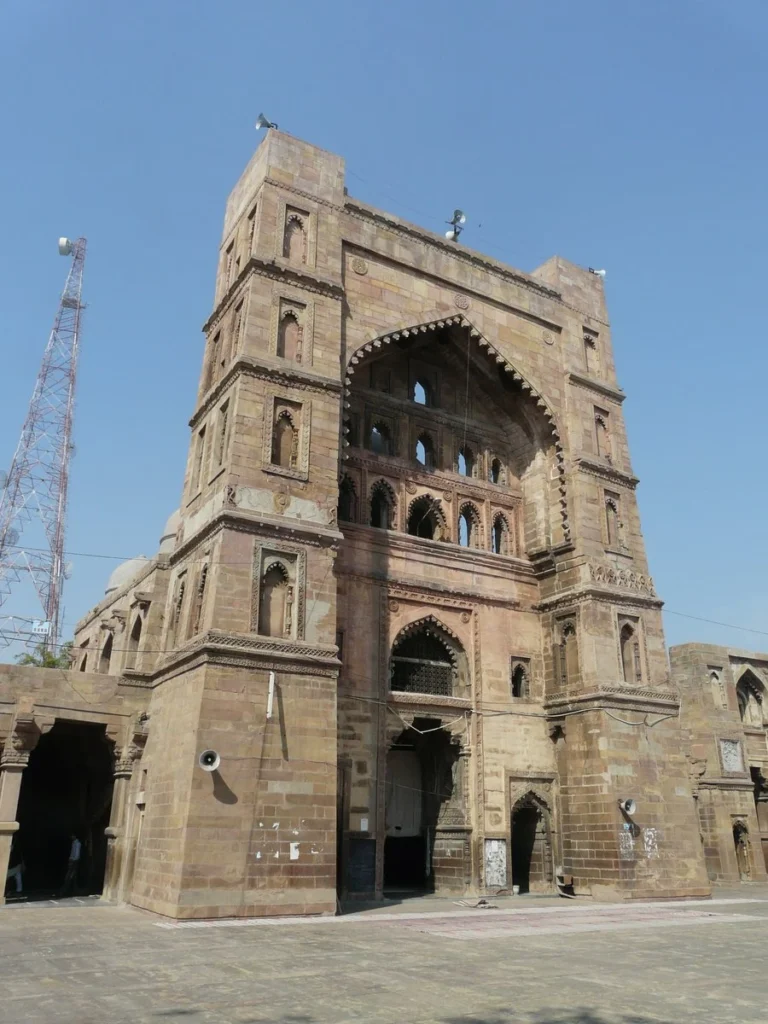
Image Source: Wikimedia
2.3 Importance
- “Shiraz-i-Hind”: scholars, Sufis and poets fled to Jaunpur from Delhi after Timur’s raid; Persian and Arabic learning flourished.
- Buffer and rival: Jaunpur fought the Sayyids and Lodis for control of Delhi. Bahlul Lodi’s victory (1479) restored Delhi’s control over the eastern Ganga plain. → WBCS Mains Delhi Sultanate PYQs
3. Malwa: The Sultanate of Mandu (1401–1562)
In simple words: Malwa is the plateau of western Madhya Pradesh, rich in black soil and placed on the road between Delhi, Gujarat and the Deccan. Its governor Dilawar Khan Ghuri became independent in 1401. His son Hoshang Shah moved the capital to the hill-fort of Mandu, which his successors filled with palaces, lakes and tombs. Malwa fought endlessly with Gujarat and Mewar, was annexed by Gujarat in 1531 and then fell to Akbar in 1561–62. Its romantic last ruler, Baz Bahadur, and the singer Rupmati are remembered in Malwa folk songs.
3.1 Dynasties and rulers
| Ruler | Years | Key facts |
|---|---|---|
| Dilawar Khan Ghuri | 1401–05 | Tughlaq governor at Dhar; independent after Timur’s raid |
| Hoshang Shah | 1405–35 | Moved the capital to Mandu, which he called Shadiabad (“City of Joy”); built the Jama Masjid plan and his own marble tomb; tolerant towards Hindus and Jains |
| Mahmud Khalji | 1436–69 | Founded the Khalji dynasty of Malwa; greatest ruler; fought Rana Kumbha of Mewar and the Bahmanis; built the seven-storeyed tower (Haft Manzil) at Mandu |
| Ghiyasuddin Khalji | 1469–1500 | Peaceful, pleasure-loving reign; the Jahaz Mahal is linked with his court |
| Nasiruddin, Mahmud II | 1500–31 | Decline; Rajput minister Medini Rai became powerful; Rana Sanga defeated Mahmud II at Gagron (1519) |
| — | 1531 | Bahadur Shah of Gujarat annexed Malwa |
| Baz Bahadur | 1555–61 | Son of Sher Shah’s governor Shujaat Khan; music lover; defeated by Akbar’s general Adham Khan at Sarangpur (1561) |
3.2 Mahmud Khalji and Rana Kumbha
- Battle of Sarangpur (1437): Rana Kumbha defeated Mahmud Khalji. Both sides claimed victory: Kumbha built the Vijay Stambha at Chittor, and Mahmud Khalji built a seven-storeyed victory tower at Mandu.
- Mahmud Khalji received a robe of honour from the Abbasid Caliph of Egypt, a sign of his prestige.
3.3 Mandu architecture
Mandu’s buildings are built of local stone, with large arches, lofty plinths, open pavilions and water channels.
- Jahaz Mahal (“Ship Palace”): a long, narrow two-storeyed palace between the Munj Talao and Kapur Talao lakes; seen from the water it looks like a ship. Correct pair: Malwa — Jahaz Mahal. → PYQ: WBCS Prelims 2022
- Hindola Mahal (“Swinging Palace”): sloping side walls make it seem to sway.
- Hoshang Shah’s Tomb: the earliest marble tomb in India; Shah Jahan’s architects studied it before the Taj Mahal.
- Jama Masjid of Mandu: modelled on the great mosque of Damascus; completed by Mahmud Khalji.
- Rupmati’s Pavilion and Baz Bahadur’s Palace: linked to the love story of the last Sultan.
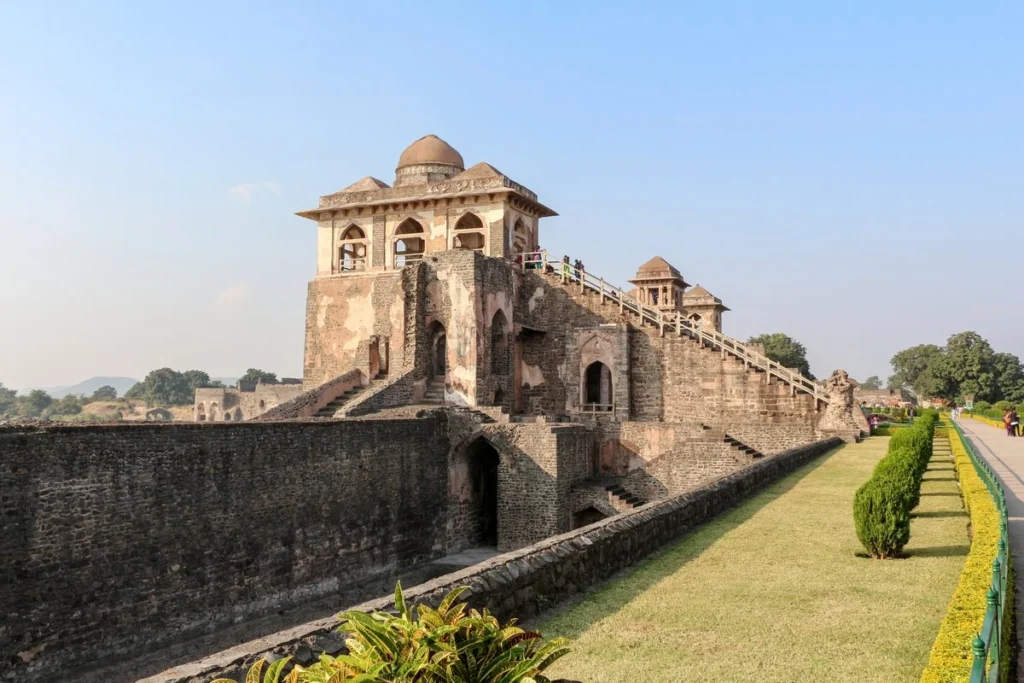
Image Source: Wikimedia
3.4 Baz Bahadur and Rupmati
- Baz Bahadur was a skilled musician; Rupmati was a Hindu singer from Sarangpur who became his queen.
- When Adham Khan conquered Malwa in 1561, Rupmati took poison to escape capture. Baz Bahadur later joined Akbar‘s service as a mansabdar and is buried beside Rupmati at Ujjain.
- Exam point: Baz Bahadur (Malwa) ≠ Bahadur Shah (Gujarat).
4. Gujarat Sultanate (1407–1573)
In simple words: Gujarat was the richest province of India because of its ports, such as Cambay (Khambhat), Surat, Broach and Diu, which traded with Arabia, Persia, Egypt and East Africa. Its governor Zafar Khan declared independence as Muzaffar Shah in 1407. His grandson Ahmad Shah I built the beautiful city of Ahmedabad, and Mahmud Begarha made Gujarat a naval power. In the 16th century Gujarat faced two new rivals: the Portuguese by sea and the Mughals by land. Akbar conquered it in 1572–73 and built the Buland Darwaza to celebrate.
4.1 Rulers
| Ruler | Years | Key facts |
|---|---|---|
| Zafar Khan (Muzaffar Shah I) | 1391–1411 | Tughlaq governor; independent 1407 |
| Ahmad Shah I | 1411–42 | Founded Ahmedabad (1411) on the Sabarmati; Jama Masjid (1424), Teen Darwaza, Bhadra Fort; strict orthodox ruler |
| Mahmud Begarha | 1458–1511 | Greatest Sultan; title Begarha = conqueror of two forts (Girnar/Junagadh, 1472 and Champaner/Pavagadh, 1484); fought the Portuguese at sea |
| Muzaffar Shah II | 1511–26 | Helped Malwa’s Mahmud II against Medini Rai |
| Bahadur Shah | 1526–37 | Annexed Malwa (1531), stormed Chittor (1535); defeated by Humayun (1535); granted Bassein (1534) and Diu (1535) to the Portuguese; killed at Diu (1537) |
| Muzaffar Shah III | 1561–73 | Last Sultan; surrendered to Akbar |
4.2 Mahmud Begarha (1458–1511)
- Two forts: Girnar (Junagadh) in Saurashtra and Champaner in eastern Gujarat. He renamed Junagadh Mustafabad and made Champaner (Muhammadabad) a second capital. Champaner-Pavagadh is a UNESCO World Heritage Site (2004).
- Foreign descriptions: the Portuguese writer Duarte Barbosa and the Italian traveller Ludovico di Varthema described his long moustache, huge appetite and the legend that his body was full of poison. → Foreign Travellers in India
- Navy against the Portuguese: allied with the Mamluk Sultan of Egypt. Their combined fleet won the Battle of Chaul (1508), but the Portuguese viceroy Francisco de Almeida crushed it at the Battle of Diu (1509), which gave the Portuguese control of the Arabian Sea.
4.3 Bahadur Shah, the Mughals and the Portuguese
- Chittor (1535): Bahadur Shah besieged Chittor; Rani Karnavati, widow of Rana Sanga, committed jauhar with the women of the fort. Legend says she had sent a rakhi to Humayun asking for help.
- Humayun’s campaign (1535): Humayun took Mandu and Champaner, but had to leave to face Sher Shah, and Bahadur Shah recovered Gujarat.
- Portuguese foothold: to get Portuguese help against Humayun, Bahadur Shah gave them Bassein (1534) and allowed a fort at Diu (1535). In 1537 he was killed while visiting a Portuguese ship at Diu. Diu remained Portuguese until 1961.
- First Europeans: the Portuguese were the first Europeans to set up trading settlements in India (Vasco da Gama reached Calicut in 1498; Albuquerque took Goa from Bijapur in 1510). → PYQ: WBPSC IDO 1996
4.4 Akbar’s conquest (1572–73)
- Akbar annexed Gujarat in 1572–73 and crushed a revolt with a famous fast march (1573).
- The Buland Darwaza at Fatehpur Sikri was built to commemorate the victory over Gujarat. → PYQ: WBP Constable 2018
- Gujarat gave the Mughals the port of Surat, the gateway for Hajj pilgrims and foreign trade.
4.5 Gujarat’s trade and economy
- Ports: Cambay (Khambhat) was the chief port in the 15th century; Surat, Broach (Bharuch), Rander and Diu handled cotton cloth, indigo, spices and horses.
- Trade network: Gujarati merchants, both Hindu Banias and Muslim Bohras and Khojas, traded from the Red Sea and East Africa to Malacca in South-East Asia.
- Why the Portuguese mattered: their cartaz (pass) system forced Asian ships to buy Portuguese licences, so control of Diu and the Arabian Sea threatened Gujarat’s wealth directly.
- Crafts: cotton textiles, bead-making, wood carving and the stone carving seen in Ahmedabad’s mosques.
4.6 Gujarat architecture: Ahmedabad
In simple words: Gujarat’s Sultans used the skills of local Hindu and Jain stone carvers, so their mosques look like temples turned inside out: carved pillars, bracket balconies, lace-like stone screens (jali) and slender minarets.
- Jama Masjid, Ahmedabad (1424): 260 pillars, built by Ahmad Shah I.
- Sidi Saiyyed Mosque (1572–73): its “Tree of Life” stone jali is the most famous window in India and is the logo of IIM Ahmedabad.
- Jhulta Minar (“Shaking Minarets”) of Sidi Bashir mosque, Rani Sipri mosque, Teen Darwaza and Bhadra Fort.
- Adalaj stepwell (1499), completed in Mahmud Begarha’s time, and the Sarkhej Roza complex.
- Ahmedabad became India’s first UNESCO World Heritage City (2017).
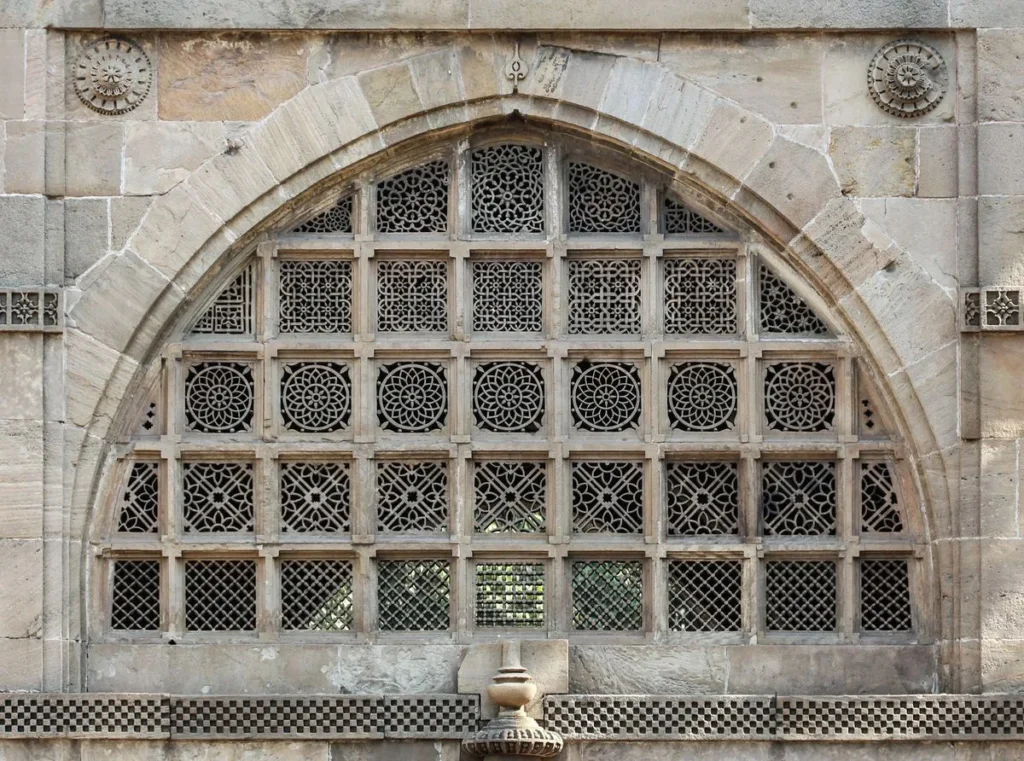
Image Source: Wikimedia
5. Khandesh: The Faruqi Kingdom (1382–1601)
In simple words: Khandesh is the valley of the Tapti river, between Gujarat, Malwa and the Deccan. Firoz Tughlaq gave it to Malik Raja Faruqi in 1382. The small Faruqi kingdom survived for more than 200 years by playing its big neighbours against one another. Its fort of Asirgarh was called the key to the Deccan, and its capture in 1601 was Akbar’s last conquest.
- Founder: Malik Raja (Ahmad) Faruqi, who claimed descent from the second Caliph, Umar al-Faruq; hence “Faruqi”.
- Capitals: first Thalner, then Burhanpur, founded by Nasir Khan and named after the Sufi saint Burhanuddin.
- Asirgarh fort: called the “Gateway of the Deccan” (Dakhin ka darwaza). Akbar took it from Miran Bahadur Shah in 1601.
- Burhanpur later became the Mughal base for Deccan campaigns; Mumtaz Mahal died there in 1631.
- Exam point: Khandesh was a buffer state; it switched alliances between Gujarat, Malwa and the Bahmanis.
6. Kashmir: The Shah Mir Sultans (1339–1561)
In simple words: For centuries Kashmir was ruled by Hindu kings, whose story Kalhana told in the Rajatarangini. In 1339 a noble named Shah Mir took the throne after the last Hindu queen, Kota Rani, and founded the first Muslim dynasty of Kashmir. One Sultan, Sikandar, earned the name “Butshikan” (idol-breaker) for destroying temples. His son Zain-ul-Abidin did the opposite: he invited Hindus back, abolished jizya and patronised Sanskrit as well as Persian. Kashmiris still call him “Budshah” (the Great King), and exam books call him the “Akbar of Kashmir”.
6.1 Rulers
| Ruler | Years | Key facts |
|---|---|---|
| Shah Mir (Shamsuddin) | 1339–42 | Founder; ended Hindu rule after Kota Rani |
| Qutbuddin | c. 1373–89 | The Sufi Mir Sayyid Ali Hamadani (Shah-i-Hamadan) came to Kashmir with hundreds of followers and craftsmen |
| Sikandar “Butshikan” | 1389–1413 | Under the influence of his minister Suha Bhatta and of Mir Muhammad Hamadani, imposed jizya, destroyed temples including the Martand Sun Temple, and forced conversions |
| Ali Shah | 1413–20 | Continued Sikandar’s policy |
| Zain-ul-Abidin “Budshah” | 1420–70 | Tolerant, learned, builder; the “Akbar of Kashmir” |
| Chak rulers | 1561–86 | Shia Chak nobles took power from the weak Shah Miris; Akbar annexed Kashmir in 1586 |
6.2 Zain-ul-Abidin: the “Akbar of Kashmir”
- Religious tolerance: abolished jizya, banned cow slaughter, allowed Hindus who had fled under Sikandar to return, restored temples and appointed Brahmins to high posts.
- Learning: made Persian the court language but patronised Sanskrit; had the Mahabharata and Kalhana’s Rajatarangini translated into Persian.
- Chroniclers: Jonaraja wrote the Dvitiya Rajatarangini (the second Rajatarangini) at his court; Jonaraja’s pupil Srivara continued it as the Jaina Rajatarangini (Tritiya Rajatarangini), named after Zain-ul-Abidin. Later Prajyabhatta and Shuka continued the story to Akbar’s conquest.
- Crafts and economy: brought craftsmen from Samarkand and Persia; developed paper-making, bookbinding, papier-mâché, shawl and carpet weaving; built canals and the Zaina Kadal bridge in Srinagar and the island of Zaina Lank in Wular Lake.
- Exam answer: the “Akbar of Kashmir” is Zain-ul-Abidin. → PYQ: WBCS Prelims 2007 | PYQ: WBCS Mains 2022
- Do not confuse: the title “Jagadguru” belongs to Ibrahim Adil Shah II of Bijapur (1580–1627), not to Zain-ul-Abidin. → PYQ: WBCS Prelims 2000
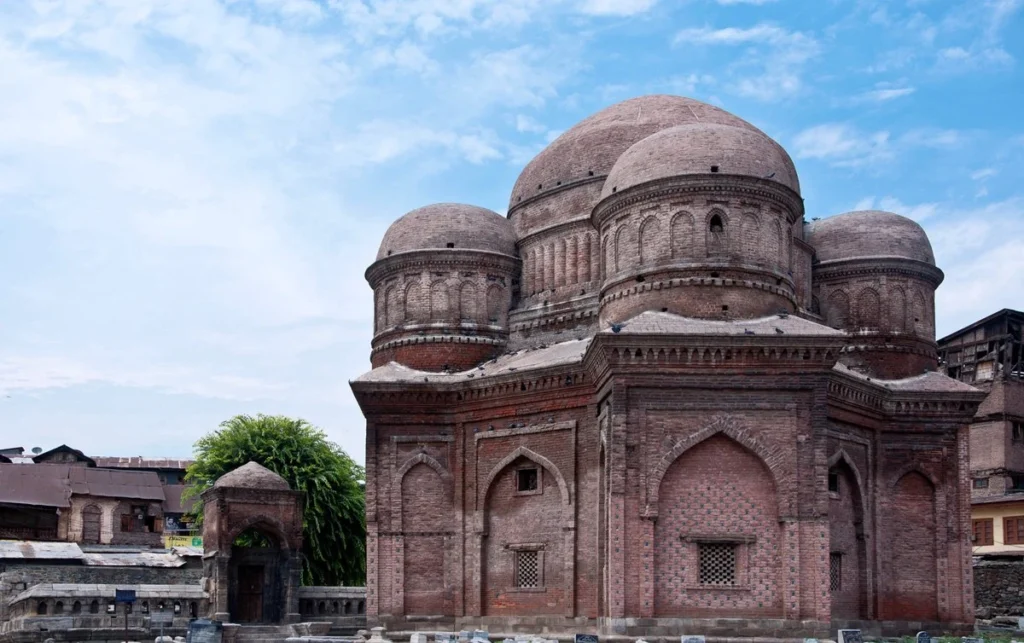
Image Source: Wikimedia
6.3 The Rajatarangini series
| Work | Author | Covers |
|---|---|---|
| Rajatarangini (1148–49) | Kalhana | Kashmir’s kings from legendary times to 1149 |
| Dvitiya Rajatarangini | Jonaraja | 1149 to the reign of Zain-ul-Abidin |
| Jaina Rajatarangini | Srivara | Zain-ul-Abidin and his successors |
| Rajavalipataka | Prajyabhatta and Shuka | Up to Akbar’s conquest (1586) |
- Exam trap: asked “Who wrote the Rajatarangini?”, the answer is Kalhana; Jonaraja and Srivara wrote its continuations. → PYQ: WBCS Mains 2021 | PYQ: WBCS Mains 2023 | PYQ: WBPSC Clerkship 2009 (2nd Shift) | Background: Early Medieval India and Rajput Kingdoms
6.4 Kashmiri culture under the Sultans
- Rishi movement: Nund Rishi (Sheikh Nooruddin Wali) and the poetess Lal Ded (Lalleshwari) blended Shaiva and Sufi ideas in Kashmiri verse. → Religious Movements
- Architecture: wooden mosques and shrines with pyramidal roofs, such as the Khanqah-e-Maula (Shah Hamadan mosque) in Srinagar, plus brick tombs with Persian domes.
7. Rajputana: Mewar and Marwar
In simple words: The Rajput clans of Rajasthan lost many forts to Alauddin Khalji but recovered them when Delhi weakened. Two great kingdoms emerged: Mewar (Chittor, Udaipur) under the Sisodias, and Marwar (Jodhpur) under the Rathors. Mewar’s Rana Kumbha was a builder and scholar who raised the Vijay Stambha and Kumbhalgarh. Rana Sanga became the strongest ruler of north India and challenged Babur at Khanwa (1527). Mewar never fully bowed to Akbar; Rana Pratap fought on, and only his son made peace in 1615.
7.1 Mewar: the Sisodias
- Origin: the Guhila dynasty of Mewar lost Chittor to Alauddin Khalji (1303). Hammir of the Sisodia branch recovered Chittor around 1326 and founded the Sisodia line of Ranas. → Delhi Sultanate
- Rana Lakha (1382–1421): developed the silver and lead mines of Zawar, which financed Mewar.
Rana Kumbha (1433–68)
- Victories: defeated Mahmud Khalji of Malwa (Sarangpur, 1437) and resisted Gujarat and Nagaur.
- Vijay Stambha (“Victory Tower”) at Chittorgarh (1440–48): nine storeys, about 37 m high, covered with images of Hindu gods; built to celebrate the victory over Malwa.
- Forts: credited with 32 of Mewar’s 84 forts. Kumbhalgarh, designed by the architect Mandan, has a wall of about 36 km, among the longest continuous walls in the world. Kumbhalgarh and Chittorgarh are part of the Hill Forts of Rajasthan UNESCO site (2013).
- Ranakpur Jain temple (1439), with 1,444 carved pillars, was built by the merchant Dharna Shah in Kumbha’s reign.
- Scholar-king: wrote Sangeet Raj, Sangeet Mimamsa and Rasikapriya (a commentary on Jayadeva’s Gita Govinda); titles Abhinava Bharatacharya and Hindu Suratrana.
- End: murdered by his son Udaykaran (Uda) in 1468.
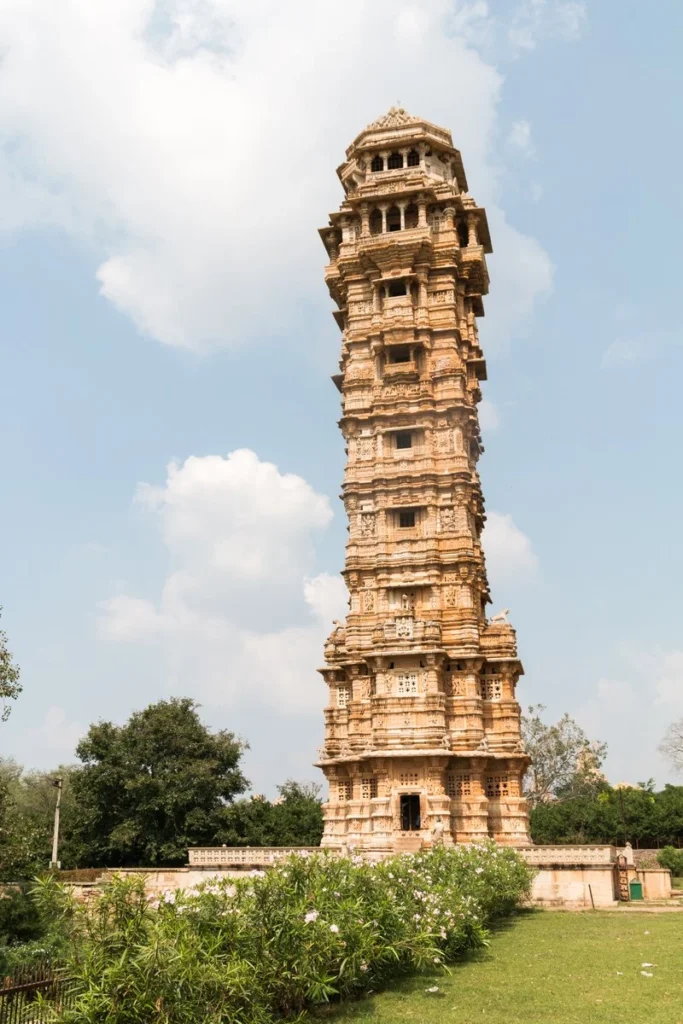
Image Source: Wikimedia
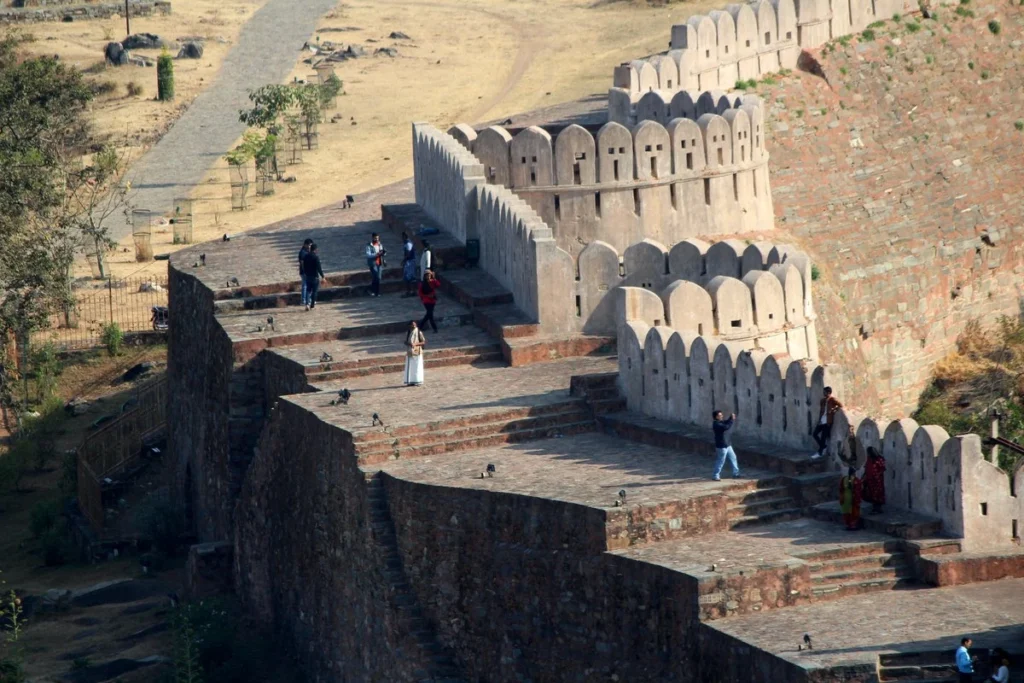
Image Source: Wikimedia
Rana Sanga (Sangram Singh, 1508–28)
- Victories: defeated Ibrahim Lodi at Khatoli (1517–18) and Dholpur, and Mahmud II of Malwa at Gagron (1519). He bore about 80 wounds and had lost an eye and an arm in battle.
- Khanwa (17 March 1527): led a Rajput–Afghan confederacy against Babur and was defeated. Babur took the title Ghazi. Sanga died in 1528. → PYQ: WBCS Prelims 2024
- Mirabai, the Krishna devotee poetess, was the wife of Sanga’s eldest son Bhoj Raj. → Religious Movements
Mewar after Sanga
- 1535: Bahadur Shah of Gujarat sacked Chittor; Rani Karnavati’s jauhar.
- Udai Singh II founded Udaipur (1559). Akbar stormed Chittor in 1568 after the heroic defence of Jaimal and Patta.
- Rana Pratap (1572–97) of the Sisodia clan fought Akbar’s army under Man Singh at Haldighati (1576) and kept up a guerrilla war from the hills. → PYQ: WBCS Prelims 2024
- Amar Singh made peace with Jahangir in 1615.
- Jauhar: the Rajput custom of mass self-immolation by women to avoid capture, practised at Chittor (1303, 1535, 1568). It belongs to Rajputana. → PYQ: WBCS Prelims 2003
7.2 Marwar: the Rathors
- Rao Chunda captured Mandore (1395). Rao Jodha founded Jodhpur and Mehrangarh fort in 1459; his son Rao Bika founded Bikaner (1488).
- Rao Maldeo (1532–62) was the strongest Rathor ruler. Sher Shah defeated his army at Sammel (Giri-Sumel, 1544) with great difficulty and remarked that he had nearly lost the empire of Hindustan “for a handful of millet” (bajra).
- Under Akbar, Udai Singh (Mota Raja) accepted Mughal service and married his daughter Jagat Gosain (Jodha Bai) to Prince Salim.
7.3 Amber (Jaipur): the Kachhwahas
- Raja Bharmal of Amber was the first major Rajput ruler to accept Akbar’s alliance (1562) and gave his daughter in marriage to Akbar. His grandson Man Singh became Akbar’s leading general. Hence the ruler of Jaipur (Amber) is the answer when exams ask which state entered a matrimonial alliance with Akbar. → PYQ: WBCS Prelims 2001
| Mewar | Marwar |
|---|---|
| Sisodias; Chittor → Udaipur | Rathors; Mandore → Jodhpur |
| Rana Kumbha: Vijay Stambha, Kumbhalgarh | Rao Jodha: Mehrangarh (1459) |
| Rana Sanga vs Babur at Khanwa (1527) | Rao Maldeo vs Sher Shah at Sammel (1544) |
| Rana Pratap vs Man Singh at Haldighati (1576) | Udai Singh joined Akbar |
8. Sindh and Multan
In simple words: Sindh (the lower Indus) and Multan (the middle Indus) were the first parts of India conquered by the Arabs in 712. In the Sultanate period both slipped away from Delhi. Sindh was ruled by the local Samma dynasty from Thatta, and Multan by the Langah dynasty. Both were overrun by the Arghuns from Kandahar in the 1520s and finally joined the Mughal Empire under Akbar. → Arab conquest of Sindh: Early Medieval India and Rajput Kingdoms
8.1 Sindh: Sumras and Sammas
- Sumras (11th–14th centuries): a local dynasty that ruled lower Sindh.
- Sammas (1351–1520): capital Thatta; rulers took the title Jam. Firoz Tughlaq led a disastrous campaign against Thatta (1365–67) and got only nominal submission.
- Jam Nizamuddin II (Jam Nindo, 1461–1508) ruled Sindh’s golden age; trade with Gujarat and the Persian Gulf flourished.
- Makli necropolis near Thatta, with thousands of carved stone tombs of the Samma, Arghun and Tarkhan periods, is a UNESCO World Heritage Site (1981).
- End: Shah Beg Arghun took Thatta in 1520; Akbar annexed Sindh in 1591.
8.2 Multan: the Langahs
- Langah dynasty (1445–1528): founded by Rai Sahra, who took the title Qutbuddin; Husain Langah was the strongest ruler.
- Sufi centre: Multan was the home of the Suhrawardi order: the shrines of Bahauddin Zakariya and of Shah Rukn-e-Alam, whose octagonal brick tomb was built in Tughlaq times. → Delhi Sultanate
- End: the Arghuns of Sindh captured Multan in 1528; it later became a Mughal province.
9. The Bengal Sultanate: A Short Overview (1342–1538)
In simple words: Bengal was so far from Delhi and so hard to reach in the rains that it was called “Bulghakpur”, the land of revolt. In 1342 Shamsuddin Ilyas Shah united Bengal and founded the independent Bengal Sultanate. Two great families ruled it: the Ilyas Shahis and the Husain Shahis. They built brick mosques at Pandua and Gaur and patronised Bengali literature. Sher Shah ended the Sultanate in 1538. This section gives only the exam essentials; the full story comes in the Medieval Bengal chapter.
9.1 Key facts
| Phase | Ruler | Exam fact |
|---|---|---|
| Ilyas Shahi (1342–1414) | Shamsuddin Ilyas Shah (1342–58) | Founder and first independent Sultan of Bengal; united Lakhnauti, Satgaon and Sonargaon; resisted Firoz Tughlaq at Ekdala |
| Sikandar Shah (1358–90) | Built the Adina Mosque at Pandua (1375), once the largest mosque in the subcontinent | |
| Ghiyasuddin Azam Shah (1390–1410) | Corresponded with the Persian poet Hafiz; founded madrasas at Mecca and Medina | |
| Raja Ganesha’s family (1415–33) | Raja Ganesha; his son Jalaluddin Muhammad Shah (Jadu, a convert) | Eklakhi Mausoleum at Pandua |
| Later Ilyas Shahi (1433–87) | Rukunuddin Barbak Shah (1459–74) | Gave Maladhar Basu the title Gunaraj Khan |
| Habshi rule (1487–93) | Abyssinian palace guards | Rapid coups |
| Husain Shahi (1493–1538) | Alauddin Husain Shah (1493–1519) | Founder; contemporary of Sri Chaitanya; conquered Kamata (1498); patron of Bengali |
| Nasiruddin Nusrat Shah (1519–33) | Built the Bara Sona Masjid at Gaur (1526) and the Qadam Rasul (1530) | |
| Ghiyasuddin Mahmud Shah (1533–38) | Last independent Sultan; lost Gaur to Sher Shah (1538) |
- Founder: the independent Bengal Sultanate was founded by Ilyas Shah. → PYQ: WBCS Prelims 2007 | PYQ: PSC Prelims 2010 | PYQ: WBCS Mains 2019
- Adina Mosque: built by Sikandar Shah at Pandua. → PYQ: WBCS Prelims 2023 | PYQ: WBCS Prelims 2024 | PYQ: WBPSC Clerkship 2009 (1st Shift)
- Madrasas in Mecca and Medina: Ghiyasuddin Azam Shah. → PYQ: WBCS Mains 2014
- Husain Shahi founder: Alauddin Husain Shah. → PYQ: WBPSC Clerkship 2007 (2nd Shift)
- Bara Sona Masjid at Gaur: Nusrat Shah; it is the correct pair Gaur — Bara Sona Masjid. → PYQ: WBCS Mains 2022 | PYQ: WBCS Prelims 2022
- Chaitanya’s contemporary: Alauddin Husain Shah. → PYQ: WBCS Prelims 2022 | PYQ: WBCS Prelims 2003
- Last independent Sultan: Ghiyasuddin Mahmud Shah. → PYQ: WBCS Prelims 2011
9.2 Bengali literature under the Sultans
- Maladhar Basu translated the Bhagavata as Sri Krishna Vijaya and received the title Gunaraj Khan. → PYQ: WBCS Prelims 2024 | PYQ: WBCS Prelims 2003
- Krittivas Ojha wrote the Bengali Ramayana (Sri Ram Panchali).
- The Mahabharata was rendered into Bengali by Kavindra Parameshvara for Paragal Khan, a general of Alauddin Husain Shah. → PYQ: WBCS Prelims 2005
- Rup and Sanatan Goswami, later Chaitanya’s leading disciples, served as ministers of Alauddin Husain Shah.
9.3 Bengal architecture in one line
Brick and terracotta mosques with curved cornices copied from Bengali bamboo huts (chala roofs), many small domes and few minarets: Adina Mosque (Pandua), Eklakhi Mausoleum (Pandua), Dakhil Darwaza, Chhota Sona and Bara Sona Masjid (Gaur). → Ancient Bengal
10. The North-East: Ahoms, Kamata and Tripura
In simple words: The Brahmaputra valley and its hills lay outside the Delhi Sultanate. Here the Ahoms, a Tai people from upper Burma, built a kingdom in 1228 that lasted for six centuries. They defeated repeated invasions from Bengal and the Mughals, kept written chronicles called buranjis, and were never conquered by Akbar. To their west lay the Kamata kingdom (later the Koch kingdom) and to the south the Manikya kings of Tripura.
10.1 The Ahom kingdom (1228–1826)
- Founder: Chaolung Sukapha, a Tai prince from Mong Mao (upper Burma), crossed the Patkai hills in 1228. 2 December is celebrated in Assam as Sukapha Divas (Asom Divas).
- Capitals: Charaideo (whose royal burial mounds, the moidams, became a UNESCO World Heritage Site in 2024), later Garhgaon and Rangpur (Sivasagar).
- Paik system: every adult male (paik) served the state in turn for labour or war in return for land; paiks were grouped into gots and khels.
- Suhungmung (Dihingia Raja, 1497–1539): the first Ahom king to take a Hindu title, Swarganarayan; expanded the kingdom and repelled Bengal’s invasion under Nusrat Shah.
- Buranjis: court chronicles written first in Tai-Ahom and later in Assamese; they are a rare tradition of historical writing in medieval India.
- Religion and culture: the Ahoms gradually adopted Hinduism. Srimanta Sankardeva (1449–1568) spread Ekasarana Dharma (devotion to Krishna) through sattras and namghars, and created Borgeet, Ankia Naat and the Sattriya dance.
The Ahoms and the Mughals
- Akbar could not annex Assam; the Ahom kingdom stayed independent throughout his reign. → PYQ: WBCS Prelims 2011
- Mir Jumla, Aurangzeb’s general, invaded in 1662 and occupied Garhgaon, but disease and the rains forced a retreat. → PYQ: WBCS Mains 2014
- Battle of Saraighat (1671): Lachit Borphukan defeated the Mughal army of Ram Singh on the Brahmaputra near Guwahati.
- End: Burmese invasions weakened the kingdom; the Treaty of Yandabo (1826) brought Assam under the British.
- Monuments: the Rang Ghar (royal pavilion for games, built in 1746), Talatal Ghar and Kareng Ghar at Sivasagar belong to the later Ahom period.
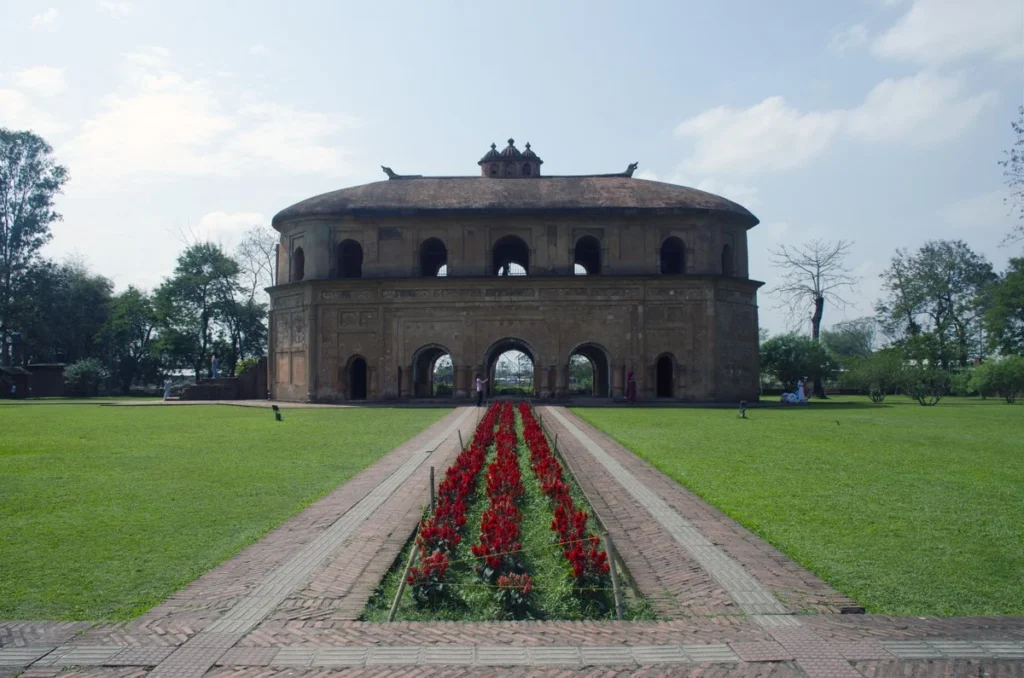
Image Source: Wikimedia
10.2 Kamata and the Koch kingdom
- Khen dynasty ruled Kamata (capital Kamatapur, near present Cooch Behar) in the 15th century. Alauddin Husain Shah of Bengal destroyed it in 1498.
- Koch dynasty: Vishwa Singha (from about 1515) built a new kingdom on Kamata’s ruins. Under Naranarayan and his general brother Chilarai it reached its peak; it later split into Koch Bihar and Koch Hajo. Naranarayan gave shelter to Sankardeva.
10.3 Tripura: the Manikya kings
- The Manikya dynasty ruled Tripura from Udaipur (Rangamati). Ratna Manikya (15th century) and Dhanya Manikya (1490–1515) were notable kings; Dhanya Manikya fought Alauddin Husain Shah and built the Tripura Sundari temple (1501).
- Their court chronicle, the Rajmala, was written in Bengali.
- Tripura remained a princely state until it merged with India in 1949.
11. Odisha: Eastern Gangas and Gajapatis
In simple words: Odisha (Orissa) was ruled by strong Hindu dynasties that kept the Delhi and Bengal Sultans away for three centuries. The Eastern Gangas built the Jagannath temple at Puri and the Sun Temple at Konark. In 1434–35 a general, Kapilendra, overthrew the last Ganga king and founded the Suryavamsi Gajapati dynasty (“lords of elephants”). The Gajapatis fought Vijayanagara, the Bahmanis and Bengal, and their capital Puri became the second home of Sri Chaitanya. Odisha fell to the Afghans of Bengal in 1568 and to Akbar in 1592.
11.1 The Eastern Gangas (c. 1078–1434)
- Anantavarman Chodaganga (1078–1147) began the Jagannath temple at Puri.
- Narasimhadeva I (1238–64) defeated the Bengal governor Tughril Tughan Khan and built the Konark Sun Temple (the “Black Pagoda”), designed as the chariot of the Sun god with 24 carved wheels and 7 horses. Konark is a UNESCO World Heritage Site (1984). → Ancient Art and Architecture | Early Medieval India and Rajput Kingdoms
- Firoz Tughlaq raided Odisha and the Jagannath temple (1360), but the Gangas survived.
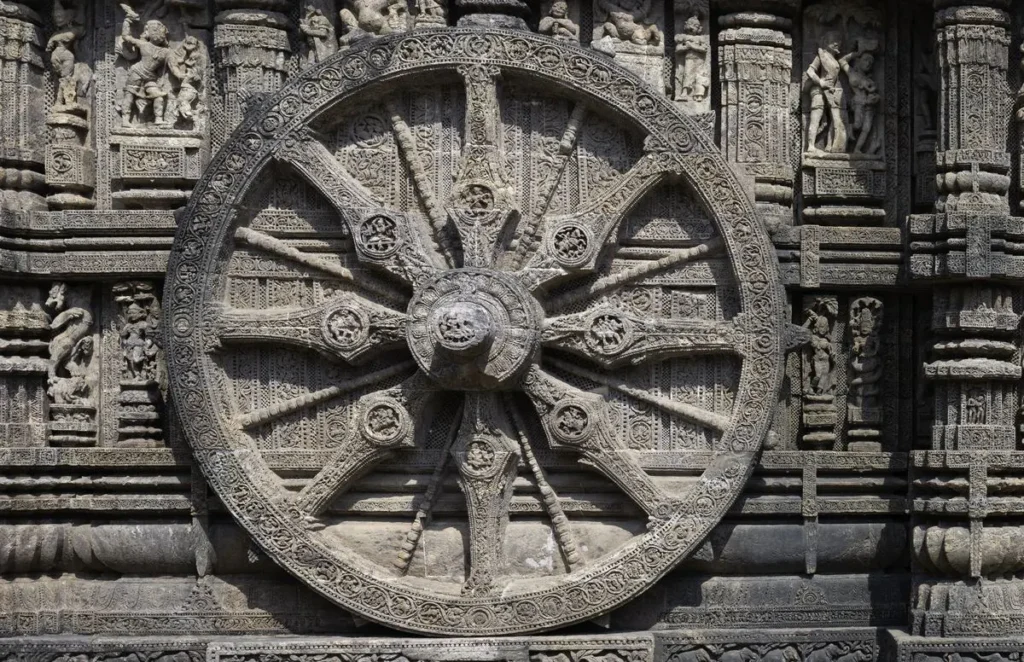
Image Source: Wikimedia
11.2 The Suryavamsi Gajapatis (1434/35–1541)
| Ruler | Years | Key facts |
|---|---|---|
| Kapilendra Deva | 1434/35–67 | Founder; overthrew Bhanudeva IV, the last Eastern Ganga king; expanded from the Ganga to the Kaveri; patron of Sarala Das |
| Purushottama Deva | 1467–97 | Recovered lost lands; subject of the Kanchi-Kaveri legend |
| Prataparudra Deva | 1497–1540 | Host and devotee of Sri Chaitanya at Puri; lost the coastal Andhra lands to Krishnadevaraya of Vijayanagara and married his daughter to him |
- Founder of the Gajapati dynasty: Kapilendra. → PYQ: WBCS Mains 2015
- Sarala Das wrote the Odia Mahabharata under Kapilendra. The Panchasakha poets (Jagannatha Das, Balarama Das and others) spread Vaishnava devotion in Odia in Prataparudra’s time.
- End: Govinda Vidyadhara founded the short Bhoi dynasty (1541). Mukunda Deva, the last independent Hindu king, was defeated in 1568 by the Afghan Karrani Sultans of Bengal, whose general Kalapahar sacked Puri. Man Singh annexed Odisha for Akbar in 1592.
11.3 Odisha between the Deccan and Bengal
- First clash with Vijayanagara: Vijayanagara first came into conflict with Odisha in the reign of Deva Raya I (1406–22), while the Eastern Gangas still ruled. → PYQ: WBCS Mains 2015
- Expansion south: Kapilendra annexed the Reddi lands of Rajahmundry and Kondavidu in coastal Andhra, fought the Bahmanis in Telangana and pushed south to the Kaveri, taking advantage of Vijayanagara’s weakness after Deva Raya II.
- Against Vijayanagara: Krishnadevaraya recovered these lands from Prataparudra in the campaigns of 1513–19, capturing Udayagiri and Kondavidu; peace was sealed by Prataparudra’s daughter’s marriage to Krishnadevaraya.
- Against Bengal: Alauddin Husain Shah raided Odisha, and the Gajapatis fought back along the Bengal border.
- Religious centre: the Jagannath temple made Puri a pilgrimage centre for all India; Chaitanya’s stay there (from 1510) made Odisha a hub of Gaudiya Vaishnavism.
12. The Deccan and the South: Pointers Only
In simple words: South of the Vindhyas, two big kingdoms rose from revolts against Muhammad bin Tughlaq: the Vijayanagara Empire (1336) and the Bahmani Kingdom (1347). They fought each other for two centuries over the rich Raichur Doab. They have their own chapter; here are only the facts you need to place them beside the provincial kingdoms.
| Kingdom | Founder | Year | Capital | Exam pointers |
|---|---|---|---|---|
| Madurai Sultanate | Jalaluddin Ahsan Shah | 1335 | Madurai | Revolted against Muhammad bin Tughlaq; ended by Vijayanagara (1378) |
| Vijayanagara | Harihara and Bukka (Sangama) | 1336 | Hampi | Ruins at Hampi; Krishnadevaraya fought the Gajapatis of Odisha |
| Bahmani | Alauddin Hasan Bahman Shah (Hasan Gangu) | 1347 | Gulbarga, later Bidar | Broke into five Deccan Sultanates after 1518 |
- Bone of contention: Vijayanagara and the Bahmanis clashed repeatedly over the Raichur Doab, the fertile land between the Krishna and Tungabhadra. → PYQ: WBCS Prelims 2011 | PYQ: WBCS Prelims 2001
- Madurai Sultanate founder: Jalaluddin Ahsan Shah. → PYQ: WBCS Mains 2015
- Bahmani founder: Alauddin Hasan Bahman Shah. → PYQ: WBCS Prelims 2014 | PYQ: WBCS Prelims 2008
- Vijayanagara’s capital and ruins: Hampi, on the Tungabhadra. → PYQ: WBCS Prelims 2016 | PYQ: PSC Prelims 2019
- Golconda (Qutb Shahi) rose on the ruins of the Kakatiya kingdom of Warangal. → PYQ: WBCS Mains 2019
- Links with the provincial kingdoms: Khandesh, Malwa and Gujarat fought the Bahmanis; the Gajapatis of Odisha fought both Vijayanagara and the Bahmanis.
13. Culture and Architecture of the Provincial Kingdoms
In simple words: When Delhi lost its grip, regional capitals became new centres of art. Each kingdom mixed the Islamic arch and dome with local building traditions and local languages. That is why a mosque in Ahmedabad looks very different from one in Gaur or Srinagar. Regional languages such as Bengali, Odia, Assamese, Kashmiri, Gujarati and Rajasthani also gained literature in this period, often with royal support.
13.1 Regional styles of architecture
| Region | Style | Famous buildings |
|---|---|---|
| Jaunpur | Massive pishtaq gateways, no minarets | Atala Masjid, Jhanjhri Masjid, Lal Darwaza Masjid, Jama Masjid |
| Malwa (Mandu) | Lofty plinths, big arches, palaces with lakes; marble tomb | Jahaz Mahal, Hindola Mahal, Hoshang Shah’s Tomb, Rupmati’s Pavilion |
| Gujarat | Temple-style carved pillars, brackets, stone jali, slender minarets | Jama Masjid (Ahmedabad), Sidi Saiyyed Mosque, Jhulta Minar, Adalaj stepwell, Champaner |
| Bengal | Brick and terracotta, curved chala cornices, many small domes | Adina Mosque, Eklakhi Mausoleum, Bara Sona and Chhota Sona Masjid |
| Kashmir | Wooden mosques with pyramidal roofs; brick tombs with Persian domes | Khanqah-e-Maula, Tomb of Zain-ul-Abidin’s mother |
| Mewar | Rajput hill forts, towers and Jain temples | Vijay Stambha, Kumbhalgarh, Ranakpur temple |
| Sindh and Multan | Carved stone tombs; glazed brick Sufi shrines | Makli necropolis, Shah Rukn-e-Alam tomb |
| Odisha | Kalinga-style temples (deul) | Jagannath (Puri), Konark Sun Temple |
| Assam | Brick pavilions and palaces, burial mounds | Rang Ghar, Talatal Ghar, Charaideo moidams |
→ Earlier temple styles: Ancient Art and Architecture
13.2 Language and literature
| Kingdom | Literature and patronage |
|---|---|
| Kashmir | Jonaraja and Srivara (Sanskrit chronicles); Persian translations of the Mahabharata and Rajatarangini; Lal Ded and Nund Rishi (Kashmiri verse) |
| Bengal | Maladhar Basu (Sri Krishna Vijaya), Krittivas (Ramayana), Kavindra Parameshvara (Mahabharata); Vaishnava literature after Chaitanya |
| Odisha | Sarala Das (Odia Mahabharata); Panchasakha poets |
| Assam | Buranjis; Sankardeva’s Borgeet and Ankia Naat; Madhavdev |
| Mewar | Rana Kumbha’s Sangeet Raj and Rasikapriya; Mirabai’s bhajans |
| Jaunpur and Malwa | Persian learning (“Shiraz-i-Hind”); music at the courts of Husain Shah Sharqi and Baz Bahadur |
| Gujarat | Narsinh Mehta’s Gujarati devotional poetry (15th century) |
13.3 Administration, economy and society
- Revenue: land revenue remained the backbone, collected through iqta holders in the sultanates and through land grants to warriors in the Hindu states (the paik system in Assam, Rajput clan holdings in Mewar and Marwar).
- Gujarat’s wanta system: Ahmad Shah I let defeated Rajput chiefs keep a quarter of their village lands (wanta) in return for loyalty, a compromise that kept the countryside quiet.
- Trade and towns: new capitals (Ahmedabad, Mandu, Jaunpur, Burhanpur, Jodhpur, Gaur) became markets and craft centres. Bengal exported rice, sugar and fine cotton; Kashmir developed shawls and papier-mâché; Gujarat dominated sea trade.
- Coins: each Sultan struck silver and copper coins with his own name; the Bengal Sultans issued silver tankas with calligraphic legends.
- Society: Sufi orders (Chishti in Jaunpur and Malwa, Suhrawardi in Multan, Kubrawi in Kashmir) and Bhakti saints spread devotional religion among ordinary people and softened religious tension.
13.4 Why the provincial kingdoms matter
- Regional identity: they laid the foundation of regional cultures and languages that continued under the Mughals.
- Hindu–Muslim synthesis: rulers such as Zain-ul-Abidin and Alauddin Husain Shah patronised Hindu scholars; Bhakti and Sufi saints such as Chaitanya, Sankardeva, Lal Ded and Nund Rishi flourished. → Religious Movements
- Trade and contact with Europe: Gujarat’s ports met the Portuguese first; Bengal’s ports later drew the Dutch and English. → Ancient Economy, Society and Coinage
- Military lessons: Babur, Sher Shah and Akbar had to defeat these regional powers one by one to build an empire.
14. Provincial Kingdoms at a Glance
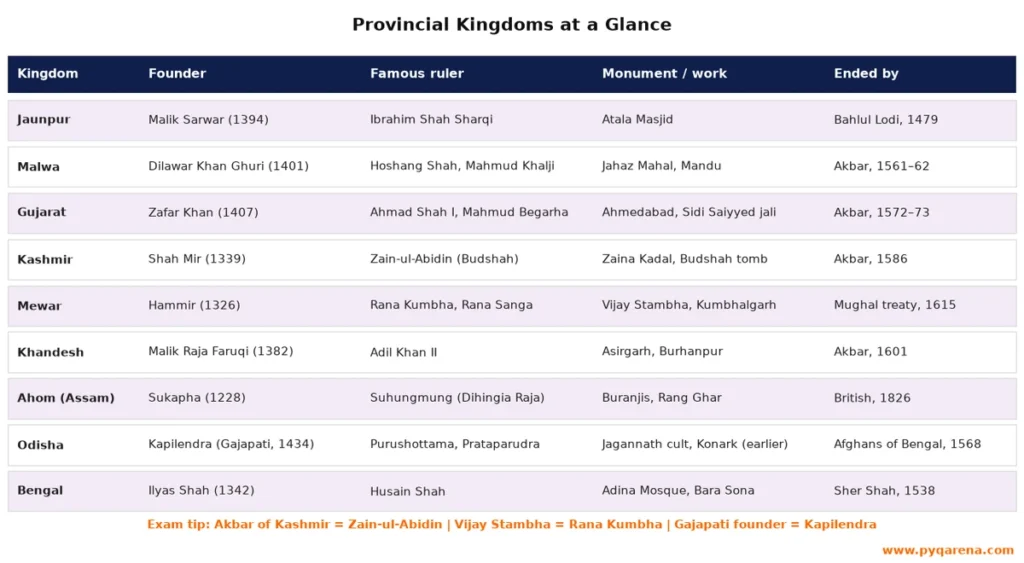
In simple words: If you remember only one table, remember this one: kingdom, founder, famous ruler, monument and who ended it.
14.1 Famous titles
| Title | Ruler | Kingdom |
|---|---|---|
| Malik-us-Sharq (“Lord of the East”) | Malik Sarwar | Jaunpur |
| Begarha (“conqueror of two forts”) | Mahmud Shah | Gujarat |
| Budshah, “Akbar of Kashmir” | Zain-ul-Abidin | Kashmir |
| Butshikan (“idol-breaker”) | Sikandar | Kashmir |
| Abhinava Bharatacharya, Hindu Suratrana | Rana Kumbha | Mewar |
| Gajapati (“lord of elephants”) | Kapilendra and successors | Odisha |
| Swarganarayan | Suhungmung | Ahom |
| Gunaraj Khan | Maladhar Basu (poet) | Bengal |
| Jagadguru | Ibrahim Adil Shah II | Bijapur (Deccan) |
14.2 Battles to remember
| Battle | Year | Between | Result |
|---|---|---|---|
| Sarangpur | 1437 | Rana Kumbha vs Mahmud Khalji | Both claimed victory; Vijay Stambha built |
| Chaul | 1508 | Gujarat–Egypt fleet vs Portuguese | Gujarat–Egypt victory |
| Diu | 1509 | Gujarat–Egypt fleet vs Portuguese (Almeida) | Portuguese victory; control of the Arabian Sea |
| Khatoli | 1517–18 | Rana Sanga vs Ibrahim Lodi | Sanga won |
| Gagron | 1519 | Rana Sanga vs Mahmud II of Malwa | Sanga won |
| Khanwa | 1527 | Babur vs Rana Sanga | Babur won |
| Sammel (Giri-Sumel) | 1544 | Sher Shah vs Maldeo’s Rathors | Sher Shah won narrowly |
| Sarangpur | 1561 | Adham Khan vs Baz Bahadur | Mughal conquest of Malwa |
| Haldighati | 1576 | Man Singh (Akbar) vs Rana Pratap | Indecisive; Mughals held the field |
| Saraighat | 1671 | Lachit Borphukan vs Ram Singh | Ahom victory |
15. Do Not Confuse
In simple words: Many names here look alike. These pairs are favourite traps in MCQs.
| Do not confuse | Fact A | Fact B |
|---|---|---|
| Bahadur Shah vs Baz Bahadur | Bahadur Shah: Sultan of Gujarat (1526–37), killed at Diu | Baz Bahadur: last Sultan of Malwa, lover of Rupmati |
| Vijay Stambha vs Kirti Stambha | Vijay Stambha: Rana Kumbha, 15th century, Hindu | Kirti Stambha: 12th-century Jain tower at Chittor |
| Mahmud Khalji vs Alauddin Khalji | Mahmud Khalji: Sultan of Malwa (1436–69) | Alauddin Khalji: Sultan of Delhi (1296–1316) |
| Zain-ul-Abidin vs Ibrahim Adil Shah II | “Akbar of Kashmir”, Budshah | “Jagadguru”, Bijapur |
| Sikandar Butshikan vs Sikandar Lodi vs Sikandar Shah | Kashmir, idol-breaker | Delhi, founded Agra (1504) / Bengal, built Adina Mosque |
| Kalhana vs Jonaraja vs Srivara | Rajatarangini (1148–49) | Second and third Rajataranginis (15th century) |
| Konark vs Gajapatis | Konark: Eastern Ganga Narasimhadeva I (13th century) | Gajapatis founded by Kapilendra (1434–35) |
| Atala Masjid vs Adina Mosque | Jaunpur, Ibrahim Shah Sharqi (1408) | Pandua (Bengal), Sikandar Shah (1375) |
| Khanwa vs Haldighati | Babur vs Rana Sanga (1527) | Akbar’s army vs Rana Pratap (1576) |
| Mehrangarh vs Kumbhalgarh | Jodhpur, Rao Jodha (Marwar) | Rana Kumbha (Mewar) |
| Ahom vs Koch | Tai people from Burma; buranjis; 1228–1826 | Kingdom on Kamata’s ruins; Naranarayan, Chilarai |
16. Timeline of the Provincial Kingdoms
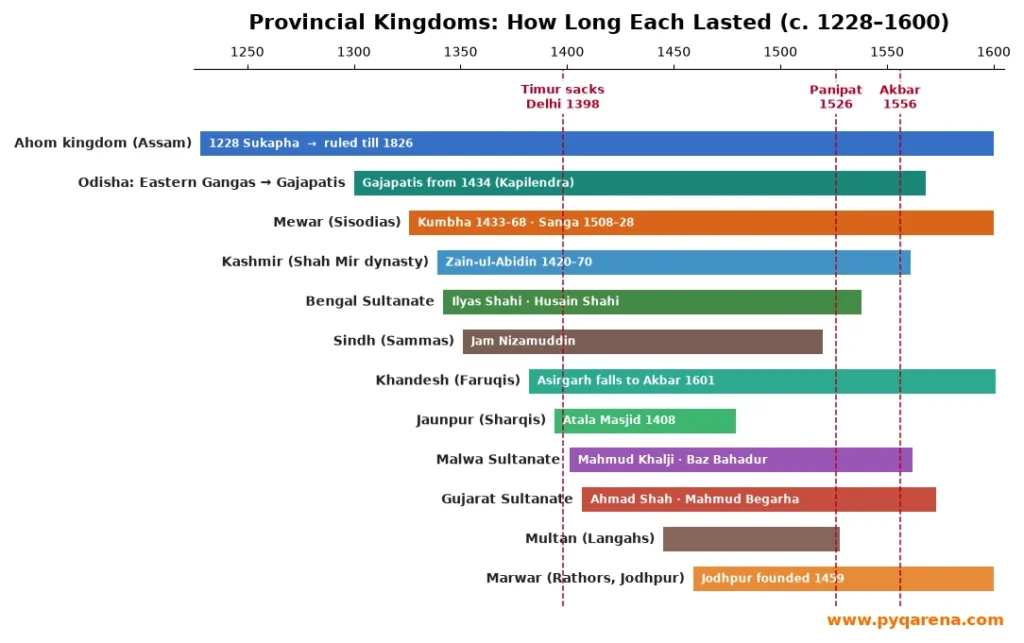
In simple words: Read the dates in order and you will see the pattern: revolts under Muhammad bin Tughlaq, a burst of new sultanates after Timur (1398), a golden age in the 15th century, and Mughal conquest in the 16th.
| Year | Event |
|---|---|
| 1228 | Sukapha founds the Ahom kingdom in Assam |
| 1238–64 | Narasimhadeva I (Eastern Ganga) builds the Konark Sun Temple |
| c. 1326 | Hammir recovers Chittor; Sisodia line of Mewar |
| 1335 | Madurai Sultanate (Jalaluddin Ahsan Shah) |
| 1336 | Vijayanagara founded by Harihara and Bukka |
| 1339 | Shah Mir founds the Muslim Sultanate of Kashmir |
| 1342 | Ilyas Shah unites Bengal: independent Bengal Sultanate |
| 1347 | Bahmani Kingdom (Alauddin Hasan Bahman Shah) |
| 1351 | Samma dynasty in Sindh (Thatta) |
| 1375 | Adina Mosque, Pandua (Sikandar Shah) |
| 1382 | Malik Raja Faruqi gets Khandesh |
| 1394 | Malik Sarwar becomes Malik-us-Sharq: Sharqi dynasty of Jaunpur |
| 1398 | Timur sacks Delhi |
| 1401 | Dilawar Khan Ghuri independent in Malwa |
| 1407 | Zafar Khan becomes Muzaffar Shah: Gujarat Sultanate |
| 1408 | Atala Masjid, Jaunpur |
| 1411 | Ahmad Shah I founds Ahmedabad |
| 1420–70 | Zain-ul-Abidin rules Kashmir |
| 1433–68 | Rana Kumbha rules Mewar; Vijay Stambha (1440–48) |
| 1434–35 | Kapilendra founds the Gajapati dynasty of Odisha |
| 1437 | Battle of Sarangpur: Kumbha vs Mahmud Khalji |
| 1445 | Langah dynasty in Multan |
| 1458–1511 | Mahmud Begarha rules Gujarat |
| 1459 | Rao Jodha founds Jodhpur |
| 1479 | Bahlul Lodi annexes Jaunpur |
| 1484 | Mahmud Begarha captures Champaner |
| 1493 | Alauddin Husain Shah founds the Husain Shahi dynasty |
| 1498 | Vasco da Gama at Calicut; Husain Shah conquers Kamata |
| 1508–09 | Battles of Chaul and Diu |
| 1508–28 | Rana Sanga rules Mewar |
| 1526 | First Battle of Panipat; Bara Sona Masjid, Gaur |
| 1527 | Battle of Khanwa: Babur defeats Rana Sanga |
| 1531 | Bahadur Shah of Gujarat annexes Malwa |
| 1535 | Bahadur Shah sacks Chittor; Portuguese fort at Diu; Humayun in Gujarat |
| 1538 | Sher Shah takes Gaur; end of the independent Bengal Sultanate |
| 1544 | Battle of Sammel: Sher Shah vs Maldeo |
| 1561 | Akbar’s army conquers Malwa (Baz Bahadur) |
| 1568 | Akbar takes Chittor; Afghans of Bengal conquer Odisha |
| 1572–73 | Akbar conquers Gujarat; Buland Darwaza |
| 1576 | Haldighati |
| 1586 | Akbar annexes Kashmir |
| 1591–92 | Akbar annexes Sindh and Odisha |
| 1601 | Akbar takes Asirgarh: end of Khandesh |
| 1615 | Mewar’s treaty with Jahangir |
| 1671 | Saraighat: Lachit Borphukan defeats the Mughals |
| 1826 | Treaty of Yandabo: Assam passes to the British |
17. Quick Revision and Memory Tricks
In simple words: Short lines and tricks to revise the whole chapter in ten minutes before the exam.
17.1 One-line facts
- Jaunpur: Sharqis; Malik-us-Sharq Malik Sarwar (1394); Ibrahim Shah; Atala Masjid (1408); “Shiraz of India”; ended by Bahlul Lodi (1479).
- Malwa: Dilawar Khan Ghuri (1401); Hoshang Shah moved the capital to Mandu (Shadiabad); Mahmud Khalji vs Rana Kumbha; Jahaz Mahal; Baz Bahadur and Rupmati; Akbar (1561).
- Gujarat: Zafar Khan / Muzaffar Shah (1407); Ahmad Shah I founded Ahmedabad (1411); Mahmud Begarha (Girnar and Champaner); Battles of Chaul (1508) and Diu (1509); Bahadur Shah gave Diu to the Portuguese; Sidi Saiyyed jali; Akbar (1572–73), Buland Darwaza.
- Khandesh: Faruqis (1382); Burhanpur; Asirgarh = Gateway of the Deccan; Akbar’s last conquest (1601).
- Kashmir: Shah Mir (1339); Sikandar Butshikan; Zain-ul-Abidin = Budshah = Akbar of Kashmir; Jonaraja and Srivara continued Kalhana; Akbar (1586).
- Mewar: Hammir (c. 1326); Rana Kumbha: Vijay Stambha, Kumbhalgarh, Sangeet Raj; Rana Sanga lost at Khanwa (1527); Rana Pratap at Haldighati (1576).
- Marwar: Rao Jodha founded Jodhpur (1459); Rao Maldeo vs Sher Shah at Sammel (1544).
- Sindh / Multan: Sammas of Thatta, Makli tombs; Langahs of Multan; both taken by Arghuns.
- Bengal: Ilyas Shah (1342) founder; Sikandar Shah: Adina Mosque; Azam Shah and Hafiz; Husain Shah: Chaitanya’s contemporary; Nusrat Shah: Bara Sona; last Sultan Ghiyasuddin Mahmud Shah (1538).
- Assam: Sukapha (1228); paik system; buranjis; Akbar could not annex Assam; Mir Jumla (1662); Lachit Borphukan at Saraighat (1671).
- Odisha: Eastern Gangas: Jagannath temple (Chodaganga), Konark (Narasimhadeva I); Kapilendra founded the Gajapatis (1434–35); Prataparudra and Chaitanya.
18. Frequently Asked Questions
In simple words: Short answers to the questions students ask most about this chapter.
Q1. What were the provincial kingdoms of the Sultanate period?
They were regional states that broke away from, or grew up beside, the Delhi Sultanate between about 1300 and 1600: Jaunpur, Malwa, Gujarat, Khandesh, Kashmir, Bengal, Sindh and Multan under Sultans; Mewar, Marwar, Odisha and the Ahom kingdom under Hindu or tribal rulers; and the Bahmani and Vijayanagara kingdoms in the Deccan.
Q2. Who is called the “Akbar of Kashmir”?
Zain-ul-Abidin (1420–70), known as Budshah, because he abolished jizya, rebuilt temples and patronised Sanskrit and Persian learning.
Q3. Where is the Atala Masjid and who completed it?
At Jaunpur, completed in 1408 by Ibrahim Shah Sharqi.
Q4. Why was Mahmud Shah of Gujarat called “Begarha”?
Because he captured two forts, Girnar (Junagadh) and Champaner (Pavagadh).
Q5. Who built the Vijay Stambha at Chittorgarh?
Rana Kumbha of Mewar, to celebrate his victory over Mahmud Khalji of Malwa (1437).
Q6. Who founded the Gajapati dynasty of Odisha?
Kapilendra Deva, in 1434–35, after overthrowing the last Eastern Ganga king.
Q7. Who founded the independent Bengal Sultanate?
Shamsuddin Ilyas Shah, in 1342.
Q8. Why could Akbar not conquer Assam?
The Ahom kingdom had a strong militia (the paik system), knew how to fight in the hills, forests and rivers of the Brahmaputra valley, and lay beyond Mughal supply lines. Akbar’s empire stopped at Bengal; even Aurangzeb’s general Mir Jumla had to retreat.
Q9. What are buranjis?
Court chronicles of the Ahom kings, written first in Tai-Ahom and later in Assamese.
Q10. Who wrote the continuations of the Rajatarangini?
Jonaraja (Dvitiya Rajatarangini) and his pupil Srivara (Jaina Rajatarangini), both in the 15th century; the original Rajatarangini is by Kalhana.
Q11. How did the Portuguese get Diu?
Bahadur Shah of Gujarat let them build a fort there in 1535 in return for help against Humayun. Diu stayed Portuguese until 1961.
Q12. Which was Akbar’s last conquest?
The fort of Asirgarh in Khandesh (1601).
Related Notes and Practice
- Notes:
- Practice:
- WBCS Prelims Medieval Indian History PYQs
- WBCS Mains Delhi Sultanate PYQs
- WBCS Mains Religious Movements PYQs
- WBCS Mains Early Medieval Indian History PYQs
- WBCS Mains Vijayanagar and Bahmani PYQs
- WBCS Mains Mughal Empire PYQs
- WBCS Mains General Knowledge History PYQs
- PSC Miscellaneous Prelims History PYQs
- WBPSC Clerkship History PYQs
- WBPSC IDO History PYQs
- WBP Constable History PYQs
Leave a Comment