

Who is this for? Beginners and aspirants for WBCS, UPSC Prelims, other State PSCs, WBP and Clerkship exams. This is Chapter 4 of Medieval Indian History and goes deep into Bengal, the most important regional history for WBCS. Each section opens with an “In simple words” explanation and then moves to exam-level detail, from the Turkish governors of 1204 to the Mughal conquest of the Baro-Bhuiyans in 1612.
🔗 Practise alongside: WBCS Prelims Medieval Indian History PYQs | WBCS Mains Religious Movements PYQs | WBCS Mains Mughal Empire PYQs | WBCS Mains Advent of Europeans PYQs | PSC Miscellaneous Prelims History PYQs | WBPSC Clerkship History PYQs | WBCS Mains General Knowledge History PYQs
📖 Read first: Ancient Bengal | Delhi Sultanate (Chapter 2) | Provincial Kingdoms of the Sultanate Period (Chapter 3) | Early Medieval India and Rajput Kingdoms (Chapter 1)
1. Medieval Bengal: The Big Picture
In simple words: For about 400 years after 1204, Bengal was ruled from its own capitals by Turkish governors, then by independent Sultans, then briefly by Afghans, and at last by the Mughals. Delhi could never hold Bengal for long: the rivers were wide, the rains were heavy and the rich delta paid well for revolt. From 1342, for almost two centuries, Bengal was a separate and wealthy Sultanate whose rulers built great mosques, welcomed Chinese envoys and gave Bengali its first royal patronage. The story ends with the Baro-Bhuiyans, the landlord-chiefs of the eastern delta, who held out against the Mughals until Islam Khan crushed them (1608–13).
1.1 The six phases of medieval Bengal
| Phase | Years | Capital | Main rulers |
|---|---|---|---|
| Turkish governors under Delhi | 1204–1338 | Lakhnauti (Gaur) | Bakhtiyar Khalji, Iwaz Khalji, Tughril, Bughra Khan |
| Ilyas Shahi dynasty | 1342–1414 | Pandua | Ilyas Shah, Sikandar Shah, Ghiyasuddin Azam Shah |
| Raja Ganesha’s house | 1414–33 | Pandua | Ganesha, Jalaluddin Muhammad Shah |
| Restored Ilyas Shahi and Habshi rule | 1433–93 | Gaur | Nasiruddin Mahmud Shah, Barbak Shah, Yusuf Shah; Abyssinian Sultans |
| Husain Shahi dynasty | 1493–1538 | Gaur and Ekdala | Alauddin Husain Shah, Nusrat Shah |
| Sur, Karrani and Mughal rule | 1538–1612 | Gaur, Tanda, Rajmahal, Dhaka | Sher Shah, Sulaiman and Daud Karrani, Man Singh, Islam Khan |
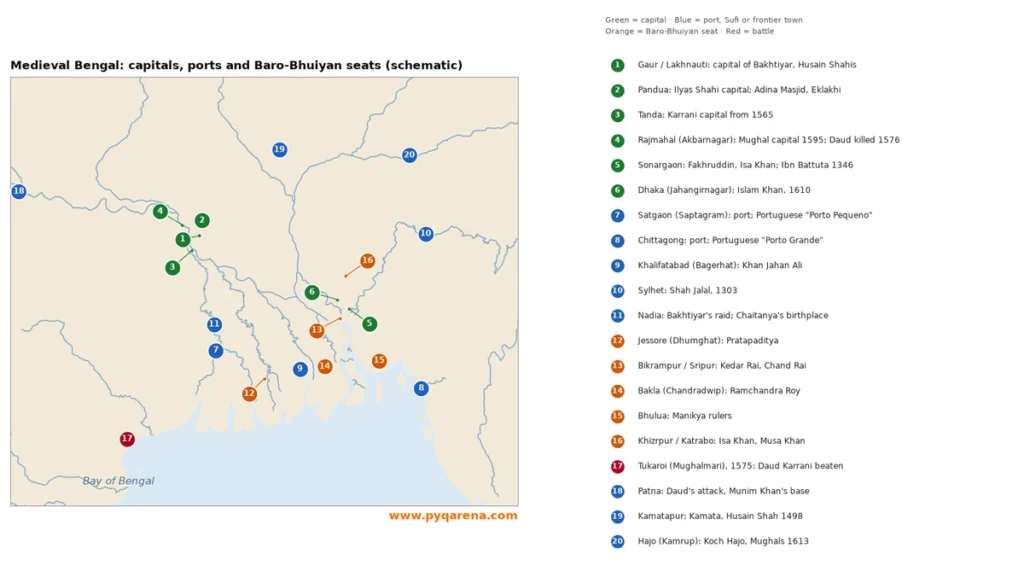
1.2 Three names to know
- Lakhnauti (from Lakshmanavati, the Sena capital) is the Turkish name for Gaur and for the whole region of north-western Bengal.
- Satgaon and Sonargaon were the south-western and eastern provinces. In 1324, Ghiyasuddin Tughlaq divided Bengal into Lakhnauti, Satgaon and Sonargaon. → Delhi Sultanate
- Bangalah became the name of the whole land in the time of Ilyas Shah, who called himself Shah-i-Bangalah and Shah-i-Bangaliyan. This is the root of the word “Bengal”.
1.3 Why Bengal matters for WBCS
- Questions come every year on the founder of the Sultanate (Ilyas Shah), the Adina Mosque (Sikandar Shah), the madrasas at Mecca and Medina (Azam Shah), Husain Shah and Chaitanya, the Bara Sona Masjid (Nusrat Shah), the last independent Sultan (Ghiyasuddin Mahmud Shah) and Maladhar Basu.
- This chapter links those facts with the people around them: poets, saints, ports, coins and the Mughal wars. → PYQ: WBCS Prelims 2007 | PYQ: WBCS Mains 2019 | PYQ: PSC Prelims 2010
| Topic | What exams usually ask |
|---|---|
| Conquest of Bengal | Bakhtiyar Khalji, Lakshmana Sena, Nadia, the date 1202 |
| Independent Sultanate | Ilyas Shah (1342), Sikandar Shah’s Adina Mosque, Azam Shah and Hafiz |
| Husain Shahis | Husain Shah and Chaitanya, Mahabharata translation, Bara Sona Masjid, last Sultan |
| Literature | Maladhar Basu and Gunaraj Khan, Krittivas, Chhuti Khan, Mukundaram |
| End of the Sultanate | Sher Shah, Karrani Afghans, Rajmahal 1576, Baro-Bhuiyans, Islam Khan |
| Europeans | Portuguese at Chittagong and Hugli; Shah Jahan expels them in 1632 |
2. Bengal under the Turkish Governors (1204–1338)
In simple words: After Bakhtiyar Khalji rode into Nadia, Bengal became a distant province of the Delhi Sultanate. But the governors were soldiers far from their master, and almost every one of them tried to rule on his own. Delhi’s sultans, Iltutmish and Balban, had to send armies again and again. Finally in 1338, when Muhammad bin Tughlaq’s grip failed, Bengal broke away for good.
2.1 Bakhtiyar Khalji and the conquest of Bengal
- Ikhtiyaruddin Muhammad bin Bakhtiyar Khalji was a Khalji soldier of Muhammad Ghori. After conquering Bihar (the sack of Odantapuri and Vikramshila), he marched on Nadia (Nabadwip), the capital of the Sena king Lakshmana Sena. The old king fled by a back door, and Bakhtiyar took the city with a small party of horsemen.
- Date: WBCS asks for 1202 CE as the date of the capture of Nadia; Minhaj-us-Siraj’s account places it around 1204. → PYQ: WBCS Prelims 2009 | PYQ: WBCS Prelims 2021 | PYQ: WBCS Prelims 2007 | PYQ: WBCS Prelims 2001 | PYQ: WBCS Prelims 2011
- Capital: he made Lakhnauti (Gaur) his capital and divided the land among his officers (iqtas). Lakshmana Sena’s family kept ruling the south-eastern delta from Vikrampur for about three decades. → Ancient Bengal
- Failure in Tibet: in 1205–06 Bakhtiyar led an army towards Tibet through Kamrup; the force was destroyed by hill warfare and disease. He returned ill and was killed at Devkot by his own officer Ali Mardan Khalji (1206).
- Source: the Tabaqat-i-Nasiri of Minhaj-us-Siraj, who visited Lakhnauti in 1243–44. → Delhi Sultanate
- Do not confuse: Bakhtiyar Khalji is the conqueror of Bengal; Qutbuddin Bakhtiyar Kaki is the Chishti saint of Delhi.
2.2 Khalji chiefs and Iwaz Khalji (1206–27)
- Ali Mardan Khalji declared independence (as Sultan Alauddin) and was murdered. The next strong ruler was Husamuddin Iwaz Khalji, who took the title Ghiyasuddin Iwaz Shah (1212–27).
- Achievements: raised embankments against floods, built a high road (a causeway) from Lakhnauti to Devkot, and led raids on Jajnagar (Odisha), Kamrup and Bang (eastern Bengal). He struck coins in his own name.
- Iltutmish steps in: after Iwaz had accepted the Delhi Sultan’s authority in 1225 and then attacked Bihar again, Iltutmish’s son Nasiruddin Mahmud defeated and killed him (1227). Delhi’s governors followed: Nasiruddin Mahmud, then a series of chiefs. → Delhi Sultanate
- Tughril Tughan Khan (1233–45) governed Bengal for Delhi, fought Jajnagar (Odisha) and was repulsed by Narasimhadeva I, the builder of Konark, in 1244. → Provincial Kingdoms
- Minhaj-us-Siraj, who came to Lakhnauti in 1243, is the main source for these early governors.
2.3 Tughril’s revolt and Balban’s campaign (1280–81)
- Mughisuddin Tughril (Tughril Khan) was Balban’s slave and the governor of Bengal. Convinced that Balban was old, he declared himself Sultan (about 1279), struck coins and read the khutba in his name.
- Two failed expeditions: Balban’s first generals, Amin Khan and Tatar Khan, were defeated by Tughril’s forces.
- Balban himself marched in 1280 with his son Bughra Khan. Tughril fled; the Delhi army caught and killed him near Sonargaon (1281). Balban hanged Tughril’s followers along the main bazaar of Lakhnauti as a warning. → Delhi Sultanate
2.4 Bughra Khan and his family (1281–1324)
- Balban made his younger son Bughra Khan governor of Bengal. When Balban died in 1287, Bughra Khan refused the throne of Delhi, left it to his son Kaiqubad and stayed in Bengal, ruling almost independently till 1291.
- Meeting of father and son (1289): at the Ghaghra river Bughra Khan and Kaiqubad met in a famous peaceful scene, described by Amir Khusrau in the Qiran-us-Sadain (“Meeting of the Two Auspicious Stars”). → Delhi Sultanate
- His descendants: Rukunuddin Kaikaus (1291–1300) and Shamsuddin Firuz Shah (1301–22) extended Bengal to Satgaon in the south-west, Sonargaon in the east and Sylhet (1303, with the saint Shah Jalal).
- Name of the family: historians call this line the Bughra Khan or Balbani house; it ruled Bengal like a small kingdom under Delhi’s nominal overlordship.
2.5 The Tughlaq take-over and the break-away (1324–42)
- Ghiyasuddin Tughlaq invaded Bengal in 1324 after a quarrel among Firuz Shah’s sons. Bahadur Shah of Sonargaon was captured. The Sultan divided Bengal into Lakhnauti, Satgaon and Sonargaon, each under a governor.
- 1338: when Muhammad bin Tughlaq was busy with revolts elsewhere, Fakhruddin Mubarak Shah, a soldier of the Sonargaon governor, took Sonargaon and became its independent Sultan (1338–49). Alauddin Ali Shah seized Lakhnauti and made Pandua his capital, and Ikhtiyaruddin Ghazi Shah held Satgaon. → PYQ: WBCS Mains 2019
- Ibn Battuta visited Sonargaon and Sylhet in 1346, when Fakhruddin ruled. He called Bengal “a hell crammed with good things” because food was so cheap but the climate so hard. → Foreign Travellers in India
- 1342: Haji Ilyas (Shamsuddin Ilyas Shah), a Satgaon noble, killed Ali Shah and took Lakhnauti. By 1352 he held Sonargaon too and ruled the whole of Bengal. The independent Sultanate had begun.
| Governor / Sultan | Years | Fact |
|---|---|---|
| Bakhtiyar Khalji | c. 1202–06 | Conquered Nadia; failed in Tibet |
| Ghiyasuddin Iwaz | 1212–27 | Embankments; killed by Nasiruddin Mahmud |
| Tughril Tughan Khan | 1233–45 | Fought Odisha |
| Mughisuddin Tughril | c. 1279–81 | Revolted; killed by Balban’s army |
| Bughra Khan | 1281–91 | Refused Delhi; Qiran-us-Sadain |
| Shamsuddin Firuz Shah | 1301–22 | Sylhet conquered 1303 |
| Fakhruddin Mubarak Shah | 1338–49 | Independent at Sonargaon |
3. The Ilyas Shahi Dynasty (1342–1414)
In simple words: Shamsuddin Ilyas Shah united the three parts of Bengal and made it a real kingdom. Delhi tried twice to get it back and failed both times. His son Sikandar Shah built the great Adina Mosque at Pandua, and his grandson Ghiyasuddin Azam Shah was a learned ruler who wrote to the Persian poet Hafiz and sent ambassadors to China. Together they made Bengal one of the strongest Muslim kingdoms in the world.
3.1 Shamsuddin Ilyas Shah (1342–58)
- Founder of the independent Sultanate of Bengal and of the Ilyas Shahi dynasty; the first Sultan of all Bengal. → PYQ: WBCS Prelims 2007 | PYQ: PSC Prelims 2010 | PYQ: WBCS Mains 2019
- Capital: Pandua (Hazrat Pandua, near Malda), also known as Firuzabad. He took the titles Shah-i-Bangalah and Shah-i-Bangaliyan. The word Bangalah for the whole country comes from his reign.
- Conquests: united Lakhnauti (1342), Satgaon and Sonargaon (1352); raided Tirhut (Bihar), Nepal, Odisha (to Lake Chilika) and went as far as Varanasi (1353).
- War with Delhi: Firoz Shah Tughlaq marched on Bengal in 1353–54 and besieged Ilyas Shah in the island fort of Ekdala. After a feigned retreat by the Bengal army and the first monsoon floods, Firoz returned to Delhi without a victory, and the two rulers exchanged gifts and envoys. → Delhi Sultanate
- Religious policy: Ilyas Shah honoured Sufi saints; the famous Akhi Siraj lived at Gaur in his reign. → see §17.
3.2 Sikandar Shah (1358–90) and the Adina Mosque
- Ilyas Shah’s son. Firoz Tughlaq invaded again in 1359 and was again held at Ekdala; peace followed with Delhi recognising Bengal’s independence in everything but name.
- Adina Mosque (1373–75): built by Sikandar Shah at Pandua, near Malda. → PYQ: WBCS Prelims 2023 | PYQ: WBCS Prelims 2024 | PYQ: WBPSC Clerkship 2009 (1st Shift)
- It was the largest mosque in the subcontinent, about 500 ft by 300 ft, with a huge cloistered courtyard and a long barrel-vaulted hall. The design recalls the Great Mosque of Damascus.
- It is built of brick faced with stone taken from older Hindu and Buddhist buildings, and carries a few carved images reused from them.
- The mihrab and the royal gallery (Badshah-ka-Takht) are its best-known parts.
- Death: Sikandar Shah was killed in battle at Goalpara by his rebellious son Ghiyasuddin Azam Shah (1390).
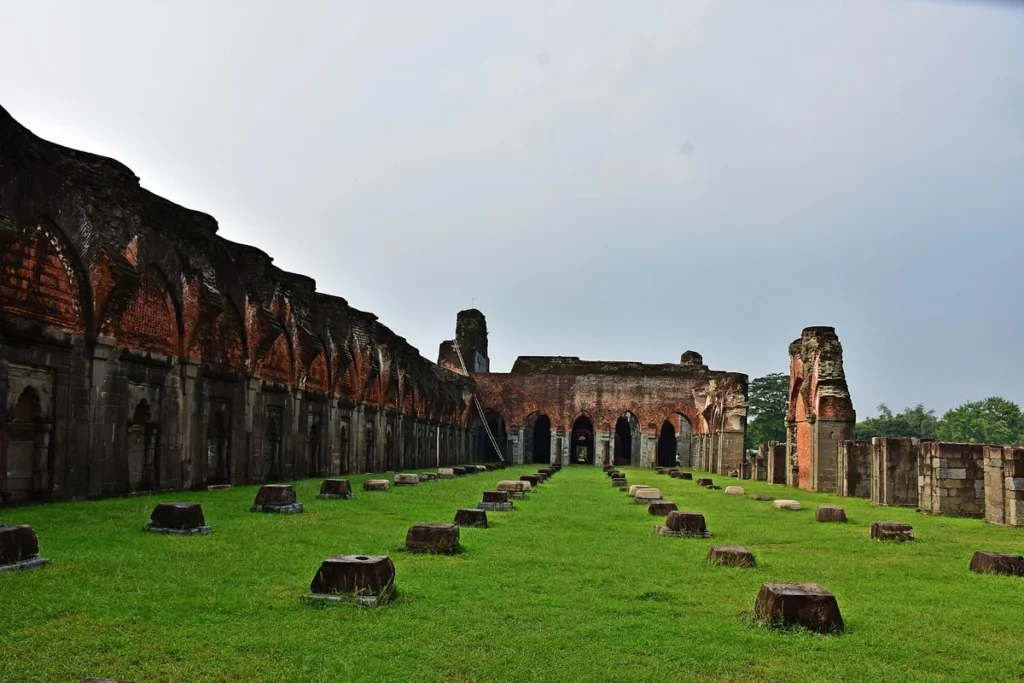
Image Source: Wikimedia
3.3 Ghiyasuddin Azam Shah (1390–1411)
- Scholar and judge: famous for justice. A story tells how he stood before his own qazi when a woman complained against him. He was a patron of Bengali poets such as Shah Muhammad Sagir (Yusuf-Zulekha).
- Letter to Hafiz: he invited the Persian poet Hafiz of Shiraz to his court. Hafiz wrote a verse, replying that “all the parrots of India will turn sugar-lipped with this Persian candy that goes to Bengal”. → Foreign Travellers in India
- Madrasas in Mecca and Medina: Azam Shah built madrasas at Mecca and Medina for Bengali pilgrims. → PYQ: WBCS Mains 2014
- Embassies to China: he exchanged missions with the Ming emperor Yongle (1405–10); a giraffe sent from Bengal reached the Chinese court in 1414, a few years after his death. Chinese members of Zheng He’s voyages, Ma Huan and Fei Xin, described Bengal and its capital.
- Death and his successors: Azam Shah’s dynasty ended in confusion: Saifuddin Hamza Shah (1411–13) and Shihabuddin Bayazid Shah (1413–14) were puppets of the nobles, led by Raja Ganesha.
3.4 Ilyas Shahi summary
| Ruler | Years | Fact |
|---|---|---|
| Shamsuddin Ilyas Shah | 1342–58 | Founder; Shah-i-Bangalah; Ekdala 1353–54 |
| Sikandar Shah | 1358–90 | Adina Mosque (1373–75) |
| Ghiyasuddin Azam Shah | 1390–1411 | Hafiz; madrasas at Mecca and Medina; China |
| Saifuddin Hamza Shah, Shihabuddin Bayazid Shah | 1411–14 | Puppets of Raja Ganesha |
4. Raja Ganesha and Jalaluddin Muhammad Shah (1414–33)
In simple words: In 1414 a powerful Hindu landlord named Raja Ganesha took power in Bengal. A famous Sufi, Nur Qutb Alam, was alarmed and asked the Sultan of Jaunpur to attack. Ganesha made peace by letting his young son Jadu become a Muslim, and the boy ruled as Jalaluddin Muhammad Shah. It was a rare case of a Hindu family at the head of the Muslim Sultanate, and it left the beautiful Eklakhi Mausoleum at Pandua.
4.1 Raja Ganesha (Danujamardana Deva)
- Origin: a Hindu zamindar (some chroniclers call him a Brahmin of Bhaturia in Dinajpur) and the most powerful noble at the Ilyas Shahi court. He killed the last Ilyas Shahi puppet and seized the throne in 1414.
- Jaunpur’s invasion: Nur Qutb Alam, the Chishti saint of Pandua, wrote to Ibrahim Shah Sharqi of Jaunpur, who marched to Bengal. Ganesha went to the saint and agreed to hand power to his son Jadu, who became a Muslim. → Provincial Kingdoms
- Second reign: after the Jaunpur army went back, Ganesha removed his son, took the title Danujamardana Deva and struck coins with the legend Sri Chandi-charana-parayana (“devoted to the feet of Chandi”). Later his son returned.
4.2 Jalaluddin Muhammad Shah (1415–16, 1418–33)
- Jadu returned to Hinduism briefly, but ruled the second time as a faithful Muslim under the name Jalaluddin Muhammad Shah.
- Policy: he received Muslim scholars generously, dug tanks and claimed the title Khalifat Allah (deputy of God) on his coins. He sent gifts to Mecca and Cairo and to the Ming court.
- Eklakhi Mausoleum: built at Pandua (about 1425) for Jalaluddin; it holds the graves of him, his wife and his son. It is called Eklakhi after its cost of one lakh (ek lakh) rupees. It is a single-domed square brick tomb with curved cornices and terracotta ornament. → see §14.
- End: his son Shamsuddin Ahmad Shah (1432–36) was cruel and was murdered by two of his nobles, Shadi Khan and Nasir Khan. Nasir Khan then took the throne.
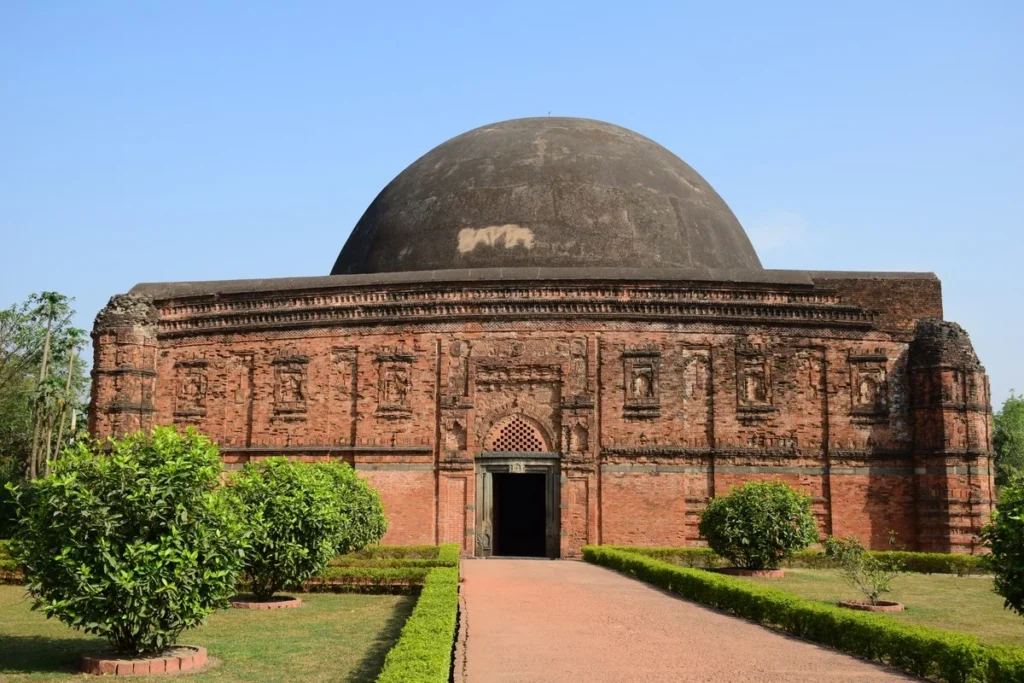
Image Source: Wikimedia
5. The Restored Ilyas Shahis and the Habshis (1433–93)
In simple words: The throne went back to a descendant of Ilyas Shah, Nasiruddin Mahmud Shah, and Bengal had half a century of stability and trade. It was then a land of poets, Sufis and builders. But the Sultans’ use of Abyssinian (Habshi) slave guards was dangerous: in 1487 a Habshi chief murdered the Sultan and took the throne. After six years of coups, a Sayyid minister named Husain ended Habshi rule and founded a new dynasty.
5.1 Restored Ilyas Shahi rulers (1433–87)
| Ruler | Years | Key facts |
|---|---|---|
| Nasiruddin Mahmud Shah I | 1435–59 | Claimed descent from Ilyas Shah; restored the line; capital shifted back to Gaur; patron of the saint-governor Khan Jahan Ali (Bagerhat) |
| Rukunuddin Barbak Shah | 1459–74 | Brought in about 8,000 Abyssinian slaves; gave Maladhar Basu the title Gunaraj Khan; built the Dakhil Darwaza |
| Shamsuddin Yusuf Shah | 1474–81 | Learned in Arabic and law; patron of Muslim Bengali poets such as Zainuddin (Rasul Vijay) |
| Sikandar II, Jalaluddin Fateh Shah | 1481–87 | Fateh Shah tried to curb the Habshi guards and was murdered |
- Gunaraj Khan: Maladhar Basu of Kulingram (Burdwan) wrote the Sri Krishna Vijaya (finished 1480), the first Bengali version of the Bhagavata Purana. Barbak Shah honoured him as Gunaraj Khan. → PYQ: WBCS Prelims 2024 | PYQ: WBCS Prelims 2003
- Gaur became the permanent capital from this reign. Its ruins lie on both sides of the present India–Bangladesh border, in Malda and Chapai Nawabganj.
5.2 The Habshi (Abyssinian) Sultans (1487–93)
- Shahzada Barbak (also called Shahzada), head of the palace guard, killed Fateh Shah in 1487 and became Sultan; he was himself murdered within months.
- Saifuddin Firuz Shah (1487–90), a former Habshi commander (Malik Indil), ruled well, gave charity and built the Firuz Minar at Gaur, a five-storey tower about 26 m high.
- Nasiruddin Mahmud Shah II (1490) and Shamsuddin Muzaffar Shah (1490–93), another Habshi, were tyrants. In 1493 the nobles rose, and Sayyid Husain, Muzaffar’s wazir, killed him and became Sultan. The new ruler expelled the Habshis from Bengal.
6. The Husain Shahi Dynasty: Bengal’s Golden Age (1493–1538)
In simple words: Alauddin Husain Shah was a Sayyid from Arabia who rose from a village schoolroom to the throne. He ended the chaos, made peace with Delhi, patronised Hindu poets and ministers, and let the great saint Sri Chaitanya preach freely. Bengali literature, Vaishnava devotion and Gaur’s architecture all peaked in his reign and that of his son Nusrat Shah. Hindus served as his wazir, treasurer and private secretaries. The Husain Shahis are remembered as the most tolerant dynasty of the Sultanate.
6.1 Alauddin Husain Shah (1493–1519)
- Founder of the Husain Shahi dynasty; contemporary of Sri Chaitanya. → PYQ: WBPSC Clerkship 2007 (2nd Shift) | PYQ: WBCS Prelims 2022 | PYQ: WBCS Prelims 2003
- Origin: son of Sayyid Ashraf of Tirmiz; he settled in Rarh and served the Habshi Sultans before becoming the wazir of Muzaffar Shah.
- Capital: Gaur, and the new city of Ekdala nearby. He is praised by Bengali poets as Nripati Tilaka (“Jewel among kings”) and Jagat Bhushan.
- Peace with Delhi: when the ruined Sultan Husain Shah Sharqi of Jaunpur took refuge in Bengal, Sikandar Lodi came to Bihar. A treaty (1495–99) kept Bengal’s border at Bihar and each side promised not to help the other’s enemies. → Provincial Kingdoms
- Expansion: he conquered Kamata (the Khen kingdom of Nilambar, about 1498), fought Odisha, held Chittagong against Arakan and pushed the border to Munger. His invasion of Assam was destroyed by the Ahoms. → Provincial Kingdoms
- Hindu officers: Purandar Khan (Gopinath Basu), his wazir; Keshab Chhatri; and the brothers Rup (private secretary, Dabir Khas) and Sanatan (Sakar Mallik), who later became Chaitanya’s disciples.
| Husain Shah and… | Fact |
|---|---|
| Chaitanya | Sultan’s contemporary; no persecution of the Vaishnavas |
| Mahabharata | His general Paragal Khan ordered Kavindra Parameshvara to translate it into Bengali. → PYQ: WBCS Prelims 2005 |
| Manasa-mangal | Vijay Gupta (1495) and Bipradas Pipilai (1495) praise him |
| Gaur | Chhota Sona Masjid and other mosques of the period |
6.2 Nasiruddin Nusrat Shah (1519–32)
- Husain Shah’s son; built the Bara Sona Masjid at Gaur (begun by his father, finished 1526) and the Qadam Rasul (1530–31). → PYQ: WBCS Mains 2022
- Treaties: he stayed neutral in Babur’s war with the Afghans and made a treaty with the Mughal (1529). He raided Tirhut and fought the Ahoms.
- Patron of literature: the Bengali Mahabharata by Kavindra and Srikara Nandi‘s Ashvamedha Parva were composed under the Sultan’s officers. His governor of Chittagong was Chhuti Khan (Paragal Khan’s son). → PYQ: PSC Prelims 2023
- Death: murdered in 1532 by a eunuch of the palace.
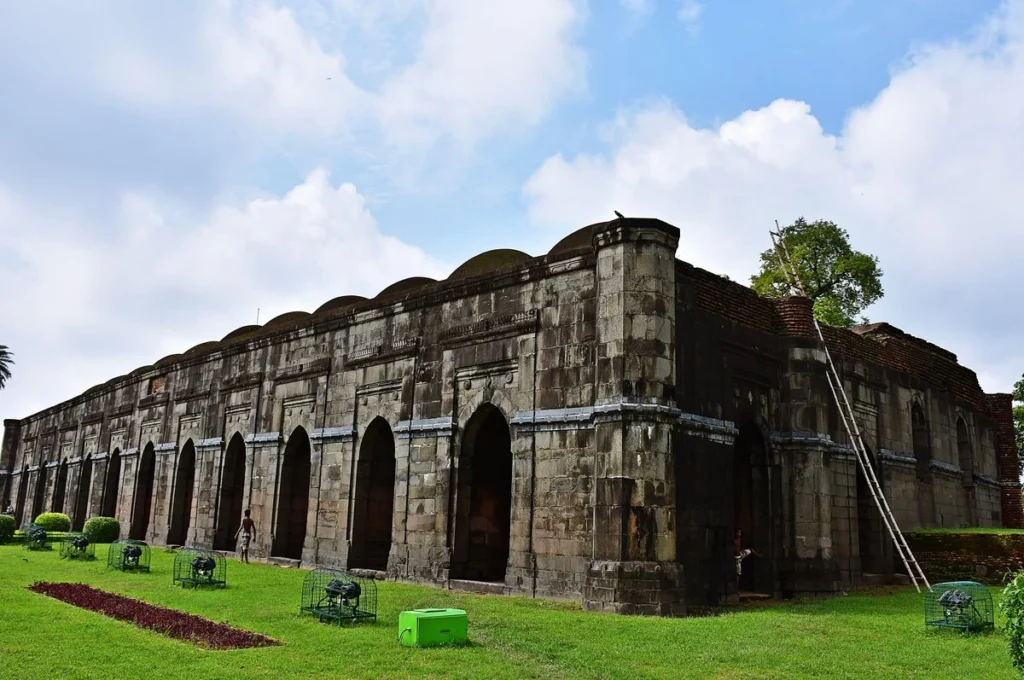
Image Source: Wikimedia
6.3 The last Sultans (1532–38)
- Alauddin Firuz Shah (1532–33), Nusrat’s son, was killed by his uncle Ghiyasuddin Mahmud Shah.
- Ghiyasuddin Mahmud Shah (1533–38) was the last independent Sultan of Bengal. → PYQ: WBCS Prelims 2011
- Sher Shah defeated the Bengal army at Surajgarh (1534), besieged Gaur and took it in 1538. Mahmud fled to Humayun, who entered Gaur and renamed it Jannatabad (“city of paradise”); Humayun’s army suffered from the climate, and he left for Agra after a few months. → Provincial Kingdoms
- Portuguese help: Mahmud allowed the Portuguese to set up trading posts at Chittagong and Satgaon (1536) in return for help against Sher Shah. → see §12.
6.4 Husain Shahi summary
| Ruler | Years | Key facts |
|---|---|---|
| Alauddin Husain Shah | 1493–1519 | Founder; Chaitanya’s contemporary; Kamata conquered; Hindu ministers |
| Nasiruddin Nusrat Shah | 1519–32 | Bara Sona Masjid, Qadam Rasul; treaty with Babur |
| Alauddin Firuz Shah | 1532–33 | Murdered by his uncle |
| Ghiyasuddin Mahmud Shah | 1533–38 | Last independent Sultan; defeated by Sher Shah |
7. Sher Shah, the Surs and the Karrani Afghans (1538–76)
In simple words: When Sher Shah took Gaur in 1538, Bengal lost its Sultans but kept its importance: it was the richest province of his empire and the eastern end of his great road. After the Surs weakened, a family of Afghan chiefs, the Karranis, took over Bengal. Their capital shifted to Tanda, and their last ruler, Daud Khan, lost the province to Akbar’s armies in 1576.
7.1 Sher Shah and Bengal (1538–45)
- Conquest: Sher Shah (Farid Khan, of the Sur clan) defeated Mahmud Shah’s army at Surajgarh (1534) and captured Gaur (1538). Humayun briefly held Gaur after Sher Shah left, but Sher Shah beat him at Chausa (1539) and Kanauj (1540). → PYQ: WBCS Prelims 2008
- Administration of Bengal: Sher Shah arrested the first governor, Khizr Khan, who had behaved like an independent king, and split Bengal into many small sarkars under Qazi Fazilat (Fazilat Khan) as chief officer. This broke the old pattern of one powerful governor. → Delhi Sultanate
- Sadak-i-Azam: he rebuilt the old highway (later the Grand Trunk Road) from Sonargaon in eastern Bengal to Peshawar, with rest houses (sarais) and wells. → PYQ: WBCS Prelims 2024 | PYQ: WBCS Mains 2022 | PYQ: WBCS Mains 2020
- Revenue: he introduced Kabuliyat (the peasant’s written promise to pay) and Patta (the state’s title deed to the peasant), and measured the land. His silver rupiya and copper dam replaced the older coins. → PYQ: WBCS Prelims 2020 | PYQ: WBCS Prelims 2024 | PYQ: WBCS Mains 2023 | PYQ: WBCS Prelims 2013
- Hindu officers: Sher Shah’s best-known Hindu general was Brahmajit Gaur, whom he sent in pursuit of Humayun after Chausa and Kanauj (1539–40). → PYQ: WBCS Prelims 2007 | PYQ: PSC Prelims 2010 | PYQ: PSC Prelims 2018
- Literature: Malik Muhammad Jayasi completed the Awadhi epic Padmavat in his reign (1540). → PYQ: WBCS Prelims 2024
- Death: he died on 22 May 1545 during the siege of Kalinjar, when a gunpowder shell exploded. → PYQ: WBCS Prelims 2001
7.2 Sur governors and the Bengal revolt (1545–64)
- After Islam Shah’s death (1553), Muhammad Khan Sur, governor of Bengal, declared himself Sultan Shamsuddin Muhammad Shah Ghazi and ruled an independent Bengal until he was killed in battle against the Delhi Sur claimant in 1555.
- His son Khizr Khan (Bahadur Shah, 1555–60) and brother Ghiyasuddin Jalal Shah (1561–63) ruled until the Karranis seized the province.
7.3 The Karrani Afghans (1564–76)
- Taj Khan Karrani and his brother Sulaiman Khan Karrani (1565–72) took Bengal and Bihar. Sulaiman moved the capital from the plague-ridden Gaur to Tanda (1565) and sent his general Kalapahar to conquer Odisha (1568), ending the Hindu kingdom of Mukunda Deva. He accepted Akbar’s name on his coins but kept his own army. → Provincial Kingdoms
- Bayazid Karrani was killed in 1572 and his brother Daud Khan Karrani (1572–76) became ruler.
- Daud’s revolt: proud of an army of 40,000 horse and 140,000 foot, Daud declared independence and attacked the Mughal fort of Zamania and the Bihar towns. Akbar led the war in person in 1574 and took Patna and Hajipur; Munim Khan (Khan-i-Khanan) and Todar Mal were sent to Bengal. Daud was forced to give up Tanda.
- Tukaroi (Mughalmari), 3 March 1575: Daud was defeated near Balasore, and signed the Treaty of Katak (Cuttack) (April 1575), keeping only Odisha. Munim Khan then moved to Gaur, where plague killed thousands, including Munim Khan himself (October 1575).
- Rajmahal, 12 July 1576: Daud revolted again, lost the battle of Rajmahal and was beheaded. Bengal became a Mughal province.
8. The Mughal Conquest of Bengal and the Bengal Subah
In simple words: The Afghans’ defeat in 1576 put Bengal under Akbar, but it took 36 more years to control the delta. Some Afghan chiefs and the Baro-Bhuiyans kept fighting from the rivers and marshes of the east, where horses and big armies were useless. The Mughals first built a base at Tanda, then moved the capital to Rajmahal (1595) and finally to Dhaka (1610), which brought the whole delta under control.
8.1 Akbar’s Bengal (1576–1605)
- Khan Jahan Quli (1575–78) was the first Mughal governor, followed by Muzaffar Khan Turbati and Raja Todar Mal. In 1580 Akbar organised the empire into twelve subahs, and Bengal (Subah Bangalah) was one.
- Revolt of 1580–81: Mughal officers in Bengal and Bihar (the Qaqshals and the Turkish and Chagatai nobles) rebelled against Akbar’s new revenue and branding (dagh) rules, and the Afghan chiefs joined them. Todar Mal and Shahbaz Khan Kamboh restored order.
- Man Singh (Raja Man Singh of Amber), governor 1594–1606: shifted the capital from Tanda to Rajmahal in 1595 and renamed it Akbarnagar; defeated the Afghans in Odisha and made terms with Isa Khan. → Provincial Kingdoms
- Revenue: the Ain-i-Akbari lists Subah Bangalah with 19 sarkars; Bengal paid large revenue and sent rice, silk and cotton cloth to the empire.
8.2 The Mughal wars with the Bhuiyans (summary)
| Year | Event |
|---|---|
| 1584–86 | Shahbaz Khan fights Isa Khan and the Bhati chiefs |
| 1594–97 | Man Singh beats Isa Khan’s forces and makes terms |
| 1599 | Isa Khan dies; Musa Khan leads the Bhuiyans |
| 1603–04 | Kedar Rai of Bikrampur is defeated by Man Singh |
| 1608 | Islam Khan Chishti becomes governor |
| 1610 | Capital moves to Dhaka (Jahangirnagar) |
| 1611 | Musa Khan and Pratapaditya surrender |
| 1612 | Usman Khan Lohani is killed at Daulatpur |
| 1613 | Kamrup (Koch Hajo) is annexed |
9. The Baro-Bhuiyans and Mughal Subjugation
In simple words: Bhuiyan means a landlord of the soil. Baro means “many” (it is also the number twelve). The Baro-Bhuiyans were a loose group of chiefs of the eastern Bengal delta, Hindu and Muslim, who ruled their river-fortresses as petty kings in the years when the Sultanate had fallen and the Mughals had not yet arrived. Their leader was Isa Khan and his son Musa Khan. The Mughals finally crushed them under Islam Khan (1608–13). This is the chapter’s last big topic and a regular question in WBCS.
9.1 Who were the Baro-Bhuiyans?
- Region: the Bhati country, the low, marshy delta of eastern and southern Bengal, criss-crossed by the Padma, Meghna and Brahmaputra, where boats, not cavalry, decided wars.
- Mix: some were Hindu landlords (Pratapaditya, Kedar Rai, Chand Rai, Ramchandra Roy, Satrajit), others Afghan (Usman Khan, Masum Khan Kabuli) and others converts (Isa Khan).
- Number: “Baro” does not mean exactly twelve. Different sources list different chiefs. What matters for exams is who led (Isa Khan, Musa Khan) and who fell (Pratapaditya, Kedar Rai).
- Sources: the Baharistan-i-Ghaibi of Mirza Nathan, a Mughal officer of Islam Khan’s time; the Akbarnama and Ain-i-Akbari; and later Bengali ballads.
9.2 The leading Bhuiyans
| Bhuiyan | Seat | Key facts |
|---|---|---|
| Isa Khan (died 1599) | Khizrpur, Sonargaon, Katrabo | Leader of the Baro-Bhuiyans; titled Masnad-i-Ala; fought Shahbaz Khan and Man Singh; a skilled river-warfare commander; ruled the Bhati region |
| Musa Khan (1599–1611) | Sonargaon, Khizrpur, Dakchara | Son of Isa Khan; led the last united resistance; surrendered to Islam Khan in 1611 and later served the Mughals |
| Pratapaditya | Jessore (Yashohar), Dhumghat | Son of Vikramaditya; strongest Hindu chief of south-west Bengal; built forts and a navy; surrendered to Islam Khan (1611–12) and died as a prisoner on the way to Delhi |
| Kedar Rai and Chand Rai | Bikrampur and Sripur | Brothers who held the central delta; defeated by Man Singh (c. 1603–04) |
| Ramchandra Roy | Bakla (Chandradwip) | Southern delta chief |
| Satrajit | Bhushna | Hindu chief of the Faridpur–Jessore country; overthrown by the Mughals (1611) |
| Usman Khan Lohani | Bokainagar (Mymensingh) | Afghan leader; killed at Daulatpur (1612) |
| Lakshman Manikya | Bhulua (Noakhali) | Hindu chief of the south-east |
9.3 Isa Khan (died 1599)
- Rise: a Rajput by birth, his father Kalidas Gazdani became a Muslim as Sulaiman Khan. Isa Khan rose to power around Sonargaon and by the 1570s ruled the Bhati region.
- Wars: he resisted Shahbaz Khan (1584–86) and then Man Singh (1594–97). In both he used war-boats on the broad rivers and the Mughals could not trap him. He was recognised by the Mughals as zamindar of Bhati and got the title Masnad-i-Ala (“the exalted throne”).
- Memory: Mughal writers call him “the Marzban of Bhati”. His descendants held the delta for years.
9.4 Pratapaditya and Kedar Rai
- Pratapaditya built forts at Dhumghat (Ishwaripur) near the Sundarbans and a navy of war-boats; he used Portuguese gunners. Islam Khan sent Mirza Nathan and others against him in 1611–12. Pratapaditya surrendered, and was sent to Delhi as a prisoner, dying at Banaras on the way. Later Bengali plays and ballads turned him into a hero of Bengal.
- Kedar Rai of Bikrampur also used Portuguese and Magh pirates and fought the Mughal general Man Singh. Kedar Rai died fighting around 1603–04.
9.5 Islam Khan Chishti and the final subjugation (1608–13)
- Islam Khan Chishti was Jahangir’s governor of Bengal (1608–13), a grandson of the Chishti saint Salim Chishti of Fatehpur Sikri.
- Capital to Dhaka (1610): he moved the Subah capital from Rajmahal to Dhaka, which he named Jahangirnagar, to command the delta from its centre. Dhaka remained the capital for more than a century.
- Strategy: he built a fleet under Ihtimam Khan, advanced step by step with fortified river camps, and used both force and treaties. Musa Khan and the Bhuiyans were broken at Dakchara and surrendered (1611); Pratapaditya and Satrajit were overthrown; Usman Khan Lohani died at Daulatpur (1612).
- Kamrup: in 1613, the Mughals took Koch Hajo (Kamrup), extending Bengal’s borders to the Ahom frontier. → Provincial Kingdoms
- After Islam Khan: Bengal became a regular Mughal Subah ruled from Dhaka. The governors Qasim Khan Chishti, Ibrahim Khan Fath-i-Jang, Shah Shuja and Shaista Khan continued it; Shaista Khan took Chittagong from the Arakanese in 1666. The capital finally moved to Murshidabad under Murshid Quli Khan (1717).
10. The Capitals of Medieval Bengal
In simple words: Bengal’s capital kept moving. Rivers changed course, plagues hit, and each new dynasty wanted a new seat. A good memory trick is to link each capital to a ruler: Gaur to Bakhtiyar and the Husain Shahis, Pandua to Ilyas Shah, Sonargaon to Fakhruddin and Isa Khan, Tanda to Sulaiman Karrani, Rajmahal to Man Singh and Dhaka to Islam Khan.
| Capital | Period | Rulers and facts |
|---|---|---|
| Lakhnauti / Gaur | 1204–1342 (governors); 1450–1565 (Sultans) | Bakhtiyar Khalji’s capital; Husain Shahi capital; Humayun called it Jannatabad (1538); abandoned after the plague of 1575; ruins in Malda and Chapai Nawabganj |
| Pandua (Firuzabad) | 1342–1450 | Ilyas Shahi capital; Adina Mosque, Eklakhi Mausoleum, shrine of Nur Qutb Alam |
| Ekdala | 14th–16th c. | Island fort near Pandua; besieged by Firoz Tughlaq (1353 and 1359); used by Husain Shah |
| Sonargaon | 13th–16th c. | Fakhruddin Mubarak Shah; eastern capital; Isa Khan; muslin centre; Ibn Battuta came in 1346 |
| Satgaon (Saptagram) | 13th–16th c. | Port and provincial capital; later silted up; replaced by Hugli |
| Tanda | 1565–95 | Sulaiman Karrani’s capital; first Mughal capital |
| Rajmahal (Akbarnagar) | 1595–1610 | Founded by Man Singh |
| Dhaka (Jahangirnagar) | 1610–1717 | Islam Khan’s capital; Shaista Khan (1664–88) |
- Why Gaur was given up: the Ganga shifted away from the city, bringing malaria; plague killed many in 1575.
- Name of Gaur: the older Sanskrit name Gauda was the kingdom of Sasanka. → Ancient Bengal
11. Administration of Medieval Bengal
In simple words: The Bengal Sultans copied Delhi’s offices but ran them in their own way. The Sultan was the head of state, army and justice, with ministers and a qazi to help. Hindu landlords and clerks did the day-to-day work in the villages. Under the Mughals the old divisions were replaced by the subah, sarkar and mahal, with governors appointed from Delhi.
11.1 The Sultanate (1342–1538)
- Sultan: absolute ruler; named in the khutba and on the coins; chose his successor by war.
- Central officers: the wazir (chief minister), the mir bakhshi (army), the qazi (justice) and the dabir khas (private secretary).
- Provinces: the kingdom was divided into iqlims (Lakhnauti, Satgaon, Sonargaon) under governors called muqtas, later split into smaller districts called arsas and shiqs.
- Army: infantry, boats and war elephants matter more than cavalry. The Paiks (foot soldiers) were recruited from local Hindus; the Habshis served as palace guards until Husain Shah expelled them.
- Hindu officers: Husain Shah’s Gopinath Basu (wazir), Rup and Sanatan (secretaries), Keshab Chhatri and the poet Maladhar Basu show how Hindus held posts of trust. → PYQ: WBCS Prelims 2024
- Local rule: Hindu zamindars and village headmen collected the revenue and kept the peace; Bengal’s Muslim rulers rarely interfered with village life.
- Hereditary titles: the Sultans gave Hindu officers Muslim titles (Gunaraj Khan, Purandar Khan, Sakar Mallik), which became family names for later generations.
11.2 Sher Shah and the Surs
- Sher Shah broke up Bengal into sarkars, each under a shiqdar (police and military) and an amin (revenue officer); the whole province was under Qazi Fazilat.
- Sadak-i-Azam (Sonargaon to Peshawar), sarais, a postal service and the Kabuliyat and Patta system gave Bengal a role in a single empire. → §7.1
11.3 The Mughal Bengal Subah
- Subahdar (governor, also nazim), Diwan (finance, appointed from Delhi), Bakhshi, Sadr, Qazi and Kotwal.
- Subah → sarkar (19 in Bengal) → mahal (pargana). Zamindars collected revenue and kept the local peace. Todar Mal’s revenue settlement (1582) fixed the assessment of Bengal. → PYQ: WBCS Prelims 2012
- Mansabdars ruled the provincial army, with a naval fleet (the nawwara) built by Islam Khan at Dhaka.
12. Economy, Trade and the Portuguese
In simple words: Bengal was the “granary and workshop” of India. Rice, sugar, silk and fine cotton cloth were sold from its rivers to China, Burma, the Maldives, Arabia and later Europe. Its ports Satgaon and Chittagong drew merchants from all over Asia. The Portuguese reached Chittagong in 1517 and changed the sea trade, but within a century the Mughals pushed them out.
12.1 Agriculture and crafts
- Crops: rice (several harvests a year), sugar cane, betel nut and leaf, cotton and mulberry silk. Ibn Battuta wrote that rice and food were cheaper in Bengal than anywhere he had seen.
- Textiles: the fine cotton cloth of Sonargaon (muslin) and the silks of Kasimbazar and Malda were famous worldwide. Chinese visitors such as Ma Huan praised the fine cloths of “Pang-ko-la”.
- Shipbuilding: Chittagong built sea-going boats; Bengal’s rivers carried huge trade by boat.
- Land and people: most Bengali farmers were Hindus and low-caste converts. Muslim pirs cleared the forests in the east and became local leaders, which helped Islam spread among the peasantry.
12.2 Ports and routes
- Satgaon (Saptagram) on the Saraswati river was the main port of western Bengal, known to Europeans as Porto Pequeno (the “little port”); when the Saraswati silted, Hugli took over its trade.
- Chittagong (Porto Grande, the “great port”) in the south-east.
- Sonargaon was the hub of inland river trade.
- Imports: horses from Central Asia and Arabia, cowrie shells from the Maldives (used as small money), spices, gold and silver, and Chinese goods. Exports: rice, sugar, silk, muslin, ginger and saltpetre.
- Overseas links: China (Ming embassies), Southeast Asia (Malacca, Burma), the Maldives and the Red Sea. → Foreign Travellers in India | Ancient Economy, Society and Coinage
12.3 Foreign accounts of Bengal
| Visitor | Year | What he said |
|---|---|---|
| Ibn Battuta | 1346 | Bengal “a hell crammed with good things”; saw Sylhet and Sonargaon |
| Ma Huan and Fei Xin | 15th c. | Chinese envoys; described Bengal’s cities, cloth and coins |
| Ludovico di Varthema | 1503 | Bengal’s trade with Malacca and rich cotton and silk cloth |
| Duarte Barbosa | c. 1514 | Described the ports and the wealth of “Bengala” |
| Ralph Fitch | 1580s | English traveller; described Satgaon and Sonargaon |
12.4 The Portuguese in Bengal
- 1517: the Portuguese first reached Chittagong. They built trading posts at Chittagong and Satgaon in the time of Ghiyasuddin Mahmud Shah (1536) and helped him against Sher Shah.
- Hugli (1579–80): with Akbar’s permission, they settled at Hugli, which became the main port. They also built their own fort, collected customs and kidnapped Bengalis for the slave trade.
- Piracy: Portuguese and Magh (Arakanese) pirates raided the delta, which is why Pratapaditya and Kedar Rai hired Portuguese gunners.
- Shah Jahan’s order: in 1632, the Mughal governor Qasim Khan laid siege to Hugli and expelled the Portuguese. → PYQ: WBCS Prelims 2013 | PYQ: WBCS Mains 2015 | PYQ: WBCS Mains 2015
- Why it matters: the fall of Hugli opened the way for the Dutch, Danish, French and English who followed. → WBCS Mains Advent of Europeans PYQs
13. Coins of Medieval Bengal
In simple words: Bengal’s Sultans issued their own silver coins from the day Ilyas Shah became independent. The coins tell us who ruled, when, and from which city. In everyday life cowrie shells worked as small change.
- Main coin: the silver tanka, with Arabic legends naming the Sultan, his titles and the year (in the Hijri era) and the mint town.
- Ilyas Shah and his successors issued silver tankas; Ghiyasuddin Azam Shah’s coins carry his full royal titles.
- Raja Ganesha’s coins show the legend Chandi-charana-parayana and the title Danujamardana Deva in Bengali script; Jalaluddin’s coins proclaim the title Khalifat Allah.
- Husain Shah’s coins bear his name, his father’s name (Sayyid Ashraf) and titles and are found in great numbers, a sign of Bengal’s wealth.
- Mints: Firuzabad (Pandua), Satgaon, Sonargaon, Fathabad, Muazzamabad, Mahmudabad, Khalifatabad and Husainabad.
- Cowries (kauri), imported from the Maldives, were used for small purchases; a rupee could buy thousands of cowries.
- Sur and Mughal coinage: Sher Shah’s silver rupiya and copper dam; the Mughals later struck rupees at Dhaka, Akbarnagar and Tanda.
14. Architecture of the Bengal Sultanate
In simple words: Bengal is a land of mud, bamboo and brick, with very little building stone. The Sultans therefore built in brick, decorated with terracotta, and copied the curved roofs of Bengali huts in their mosques and tombs. They also reused old stone pillars from Hindu and Buddhist buildings at Gaur and Pandua. The result is a style found nowhere else in India: low, many-domed, hut-roofed mosques with rich carving and very few minarets.
14.1 Features of the Bengal style
- Material: brick (with stone from older temples at Gaur and Pandua) and glazed tiles.
- Curved cornice: the roof edge curves downwards like the do-chala (two-sloped) thatched hut. The same chala roof later gave Bengal’s char-chala, at-chala and ratna temples.
- Many small domes: mosques are covered by rows of small domes on pendentives rather than one large dome.
- Terracotta: baked clay plaques with floral, geometric and sometimes human forms decorate the walls. Bengali potters supplied them.
- Minarets: few or none, except tall towers like the Firuz Minar.
- Hindu craft: local masons carved stone and brick in familiar Bengali patterns: lotuses, chains and bells.
14.2 Pandua monuments (Ilyas Shahi and Ganesha’s family)
| Monument | Builder and date | Notes |
|---|---|---|
| Adina Mosque | Sikandar Shah, 1373–75 | Largest mosque in the subcontinent; Damascus-inspired plan; reused Hindu stone |
| Eklakhi Mausoleum | Jalaluddin Muhammad Shah, c. 1425 | Single-domed square brick tomb; terracotta; curved cornice |
| Shrine of Nur Qutb Alam | 15th c. | Chishti Sufi shrine at Pandua |
| Ekdala fort | 14th c. | Island fort where Firoz Tughlaq was held (1353, 1359) |
→ PYQ: WBCS Prelims 2023 | PYQ: WBPSC Clerkship 2009 (1st Shift)
14.3 Gaur monuments (Husain Shahi and earlier)
| Monument | Builder and date | Notes |
|---|---|---|
| Dakhil Darwaza | Barbak Shah, c. 1460–74 | Ceremonial gate of the citadel; brick, with two bastion towers and turrets |
| Firuz Minar | Saifuddin Firuz Shah, c. 1487–90 | Five-storey tower, about 26 m high |
| Chamkati and Lotan mosques | late 15th c. | Glazed-tile decoration |
| Chhota Sona Masjid (Small Golden Mosque) | Wali Muhammad, under Husain Shah (1493–1519) | Fifteen domes, once gilded; stone-faced walls |
| Bara Sona Masjid (Great Golden Mosque; also Baroduari) | Alauddin Husain Shah, completed by Nusrat Shah, 1526 | Twelve-doored; one of the biggest mosques of Gaur |
| Qadam Rasul | Nusrat Shah, 1530–31 | Shrine for a stone with the Prophet’s footprint |
- Bara Sona Masjid: correct pair Gaur — Bara Sona Masjid; built by Nusrat Shah. → PYQ: WBCS Mains 2022 | PYQ: WBCS Prelims 2022
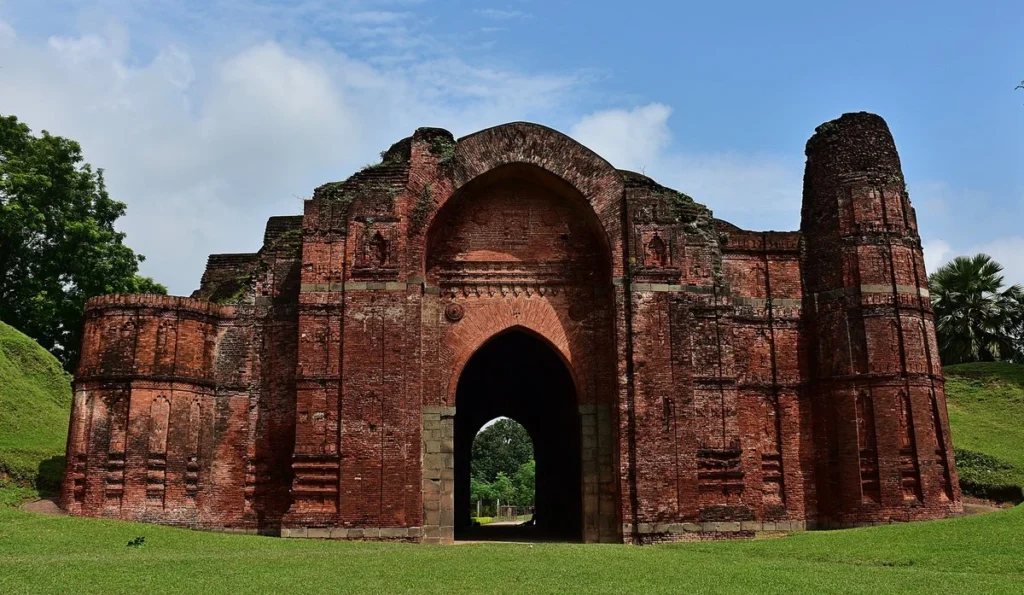
Image Source: Wikimedia
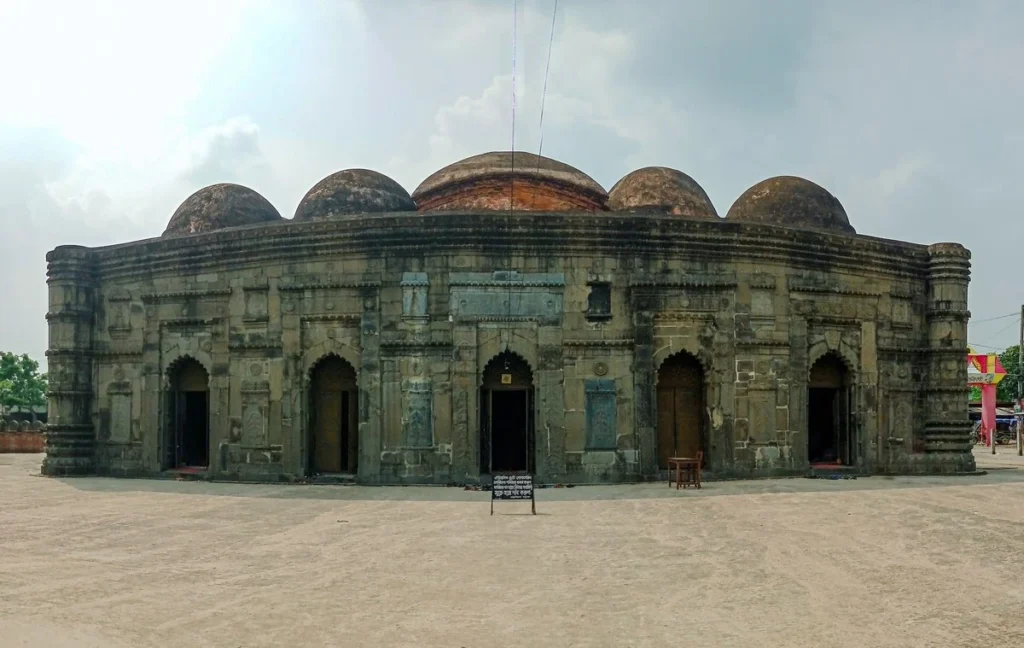
Image Source: Wikimedia
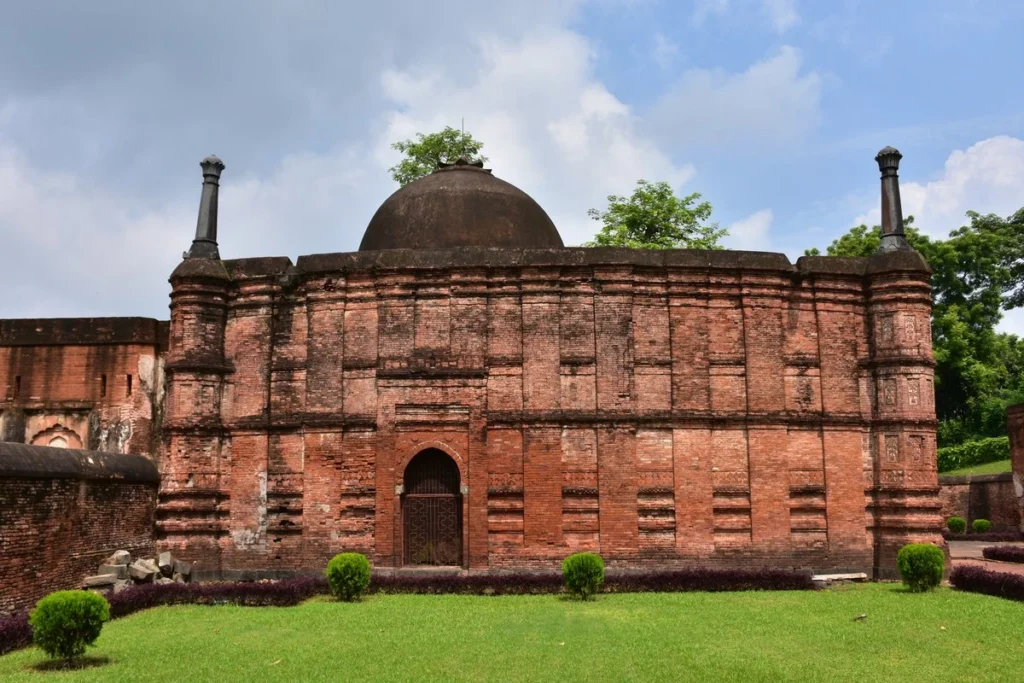
Image Source: Wikimedia
14.4 Terracotta temples and the do-chala roof
- Hindu temples in Bengal took the same hut roofs: do-chala, char-chala, at-chala and ratna (pinnacled) types. The great terracotta temples of Bishnupur (Bankura) were built by the Malla kings in the 17th century.
- Jor-Bangla temple (Keshta Rai, 1655): two do-chala huts joined to a pinnacled roof, with terracotta panels showing scenes from the Ramayana, Mahabharata and daily life.
- Why terracotta: Bengal’s soil gives excellent clay but no building stone. → PYQ: WBCS Mains 2023 (West Bengal Geography) | PYQ: WBCS Mains 2023 (West Bengal Geography)
- The Sultanate style and the Malla temples are two branches of the same Bengali building tradition.
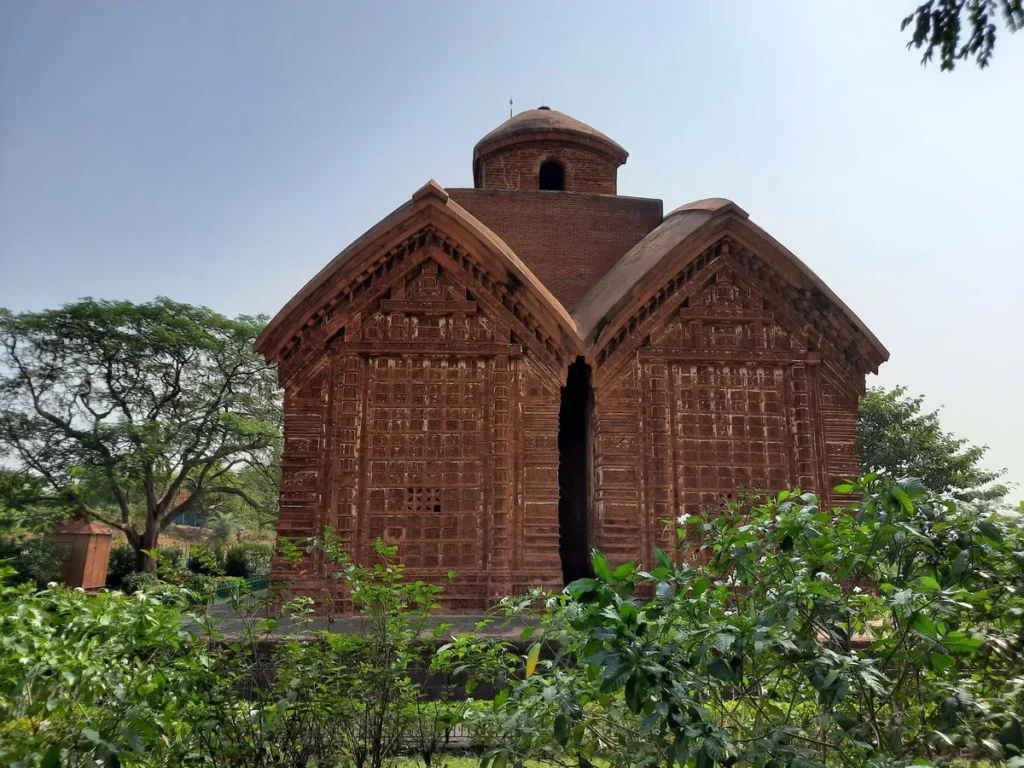
Image Source: Wikimedia
15. Bengali Literature under the Sultans
In simple words: Before 1200 Bengal’s court language was Sanskrit. Under the Sultans, Persian became the language of government, but Bengali poets found patrons in the new courts. For the first time in history, rulers asked for the Hindu epics to be put into Bengali. This was the real beginning of Bengali literature as we know it.
15.1 Poets and their patrons
| Poet / work | Patron or period | Notes |
|---|---|---|
| Krittivas Ojha, Sri Rama Panchali | Gaur’s king, 15th c. | Bengali Ramayana from Valmiki; popular in every village |
| Maladhar Basu, Sri Krishna Vijaya | Barbak Shah, finished 1480 | First Bengali Bhagavata; title Gunaraj Khan. → PYQ: WBCS Prelims 2024 | PYQ: WBCS Prelims 2003 |
| Kavindra Parameshvara | Paragal Khan, Husain Shah’s general | Mahabharata in Bengali. → PYQ: WBCS Prelims 2005 |
| Srikara Nandi | Chhuti Khan, governor of Chittagong, son of Paragal Khan | Ashvamedha Parva. → PYQ: PSC Prelims 2023 |
| Shah Muhammad Sagir, Yusuf-Zulekha | Azam Shah | First Bengali romance by a Muslim poet |
| Zainuddin, Rasul Vijay | Yusuf Shah | Life of the Prophet in Bengali |
| Vijay Gupta and Bipradas Pipilai | Husain Shah, 1495 | Manasa-mangal poems |
| Mukundaram Chakravarti (Kabikankan) | Late 16th c. | Chandi-mangal. → PYQ: WBCS Mains 2022 |
15.2 Mangal-kavya
- Mangal-kavya are narrative poems in praise of local gods and goddesses; they show how folk and Brahmanical worship mixed in Bengal.
- Manasa-mangal: the snake goddess Manasa and the merchant Chand Sadagar (Vijay Gupta, Bipradas, Ketakadas Kshemananda).
- Chandi-mangal: the goddess Chandi, the hunter Kalaketu and his wife Phullara, and the merchant Dhanapati (Mukundaram‘s version is the best-known).
- Dharma-mangal: the god Dharma and the hero Lausen (Ghanaram Chakravarti, 18th c.).
- Annada-mangal: Bharatchandra (1752), at the court of Krishnachandra of Nadia.
15.3 Vidyapati and Chandidas
- Vidyapati (14th–15th c.) was a Maithili poet of Mithila (Bihar). His love songs of Radha and Krishna spread to Bengal and shaped the Vaishnava padavali and the artificial literary language Brajabuli.
- Chandidas: the poet of the Sri Krishna Kirtan (found in 1909 at Bankura) and many padas on Radha and Krishna, sung by Chaitanya himself.
- Jayadeva’s Sanskrit Gita Govinda, written at the court of Lakshmana Sena, is the great poem on Krishna’s love for Radha that inspired both. → PYQ: WBCS Mains 2017 | PYQ: PSC Prelims 2007 | Ancient Bengal
15.4 Language and script
- Bengali separated from Magadhi Prakrit by the 10th century (the Charyapada). Under the Sultans, it grew from a language of folk verse into a literary one. → Ancient Bengal
- Persian was the official language, and Arabic the language of religion; Bengali served the people.
16. Chaitanya and the Vaishnava Movement
In simple words: In 1486 a boy named Nimai was born in Nabadwip (Nadia). As the saint Sri Chaitanya, he made Krishna-devotion, singing and dancing in the streets a mass movement. Alauddin Husain Shah was Bengal’s ruler then, and he did not stop it. The movement gave Bengal a deep religious literature and thousands of devotees in every village.
16.1 Chaitanya (1486–1533)
- Born at Nabadwip (1486); taught by Gangadas; took sannyasa from Keshab Bharati in 1510 with the name Sri Krishna Chaitanya; spent his last years at Puri, in the kingdom of Prataparudra Gajapati. → Provincial Kingdoms
- Contemporary ruler: Alauddin Husain Shah. → PYQ: WBCS Prelims 2022 | PYQ: WBCS Prelims 2003
- Hindus and Muslims as followers: he accepted disciples of both faiths, including Haridas Thakur, a Muslim-born saint. → PYQ: WBCS Prelims 2007 | PYQ: WBCS Prelims 2000
- Chand Kazi: the city qazi of Nabadwip once broke the drums of a Kirtan party; Chaitanya led a huge peaceful procession to his house and won him over. The Sultan’s government left the Vaishnavas alone.
- Teaching: devotion (bhakti) to Krishna, public kirtan (hymn singing) and Achintya-Bhedabheda (“inconceivable oneness and difference”).
- Disciples: Nityananda and Advaita in Bengal; the Six Goswamis (Rup, Sanatan, Jiva, Gopala Bhatta, Raghunath Das and Raghunath Bhatta) settled at Vrindavan. Rup and Sanatan had held high posts at Husain Shah’s court.
16.2 Vaishnava literature
- Chaitanya Bhagavata by Vrindavan Das (mid-16th c.).
- Chaitanya Charitamrita by Krishnadas Kaviraj (c. 1615), the standard Chaitanya biography.
- Chaitanya Mangala by Jayananda and Lochan Das.
- Padavali (Vaishnava lyrics) by Govindadas, Jnanadas and others, following Vidyapati and Chandidas.
17. Sufis, Pirs and Religious Life in Medieval Bengal
In simple words: Islam spread in Bengal more by Sufi saints than by armies. They settled in the forests of the east, cleared land, built mosques and shrines (dargahs) and taught in simple language. Their tombs became places of prayer for both Muslims and Hindus. Many local saints, such as Satya Pir, mixed Hindu and Muslim stories in the same cult.
17.1 The major Sufi saints of Bengal
| Saint | Order and place | Facts |
|---|---|---|
| Shaikh Jalaluddin Tabrizi | Suhrawardi, Pandua (13th c.) | Early Suhrawardi saint of Bengal (13th c.); his shrine is at Deva-tala |
| Shah Jalal | Sylhet | Helped conquer Sylhet (1303); Ibn Battuta met him in 1346 |
| Akhi Siraj Aina-i-Hind (died 1357) | Chishti, Gaur | Disciple of Nizamuddin Auliya of Delhi; adviser of Ilyas Shah |
| Ala-ul-Haq (died 1398) | Chishti, Pandua | Akhi Siraj’s pupil; ran a large free kitchen (langar) |
| Nur Qutb Alam (died c. 1415) | Chishti, Pandua | Invited the Sharqi Sultan against Raja Ganesha |
| Khan Jahan Ali (died 1459) | Khalifatabad (Bagerhat) | Saint-governor of the Sundarbans; built the Sixty Dome Mosque |
| Shah Sultan Mahisawar | Mahasthan (Bogra) | One of the earliest saints |
- Sufi orders in India were called silsilahs (chains of teachers). → PYQ: WBCS Mains 2022
- The Qadri order was founded by Shaikh Abdul Qadir Jilani of Baghdad; Shah Niamatullah Qadri is its best-known Indian saint. → PYQ: WBCS Mains 2022
- Auliya (saints) are not themselves an order. → PYQ: WBCS Mains 2022 | Religious Movements
17.2 Khan Jahan Ali and the Sixty Dome Mosque
- Khan Jahan Ali (Ulugh Khan Jahan) received the forest lands of the Sundarbans (the Jessore-Khulna region) from Nasiruddin Mahmud Shah, founded Khalifatabad (now Bagerhat) and built mosques, roads and tanks. He died in 1459.
- Sixty Dome Mosque (Shat Gombuj): a large brick mosque with 77 domes on 60 pillars (shat = sixty) at Bagerhat, in modern Bangladesh. It is a UNESCO World Heritage Site (1985).
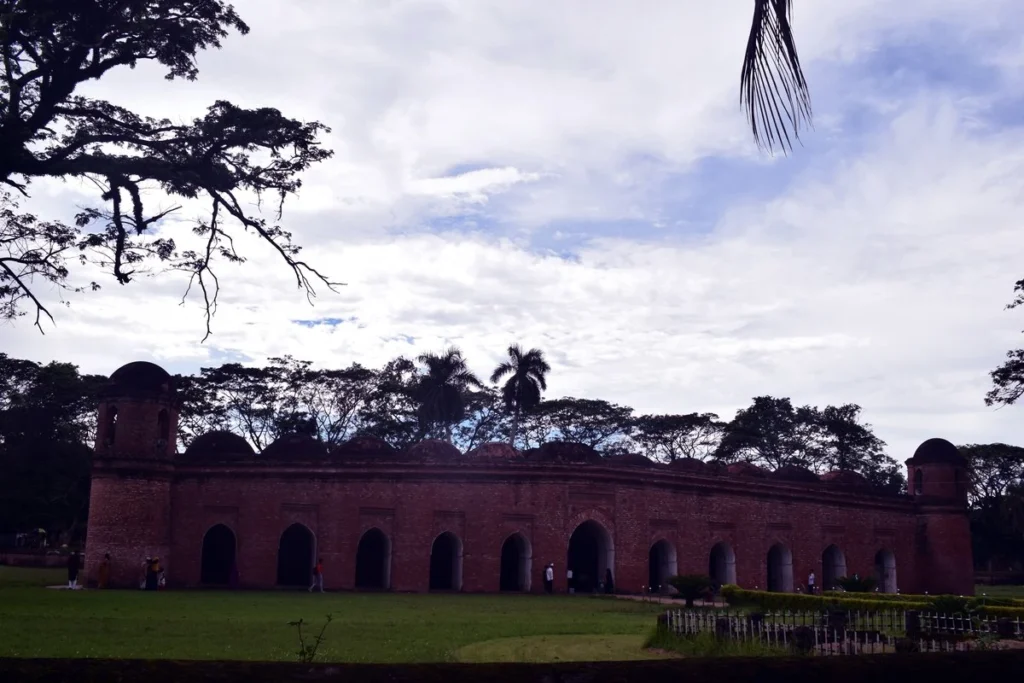
Image Source: Wikimedia
17.3 Pirs and syncretic cults
- Satya Pir, Manik Pir and Ghazi Pir were saints worshipped by both Hindus and Muslims, a sign of Bengal’s blended faith.
- Bonbibi is the forest goddess of the Sundarbans whom both communities worship.
- Bhakti–Sufi exchange: Chaitanya’s disciple Haridas, the Baul songs and the later Sahajiya poets belong to the same stream of devotion. → Religious Movements
18. Sources for Medieval Bengal
In simple words: Our knowledge of medieval Bengal comes from four kinds of source: Persian chronicles, foreign travellers, Bengali poems and the Sultans’ own coins and building inscriptions.
| Type | Source | What it gives |
|---|---|---|
| Persian chronicles | Tabaqat-i-Nasiri (Minhaj-us-Siraj) | Bakhtiyar’s conquest and early governors |
| Tarikh-i-Firuz Shahi (Barani, Afif) | Balban’s campaign; Firoz Tughlaq’s invasions | |
| Akbarnama and Ain-i-Akbari (Abul Fazl) | Karrani wars; Mughal conquest; Bengal’s 19 sarkars | |
| Baharistan-i-Ghaibi (Mirza Nathan) | Islam Khan’s wars with the Bhuiyans | |
| Travellers | Ibn Battuta; Ma Huan, Fei Xin; Varthema; Barbosa; Ralph Fitch | Society, trade, prices, cities |
| Literature | Bengali Mangal-kavya, translations, Vaishnava biographies | Religion, society, patronage |
| Archaeology | Coins, inscriptions (in Arabic and Persian), mosques, tombs | Dates, titles, mints |
19. Do Not Confuse
In simple words: Many names and facts in this chapter look alike. Learn these pairs to avoid the traps that WBCS sets.
| Do not confuse | Fact A | Fact B |
|---|---|---|
| Bakhtiyar Khalji vs Bakhtiyar Kaki | Conqueror of Bengal | Chishti saint of Delhi |
| Ilyas Shah vs Husain Shah | Founder of the independent Sultanate (1342) | Founder of the Husain Shahi dynasty (1493) |
| Adina Mosque vs Atala Masjid | Pandua, Sikandar Shah (1373–75) | Jaunpur, Ibrahim Sharqi (1408) |
| Adina vs Eklakhi | Big mosque of Sikandar Shah | Tomb of Jalaluddin Muhammad Shah |
| Bara Sona vs Chhota Sona | Nusrat Shah, 1526 | Wali Muhammad, under Husain Shah |
| Firuz Minar vs Dakhil Darwaza | Tower of Saifuddin Firuz Shah | Gate of Barbak Shah |
| Sikandar Shah (Bengal) vs Sikandar Lodi vs Sikandar Butshikan | Built Adina Mosque | Founded Agra (1504) / Idol-breaker of Kashmir |
| Husain Shah of Bengal vs Husain Shah Sharqi | Alauddin Husain Shah, Chaitanya’s contemporary | Last Sharqi Sultan of Jaunpur |
| Jahangirnagar vs Akbarnagar | Dhaka, Islam Khan, 1610 | Rajmahal, Man Singh, 1595 |
| Sonargaon vs Satgaon | East, Fakhruddin, Isa Khan, muslin | West, port, Porto Pequeno |
| Habshi vs Sayyid Husain | Abyssinian guards (1487–93) | Wazir who expelled them and founded the Husain Shahis |
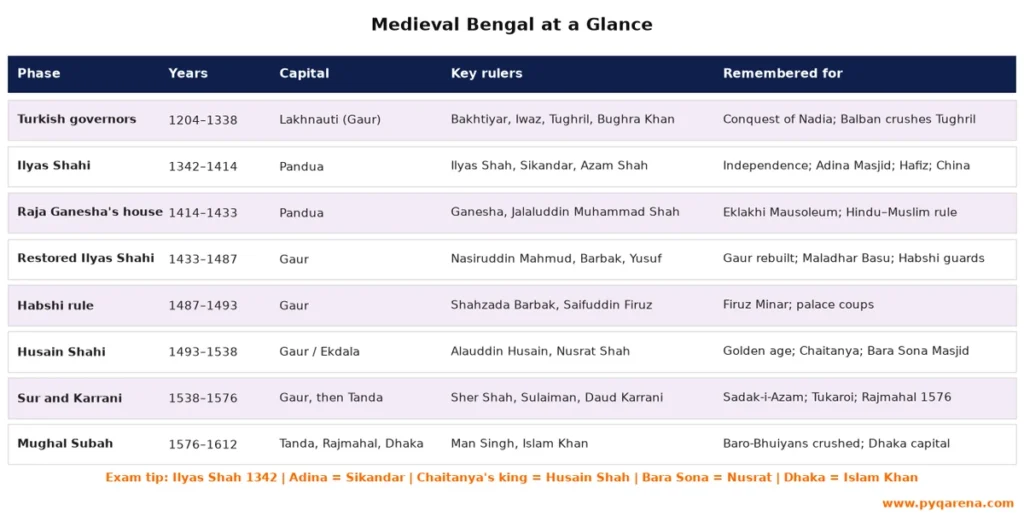
20. Medieval Bengal at a Glance
In simple words: One table, one chart: the whole story of medieval Bengal on a single page.
21. Timeline of Medieval Bengal
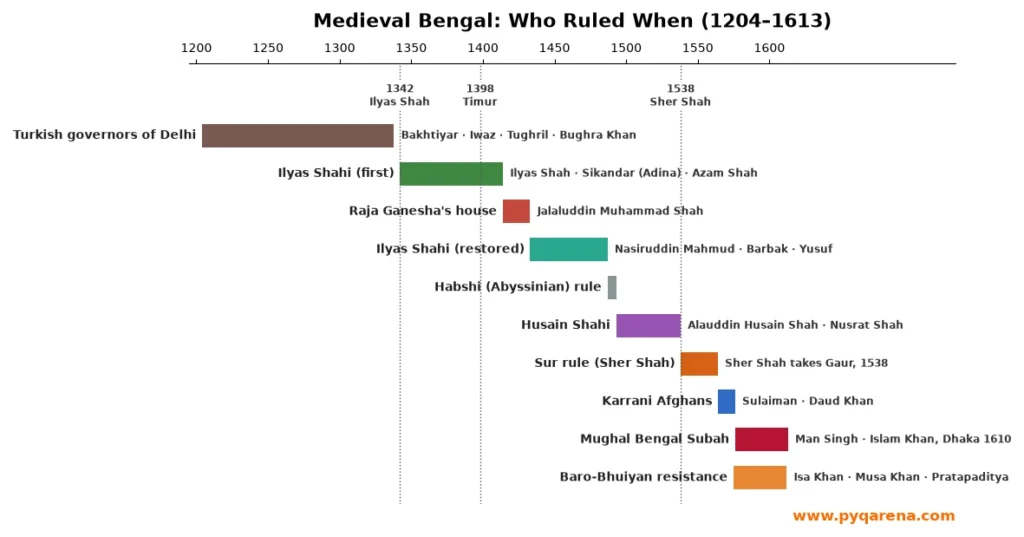
In simple words: The key dates in order, from Bakhtiyar’s ride to Islam Khan’s conquest.
| Year | Event |
|---|---|
| 1202–04 | Bakhtiyar Khalji takes Nadia; Lakhnauti the capital |
| 1212–27 | Iwaz Khalji rules |
| 1280–81 | Balban crushes Tughril |
| 1324 | Ghiyasuddin Tughlaq divides Bengal in three |
| 1338 | Fakhruddin Mubarak Shah independent at Sonargaon |
| 1342 | Ilyas Shah takes Lakhnauti: independent Sultanate |
| 1353–54, 1359 | Firoz Tughlaq fails at Ekdala |
| 1373–75 | Adina Mosque, Pandua |
| 1390 | Azam Shah kills Sikandar Shah; Hafiz |
| 1414 | Raja Ganesha seizes power |
| 1435 | Nasiruddin Mahmud Shah restores Ilyas Shahis |
| 1480 | Maladhar Basu’s Sri Krishna Vijaya |
| 1487–93 | Habshi rule |
| 1486 | Chaitanya born |
| 1493 | Husain Shah becomes Sultan |
| 1498 | Kamata conquered |
| 1526 | Bara Sona Masjid finished |
| 1534 | Sher Shah wins at Surajgarh |
| 1538 | Sher Shah takes Gaur: end of the Sultanate |
| 1565 | Sulaiman Karrani shifts capital to Tanda |
| 1575 | Tukaroi; Treaty of Katak; plague at Gaur |
| 1576 | Rajmahal: Daud Khan killed; Bengal Mughal |
| 1595 | Man Singh makes Rajmahal (Akbarnagar) capital |
| 1610 | Islam Khan moves capital to Dhaka (Jahangirnagar) |
| 1611–12 | Musa Khan, Pratapaditya surrender; Usman Khan killed (1612) |
| 1632 | Portuguese expelled from Hugli |
22. One-line facts
- Conquest: Bakhtiyar Khalji, Nadia, Lakshmana Sena, Lakhnauti (1202–04).
- Governors: Iwaz Khalji (1212–27); Tughril crushed by Balban (1280–81); Bughra Khan and the Qiran-us-Sadain (1289).
- Independence: Fakhruddin (Sonargaon, 1338); Ilyas Shah (1342), Shah-i-Bangalah; Ekdala (1353–54, 1359).
- Sikandar Shah: Adina Mosque at Pandua. Azam Shah: Hafiz, Mecca-Medina madrasas, China.
- Ganesha: Danujamardana Deva; son Jalaluddin Muhammad Shah; Eklakhi tomb.
- Restored Ilyas Shahis: Nasiruddin Mahmud (Gaur); Barbak Shah gave Gunaraj Khan to Maladhar Basu.
- Habshis (1487–93): Firuz Minar; ended by Sayyid Husain.
- Husain Shah (1493–1519): Chaitanya; Mahabharata (Paragal Khan, Chhuti Khan); Rup–Sanatan; Kamata (1498).
- Nusrat Shah: Bara Sona Masjid (1526), Qadam Rasul. Last Sultan: Ghiyasuddin Mahmud Shah (1538).
- Sher Shah: Sadak-i-Azam, Kabuliyat–Patta. Karranis: Tanda (1565); Daud killed at Rajmahal (1576).
- Mughals: Subah (1580); Man Singh (Rajmahal, 1595); Islam Khan (Dhaka, 1610).
- Baro-Bhuiyans: Isa Khan (d. 1599), Musa Khan, Pratapaditya, Kedar Rai.
- Portuguese: Chittagong (1517), Hugli (1579–80), expelled 1632.
23. Frequently Asked Questions
Q1. Who founded the independent Sultanate of Bengal?
Shamsuddin Ilyas Shah, in 1342.
Q2. Who built the Adina Mosque and where is it?
Sikandar Shah, at Pandua in Malda district, in 1373–75.
Q3. Which Bengal Sultan built madrasas at Mecca and Medina?
Ghiyasuddin Azam Shah.
Q4. Who was Chaitanya’s contemporary ruler of Bengal?
Alauddin Husain Shah.
Q5. Who was the last independent Sultan of Bengal?
Ghiyasuddin Mahmud Shah, who lost Gaur to Sher Shah in 1538.
Q6. Who were the Baro-Bhuiyans?
A group of Hindu and Muslim landlord-chiefs of the Bhati (eastern) delta, led by Isa Khan and Musa Khan, who resisted the Mughals until Islam Khan subdued them (1608–13).
Q7. Who shifted the capital of Bengal to Dhaka?
Islam Khan Chishti, in 1610; Dhaka was named Jahangirnagar.
Q8. When and by whom were the Portuguese expelled from Hugli?
By the Mughal governor Qasim Khan, in 1632 under Shah Jahan.
Related Notes and Practice
- Notes:
- Practice:
Leave a Comment