

Who is this for? Beginners and aspirants for WBCS, UPSC Prelims, other State PSCs, WBP and Clerkship exams. This is Chapter 5 of Medieval Indian History and covers the last great Hindu empire of South India, from the founding of Vijayanagara in 1336 to its fall after Talikota (1565) and the Aravidu twilight (to 1646). Each section opens with an “In simple words” explanation and then moves to exam-level detail. 🔗 Practise alongside: WBCS Mains Vijayanagar and Bahmani PYQs | WBCS Prelims Medieval Indian History PYQs | UPSC Prelims Medieval History: Vijayanagara and Regional Kingdoms PYQs | UPSC Prelims Art and Culture: Architecture PYQs | UPSC Prelims Medieval History: Administration, Culture and Marathas PYQs | PSC Miscellaneous Prelims History PYQs | WBCS Mains General Knowledge History PYQs | WBCS Mains Advent of Europeans PYQs | WBCS Mains Religious Movements PYQs | WBCS Mains General Knowledge Art and Culture PYQs 📖 Read first: Delhi Sultanate (Chapter 2) | Provincial Kingdoms of the Sultanate Period (Chapter 3) | Medieval Bengal (Chapter 4) | Early Medieval Regional Kingdoms | Sangam Age and Early South India
1. Vijayanagara Empire: The Big Picture
In simple words: When the Delhi Sultanate reached deep into the south in the early 1300s, the old Hindu kingdoms of the Deccan (Kakatiyas, Hoysalas, Yadavas, Pandyas) collapsed one after another. Vijayanagara, “the City of Victory”, rose out of that collapse in 1336 on the banks of the Tungabhadra and for more than two centuries held the whole south, from the Krishna river to Cape Comorin. Its kings fought the Bahmani and Deccan Sultans for the fertile Raichur Doab, traded horses and spices with the Portuguese and the Arabs, and built the great temple city of Hampi. The empire reached its peak under Krishnadevaraya (1509–29) and broke after the Battle of Talikota (1565).
1.1 The empire in one table
| Point | Fact |
|---|---|
| Founded | 1336 by Harihara I and Bukka I, guided by Vidyaranya |
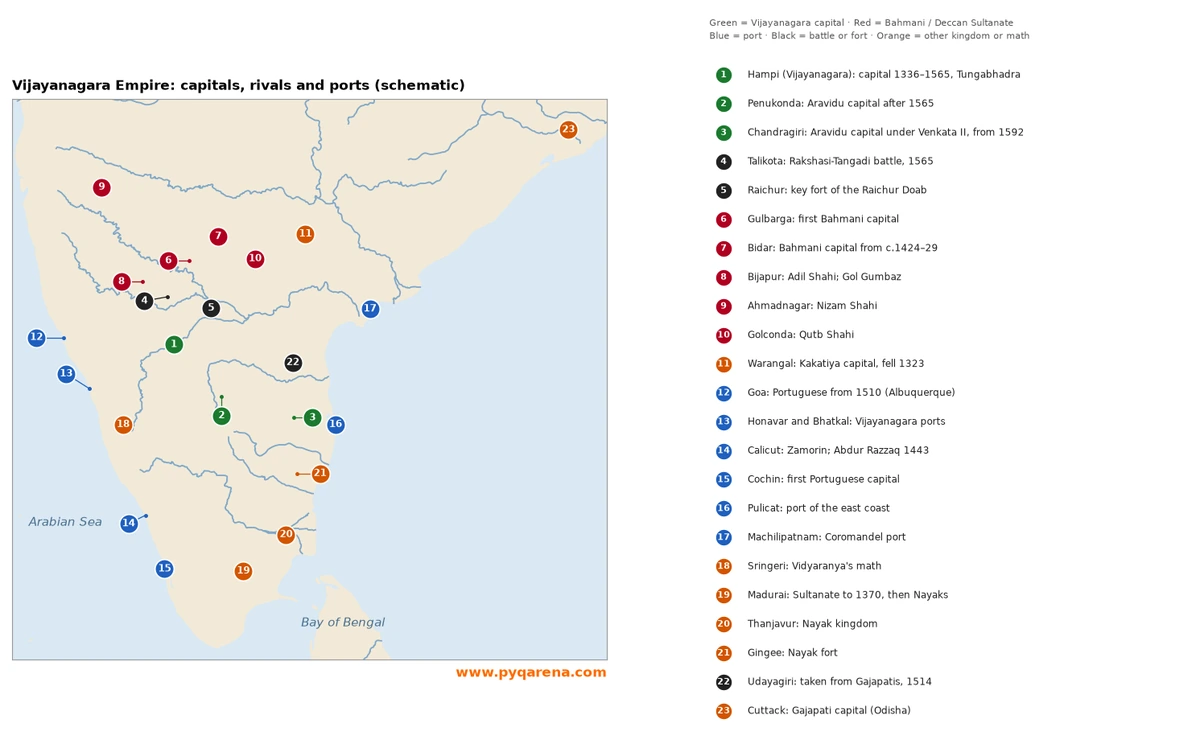
| Capital | Vijayanagara (modern Hampi, Ballari district, Karnataka) on the south bank of the Tungabhadra; later Penukonda and Chandragiri |
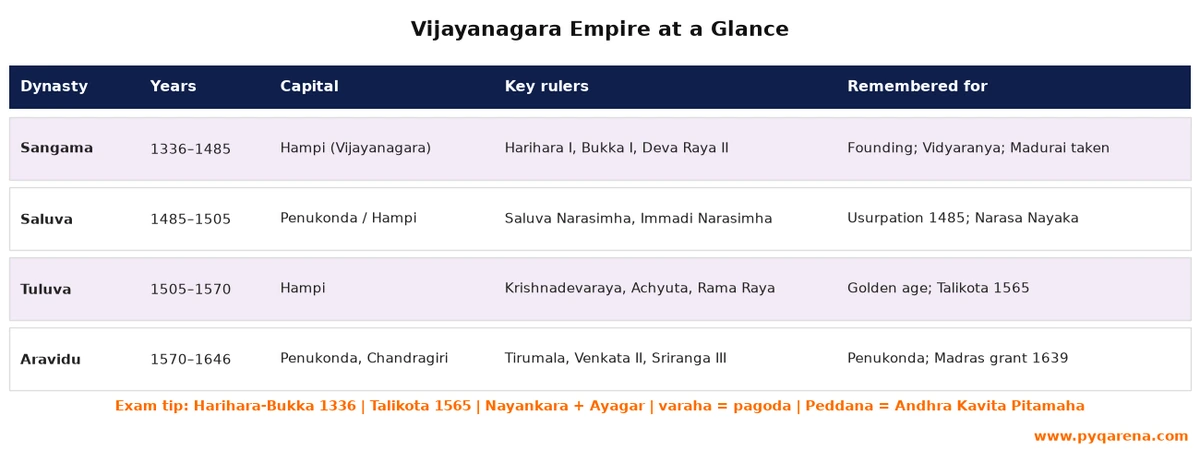
| Dynasties | Sangama (1336–1485), Saluva (1485–1505), Tuluva (1505–70), Aravidu (1570–1646) |
| Greatest king | Krishnadevaraya (1509–29) of the Tuluva dynasty |
| Main rivals | Bahmani Sultanate and its five successors; Gajapatis of Odisha; Reddis of Kondavidu |
| Turning point | Talikota (Rakshasi-Tangadi), 1565 |
| Administration | Nayankara system; Amaram lands; Ayagar village officials |
| Coins | Gold varaha (the pagoda of the Portuguese), pratapa, pana (fanam) |
| UNESCO site | Group of Monuments at Hampi (1986) |
1.2 Why Vijayanagara matters for exams
- It is a favourite of WBCS Mains (the whole Vijayanagar and Bahmani post is devoted to it), of WBCS Prelims (Amuktamalyada, Talikota, Raichur Doab, Hampi, Nayankara) and of UPSC Prelims (Harihara I, Saluva Narasimha, Deva Raya I’s dam, Nuniz on women, Krishnadevaraya’s taxes, the fanam, kalyana mandapas and Hampi’s temples).
- It ties together three kinds of facts: kings and dates, foreign travellers, and architecture at Hampi. This chapter keeps all three side by side.
- It links backward to the Delhi Sultanate, whose southern campaigns cleared the ground, and to the Chola, Hoysala and Pandya kingdoms it replaced. It links forward to the Nayak kingdoms and the arrival of the English at Madras.
- Compare its Hindu–Muslim contact with the mixed culture of the Bengal Sultanate and the regional courts in Provincial Kingdoms.
2. The Founding of Vijayanagara (1336)
In simple words: Two brothers, Harihara and Bukka, sons of Sangama, set up a new kingdom beside the Tungabhadra river at a time when the south had no strong Hindu power left. The sage Vidyaranya of the Sringeri math advised them, and the new capital was called Vijayanagara, “City of Victory”.
2.1 The two brothers and the sage
- Founders: Harihara I and Bukka I, sons of Sangama. The first dynasty is therefore called the Sangama dynasty. → PYQ: WBCS Mains 2022
- Year: 1336. The new city rose on the south bank of the Tungabhadra, a tributary of the Krishna, opposite the old fort of Anegondi (the ancient Kishkindha). Harihara I ruled the new kingdom as the agent of the deity Virupaksha, to whom all the land south of the Krishna was held to belong. → PYQ: UPSC Prelims 2015
- Vidyaranya: also called Madhava, head of the Sringeri math founded by Shankaracharya. He guided the brothers, and his brother Sayana became the great commentator of the Vedas. → PYQ: WBCS Mains 2016
- Context: Muhammad bin Tughlaq had taken Kampili (1327–28) and the Kakatiyas of Warangal had fallen (1323). The Hoysala king Ballala III held out until he died fighting the Madurai Sultan (1342). → Delhi Sultanate
- Hoysala lands: after Ballala III’s death the Hoysala territory passed into Harihara I’s hands, and Vijayanagara became the strongest power south of the Krishna.
2.2 Where did the founders come from? Three views
Historians have put forward three origins for Harihara and Bukka, and exam questions only ask the result, not the origin. Learn the three views side by side.
| View | Claim | Support |
|---|---|---|
| Telugu (Andhra) origin | They served the Kakatiyas of Warangal, in the treasury, and fled south when Warangal fell in 1323 | Telugu inscriptions and later Telugu chronicles |
| Kannada (Hoysala) origin | They were Hoysala commanders posted on the northern frontier at the Tungabhadra | The early Vijayanagara kings ruled Kannada lands and used the Hoysala symbols |
| Kampili origin | They were officers of the chief of Kampili; after Tughlaq took Kampili (1327–28) they were carried to Delhi and sent back as governors | Isami and Ferishta state that the brothers were taken to Delhi |
- Lasting point: the early kings called themselves Hindu Rayas, and the new state grew as the Hindu answer to the Sultanates of the north and south.
- Religious guide: Vidyaranya gave the new state the support of the Sringeri math, which brought in the Brahmins and the learned class.
2.3 Harihara I and Bukka I
- Harihara I (1336–56): consolidated the Tungabhadra region and the Hoysala lands, took the title of a sovereign king, and signed royal grants in the name of Virupaksha.
- Bukka I (1356–77): conquered Madurai and extended the kingdom to Rameswaram in the south.
- The Madurai Sultanate: founded by Jalaluddin Ahsan Shah (about 1334–35) after the governor of Madurai broke away from Delhi. It was overthrown by Bukka’s son Kumara Kampana (about 1370), whose story is told in the Sanskrit poem Madhura Vijayam by his wife Gangadevi. → PYQ: WBCS Mains 2015
- Embassy to China: Bukka I sent an embassy to Ming China in 1374. → PYQ: WBCS Mains 2015
- Sayana’s commentary: Sayana, minister of Bukka I, wrote the most important commentary on the Rigveda in the medieval period. → PYQ: WBCS Mains 2016
- First Bahmani war: in Bukka I’s reign began the long struggle with the Bahmani Sultanate over the Raichur Doab and the fort of Mudgal. → §4
| Ruler | Years | Key fact |
|---|---|---|
| Harihara I | 1336–56 | Founder with Bukka; city on the Tungabhadra; agent of Virupaksha |
| Bukka I | 1356–77 | Madurai conquered through Kumara Kampana; embassy to China (1374) |
| Harihara II | 1377–1404 | Maharajadhiraja; extended to the Konkan, Goa and Belgaum |
| Deva Raya I | 1406–22 | Irrigation works; Conti visits |
| Deva Raya II | 1422–46 | Praudha Deva Raya; Abdur Razzaq visits |
3. The Sangama Dynasty (1336–1485)
In simple words: The Sangama kings built the empire, fought the Bahmanis for a century and gave Vijayanagara its first golden age under Deva Raya II. Their weakness was the lack of a fixed rule of succession: after Deva Raya II’s death, weak kings let the nobles grow strong, and a general took the throne.
3.1 Harihara II to Deva Raya I
- Harihara II (1377–1404): took the title Maharajadhiraja Rajaparameshvara; his generals took Belgaum, Goa and the Konkan coast and he extended the realm to the east coast.
- Deva Raya I (1406–22): lost a war to Firuz Shah Bahmani (1406) and gave him his daughter in marriage. He built a large dam across the Tungabhadra and a canal-cum-aqueduct several kilometres long from the river to the capital city. → PYQ: UPSC Prelims 2023
- Bukka I’s Bahmani war: the first great war over the Raichur Doab was fought in 1367 at Mudgal against Muhammad Shah I of the Bahmani Sultanate, and the fighting on both sides was savage.
- Harihara II’s titles: he took the royal titles Maharajadhiraja and Rajaparameshvara, a sign that Vijayanagara now ranked as an empire.
- Southern kingdoms: with the Madurai Sultanate gone, the south of the peninsula, up to Rameswaram, passed under Vijayanagara governors; Kumara Kampana first governed it.
- Nicolo de Conti, an Italian merchant, visited Vijayanagara in his reign and described the huge city, its festivals and the practice of sati. → PYQ: WBCS Mains 2016
- First clash with Odisha: in his reign Vijayanagara first came into conflict with Odisha. → PYQ: WBCS Mains 2015
3.2 Deva Raya II (1422–46)
- Titles: Praudha Deva Raya (the Mature) and Gajabetekara (the elephant hunter).
- Army reform: after early defeats he recruited Muslim archers and cavalry and trained Hindu soldiers in the use of the bow, which improved the army.
- Conquests: he raided Kerala as far as Quilon, the Reddis of Kondavidu fell under his control and he fought the Gajapati Kapilendra, founder of the Gajapati dynasty. → PYQ: WBCS Mains 2015
- Abdur Razzaq, ambassador of the Timurid ruler Shah Rukh, visited his court in 1443. → PYQ: WBCS Prelims 2002
- Scholar-king: he wrote the Sanskrit works Mahanataka Sudhanidhi and a commentary on the Brahma Sutra; the Telugu poet Srinatha and the Kannada poet Chamarasa adorned his court.
- Death: he died in 1446; the rulers who followed lost the confidence of the nobles. Vasco da Gama reached the Kerala coast in 1498, more than fifty years after Deva Raya II’s death, so he did not visit this reign. → PYQ: UPSC Prelims 2021
3.3 The decline of the Sangamas
- Mallikarjuna (1446–65) and Virupaksha II (1465–85) were weak. The Gajapatis of Odisha and the Bahmanis under Mahmud Gawan seized coastal districts, including the Konkan ports.
- 1485: the general Saluva Narasimha took the throne from the last Sangama king, and the Saluva dynasty began.
3.4 An estimate of the Sangama period
- Gains: unity of the south, victory over Madurai, the Tungabhadra irrigation works and a first golden age under Deva Raya II.
- Weak points: no fixed rule of succession, constant pressure from the Bahmanis and the Gajapatis, and powerful provincial governors.
- Cultural side: Sanskrit, Telugu and Kannada all had royal patrons, and Hampi began its growth as a temple city.
4. Vijayanagara and the Bahmani Sultanate: The Raichur Doab
In simple words: For almost two centuries a quarrel over one stretch of rich land, the Raichur Doab between the Krishna and Tungabhadra, kept Vijayanagara and the Bahmani Sultanate at war. The land was fertile, held strong forts like Raichur and Mudgal, and whoever held it controlled the way into the other’s heartland.
4.1 The Raichur Doab
- What it is: the triangle of land between the rivers Krishna and Tungabhadra.
- Why it mattered: rich black soil and cotton, forts at Raichur and Mudgal, and a border where trade routes from the Arabian Sea to the Bay of Bengal crossed.
- PYQ fact: the Bahmani Kingdom and Vijayanagar Empire clashed frequently over the Raichur Doab. → PYQ: WBCS Prelims 2011 | PYQ: WBCS Prelims 2001
- Other causes: the Krishna-Godavari delta with its ports; control of the Konkan ports and the horse trade; and the clash of two religions and ambitions.
4.2 Vijayanagara’s other neighbours
| Neighbour | Relation |
|---|---|
| Reddis of Kondavidu and Rajahmundry | Rivals in the Krishna-Godavari delta; Deva Raya II brought them under control |
| Gajapatis of Odisha | Kapilendra (founder, 1435) fought Deva Raya II; Prataparudra lost Udayagiri and Kondavidu to Krishnadevaraya (1514–15). → PYQ: WBCS Mains 2015 |
| Zamorin of Calicut | Rulers of the Malabar coast; Deva Raya II raided Kerala |
| Madurai Sultanate | Founded about 1334–35; conquered by Kumara Kampana |
| Portuguese at Goa | Friends and horse suppliers from 1510 |
4.3 The Bahmani Sultanate in brief
- Founder: Alauddin Hasan Bahman Shah (Zafar Khan), who revolted against Muhammad bin Tughlaq and founded the Sultanate at Gulbarga in 1347. → PYQ: WBCS Prelims 2014 | PYQ: WBCS Prelims 2008
- Capital shifted: Ahmad Shah Wali moved the capital from Gulbarga to Bidar. → PYQ: WBCS Mains 2017
- Mahmud Gawan: the Persian prime minister (1463–81) of Muhammad Shah III, who reorganised the army and the provinces and built a famous madrasa at Bidar. He was put to death in 1481 and the Sultanate began to break up.
4.4 The five successor Sultanates (c. 1490–1527)
| Sultanate | Dynasty | Capital | Remembered for |
|---|---|---|---|
| Bijapur | Adil Shahi (Yusuf Adil Shah, 1490) | Bijapur | Gol Gumbaz (Muhammad Adil Shah, 1656), the world’s second-largest dome |
| Ahmadnagar | Nizam Shahi (Malik Ahmad, 1490) | Ahmadnagar | Chand Bibi‘s defence against Akbar (1595) |
| Golconda | Qutb Shahi (Quli Qutb Shah, 1518) | Golconda, later Hyderabad | Grew on the ruins of the old Hindu kingdom of Warangal |
| Berar | Imad Shahi (1490) | Ellichpur | First to be absorbed (by Ahmadnagar, 1574) |
| Bidar | Barid Shahi (1527) | Bidar | Smallest of the five |
- Gol Gumbaz: built by Muhammad Adil Shah at Bijapur, with the whispering gallery. → PYQ: WBCS Mains 2015 | PYQ: WBCS Mains 2020
- Golconda: grew up on the ruins of Warangal, the Kakatiya capital. → PYQ: WBCS Mains 2019
- Chand Bibi: ruled over Ahmadnagar. → PYQ: WBCS Prelims 2022
- Mughal end: the Mughals took Ahmadnagar’s fort in 1600 and Aurangzeb annexed Bijapur (1686) and Golconda (1687). → Delhi Sultanate
5. The Saluva Dynasty (1485–1505)
In simple words: The Saluva dynasty is a short bridge between the Sangamas and the Tuluvas. Saluva Narasimha, a strong provincial governor, saved the empire from collapse by taking the crown himself, but the real power soon passed to his general Narasa Nayaka.
- Saluva Narasimha (1485–91): a governor from Chandragiri, he ended the Sangama dynasty, seized the throne and assumed the royal title to save the kingdom from further decline, and recovered much territory from the Gajapatis. → PYQ: WBCS Prelims 2006 | PYQ: UPSC Prelims 2003 | PYQ: UPSC Prelims 2004
- Narasa Nayaka: his commander, took charge as regent for Narasimha’s young sons and ruled in all but name until 1503. He was the father of Vira Narasimha and Krishnadevaraya.
- Immadi Narasimha (1491–1505): the second Saluva king; a boy-ruler kept under the guard of Narasa Nayaka and later of Vira Narasimha.
- 1505: Vira Narasimha, Narasa Nayaka’s son, deposed the last Saluva ruler Immadi Narasimha and took the crown. This is the start of the Tuluva dynasty. → §6 | PYQ: UPSC Prelims 2004
- Lasting contribution: the Saluvas held the empire together long enough for the Tuluvas to take it to its greatest height.
6. The Tuluva Dynasty (1505–70)
In simple words: The Tuluvas gave Vijayanagara its greatest king, Krishnadevaraya, and its worst defeat, at Talikota. Under Krishnadevaraya the empire won every war it fought, built temples and cities, and welcomed poets and Portuguese envoys. Under his weaker successors, power slipped to the regent Rama Raya, who played the Deccan Sultans against each other until they joined hands against him.
6.1 Vira Narasimha (1505–09)
- Took the throne in 1505 after murdering Immadi Narasimha and founded the Tuluva dynasty (named after the Tuluva region of the west coast).
- Spent his reign putting down rebellions of the nayakas and fighting the Adil Shah of Bijapur.
- Died in 1509, and his younger brother Krishnadevaraya was crowned. → PYQ: UPSC Prelims 2004
6.2 Krishnadevaraya (1509–29)
- Greatest ruler: the best-known king of Vijayanagara, a warrior, administrator, poet and builder; titles include Andhra Bhoja, Kannada Rajya Rama Ramana and Yavanarajya Sthapanacharya. → PYQ: WBCS Mains 2018 In the sequence of events, the Qutb Minar and the death of Firuz Shah Tughlaq (1388) both come before the arrival of the Portuguese (1498), and Krishnadevaraya’s reign comes last. → PYQ: UPSC Prelims 2000
- Wars against the Bahmani remnants: he defeated the Adil Shah of Bijapur at Diwani (1509) and restored the Bahmani Sultan Mahmud Shah to the throne of Bidar, which is why he took the title Yavanarajya Sthapanacharya (“establisher of the Yavana kingdom”).
- Raichur (1520): the great siege and victory over Ismail Adil Shah of Bijapur, who had held the Raichur Doab fort. This is the best-known military feat of his reign.
- War with the Gajapatis (1513–18): in four campaigns he took Udayagiri (1514), Kondavidu (1515) and other forts from Prataparudra Gajapati of Odisha and ended the war by marrying the Gajapati’s daughter. → PYQ: WBCS Mains 2015
- Srirangapatna and the south: he crushed the Ummattur chiefs and brought the Mysore plateau and the Kaveri valley under direct rule.
- Portuguese: in 1510 Albuquerque took Goa from Bijapur. Krishnadevaraya made friends with the Portuguese, who supplied him horses, and gave them permission to build a fort at Bhatkal. Domingo Paes visited his court. → §10 | PYQ: UPSC Prelims 2024
- The city of Nagalapura: he built a new suburb, Nagalapura (modern Hosapete), named after his mother Nagaladevi. → PYQ: WBCS Mains 2015
- Temples: the Hazara Rama and Vitthala temples, the Krishna temple (1513) and the great gopurams at Chidambaram, Srirangam, Tiruvannamalai and Kanchipuram. → §13
- Literature: he wrote the Telugu Amuktamalyada (also called Vishnuchittiyam) and the Sanskrit Jambavati Kalyanam; his court had the Ashtadiggajas. → §14
- Religion and tolerance: Vaishnava by faith, but gave equal gifts to Shaiva and Jain shrines; his guru was the Madhva saint Vyasatirtha.
6.2A Titles of the great kings
| King | Title | Meaning |
|---|---|---|
| Harihara II | Maharajadhiraja Rajaparameshvara | Great king of kings, supreme lord |
| Deva Raya II | Praudha Deva Raya; Gajabetekara | The mature; the elephant hunter |
| Krishnadevaraya | Andhra Bhoja | The Bhoja of the Telugu country |
| Krishnadevaraya | Kannada Rajya Rama Ramana | Lord of the Kannada kingdom |
| Krishnadevaraya | Yavanarajya Sthapanacharya | Establisher of the Yavana (Bahmani) kingdom |
| Krishnadevaraya | Mooru Rayara Ganda | Hero among three kings |
6.2B The Raichur campaign (1520)
- Background: Ismail Adil Shah of Bijapur held Raichur, the key fort of the Raichur Doab, and Krishnadevaraya set out to take it.
- The army: Krishnadevaraya marched with a very large army, and Paes and Nuniz both describe the siege and the great battle outside Raichur.
- Result: the fort fell to Vijayanagara after a long siege and a hard-fought battle, and the king’s army pressed on into the Sultans’ lands.
- After the victory: Vijayanagara held the Raichur Doab for the rest of his reign, and the war is the best-known feat of his career.
6.3 Krishnadevaraya’s government and army
- Army: a vast force of infantry, cavalry and war elephants. Paes saw him review the troops and described a standing army of several hundred thousand, supported by the nayakas.
- Justice and order: the king heard petitions himself and punished corrupt officials; Paes records his daily routine of exercise, prayer and audience.
- The advice of the Amuktamalyada: the poem tells the king to protect his ports, welcome foreign traders, import horses and elephants, keep the forests and tanks in order and care for the people’s welfare.
- Patronage: the king rewarded poets with land and elephants and held literary contests in a hall called the Bhuvana Vijayam, the “Hall of the World’s Victory”.
- Bhuvana Vijayam: this was the court where the Ashtadiggajas recited their poems.
- Personality: Paes called him the most feared and perfect king, a strong, cheerful ruler, a good horseman and a lover of music.
- Taxation: the land tax was fixed according to the quality of the land, and private owners of workshops paid an industries tax. → PYQ: UPSC Prelims 2016
- Death: he died in 1529, and the succession passed to his half-brother Achyuta Raya because his own son was a child. → PYQ: UPSC Prelims 2004
6.4 Achyuta Raya (1529–42)
- Succession: Krishnadevaraya’s half-brother; he faced Bijapur and Gajapati raids and was dependent on his brother-in-law Salakaraju Tirumala.
- Fernao Nuniz, a Portuguese horse-dealer, stayed at his court (about 1535–37) and wrote a chronicle of the kings of Vijayanagara.
- Temple: the Tiruvengalanatha (Achyutaraya) temple at Hampi and its bazaar.
- Queen and poet: Tirumalamba Devi, his queen, wrote the Sanskrit Varadambika Parinayam.
6.5 Sadashiva Raya (1542–70) and Rama Raya
- Nominal king: Sadashiva Raya was a figurehead; the real ruler was Aliya Rama Raya, son-in-law of Krishnadevaraya.
- Rama Raya’s policy: he made and broke alliances with Bijapur, Ahmadnagar and Golconda, and once marched the Vijayanagara army into the Deccan to settle their quarrels. The Sultans never forgave the insults.
- End: in 1565 the four Sultans united and struck at Talikota, where Rama Raya, then about 96 years old, was captured and beheaded. → PYQ: WBCS Mains 2017
7. The Battle of Talikota (1565)
In simple words: In January 1565 the armies of four Deccan Sultans met the great army of Vijayanagara near the Krishna river. For most of the day Vijayanagara was winning. Then Rama Raya was captured and beheaded, his army panicked, and the Sultans’ men sacked the capital for months. The empire survived, but its heart was gone.
7.1 The facts of the battle
- Date: 23 January 1565, the Battle of Talikota, also called Rakshasi-Tangadi, after two villages on the Krishna river. → PYQ: WBCS Prelims 2005 | PYQ: PSC Prelims 2006
- Sides: Vijayanagara under Aliya Rama Raya against the allied Sultans of Bijapur (Ali Adil Shah I), Ahmadnagar (Husain Nizam Shah), Golconda (Ibrahim Qutb Shah) and Bidar (Ali Barid Shah). Berar did not join.
- Result: Rama Raya was captured and beheaded, and his army broke and fled. → PYQ: WBCS Mains 2017
- Sack: the Sultans’ soldiers plundered Hampi for about five to six months, burning palaces and breaking temples.
- Flight: Tirumala Raya, Rama Raya’s brother, escaped with the royal treasure and the puppet king Sadashiva to Penukonda.
7.2 How the battle went
- The armies met across the river near the villages of Rakshasi and Tangadi on the Krishna; Vijayanagara had a large army with nayakas’ contingents and the Sultans had cannon and a strong cavalry.
- First phase: the Vijayanagara troops fought well, and for part of the day the Sultans’ lines were in danger.
- Turning point: the Sultans’ artillery under Rumi Khan of Ahmadnagar fired into the Vijayanagara ranks, and the Sultans’ cavalry then charged; Rama Raya was captured and executed in front of his men.
- Collapse: with their commander dead, the Vijayanagara army fled in panic and the Sultans’ men ran after them to the capital.
- Aftermath: the royal family and the court escaped to Penukonda, and the city was left to the plunderers.
7.3 Causes
| Cause | Meaning |
|---|---|
| Rama Raya’s arrogance | He played the Sultans against each other and insulted them in their own courts |
| Earlier insults to the Sultans | His forces had plundered and humiliated Bijapur and Ahmadnagar in earlier campaigns |
| Disputes over the Raichur Doab and Konkan ports | Old quarrels were never settled |
| Sultans’ unity | Marriage alliances (such as Ali Adil Shah and Chand Bibi, daughter of Husain Nizam Shah) joined the rivals against a common enemy |
7.4 Results
- Hampi never recovered: the city lay in ruins and was never rebuilt as a capital.
- The empire shrank: the Aravidu kings ruled from Penukonda and Chandragiri over a smaller realm.
- The Nayaks broke away in the following decades, and the south split into several kingdoms.
- The Sultans gained: but their own quarrels began again, and in time the Mughals swallowed them. → Delhi Sultanate
8. The Aravidu Dynasty and the Fall (1570–1646)
In simple words: The Aravidu dynasty was a last attempt to rebuild the empire from new capitals in the south-east. It kept up the old titles and a part of the old glory, but the Nayaks of Madurai, Thanjavur, Gingee, Mysore and Ikkeri grew independent, and in 1646 the line ended with Sriranga III.
8.1 The kings and capitals
| Ruler | Years | Capital and key fact |
|---|---|---|
| Tirumala Raya | 1570–72 | Set aside Sadashiva and took the crown; founded the Aravidu line at Penukonda |
| Sriranga I | 1572–86 | Faced repeated attacks from Bijapur and Golconda |
| Venkata II | 1586–1614 | Moved the capital to Chandragiri (1592); the last strong Aravidu king |
| Sriranga II to Venkata III | 1614–42 | A shrinking realm; civil war after Venkata II’s death |
| Sriranga III | 1642–46 | Defeated by Bijapur and Golconda; the dynasty ended in 1646 |
- Penukonda (Anantapur district) became the first capital after 1565. Chandragiri (near Tirupati) was the capital under Venkata II from 1592.
- Venkata II: the last strong Aravidu king; he held the Nayaks in check and kept the Sultans at bay for a time. When Raja Wodeyar founded the kingdom of Mysore in 1610, Venkata II was the ruler of Vijayanagara. → PYQ: UPSC Prelims 2006
- The Madras grant (1639): the local ruler Damarla Venkatapati granted the English East India Company the land on which Fort St George (Madras) was built, with the approval of the Aravidu king (confirmed by Sriranga III). This is the beginning of British Madras. → WBCS Mains Advent of Europeans PYQs
8.2 The Nayak kingdoms
Many Nayaks, who had held amaram lands, became independent rulers as the central power weakened.
| Nayak state | Founder or leader | Capital |
|---|---|---|
| Madurai | Viswanatha Nayaka (c. 1529) | Madurai (Meenakshi temple’s great expansion under Tirumala Nayak) |
| Thanjavur | Sevappa Nayaka | Thanjavur |
| Gingee | Tupakki Krishnappa | Gingee |
| Keladi (Ikkeri) | Chaudappa Nayaka | Ikkeri, later Bidanur |
| Mysore | Raja Wodeyar (1610, took Srirangapatna, under Venkata II) | Srirangapatna |
- Mysore: the Mysore kingdom of the Wodeyars grew out of the Vijayanagara Empire. → PYQ: UPSC Prelims 2021
- End of empire: by about 1646 the Aravidu line was a name; the Nayaks took the lead in the south for the next century until the Marathas, the Mughals and finally the English pushed them aside. → Provincial Kingdoms
8.3 Why the empire declined
| Cause | Meaning |
|---|---|
| Talikota (1565) | Destroyed the capital, the treasure and the prestige of the Rayas |
| Strong Nayaks | The nayankara system turned chiefs into rulers as the king’s grip loosened |
| Weak succession | No fixed rule; usurpations in 1485, 1505 and 1570 |
| Civil war | The Battle of Toppur (1616–17) between rival claimants split the Aravidu house |
| Deccan Sultans | Bijapur and Golconda kept taking northern and eastern districts |
| Horse dependence | The army depended on foreign horse supplies from the Portuguese and Arabs |
- Legacy: the Nayak states, the Mysore kingdom, the temple style of the south, the Telugu and Kannada literary tradition and Carnatic music (Purandaradasa) all carried forward Vijayanagara’s culture.
9. Administration: Nayankara, Amaram and Ayagar
In simple words: The king ruled through a council of ministers and a chain of governors. The most important and most asked feature is the nayankara system, in which military chiefs called nayakas held land (amaram) in return for keeping troops for the king. Village life was run by hereditary officers called ayagars. Learn these two systems together: they are the “backbones” of Vijayanagara administration.
9.1 The king and the council
- Absolute monarchy: the king (called Raya) was the head of the state, the chief of the army and the supreme judge. The royal emblem was the varaha (boar).
- Council of ministers: the Mahapradhana (chief minister), Pradhani, Rayasam (secretary) and Karanikas (accountants) worked with the king, and the Sabhanayaka managed the court.
- Heir: the Yuvaraja was crowned in the king’s lifetime.
9.2 Provinces and local rule
| Level | Name | Head |
|---|---|---|
| Empire | Rajya | Raya (the king) |
| Province | Mandalam | Dandanayaka or Mahamandaleshwara |
| District | Nadu (also kottam, valanadu) | Governor of the district |
| Sub-division | Sthala | Local officers |
| Village | Grama | Ayagars |
9.3 The Nayankara system
- Nayakas: military chiefs who held large estates called amaram from the king. They could be Telugu, Kannada or Tamil chieftains. In the same way that the Delhi Sultans used the iqta, the Mughals the jagir and the Marathas the mokasa, Vijayanagara used the amaram. → PYQ: UPSC Prelims 2000
- Duties: to keep an army of fixed size (foot, horse and elephants), to pay a fixed share of the revenue (about half) to the king and to attend court during Dasara.
- Supervision: the king moved the nayakas from one province to another and sent Maha-nayakacharya, a special officer, to keep a watch.
- Why it mattered: it gave the king an army without paying salaries, but it also created strong regional chiefs, who broke away later (see §8.2).
- PYQ fact: the Nayankara system is associated with the Vijayanagara Empire. → PYQ: WBCS Prelims 2021
9.4 The Ayagar system
- Ayagars: a group of twelve hereditary village officers such as the karnam (accountant), talayari (watchman), smith, carpenter and washerman, who were paid from the village produce and tax-free land.
- PYQ fact: the Nayankara and Ayagar systems were the backbones of Vijayanagara administration. → PYQ: WBCS Mains 2020
- Asthavana: the land revenue department of the empire. → PYQ: WBCS Mains 2015
9.5 Army and justice
- Army: infantry, cavalry, elephants and artillery; the king employed Muslim archers and cavalry. Horses had to be imported, and the Portuguese held a monopoly of that trade after 1510. → §10
- Police and justice: policemen (kavalgars) were paid from taxes, and Abdur Razzaq says they were paid from the tax on prostitutes. → PYQ: WBCS Mains 2016 | PYQ: WBCS Mains 2017
- Dasara (Mahanavami): each year the nayakas came to the capital for the nine-day festival, brought their tribute and paraded their troops before the king on the Mahanavami Dibba. The festival was a yearly show of loyalty and strength. → §13
- Revenue: land tax was about one-sixth of the produce, and the rate was fixed according to the quality of the land. There were many taxes on professions, markets and marriages, and private owners of workshops paid an industries tax. → PYQ: UPSC Prelims 2016
10. Economy, Trade, Coins and the Portuguese
In simple words: Vijayanagara was rich. Its farmers grew rice, cotton and sugar with the help of tanks and canals, its weavers made fine cloth, and its ports on both coasts shipped pepper and spices to the Arabs, Chinese and Europeans. The biggest import was horses, which the empire needed for war and could not breed. Temples were the centre of economic life: they owned land, ran markets and gave loans. Gold varaha coins paid for it all.
10.1 Agriculture and irrigation
- Tanks and canals: the kings built tanks, dams and canals to bring Tungabhadra water to the dry plateau. Deva Raya I built a dam and aqueduct across the river; Krishnadevaraya dug the Basavanna canal and the great Kamalapuram tank, and other canals watered the Hampi valley.
- Crops: rice, millets, cotton, sugarcane, coconut, areca nut and spices; the black soil of the Doab gave excellent cotton.
- Land categories: amara land given to nayakas, bhandaravada (crown land), devadaya (temple land) and brahmadeya (land for Brahmins).
10.2 Industry and markets
- Textiles were the biggest industry, along with iron, steel, diamond mining (Golconda area), perfumes and sugar.
- Guilds of merchants (Chettis and Komatis) and artisans ran the markets, and great bazaars grew up along the temple streets of Hampi.
- Temples as economic centres: they owned land, hired labour, gave loans and ran markets and workshops.
10.3 Trade and ports
- West-coast ports: Mangalore, Honavar, Bhatkal, Barkur, Cannanore, Calicut and Cochin.
- East-coast ports: Machilipatnam, Pulicat, Nagapattinam and Santhome.
- Imports: horses from Hormuz and Persia, pearls, copper, mercury, velvet and Chinese silk. → PYQ: WBCS Prelims 2020
- Exports: pepper and other spices, cotton cloth, rice, sugar, iron, saltpetre and diamonds.
-
Single biggest import: horses. Without them the cavalry could not be kept up, and whoever controlled the supply held the empire’s military future.
-
Merchant guilds: older south Indian guilds such as the Nanadesis and the Ayyavole 500 continued to trade across the peninsula, and new groups of Chettis, Komatis and Muslim merchants joined them.
- Taxation of trade: the state took duties at ports and city gates and sold monopolies (for example, the horse trade).
10.4 Coins
| Coin | Metal | Notes |
|---|---|---|
| Varaha (also hun, gadyana, pon) | Gold | The standard coin; named pagoda by the Portuguese; carried deities such as Venkateswara, Balakrishna and the boar |
| Pratapa | Gold | Half a varaha |
| Pana (fanam) | Gold or silver | Small coin worth about a tenth of a varaha; in medieval India the term fanam referred to coins. → PYQ: UPSC Prelims 2022 |
| Tara | Silver | Small silver coin |
| Kasu | Copper | Everyday money |
- PYQ fact: a foreign traveller named one of the famous Vijayanagara coins the pagoda; originally it was the varaha. → PYQ: WBCS Mains 2018
- Compare: the Sultanate’s silver tanka and the Mughal rupee.
10.5 The Portuguese and Vijayanagara
- 1498: Vasco da Gama reached Calicut, long after the reign of Deva Raya II (1422–46). Cochin was the first Portuguese capital in India. → PYQ: WBCS Mains 2015 | PYQ: UPSC Prelims 2021
- 1510: Albuquerque captured Goa from Bijapur, and in time Goa became the centre of Portuguese power. → PYQ: WBCS Prelims 2014
- Horses and cannon: the Portuguese held the sea-borne horse trade and sold horses to Vijayanagara in return for trading rights on the west coast.
- Why friendship: both the Portuguese and Vijayanagara were rivals of the Muslim sultans, and Krishnadevaraya allowed the Portuguese to build a fort at Bhatkal. → PYQ: UPSC Prelims 2024
- New crops: in the sixteenth and seventeenth centuries the Portuguese introduced papaya, pineapple and guava into India. → PYQ: UPSC Prelims 2025
- Result: the trade made the west-coast ports rich, but it also made the empire depend on foreign horse supplies.
10.6 Temples and the economy
- Land and taxes: kings and nayakas gave devadaya land and villages to temples, and the temples held large estates worked by tenants.
- Grants for festivals: gifts by kings and merchants paid for daily worship, festivals, lamps and musicians; the Tirumala Venkateswara temple at Tirupati received lavish gifts from Krishnadevaraya.
- Banking and loans: temples lent money to villages and to merchants, and kept deposits.
- Markets round temples: the long bazaar streets of Hampi (Virupaksha, Achyutaraya and Krishna bazaars) show how markets grew around temples.
- Taxes: the state taxed land, trades, markets, marriages and professions; special taxes such as kattukodage (fixed rent on land) and siddhaya (land revenue) are named in inscriptions.
11. Society and Religion
In simple words: The empire’s society was Hindu at its core, with Brahmins, merchants and cultivators at the centre, but it also had Muslim soldiers, Jain traders and Christians on the coast. Women had a visible role at court and in the arts, but customs such as sati were also practised. The kings supported all religions, though the royal family worshipped Shiva (as Virupaksha) and later Vishnu.
11.1 Social groups
- Brahmins: priests, ministers, scholars and sometimes generals.
- Merchants: the Chettis and Komatis of the guilds, along with Muslim and foreign traders.
- Cultivators and artisans: the base of the society, and the main payers of taxes.
- Nayakas: the new military aristocracy created by the nayankara system.
- Women: at court, women held office as guards and musicians, and queens such as Tirumalamba Devi wrote poetry. Sati was also practised, and devadasis served in temples.
- Festivals: Mahanavami (Dasara) was the great state festival, with processions, sacrifices, wrestling, dances and military displays. → §13
11.2 Religion
- Shaivism: the Virupaksha temple (Shiva as Pampapati) was the royal family’s chief shrine, and the kings signed their grants “Sri Virupaksha”.
- Vaishnavism: grew under Krishnadevaraya and Achyuta Raya; the Sri Vaishnava acharyas were respected, and the Tirumala Venkateswara temple at Tirupati received lavish gifts.
- Madhva school: Vyasatirtha was Krishnadevaraya’s guru and the head of the Madhva tradition in the south.
- Haridasa movement: Purandaradasa and Kanakadasa wrote devotional songs in Kannada, and Purandaradasa is called the father of Carnatic music.
- Jainism and Islam: the kings gave grants to Jain temples and allowed mosques in the capital; Muslim soldiers were welcome at court.
- Compare: the mixed Hindu–Muslim culture of medieval Bengal and the Bhakti and Sufi movements.
11.3 Women, education and daily life
- Women at court: according to the Portuguese writer Nuniz, the women of the Vijayanagara Empire were expert in wrestling, astrology, accounting and soothsaying. Paes also describes women who served as musicians, judges and bodyguards, and the great queens gave to temples and wrote poetry. → PYQ: UPSC Prelims 2021
- Education: Brahmin teachers ran agraharas and temple schools; Sringeri, Tirupati and Hampi were centres of learning.
- Food and dress: rice, ragi, pulses and ghee were common; the rich wore silks, gold and pearls, and the king’s court was famous for its perfumes.
- Entertainment: wrestling, cockfights, music and dance; devadasis danced in the great temples.
12. Foreign Travellers at Vijayanagara
In simple words: Vijayanagara is the best-described empire of medieval India, because a string of foreign visitors wrote about it: an Italian, a Persian, a Russian and several Portuguese. Learn who came in which reign and what each one is known for.
| Traveller | Home | Visited | Reign | Known for |
|---|---|---|---|---|
| Ibn Battuta | Morocco | 1342 (Malabar coast and Honavar) | Harihara I (context) | Served Muhammad bin Tughlaq in Delhi; on the west coast he names the Hindu king “Haryab” (Harihara) as overlord of the coast, which dates the new kingdom’s reach |
| Nicolo de Conti | Italy | c. 1420 | Deva Raya I | Describes the city, its festivals and sati → PYQ: WBCS Mains 2016 |
| Abdur Razzaq | Persia (Herat) | 1443 | Deva Raya II | Praised the city and its wealth; says policemen were paid from the tax on prostitutes → PYQ: WBCS Prelims 2002 |
| Athanasius Nikitin | Russia | 1468–74 | Bahmani (not Vijayanagara) | Visited Bidar in the 15th century and described the Bahmani court, for comparison → PYQ: WBCS Mains 2020 |
| Duarte Barbosa | Portugal | c. 1500–16 | Krishnadevaraya | Described the coastal trade and customs |
| Domingo Paes | Portugal | c. 1520–22 | Krishnadevaraya | Eyewitness account of the city, Mahanavami festival and the king |
| Fernao Nuniz | Portugal | c. 1535–37 | Achyuta Raya | Wrote the chronicle of the Vijayanagara kings |
- How to remember: Conti = Court of Deva Raya I; Razzaq = Raya II; Paes = Peak of Krishnadevaraya; Nuniz = Next king (Achyuta).
- Not at Vijayanagara: Nikitin (Bahmani Bidar), Thomas Roe (Jahangir’s court, 1615–19) and Bernier (Mughal India). → Foreign Travellers in India
- After Talikota: the Venetian merchant Caesar Frederick visited the ruined capital in 1567.
13. Hampi: The Architecture of Vijayanagara
In simple words: Hampi is a city built of granite, with temples, palaces, bazaars and water tanks spread over rocky hills beside the Tungabhadra. Vijayanagara builders blended the old Dravida temple style with Deccan and Islamic ideas such as arches and domes. The raya gopurams (tall gateways), the kalyana mandapas (marriage halls) and the musical pillars are the signature features. Hampi is a UNESCO World Heritage Site (1986).
13.1 Features of the Vijayanagara style
- Raya gopurams: gateways of a new, tall, many-storeyed type, built over temple walls; famous ones at Chidambaram, Srirangam, Tiruvannamalai, Kanchipuram and Hampi.
- Kalyana mandapa: a pillared hall for the marriage of the deity (the festival of divine wedding). Building kalyana mandapas was a notable feature of temple construction in the Vijayanagara kingdom. → PYQ: UPSC Prelims 2019
- Pillars: the composite pillar with the horse-like beast called yali rearing on its shaft; the Vijaya Vitthala temple at Hampi has 56 carved pillars that emit musical notes when tapped. → PYQ: UPSC Prelims 2007
- Walls: several concentric enclosures; shrines for goddesses inside the main temple area; a hundred-pillared hall.
- Secular buildings: palaces, baths and stables with arches and domes drawn from the Indo-Islamic style of the Deccan.
- Material: local granite for temples and platforms; brick and lime plaster for the upper storeys of palaces.
13.2 The Sacred Centre
| Monument | Builder | Notes |
|---|---|---|
| Virupaksha temple | Old shrine enlarged by the Vijayanagara kings; main gopuram and a mandapa under Krishnadevaraya (1510) | Shiva as Pampapati, the living temple of Hampi; a nine-tier gopuram about 50 m high. → PYQ: UPSC Prelims 2009 |
| Vitthala temple | Krishnadevaraya (begun about 1513), carried on by Achyuta Raya | Dedicated to Vishnu as Vitthala (also called the Vijaya Vitthala temple); the stone chariot, 56 musical pillars and the kalyana mandapa. → PYQ: UPSC Prelims 2007 |
| Hazara Rama temple | Deva Raya I (early 15th century) | The royal temple; the walls carry Ramayana scenes in stone |
| Krishna temple | Krishnadevaraya (1513) | Built after the capture of Udayagiri |
| Achyutaraya (Tiruvengalanatha) temple | Achyuta Raya | With a long bazaar street |
| Ugra Narasimha | Krishnadevaraya (1528) | A monolithic statue of Narasimha, about 6.7 m high |
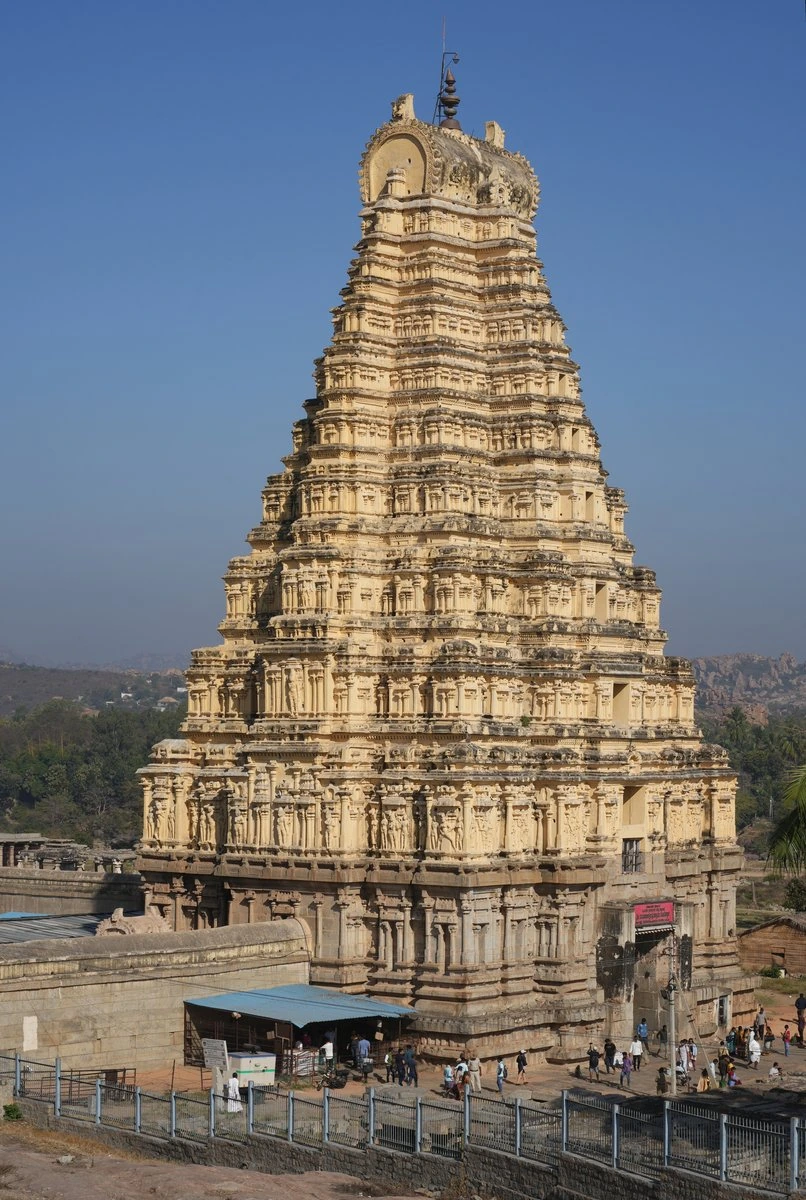
Image Source: Wikimedia
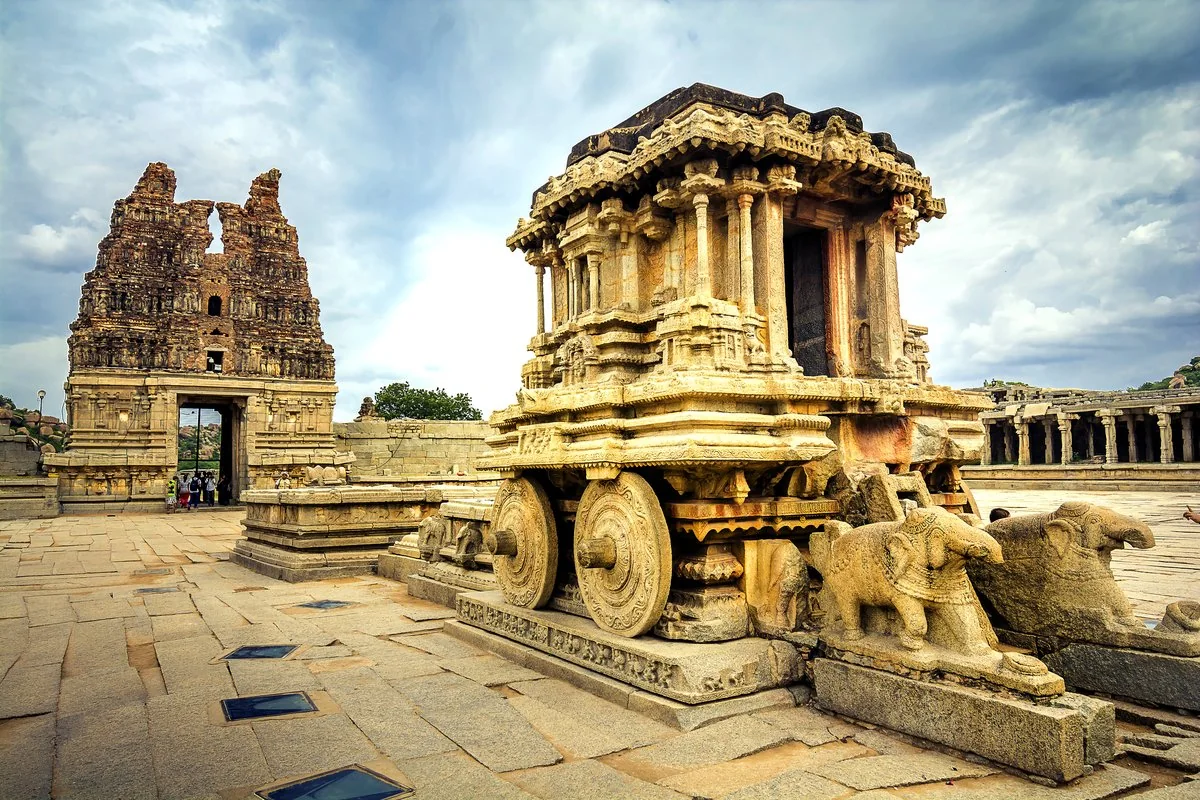
Image Source: Wikimedia
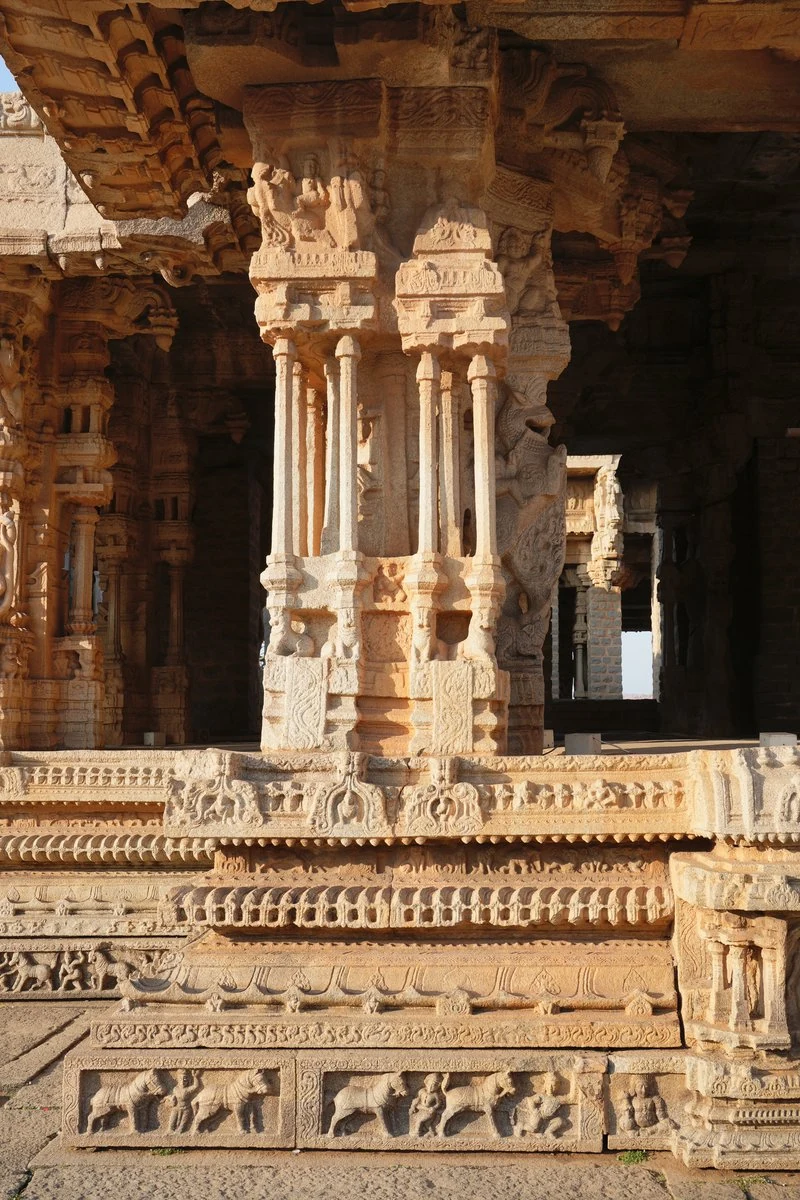
Image Source: Wikimedia
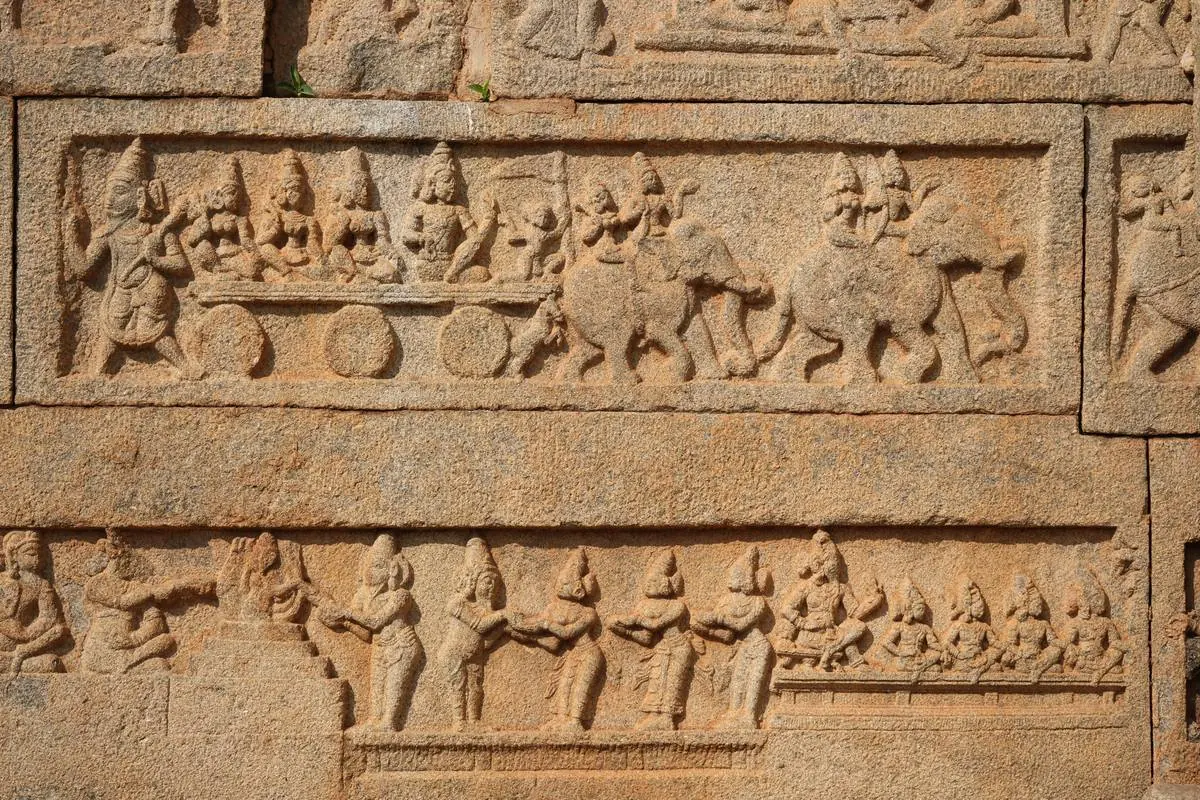
Image Source: Wikimedia
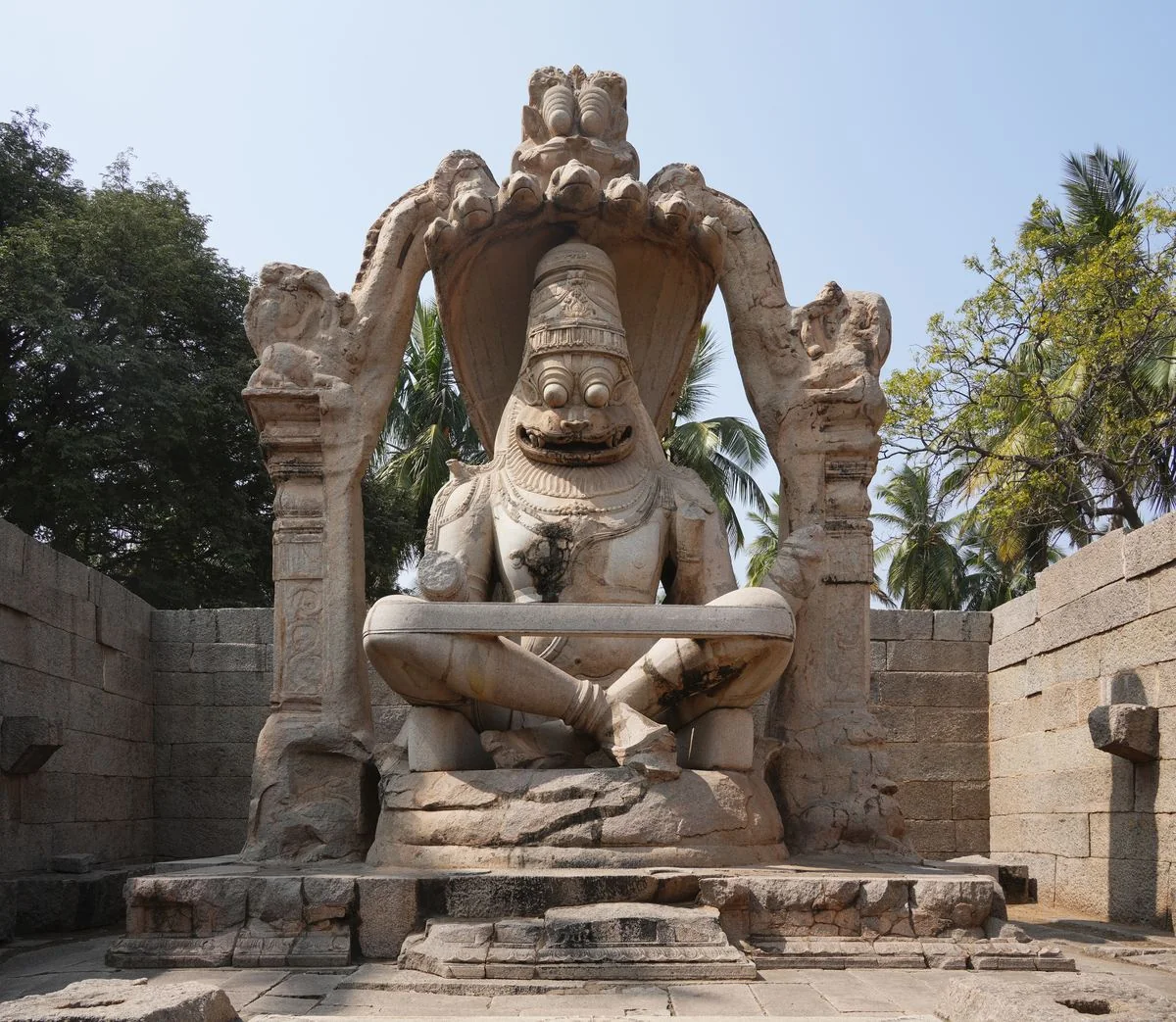
Image Source: Wikimedia
13.3 The Royal Centre
| Monument | What it is |
|---|---|
| Lotus Mahal | A two-storeyed pavilion in the zenana enclosure with lotus-shaped arches and a pyramidal roof; shows the Indo-Islamic blend |
| Elephant Stables | A long building with eleven domed chambers for the royal elephants, with a central hall for musicians |
| Mahanavami Dibba | A stepped granite platform used by the king to watch the Dasara (Mahanavami) festival |
| Queen’s Bath | A large bath with a vaulted corridor and balconies, for the royal women |
| Pushkarani | A stepped tank of granite blocks near the Mahanavami Dibba |
| Zenana enclosure | Walled women’s quarter with watchtowers |
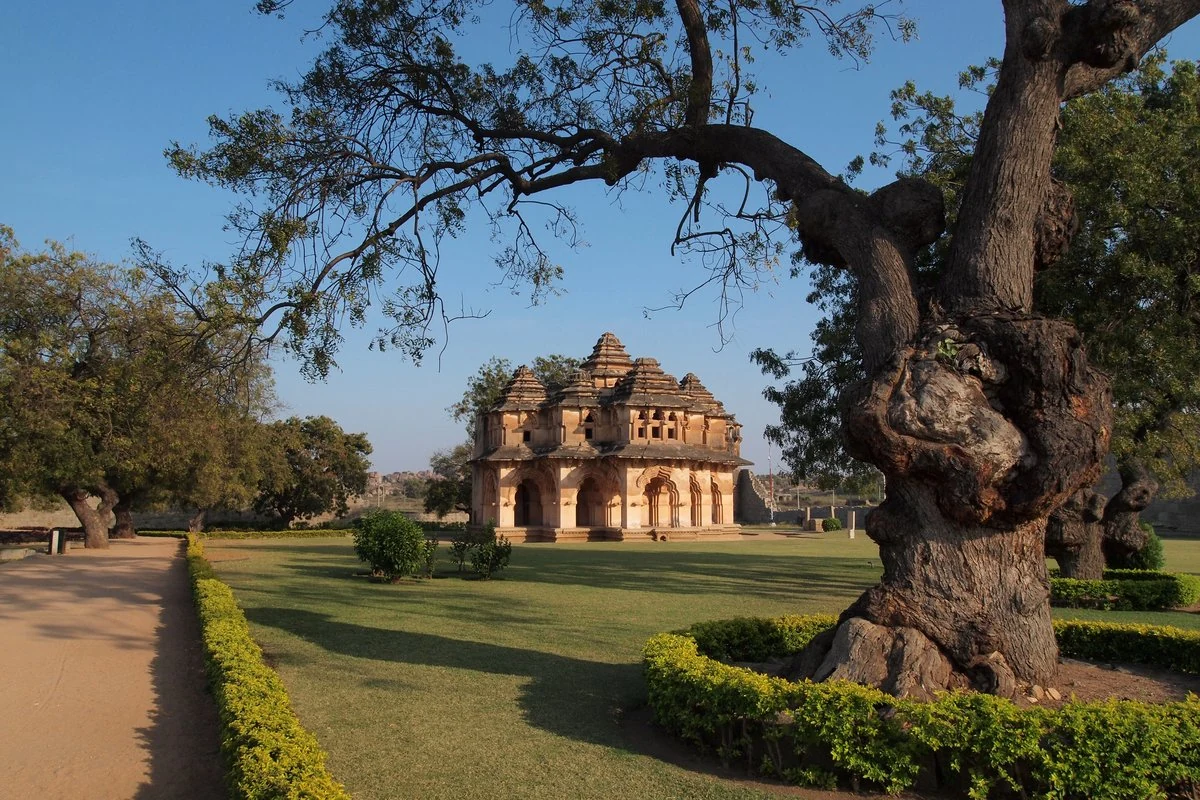
Image Source: Wikimedia
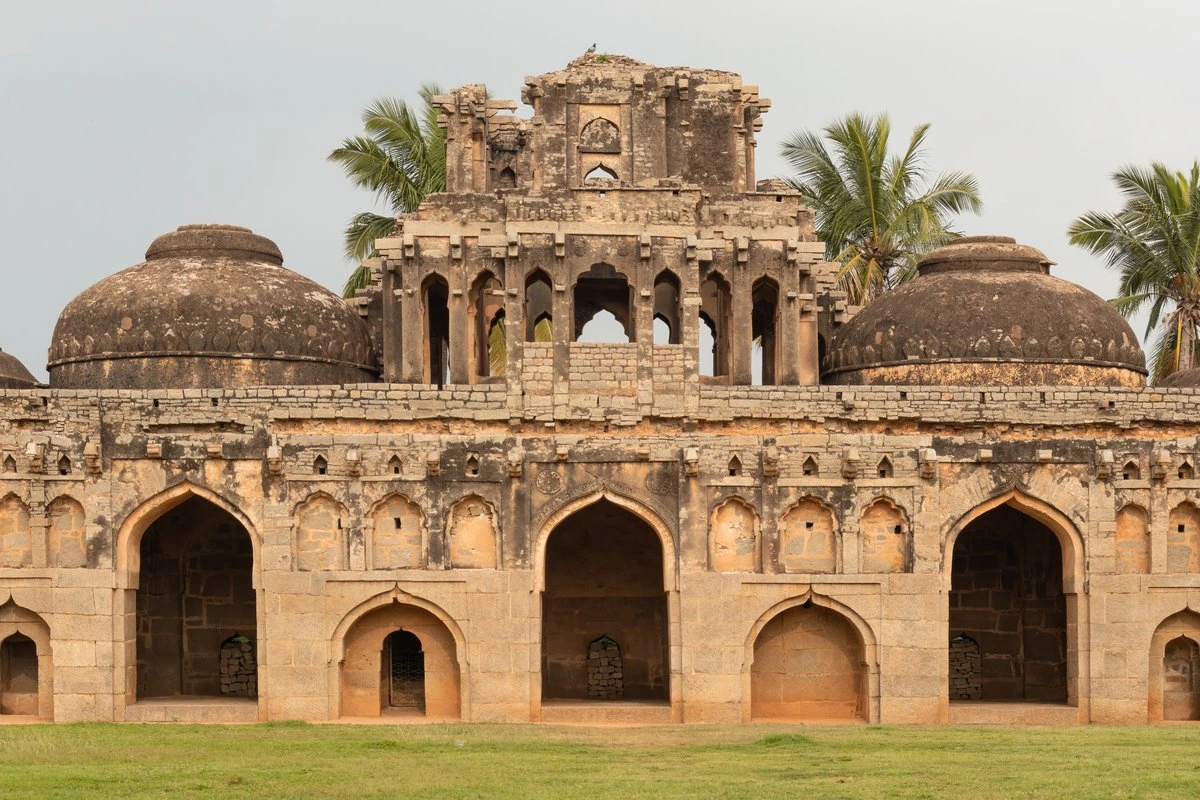
Image Source: Wikimedia
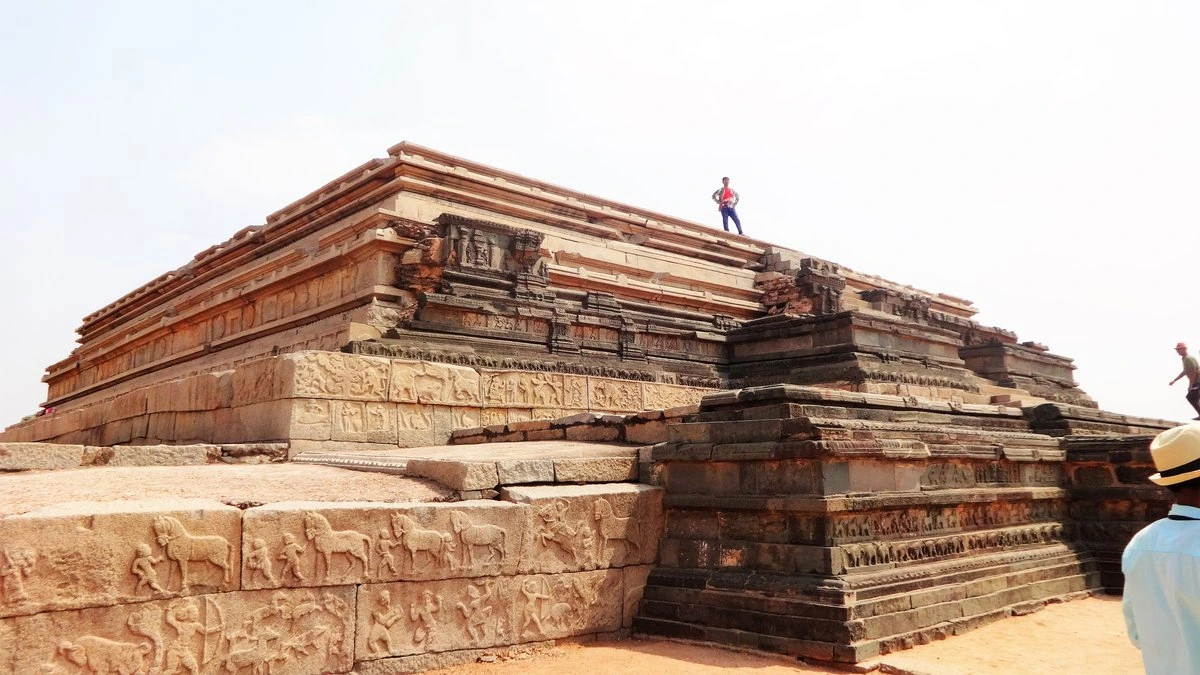
Image Source: Wikimedia
13.4 The city as the travellers saw it
- Abdur Razzaq (1443) wrote that the city had seven concentric lines of fortification: between the first three walls lay fields, gardens and houses, and the royal palace stood inside the seventh.
- Domingo Paes (c. 1520–22) said Vijayanagara was “as large as Rome” and “very beautiful to the sight”, with many tanks, groves and streets full of merchants selling rubies, diamonds, pearls and cloth.
- Layout: the Sacred Centre (Tungabhadra bank and temples), the Royal Centre (palaces and ceremonial buildings) and the Urban Core (bazaars, houses and tanks) were joined by roads and water channels.
- Water works: aqueducts, stepped tanks and canals carried the Tungabhadra water across the site and watered the gardens.
13.5 Rediscovery of Hampi
- 1800: Colin Mackenzie, the first Surveyor General of India, mapped the ruins.
- 1900: Robert Sewell published A Forgotten Empire, which made the history of the empire widely known.
- 1986: UNESCO listed the Group of Monuments at Hampi as a World Heritage Site.
13.6 Hampi in the exam
- Hampi holds the remains of the Vijayanagar Empire. → PYQ: WBCS Prelims 2016 | PYQ: PSC Prelims 2019
- Capital of Vijayanagara: Hampi (the old name was Pampa-kshetra, after the river goddess Pampa). → PYQ: PSC Prelims 2019
- Nayak legacy: the great gopurams of Madurai (Meenakshi) and Srirangam were raised under the Nayak rulers in the Vijayanagara style. → Ancient Art and Architecture
14. Literature under Vijayanagara
In simple words: The Vijayanagara kings were great patrons of scholars. Four languages flourished at once: Sanskrit for religion and commentary, Telugu for the court’s finest poetry, Kannada for devotional songs and epics, and Tamil under the Nayaks. Krishnadevaraya’s reign is the golden age of Telugu literature.
14.1 Telugu
- Krishnadevaraya wrote Amuktamalyada, a Telugu prabandha (also called Vishnuchittiyam) on the love of the Tamil Alvar saint Andal for Vishnu and on the duties of a king. → PYQ: WBCS Prelims 2005 | PYQ: WBCS Prelims 2021 | PYQ: WBCS Prelims 2023
- Language of the work: Telugu. → PYQ: WBCS Prelims 2002
- Ashtadiggajas (the “eight elephants” who held up the Telugu literary world) were patronised by Krishnadevaraya. → PYQ: WBCS Prelims 2024
| Poet | Work |
|---|---|
| Allasani Peddana | Manucharitra (also Swarochisha Sambhava); the greatest Telugu prabandha poet |
| Nandi Thimmana | Parijatapaharanam |
| Madayyagari Mallana | Rajasekhara Charitamu |
| Dhurjati | Kalahasti Mahatmyamu |
| Ayyalaraju Ramabhadrudu | Ramabhyudayamu |
| Pingali Surana | Raghava Pandaviyamu (a poem that tells two stories at once) |
| Ramarajabhushanudu (Bhattumurti) | Vasucharitra |
| Tenali Ramakrishna | Panduranga Mahatmyamu |
- Peddana: given the title Andhra Kavita Pitamaha (“grandfather of Telugu poetry”). → PYQ: WBCS Prelims 2007 | PYQ: WBCS Prelims 2000
- Earlier Telugu: Srinatha at the court of Deva Raya II; his Sringara Naishadham is a classic.
14.2 Kannada
- Kumara Vyasa: Karnata Bharata Katha Manjari (the Mahabharata in Kannada).
- Haridasas: Purandaradasa and Kanakadasa wrote devotional songs (kirtanas).
- Chamarasa: Prabhulinga Leele, at the court of Deva Raya II.
- Krishnadevaraya’s title Kannada Rajya Rama Ramana (“the Rama of the Kannada kingdom”) shows his role as patron of Kannada.
14.3 Sanskrit
- Sayana: the great commentary on the Rigveda (Vedartha Prakasha) and commentaries on the other Vedas, written under Bukka I. → PYQ: WBCS Mains 2016
- Vidyaranya: Panchadashi and other Vedanta works.
- Gangadevi: Madhura Vijayam on the conquest of Madurai.
- Krishnadevaraya: Jambavati Kalyanam and other plays.
- Deva Raya II: Mahanataka Sudhanidhi.
- Tirumalamba Devi: Varadambika Parinayam.
- Vyasatirtha: Nyayamrita and other works of Madhva philosophy.
14.4 The literary map at a glance
| Language | Patron | Key work |
|---|---|---|
| Telugu | Krishnadevaraya | Amuktamalyada, Manucharitra, Parijatapaharanam |
| Kannada | Deva Raya II, Krishnadevaraya | Karnata Bharata Katha Manjari, Prabhulinga Leele, Haridasa kirtanas |
| Sanskrit | Bukka I, Deva Raya II, Krishnadevaraya | Vedartha Prakasha, Madhura Vijayam, Jambavati Kalyanam, Mahanataka Sudhanidhi |
| Tamil | Nayaks of Madurai and Thanjavur | Tiruppugal, Nayak-era pillai-tamil poems |
14.5 Tamil and the Nayaks
- Tamil poetry found patrons in the Nayak courts at Madurai and Thanjavur: the saint-poet Kumaragurupara Swamigal wrote under Tirumala Nayak of Madurai, and the Nayaks of Thanjavur supported Telugu and Tamil music and drama.
- Arunagirinathar: the composer of the Tamil devotional Tiruppugal hymns to Murugan in the 15th century.
15. Sources for Vijayanagara History
In simple words: We know Vijayanagara from four kinds of source: poems and chronicles in several languages, accounts by foreign visitors, inscriptions and coins, and the ruins of Hampi itself.
| Type | Source | What it gives |
|---|---|---|
| Literature | Amuktamalyada (Krishnadevaraya), Madhura Vijayam (Gangadevi), Rayavachakamu, Sanskrit and Telugu court poems | Kings, wars, court life, administration |
| Foreign accounts | Conti, Abdur Razzaq, Barbosa, Paes, Nuniz | City, society, trade, army, festivals |
| Persian chronicles | Ferishta and other Deccan histories | The Bahmani–Vijayanagara wars and Talikota |
| Inscriptions | Copper-plate and stone grants in Kannada, Telugu, Tamil and Sanskrit | Land grants, taxes, titles, genealogies |
| Coins | Gold varaha, pratapa and pana | Kings, deities, economy |
| Monuments | Hampi | Art, architecture, city planning |
| Modern study | Robert Sewell‘s A Forgotten Empire (1900) | Brought the Paes and Nuniz accounts to a wide audience |
16. Do Not Confuse
In simple words: Many names in this chapter look alike. Learn these pairs to avoid the traps.
| Do not confuse | Fact A | Fact B |
|---|---|---|
| Sangama vs Tuluva | First dynasty (1336–1485) | Third dynasty (1505–70), Krishnadevaraya’s |
| Deva Raya I vs II | Conti; first Odisha clash; Hazara Rama | Abdur Razzaq; Gajabetekara |
| Krishnadevaraya vs Achyuta Raya | Amuktamalyada; Raichur 1520; Portuguese friend | Nuniz’s king; Tiruvengalanatha temple |
| Rama Raya vs Tirumala Raya | Regent killed at Talikota | His brother who fled to Penukonda and began the Aravidu line |
| Talikota vs Rakshasi-Tangadi | Same battle (1565) | Alternative name from two villages |
| Vitthala vs Virupaksha | Vishnu temple, stone chariot, musical pillars | Shiva temple, living temple, nine-tier gopuram |
| Nayankara vs Ayagar | Military system; amaram lands | Village officials |
| Varaha vs pagoda | Indian name of gold coin | European name for the same coin |
| Penukonda vs Chandragiri | Capital after 1565 | Capital from 1592 under Venkata II |
| Bahmani vs Vijayanagara | Muslim Sultanate at Gulbarga/Bidar | Hindu empire at Hampi |
| Nikitin vs Abdur Razzaq | Russian, 15th century, Bahmani Bidar | Persian ambassador, Vijayanagara 1443 |
| Ashtadiggajas vs Ashtapradhan | Eight Telugu poets of Krishnadevaraya’s court | The Maratha council of eight ministers, not a Vijayanagara body |
| Pana vs fanam | Indian name of the small gold (or silver) coin | European name for the same coin |
| Vira Narasimha vs Krishnadevaraya | Founder of the Tuluva line (1505); older brother | Younger brother; succeeded in 1509 |
| Deva Raya II vs Vasco da Gama | Ruled 1422–46; Abdur Razzaq in 1443 | Reached Calicut in 1498, after Deva Raya II’s death |
17. Vijayanagara at a Glance
In simple words: One table, one chart: the four dynasties on a single page.
18. Timeline of Vijayanagara
In simple words: The key dates in order, from the founding in 1336 to the end of the Aravidu line in 1646.
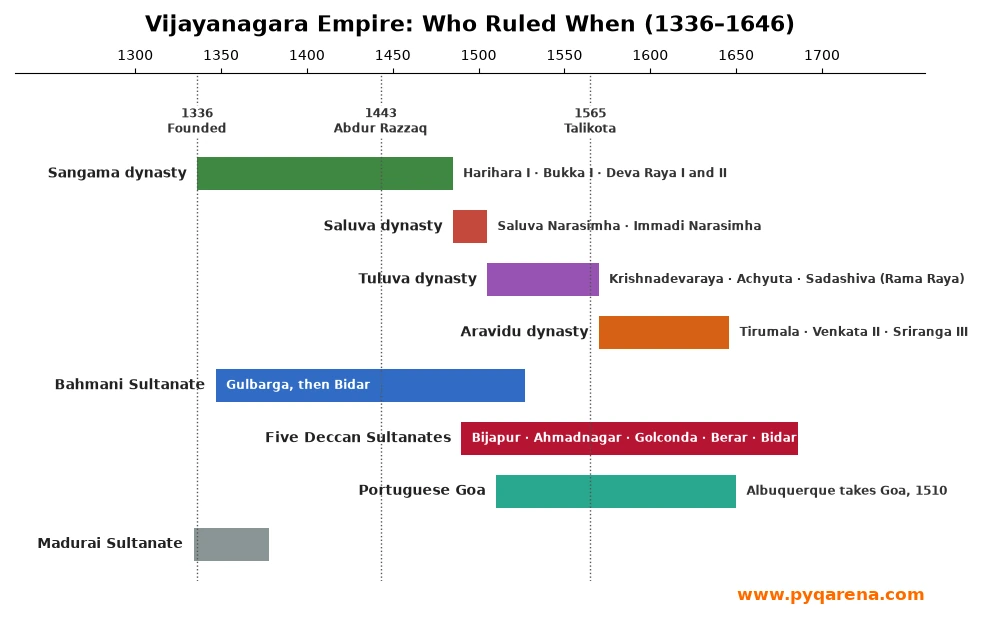
| Year | Event |
|---|---|
| 1323 | Kakatiyas of Warangal fall to Delhi |
| 1336 | Harihara I and Bukka I found Vijayanagara |
| 1347 | Bahmani Sultanate founded at Gulbarga |
| c. 1370 | Kumara Kampana ends the Madurai Sultanate |
| 1374 | Bukka I‘s embassy to China |
| 1406 | Firuz Shah Bahmani defeats Deva Raya I |
| c. 1420 | Nicolo de Conti visits |
| 1443 | Abdur Razzaq visits Deva Raya II |
| 1485 | Saluva Narasimha seizes the throne |
| 1505 | Vira Narasimha founds the Tuluva line |
| 1509 | Krishnadevaraya crowned |
| 1510 | Albuquerque takes Goa |
| 1513–18 | Gajapati campaigns; Udayagiri and Kondavidu taken |
| 1520 | Raichur captured from Ismail Adil Shah |
| 1529 | Achyuta Raya succeeds |
| c. 1535–37 | Nuniz at the court |
| 1542 | Sadashiva Raya and the regent Rama Raya |
| 1565 | Talikota (Rakshasi-Tangadi); Rama Raya killed; Hampi sacked |
| 1570 | Tirumala Raya founds the Aravidu dynasty at Penukonda |
| 1592 | Venkata II moves the capital to Chandragiri |
| 1610 | Raja Wodeyar founds the kingdom of Mysore, in the reign of Venkata II |
| 1639 | The English receive the Madras grant |
| 1646 | Sriranga III defeated; the dynasty ends |
19. Quick Revision and Memory Tricks
In simple words: Short lines and tricks to revise the whole chapter in ten minutes.
19.1 One-line facts
- Founders: Harihara I and Bukka I, sons of Sangama, 1336; adviser Vidyaranya of Sringeri.
- Dynasties in order: Sangama → Saluva → Tuluva → Aravidu.
- Sangama: Bukka I (embassy to China 1374; Madurai conquered); Deva Raya I (Conti, first Odisha clash, Tungabhadra dam and aqueduct); Deva Raya II (Abdur Razzaq 1443, Gajabetekara).
- Saluva: Saluva Narasimha of Chandragiri, who took the throne to save the kingdom; real power with Narasa Nayaka.
- Tuluva: Krishnadevaraya (1509–29): Raichur 1520, Gajapati wars, Amuktamalyada (Telugu), Ashtadiggajas, Hazara Rama and Vitthala.
- Last Tuluvas: Achyuta Raya (Nuniz); Sadashiva and regent Rama Raya.
- Talikota: 1565; Rama Raya beheaded at about 96; four Sultans (Bijapur, Ahmadnagar, Golconda, Bidar).
- Aravidu: Tirumala Raya (Penukonda); Venkata II (Chandragiri; Mysore founded by Raja Wodeyar in 1610); Sriranga III (end, 1646).
- Administration: Nayankara (military chiefs, amaram lands) and Ayagar (twelve village officers); land tax by quality of land, plus an industries tax.
- Money and trade: gold varaha = pagoda; pana = fanam; biggest import horses; ports Honavar, Bhatkal, Calicut, Cochin, Machilipatnam.
- Travellers: Conti (Deva Raya I), Razzaq (Deva Raya II), Paes (Krishnadevaraya), Nuniz (Achyuta).
- Hampi: Vitthala (stone chariot, 56 musical pillars, kalyana mandapa), Virupaksha, Hazara Rama, Lotus Mahal, Elephant Stables, Mahanavami Dibba.
19.2 Memory tricks
- “S-S-T-A” for the dynasties: Sangama, Saluva, Tuluva, Aravidu.
- “Four dates”: 1336 (found), 1485 (Saluva), 1505 (Tuluva), 1565 (Talikota).
- “Peddana = Papa of Telugu poetry”: Peddana = Pitamaha.
- “Royal Centre = L-E-M”: Lotus Mahal, Elephant Stables, Mahanavami Dibba.
20. Frequently Asked Questions
In simple words: Short answers to the questions students ask most about this chapter.
Q1. Who founded the Vijayanagara Empire? Harihara I and Bukka I, in 1336.
Q2. Which dynasty did Krishnadevaraya belong to? The Tuluva dynasty.
Q3. Who wrote Amuktamalyada and in which language? Krishnadevaraya, in Telugu.
Q4. What was the Battle of Talikota? The battle of 23 January 1565, also called Rakshasi-Tangadi, in which the allied Deccan Sultans defeated Rama Raya and ruined Hampi.
Q5. What is the Nayankara system? The system in which military chiefs called nayakas held amaram land from the king in return for keeping an army.
Q6. What is the coin pagoda? The European name for the gold varaha of Vijayanagara.
Q7. Which foreign traveller visited Vijayanagara in 1443? Abdur Razzaq, the ambassador of Shah Rukh.
Q8. Which are the Ashtadiggajas? The eight great Telugu poets of Krishnadevaraya‘s court, led by Allasani Peddana.
Q9. Who built the Vitthala temple at Hampi? Krishnadevaraya began it (about 1513), and Achyuta Raya carried on the work.
Q10. What is the Raichur Doab? The fertile land between the Krishna and Tungabhadra rivers, over which Vijayanagara and the Bahmani Sultanate fought.
Q11. Who built the dam and aqueduct from the Tungabhadra to the capital? Deva Raya I.
Q12. What is a kalyana mandapa? A pillared hall in a Vijayanagara temple for the marriage of the deity.
Q13. What did the term fanam refer to? A coin: the small gold or silver pana of Vijayanagara.
21. Summary
In simple words: The whole chapter in one paragraph.
Harihara I and Bukka I founded Vijayanagara in 1336 on the Tungabhadra with the advice of Vidyaranya, and the Sangama kings conquered Madurai, fought the Bahmanis for the Raichur Doab and reached a first peak under Deva Raya II. The Saluvas held the empire together briefly, and the Tuluva dynasty took it to its height under Krishnadevaraya (1509–29), who took Raichur, humbled the Gajapatis, welcomed the Portuguese, wrote the Amuktamalyada and built the Hazara Rama and Vitthala temples with the help of the Ashtadiggajas. His successors lost power to Rama Raya, who fell at Talikota (1565); Hampi was sacked. The Aravidu kings ruled from Penukonda and Chandragiri until 1646, while the Nayaks became independent. The empire was run through the nayankara and ayagar systems, lived on temple-centred agriculture and the import of horses, minted the gold varaha, and was described by Conti, Abdur Razzaq, Paes, Nuniz and others. Its legacy is Hampi, a UNESCO World Heritage Site, and a literature in Telugu, Kannada, Sanskrit and Tamil.
🔗 Related Notes and Practice
- Notes:
- Delhi Sultanate
- Provincial Kingdoms of the Sultanate Period
- Medieval Bengal
- Early Medieval India and Rajput Kingdoms
- Early Medieval Regional Kingdoms
- Sangam Age and Early South India
- Foreign Travellers in India
- Ancient Art and Architecture
- Ancient Indian Economy, Society and Coinage
- Ancient Literature and Scientific Works
- Religious Movements of Ancient India
- Practice:
- WBCS Mains Vijayanagar and Bahmani PYQs
- WBCS Prelims Medieval Indian History PYQs
- PSC Miscellaneous Prelims History PYQs
- WBCS Mains General Knowledge History PYQs
- WBCS Mains Advent of Europeans PYQs
- WBCS Mains South Indian Dynasties PYQs
- WBCS Mains Religious Movements PYQs
- WBCS Mains General Knowledge Art and Culture PYQs
- WBCS Mains General Knowledge Books and Literature PYQs
- UPSC Prelims Medieval History: Vijayanagara and Regional Kingdoms PYQs
- UPSC Prelims Art and Culture: Architecture PYQs
- UPSC Prelims Medieval History: Administration, Culture and Marathas PYQs
- UPSC Prelims European Expansion PYQs
Leave a Comment