

Who is this for? Beginners and aspirants for UPSC Prelims, WBCS, other State PSCs and SSC. Each section opens with an “In simple words” explanation and then goes to exam-level detail. Practise alongside: WBCS Mains Pre-Mauryan & Mauryan PYQs | WBCS Prelims Ancient Indian History PYQs. Previous chapters: Prehistoric India Notes → Indus Valley Civilization Notes → Vedic Age Notes
1. Background: The Second Urbanisation (c. 600–300 BCE)
In simple words: About 1,000 years after the Harappan cities disappeared, cities grew again in India. This time they grew in the Ganga valley. This is called the Second Urbanisation. Big states, coins, trade and new religions such as Buddhism and Jainism all appeared in this age.
Why cities grew again:
- Iron tools. Iron axes cleared the thick Ganga forests, and iron ploughshares turned more land into farms.
- Wet-rice farming. Rice grew well on the fertile soil, so villages produced surplus food.
- Trade and crafts. Surplus food supported traders and craftsmen. Merchants were called setthis, craftsmen’s guilds were called shrenis, and rich landowners were called gahapatis.
- Coins. Punch-marked coins came into use, which made trade easier (see Section 9).
- Pottery marker. Archaeologists identify this period by NBPW (Northern Black Polished Ware), a glossy black pottery made from about 700 to 200 BCE.
Main cities of this age: Rajagriha, Pataliputra, Shravasti, Kaushambi, Varanasi, Champa, Ujjain and Taxila.
Where the Mahajanapadas were: most of them were in North India, mainly in the Ganga plains. → PYQ: WBCS Mains 2017
2. The 16 Mahajanapadas
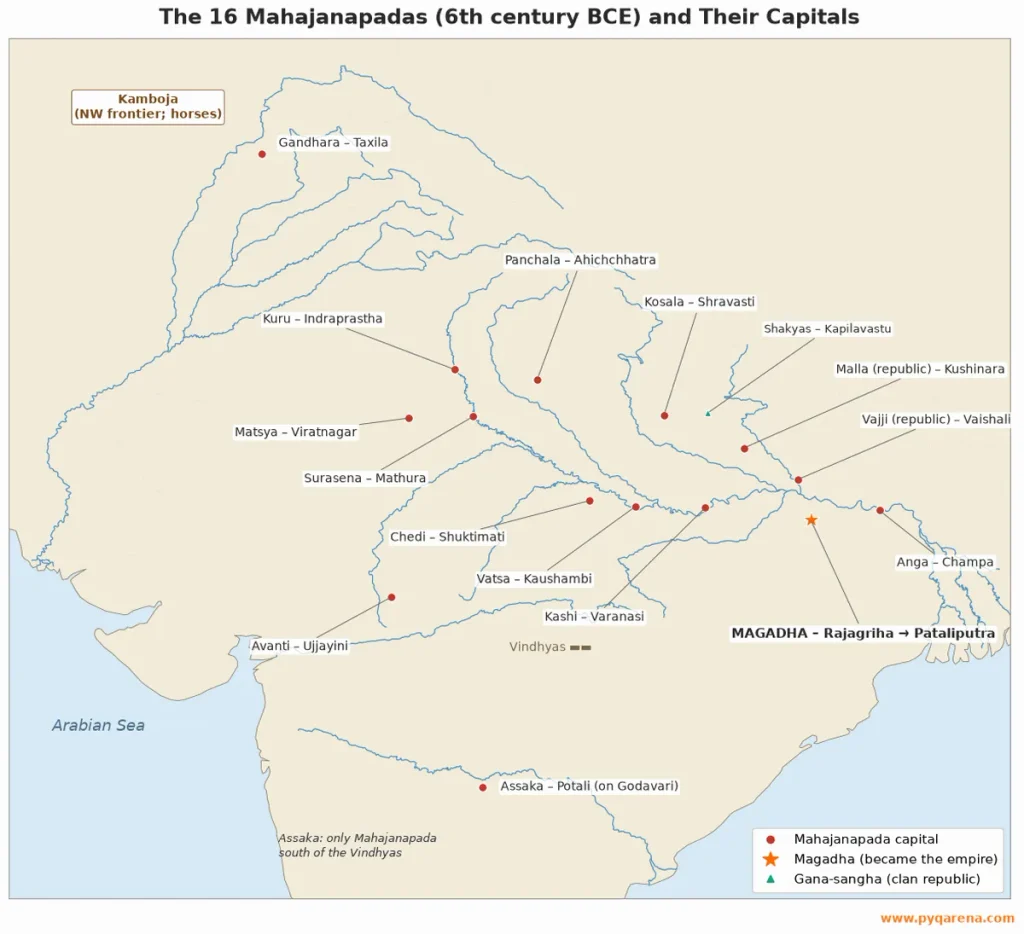
In simple words: The tribes (janas) of the Vedic age settled down and became territories. A territory was called a janapada, and a large or powerful one was called a Mahajanapada (“great state”). In the 6th century BCE there were 16 Mahajanapadas. → PYQ: WBCS Mains GK 2020
Sources for the list:
- The Buddhist text Anguttara Nikaya gives the list of 16. → PYQ: WBCS Prelims 2024
- The Jain text Bhagavati Sutra gives its own list of 16. That list includes Vanga and Malaya.
| # | Mahajanapada | Capital | Modern region | River / note |
|---|---|---|---|---|
| 1 | Anga | Champa | Bhagalpur–Munger (Bihar) | Champa river. Annexed by Bimbisara |
| 2 | Magadha | Girivraja / Rajagriha, later Pataliputra | Patna–Gaya (Bihar) | Ganga, Son. Became the empire → PYQs: WBCS Prelims 2018, 2023 |
| 3 | Kashi | Varanasi | Varanasi (UP) | Varuna and Assi rivers. Absorbed by Kosala |
| 4 | Kosala | Shravasti (also Ayodhya/Saketa) | Eastern UP (Awadh) | Sarayu. King Prasenajit |
| 5 | Vajji (Vriji) | Vaishali | North Bihar | Republic: a confederacy of 8 clans. → PYQ: WBCS Mains GK 2023 |
| 6 | Malla | Kushinara and Pava | Gorakhpur–Deoria (UP) | Republic. Buddha died at Kushinara and Mahavira at Pava |
| 7 | Chedi | Shuktimati (Sotthivati) | Bundelkhand | Ken river |
| 8 | Vatsa (Vamsa) | Kaushambi | Prayagraj (UP) | Yamuna. King Udayana |
| 9 | Kuru | Indraprastha (also Hastinapur) | Delhi–Meerut–Haryana | Yamuna |
| 10 | Panchala | Ahichchhatra (north), Kampilya (south) | Rohilkhand (western UP) | Ganga |
| 11 | Matsya | Viratnagar (Bairat) | Jaipur–Alwar (Rajasthan) | — |
| 12 | Surasena | Mathura | Mathura (UP) | Yamuna |
| 13 | Assaka (Ashmaka) | Potali (Paudanya) | Maharashtra / Telangana | Godavari. The only Mahajanapada south of the Vindhyas |
| 14 | Avanti | Ujjayini (north), Mahishmati (south) | Malwa (MP) | Kshipra, Narmada. King Chanda Pradyota |
| 15 | Gandhara | Taxila (Takshashila) | Rawalpindi–Peshawar (Pakistan) | Indus. A centre of learning |
| 16 | Kamboja | Rajapura | Hazara / NE Afghanistan | Famous for horses |
Memory trick: say them in pairs, from east to west.
“Anga-Magadha, Kashi-Kosala, Vajji-Malla, Chedi-Vatsa, Kuru-Panchala, Matsya-Surasena, Assaka-Avanti, Gandhara-Kamboja.”
Exam facts from the table
- Four great monarchies in the Buddha’s age: Magadha, Kosala, Vatsa and Avanti. They fought each other for supremacy, and Magadha won. → PYQs: WBCS Mains 2016, 2022
- Saurashtra, Pragjyotishpur and Sialkot were not Mahajanapadas.
- The only state south of the Vindhyas: Assaka.
- The Kashi–Kosala–Magadha rivalry: Kashi was the prize. Bimbisara received a Kashi village as dowry when he married the Kosalan princess.
3. Monarchies vs Gana-Sanghas (Republics)
In simple words: Most states had a king (monarchy). Some were run by an assembly of clan heads, a bit like a council. These were called gana-sanghas or republics.
| Feature | Monarchy | Gana-sangha |
|---|---|---|
| Ruler | Hereditary king | Assembly of rajas (clan heads) meeting in a santhagara (assembly hall) |
| Location | Ganga plains (Magadha, Kosala) | Himalayan foothills, north Bihar, eastern UP |
| Priests | Brahmanical rituals important | Less priestly influence. Buddhism and Jainism flourished here |
| Examples | Magadha, Kosala, Vatsa, Avanti | Vajji, Malla, Shakya, Koliya, Moriya |
Important gana-sanghas:
| Clan | Capital | Fact |
|---|---|---|
| Vajji confederacy | Vaishali | 8 clans, the chief ones being the Licchavis, Videhas and Jnatrikas. The world’s earliest known republic. → PYQ: WBCS Mains 2023 |
| Licchavis | Vaishali | Mahavira’s mother Trishala was a Licchavi |
| Jnatrikas | Kundagrama | Mahavira’s clan |
| Videhas | Mithila | Old kingdom of Janaka |
| Shakyas | Kapilavastu | Gautama Buddha’s clan. → PYQ: WBCS Mains 2022 |
| Koliyas | Ramagrama | Clan of the Buddha’s mother |
| Mallas | Kushinara, Pava | Buddha’s death took place at Kushinara |
| Moriyas | Pippalivana | The Mauryas came from this clan |
- Match carefully: Moriyas–Pippalivana ✔, Videhas–Mithila ✔, Licchavis–Vaishali ✔, Mallas–Kapilavastu ✘. Kapilavastu belongs to the Shakyas; the Mallas’ capital is Kushinara. → PYQ: WBCS Prelims 2022
4. Why Did Magadha Rise to Power?
In simple words: Magadha had everything a growing kingdom needs: iron, fertile land, rivers, forests full of elephants, safe capitals and very ambitious kings.
| Reason | Detail |
|---|---|
| Iron | Rich iron ore near Rajgir and in the Chhotanagpur area gave better weapons and tools |
| Fertile land | Alluvial Ganga soil and heavy rainfall gave rice surpluses and a large tax income |
| Rivers | The Ganga, Son and Gandak gave trade routes and natural defence |
| Safe capitals | Rajagriha is surrounded by five hills. Pataliputra was a water-fort at the meeting of the Ganga and Son |
| Elephants | From the eastern forests. Magadha was the first to use elephants on a large scale in war |
| Forests | Timber for buildings and chariots |
| Society | A mixed and less orthodox society that was open to new ideas |
| Rulers | Able and ambitious kings: Bimbisara, Ajatashatru, Mahapadma Nanda |
Result: Magadha was the one Mahajanapada that founded an empire. → PYQ: WBCS Prelims 2023
5. Dynasties of Magadha
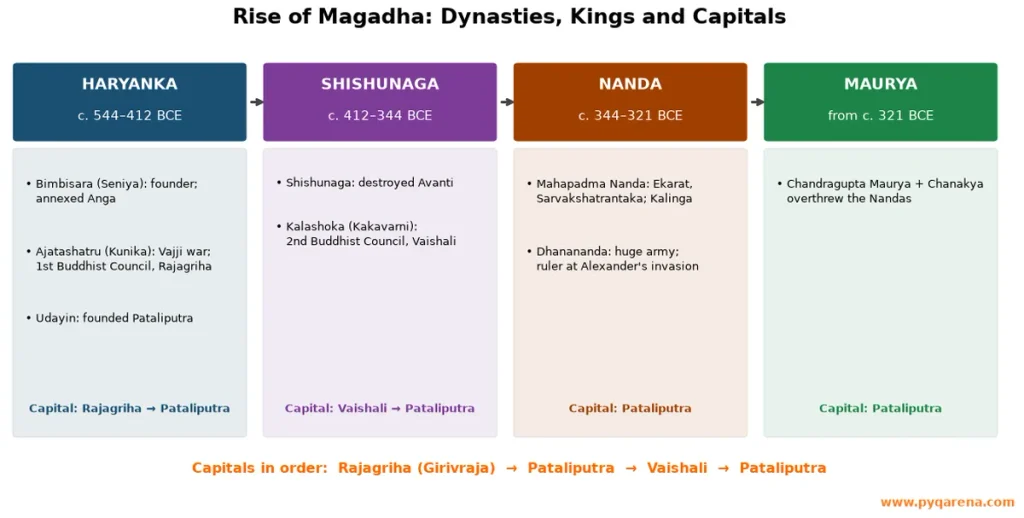
5.1 Haryanka Dynasty (c. 544–412 BCE)
This family made Magadha the strongest state, partly by marriage and partly by war.
Bimbisara (c. 544–492 BCE)
- Founder of the Haryanka dynasty. → PYQs: WBCS Mains 2022 | WBCS Mains GK 2023
- Also called Seniya / Shrenika. → PYQ: WBCS Prelims 2017
- Capital: Girivraja (Rajagriha / Rajgir), the first capital of Magadha. → PYQs: WBCS Mains 2022 | WBCS Prelims 2005
- Marriage alliances:
- Kosala Devi, sister of Prasenajit of Kosala. Her dowry was a Kashi village.
- Chellana, a Licchavi princess of Vaishali.
- Khema, of Madra (Punjab).
- Conquest: he annexed Anga (capital Champa), defeating King Brahmadatta.
- He sent his royal physician Jivaka to treat Chanda Pradyota of Avanti. Jivaka was the famous physician of the Buddha’s time. → PYQ: WBCS Prelims 2017
- He was a contemporary of both the Buddha and Mahavira. → PYQ: WBCS Prelims 2014
Ajatashatru (c. 492–460 BCE)
- Also called Kunika. → PYQ: WBCS Prelims 2005
- He killed his father Bimbisara and took the throne.
- Wars:
- He fought Kosala (Prasenajit). The war ended in peace, with Magadha keeping Kashi.
- He spent 16 years fighting the Vajji confederacy (the Licchavis). His minister Vassakara first broke their unity by sowing quarrels among them.
- New war machines: Mahashilakantaka, a catapult for hurling big stones, and Rathamusala, a chariot with a mace or blades fixed to it. → PYQ: WBCS Mains 2016
- He built a fort at Pataligrama, the seed of Pataliputra.
- Both the Buddha (483 BCE) and Mahavira died during his reign. → PYQ: WBCS Mains 2017
- First Buddhist Council: held in the Saptaparni cave, Rajagriha, c. 483 BCE, under his patronage and presided over by Mahakassapa. → PYQs: WBCS Prelims 2023, 2024
Udayin (c. 460–444 BCE)
- He founded Pataliputra at the meeting of the Ganga and Son and moved the capital there.
- The last Haryanka king was Nagadasaka.
5.2 Shishunaga Dynasty (c. 412–344 BCE)
- Shishunaga was a minister (amatya) who was made king by the people.
- He destroyed Avanti, ending the Pradyota dynasty. This ended the long Magadha–Avanti rivalry.
- He moved the capital to Vaishali for a time.
- Kalashoka (Kakavarni) moved the capital back to Pataliputra.
- Second Buddhist Council: held at Vaishali in 383 BCE under Kalashoka. It led to the first split, into the Sthaviravadins and the Mahasanghikas.
5.3 Nanda Dynasty (c. 344–321 BCE)
In simple words: The Nandas were the first “empire-builders” of India. They were very rich, had a huge army, and were famously unpopular.
Mahapadma Nanda
- Founder of the Nanda dynasty. → PYQs: WBCS Prelims 2002, 2009
- He was of low birth, and the Puranas call him the first non-Kshatriya ruler.
- Titles: Ekarat (sole monarch) and Sarvakshatrantaka (destroyer of all Kshatriyas). He is also called Ugrasena.
- He conquered Kalinga. Kharavela’s Hathigumpha inscription refers to a “Nandaraja” and a canal in Kalinga.
Dhanananda
- The last Nanda king. Greek writers call him Agrammes / Xandrames.
- He was the ruler of Magadha at the time of Alexander’s invasion. → PYQ: WBCS Mains 2023
- Huge army: about 2,00,000 infantry, 20,000 cavalry, 2,000 chariots and 3,000 elephants. Fear of this army was one reason Alexander’s soldiers refused to march east.
- Famous wealth: the name “Dhana” means wealth. He was unpopular because of his heavy taxes.
End of the Nandas
- Chandragupta Maurya, guided by Chanakya (Kautilya), overthrew the Nandas in c. 321 BCE.
- This is the subject of Vishakhadatta’s play Mudrarakshasa. → PYQ: WBCS Prelims 2016
- The Nandas ruled Magadha just before the Mauryas. → PYQ: WBCS Mains 2023
- First historical emperor of India: Chandragupta Maurya, not Bimbisara or Mahapadma Nanda. → PYQs: WBCS Prelims 2000, 2004, 2023
5.4 Capitals of Magadha in order
| Order | Capital | Under |
|---|---|---|
| 1 | Girivraja / Rajagriha (Rajgir) | Bimbisara |
| 2 | Pataliputra | Udayin |
| 3 | Vaishali | Shishunaga |
| 4 | Pataliputra (again, for good) | Kalashoka → Nandas → Mauryas (Chandragupta). → PYQ: WBCS Mains 2023 |
6. Persian (Achaemenid) Invasion
In simple words: Before Alexander, the kings of Persia (Iran) captured parts of north-west India and collected huge taxes from it.
- Cyrus (c. 558–530 BCE) was the first Persian ruler to campaign towards India, in the Gandhara region.
- Darius I (c. 522–486 BCE) conquered Punjab, Sindh and Gandhara. They became the 20th satrapy (province) of the Persian Empire.
- That satrapy was the most populous and most prosperous province. It paid 360 talents of gold dust a year, a third of all the empire’s revenue. This information comes from Herodotus, the “Father of History“. → PYQs: WBCS Mains 2016 | WBCS Mains GK 2020
- Indian soldiers fought in the army of Xerxes against the Greeks.
Effects of the Persian contact:
- The Kharosthi script, which is written right to left and comes from Aramaic. Ashoka’s edicts in the north-west use it.
- Persian coins (the gold daric and the silver siglos) encouraged Indian coinage.
- The satrap system of provincial government.
- Persian influence on Mauryan art: the idea of pillars and of royal edicts carved on rock.
- Growth of trade between India and West Asia.
7. Alexander’s Invasion (327–325 BCE)

In simple words: Alexander of Macedonia (Greece) conquered the Persian Empire and then entered India. He defeated King Porus at the Jhelum river. His tired army refused to go further, so he turned back.
Before India
- Alexander was king of Macedonia from 336 to 323 BCE. That is the period when he conquered Asia and reached India. → PYQ: PSC Misc 2018
- He was the son of Philip II and a student of Aristotle.
Route into India
- He crossed the Hindu Kush in 327 BCE and entered India, crossing the Indus in 326 BCE. → PYQ: WBPSC Clerkship 2019
- Ambhi, the king of Taxila, surrendered to him and helped him. Ambhi was a rival of Porus. → PYQ: WBCS Mains 2016
Battle of the Hydaspes (326 BCE)
- Fought between Alexander and Porus (Puru), the ruler of the land between the Jhelum and the Chenab. → PYQs: WBCS Mains 2022 | WBCS Mains GK 2018
- It took place on the banks of the Jhelum (Hydaspes). → PYQ: WBCS Prelims 2014
- Porus offered the stiffest resistance. → PYQ: WBCS Prelims 2013
- When Porus was captured and asked how he wished to be treated, he replied “as a king treats a king.” Alexander gave his kingdom back to him.
Turning back
- His soldiers refused to cross the Beas (Hyphasis), partly out of fear of the huge Nanda army.
- He returned through Sindh. His admiral Nearchus sailed the fleet back by sea.
- Alexander stayed in India for about 19 months. → PYQs: WBCS Prelims 2006, 2011
- He died in Babylon in 323 BCE.
- He founded the cities of Bucephala (named after his horse) and Nicaea.
Effects
- His campaign opened land and sea routes between India and the West.
- Greek writers left dated records. 326 BCE is the first firm date in Indian history.
- The north-west was left divided and weak, which helped Chandragupta Maurya unify it.
- Indo-Greek contact later helped produce Gandhara art.
- Greek sources: Arrian, Plutarch, Curtius, Diodorus.
8. Administration, Economy & Society
Taxes and administration
- Bali: became a regular tax.
- Bhaga: the king’s share of the crop, usually one-sixth.
- Shulka: customs and tolls.
- Kara: a general tax.
- Vishti: forced (unpaid) labour. → PYQ: WBCS Prelims 2022
- Officials: village headmen (gramabhojaka) collected taxes. Kings kept standing armies and paid them with tax money.
Economy
- Farming: rice, wheat, sugarcane and cotton.
- Crafts were organised in guilds (shreni). Long-distance trade ran along the Uttarapatha and Dakshinapatha routes.
Towns and learning
- Big towns grew up at Rajagriha, Shravasti and Kaushambi.
- Taxila was a famous centre of learning.
Society
- The varna system hardened.
- Chandalas were treated as untouchables.
- Merchants became richer and more important, and many of them supported the new religions.
New religions
- Buddhism, Jainism and the Ajivikas (founded by Makkhali Gosala) all arose at this time.
- They reacted against costly Vedic rituals and found support in the cities and among the gana-sanghas.
9. Coinage: Punch-Marked Coins
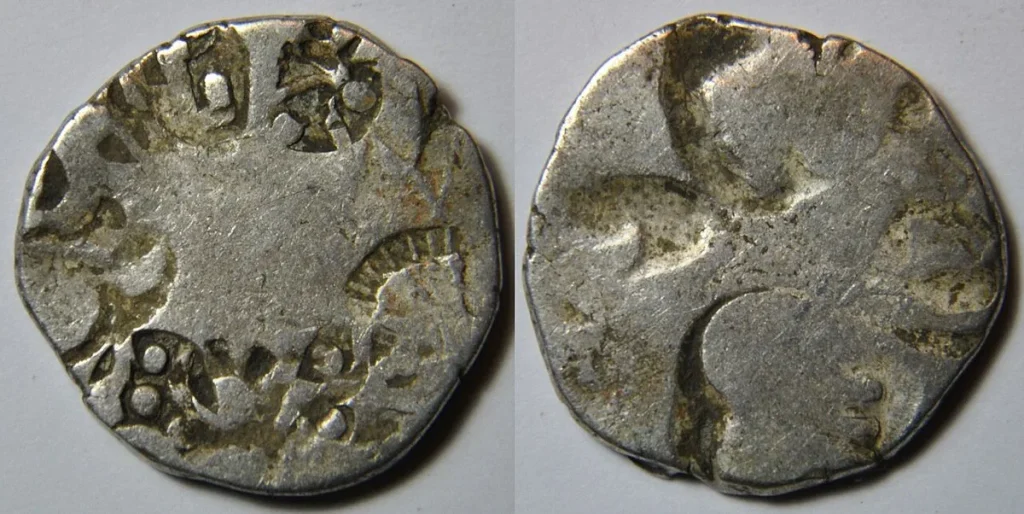
Image Source: Wikimedia
In simple words: India’s first coins were small pieces of silver with symbols punched on them (sun, tree, animals, hills). They are called punch-marked coins, or aahat coins.
- When: c. 6th–5th century BCE. Most were silver; some were copper.
- What they were called: Karshapana or pana, a type of currency. → PYQ: WBCS Mains 2022
- Who issued them: guilds and merchants issued them first, and later the state did. They had no king’s name or portrait.
- Where they are found: the largest numbers come from the Ganga valley (Magadha). Mauryan-era punch-marked coins carry five symbols.
- Other units: Nishka and Satamana (gold and silver units in the texts).
10. Sources for This Period
| Type | Source | What it gives |
|---|---|---|
| Buddhist | Anguttara Nikaya | List of the 16 Mahajanapadas |
| Buddhist | Digha Nikaya, Jatakas, Mahavamsa, Dipavamsa | Kings, cities, the Buddhist Councils |
| Jain | Bhagavati Sutra | Its own list of 16 Mahajanapadas |
| Jain | Parishishtaparvan (Hemachandra) | Stories of the Magadhan kings |
| Brahmanical | Puranas | Dynastic lists (Haryanka, Shishunaga, Nanda) |
| Grammar | Panini’s Ashtadhyayi | Janapadas and gana-sanghas |
| Greek | Herodotus, Arrian, Plutarch, Curtius | Persian and Alexander’s invasions, the Nanda army |
| Archaeology | NBPW pottery, punch-marked coins, Rajgir walls | Second urbanisation |
11. Frequently Asked Facts
| Question | Answer |
|---|---|
| Number of Mahajanapadas | 16 |
| Buddhist text listing them | Anguttara Nikaya |
| Jain text listing them | Bhagavati Sutra |
| Region with most Mahajanapadas | North India (Ganga plains) |
| Only Mahajanapada south of the Vindhyas | Assaka |
| Kingdom covering Patna–Gaya | Magadha |
| Mahajanapada that built an empire | Magadha |
| Republic of 8 clans | Vajji (capital Vaishali) |
| Buddha’s clan | Shakya (Kapilavastu) |
| Mallas’ capital | Kushinara (and Pava) |
| Founder of the Haryanka dynasty | Bimbisara (Seniya) |
| First capital of Magadha | Girivraja / Rajagriha |
| Ajatashatru also called | Kunika |
| Rathamusala & Mahashilakantaka | Ajatashatru |
| Buddha & Mahavira died in the reign of | Ajatashatru |
| Contemporary of both the Buddha and Mahavira | Bimbisara (also Ajatashatru) |
| Founder of Pataliputra | Udayin |
| Capital moved to Vaishali | Shishunaga |
| Second Buddhist Council | Vaishali, Kalashoka, 383 BCE |
| Physician of the Buddha’s age | Jivaka |
| Founder of the Nanda dynasty | Mahapadma Nanda |
| Magadha’s ruler during Alexander’s invasion | Dhanananda |
| Dynasty before the Mauryas | Nanda |
| Play on the fall of the Nandas | Mudrarakshasa (Vishakhadatta) |
| First historical emperor | Chandragupta Maurya |
| 20th satrapy of Persia | Indian province (Herodotus) |
| Father of History | Herodotus |
| Battle of the Hydaspes | Alexander vs Porus, 326 BCE, Jhelum |
| King of Taxila who surrendered | Ambhi |
| Alexander’s stay in India | About 19 months |
| Alexander’s reign | 336–323 BCE |
| First coins of India | Punch-marked (karshapana) |
| Unpaid labour | Vishti |
12. Quick-Revision Sheet
- Second urbanisation: iron + rice surplus + trade + coins + NBPW, c. 600–300 BCE.
- 16 Mahajanapadas (Anguttara Nikaya): AM KK VM CV KP MS AA GK.
- Big four monarchies: Magadha, Kosala, Vatsa, Avanti. Republics: Vajji (Vaishali), Malla (Kushinara, Pava), Shakya (Kapilavastu).
- Why Magadha won: iron, fertile soil, rivers, elephants, five-hill Rajgir, water-fort Pataliputra, able kings.
- Haryanka: Bimbisara (Seniya; Girivraja; marriages; Anga; Jivaka) → Ajatashatru (Kunika; patricide; Vajji war; Rathamusala; First Council at Rajagriha) → Udayin (Pataliputra).
- Shishunaga: Avanti destroyed; Vaishali capital; Kalashoka; Second Council at Vaishali (383 BCE).
- Nanda: Mahapadma (Ekarat, Sarvakshatrantaka, Kalinga) → Dhanananda (Agrammes; huge army; Alexander’s time) → overthrown by Chandragupta and Chanakya (Mudrarakshasa).
- Capitals: Rajgir → Pataliputra → Vaishali → Pataliputra.
- Persian: Cyrus, Darius I; 20th satrapy; Herodotus; Kharosthi from Aramaic.
- Alexander: 336–323 BCE reign; Ambhi surrendered; Hydaspes (Jhelum) 326 BCE vs Porus; army stopped at the Beas; about 19 months in India.
- Coins: punch-marked silver karshapana. Taxes: bali, bhaga (1/6), shulka, vishti (forced labour).
13. Related PYQs on PYQ Arena
- WBCS Mains Pre-Mauryan & Mauryan Empire PYQs
- WBCS Prelims Ancient Indian History Previous Year Questions (1999–2024)
- WBCS Mains Buddhism & Jainism PYQs
- WBCS Mains General Knowledge – History PYQs
- WBCS Mains Stone Age & Miscellaneous PYQs
- WBPSC Miscellaneous Prelims History Questions
- WBPSC Clerkship History Previous Year Questions
- Previous chapters: Prehistoric India Notes | Indus Valley Civilization Notes | Vedic Age Notes
Leave a Comment