

Who is this for? Beginners and aspirants for WBCS, UPSC Prelims, other State PSCs, WBP and Clerkship exams. This is Chapter 11 of Medieval Indian History. It covers the Later Mughals from Bahadur Shah I to Shah Alam II, the Sayyid brothers, Nadir Shah’s invasion of 1739, Ahmad Shah Abdali, the causes of Mughal decline, and the regional states that rose in the eighteenth century: Bengal, Awadh, Hyderabad, the Carnatic, Mysore, the Sikhs, the Jats, the Rajputs, the Rohillas and Travancore. The Marathas, the largest successor power, have their own notes, The Marathas. The reign of Aurangzeb is in Mughal Empire; the jagir and mansab crisis has its roots in Mughal Administration, Economy and Society. Every exam question that belongs to this century is answered below. 🔗 Practise alongside: WBCS Prelims Modern Indian History PYQs | WBCS Mains Advent of Europeans PYQs | UPSC Prelims Modern History: European Expansion PYQs | WBCS Prelims Medieval Indian History PYQs | WBCS Mains Mughal Empire PYQs | UPSC Prelims Medieval History: Mughal Empire PYQs | PSC Miscellaneous Prelims History Questions 📖 Read first: The Marathas | Mughal Empire | Mughal Administration, Economy and Society | Medieval Bengal | Vijayanagara Empire | Bhakti and Sufi Movements
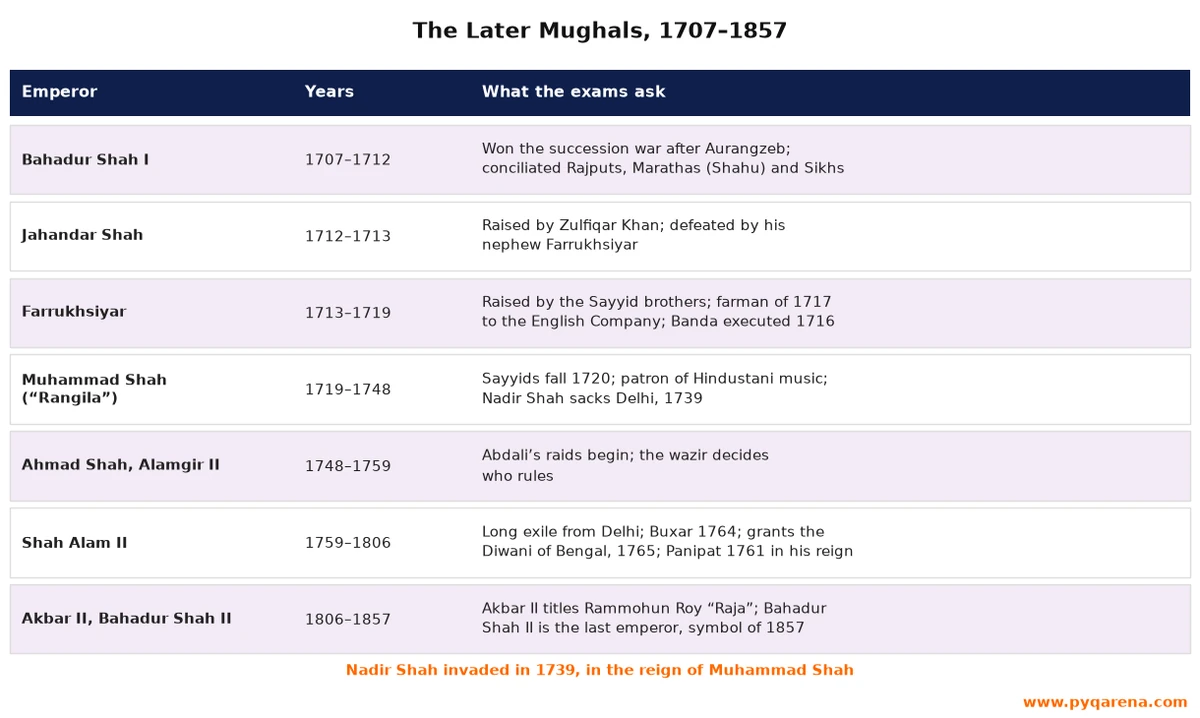
1. The Big Picture
In simple words: When Aurangzeb died in 1707, the Mughal empire was still the largest state in India. Within fifty years it had shrunk to a court at Delhi. Weak emperors followed one another, powerful nobles such as the Sayyid brothers made and unmade them, Nadir Shah sacked Delhi in 1739, and Ahmad Shah Abdali raided the north again and again. Governors in the provinces stopped sending revenue and founded their own dynasties: the Nawabs of Bengal, the Nawabs of Awadh and the Nizams of Hyderabad. Other powers rose against the empire: the Marathas, the Sikhs, the Jats and the Rohillas. In the south, Mysore under Haidar Ali and Tipu Sultan and Travancore under Marthanda Varma built strong new states. Into this divided field came the English East India Company.
Most regional rulers still struck coins in the emperor’s name and asked him for titles, but real power had moved to the provinces. The Diwani of Bengal that Shah Alam II granted to the Company in 1765, after Plassey (1757) and Buxar (1764), marks the point where this chapter hands over to Modern History.
1.1 Why this chapter matters for exams
- WBCS asks the farman of 1717 (Farrukhsiyar), Rangila (Muhammad Shah), Nadir Shah in 1739, the Diwani from Shah Alam II, Murshid Quli Khan and Murshidabad, Alivardi, Siraj-ud-Daulah, Plassey and Buxar, Mir Qasim, Safdar Jang, Surajmal, Tipu Sultan and the Tree of Liberty, the Anglo-Mysore treaties, Ranjit Singh and the Sukerchakia misl. See WBCS Prelims Modern Indian History PYQs, WBCS Mains Advent of Europeans PYQs and WBCS Prelims Medieval Indian History PYQs.
- UPSC Prelims asks how Jahandar Shah’s reign ended, why Shah Alam II spent his first years away from Delhi, the origins of Arcot, Mysore and Rohilkhand, the order Ambur — Plassey — Wandiwash — Buxar, Dupleix, Tipu’s embassies, and a statement set on Murshid Quli, Ranjit Singh, Sawai Jai Singh and Tipu. See UPSC Prelims Modern History: European Expansion PYQs and UPSC Prelims Medieval History: Mughal Empire PYQs.
2. Bahadur Shah I, Jahandar Shah and Farrukhsiyar
In simple words: After Aurangzeb, his son Bahadur Shah I became emperor after a war of succession. He made peace with many rebels but died in 1712. Jahandar Shah then ruled for less than a year before his nephew Farrukhsiyar defeated him in battle. Farrukhsiyar came to power with the help of the Sayyid brothers and gave the English Company the famous farman of 1717.
2.1 Bahadur Shah I, 1707–1712
Prince Muazzam, Aurangzeb’s eldest surviving son, defeated his brother Azam at Jajau (1707) and took the throne as Bahadur Shah I (also styled Shah Alam I). He was already old. His policy was conciliation. He made terms with the Rajput rulers of Amber and Marwar. The Maratha prince Shahu, freed in 1707 during the succession struggle, returned to the Deccan and split the Maratha house (the story is told in The Marathas); Bahadur Shah granted him the sardeshmukhi of the Deccan but not the chauth. He did not reimpose harsh measures, though he did not formally abolish the jizya either. The Sikhs under Banda Bahadur rose in the Punjab during his reign, and the emperor himself marched against them. Bahadur Shah I died at Lahore in 1712.
2.2 Jahandar Shah, 1712–1713
Another succession war followed. Jahandar Shah won it with the help of the powerful noble Zulfiqar Khan, who became his wazir. Jahandar is remembered for his favourite, Lal Kunwar, and for ijara, revenue farming, which Zulfiqar Khan encouraged to raise cash quickly.
UPSC Prelims 2003 asks how Jahandar Shah’s reign came to an early end. He was defeated by his nephew in a battle. The nephew was Farrukhsiyar, son of Jahandar’s brother Azim-ush-Shan. Farrukhsiyar marched from Bengal with the support of the Sayyid brothers, defeated Jahandar near Agra in 1713, and had him put to death. Jahandar was not deposed by his wazir, did not die after a fall, and did not die of drink. Practise the question on UPSC Prelims Medieval History: Mughal Empire PYQs.
2.3 Farrukhsiyar and the Sayyid brothers, 1713–1719
Farrukhsiyar owed his throne to Sayyid Abdullah Khan and Sayyid Husain Ali Khan, the Sayyid brothers of Barha. Abdullah Khan became wazir and Husain Ali Khan became Mir Bakshi. Historians call them the “king makers” of the age. They abolished the jizya, allied with Rajput chiefs such as Ajit Singh of Marwar, and in 1719 Husain Ali Khan made a settlement with the Marathas that brought the Peshwa Balaji Vishwanath to Delhi and granted chauth and sardeshmukhi of the Deccan (see The Marathas). In the same year the Sayyids deposed, blinded and killed Farrukhsiyar. Two short-lived puppets, Rafi-ud-Darajat and Rafi-ud-Daula, followed before Muhammad Shah was raised in 1719.
Banda Bahadur was captured and executed at Delhi in 1716, in Farrukhsiyar’s reign. That date closes the first Sikh rising.
2.4 The farman of 1717
In 1717 Farrukhsiyar issued a farman to the English East India Company. An English embassy led by John Surman had come to Delhi; a Company surgeon, William Hamilton, is remembered for treating the emperor. The farman allowed the Company to trade in Bengal free of customs duties in return for a fixed annual payment of Rs 3,000, to rent more villages around Calcutta, and to use its own dastaks (passes) for its goods. In the Deccan (the later dominions of the Nizam of Hyderabad) it confirmed the Company’s freedom from dues, and at Surat it exempted the Company from duties for Rs 10,000 a year. The Company’s servants later stretched the dastak to their private trade, and that abuse became a running quarrel with the Nawabs of Bengal, ending in the wars with Siraj-ud-Daulah and Mir Qasim.
WBCS Mains 2022 names Farrukhsiyar as the issuer of the farman of 1717. WBCS Prelims 2023 names Farrukhsiyar as the emperor who granted the farman of 1717 to the British East India Company, with Bahadur Shah II, Shah Alam II and Muhammad Shah as wrong options. Practise the pairing on WBCS Mains Advent of Europeans PYQs and WBCS Prelims Modern Indian History PYQs.
3. Muhammad Shah and Nadir Shah’s Invasion, 1739
In simple words: Muhammad Shah (1719–1748) was called “Rangila”, the pleasure-loving, and he was a great patron of Hindustani music. He got rid of the Sayyid brothers in 1720, but the provinces slipped away in his reign. In 1739 the Persian ruler Nadir Shah defeated the Mughal army at Karnal, entered Delhi, massacred its people and carried away the Peacock Throne and the Kohinoor.
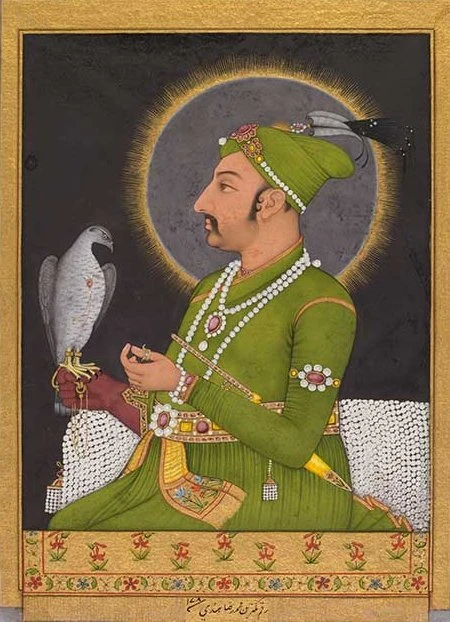
Image Source: Wikimedia
3.1 Muhammad Shah “Rangila”
Muhammad Shah was raised by the Sayyids in 1719. In 1720, with the help of Nizam-ul-Mulk and Turani nobles, he had Husain Ali Khan murdered and defeated Abdullah Khan, ending the Sayyid period. He then let the great nobles carve out their own regions. Nizam-ul-Mulk left the wazirship and founded Hyderabad in 1724; Saadat Khan became governor of Awadh in 1722; Murshid Quli Khan and his successors ruled Bengal; the Marathas pushed into Malwa and Gujarat and reached Delhi in 1737.
His court was famous for music, painting and poetry rather than for war. The khayal style of Hindustani music flourished under the court musicians Sadarang and Adarang, and Urdu poetry grew in Delhi. WBCS Mains 2020 names Muhammad Shah as the Mughal emperor who was a patron of Hindustani music and was popularly known as Rangila, with Bahadur Shah I, Bahadur Shah II and Ahmad Shah as wrong options. Practise it on WBCS Mains Mughal Empire PYQs.
3.2 Nadir Shah, 1739
Nadir Shah had made himself ruler of Persia in 1736. In 1738–39 he crossed the passes, took Kabul and Lahore, and on 24 February 1739 defeated the Mughal army at Karnal, north of Delhi. Saadat Khan of Awadh was taken prisoner; the old Mir Bakshi Khan-i-Dauran was killed. Muhammad Shah submitted. Nadir entered Delhi in March 1739. A rumour of his death led to attacks on his soldiers, and he ordered a general massacre in which many thousands of citizens died. When he left two months later, he carried away the treasury, jewels, the Peacock Throne of Shah Jahan and the Kohinoor diamond, and took the Mughal territories west of the Indus.
The invasion is asked by year and by reign. WBCS Prelims 2010 and WBCS Mains 2023 give the year as 1739. WBCS Prelims 2024 asks during whose reign Nadir Shah invaded India, and the answer is Muhammad Shah, not Farrukhsiyar, Bahadur Shah or Shah Alam. UPSC Prelims 1998 pairs 1739 with Nadir Shah’s capture of Delhi in a list that also pairs 1556, 1600 and 1686 (the 1686 pairing is discussed in The Marathas). Practise these on WBCS Prelims Medieval Indian History PYQs, WBCS Mains Mughal Empire PYQs and UPSC Prelims Medieval History: Mughal Empire PYQs.
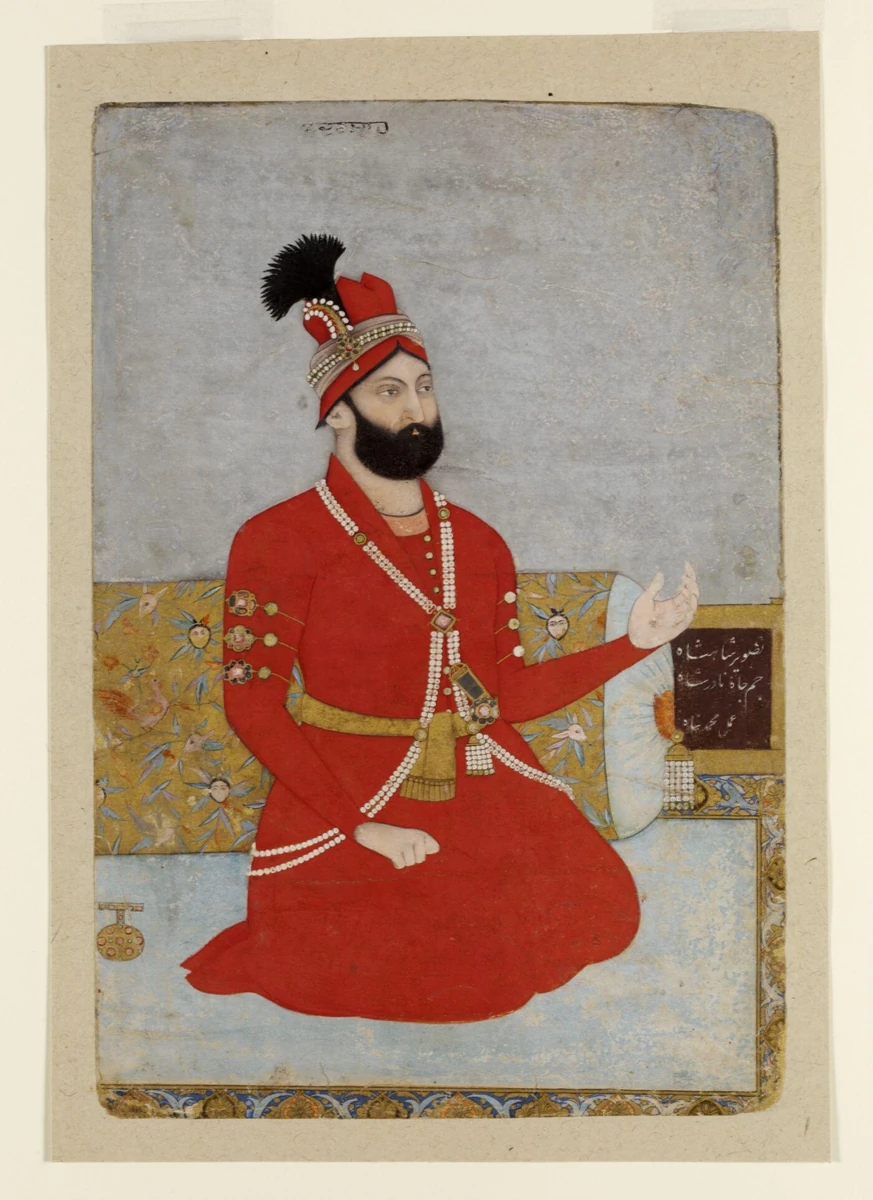
Image Source: Wikimedia
4. Ahmad Shah Abdali and Shah Alam II
In simple words: After Nadir Shah was murdered in 1747, his Afghan general Ahmad Shah Abdali (Durrani) founded a kingdom in Afghanistan and invaded India many times between 1748 and 1767. His greatest victory was over the Marathas at Panipat in 1761. The emperor of those years, Shah Alam II, spent his first years far from Delhi, fought the English at Buxar in 1764, and in 1765 granted them the Diwani of Bengal, Bihar and Orissa.
4.1 Abdali’s invasions
Ahmad Shah Abdali first invaded in 1748 and was beaten back at Manupur. He returned again and again, took the Punjab, and in 1757 plundered Delhi and Mathura. The Mughal emperors of these years were puppets of their wazirs: Ahmad Shah (1748–1754) was blinded and deposed, and Alamgir II (1754–1759) was murdered by his own wazir, Imad-ul-Mulk. When the Marathas expelled Abdali’s son and viceroy Timur Shah from Lahore, Abdali came back and destroyed the Maratha army at the Third Battle of Panipat on 14 January 1761. UPSC Prelims 2010 gives that expulsion as the immediate reason for the invasion. The battle, its causes and its results belong to The Marathas; practise them on UPSC Prelims Modern History: European Expansion PYQs and WBCS Mains Advent of Europeans PYQs (2017). The Mughal emperor at the time of Abdali’s 1761 invasion was Shah Alam II (WBPSC IDO History, 2001).
Abdali did not found an Indian empire. His soldiers mutinied for pay and wanted to go home; the Sikhs harassed his armies in the Punjab and took it over after his last invasions. Panipat weakened both the Afghans and the Marathas, and the English were the gainers.
4.2 Shah Alam II, 1759–1806
Prince Ali Gauhar fled Delhi in fear of the wazir Imad-ul-Mulk and was in the east when his father was murdered in 1759. He proclaimed himself emperor as Shah Alam II but did not enter Delhi until 1772, when the Maratha chief Mahadji Scindia escorted him back. UPSC Prelims 2003 states as an assertion that Shah Alam II spent the initial years as an Emperor far away from his capital, and as the reason that there was always a lurking danger of foreign invasion from the north-west frontier; both are treated as true, and the reason as the correct explanation. Abdali’s presence in the Punjab and his hold over Delhi through Najib-ud-Daula explain why the young emperor stayed in the east. Practise it on UPSC Prelims Modern History: European Expansion PYQs.
In exile Shah Alam joined Mir Qasim of Bengal and Shuja-ud-Daulah of Awadh against the English and was defeated at Buxar (1764). By the Treaty of Allahabad (1765) he granted the Diwani of Bengal, Bihar and Orissa to the Company, in return for an annual tribute of Rs 26 lakh and the districts of Kora and Allahabad.
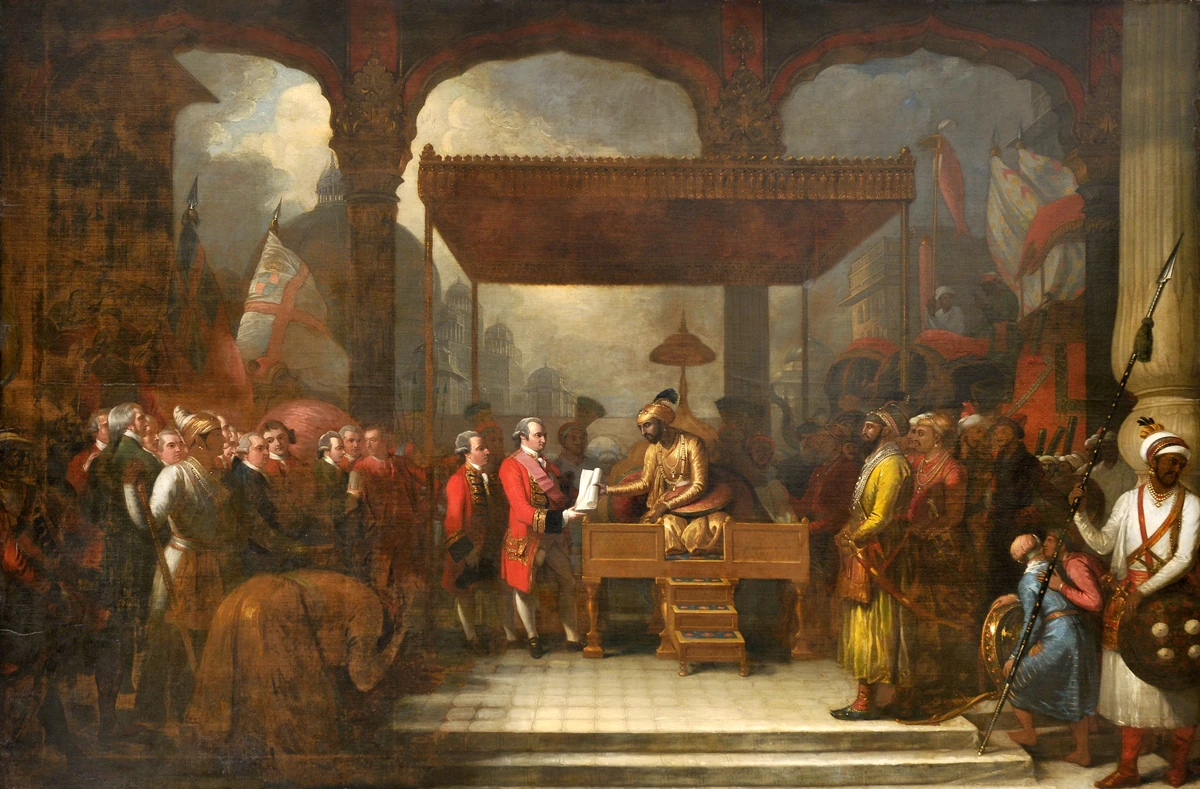
Image Source: Wikimedia
The Diwani is one of the most repeated facts in the bank. WBCS Prelims 2008, WBCS Prelims 2004, WBCS Mains 2023 and PSC Miscellaneous 2008 all name Shah Alam II as the emperor who granted the Diwani to the Company, against Farrukhsiyar, Bahadur Shah II, Aurangzeb, Shuja-ud-Daulah and Jahandar Shah. WBCS Prelims 2010 gives the year the Diwani was granted to Clive as 1765 A.D. Practise these on WBCS Prelims Modern Indian History PYQs, WBCS Mains Advent of Europeans PYQs and PSC Miscellaneous Prelims History Questions.
In 1788 the Rohilla Ghulam Qadir blinded him; in 1803 the English took Delhi.
4.3 The last emperors
Akbar II (1806–1837) gave Rammohun Roy the title Raja and sent him to England to plead for a higher pension. Bahadur Shah II (Bahadur Shah Zafar, 1837–1857), a poet, was proclaimed emperor by the rebels of 1857 and became the symbol of the revolt; he was exiled to Rangoon and the dynasty ended. These are Modern History questions, linked here only so that the line of emperors is complete (WBCS Prelims Modern Indian History, 2017 and 2021).
5. Why the Mughal Empire Declined
In simple words: The empire did not fall for one reason. Aurangzeb’s long Deccan wars and harsh policies drained it. After him came wars of succession and weak emperors. The nobles fought among themselves and there were not enough good jagirs to pay them. The Marathas, Sikhs and Jats rebelled. Nadir Shah and Abdali looted the north. Finally the Europeans, with better-trained armies and money, took over the richest province, Bengal.
5.1 Causes at the centre
- Aurangzeb’s legacy. Twenty-five years of war in the Deccan exhausted the treasury and the army. Jadunath Sarkar’s line, “the Spanish ulcer ruined Napoleon and the Deccan ulcer ruined Aurangzeb,” is asked in PSC Miscellaneous 2024 and is explained in Mughal Empire. The break with the Rajputs over Marwar and the reimposition of the jizya also cost him old allies.
- No law of succession. Every death of an emperor brought a war among princes, in 1707, 1712, 1713 and 1719. Each war wasted money and raised kingmakers.
- Weak emperors and the rule of the wazirs. From Jahandar Shah onward, nobles such as Zulfiqar Khan, the Sayyid brothers and Imad-ul-Mulk held the real power.
- Factions of nobles. The nobility split into Irani, Turani and Hindustani groups that fought over offices.
5.2 The jagirdari crisis and the provinces
The empire paid its officers through jagirs, as explained in Mughal Administration, Economy and Society. By the late seventeenth century there were more mansabdars than good jagirs, a shortage called be-jagiri. Nobles squeezed their jagirs, revenue farming (ijara) spread, and peasants and zamindars resisted. Provincial governors kept the revenue and made their offices hereditary. The empire was replaced region by region by its own governors.
5.3 Causes from outside
Peasant and zamindar revolts took political form among the Marathas, the Jats and the Sikhs. The invasions of Nadir Shah (1739) and Ahmad Shah Abdali (1748–1767) broke the empire’s prestige and treasury. The English and French companies, with disciplined infantry, artillery and sea power, used the quarrels of Indian rulers to gain territory, first in the Carnatic and then in Bengal.
6. Bengal: From Murshid Quli Khan to Siraj-ud-Daulah
In simple words: Murshid Quli Khan was sent by Aurangzeb to manage Bengal’s revenue. He moved the capital from Dacca to Murshidabad and became the first independent Nawab of Bengal. He was followed by his son-in-law Shujauddin, then Sarfaraz Khan, then Alivardi Khan, who seized power in 1740 and fought the Maratha Bargis. Alivardi’s grandson Siraj-ud-Daulah became Nawab in 1756, quarrelled with the English and lost the Battle of Plassey in 1757.
6.1 Murshid Quli Khan
Murshid Quli Khan came to Bengal as diwan in about 1700. He shifted the diwani office from Dacca to the town of Maksudabad, which he renamed Murshidabad after himself, and later became governor as well. WBCS Prelims 2011 asks where he transferred his capital from Dacca; the answer is Murshidabad, not Monghyr, Gaur or Pandua. He held both the diwani and the nizamat, sent revenue to Delhi regularly, but made his family the rulers of Bengal in practice. The WBPSC Clerkship paper names Murshid Quli Khan as the first independent Nawab of Bengal, against Siraj-ud-Daulah, Mir Kasim and Alivardi Khan. Practise it on WBPSC Clerkship History Previous Year Questions and WBCS Prelims Modern Indian History PYQs.
Murshid Quli reorganised revenue. He made a fresh settlement (mal zamini), took many jagirs into khalisa land, and gave the collection of revenue to revenue farmers (ijaradars) under contract. UPSC Prelims 2003 gives four statements and treats as not correct the claim that “Ali Mardan Khan introduced the system of revenue farming in Bengal”: it was Murshid Quli Khan who did so. The other three statements of that question are correct: Maharaja Ranjit Singh set up modern foundries to make cannons at Lahore; Sawai Jai Singh of Amber had Euclid’s Elements of Geometry translated into Sanskrit; and Tipu Sultan gave money for the temple of the goddess Sharada at Sringeri. Those three facts are taught in their sections below. Practise the question on UPSC Prelims Modern History: European Expansion PYQs.
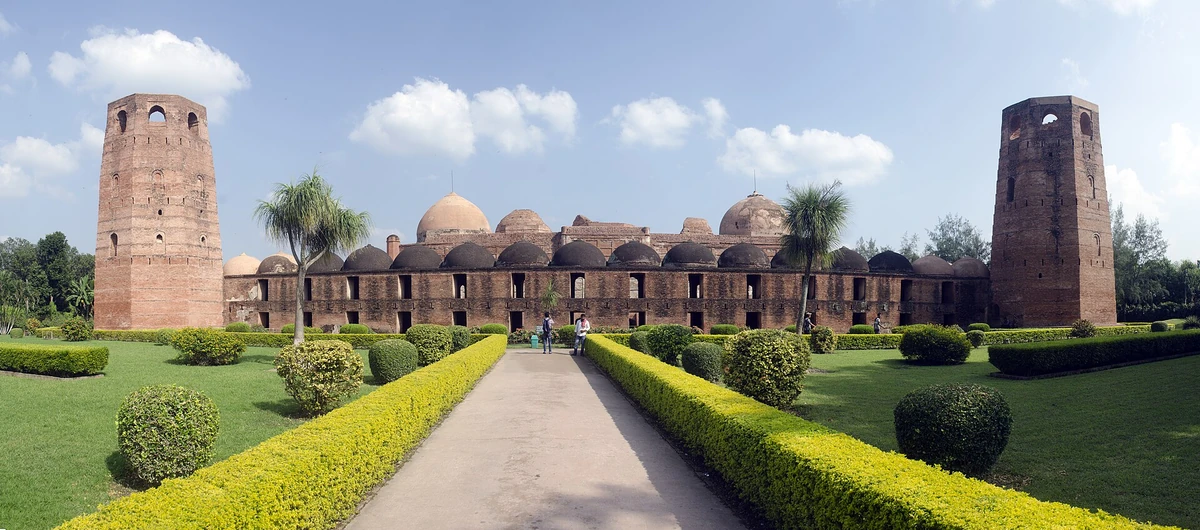
Image Source: Wikimedia
6.2 Shujauddin, Sarfaraz and Alivardi
When Murshid Quli died in 1727, he was succeeded by his son-in-law Shujauddin (Shuja-ud-din Muhammad Khan), not by Sarfaraz Khan, Shaukat Jung or Alivardi. WBCS Prelims 2012 asks this succession. Shujauddin ruled with the help of a council that included Alivardi Khan and his brother Haji Ahmad, and the banker Jagat Seth. Bihar was added to his government. His son Sarfaraz Khan succeeded in 1739, but in 1740 Alivardi Khan defeated and killed him at Giria and became Nawab, later obtaining confirmation from Delhi.
Alivardi (1740–1756) spent much of his reign fighting the Bargis, the Maratha horsemen sent by the Bhonsles of Nagpur under Bhaskar Pandit. The English dug the Maratha Ditch around Calcutta in 1742, and in 1751 Alivardi ceded the revenue of Orissa and agreed to pay chauth for Bengal. The Bargi raids are taught in The Marathas and Medieval Bengal. Alivardi kept the European companies under control and refused to let them fortify their settlements. He named his grandson Siraj-ud-Daulah as heir; WBCS Mains 2022 asks whose grandfather Alivardi was, and the answer is Siraj-ud-Daulah. Practise it on WBCS Mains Advent of Europeans PYQs.
6.3 Siraj-ud-Daulah and the quarrel with the English
Siraj-ud-Daulah ascended the throne in 1756 (WBCS Prelims 2024). He faced rivals in his own family, including his aunt Ghaseti Begum and his cousin Shaukat Jang of Purnia, and a court party of bankers and generals who disliked him. The English made things worse. During the Seven Years’ War they began additional fortifications of Calcutta to protect themselves from the French, without the Nawab’s permission; WBCS Mains 2018 gives fear of the French on the occasion of the Seven Years’ War as the plausible reason. They also misused the dastaks of the 1717 farman and sheltered a man the Nawab wanted, Krishna Das.
Siraj marched on Calcutta and took Fort William in June 1756. He renamed Calcutta Alinagar (WBP SI 2021). A number of English prisoners were confined in a small room of the fort, and many died; this is the so-called Black Hole Tragedy, described by J. Z. Holwell, and it took place in Calcutta (WBCS Mains 2016), not Dacca, Monghyr or Murshidabad. Clive and Admiral Watson came from Madras, retook Calcutta in January 1757, and forced the Treaty of Alinagar. Practise these on WBCS Mains Advent of Europeans PYQs and WBP SI Prelims History Previous Year Questions.
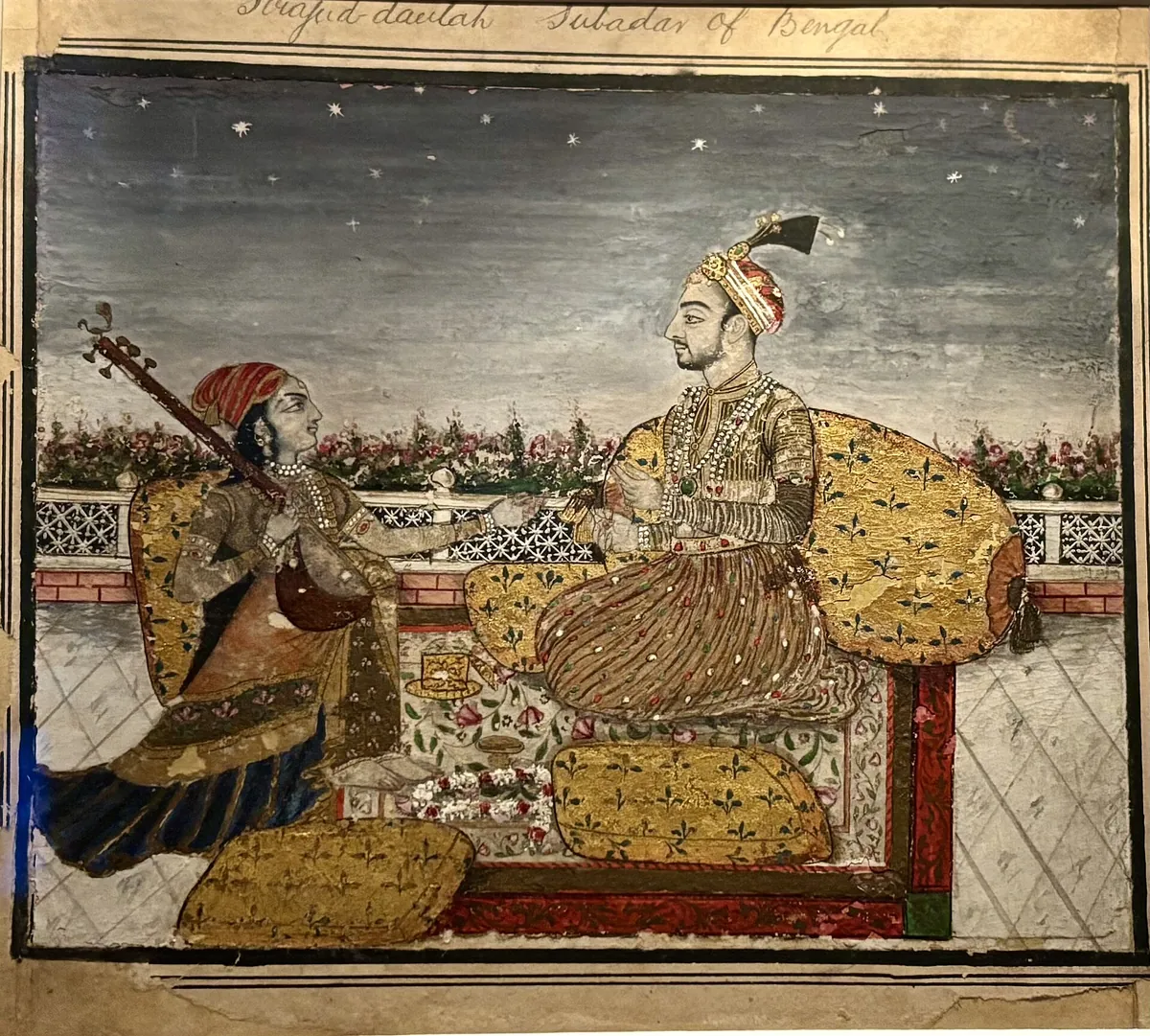
Image Source: Wikimedia
6.4 The conspiracy and Plassey, 1757
The English then joined a conspiracy at the Nawab’s court. The plotters were Mir Jafar, the Nawab’s commander (bakhshi); Rai Durlabh; the banker Jagat Seth; and the merchant Umi Chand (Omichand). Clive drew up two treaties, a real one and a false one, to deceive Umi Chand, who had demanded a large share; WBCS Mains 2018 names Umi Chand as the conspirator who was duped. Mohanlal, by contrast, was a loyal general of Siraj who fought for him at Plassey; WBCS Prelims 2008 names Mohanlal as the person not involved in the conspiracy, against Mir Jafar, Omichand and Clive.
At Plassey, on 23 June 1757, Mir Jafar and Rai Durlabh held their troops back, Mir Madan and Mohanlal fought and were beaten, and Robert Clive won. Siraj fled and was killed by Mir Jafar’s son Miran. The battle was fought in 1757 (WBCS Mains 2022; WBPSC Clerkship) and between Robert Clive and Siraj-ud-Daulah (PSC Miscellaneous 2018). UPSC Prelims 2004 treats as correct the statement that Mir Jafar entered into a conspiracy with the English for the defeat of Nawab Siraj-ud-Daulah in the Battle of Plassey, and as false two other statements in the same set: that Abdali defeated Ibrahim Lodi at the Third Battle of Panipat, and that Tipu Sultan was killed in the Third Anglo-Mysore War. Siraj-ud-Daulah was the last independent Nawab of Bengal (WBCS Prelims 2008). Practise these on WBCS Prelims Modern Indian History PYQs, PSC Miscellaneous Prelims History Questions and UPSC Prelims Modern History: European Expansion PYQs.
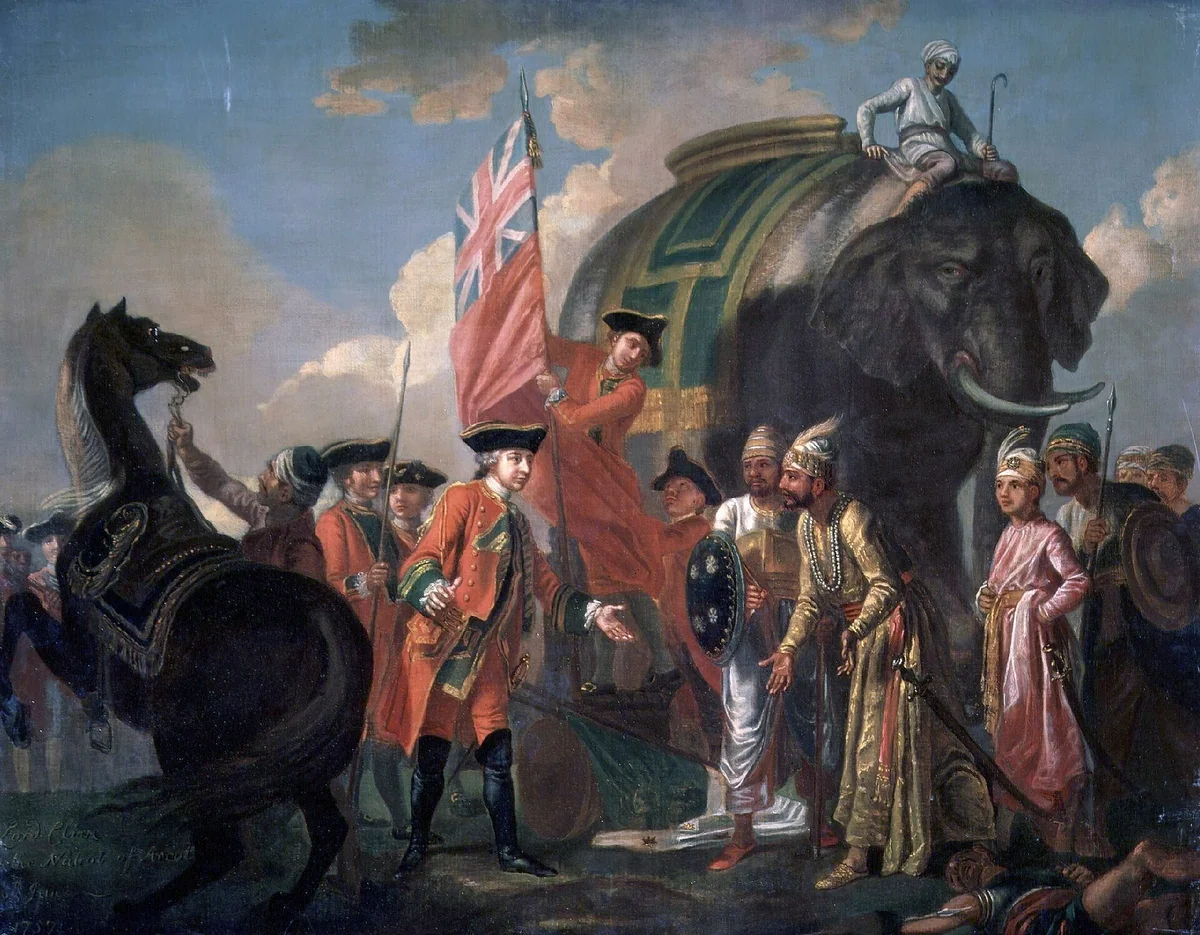
Image Source: Wikimedia
7. Mir Jafar, Mir Qasim and the Battle of Buxar
In simple words: The English made Mir Jafar Nawab after Plassey, then replaced him in 1760 with his son-in-law Mir Qasim. Mir Qasim moved his capital to Monghyr, built up an army and quarrelled with the Company over private trade. He was beaten by Major Adams in 1763, fled to Awadh, and joined Shuja-ud-Daulah and Shah Alam II. Their combined army was defeated at Buxar in 1764. In 1765 the emperor granted the Company the Diwani.
7.1 Mir Jafar and Mir Qasim
Mir Jafar paid the Company and its officers huge sums and gave it the zamindari of the 24 Parganas. He could not meet further demands, and in 1760 the English placed Mir Qasim on the masnad in return for the districts of Burdwan, Midnapore and Chittagong. Mir Qasim was an able ruler. He reorganised revenue, paid off the Company, and modernised his army with European-style training and a gun factory.
He moved his capital from Murshidabad to Monghyr (Munger) in Bihar. WBCS Mains 2021 gives all of the following reasons: Murshidabad was easily reached from Calcutta by river; its fortifications were weak against Company firepower; and from Monghyr it was easier to get military help from Awadh and north India without being watched. The open break came over private trade. Company servants used dastaks to trade duty-free inside Bengal; when Mir Qasim abolished all internal duties so that Indian merchants were treated equally, the Company went to war. The British officer who defeated Mir Qasim in a series of battles in 1763 (Katwa, Giria, Udaynala) was Major Adams (WBCS Mains 2015), not Hector Munro, who commanded at Buxar a year later. Mir Jafar was restored as Nawab in 1763 and held the masnad until his death in 1765. Practise these on WBCS Mains Advent of Europeans PYQs.
7.2 Buxar, 1764, and the Diwani
Mir Qasim fled to Awadh and formed an alliance with Shuja-ud-Daulah, the Nawab of Awadh, and the emperor Shah Alam II. On 22 October 1764, at Buxar in Bihar, Major Hector Munro defeated the three allies. The year 1764 is asked in WBCS Prelims 2019, WBCS Mains 2022 and WBCS Mains General Knowledge 2021, against the traps 1762, 1765, 1768, 1772, 1760, 1780 and 1754. WBCS Prelims 2018 names Mir Qasim as the Nawab of Bengal at the time of the Battle of Buxar; it was the deposed Mir Qasim who fought there, while Mir Jafar sat on the masnad in Murshidabad. WBCS Prelims 2002 names Buxar, not Wandiwash, Plassey or Seringapatam, as the most significant battle in the establishment of British supremacy in India: Plassey was won by treachery against one Nawab, while Buxar was won in open battle against the Nawab of Bengal, the Nawab of Awadh and the Mughal emperor together. UPSC Prelims 1995 lists “Battle of Buxar — Mir Jafar vs. Clive” as a wrong pair. Practise these on WBCS Prelims Modern Indian History PYQs, WBCS Mains Advent of Europeans PYQs and WBCS Mains General Knowledge History PYQs.
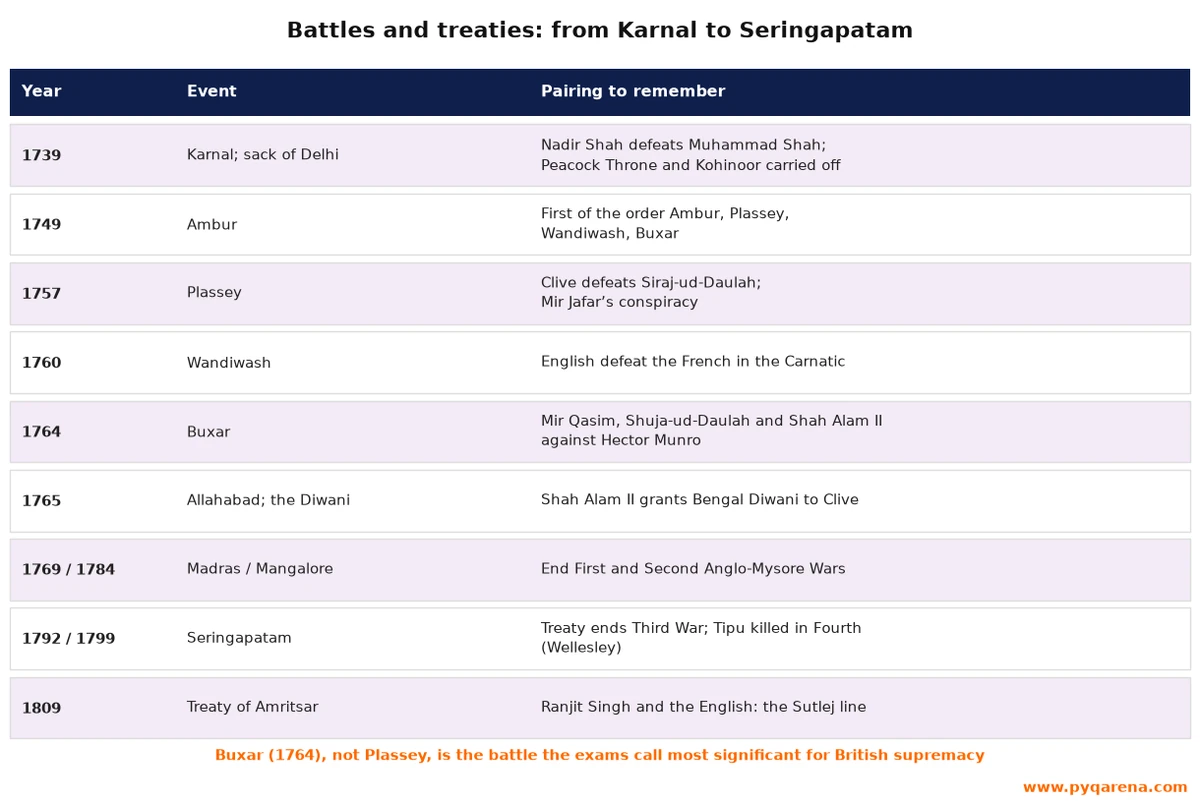
The result was the Treaty of Allahabad (1765). Clive returned Awadh to Shuja-ud-Daulah for a payment, and Shah Alam II granted the Diwani of Bengal, Bihar and Orissa. The Company now collected the revenue while the Nawab kept the nizamat, the dual government of Clive. UPSC Prelims 2005 asks the order of four eighteenth-century battles: Ambur (1749) — Plassey (1757) — Wandiwash (1760) — Buxar (1764). Practise that order on UPSC Prelims Modern History: European Expansion PYQs.
8. Awadh: Saadat Khan, Safdar Jang and Shuja-ud-Daulah
In simple words: Saadat Khan (Burhan-ul-Mulk), a Persian noble, became governor of Awadh in 1722 and founded a hereditary nawabi. His nephew and son-in-law Safdar Jang became the wazir of the Mughal empire. Safdar Jang’s son Shuja-ud-Daulah fought at Buxar in 1764. Later Nawabs moved the capital to Lucknow. Lord Dalhousie annexed Awadh in 1856 on the ground of misgovernment.
8.1 Saadat Khan and Safdar Jang
Saadat Khan Burhan-ul-Mulk was appointed governor of Awadh in 1722 by Muhammad Shah. He suppressed rebellious zamindars, made a fresh revenue settlement, and gave posts to Hindus as well as Muslims. He was captured at Karnal in 1739 and died soon after, during Nadir Shah’s stay in Delhi. His successor Safdar Jang (1739–1754) also held the post of wazir of the Mughal empire from 1748. WBCS Mains 2019 names Safdar Jang as the Nawab of Awadh who was appointed wazir, not Sadat Khan, Asaf-ud-Daulah or Nasiruddin. His tomb in Delhi, the Safdarjung’s Tomb, is one of the last great Mughal-style garden tombs. Practise the wazir question on WBCS Mains Advent of Europeans PYQs.
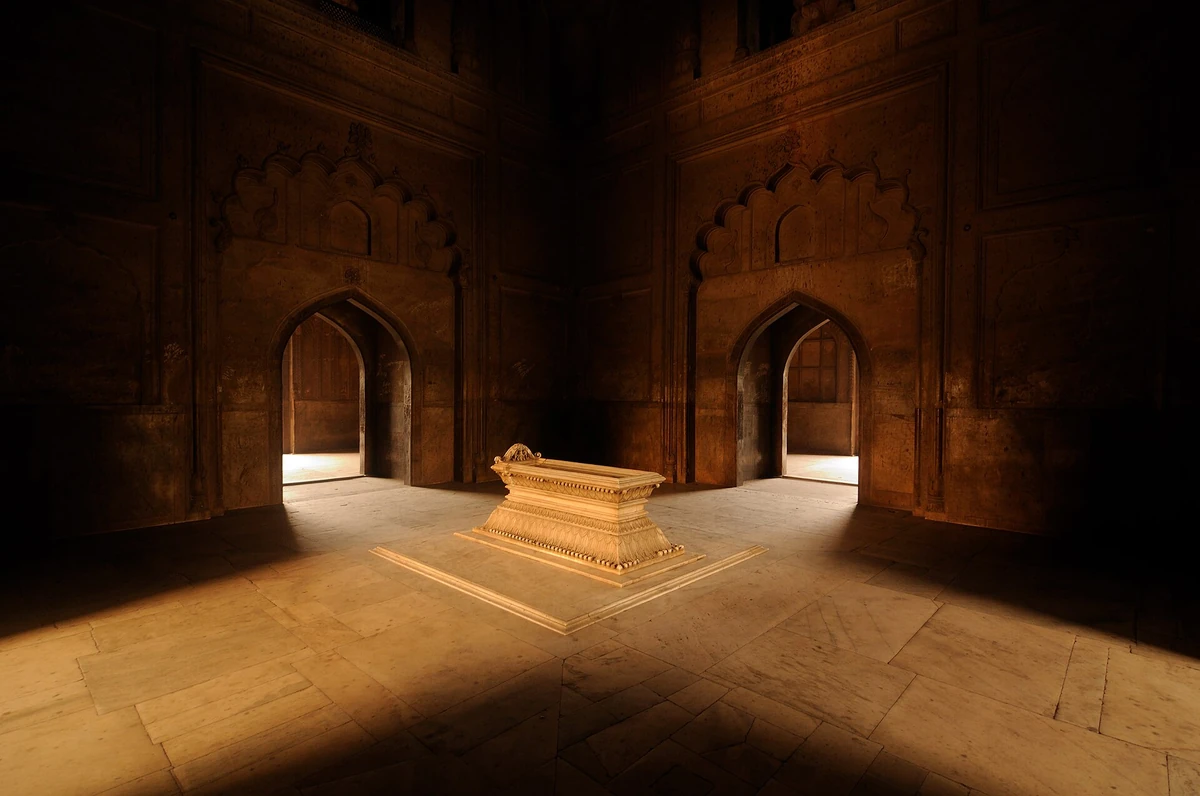
Image Source: Wikimedia
8.2 Shuja-ud-Daulah to annexation
Shuja-ud-Daulah (1754–1775) sided with Abdali at Panipat in 1761, sheltered Mir Qasim, and was defeated at Buxar in 1764. By the Treaty of Allahabad he got Awadh back, paid a war indemnity, and accepted a Company force for his defence, at his own cost. He used Company troops in the Rohilla War of 1774. His son Asaf-ud-Daulah (1775–1797) moved the capital from Faizabad to Lucknow and built the Bara Imambara (1784). Awadh fell more and more under Company control, and in 1801 Wellesley took half its territory.
In 1856 Dalhousie annexed Awadh and deposed Wajid Ali Shah on the pretext of misgovernance, not by the Doctrine of Lapse. UPSC Prelims 2007 names Awadh as the state removed from power on that pretext, against Jhansi, Nagpur and Satara, which were taken by lapse. WBCS Prelims 2012 gives the year of annexation as 1856 AD. In 1857 Begum Hazrat Mahal proclaimed her son Birjis Qadr as Nawab of Oudh (WBCS Prelims 2024). Practise these on UPSC Prelims Modern History: European Expansion PYQs and WBCS Prelims Modern Indian History PYQs.
9. Hyderabad and the Carnatic
In simple words: Nizam-ul-Mulk (Chin Qilich Khan), a leading Mughal noble, defeated the Mughal governor at Shakar Kheda in 1724 and founded the state of Hyderabad in the Deccan. He took the title Asaf Jah, and his descendants were the Nizams. South of Hyderabad, the Nawabs of the Carnatic ruled from Arcot. Their succession disputes drew in the English and the French and led to the three Carnatic Wars.
9.1 Nizam-ul-Mulk and Hyderabad
Chin Qilich Khan, titled Nizam-ul-Mulk, was a Turani noble who had helped Muhammad Shah overthrow the Sayyids. He became wazir in 1722 but found reform impossible at court and returned to the Deccan. In 1724 he defeated the governor Mubariz Khan at Shakar Kheda and made himself master of the Deccan. He took the title Asaf Jah, kept nominal loyalty to Delhi, and founded the dynasty of the Nizams. He fought the Marathas and was defeated by Baji Rao I at Palkhed (1728) and Bhopal (1737) (see The Marathas). He died in 1748, and a succession war among his sons and grandson was fought with French and English help.
Hyderabad’s later rulers lived between the Marathas, Mysore and the Company. WBCS Mains 2019 names the Nizam of Hyderabad as the ruler in whose dominions the English secured duty-free trade after Bengal; the farman of 1717 had already confirmed their freedom from dues in the Deccan (section 2.4). In 1798 the Nizam became the first Indian ruler to accept Wellesley’s Subsidiary Alliance. This is asked in WBCS Mains 2023 and 2018 and WBCS Prelims 2024, against the Peshwa (Baji Rao II or Balaji Baji Rao), the Nawab of Awadh, the Nawab of Bengal and the King of Travancore. The Peshwa accepted the alliance only in 1802 by the Treaty of Bassein (The Marathas). Practise these on WBCS Mains Advent of Europeans PYQs and WBCS Prelims Modern Indian History PYQs.
9.2 The Nawabs of Arcot
The Carnatic was a Mughal province in the south-east, with its capital at Arcot. In 1710 Saadatullah Khan was appointed its Nawab, and he made the office hereditary in his family. After 1724 the Nizam of Hyderabad claimed to be the overlord of the Carnatic. Dost Ali and then Anwaruddin ruled at Arcot. In the 1740s Chanda Sahib, Dost Ali’s son-in-law, claimed the throne with French help, while Anwaruddin and his son Muhammad Ali looked to the English.
UPSC Prelims 2021 gives three statements on regional states and accepts only one as correct: the Mysore kingdom emerged out of the Vijayanagara Empire. The claims that the Nizamat of Arcot emerged out of Hyderabad State and that Rohilkhand was formed out of territories occupied by Ahmad Shah Durrani are not accepted. The Arcot nawabi was a Mughal appointment of 1710, older than the Hyderabad state of 1724. Rohilkhand was built by Ali Muhammad Khan out of Mughal lands in the Doab, not out of Durrani conquests. Practise it on UPSC Prelims Modern History: European Expansion PYQs.
9.3 The Carnatic Wars
The three Carnatic Wars were fought between the French East India Company and the English East India Company (WBCS Prelims 2019), with Indian rulers as allies.
- First Carnatic War (1746–1748): an extension of the Austrian Succession war in Europe. The French took Madras. At St. Thomé (Adyar) a small French force defeated the large army of Anwaruddin, showing the power of trained infantry.
- Second Carnatic War (1749–1754): a war of succession in Hyderabad and the Carnatic. The French governor Dupleix backed Muzaffar Jang in Hyderabad and Chanda Sahib in the Carnatic; at Ambur (1749) Anwaruddin was killed. The English backed Muhammad Ali. Clive’s seizure and defence of Arcot (1751) turned the war, and Chanda Sahib was killed in 1752. Dupleix was recalled in 1754. WBCS Prelims 2004 names the Second Carnatic War as the battle that dashed the hopes of Dupleix to establish an empire in India. UPSC Prelims 1996 names Dupleix as the first European to take part in the quarrels of Indian princes with a view to acquiring territory, not Clive, Albuquerque or Warren Hastings.
- Third Carnatic War (1756–1763): part of the Seven Years’ War. At Wandiwash (1760) Sir Eyre Coote defeated the French under Count de Lally, and Pondicherry fell in 1761. UPSC Prelims 1995 gives Battle of Wandiwash — French vs. East India Company as the correctly matched pair, against Buxar — Mir Jafar vs Clive and Chilianwala — Dalhousie vs Marathas.
WBCS Mains 2018 gives an assertion that the Carnatic War has a fame in history not fully justified by its immediate issues or incidents, with the reason that for nearly twenty years the Carnatic was the scene of a contest between the French and the English that ended French power in India and produced momentous results in Bengal. Both are treated as correct, and the reason as the explanation: the wars were small, but they decided which European power would rule. Practise these on WBCS Prelims Modern Indian History PYQs, WBCS Mains Advent of Europeans PYQs and UPSC Prelims Modern History: European Expansion PYQs.
10. Mysore: Haidar Ali and Tipu Sultan
In simple words: The Wodeyar kings of Mysore began as subordinates of Vijayanagara. In the 1760s a soldier, Haidar Ali, took over the real power. He and his son Tipu Sultan made Mysore a strong, modern-minded state with its capital at Seringapatam. They fought four Anglo-Mysore Wars against the English. Tipu was killed defending Seringapatam in 1799, in the time of Lord Wellesley.
10.1 The Wodeyars and the rise of Haidar Ali
Raja Wodeyar founded the kingdom of Mysore in 1610 by taking Srirangapatna from the Vijayanagara viceroy. UPSC Prelims 2006 names Venkata II as the Vijayanagara ruler of that time; the background is in Vijayanagara Empire. Practise it on UPSC Prelims Medieval History: Vijayanagara and Regional Kingdoms PYQs.
Haidar Ali rose from the ranks of the army, became faujdar of Dindigul, and set up a modern arsenal there with French help. By 1761 he had pushed aside the ministers and become the ruler of Mysore, keeping the Wodeyar king as a figurehead. He conquered Bednur, Sunda, Sera, Canara and Malabar, and gave Mysore an army with European-trained infantry, artillery and rockets.
10.2 The four Anglo-Mysore Wars
- First Anglo-Mysore War (1767–1769): the English, the Nizam and the Marathas joined against Haidar. Haidar broke the alliance and reached the outskirts of Madras. The war ended with the Treaty of Madras (1769): mutual restoration of conquests and a defensive alliance between Mysore and the Company. WBCS Mains 2021 asks which statement about this treaty is not true. It was forced by Haidar after a victorious campaign against the Madras Council and the Nizam, and it did contain a defensive alliance; the statement that is not true is that the Company was exempted from the defensive alliance if Mysore went to war with Hyderabad. When the Marathas attacked Mysore in 1771, the Company did not come to Haidar’s help, which he never forgot.
- Second Anglo-Mysore War (1780–1784): Haidar joined the Marathas and the Nizam against the Company and destroyed a British force under Colonel Baillie. He died in 1782, and Tipu carried on the war. The Treaty of Mangalore (1784) brought the Second Anglo-Mysore War to a close (WBCS Mains 2021), with mutual restoration of conquests. The alignment of southern powers against the Company in the 1770s had been initiated by the Marathas (WBCS Mains 2021; see The Marathas).
- Third Anglo-Mysore War (1790–1792): Tipu attacked Travancore, an ally of the Company. Cornwallis, with the Nizam and the Marathas, besieged Seringapatam. By the Treaty of Seringapatam (1792) Tipu gave up half of his territory, which was shared among the Company, Hyderabad and the Marathas, and paid a large indemnity. Two of Tipu’s sons were held as hostages in the Company’s hands until it was paid (WBCS Mains 2021). WBCS Mains 2020 connects the Treaty of Seringapatam with the end of the Third Anglo-Mysore War. The Bhonsle of Berar was not among those who gained land from this treaty (WBCS Mains 2021).
- Fourth Anglo-Mysore War (1799): Wellesley accused Tipu of intriguing with the French. Seringapatam was stormed on 4 May 1799, and Tipu was killed fighting at its gates. WBCS Prelims 2024 names Lord Wellesley as the Governor-General at whose hands Tipu met his final defeat, not Cornwallis, Dalhousie or John Shore. Tipu was killed in the Fourth, not the Third, war; UPSC Prelims 2004 treats the statement that “Tipu Sultan was killed in the Third Anglo-Mysore War” as false. The Wodeyar family was restored to a smaller Mysore under a subsidiary alliance.
Practise all of these on WBCS Mains Advent of Europeans PYQs and WBCS Prelims Modern Indian History PYQs.
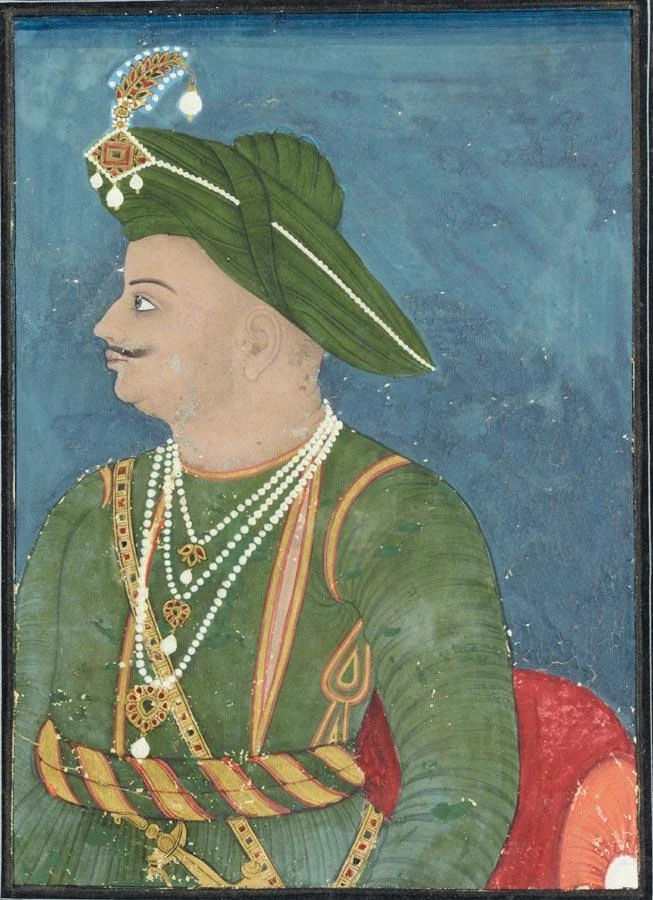
Image Source: Wikimedia
10.3 Tipu Sultan: ruler and innovator
Tipu’s capital was Seringapatam (Srirangapatna), not Mysore, Sringeri or Belur (WBCS Prelims 2010). He was a ruler of new ideas.
- Links with France. Tipu is the ruler in WBCS Prelims 2018 who was associated with the French, against Haidar Ali, Safdar Jang and Mir Qasim. He became a member of the Jacobin Club of French officers at Seringapatam and planted a Tree of Liberty there. WBCS Prelims 2024 and PSC Miscellaneous 2023 name Tipu Sultan as the man who planted the Tree of Liberty, against Haidar Ali, Chin Qilich Khan, Murshid Quli Khan and the Wodeyar kings.
- Embassies abroad. UPSC Prelims 2001 names Tipu Sultan as the Indian ruler who established embassies in foreign countries on modern lines, against Haidar Ali, Mir Qasim and Shah Alam II. WBCS Mains 2017 asks from which countries he sought help to expel the British: all of France, Turkey, and Arabia and Afghanistan. He sent missions to France, to the Ottoman Sultan at Constantinople, and to Zaman Shah of Afghanistan.
- Breaking with the Mughals. WBCS Mains 2016 asks which statement about Tipu is not correct. It is true that his reign was rooted in a strong regional base, that he issued coins without any reference to the Mughal emperor, and that he replaced Shah Alam’s name with his own in the Friday prayer. The statement that is not correct is that he never sought a sanad from the Ottoman Khalifa: he did seek one, to legitimise his rule without Delhi.
- Administration and the economy. Tipu introduced a new calendar, new coins and new weights and measures, built a navy, set up state trading factories, and tried to control the trade in sandalwood, pepper and other goods. He gave grants to Hindu temples and funded the repair of the Sharada temple at Sringeri after it was raided by the Marathas in 1791 (UPSC Prelims 2003).
Practise these on UPSC Prelims Modern History: European Expansion PYQs, WBCS Mains Advent of Europeans PYQs, WBCS Prelims Modern Indian History PYQs and PSC Miscellaneous Prelims History Questions.
11. Kerala and Travancore: Marthanda Varma
In simple words: In the far south, Marthanda Varma (1729–1758) turned Travancore from a small chiefdom into a strong kingdom. He crushed the local nobles, defeated the Dutch at Colachel in 1741, and dedicated his kingdom to the deity Padmanabha. Further north, the Zamorin of Calicut was the old power of Malabar until Haidar Ali conquered it.
11.1 Marthanda Varma
Marthanda Varma broke the power of the Ettuvittil Pillamar nobles and of the local chiefs, annexed neighbouring principalities such as Kayamkulam and Ambalapuzha, and built a European-trained army with the help of a captured Dutch officer, Eustachius De Lannoy. At Colachel (1741) he defeated the Dutch East India Company, one of the rare defeats of a European power by an Indian state in this century. In 1750 he dedicated the kingdom to Sri Padmanabha (the Thrippadidanam) and ruled as the deity’s servant. He made pepper a state monopoly. His capital was at Padmanabhapuram; the capital later moved to Trivandrum (Thiruvananthapuram).
11.2 Travancore and the Company
Tipu’s attack on Travancore in 1789 started the Third Anglo-Mysore War. Travancore accepted a subsidiary treaty with the Company in 1805. The Dewan Velu Thampi then led a revolt against the British in Travancore in 1808–09 (WBCS Prelims 2017). WBCS Mains 2018 places it in the chronological order of “restorative rebellions”: Poligar rebellion under Kattabomman (1799) — Travancore revolt under Velu Thampi (1808–09) — Paik rebellion under Jagabandhu (1817) — Kittur rising under Rani Chennamma (1824). Practise these on WBCS Prelims Modern Indian History PYQs and WBCS Mains Economic Impact of British Rule PYQs.
12. The Sikhs: Banda Bahadur, the Misls and Ranjit Singh
In simple words: Guru Gobind Singh founded the Khalsa in 1699. After his death, Banda Bahadur led a Sikh rising in the Punjab until he was executed in 1716. The Sikhs then organised themselves into twelve misls, political and military units, which took the Punjab from the Mughals and Afghans. Ranjit Singh of the Sukerchakia misl united them into the kingdom of Lahore and was called Sher-i-Punjab.
12.1 From the Gurus to Banda Bahadur
The Sikh Gurus, from Guru Nanak to Guru Gobind Singh, and the founding of the Khalsa are treated in Bhakti and Sufi Movements; the execution of Guru Tegh Bahadur by Aurangzeb is in Mughal Empire. Guru Gobind Singh turned the Sikhs into a martial community and was the tenth and last Guru (WBCS Prelims 2007, 2023 and 2024). Before he died in 1708 he sent Banda Bahadur (Banda Singh Bahadur) to the Punjab as the military leader of the Sikhs. UPSC Prelims 2004 treats as false the statement that Banda Bahadur was appointed military leader by Guru Tegh Bahadur; it was Guru Gobind Singh. The same question treats as correct that Guru Arjan Dev became Guru after Guru Ram Das; its statement on the Gurmukhi script is discussed in Bhakti and Sufi Movements. Practise it on UPSC Prelims Medieval History: Vijayanagara and Regional Kingdoms PYQs.
Banda gathered peasants and soldiers, sacked Sirhind in 1710, struck coins in the name of the Gurus, and built a fort at Lohgarh. He abolished the zamindari rights of many landlords and gave land to the tillers. Bahadur Shah I marched against him; Farrukhsiyar’s generals finally captured him at Gurdas Nangal, and he was executed at Delhi in 1716.
12.2 The misls
After Banda, the Sikhs fought on in small bands. In the 1740s and 1750s they took advantage of Nadir Shah’s and Abdali’s raids to plunder the invaders and to take over the land. The bands grew into twelve misls, each under its own chief, such as the Bhangi, Kanhaiya, Ahluwalia, Ramgarhia, Phulkian and Sukerchakia misls. WBCS Prelims 2001 defines a misl as a political unit, not a tax, a conquered area or a book. The misls combined in the Dal Khalsa for joint campaigns, and the Sarbat Khalsa met at Amritsar. They offered protection to villages under the rakhi system in return for a share of the produce. By the 1760s, after Abdali’s last invasions, the Sikhs held most of the Punjab. Practise the misl question on WBCS Prelims Medieval Indian History PYQs.
12.3 Ranjit Singh
Ranjit Singh (1780–1839) was the leader of the Sukerchakia misl (WBCS Prelims 2016), not the Bhangi, Kanhaiya or a “Gobind” misl. He took Lahore in 1799, was proclaimed Maharaja in 1801, and conquered Amritsar, Multan (1818), Kashmir (1819) and Peshawar. He is called “Sher-i-Punjab”, the Lion of the Punjab (PSC Miscellaneous 2018). His army, trained by European officers such as Ventura and Allard, was the strongest Indian army of its time, and he set up modern foundries to make cannon at Lahore (UPSC Prelims 2003).
By the Treaty of Amritsar of 1809 (WBCS Prelims 2010), negotiated by Charles Metcalfe, Ranjit Singh accepted the Sutlej as the boundary of his kingdom with the Company and gave up the Cis-Sutlej states. Shown a map of India with British territory coloured red, he remarked, “Sab lal ho jayega” — “all will become red” (WBCS Prelims 2004 and 2013). After his death the kingdom broke up in faction. The two Anglo-Sikh Wars (1845–46 and 1848–49) ended with the annexation of the Punjab in 1849. After the first war, by the Treaty of Lahore and then the separate Treaty of Amritsar (1846), the Company sold Jammu and Kashmir to Gulab Singh (WBCS Mains 2021); do not confuse this 1846 treaty with Ranjit Singh’s Treaty of Amritsar of 1809. Practise these on WBCS Prelims Modern Indian History PYQs, PSC Miscellaneous Prelims History Questions and WBCS Mains Advent of Europeans PYQs.
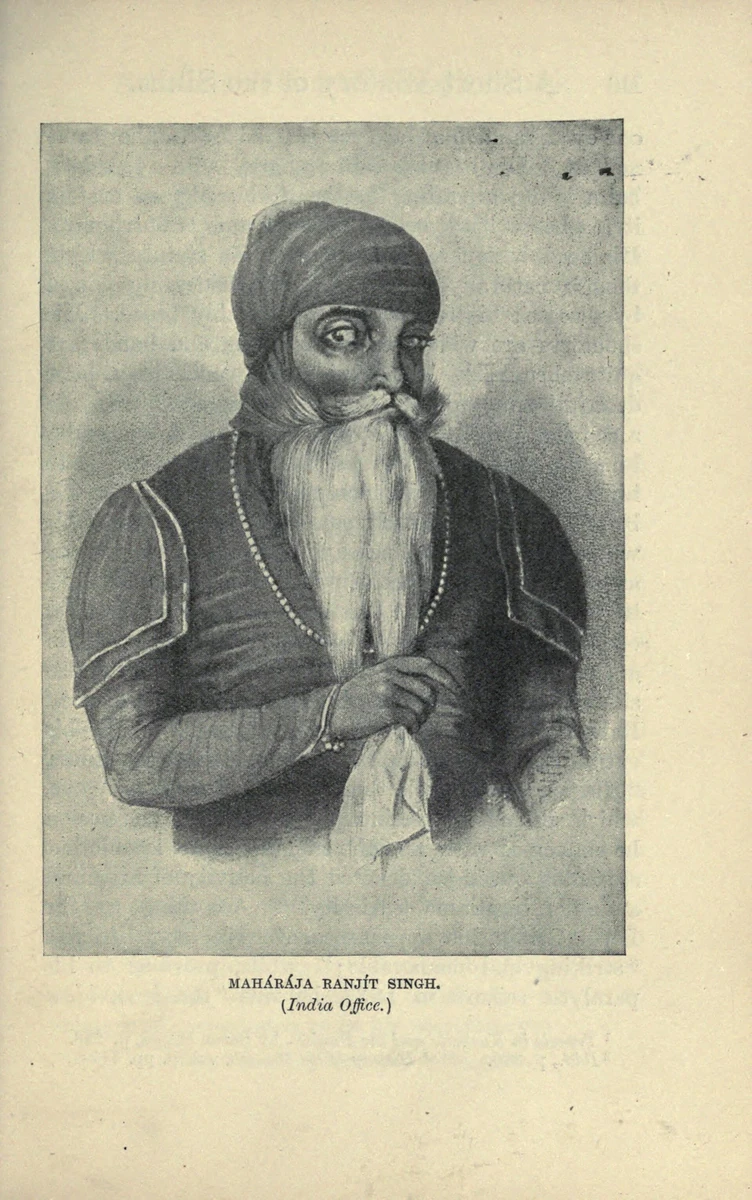
Image Source: Wikimedia
13. The Jats, the Rajputs and the Rohillas
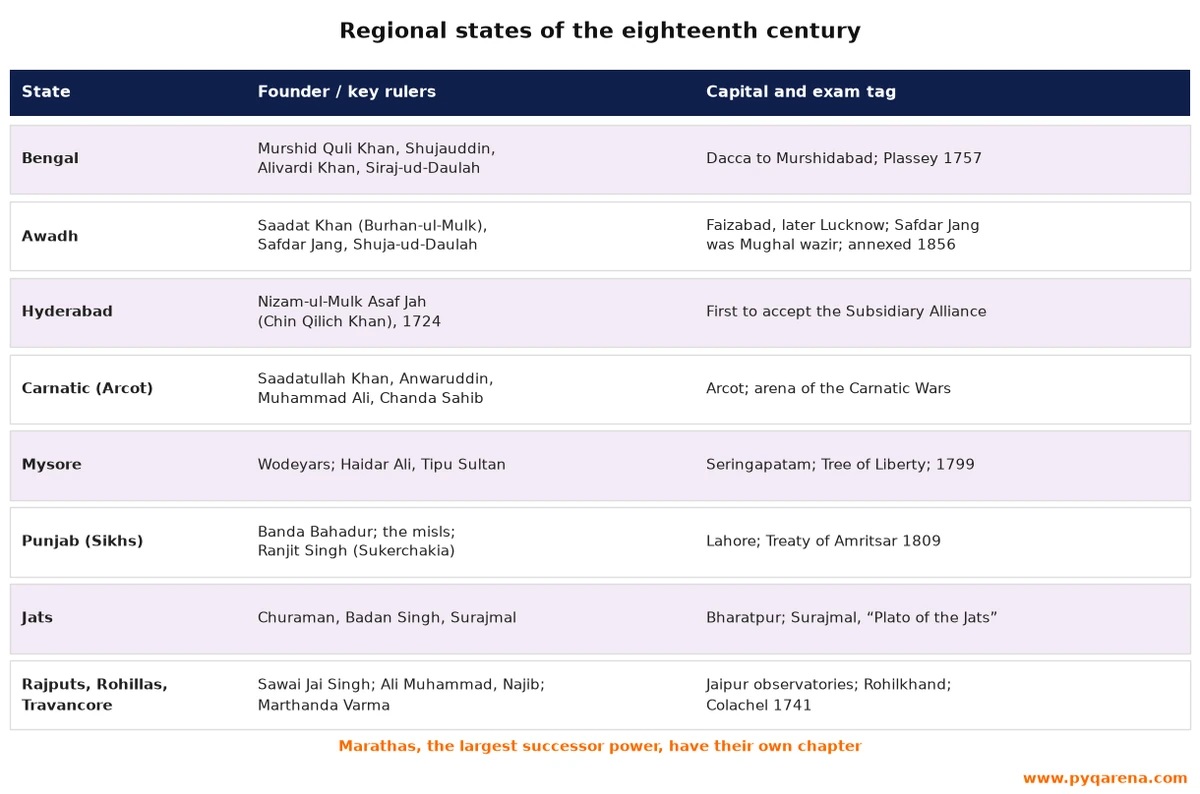
In simple words: The Jats, peasant-cultivators around Delhi, Agra and Mathura, rebelled under Aurangzeb and built the kingdom of Bharatpur under Churaman, Badan Singh and Surajmal; Surajmal is called the “Plato of the Jat tribe”. Among the Rajputs, Sawai Jai Singh of Amber built Jaipur and five astronomical observatories. The Rohillas, Afghans settled east of the Ganga, founded Rohilkhand.
13.1 The Jats of Bharatpur
The Jat peasants of the Delhi–Agra–Mathura region rose under Gokula in Aurangzeb’s reign and then under Rajaram. Churaman built the Jat state in the disorder after 1707. Badan Singh consolidated it and founded the line of the Bharatpur rajas. The greatest of them was Surajmal (ruled 1756–1763), who extended the state from Agra to Mathura and Meerut, built the fort of Lohagarh at Bharatpur and the palaces of Deeg, and gave his state a sound revenue system. Historians have called him the “Plato of the Jat tribe” for his wisdom; WBCS Mains 2019 asks this, with Rajaram, Churaman and Badan Singh as wrong options. Surajmal refused to fight beside the Marathas at Panipat in 1761 after a quarrel with Sadashiv Rao Bhau, and was killed in battle in 1763. Practise it on WBCS Mains Advent of Europeans PYQs.
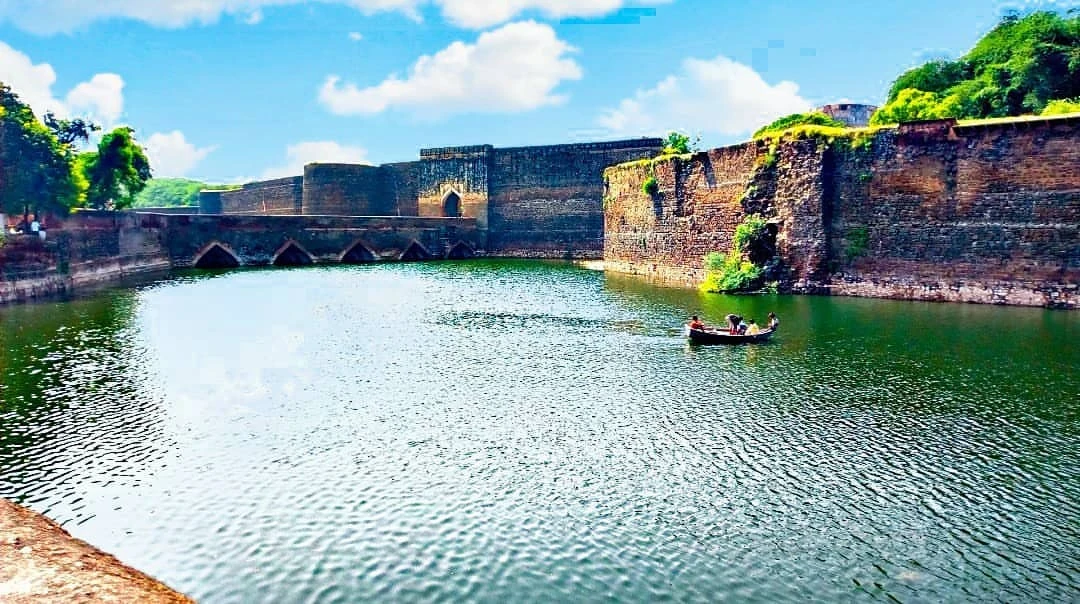
Image Source: Wikimedia
13.2 The Rajputs and Sawai Jai Singh
The Rajput states took advantage of Delhi’s weakness to free themselves from Mughal control, but they quarrelled among themselves. Ajit Singh of Marwar was drawn into the politics of the Sayyids. The outstanding figure was Sawai Jai Singh II of Amber (1699–1743). He founded the city of Jaipur in 1727, laid out on a regular plan. He was a scientist as well as a ruler: he built astronomical observatories (Jantar Mantar) at Delhi, Jaipur, Ujjain, Varanasi and Mathura, and prepared astronomical tables called the Zij-i-Muhammadshahi, dedicated to the emperor. He had Euclid’s Elements of Geometry translated into Sanskrit (UPSC Prelims 2003).
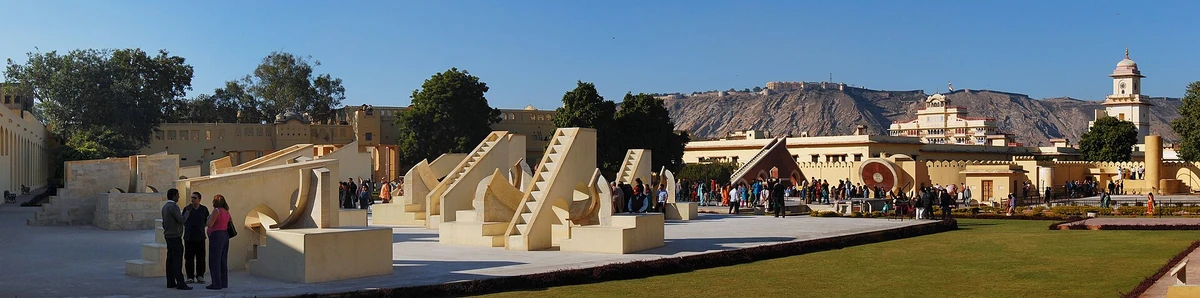
Image Source: Wikimedia
13.3 The Rohillas
The Rohillas were Afghans who settled in the region between the Ganga and the Himalayan foothills, later called Rohilkhand. Ali Muhammad Khan founded the Rohilla state in the 1740s out of Mughal territory, with its centre at Bareilly and Aonla. Najib-ud-Daula, a Rohilla chief, became Abdali’s ally and controlled Delhi in the 1760s. The Rohillas fought the Nawabs of Awadh, and in the Rohilla War of 1774 Shuja-ud-Daulah conquered most of Rohilkhand with Company troops lent by Warren Hastings. In 1788 the Rohilla Ghulam Qadir blinded Shah Alam II. The UPSC Prelims 2021 statement that Rohilkhand was formed out of territories occupied by Ahmad Shah Durrani is not accepted (section 9.2).
14. Do Not Confuse
In simple words: This chapter is full of similar names, dates and treaties. The list below keeps the traps apart.
- Farman of 1717 vs Diwani of 1765. The 1717 farman (duty-free trade in Bengal for Rs 3,000 a year) was issued by Farrukhsiyar. The 1765 Diwani of Bengal, Bihar and Orissa was granted by Shah Alam II to Clive. Bahadur Shah II, Jahandar Shah and Muhammad Shah are the wrong options in both.
- Rangila and Nadir Shah. Muhammad Shah is “Rangila” and the emperor of 1739. Nadir Shah invaded in 1739, not 1738 or 1740; Abdali invaded from 1748 and won Panipat in 1761, when Shah Alam II was emperor.
- First independent Nawab vs first independent Sultan of Bengal. Murshid Quli Khan (Nawab, capital Murshidabad) vs Ilyas Shah (Sultan, fourteenth century). Murshid Quli, not Ali Mardan Khan, introduced revenue farming in Bengal.
- Plassey vs Buxar. Plassey (1757): Clive vs Siraj-ud-Daulah, won through Mir Jafar’s conspiracy. Buxar (1764): Hector Munro vs Mir Qasim, Shuja-ud-Daulah and Shah Alam II; the most significant battle for British supremacy. Mir Qasim was beaten in 1763 by Major Adams, not Munro.
- Umi Chand vs Mohanlal. Umi Chand was the conspirator duped by Clive’s false treaty. Mohanlal was loyal to Siraj and was not in the conspiracy.
- Awadh annexation. 1856, by Dalhousie, on the pretext of misgovernance — not the Doctrine of Lapse (Satara, Jhansi, Nagpur). Awadh’s wazir-Nawab was Safdar Jang.
- First Subsidiary Alliance. The Nizam of Hyderabad (1798), not the Peshwa (1802), the Nawab of Awadh or the King of Travancore.
- Carnatic Wars. Fought between the French and English companies. Dupleix was the first European to meddle in Indian succession quarrels for territory; the Second Carnatic War ended his hopes. Wandiwash (1760) was French vs the English Company. The order is Ambur — Plassey — Wandiwash — Buxar.
- Anglo-Mysore treaties. Madras (1769) ended the First war; Mangalore (1784) the Second; Seringapatam (1792) the Third, with Tipu’s sons as hostages. Tipu died in the Fourth war, 1799, under Wellesley. His capital was Seringapatam.
- Two Treaties of Amritsar. 1809: Ranjit Singh and the English (Sutlej boundary). 1846: the Company and Gulab Singh (Jammu and Kashmir).
15. Quick Revision
In simple words: Ten lines to recite before a paper.
- 1707–1719: Bahadur Shah I; Jahandar Shah, defeated by his nephew Farrukhsiyar; the Sayyid brothers; the farman of 1717; Banda executed 1716.
- 1719–1748: Muhammad Shah “Rangila”; Nadir Shah at Karnal and Delhi, 1739; Peacock Throne and Kohinoor lost.
- 1748–1765: Abdali from 1748; Panipat 1761; Shah Alam II in exile, at Buxar (1764), grants the Diwani to Clive (1765).
- Bengal: Murshid Quli (Murshidabad, revenue farming, first independent Nawab) → Shujauddin → Sarfaraz → Alivardi (Siraj’s grandfather) → Siraj (1756, Alinagar, Black Hole, last independent Nawab) → Plassey 1757 → Mir Jafar → Mir Qasim (Monghyr; Major Adams 1763) → Buxar 1764.
- Order: Ambur 1749 — Plassey 1757 — Wandiwash 1760 — Buxar 1764.
- Awadh: Saadat Khan 1722; Safdar Jang the wazir; Shuja-ud-Daulah; annexed 1856 for misgovernance.
- Hyderabad and Carnatic: Nizam-ul-Mulk, 1724; first Subsidiary Alliance; Arcot 1710; Dupleix; Second Carnatic War; Wandiwash.
- Mysore: from Vijayanagara; Haidar; Madras 1769, Mangalore 1784, Seringapatam 1792; Tipu — French, Tree of Liberty, embassies, Ottoman sanad — killed 1799 under Wellesley.
- South-west: Marthanda Varma, Colachel 1741; Velu Thampi in Travancore.
- North: misl = political unit; Ranjit Singh (Sukerchakia, Sher-i-Punjab, Amritsar 1809); Gulab Singh, Amritsar 1846; Surajmal, “Plato of the Jat tribe”; Sawai Jai Singh, Jaipur and Jantar Mantar; Rohillas of Rohilkhand.
Related notes: The Marathas | Mughal Empire | Mughal Administration, Economy and Society | Medieval Bengal | Vijayanagara Empire | Bhakti and Sufi Movements | Bahmani Empire and Deccan Sultanates
Practice: WBCS Prelims Modern Indian History PYQs | WBCS Mains Advent of Europeans PYQs | UPSC Prelims Modern History: European Expansion PYQs | WBCS Prelims Medieval Indian History PYQs | WBCS Mains Mughal Empire PYQs | UPSC Prelims Medieval History: Mughal Empire PYQs | UPSC Prelims Medieval History: Vijayanagara and Regional Kingdoms PYQs | PSC Miscellaneous Prelims History Questions | WBPSC Clerkship History Previous Year Questions | WBP SI Prelims History Previous Year Questions | WBPSC IDO History Previous Year Questions | WBCS Mains General Knowledge History PYQs | WBCS Mains Economic Impact of British Rule PYQs
Leave a Comment