

Who is this for? Beginners and aspirants for UPSC Prelims, WBCS, other State PSCs and SSC. Each section opens with an “In simple words” explanation and then goes to exam-level detail. Practise alongside: WBCS Prelims Ancient Indian History PYQs | WBCS Mains Buddhism & Jainism PYQs | WBCS Mains Religious Movements PYQs Previous chapters: Prehistoric India Notes → Indus Valley Civilization Notes → Vedic Age Notes → Mahajanapadas & Rise of Magadha Notes → Buddhism and Jainism
1. What is a Darshana?
In simple words: Darshana means “seeing” or “vision”. It is a complete way of looking at life: what the world is made of, what the soul is, how we know things, and how we gain freedom (moksha) from suffering. Indian thinkers built many such systems. Exams group them into two families: those that accept the Vedas and those that do not.
- Root idea: almost every Indian school aims at moksha / nirvana / kaivalya, freedom from the cycle of birth and death (samsara).
- Common ideas shared by most schools:
- Karma: every action has a result.
- Rebirth: the soul takes new bodies until it is free. (The Charvakas reject both.)
- Pramana: valid means of knowledge, such as perception and inference.
- Sources: the ideas began in the Upanishads and grew into formal sutras (short verses), which later teachers explained in bhashyas (commentaries).

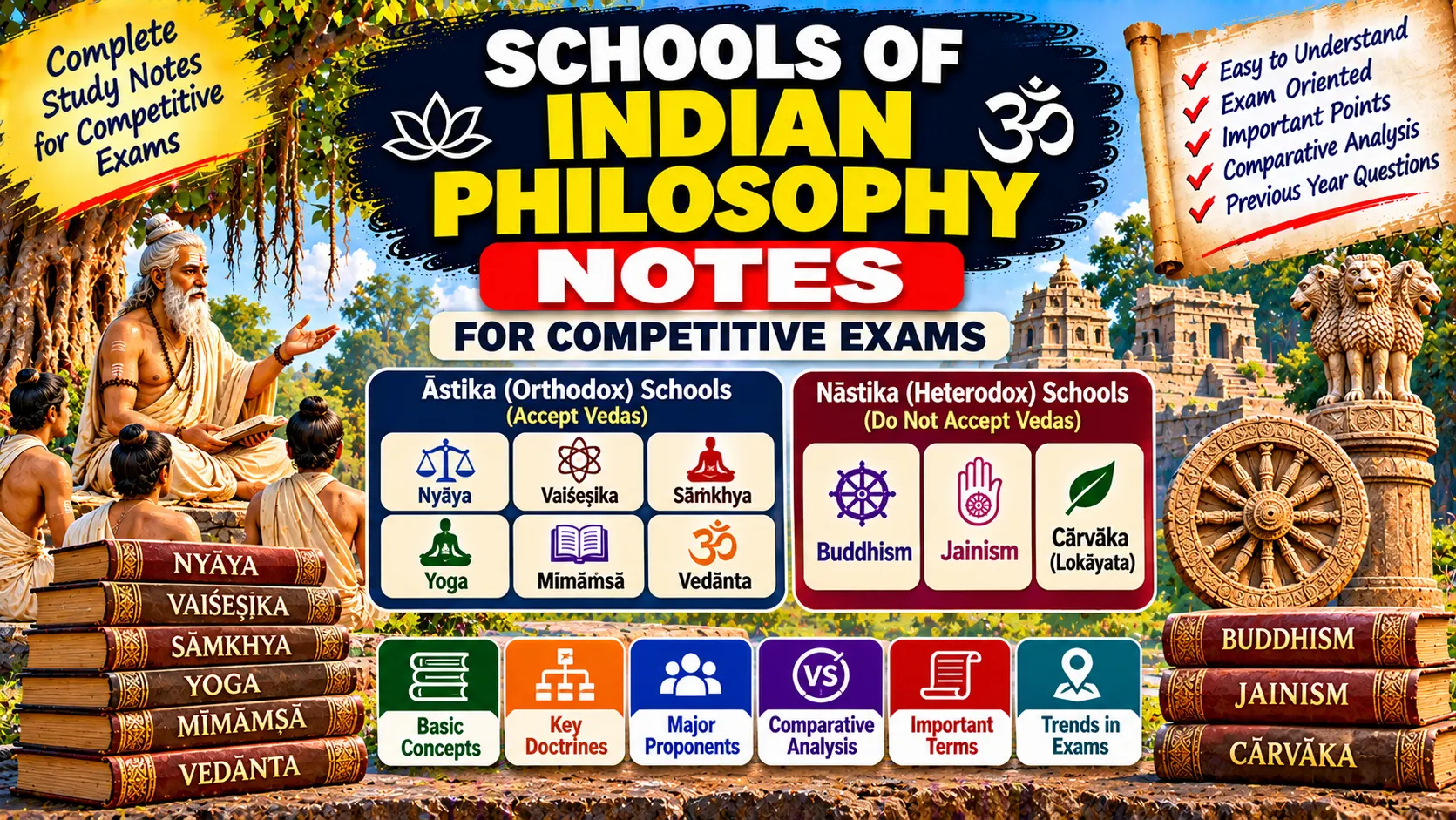
The two families of Indian philosophy: six Astika (orthodox) and the main Nastika (heterodox) schools.
1.1 Astika vs Nastika
| Basis | Astika (orthodox) | Nastika (heterodox) |
|---|---|---|
| Meaning | “There is”: those who accept the authority of the Vedas | Those who reject the authority of the Vedas |
| Schools | Six Darshanas (Shad-darshana): Samkhya, Yoga, Nyaya, Vaisheshika, Mimamsa, Vedanta | Charvaka (Lokayata), Ajivika, Buddhism, Jainism |
| God | Not required: Samkhya and Mimamsa do not need a creator God, yet they are Astika | Charvaka denies God; Buddhism is silent; Jainism rejects a creator |
- Key point: Astika and Nastika are about the Vedas, not about belief in God. That is why Samkhya (without God) is Astika, while Jainism (with gods and souls) is Nastika.
- Pairs: the six schools come in three related pairs:
- Samkhya–Yoga: theory and practice.
- Nyaya–Vaisheshika: logic and physics.
- Mimamsa–Vedanta: ritual and knowledge.
2. Upanishads: The Root of Indian Philosophy
In simple words: The Upanishads are the last part of the Vedas, which is why they are called Vedanta (“end of the Veda”). Students sat near (upa-ni-shad) a teacher and discussed deep questions: “Who am I?” and “What is the final reality?” Their answer: the inner self (Atman) and the universal reality (Brahman) are one. (See the Vedic Age Notes for the full Vedic literature chart.)
- Number: 108 Upanishads in all, of which 13 are principal (Mukhya Upanishads).
- Period: the main Upanishads were composed around 800–500 BCE, and their compilation is placed around 600 BCE. → PYQ: WBCS Prelims 2016
- Core ideas:
- Brahman: the one supreme reality.
- Atman: the inner self.
- “Tat Tvam Asi” (“That thou art”, from the Chandogya).
- “Aham Brahmasmi” (“I am Brahman”, from the Brihadaranyaka).
- Jnana-marga: the Upanishads value knowledge over sacrifice. They criticise ritual as a “leaky boat”.
| Famous line / fact | Upanishad |
|---|---|
| “Asato ma sadgamaya, Tamaso ma jyotirgamaya, Mrityor ma amritam gamaya” | Brihadaranyaka → PYQ: WBCS Prelims 2024 |
| “Satyameva Jayate” (national motto) | Mundaka |
| Dialogue of Nachiketa and Yama (death) | Katha |
| “Tat Tvam Asi”; earliest mention of untouchables (Chandalas) treated as outcastes | Chandogya → PYQ: WBCS Mains 2021 |
| Oldest and largest Upanishad; Yajnavalkya–Gargi debate | Brihadaranyaka |
| “Om” explained in 12 verses; shortest Upanishad | Mandukya |
- Persian translation: Mughal prince Dara Shikoh translated 52 Upanishads into Persian as Sirr-i-Akbar (“The Great Secret”) in 1657. → PYQ: WBCS Prelims 2000
- Prasthanatrayi (“three sources”): the Upanishads, Brahma Sutra and Bhagavad Gita form the base of every Vedanta school.
- Modern commentary: Sri Aurobindo wrote Essays on the Gita. → PYQ: WBPSC Misc GK 2000
Part A: THE SIX ASTIKA (ORTHODOX) SCHOOLS
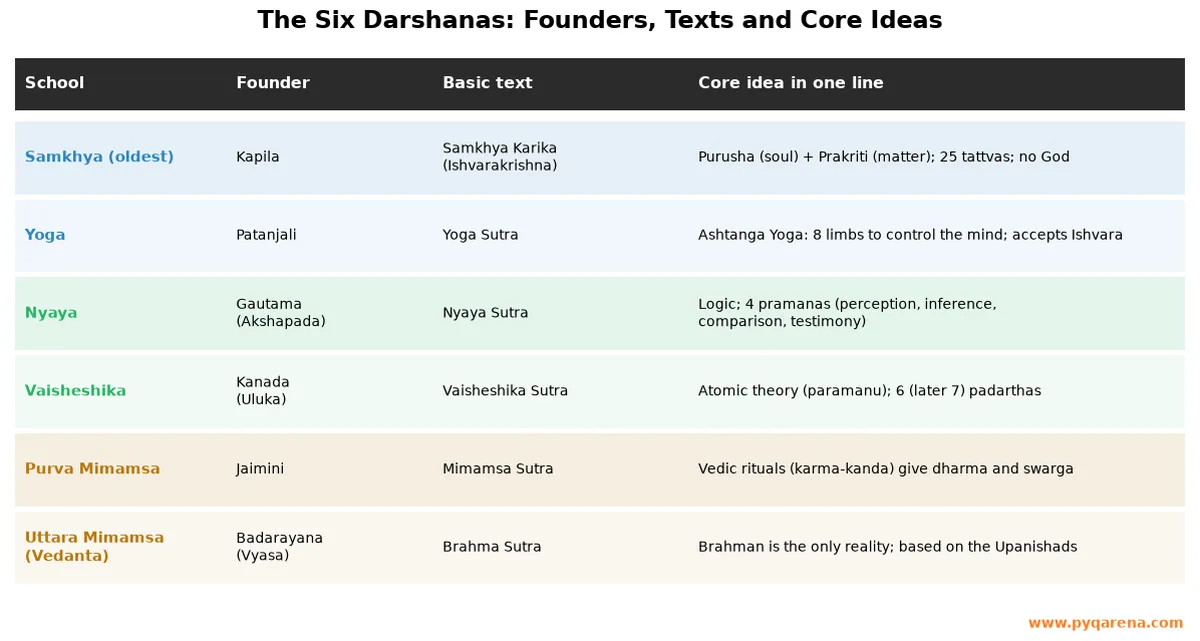
The six Darshanas at a glance: founder, basic text and core idea.
| School | Founder | Basic text | Core idea | Main commentator |
|---|---|---|---|---|
| Samkhya (oldest) | Kapila | Samkhya Sutra; Samkhya Karika | Purusha + Prakriti (dualism) | Ishvarakrishna (Karika), Vachaspati Mishra |
| Yoga | Patanjali | Yoga Sutra | Eight limbs to control the mind | Vyasa (Yoga Bhashya) |
| Nyaya | Gautama (Akshapada) | Nyaya Sutra | Logic and valid knowledge | Vatsyayana (Nyaya Bhashya) |
| Vaisheshika | Kanada (Uluka) | Vaisheshika Sutra | Atomic theory | Prashastapada |
| Purva Mimamsa | Jaimini | Mimamsa Sutra | Vedic ritual = dharma | Shabara, Kumarila Bhatta, Prabhakara |
| Uttara Mimamsa (Vedanta) | Badarayana | Brahma Sutra | Brahman is the only reality | Shankaracharya, Ramanuja, Madhva |
3. Samkhya: The Oldest School
In simple words: Samkhya means “counting” or “enumeration”. It explains the universe by counting its basic elements (25 tattvas). Everything comes from two eternal things: Purusha (pure consciousness, the soul) and Prakriti (matter). We suffer because the soul wrongly thinks it is the body. Right knowledge of the difference brings freedom.
- Oldest school of Indian philosophy: Samkhya. → PYQ: WBCS Prelims 2010
- Founder: sage Kapila.
- Text: Samkhya Sutra (Kapila); Samkhya Karika by Ishvarakrishna (c. 4th century CE) is the oldest surviving text.
- Dualism (Dvaita): Purusha (many souls, inactive, conscious) and Prakriti (one, active, unconscious matter).
- Three gunas of Prakriti:
- Sattva: goodness, light.
- Rajas: activity, passion.
- Tamas: darkness, inertia.
- The world appears when the balance of the gunas is disturbed.
- Satkaryavada: the effect already exists in the cause. Curd already exists in milk.
- God: classical Samkhya does not need a creator God, so it is atheistic (nirishvara) but still Astika, because it accepts the Vedas.
- Pramanas accepted: 3 (perception, inference, testimony).
- Liberation (kaivalya): knowledge that Purusha is different from Prakriti.
4. Yoga: The Practical Path
In simple words: Yoga is the practical partner of Samkhya. Samkhya says what to know. Yoga shows how to reach it: by controlling body, breath and mind step by step until the mind is perfectly still.
- Founder: Patanjali. Text: Yoga Sutra (196 sutras in 4 padas: Samadhi, Sadhana, Vibhuti, Kaivalya).
- Definition: “Yogash chitta-vritti-nirodhah”: yoga is the stopping of the fluctuations of the mind.
- God: accepts Ishvara as a special soul, so Yoga is called “Seshvara Samkhya” (Samkhya with God).
- Ashtanga Yoga (eight limbs):
- Yama: restraints (ahimsa, satya, asteya, brahmacharya, aparigraha).
- Niyama: observances (purity, contentment, austerity, study, devotion).
- Asana: posture.
- Pranayama: breath control.
- Pratyahara: withdrawal of senses.
- Dharana: concentration.
- Dhyana: meditation.
- Samadhi: complete absorption.
- Memory trick: “Your Nice Aunt Prepared Pure Dal Daily Sweetly” = Yama, Niyama, Asana, Pranayama, Pratyahara, Dharana, Dhyana, Samadhi.
- Do not confuse the two Patanjalis: Patanjali the grammarian wrote the Mahabhashya (commentary on Panini’s grammar). He was a contemporary of Pushyamitra Shunga (2nd century BCE) and acted as priest in his Ashvamedha. → PYQ: WBCS Prelims 2001
- International Day of Yoga: 21 June (UN declaration of 2014).
5. Nyaya: The School of Logic
In simple words: Nyaya is India’s school of logic. It asks, “How do we know that something is true?” It gives careful rules for correct thinking and debate, so that a person can reach true knowledge and, through it, liberation.
- Founder: Gautama, also called Akshapada (different from Gautama Buddha). Text: Nyaya Sutra.
- Commentators: Vatsyayana (Nyaya Bhashya), Uddyotakara, Udayana (Nyaya Kusumanjali, proof of God).
- Four pramanas (means of valid knowledge):
- Pratyaksha: perception.
- Anumana: inference (“where there is smoke, there is fire”).
- Upamana: comparison.
- Shabda: reliable testimony (including the Vedas).
- Five-step syllogism (Panchavayava): the hill has fire (claim) → because it has smoke (reason) → wherever there is smoke there is fire, as in a kitchen (example) → the hill has such smoke (application) → so the hill has fire (conclusion).
- God: Nyaya proves God by logic. God is the efficient cause of the world.
- Navya-Nyaya (New Logic):
- Founded by Gangesha Upadhyaya of Mithila (14th century) with Tattvachintamani.
- It later flourished at Nabadwip (Bengal) under Raghunatha Shiromani and Vasudeva Sarvabhauma.
6. Vaisheshika: The Atomic School
In simple words: Vaisheshika is India’s early physics. It says everything in the world is made of tiny, invisible, eternal particles called paramanu (atoms). When atoms join, objects form; when they separate, objects break.
- Founder: Kanada (also called Uluka or Kashyapa). Text: Vaisheshika Sutra.
- Name: from vishesha (“particularity”), the quality that makes each atom distinct.
- Atomic theory:
- Paramanu is eternal and indivisible.
- Two atoms make a dvyanuka (dyad), and three dyads make a tryanuka (triad), the smallest visible particle.
- Atoms of four elements: earth, water, fire and air.
- Padarthas (categories of reality): 6 in Kanada: dravya (substance), guna (quality), karma (action), samanya (generality), vishesha (particularity), samavaya (inherence). Later thinkers added a 7th: abhava (non-existence).
- Pramanas accepted: 2 (perception and inference).
- Commentator: Prashastapada (Padarthadharmasangraha).
- Nyaya and Vaisheshika later merged into a single Nyaya-Vaisheshika system.
7. Purva Mimamsa: The School of Ritual
In simple words: Mimamsa means “investigation”. Purva (“earlier”) Mimamsa studies the earlier, ritual part of the Vedas (Samhitas and Brahmanas). It says the Vedas are eternal and authorless, and that performing Vedic rituals correctly is dharma, which leads to heaven (swarga).
- Founder: Jaimini. Text: Mimamsa Sutra (the largest of the sutra texts, 12 chapters).
- Commentators:
- Shabara Swami (Shabara Bhashya).
- Kumarila Bhatta: the Bhatta school; strongly opposed Buddhism.
- Prabhakara: the Prabhakara school.
- Key ideas:
- Vedas are apaurusheya: not made by any person, eternal and self-valid.
- Karma-kanda: stress on ritual action.
- Apurva: an unseen power created by a ritual that gives its fruit later.
- God: early Mimamsa does not need a creator God; the Vedas themselves are the authority.
- Pramanas: 6 in the Bhatta school (perception, inference, comparison, testimony, arthapatti (presumption), anupalabdhi (non-perception)).
- Exam link: Mimamsa rules of interpretation were later used in Hindu law (Dharmashastra). Vijnaneshvara’s Mitakshara (12th century, court of Chalukya king Vikramaditya VI) is the leading commentary on the Yajnavalkya Smriti. → PYQ: WBCS Prelims
8. Uttara Mimamsa (Vedanta)
In simple words: Uttara (“later”) Mimamsa studies the later, knowledge part of the Vedas, the Upanishads. Its central question is: what is Brahman, and how is the soul related to it? Different teachers gave different answers, and so Vedanta split into several sub-schools.
- Founder: Badarayana (also called Vyasa). Text: Brahma Sutra (Vedanta Sutra), 555 sutras.
- Base: the Prasthanatrayi: Upanishads + Brahma Sutra + Bhagavad Gita.
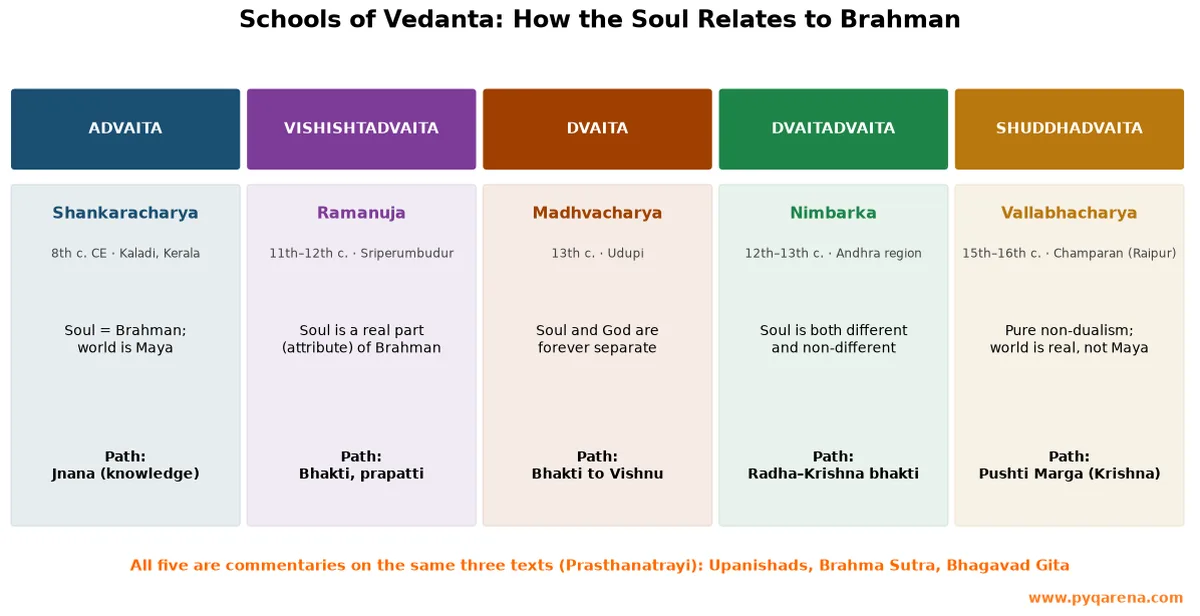
The five main schools of Vedanta and how each sees the relation between the soul and Brahman.
8.1 Advaita (Non-dualism): Adi Shankaracharya
- Life: born at Kaladi (Kerala) in the 8th century CE (788–820 CE); died young at Kedarnath.
- Guru: Govinda Bhagavatpada, a disciple of Gaudapada. Gaudapada’s Mandukya Karika is the first Advaita text.
- Teaching:
- “Brahma satyam jagan mithya, jivo brahmaiva naparah”: Brahman alone is real; the world is an appearance (Maya); the soul is nothing but Brahman.
- Brahman is nirguna (without attributes).
- Ignorance (avidya) makes us see the world as separate. A rope looks like a snake in dim light.
- Path: Jnana (knowledge).
- Works: Brahma Sutra Bhashya, commentaries on the Upanishads and the Gita, Vivekachudamani, Bhaja Govindam, Saundarya Lahari.
- Four Mathas (Amnaya Peethas):
- Sringeri (south, Karnataka).
- Dwarka (west, Gujarat).
- Puri (east, Odisha).
- Jyotirmath (north, Uttarakhand).
- Dashanami order: he organised monks into the Dashanami order (ten names, such as Giri, Puri, Bharati and Saraswati).
- Debate: he defeated the Mimamsa scholar Mandana Mishra, who later became his disciple Sureshvara.
- Revival of Vedic religion: he revived Vedic religion against Buddhism and Jainism. Critics called him a “prachchhanna Bauddha” (hidden Buddhist) because his Maya doctrine resembles Buddhist ideas.
- Statue of Oneness: a 108-ft statue of Shankaracharya unveiled in 2023 at Omkareshwar (Madhya Pradesh).
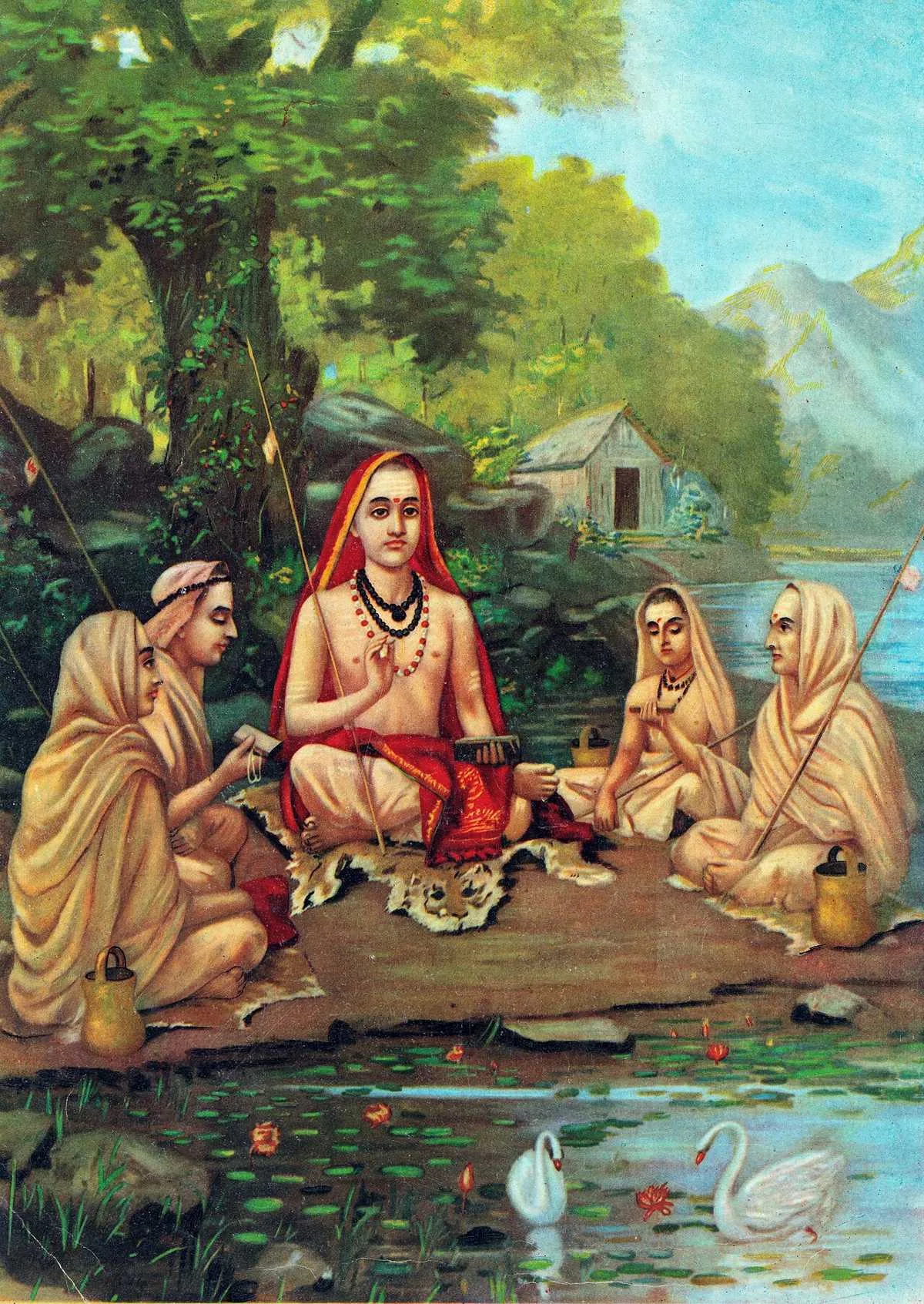
Adi Shankaracharya with his disciples, painted by Raja Ravi Varma.
Image Source: Wikimedia
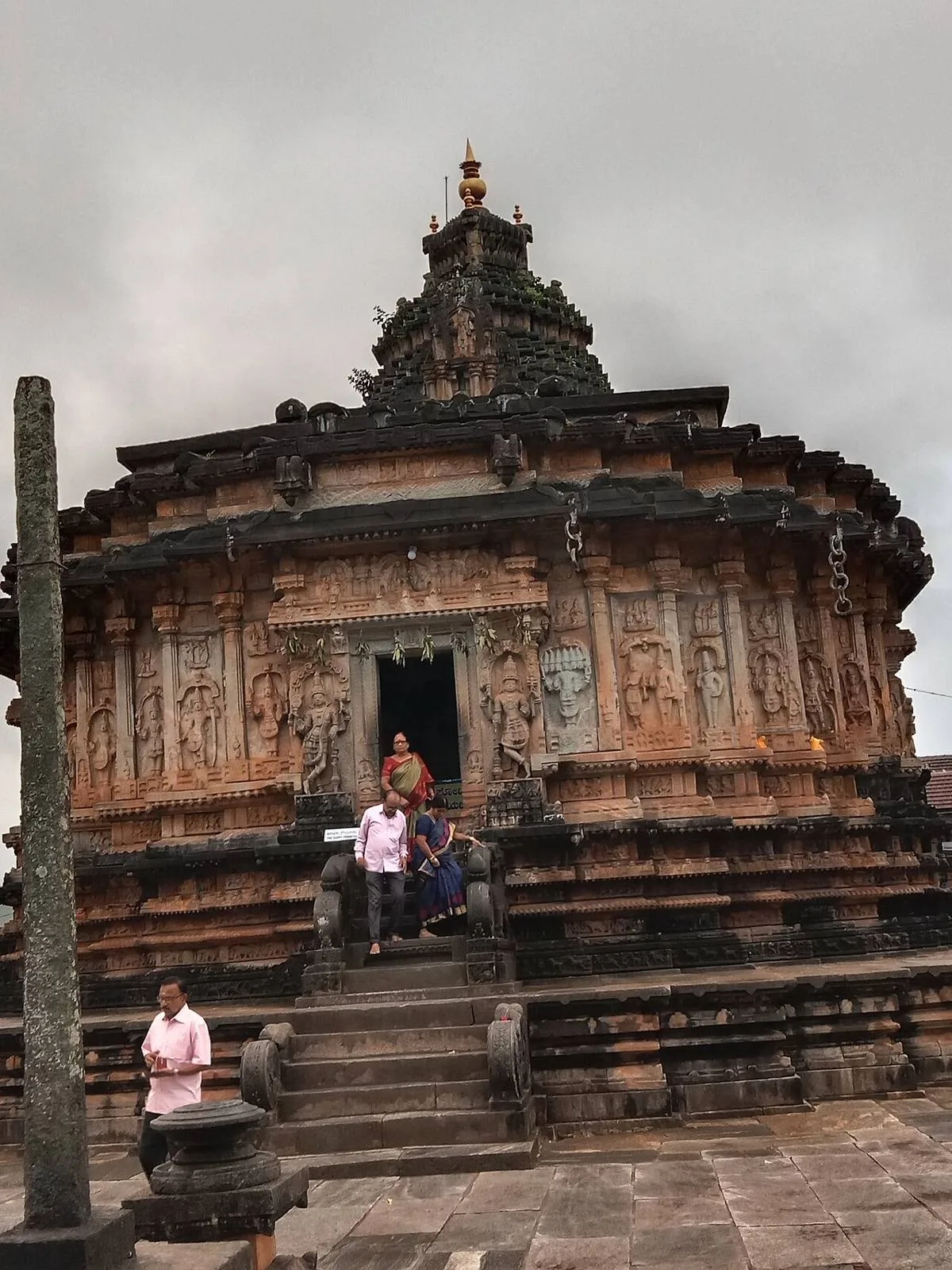
The Vidyashankara temple at Sringeri, Karnataka, home of the Sringeri Sharada Peetham, Shankaracharya’s southern math.
Image Source: Wikimedia
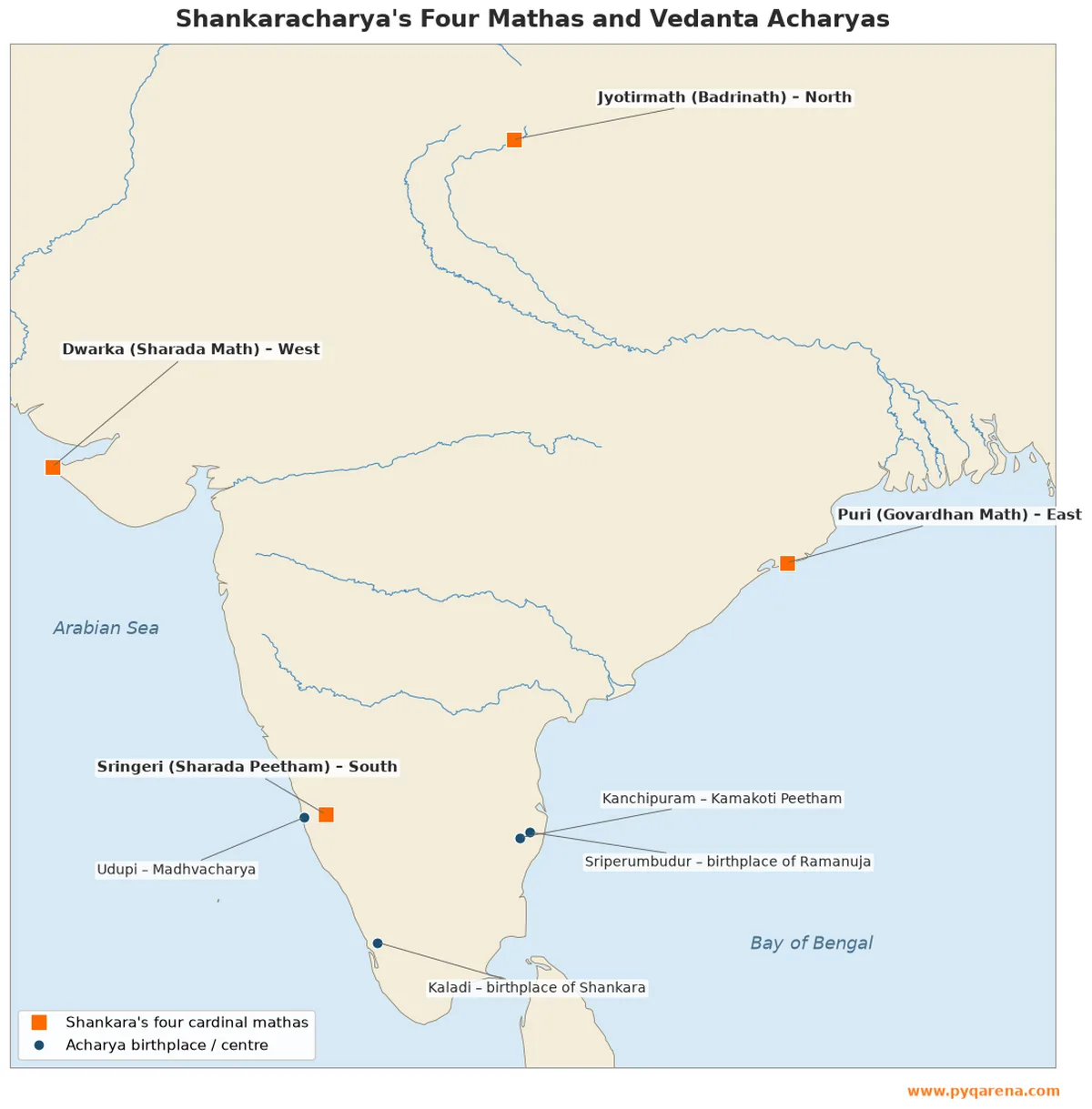
Shankaracharya’s four cardinal mathas and the home towns of the main Vedanta acharyas.
8.2 Vishishtadvaita (Qualified non-dualism): Ramanuja
- Life: Ramanujacharya (1017–1137 CE), born at Sriperumbudur (Tamil Nadu); taught at Srirangam. His teacher in Kanchi was Yadavaprakasha, and he later followed the line of Yamunacharya.
- Teaching:
- Brahman (Vishnu / Narayana) is real and saguna (with qualities).
- Souls (chit) and matter (achit) are real and form the “body” of God, like qualities of one whole.
- The world is real, not Maya.
- Path: Bhakti and prapatti (total surrender).
- Work: Shri Bhashya (on the Brahma Sutra), Vedartha Sangraha, Gita Bhashya.
- Sect: Sri Vaishnavism. He opened temple worship to lower castes.
- Statue of Equality:
- A 216-ft seated statue of Ramanuja at Muchintal, Hyderabad, unveiled in 2022, marking his 1,000th birth anniversary.
- It is the world’s second-tallest seated statue.
- Link to the Bhakti movement: Ramananda, who carried Ramanuja’s line to North India, was influenced by Islam and took disciples from all castes and both religions (Kabir, Ravidas). → PYQ: WBCS Mains 2017
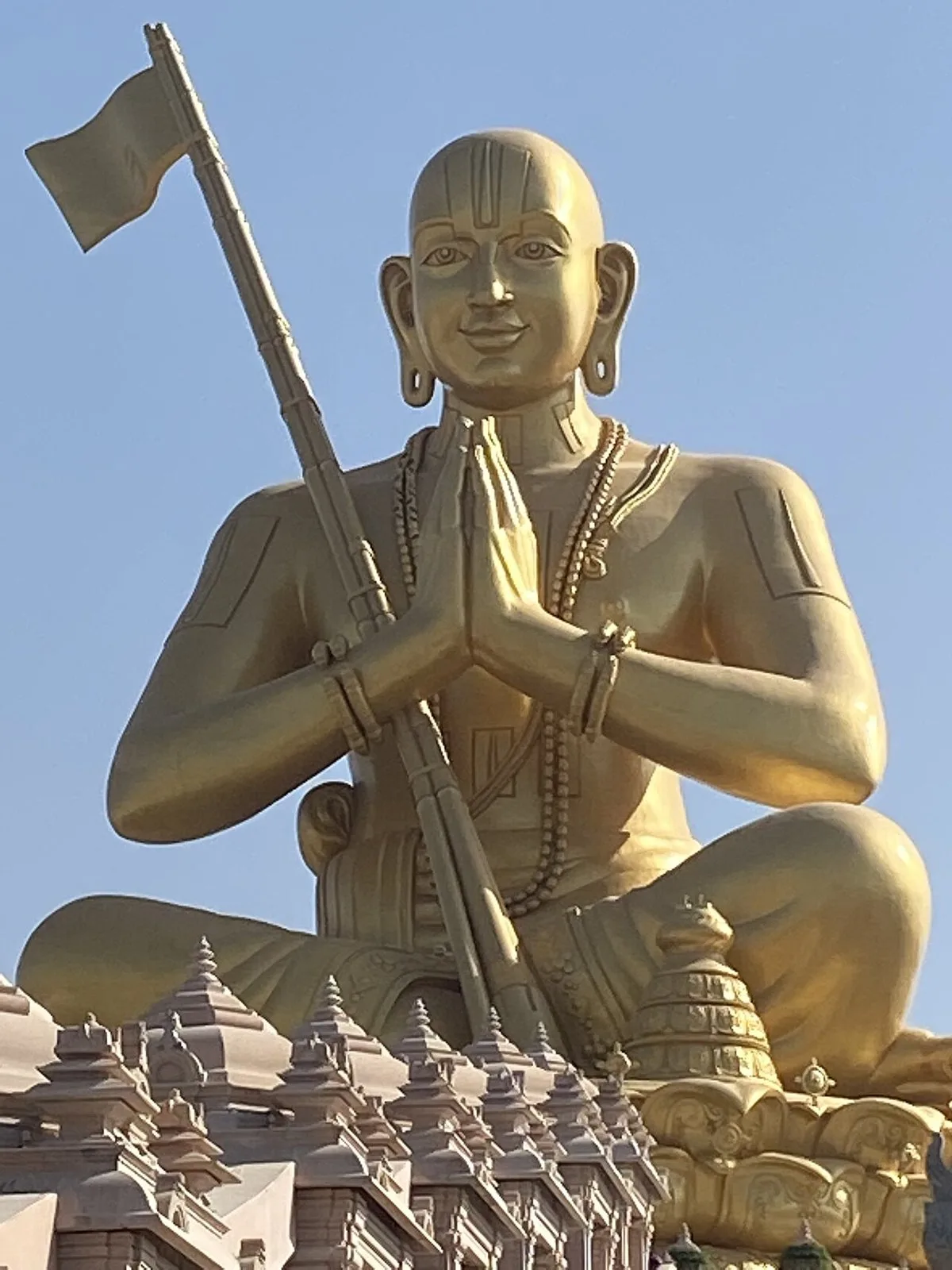
The 216-ft Statue of Equality of Ramanuja at Muchintal, Hyderabad.
Image Source: Wikimedia
8.3 Dvaita (Dualism): Madhvacharya
- Life: Madhvacharya (1238–1317 CE), also called Anandatirtha or Purnaprajna, born near Udupi (Karnataka).
- Teaching:
- God (Vishnu) and souls are forever separate.
- Five eternal differences (Pancha-bheda): God–soul, God–matter, soul–soul, soul–matter, matter–matter.
- Path: Bhakti to Vishnu; grace of God is necessary.
- Founded: the Udupi Krishna Matha and its eight mathas (Ashta Mathas).
- Influence: the Haridasa movement of Karnataka (Purandaradasa, Kanakadasa).
8.4 Dvaitadvaita (Dualistic non-dualism): Nimbarka
- Nimbarka (12th–13th century) taught Bhedabheda: the soul is both different and not different from God, as a wave is to the sea.
- Worship: Radha–Krishna. The Nimbarka Sampradaya has its main seat near Vrindavan / Mathura.
8.5 Shuddhadvaita (Pure non-dualism): Vallabhacharya
- Vallabhacharya (1479–1531 CE), born at Champaran near Raipur (Chhattisgarh) in a Telugu family.
- Teaching: the world is a real form of Brahman (Krishna), not Maya; hence “pure” non-dualism.
- Path: Pushti Marga (“path of grace”), loving devotion to Krishna (Shrinathji). He was the most distinguished preacher of the Krishna cult. → PYQ: WBCS Mains 2014
- Disciple: the poet Surdas (Sursagar) belonged to his line (Ashtachhap poets).
8.6 Achintya Bhedabheda: Sri Chaitanya (Bengal)
- Sri Chaitanya Mahaprabhu (1486–1534) of Nabadwip taught that the relation between God and soul is “inconceivable (achintya) difference and non-difference”.
- Practice: Krishna-bhakti through sankirtan.
- Followers: his teaching founded Gaudiya Vaishnavism, carried on by the Six Goswamis of Vrindavan. He drew disciples from both Hindus and Muslims (for example, Haridas Thakur). → PYQ: WBCS Prelims
| Vedanta school | Acharya | Soul and Brahman | World |
|---|---|---|---|
| Advaita | Shankaracharya | Identical | Maya (appearance) |
| Vishishtadvaita | Ramanuja | Soul is a real part / attribute | Real |
| Dvaita | Madhvacharya | Eternally different | Real |
| Dvaitadvaita | Nimbarka | Different and non-different | Real |
| Shuddhadvaita | Vallabhacharya | Identical (pure) | Real form of Brahman |
| Achintya Bhedabheda | Chaitanya | Inconceivably different and non-different | Real |
Part B: NASTIKA (HETERODOX) SCHOOLS
9. Charvaka (Lokayata): Indian Materialism
In simple words: The Charvakas believed only in what we can see and touch. No soul, no God, no heaven, no rebirth. Since this life is the only one, enjoy it wisely. They called the Vedas the work of clever priests.
- Founder: Brihaspati (the Brihaspati Sutra, now lost). The school is also called Lokayata (“prevalent among the people” or “this-worldly”).
- Name “Charvaka”: from charu-vak (“sweet talk”), because its ideas pleased the common people.
- Only pramana: pratyaksha (perception). Inference is not reliable.
- World: made of four elements: earth, water, fire and air. They did not accept akasha (ether), because it cannot be seen.
- Consciousness: arises from the body, like the intoxicating power of fermented grains. When the body dies, everything ends.
- Ethics: pleasure (kama) and wealth (artha) are the only goals.
- Famous saying: “Yavaj jivet sukham jivet, rinam kritva ghritam pibet” (“Live happily as long as you live; drink ghee even if you must borrow”).
- Rejects: the Vedas, God, the soul, karma, rebirth, heaven, hell and rituals.
- Sources: their own books are lost. We know them from criticism in other texts, such as Madhava’s Sarva-Darshana-Sangraha (14th century), whose first chapter explains Charvaka.
- Ajita Kesakambali, a contemporary of the Buddha, taught a similar materialism.
10. Ajivika: The School of Fate (Niyati)
In simple words: The Ajivikas believed that everything is fixed by fate (niyati). Human effort cannot change anything. Every soul passes through a fixed number of births and then becomes free automatically.
- Founder: Makkhali Gosala (Goshala Maskariputra), a one-time companion of Mahavira. → PYQ: WBCS Mains 2019, 2017 | PYQ: WBPSC Misc 2023
- Other leaders: Purana Kassapa and Pakudha Kaccayana were linked with the Ajivikas.
- Doctrine: Niyativada (determinism). Monks practised severe austerity and went naked.
- Royal patronage:
- Bindusara respected Ajivika ascetics.
- Ashoka donated the Barabar caves (Sudama, Karna Chaupar) near Gaya to the Ajivikas.
- His grandson Dasharatha donated the Nagarjuni caves.
- The Lomas Rishi cave in the Barabar hills belongs to the Ajivikas. → PYQ: WBCS Mains 2016
- End: the sect survived in South India till about the 14th century CE, then disappeared. No Ajivika text survives.
11. Buddhism and Jainism as Philosophies (brief link)
In simple words: Buddhism and Jainism are called Nastika because they reject the authority of the Vedas, not because they lack spiritual teaching. Both accept karma, rebirth and liberation. Full notes are in the Buddhism and Jainism chapter. Practise with the WBCS Mains Buddhism & Jainism PYQs.
| Point | Buddhist philosophy | Jain philosophy |
|---|---|---|
| Key doctrines | Four Noble Truths; Anatta (no permanent soul); Anicca (impermanence); Pratityasamutpada | Anekantavada (many-sidedness); Syadvada (sevenfold “maybe” logic); jiva and ajiva |
| Goal | Nirvana | Kaivalya / Moksha |
| Pramanas | Perception and inference | Perception, inference and testimony |
| Main schools | Madhyamika / Shunyavada (Nagarjuna); Yogachara / Vijnanavada (Asanga, Vasubandhu); Sautrantika; Vaibhashika | Digambara, Shvetambara |
- Four Buddhist philosophical schools:
- Vaibhashika and Sautrantika (Hinayana): realists.
- Madhyamika (emptiness, shunyata) and Yogachara (only consciousness is real) (Mahayana).
- Dignaga and Dharmakirti founded Buddhist logic, which competed with Nyaya.
12. Other Important Philosophical Traditions
- Kashmir Shaivism (Pratyabhijna):
- A non-dual Shaiva school; Shiva is the only reality.
- Founded by Vasugupta (Shiva Sutras, 9th century) and perfected by Abhinavagupta (Tantraloka).
- Shaiva Siddhanta: a Tamil school based on the 28 Agamas and the hymns of the Nayanars. Meykandar wrote Sivajnana Bodham.
- Virashaiva (Lingayat): Basavanna (12th century, minister of Kalachuri king Bijjala). It rejected caste and temple rituals and spread through vachanas.
- Pashupata: the oldest Shaiva sect, founded by Lakulisha (2nd century CE).
- Bhagavad Gita: a synthesis of Jnana, Bhakti and Karma yoga, with nishkama karma (action without desire for its fruit).
13. Pramanas: Which School Accepts How Many?
In simple words: A pramana is a valid way of knowing. Schools differ on how many they accept. This is a favourite match-the-following topic.
| No. | School | Pramanas accepted |
|---|---|---|
| 1 | Charvaka | Perception only |
| 2 | Vaisheshika, Buddhism | Perception, inference |
| 3 | Samkhya, Yoga, Jainism | + Testimony (shabda) |
| 4 | Nyaya | + Comparison (upamana) |
| 5 | Prabhakara Mimamsa | + Presumption (arthapatti) |
| 6 | Bhatta Mimamsa, Advaita Vedanta | + Non-perception (anupalabdhi) |
14. Frequently Asked Facts (PYQ trends)
| Question | Answer |
|---|---|
| Oldest school of Indian philosophy | Samkhya (Kapila) |
| Atomic theory | Vaisheshika (Kanada) |
| School of logic | Nyaya (Gautama / Akshapada) |
| Yoga Sutra | Patanjali |
| Brahma Sutra | Badarayana |
| Mimamsa Sutra | Jaimini |
| Grammarian Patanjali was a contemporary of | Pushyamitra Shunga |
| Samkhya Karika | Ishvarakrishna |
| Navya-Nyaya founder | Gangesha (Tattvachintamani) |
| Advaita | Shankaracharya (born at Kaladi) |
| Vishishtadvaita | Ramanuja |
| Dvaita | Madhvacharya |
| Dvaitadvaita | Nimbarka |
| Shuddhadvaita / Pushti Marga / Krishna cult | Vallabhacharya |
| Achintya Bhedabheda | Chaitanya |
| Materialist school | Charvaka / Lokayata (Brihaspati) |
| Ajivika founder | Makkhali Gosala |
| Lomas Rishi cave given to | Ajivikas |
| “Tamaso ma jyotirgamaya” | Brihadaranyaka Upanishad |
| “Satyameva Jayate” | Mundaka Upanishad |
| Upanishads compiled around | 600 BCE |
| Earliest mention of untouchables | Chandogya Upanishad |
| Upanishads translated into Persian | Dara Shikoh (Sirr-i-Akbar) |
| Essays on the Gita | Sri Aurobindo |
| Mitakshara | Vijnaneshvara |
| Bhakti saint influenced by Islam | Ramananda |
15. Quick-Revision Sheet
- Astika = accept the Vedas (6 schools); Nastika = reject the Vedas (Charvaka, Ajivika, Buddhism, Jainism).
- Pairs: Samkhya–Yoga | Nyaya–Vaisheshika | Mimamsa–Vedanta.
- Samkhya: Kapila; oldest; Purusha + Prakriti; 3 gunas; 25 tattvas; Satkaryavada; Ishvarakrishna’s Karika; no God.
- Yoga: Patanjali; Yoga Sutra (4 padas); Ashtanga (Yama → Samadhi); accepts Ishvara.
- Nyaya: Gautama (Akshapada); logic; 4 pramanas; five-step syllogism; Navya-Nyaya (Gangesha; Nabadwip).
- Vaisheshika: Kanada (Uluka); paramanu; 6 (+1) padarthas; 2 pramanas.
- Purva Mimamsa: Jaimini; ritual; Vedas apaurusheya; Kumarila Bhatta, Prabhakara.
- Vedanta: Badarayana (Brahma Sutra); Prasthanatrayi.
- Advaita (Shankara, Kaladi, 4 mathas, Maya).
- Vishishtadvaita (Ramanuja, Sriperumbudur, Statue of Equality).
- Dvaita (Madhva, Udupi).
- Dvaitadvaita (Nimbarka).
- Shuddhadvaita (Vallabha, Pushti Marga).
- Achintya Bhedabheda (Chaitanya).
- Charvaka: Brihaspati; perception only; 4 elements; no soul or God.
- Ajivika: Makkhali Gosala; niyati (fate); Barabar caves (Ashoka) and Nagarjuni caves (Dasharatha).
- Upanishads: Brihadaranyaka (Tamaso ma jyotirgamaya), Mundaka (Satyameva Jayate), Katha (Nachiketa), Chandogya (Tat Tvam Asi); Dara Shikoh (Sirr-i-Akbar).
16. Related PYQs on PYQ Arena
- WBCS Prelims Ancient Indian History Previous Year Questions
- WBCS Mains Buddhism & Jainism PYQs
- WBCS Mains Vedic Age PYQs
- WBCS Mains Religious Movements PYQs
- WBCS Mains Pre-Mauryan & Mauryan Empire PYQs
- WBCS Prelims Medieval Indian History PYQs
- WBPSC Miscellaneous Prelims History Questions
- WBPSC Miscellaneous Prelims General Knowledge
- Previous chapters: Prehistoric India Notes | Indus Valley Civilization Notes | Vedic Age Notes | Mahajanapadas & Rise of Magadha Notes
Leave a Comment