

Who is this for? Beginners and aspirants for UPSC Prelims, WBCS, other State PSCs and SSC. Each section opens with an “In simple words” explanation and then goes to exam-level detail. Practise alongside: WBCS Mains Buddhism & Jainism PYQs | WBCS Prelims Ancient Indian History PYQs Previous chapters: Prehistoric India Notes → Indus Valley Civilization Notes → Vedic Age Notes → Mahajanapadas & Rise of Magadha Notes
1. Background: Why New Religions Arose in the 6th Century BCE
In simple words: Around 600 BCE, the Ganga valley was full of new cities, traders and kingdoms. Many people were unhappy with costly Vedic sacrifices and the strict varna system. Wandering teachers called shramanas offered new, simpler paths to happiness. Two of them, Gautama Buddha and Vardhamana Mahavira, founded religions that still have millions of followers.
Causes of the religious movement:
- Costly and complex Vedic rituals.
- Yajnas needed many priests, gifts and animal sacrifices, which ordinary people could not afford.
- The Brahmanas controlled religion through Sanskrit texts that common people could not read. (See the Vedic Age Notes for Later Vedic rituals.)
- Rigid varna system.
- Kshatriyas resented the claim of Brahmana superiority. Both the Buddha and Mahavira were Kshatriyas.
- Vaishyas (traders) were rich but had low social status, so they supported the new faiths.
- New agricultural economy.
- Iron ploughs made farming depend on cattle. Killing cattle in sacrifices hurt farmers, so ahimsa (non-violence) became popular.
- Rise of trade and cities.
- Traders liked religions that did not condemn money-lending and sea trade. The Vedic texts looked down on both.
- Second urbanisation and the rise of Magadha are covered in the Mahajanapadas & Rise of Magadha Notes.
- Simple language. The Buddha preached in Pali and Mahavira in Prakrit (Ardha-Magadhi), the languages of the common people.
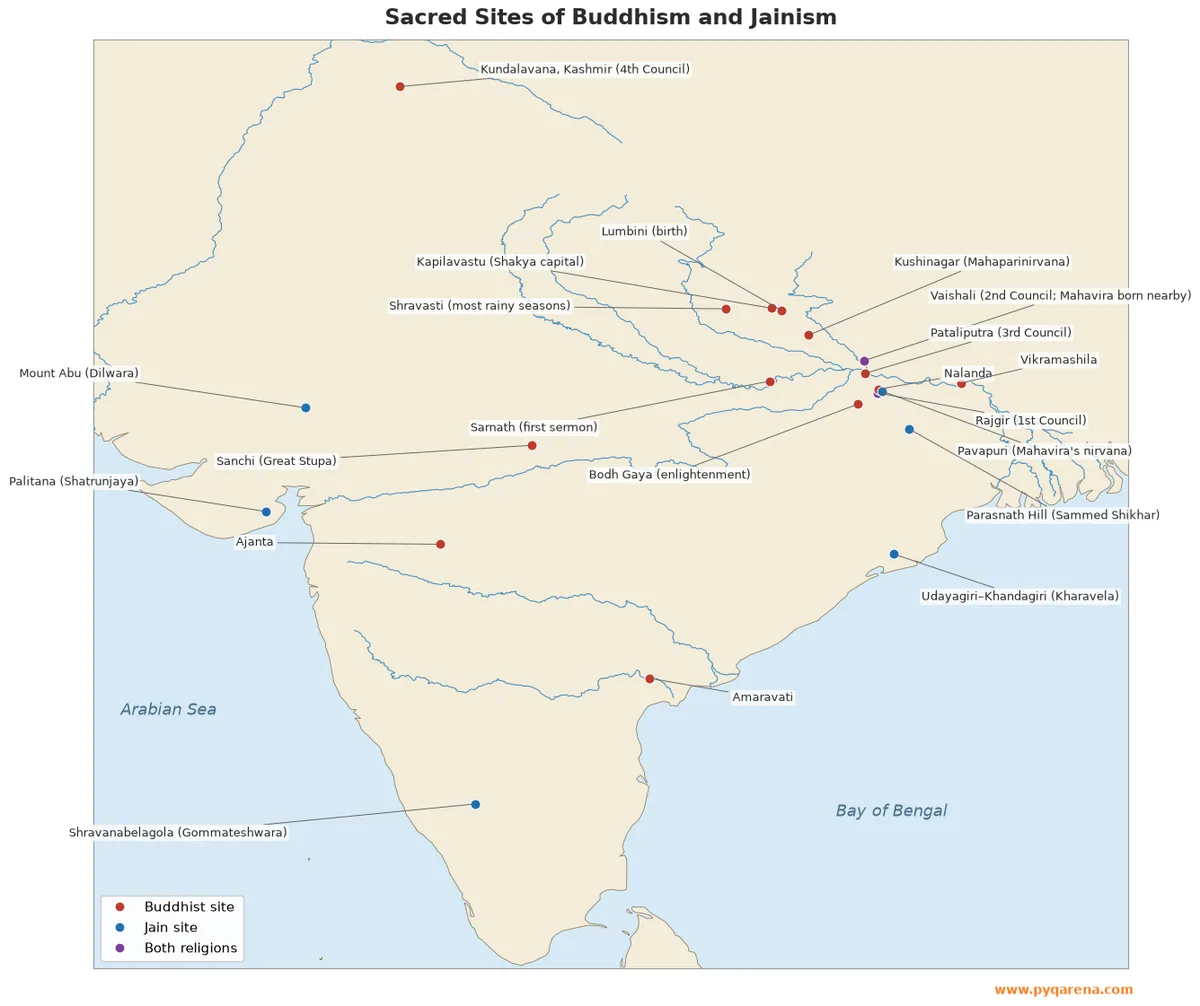
Major Buddhist and Jain sacred sites of India.
2. The Six Heterodox Teachers (Shramana Sects)
In simple words: Buddhist texts name 62 sects in the Buddha’s time. Six famous teachers rejected the Vedas. Exams ask mainly about the Ajivikas and the Charvakas.
| Teacher | School / idea | Key point |
|---|---|---|
| Makkhali Gosala | Ajivika (founder) | Niyati (fate): everything is predetermined; human effort is useless |
| Purana Kassapa | Akiriyavada | Good or bad deeds bring no merit or sin |
| Ajita Kesakambali | Materialist (Uchchhedavada) | Nothing survives death; body is made of four elements. Forerunner of Charvaka / Lokayata |
| Pakudha Kaccayana | Sassatavada | Seven eternal elements that cannot be destroyed |
| Sanjaya Belatthiputta | Agnosticism (Ajnanavada) | Neither affirms nor denies anything |
| Nigantha Nataputta | Jainism | This is Mahavira himself |
Ajivika facts:
- Founder: Makkhali Gosala, a one-time companion of Mahavira. → PYQ: WBCS Mains 2019, 2017 | PYQ: WBPSC Misc 2023
- Royal patrons: Bindusara favoured them. Ashoka and his grandson Dasharatha donated the Barabar and Nagarjuni caves (near Gaya, Bihar) to Ajivika monks.
- Lomas Rishi cave in the Barabar hills was donated to the Ajivikas. → PYQ: WBCS Mains 2016
Charvaka (Lokayata): a fully materialist school founded by Brihaspati. It accepted only perception (pratyaksha) as proof and denied God, soul and rebirth.
Part A: BUDDHISM
3. Life of Gautama Buddha (563–483 BCE)
In simple words: Prince Siddhartha of the Shakya clan saw old age, disease and death, and left his palace to find the cause of suffering. After six years of searching, he became the Buddha (“the Enlightened One”) at Bodh Gaya. He taught for 45 years and died at Kushinagar at the age of 80.
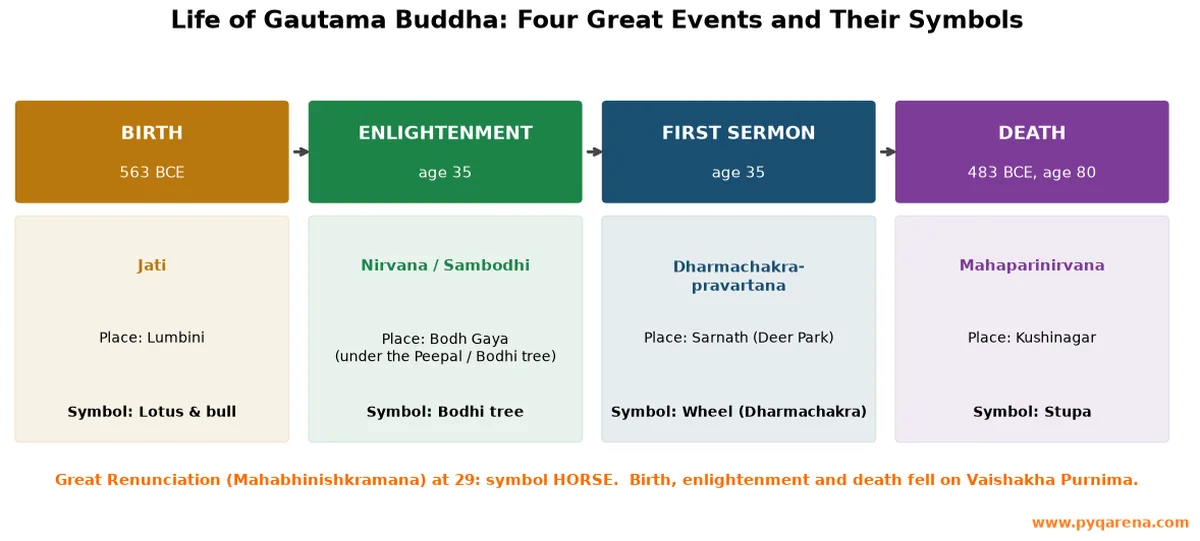
The four great events of the Buddha’s life, with their places and symbols.
3.1 Family and early life
- Born:563 BCE at Lumbini (in present-day Nepal), near Kapilavastu. → PYQ: WBCS Prelims 2013 | PYQ: WBPSC Clerkship
- Ashoka’s Rummindei pillar marks Lumbini as the Buddha’s birthplace. Ashoka cut the land tax of the village to 1/8 (atthabhagiya) and exempted it from bali. → PYQ: WBCS Mains 2017, 2014
- Clan: Shakya (a gana-sangha / republic). That is why he is called Shakyamuni (“sage of the Shakyas”). → PYQ: WBCS Mains 2022
- Father: Suddhodana, chief of the Shakyas.
- Mother: Mahamaya, a Koliya princess. She died seven days after his birth.
- Raised by: his aunt and stepmother Mahaprajapati Gautami, who later became the first Buddhist nun.
- Wife: Yashodhara. Son: Rahula. → PYQ: WBPSC Clerkship
- Gotra name: Gautama. Other titles: Tathagata (“one who has thus gone”), Shakyamuni, Buddha.
3.2 The Four Sights and the Great Renunciation
- Four sights: an old man, a sick man, a dead body and an ascetic. These made Siddhartha think about suffering.
- Mahabhinishkramana (Great Renunciation): he left home at 29.
- His horse was Kanthaka and his charioteer was Channa.
- Symbol: horse.
- Teachers: Alara Kalama (taught meditation) and Udraka Ramaputra.
- Six years of hard penance at Uruvela with five companions. He nearly starved, then accepted rice-milk (kheer) from Sujata and chose the Middle Path.
3.3 Enlightenment (Nirvana / Sambodhi)
- Where: Bodh Gaya (Uruvela), under a peepal (Bodhi) tree on the bank of the Niranjana (Phalgu) river. → PYQ: WBCS Prelims 2019
- Age: 35, after 49 days of meditation.
- Symbol: Bodhi tree.
- He became the Buddha. The Mahabodhi Temple stands at this spot today (UNESCO World Heritage Site, 2002).
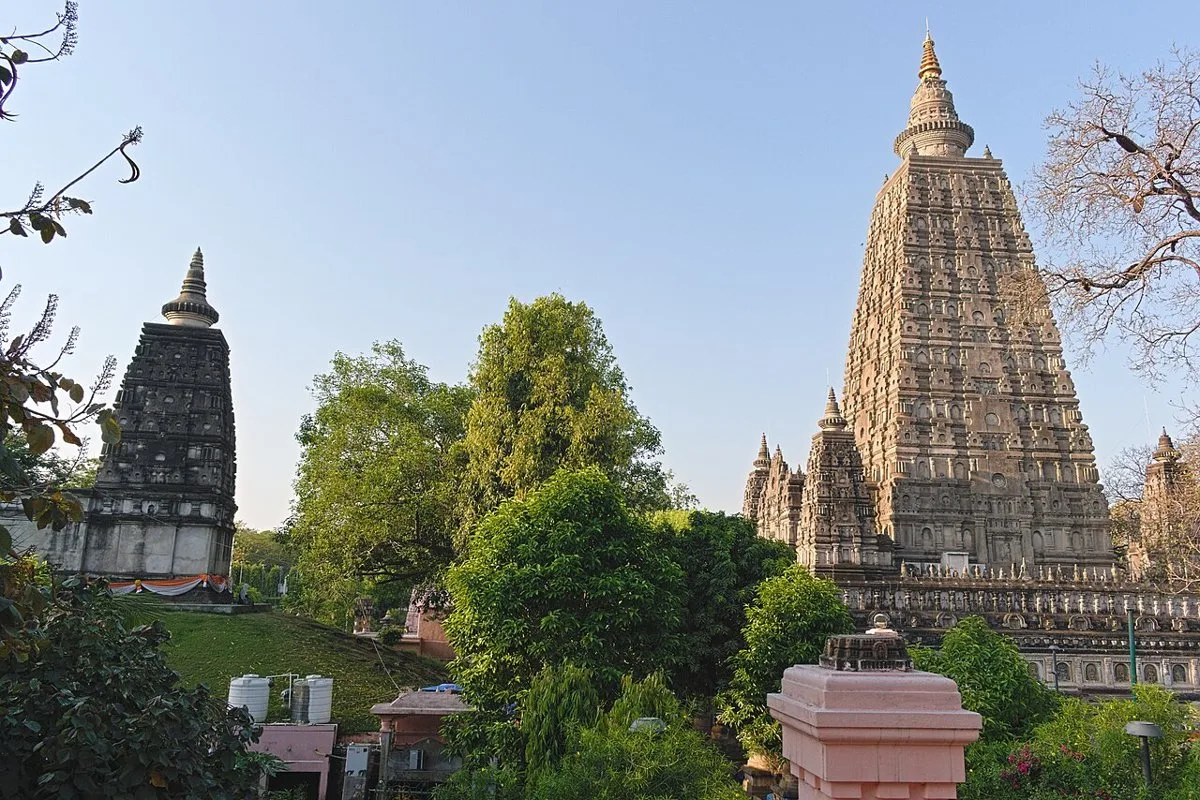
The Mahabodhi Temple at Bodh Gaya, Bihar, built at the place of the Buddha’s enlightenment.
Image Source: Wikimedia
3.4 First Sermon (Dharmachakra-pravartana)
- Where: Sarnath (Rishipatana / Mrigadava, the Deer Park) near Varanasi. → PYQ: WBCS Mains 2022 | PYQ: WBCS Prelims 2018, 2011, 2004 | PYQ: WBCS Mains GK
- Name: Dharmachakra-pravartana, “Turning the Wheel of Law (Dhamma)”. → PYQ: WBCS Prelims 2022 | PYQ: WBPSC Misc 2023
- Audience: his five former companions (Kaundinya and four others). They became the first monks, and the Sangha began.
- Symbol: wheel (Dharmachakra).
- Sarnath today:
- The Dhamek Stupa marks the spot of the first sermon.
- Ashoka’s Lion Capital, found at Sarnath, is India’s National Emblem and appears on currency notes. → PYQ: WBCS Prelims 2011, 2003
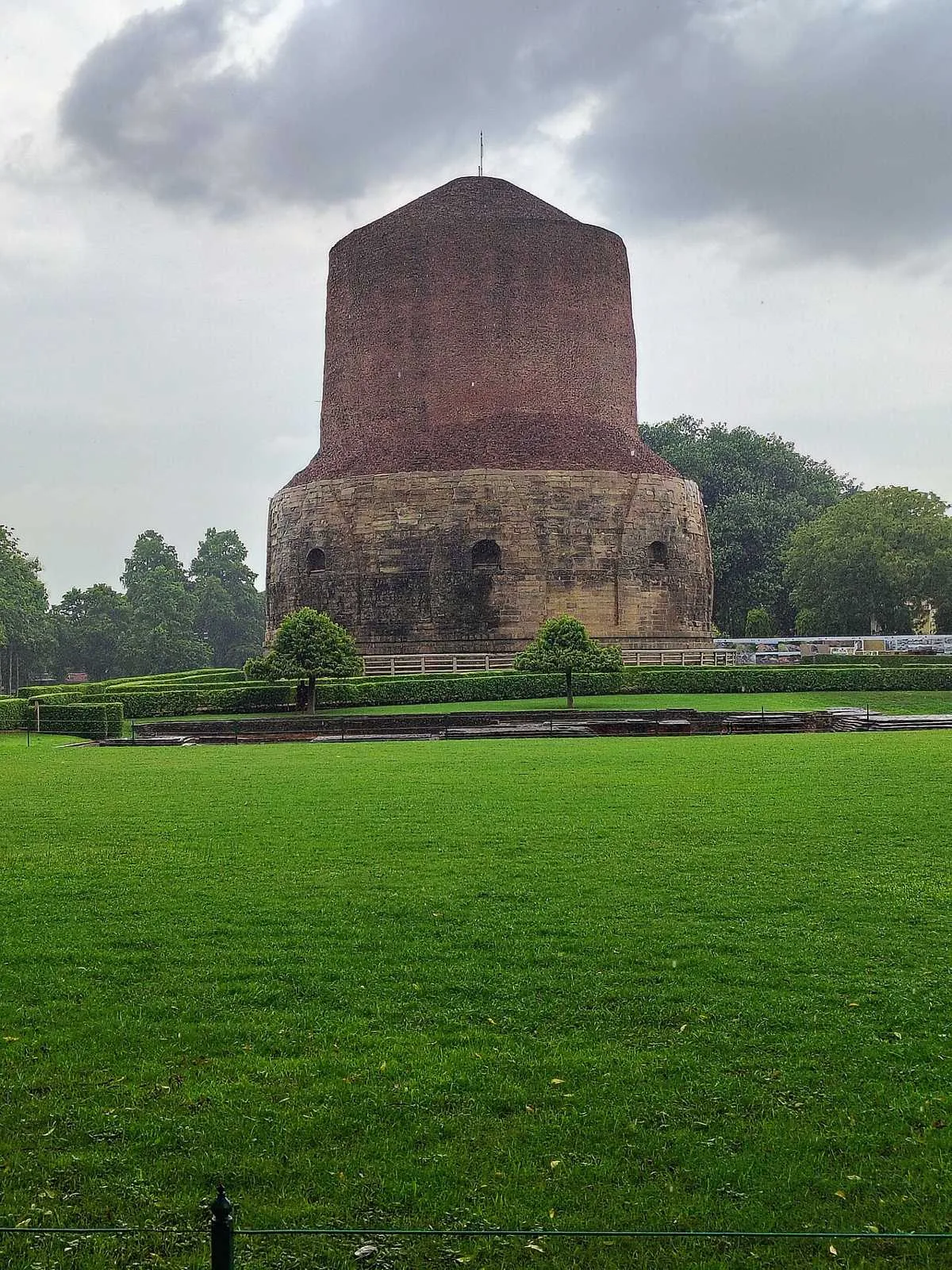
The Dhamek Stupa at Sarnath marks the site of the Buddha’s first sermon.
Image Source: Wikimedia
3.5 Preaching years
- He preached for 45 years, mostly in Magadha and Kosala.
- Shravasti (capital of Kosala): he spent the most rainy seasons (vassa) here, at the Jetavana monastery gifted by the merchant Anathapindika.
- Rajagriha: King Bimbisara gifted the Venuvana (bamboo grove) monastery.
- Vaishali: the courtesan Amrapali gifted her mango grove. Here, at the request of Ananda, the Buddha allowed women into the Sangha.
- Royal followers: Bimbisara and Ajatashatru (Magadha), Prasenajit (Kosala), Udayana (Vatsa) and Pradyota (Avanti).
- Jivaka, the royal physician of Bimbisara, treated the Buddha. He was the most famous physician of the Buddha’s time. → PYQ: WBCS Prelims 2000
- Chief disciples:
- Sariputta and Moggallana: the two chief disciples.
- Ananda: cousin and personal attendant.
- Upali: a barber, the master of monastic rules (Vinaya).
- Mahakassapa: presided over the First Council.
- Devadatta, the Buddha’s cousin, opposed him and tried to split the Sangha.
3.6 Mahaparinirvana (death)
- Where: Kushinagar (Kushinara), capital of the Mallas, in present-day Uttar Pradesh.
- When: 483 BCE, at the age of 80, after a meal offered by the smith Chunda at Pava.
- Symbol: stupa.
- The Ceylonese (Sri Lankan) tradition places the Mahaparinirvana in 544/543 BCE. → PYQ: WBCS Prelims 2006
- His relics were divided into eight parts, and stupas were built over them.
King connection (high-yield):
- Bimbisara was a contemporary of both the Buddha and Mahavira. → PYQ: WBCS Prelims 2000
- Both the Buddha and Mahavira died during the reign of Ajatashatru. → PYQ: WBCS Mains 2017
Full-moon (Purnima) rule: The Buddha’s birth, enlightenment and Mahaparinirvana all took place on Vaishakha Purnima, celebrated as Buddha Purnima. The Great Renunciation did not take place on Vaishakha Purnima. → PYQ: WBCS Mains 2017
| Event | Sanskrit/Pali term | Place | Symbol |
|---|---|---|---|
| Birth | Jati | Lumbini | Lotus and bull |
| Great Renunciation | Mahabhinishkramana | Kapilavastu | Horse |
| Enlightenment | Nirvana / Sambodhi | Bodh Gaya | Bodhi tree |
| First sermon | Dharmachakra-pravartana | Sarnath | Wheel |
| Death | Mahaparinirvana | Kushinagar | Stupa |
4. Teachings of the Buddha
In simple words: The Buddha said life is full of suffering. Suffering comes from desire (trishna). If desire ends, suffering ends. The way to end desire is the Eightfold Path, a balanced Middle Path between luxury and extreme self-torture.
4.1 Four Noble Truths (Arya Satya)
- Dukkha: the world is full of suffering.
- Dukkha Samudaya: suffering has a cause, which is desire / craving (trishna). → PYQ: WBCS Prelims 2016
- Dukkha Nirodha: suffering can be ended.
- Dukkha Nirodha Gamini Pratipada: the way to end suffering is the Eightfold Path.
4.2 Eightfold Path (Ashtangika Marga)
The Eightfold Path is called the Ashtangika Marga. → PYQ: WBCS Mains 2022
| Group | Steps |
|---|---|
| Prajna (wisdom) | 1. Right View, 2. Right Intention (Resolve) |
| Sila (conduct) | 3. Right Speech, 4. Right Action, 5. Right Livelihood |
| Samadhi (concentration) | 6. Right Effort, 7. Right Mindfulness, 8. Right Concentration |
4.3 Other core ideas
- Middle Path (Madhyama Pratipada): avoid both luxury and harsh penance.
- Three Jewels (Triratna) of Buddhism:Buddha, Dhamma and Sangha. Every Buddhist “takes refuge” in these three. → PYQ: WBCS Mains 2022
- Jainism also has its own Triratna (Right Faith, Right Knowledge, Right Conduct). See Section 11.
- Nirvana: “blowing out” the fire of desire. It frees a person from the cycle of rebirth.
- Karma and rebirth: accepted. Deeds decide the next birth.
- No permanent soul (Anatta / Anatman): the Buddha rejected an eternal soul.
- Anicca: everything is impermanent.
- Pratityasamutpada (dependent origination): everything arises from causes. The chain has 12 links.
- God: the Buddha stayed silent about God and did not accept the authority of the Vedas.
- Varna: he rejected birth-based caste. Anyone could join the Sangha.
- Panchashila (five precepts) for lay followers: do not kill, do not steal, no sexual misconduct, do not lie, no intoxicants.
4.4 The Sangha
- Who could join: anyone above 15 years who was not a debtor, slave, soldier or sick person. Minors needed parental permission.
- Bhikkhus (monks) and bhikkhunis (nuns). Lay followers were upasakas and upasikas.
- Uposatha: a fortnightly meeting where monks confessed faults.
- Vassa: the rainy-season retreat, when monks stayed in one place.
- Decisions were taken by voting, following the model of the gana-sanghas.
4.5 Position of women in the Buddha’s age
- The general status of women was declining. Child marriage and polygamy among the ruling classes were growing.
- Education was not denied to women. Nuns such as those in the Therigatha (songs of elder nuns) composed poetry. → PYQ: WBCS Mains 2020
5. Buddhist Councils (Sangitis)
In simple words: After the Buddha died, his followers met four times to collect his teachings and settle quarrels. Exams ask the place, king, president and result of each council.
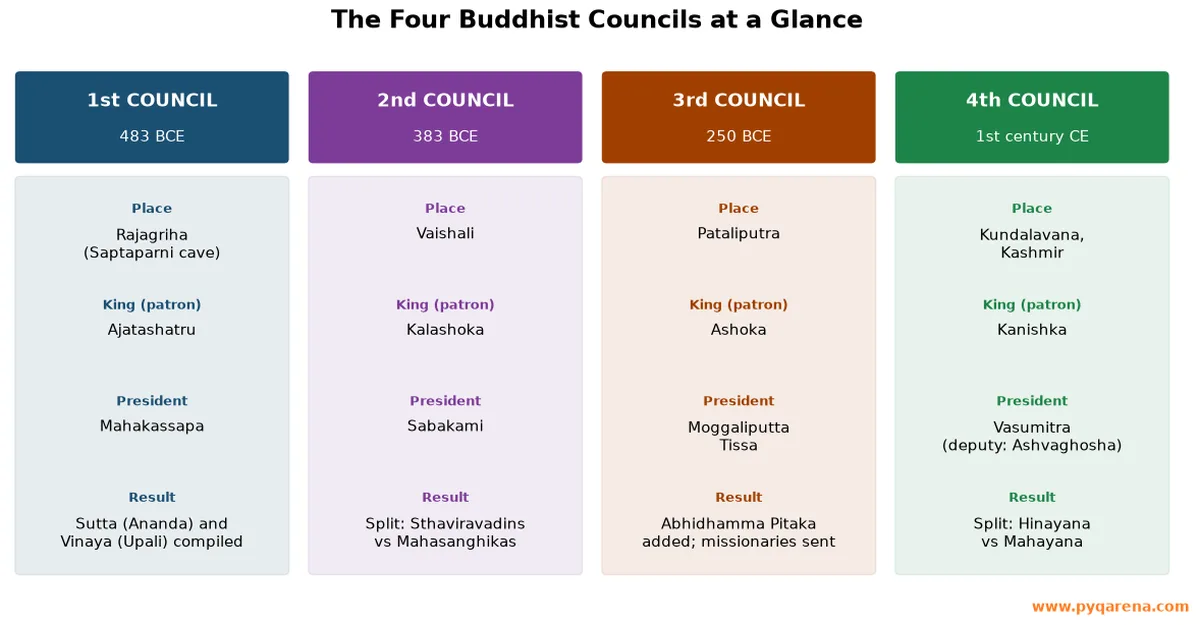
The four Buddhist councils: place, patron, president and result.
| Council | Year | Place | Patron king | President | Result |
|---|---|---|---|---|---|
| 1st | 483 BCE | Rajagriha (Saptaparni cave) | Ajatashatru (Haryanka) | Mahakassapa | Sutta Pitaka recited by Ananda; Vinaya Pitaka by Upali |
| 2nd | 383 BCE | Vaishali | Kalashoka (Shishunaga) | Sabakami | Split into Sthaviravadins (Theravada) and Mahasanghikas over ten rules of discipline |
| 3rd | c. 250 BCE | Pataliputra | Ashoka (Maurya) | Moggaliputta Tissa | Abhidhamma Pitaka compiled; missionaries sent abroad |
| 4th | 1st century CE | Kundalavana, Kashmir | Kanishka (Kushana) | Vasumitra; vice-president Ashvaghosha | Split into Hinayana and Mahayana; texts written in Sanskrit |
- First Council was held at Rajagriha and presided over by Mahakassapa. → PYQ: WBCS Prelims 2024, 2023
- Fourth Council was the last of the four ancient councils. It was held at Kundalavana (Kashmir) under Kanishka. → PYQ: WBCS Mains 2023, 2022
- After the Third Council, Ashoka sent his son Mahendra and daughter Sanghamitra to Sri Lanka.
6. Buddhist Literature
In simple words: The Buddha’s teachings were collected in three “baskets” called the Tripitaka. They were written in Pali. Later texts in Sanskrit include famous poems and biographies.
6.1 Tripitaka (the three baskets), in Pali
The Tripitaka is the principal sacred book of the Buddhists. → PYQ: WBCS Prelims 2006
It is written in Pali. → PYQ: WBCS Prelims 2011, 2009, 2003 | PYQ: WBP SI 2021
| Pitaka | Content | Compiled by |
|---|---|---|
| Sutta Pitaka | The Buddha’s own sermons and sayings | Ananda (1st Council) |
| Vinaya Pitaka | Rules for monks and nuns | Upali (1st Council) |
| Abhidhamma Pitaka | Philosophy and analysis of the teachings | 3rd Council |
- Sutta is the basket that contains what the Buddha himself said. → PYQ: WBCS Mains 2017
- The Sutta Pitaka has five Nikayas: Digha, Majjhima, Samyutta, Anguttara and Khuddaka.
- The Anguttara Nikaya gives the list of the 16 Mahajanapadas. → PYQ: WBCS Prelims 2024 (see the Mahajanapadas Notes)
- The Khuddaka Nikaya includes the Dhammapada, which holds the Buddha’s core doctrines in verse. → PYQ: WBCS Prelims 2001
- It also includes the Theragatha and Therigatha.
- Jatakas: about 550 stories of the previous births of the Buddha (as a Bodhisattva). → PYQ: WBPSC Clerkship
- The Jataka tales are not one of the three Pitakas. → PYQ: WBCS Prelims 2002
- They are a rich source for the social and economic life of the 6th century BCE.
6.2 Other Pali texts
- Milindapanha (“Questions of Milinda”): a philosophical dialogue between the Indo-Greek king Menander (Milinda) and the monk Nagasena. → PYQ: WBCS Mains 2023, 2022, 2014
- Dipavamsa (4th century CE) and Mahavamsa (5th century CE) are the Sri Lankan chronicles. They are genealogical histories of kings and the Sangha. → PYQ: WBCS Prelims 2015
- According to Buddhist tradition, Chandragupta Maurya came from the Moriya clan of Kshatriyas. → PYQ: WBCS Prelims 2002
- Visuddhimagga: by Buddhaghosha (5th century CE, Sri Lanka).
6.3 Sanskrit Buddhist texts
- Ashvaghosha (court of Kanishka) wrote:
- Buddhacharita, a biography of the Buddha. → PYQ: WBCS Mains 2023 | PYQ: WBCS Prelims 2018, 2009
- Saundarananda, a Sanskrit kavya about the conversion of the Buddha’s half-brother Nanda. → PYQ: WBCS Mains 2020
- Vajrasuchi, which criticises the caste system.
- Nagarjuna: Madhyamaka-karika, which founded the Shunyavada (emptiness) school.
- Lalitavistara, Mahavastu and Divyavadana are Sanskrit texts on the Buddha’s life and legends.
7. Sects of Buddhism
In simple words: At first the Buddha was a teacher, not a god. Later, one group began to worship him as a divine saviour and to make his images. That group became Mahayana (“Great Vehicle”). The older group was called Hinayana (“Lesser Vehicle”).
| Feature | Hinayana (Theravada) | Mahayana |
|---|---|---|
| Meaning | Lesser Vehicle | Great Vehicle |
| View of the Buddha | Great teacher, a human | Divine saviour; worshipped |
| Image worship | No; symbols only (footprint, wheel, tree, stupa) | Yes; Buddha and Bodhisattva images |
| Goal | Individual salvation (Arhat) | Salvation of all beings (Bodhisattva ideal) |
| Language | Pali | Sanskrit |
| Spread | Sri Lanka, Myanmar, Thailand (southern Buddhism) | China, Japan, Korea, Tibet (northern Buddhism) |
| Formal split | — | 4th Council under Kanishka |
- Bodhisattva: a being who delays his own nirvana to help others.
- Avalokiteshvara (Padmapani): compassion (painted at Ajanta).
- Manjushri: wisdom.
- Vajrapani: protector.
- Maitreya: the future Buddha.
- Kshitigarbha: guardian of beings in hell.
- Vajrayana (Tantric Buddhism, “Thunderbolt Vehicle”):
- It grew from the 7th–8th century CE in Bengal and Bihar under the Pala kings.
- It spread to Tibet, where Padmasambhava and Atisha Dipankara Srijnana (from Vikrampur, Bengal) took it.
- Philosophical schools:
- Madhyamika / Shunyavada: founded by Nagarjuna.
- Yogachara / Vijnanavada: founded by Asanga and Vasubandhu.
8. Buddhist Architecture and Art
In simple words: Buddhists built three main types of structures: stupas (relic mounds), chaityas (prayer halls) and viharas (monasteries). The gopuram is a gateway tower of South Indian Hindu temples, not a Buddhist structure. → PYQ: WBCS Mains 2017
| Structure | What it is | Famous examples |
|---|---|---|
| Stupa | A solid dome over relics of the Buddha or monks | Sanchi, Bharhut, Amaravati, Dhamek (Sarnath), Kesariya (tallest in India) |
| Chaitya | A prayer hall with a stupa at one end | Karle (largest), Bhaja, Ajanta caves 9, 10, 19, 26 |
| Vihara | A monastery where monks live | Ajanta, Nalanda, Ellora |
Parts of a stupa:
- Anda: the dome.
- Harmika: the railing on top.
- Chhatra: the umbrella.
- Medhi: the base platform.
- Vedika: the railing around it.
- Torana: the gateway.
- Pradakshina path: the circular walk around the stupa.

The Great Stupa (Stupa 1) at Sanchi, Madhya Pradesh, with its carved eastern torana.
Image Source: Wikimedia
Sanchi Stupa:
- It was built by Ashoka in brick.
- The Shungas enlarged it in stone, and the Satavahanas added the four carved toranas.
- It is a UNESCO World Heritage Site (1989).
8.1 Schools of sculpture
| School | Region and patron | Material | Style |
|---|---|---|---|
| Gandhara | North-west (Peshawar, Taxila); Kushanas | Grey-blue schist and stucco | Greco-Buddhist (Indo-Greek): wavy hair, moustache, heavy drapery |
| Mathura | Mathura; Kushanas | Spotted red sandstone | Indigenous: smiling face, shaven head, thin robe; made Buddhist, Jain and Hindu images |
| Amaravati | Krishna–Godavari delta; Satavahanas | White marble | Narrative panels; Buddha’s life stories |
- The first images of the Buddha in human form were made by the Gandhara School. → PYQ: WBCS Prelims 2001, 2002
- The Gandhara school flourished under the Kushanas, especially Kanishka. → PYQ: WBCS Mains 2023 | PYQ: WBCS Prelims 2003
- The Amaravati School flourished in the lower Krishna–Godavari valleys (2nd century BCE to 3rd century CE). → PYQ: WBCS Mains
- The Bamiyan Buddhas were giant standing Buddhas carved into a cliff in Afghanistan. The Taliban destroyed them in 2001. → PYQ: WBCS Mains GK 2014
- Ajanta caves (Maharashtra): 29 Buddhist caves with world-famous paintings (Padmapani, Jataka scenes). Most of the paintings date to the Vakataka period (5th century CE).
- Sir Aurel Stein found ancient Buddhist relics, manuscripts and paintings in Central Asia (Dunhuang, Khotan). → PYQ: WBCS Prelims 2004
9. Royal Patrons and Buddhist Universities
9.1 Royal patrons of Buddhism
- Bimbisara, Ajatashatru (Magadha) and Prasenajit (Kosala) were followers in the Buddha’s lifetime.
- Ashoka:
- He became a Buddhist after the Kalinga war (261 BCE) and preached Dhamma. → PYQ: WBCS Mains
- He held the Third Council and sent missions abroad.
- He calls himself Devanampiya Piyadasi in his inscriptions. → PYQ: WBCS Prelims
- Kanishka (Kushana) was the chief patron of the Fourth Council. → PYQ: WBCS Mains 2023
- Harshavardhana held a great assembly at Kannauj in honour of Xuanzang (Hiuen Tsang).
- Pala kings of Bengal (Gopala, Dharmapala, Devapala) were the last great royal patrons of Buddhism in India.
- Buddhist scholars such as Haribhadra worked at the Pala court. → PYQ: WBCS Mains 2016
9.2 Buddhist universities (Mahaviharas)
| University | Place | Founder | Key fact |
|---|---|---|---|
| Nalanda | Bihar | Kumaragupta I (Gupta) | Xuanzang studied here under Shilabhadra; Yijing (I-tsing) stayed 10 years; destroyed by Bakhtiyar Khilji (c. 1193) |
| Vikramashila | Bhagalpur, Bihar | Dharmapala (Pala) | Famous for Tantric (Vajrayana) Buddhism; Atisha Dipankara taught here |
| Odantapuri | Bihar Sharif | Gopala (Pala) | Model for Tibet’s first monastery |
| Somapura Mahavihara | Paharpur (Bangladesh) | Dharmapala | Largest vihara south of the Himalayas |
| Valabhi | Gujarat | Maitraka kings | Centre of Hinayana learning |
- Nalanda was founded by Kumaragupta I. → PYQ: WBCS Prelims 2023 | PYQ: WBCS Mains 2017 | PYQ: WBPSC Clerkship
- Yijing lived for ten years at Nalanda. → PYQ: WBCS Mains 2017
- Vikramashila was founded by Dharmapala. → PYQ: WBCS Prelims 2021, 2016, 2008, 2005 | PYQ: WBCS Mains GK 2021
9.3 West Bengal focus (WBCS)
- Moghalmari (Paschim Medinipur): a large Buddhist vihara of the 6th–7th century CE.
- Raktamrittika (Rajbadidanga) near Karnasuvarna (Murshidabad): the capital of Shashanka; Xuanzang saw a vihara here.
- Jagjivanpur (Malda): a Pala-era Buddhist vihara (Nandadirghika-udranga).
- Tamralipta (Tamluk): a Buddhist port; Faxian sailed from here to Sri Lanka.
- Atisha Dipankara (born at Vikrampur, Bengal) took Buddhism to Tibet.
10. Spread and Decline of Buddhism
Why Buddhism spread:
- It used a simple message and the people’s language (Pali).
- The organised Sangha sent monks everywhere.
- It received royal patronage from Ashoka, Kanishka, Harsha and the Palas.
- It opened its doors to all castes and to women.
Why Buddhism declined in India:
- The Sangha became rich and lazy, and monks moved away from simple living.
- Sanskrit replaced Pali in Mahayana texts, which distanced the common people.
- Tantric practices under Vajrayana weakened its moral appeal.
- Revival of Brahmanism through Bhakti saints and Shankaracharya, and the Buddha was accepted as an avatar of Vishnu.
- Loss of royal patronage after the Palas, and Turkish invasions: Bakhtiyar Khilji destroyed Nalanda and Vikramashila (c. 1193–1203).
Modern revival: Dr B. R. Ambedkar embraced Buddhism at Nagpur (Deekshabhoomi) on 14 October 1956, along with lakhs of followers, as a path to end caste oppression. This form is called Navayana. → PYQ: WBCS Mains | PYQ: WBCS Prelims
Part B: JAINISM
11. Origin and the 24 Tirthankaras
In simple words: Jains believe their faith is very old and was taught by 24 Tirthankaras (“ford-makers”, those who help people cross the river of rebirth). The first was Rishabhanatha and the last was Mahavira. Mahavira did not found Jainism. He reformed and spread it.
- Tirthankara count: 24. → PYQ: WBCS Prelims 2009
- Word “Jaina”: from Jina (“conqueror”), one who has conquered the senses.
- Original name of the sect: Nirgranthas (“free from bonds”). → PYQ: WBCS Prelims 2002
| No. | Tirthankara | Symbol (lanchhana) | Key fact |
|---|---|---|---|
| 1st | Rishabhanatha (Adinatha) | Bull | Founder of Jainism; mentioned in the Rig Veda and the Vishnu/Bhagavata Purana; father of Bharata and Bahubali |
| 2nd | Ajitanatha | Elephant | — |
| 22nd | Neminatha (Arishtanemi) | Conch | Cousin of Krishna; linked with Girnar |
| 23rd | Parshvanatha | Snake (serpent hood) | Prince of Kashi, son of King Ashvasena; gave four vows; nirvana at Sammed Shikhar |
| 24th | Mahavira (Vardhamana) | Lion | Last Tirthankara; added the fifth vow |
- 23rd Tirthankara: Parshvanatha. → PYQ: WBCS Mains 2022
- Last (24th) Tirthankara: Mahavira. → PYQ: WBCS Prelims 2009 | PYQ: WBPSC Misc 2008
- Parshvanatha’s followers wore white clothes. His four vows (chaturyama) were ahimsa, satya, asteya and aparigraha.
Memory trick: Tirthankaras 1-23-24 = Bull–Snake–Lion (“Big Strong Lion”).
12. Life of Vardhamana Mahavira (540–468 BCE)
In simple words: Vardhamana was a prince born near Vaishali. At 30, he left home, lived as a naked ascetic for 12 years, and gained supreme knowledge (kaivalya) at 42. He taught for 30 years and died at Pavapuri at 72.
- Born: 540 BCE at Kundagrama near Vaishali (Bihar).
- Clan: Jnatrika (Nata) Kshatriya clan. That is why he is called Nigantha Nataputta in Buddhist texts.
- Father: Siddhartha, chief of the Jnatrika clan.
- Mother:Trishala, a Lichchhavi princess and sister of the Lichchhavi chief Chetaka.
- Chetaka’s daughter Chellana married Bimbisara, so Mahavira was related to the royal family of Magadha.
- Wife:Yashoda. Daughter:Anojja (Priyadarshana).
- Her husband Jamali became Mahavira’s first disciple and later the first schismatic (he caused the first split).
- Renunciation: at 30, after his parents’ death.
- Penance:12 years of severe austerity. After 13 months he gave up clothes completely.
- He spent six years with Makkhali Gosala, who later founded the Ajivikas.
- Kaivalya (supreme knowledge):
- Age: 42.
- Place: under a sal tree at Jrimbhikagrama, on the bank of the Rijupalika river.
- Titles: after this he was called Kevalin (all-knowing), Jina (conqueror), Mahavira (great hero) and Nirgrantha (free from bonds).
- First sermon: at Pava, to 11 disciples (the Ganadharas), led by Indrabhuti Gautama.
- Death (Nirvana):
- When: 468 BCE, at 72.
- Where: Pavapuri (near Rajgir, Bihar).
- King: during the reign of Ajatashatru.
- Royal followers: Bimbisara, Ajatashatru (Kunika), Udayin and Chetaka of Vaishali.
- Sudharma was the only Ganadhara who outlived him, and he led the order after Mahavira.
13. Teachings of Jainism
In simple words: Jains believe that everything has a soul (jiva), even plants, water and stones. Karma sticks to the soul like dust. To free the soul, a person must follow the Three Jewels and the Five Vows, and must never harm any living being.
13.1 Triratna (Three Jewels) of Jainism
- Samyak Darshana: Right Faith.
- Samyak Jnana: Right Knowledge.
- Samyak Charitra: Right Conduct.
These three together lead to moksha (liberation of the soul from karma).
13.2 Five Great Vows (Pancha Mahavrata)
| Vow | Meaning | Given by |
|---|---|---|
| Ahimsa | Non-violence | Parshvanatha |
| Satya | Truth | Parshvanatha |
| Asteya | Non-stealing | Parshvanatha |
| Aparigraha | Non-possession | Parshvanatha |
| Brahmacharya | Celibacy | Added by Mahavira |
- Monks follow them strictly as Mahavratas. Lay followers follow lighter forms called Anuvratas.
13.3 Key doctrines
- Jiva and Ajiva: the universe is made of jiva (soul) and ajiva (matter). Every object has a soul.
- Karma: karma is a fine matter that sticks to the soul. Nirjara (shedding karma) through penance frees the soul.
- Anekantavada: “many-sidedness”, the idea that truth has many aspects.
- Syadvada (Saptabhangi Naya): “maybe” logic with seven ways of looking at any statement. It is the logical form of Anekantavada.
- God: Jainism does not accept a creator God. It does not reject the varna system completely.
- Strict ahimsa:
- Jains avoid farming and other work that kills insects, so many became traders.
- Monks cover the mouth and sweep the path to avoid killing tiny beings.
- Sallekhana (Santhara): a ritual fast unto death taken in old age. Chandragupta Maurya died this way at Shravanabelagola.
- Comparison with Buddhism: Jainism stresses extreme austerity, while Buddhism chose the Middle Path.
14. Jain Councils and Sects
In simple words: A great famine in Magadha split the Jains. One group went south with Bhadrabahu. The other stayed in Magadha with Sthulabhadra. When they met again, they disagreed on clothes and texts, and this led to the Digambara–Shvetambara split.
| Council | Year | Place | President | Result |
|---|---|---|---|---|
| 1st | c. 300 BCE | Pataliputra | Sthulabhadra | The 12 Angas were compiled; the split into two sects began |
| 2nd | 512 CE | Valabhi (Gujarat) | Devardhi Kshamashramana | The Agamas were finally written down in their present form |
- Famine (c. 300 BCE):
- Bhadrabahu led the monks to Shravanabelagola (Karnataka).
- Chandragupta Maurya went with him and followed Jainism in his last years. → PYQ: WBCS Mains 2023
- The Chandragupta Basadi on Chandragiri hill at Shravanabelagola is named after him.
| Feature | Digambara (“sky-clad”) | Shvetambara (“white-clad”) |
|---|---|---|
| Leader of origin | Bhadrabahu (went south) | Sthulabhadra (stayed in Magadha) |
| Clothes | Monks go naked | Monks and nuns wear white |
| Women | Cannot attain moksha without rebirth as a man | Can attain moksha; the 19th Tirthankara Mallinatha was a woman |
| Mahavira | Never married | Married Yashoda |
| Canon | Original Agamas were lost | Accept the 12 Angas compiled at Pataliputra |
| Region | Karnataka, south and central India | Gujarat, Rajasthan |
- Later sub-sects:
- Terapanthis and Sthanakavasis (Shvetambara branches that reject idol worship).
- Bispanthi and Taranapanthi (Digambara branches).
15. Jain Literature
In simple words: Jain sacred texts are called the Agamas. They were written in Prakrit, mainly the Ardha-Magadhi dialect. → PYQ: WBCS Mains 2014
- 12 Angas: the most important part of the Agamas.
- Acharanga Sutta: rules of conduct for monks; Mahavira’s austerities.
- Bhagavati Sutta: mentions the 16 Mahajanapadas (in a list different from the Buddhist one).
- 12 Upangas, 10 Prakirnas, 6 Chhedasutras, 4 Mulasutras and 2 Sutras make up the rest of the canon.
- Kalpasutra: written by Bhadrabahu; gives the biographies of the Tirthankaras.
- Parishishtaparvan: written by Hemachandra (12th century, court of the Solanki king Kumarapala). It tells the story of Chandragupta Maurya’s conversion to Jainism.
- Jain scholars also wrote in Sanskrit, Apabhramsha, Kannada and Tamil.
- Tamil epics: Silappadikaram (by Ilango Adigal, a Jain monk) and Jivaka Chintamani.
16. Patrons, Jain Art and Pilgrimage Centres
16.1 Royal patrons of Jainism
- Chandragupta Maurya: became a Jain monk under Bhadrabahu.
- Kharavela of Kalinga (1st century BCE):
- He recorded his deeds in the Hathigumpha inscription at Udayagiri.
- He built caves for Jain monks at Udayagiri–Khandagiri (near Bhubaneswar).
- Western Gangas: their minister Chavundaraya built the Gommateshwara statue.
- Rashtrakutas: Amoghavarsha I became a Jain and wrote Kavirajamarga. The Rashtrakutas were great patrons of Jainism. → PYQ: WBCS Mains 2020
- Solankis (Chalukyas of Gujarat): Kumarapala became a Jain under Hemachandra. Their ministers built the Dilwara temples.
- Kalachuris, Hoysalas (early) and Kadambas also supported Jainism.
16.2 Famous Jain monuments
- Gommateshwara (Bahubali) statue, Shravanabelagola (Karnataka):
- It stands 57 feet (17.4 m) tall on Vindhyagiri hill and is one of the world’s tallest free-standing monolithic statues.
- It was built around 983 CE by Chavundaraya, minister of the Western Ganga king Rachamalla IV.
- The Mahamastakabhisheka festival (anointing of the statue) is held every 12 years. → PYQ: WBCS Mains GK 2002
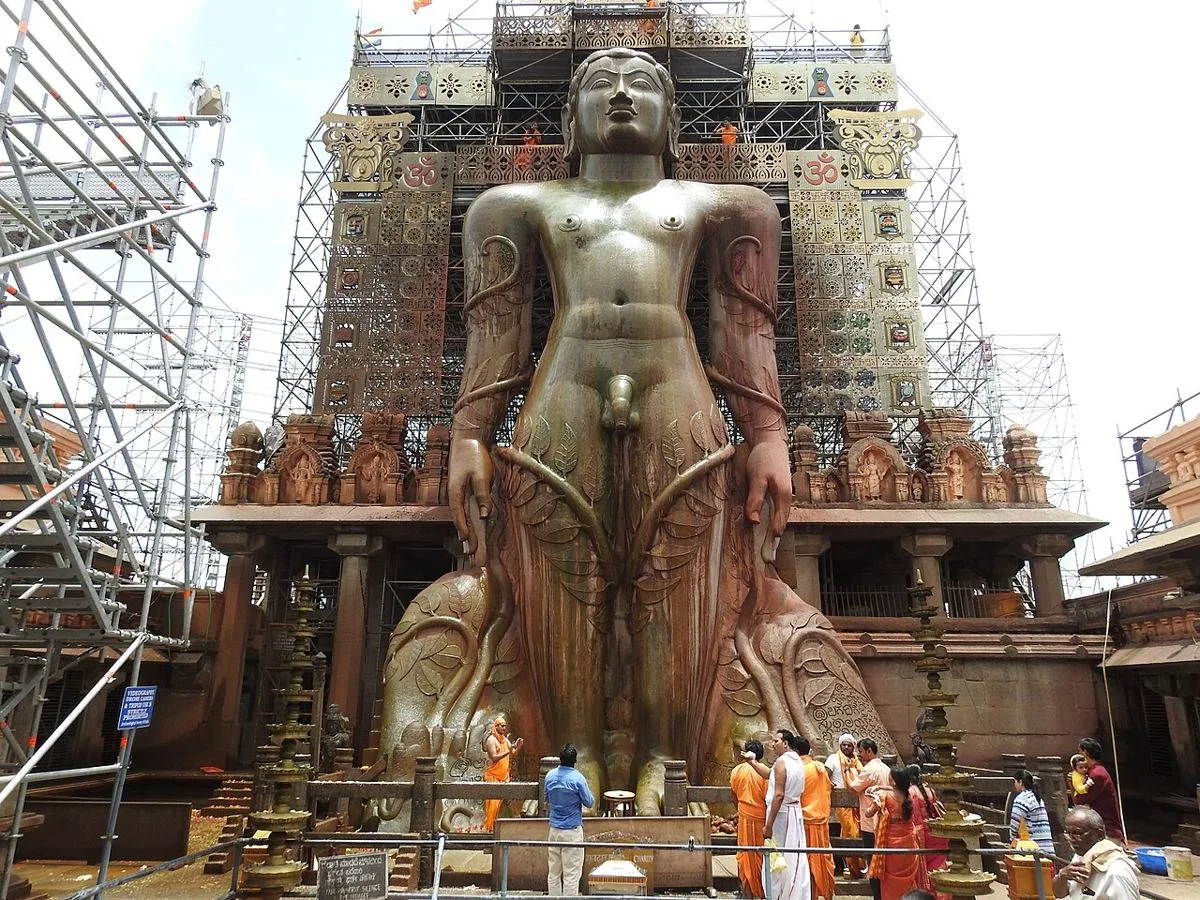
The 57-foot Gommateshwara (Bahubali) statue on Vindhyagiri hill, Shravanabelagola, shown with scaffolding for the Mahamastakabhisheka festival.
Image Source: Wikimedia
- Dilwara Temples, Mount Abu (Rajasthan):
- They are built of white marble with very fine carving. → PYQ: WBCS Mains GK 2002
- Vimala Vasahi (dedicated to Adinatha) was built in 1031 CE by Vimal Shah, minister of the Solanki king Bhima I.
- Luna Vasahi (dedicated to Neminatha) was built in 1230 CE by the brothers Vastupala and Tejapala, ministers of the Vaghela rulers.
- Builders: the Solankis. → PYQ: WBCS Mains 2015
- Mount Abu is in the Aravalli range, and its highest peak is Guru Shikhar. → PYQ: WBCS Mains
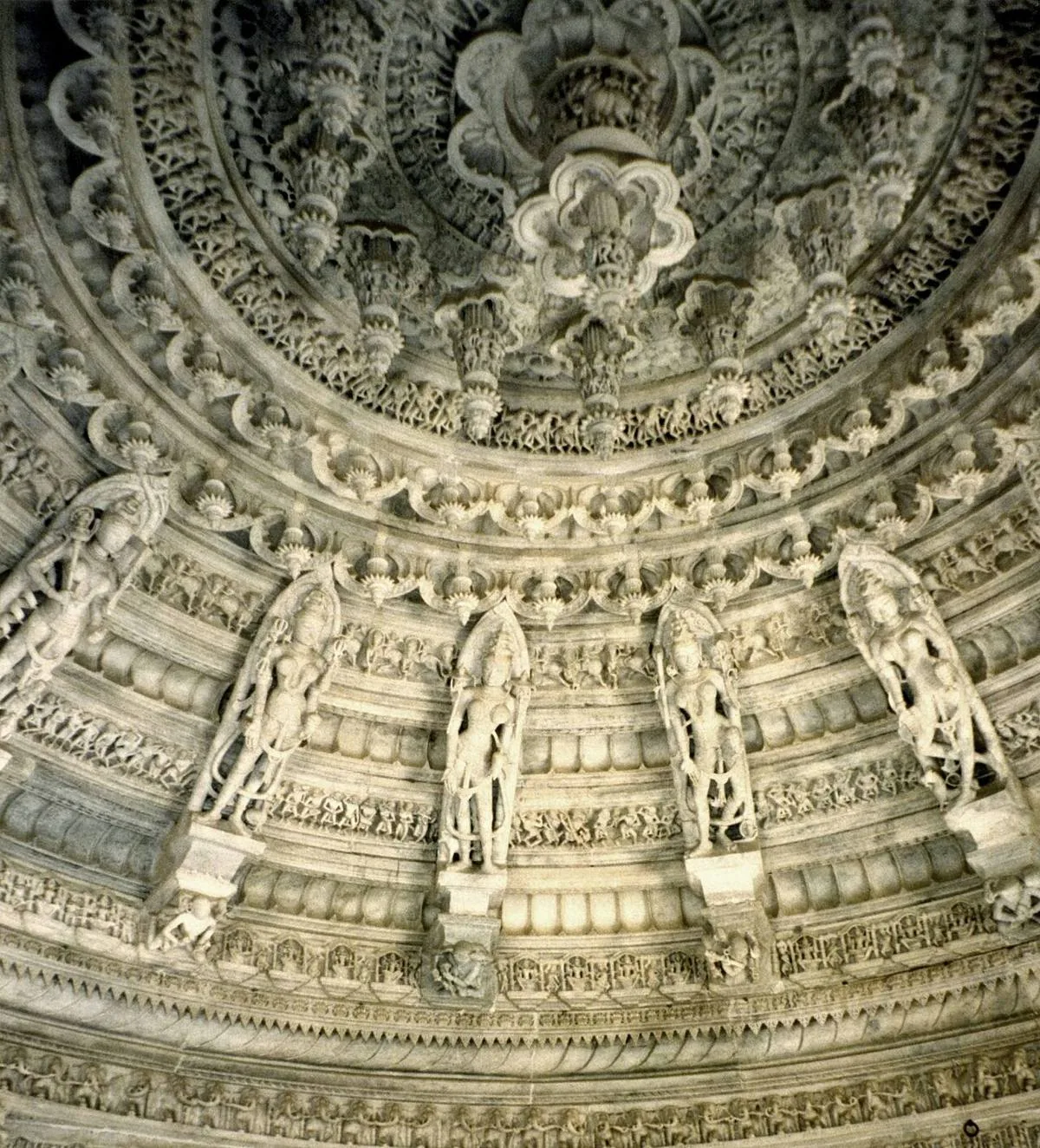
The intricately carved marble ceiling of a Dilwara Jain temple, Mount Abu, Rajasthan.
Image Source: Wikimedia
- Other Jain sites:
- Ranakpur (Rajasthan): Chaumukha temple with 1,444 pillars, built under Rana Kumbha.
- Palitana (Shatrunjaya hill, Gujarat): over 800 temples.
- Girnar (Gujarat): linked with Neminatha.
- Sammed Shikhar (Parasnath hill, Jharkhand): the place of nirvana of 20 Tirthankaras, including Parshvanatha.
- Pavapuri (Bihar): Jal Mandir at the spot of Mahavira’s nirvana.
- Ellora caves 30–34 (Maharashtra): Jain caves, including the Indra Sabha.
- Khajuraho: the Parshvanatha temple belongs to the Chandela period.
16.3 West Bengal focus (WBCS)
- Purulia and Bankura have many Jain temples and images from the 9th–12th century. These include Pakbirra (a giant Padmaprabha image), Telkupi, Deoli and Sitalpur.
- These remains are linked to the Sarak community, whose name comes from Shravaka (Jain lay followers).
- Jain texts say Mahavira travelled in Radha (West Bengal), where people set dogs on him.
17. Buddhism vs Jainism: Master Comparison

Buddhism and Jainism compared side by side.
| Point | Buddhism | Jainism |
|---|---|---|
| Founder | Gautama Buddha | Rishabhanatha; Mahavira = 24th Tirthankara |
| Dates | 563–483 BCE | Mahavira: 540–468 BCE |
| Birthplace | Lumbini | Kundagrama (Vaishali) |
| Enlightenment | Bodh Gaya, under a peepal tree, age 35 | Jrimbhikagrama, under a sal tree, age 42 |
| Death | Kushinagar | Pavapuri |
| Path | Middle Path; Eightfold Path | Extreme austerity; Five Vows |
| Three Jewels | Buddha, Dhamma, Sangha | Right Faith, Right Knowledge, Right Conduct |
| Soul | No permanent soul (Anatta) | Soul in every being and object |
| God | Silent | Rejects a creator God |
| Language of texts | Pali (Tripitaka) | Prakrit / Ardha-Magadhi (Agamas) |
| Sects | Hinayana, Mahayana, Vajrayana | Digambara, Shvetambara |
| Spread | All over Asia | Mostly within India |
| Common points | Both rejected the Vedas, sacrifices and Brahmana supremacy; both were founded by Kshatriyas; both believed in karma and rebirth and preached ahimsa | ← same |
18. Frequently Asked Facts (PYQ trends)
| Question | Answer |
|---|---|
| Buddha born at | Lumbini (563 BCE) |
| Buddha’s clan | Shakya |
| Buddha’s son | Rahula |
| Enlightenment | Bodh Gaya |
| First sermon | Sarnath; called Dharmachakra-pravartana |
| Mahaparinirvana | Kushinagar (483 BCE) |
| Cause of sorrow | Trishna (desire) |
| Eightfold Path | Ashtangika Marga |
| Event NOT on Vaishakha Purnima | Great Renunciation |
| Tripitaka language | Pali |
| Buddha’s own words | Sutta Pitaka |
| Not part of the Tripitaka | Jatakas |
| Lists 16 Mahajanapadas | Anguttara Nikaya |
| Buddhist genealogical chronicle | Dipavamsa |
| Buddhacharita, Saundarananda | Ashvaghosha |
| Milindapanha | Nagasena (philosophical dialogue with Menander) |
| 1st Council president | Mahakassapa (Rajagriha) |
| Patron of 4th Council | Kanishka (Kundalavana, Kashmir) |
| Not Buddhist architecture | Gopuram |
| First Buddha images | Gandhara School (Kushana period) |
| Lion Capital found at | Sarnath |
| Bamiyan Buddhas | Afghanistan |
| Nalanda founded by | Kumaragupta I |
| Vikramashila founded by | Dharmapala |
| Chinese pilgrim 10 years at Nalanda | Yijing (I-tsing) |
| Physician in the Buddha’s time | Jivaka |
| Ruler contemporary of both the Buddha and Mahavira | Bimbisara |
| Both died in the reign of | Ajatashatru |
| Ajivika founder | Makkhali Gosala |
| Total Tirthankaras | 24 |
| 23rd Tirthankara | Parshvanatha |
| Last Tirthankara | Mahavira |
| Original name of the Jains | Nirgranthas |
| Language of Jain texts | Prakrit (Ardha-Magadhi) |
| Chandragupta Maurya’s religion | Jainism |
| Gommateshwara statue | Shravanabelagola (Karnataka) |
| Dilwara temples | Mount Abu, Rajasthan; built by the Solankis |
| Dynasty that patronised Jainism (South) | Rashtrakutas |
| Leader who embraced Buddhism in 1956 | B. R. Ambedkar |
19. Quick-Revision Sheet
- Causes: costly rituals, varna rigidity, cattle-based farming (ahimsa), rich traders, people’s languages.
- Buddha: 563–483 BCE; Lumbini; Shakya; Suddhodana–Mahamaya–Gautami; Yashodhara; Rahula; renounced at 29 (Kanthaka, Channa); enlightened at 35 at Bodh Gaya (Niranjana); first sermon at Sarnath (5 monks); died at 80 at Kushinagar.
- Symbols: lotus/bull (birth), horse (renunciation), Bodhi tree (enlightenment), wheel (sermon), stupa (death).
- Doctrine: 4 Noble Truths; Eightfold Path (Prajna–Sila–Samadhi); Middle Path; Triratna (Buddha, Dhamma, Sangha); Anatta; Pratityasamutpada.
- Councils: Rajagriha–Ajatashatru–Mahakassapa | Vaishali–Kalashoka–Sabakami | Pataliputra–Ashoka–Moggaliputta Tissa | Kundalavana–Kanishka–Vasumitra.
- Texts: Tripitaka (Pali): Sutta (Ananda), Vinaya (Upali), Abhidhamma; Jatakas (550 stories); Dipavamsa, Mahavamsa; Milindapanha (Nagasena); Ashvaghosha (Buddhacharita, Saundarananda).
- Sects: Hinayana (Pali, symbols, Arhat) vs Mahayana (Sanskrit, images, Bodhisattva); Vajrayana under the Palas.
- Art: stupa, chaitya, vihara; Gandhara (schist, Greco-Buddhist), Mathura (red sandstone), Amaravati (white marble).
- Universities: Nalanda (Kumaragupta I), Vikramashila and Somapura (Dharmapala), Odantapuri (Gopala).
- Jainism: 24 Tirthankaras; Rishabha (bull), Parshva (snake, 4 vows), Mahavira (lion, added brahmacharya).
- Mahavira: 540–468 BCE; Kundagrama; Siddhartha–Trishala; Jnatrika; Yashoda; Jamali; renounced at 30; kaivalya at 42 (sal tree, Rijupalika); died at 72 at Pavapuri.
- Jain doctrine: Triratna (faith, knowledge, conduct); 5 vows; Anekantavada, Syadvada; Sallekhana.
- Jain councils: Pataliputra (Sthulabhadra, c. 300 BCE) → Valabhi (Devardhi, 512 CE). Sects: Digambara (Bhadrabahu) and Shvetambara (Sthulabhadra).
- Jain monuments: Gommateshwara (Chavundaraya, 983 CE), Dilwara (Vimal Shah 1031; Vastupala–Tejapala 1230), Udayagiri–Khandagiri (Kharavela), Ranakpur, Palitana, Sammed Shikhar.
20. Related PYQs on PYQ Arena
- WBCS Mains Buddhism & Jainism PYQs
- WBCS Prelims Ancient Indian History Previous Year Questions
- WBCS Mains Pre-Mauryan & Mauryan Empire PYQs
- WBCS Mains Post-Mauryan Empire PYQs
- WBCS Mains Gupta Empire PYQs
- WBCS Mains General Knowledge – History PYQs
- WBCS Mains General Knowledge – Art & Culture PYQs
- WBCS Mains South Indian Dynasties PYQs
- WBCS Mains Religious Movements PYQs
- WBPSC Miscellaneous Prelims History Questions
- WBPSC Clerkship History Previous Year Questions
- WBP SI Prelims History Previous Year Questions
- Previous chapters: Prehistoric India Notes | Indus Valley Civilization Notes | Vedic Age Notes | Mahajanapadas & Rise of Magadha Notes
Leave a Comment