

Who is this for? Beginners and aspirants for UPSC Prelims, WBCS, other State PSCs and SSC. Each section opens with an “In simple words” explanation and then goes to exam-level detail.
Practise alongside: WBCS Mains Post-Mauryan PYQs | WBCS Prelims Ancient Indian History PYQs
Previous chapters: Prehistoric India Notes → Indus Valley Civilization Notes → Vedic Age Notes → Mahajanapadas & Rise of Magadha Notes → Buddhism and Jainism → Schools of Indian Philosophy → Mauryan Empire
1. Introduction: India after the Mauryas
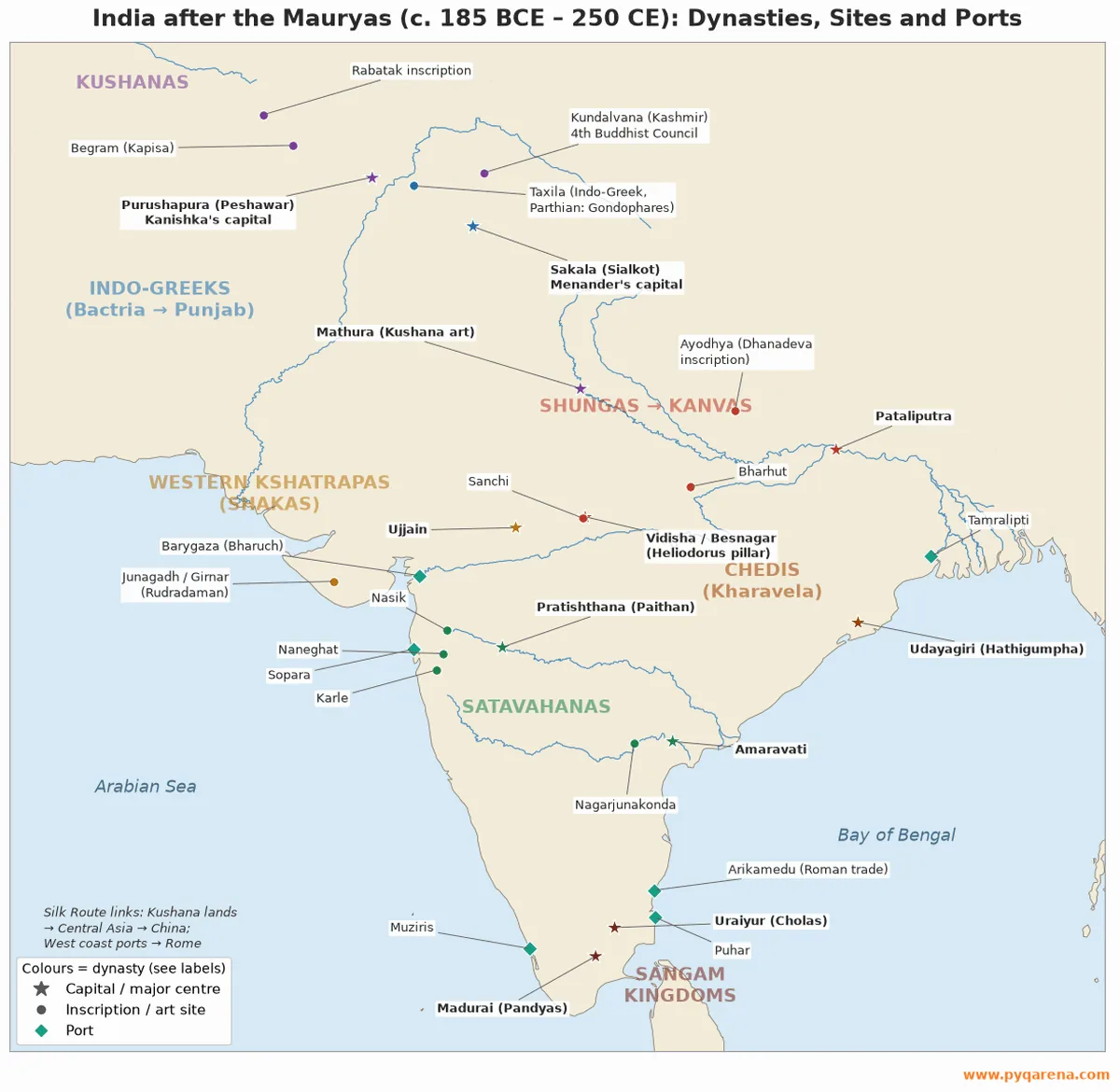
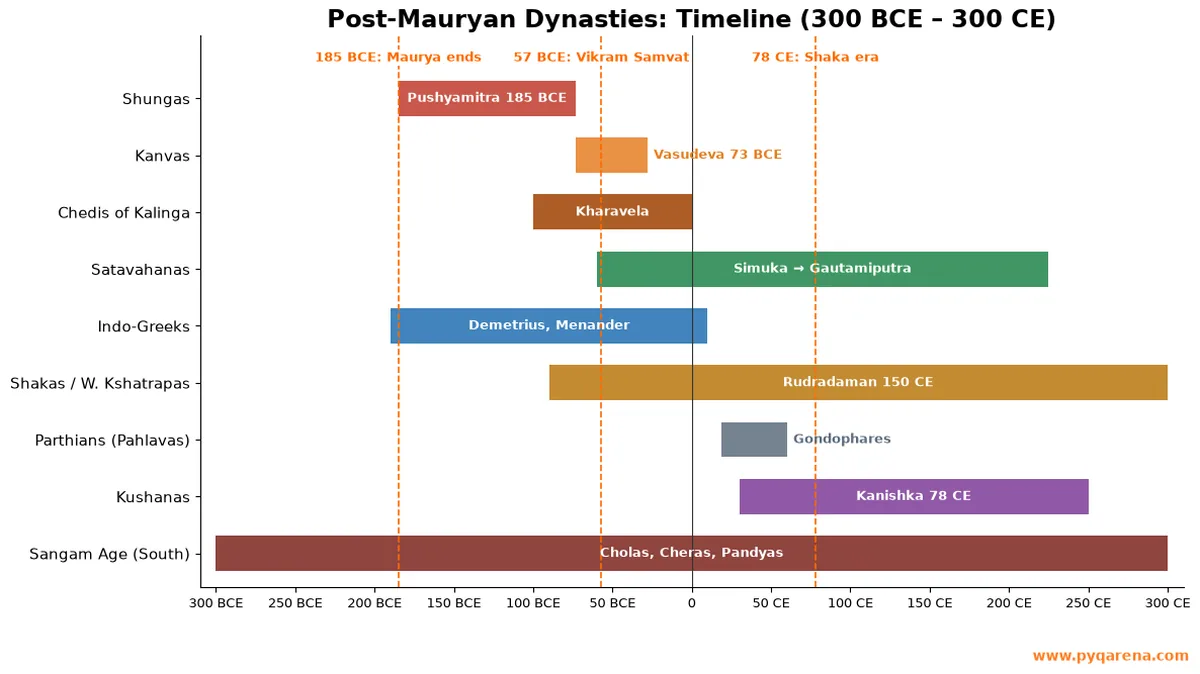
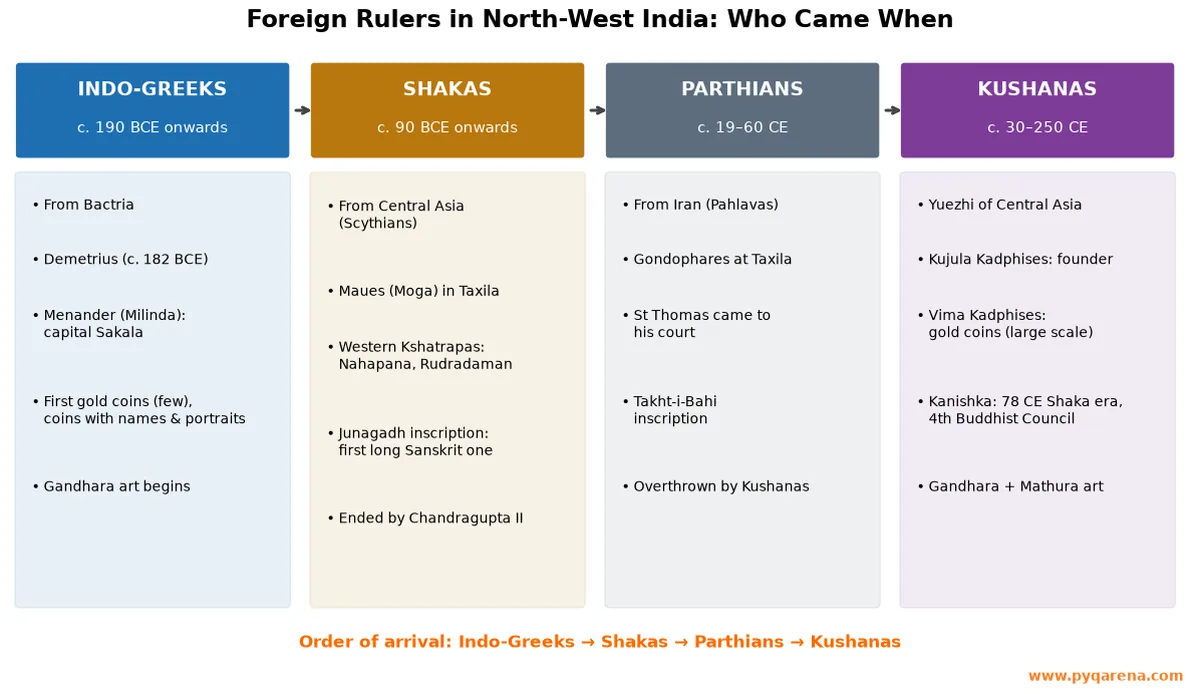
In simple words: When the last Mauryan king was killed in 185 BCE, India did not have one big empire again until the Guptas (c. 320 CE). In these 500 years many smaller dynasties ruled different regions. Indian dynasties ruled the Ganga valley (Shungas, Kanvas), Kalinga (Chedis), the Deccan (Satavahanas) and the far south (Sangam kingdoms), while foreign rulers came in from the north-west (Indo-Greeks, Shakas, Parthians, Kushanas).
This was not a dark age. Trade with Rome and China boomed, guilds grew rich, Buddhism split into Mahayana and Hinayana, and three great schools of sculpture appeared: Gandhara, Mathura and Amaravati.
- Period covered: c. 185 BCE – 300 CE.
- Who ruled where:
| Region | Dynasty | Key ruler |
|---|---|---|
| Magadha and central India | Shunga (185–73 BCE), Kanva (73–28 BCE) | Pushyamitra Shunga |
| Kalinga (Odisha) | Chedi (Mahameghavahana) | Kharavela |
| Deccan | Satavahana | Gautamiputra Satakarni |
| North-west and Punjab | Indo-Greeks | Menander |
| Western India, Malwa | Shakas (Western Kshatrapas) | Rudradaman I |
| Gandhara / Taxila | Parthians (Pahlavas) | Gondophares |
| North India and Central Asia | Kushanas | Kanishka |
| Tamil country | Cheras, Cholas, Pandyas (Sangam age) | Karikala (Chola) |
- After the Mauryas: the Shunga dynasty ruled Magadha. → PYQ: WBCS Mains 2020
- Vedic revival: rulers of both North India and the Deccan performed big Vedic sacrifices such as Ashvamedha, Rajasuya and Vajapeya.
- Pushyamitra Shunga performed two Ashvamedhas.
- Satakarni I performed Ashvamedha and Rajasuya.
- → PYQ: WBCS Mains 2016
- Romila Thapar’s labels:
- She calls c. 200 BCE – 300 CE an age “of politics and trade” and of “the rise of the mercantile community”.
- She calls the next period, the Gupta and post-Gupta age, the “Threshold Times”. → PYQ: WBCS Mains 2016
- Oldest dynasty: among Maurya, Kanva, Kushana and Gupta, the Maurya is the oldest. → PYQ: WBCS Mains GK 2021
2. The Shungas (185–73 BCE)
In simple words: Pushyamitra Shunga was the Brahmin commander-in-chief of the last Mauryan king, Brihadratha. He killed his master during an army parade and became king. The Shungas protected the Ganga valley from the Greeks and revived Vedic rituals and Sanskrit learning.
2.1 Rulers and events
- Founder:Pushyamitra Shunga (185–149 BCE).
- Bana’s Harshacharita describes the killing of Brihadratha.
- Capital: Pataliputra. Vidisha was the second centre, where his son Agnimitra was viceroy.
- He performed two Ashvamedha sacrifices. The Ayodhya inscription of Dhanadeva records this.
- Patanjali:
- The great grammarian Patanjali was a contemporary of Pushyamitra Shunga and the priest at his Ashvamedha. → PYQ: WBCS Prelims 2001
- He wrote the Mahabhashya, a commentary on Panini’s Ashtadhyayi.
- Greek wars:
- The Yavanas (Indo-Greeks) attacked the Shunga kingdom.
- Prince Vasumitra (Agnimitra’s son) defeated them on the banks of the Sindhu river.
- Malavikagnimitram: Kalidasa’s play has Agnimitra Shunga as its hero and describes this war. → PYQ: WBCS Mains 2015
- Buddhists: the Divyavadana describes Pushyamitra as a persecutor of Buddhists. Yet the great Buddhist monuments at Bharhut and Sanchi were enlarged in the Shunga period.
- Bhagabhadra: a later Shunga king. The Greek envoy Heliodorus came to his court at Vidisha.
- Devabhuti: the last Shunga king. His minister Vasudeva Kanva killed him in 73 BCE.
2.2 Heliodorus Pillar (Garuda Pillar), Besnagar
- Who and when: Heliodorus set it up at Besnagar (Vidisha, Madhya Pradesh), c. 113 BCE. → PYQ: WBCS Mains 2022
- Who he was:
- A Greek ambassador from Taxila, sent by the Indo-Greek king Antialcidas to the Shunga king Bhagabhadra.
- He was the son of Dion.
- The pillar:
- It is dedicated to Vasudeva (Krishna) and once carried a Garuda capital.
- Heliodorus calls himself a Bhagavata.
- Why it matters:
- It is the earliest inscriptional evidence of the Bhagavata (Vaishnava) cult.
- It is a clear example of a Greek adopting an Indian religion.
- Locally the pillar is called Khamba Baba.
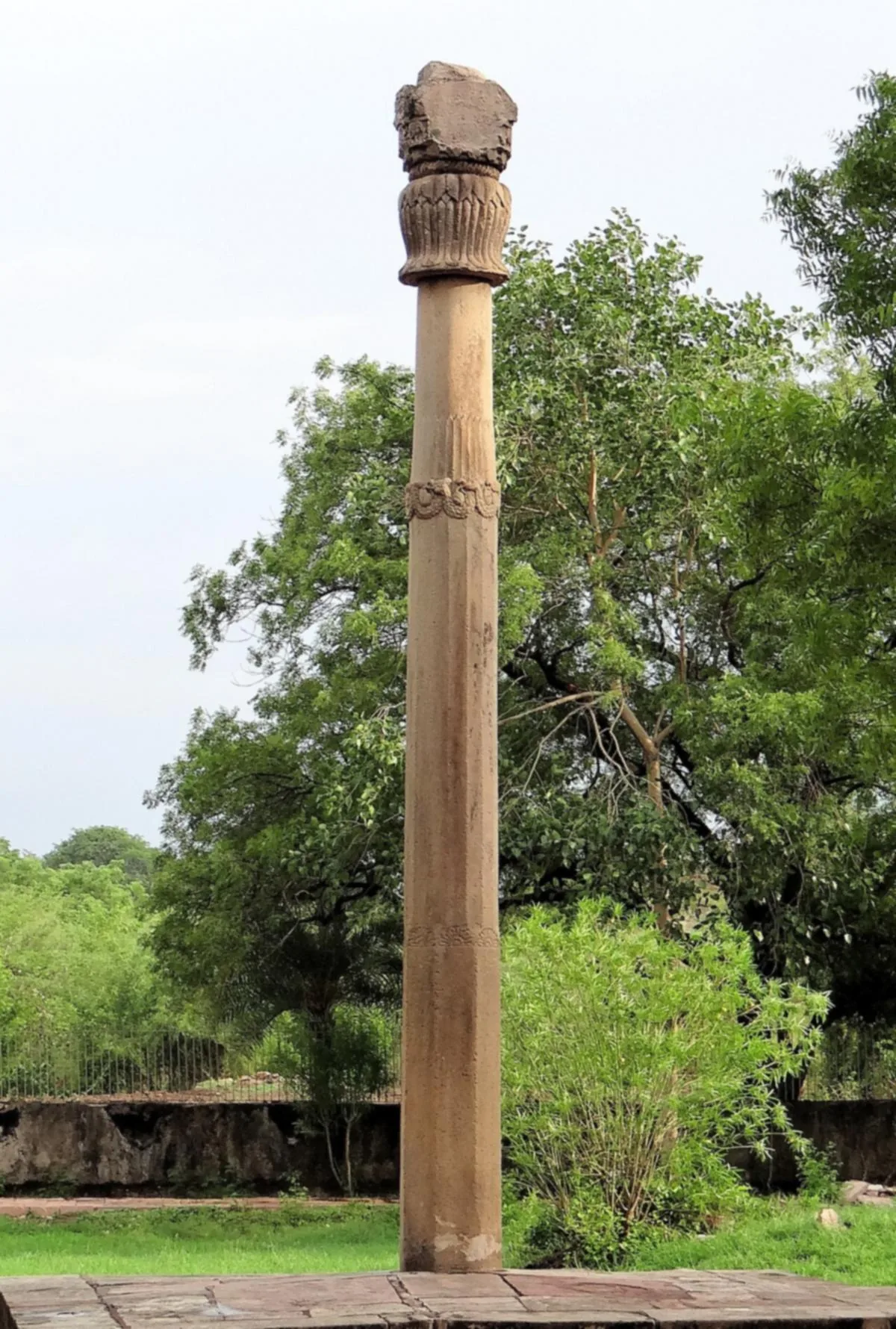
Image Source: Wikimedia
2.3 Shunga art and culture
- Bharhut stupa (Satna, Madhya Pradesh):
- Its stone railings and gateways are Shunga work.
- The carvings show Jataka stories with labels, plus Yakshas and Yakshis.
- The Buddha is shown only by symbols (footprints, empty throne, Bodhi tree, wheel).
- Sanchi:
- Ashoka’s brick stupa was doubled in size and cased in stone under the Shungas.
- The four carved gateways (toranas) were added under the Satavahanas. An inscription on the southern gateway names an artisan of King Satakarni, and the ivory carvers of Vidisha donated a panel.
- Other works: Bodh Gaya railings; early caves at Bhaja.
- Literature:
- Sanskrit revived.
- The Manusmriti was compiled in the post-Mauryan centuries (c. 200 BCE – 200 CE).
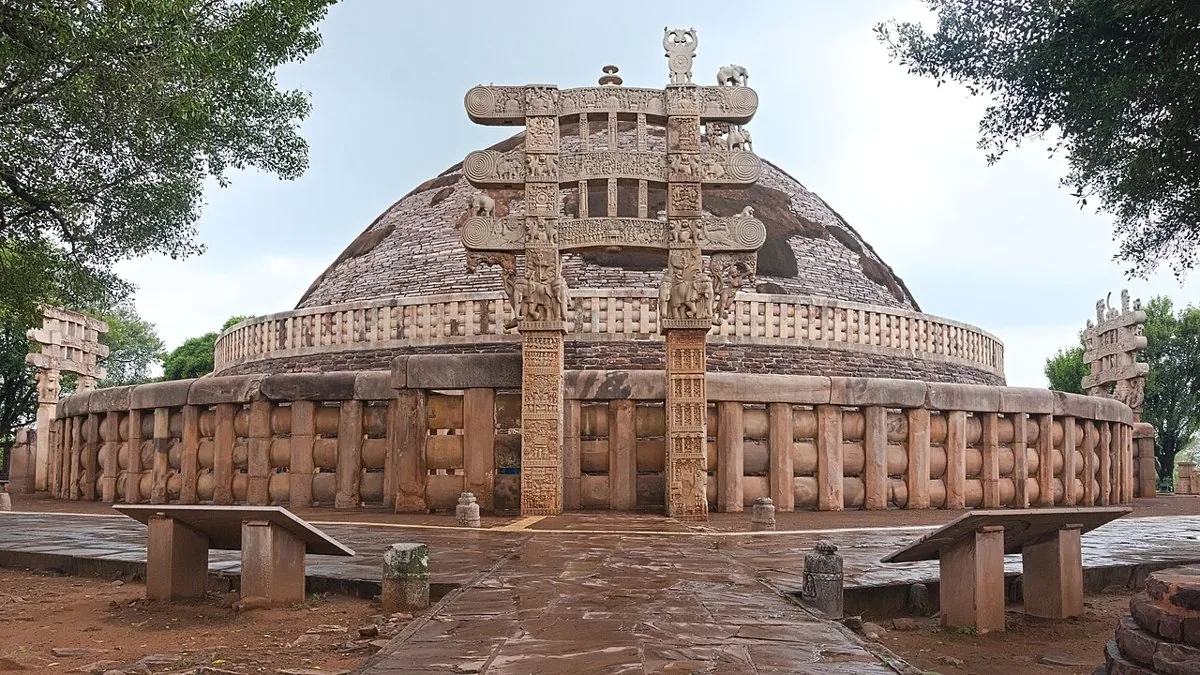
Image Source: Wikimedia
3. The Kanvas (73–28 BCE)
- Founder: Vasudeva Kanva, a Brahmin minister who killed the last Shunga king, Devabhuti.
- Rulers and years: 4 kings who ruled for 45 years: Vasudeva, Bhumimitra, Narayana and Susharman.
- End: the Satavahanas ended Kanva rule. Magadha then lost its central place until the Guptas.
- Sequence: Maurya → Shunga (185 BCE) → Kanva (73 BCE). The Maurya is the oldest of these dynasties. → PYQ: WBCS Mains GK 2021
4. The Chedis of Kalinga: Kharavela and the Hathigumpha Inscription
In simple words: After Ashoka, Kalinga became free again. In the 1st century BCE a powerful Jain king, Kharavela, ruled here. He recorded his whole career year by year in a cave inscription called Hathigumpha (“Elephant Cave”) near Bhubaneswar.
- Dynasty: Chedi, also called Mahameghavahana. Kharavela was its third king.
- Hathigumpha inscription:
- Where: Udayagiri hills, near Bhubaneswar, Odisha.
- Language and script: Prakrit, in Brahmi script.
- Content: a year-by-year account of his reign up to the 13th year. It is the main source on Kharavela.
- What it says:
- He sent an army west without caring for Satakarni (the Satavahana king).
- He attacked Magadha, humbled its king, and brought back a Jina image that the Nanda king had carried away from Kalinga.
- He broke up a confederacy of Tamil states that had lasted 113 years.
- On his approach, a Yavana (Greek) king retreated to Mathura.
- He extended a canal first dug by a Nanda king. This is one of the earliest references to the Nandas in an inscription.
- Religion:
- A Jain. He excavated rock-cut cells for Jain monks at Udayagiri and Khandagiri.
- He also respected other sects.
- Titles: Kalingadhipati, Bhikshuraja and Dharmaraja.
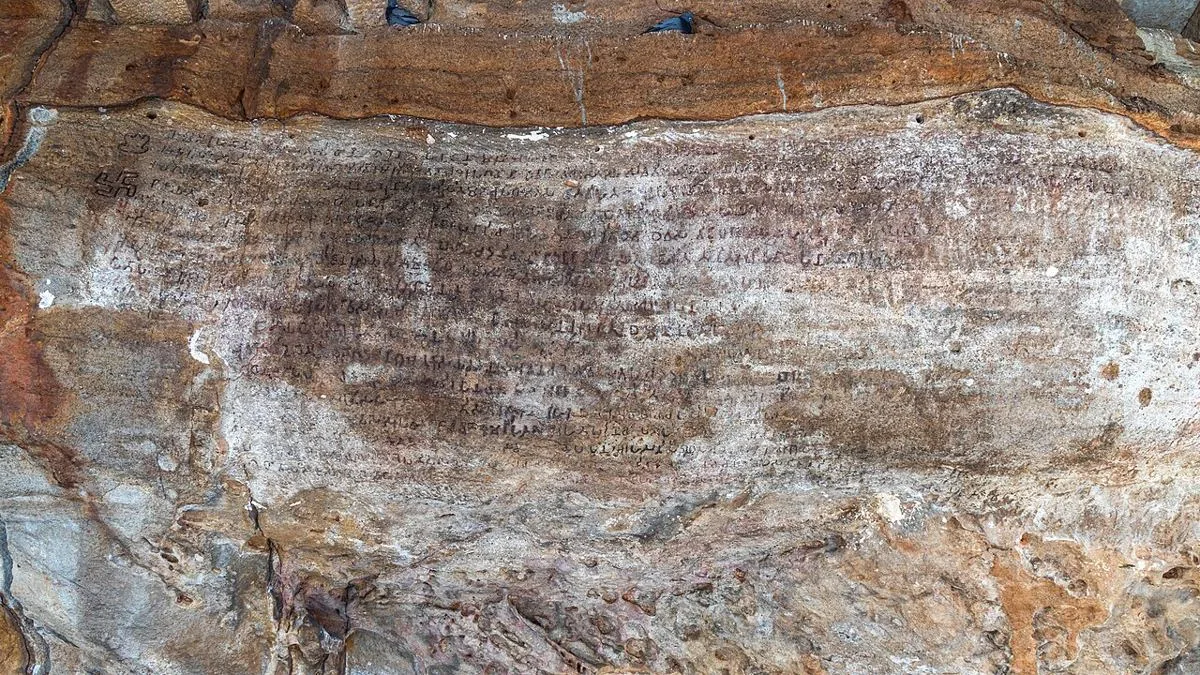
Image Source: Wikimedia
5. The Satavahanas (c. 1st century BCE – 3rd century CE)
In simple words: The Satavahanas were the first big kingdom of the Deccan, ruling Maharashtra and Andhra between the Narmada and the Krishna. They were Brahmins who fought the Shakas, gave land to Brahmins and Buddhists, and patronised the beautiful Amaravati art and the rock-cut chaityas of the Western Ghats.
5.1 Basic facts
- Other name: the Puranas call them Andhras (Andhra-bhrityas).
- Founder: Simuka. → PYQ: WBCS Prelims 2005
- Capital: Pratishthana (Paithan) on the Godavari, Maharashtra. Later Amaravati / Dhanyakataka in Andhra.
- Language: Prakrit in Brahmi script, used in their inscriptions.
- Caste: they were Brahmins. Gautamiputra calls himself Ekabrahmana (“the unique Brahmin”).
5.2 Important rulers
| Ruler | Key facts |
|---|---|
| Simuka | Founder; overthrew the Kanva remnants |
| Satakarni I | Performed two Ashvamedhas and a Rajasuya; title Dakshinapathapati; known from the Naneghat inscription of his queen Naganika (Nayanika) |
| Hala | Poet-king; compiled the Gathasaptasati (Gaha Sattasai), 700 Prakrit love verses |
| Gautamiputra Satakarni (c. 106–130 CE) | Greatest Satavahana; destroyed the Shaka Kshatrapa Nahapana; Nasik prashasti |
| Vasishthiputra Pulumavi | Son of Gautamiputra; extended rule into Andhra (Amaravati) |
| Yajna Sri Satakarni | Last great ruler; ship-type coins show sea trade |
5.3 Naneghat inscription (Queen Naganika)
- Where: the Naneghat pass, Pune district, Maharashtra.
- Issued by: Queen Naganika (Nayanika), widow of Satakarni I.
- Whose achievements: it describes the deeds of Satakarni I: his Ashvamedha and Rajasuya sacrifices and his huge gifts to Brahmins. → PYQ: WBCS Prelims 2000
- Firsts: one of the earliest records of Vedic sacrifices and of numerals in Brahmi. It also invokes Sankarshana and Vasudeva.
5.4 Gautamiputra Satakarni and the Nasik inscription
- Achievements:
- He destroyed the Kshaharata Shaka ruler Nahapana and restruck his silver coins. The Jogalthembi hoard (Nasik) has about 13,000 such coins.
- He is called the “destroyer of the Shakas, Yavanas and Pahlavas” and the “restorer of the varna order”.
- His horses “drank the water of the three oceans” (trisamudra-toya-pita-vahana).
- Nasik prashasti:
- It records Gautamiputra Satakarni’s achievements, so it is the main source on the Satavahanas. → PYQ: WBCS Mains 2023 | PYQ: WBCS Prelims 2011, 2004
- It was engraved in Cave 3 at Pandavleni, Nasik, by his mother Gautami Balashri, in the 19th year of his son Vasishthiputra Pulumavi.
5.5 Society, economy and administration
- Matronymics:
- Kings carried their mother’s name, such as Gautami-putra and Vasishthi-putra.
- Queens were powerful (Naganika, Gautami Balashri). Succession to the throne still passed in the male line.
- Land grants:
- The Satavahanas were the first rulers to grant land to Brahmanas and Buddhist monks.
- These grants were free from taxes and from entry by royal officers.
- This started the trend that led to feudal features in later times. → PYQ: WBCS Prelims 2002
- Coins:
- Mostly lead, plus potin (an alloy of copper, lead and tin), copper and bronze.
- Some silver portrait coins copied the Shaka style.
- Yajna Sri’s coins show a ship with two masts.
- Administration:
- Districts were called ahara, under amatyas.
- Feudatories included the Maharathis, Mahabhojas and Mahatalavaras.
- Military camps were called kataka and skandhavara.
- Ports: Sopara and Kalyan on the west coast, Barygaza (Bharuch) nearby, and Ghantasala on the east coast. → PYQ: WBCS Prelims 2011, 2002
- Literature:
- Hala‘s Gathasaptasati.
- Gunadhya‘s Brihatkatha (in Paishachi Prakrit).
- Sarvavarman‘s Katantra (a Sanskrit grammar).
5.6 Satavahana art and architecture
- Rock-cut chaityas and viharas in the Western Ghats: Karle (the largest chaitya), Bhaja, Nasik (Pandavleni), Kanheri and Ajanta caves 9 and 10.
- A chaitya is a prayer hall with a stupa at the end.
- A vihara is a monastery for monks.
- Stupas: Amaravati and Nagarjunakonda. Nagarjunakonda was patronised by their successors, the Ikshvakus.
- Amaravati School of Art:
- It flourished in the lower Krishna–Godavari valleys from the 2nd century BCE to the 3rd century CE. → PYQ: WBCS Mains 2016
- It used white marble and is known for narrative reliefs.
- Sanchi gateways: carved in their time.
- Successors in the Deccan: Ikshvakus, Abhiras, Chutus, Vakatakas and Pallavas.
6. The Indo-Greeks (Bactrian Greeks)
In simple words: After Alexander, Greek kings ruled Bactria (northern Afghanistan). When the Mauryan Empire weakened, these “Yavanas” crossed the Hindu Kush into India. We know them mainly from their beautiful coins. Their most famous king, Menander, became a Buddhist.
- First invader: Demetrius invaded India in about 182 BCE and took a large part of the north-west. → PYQ: WBCS Mains 2015
- Rival houses: two Greek families ruled in rivalry, those of Euthydemus (Demetrius) and Eucratides.
- Menander (Milinda), c. 165–130 BCE:
- The most famous Indo-Greek ruler. → PYQ: WBCS Prelims 2016 | PYQ: WBCS Mains 2022, 2014
- His capital was Sakala (Sialkot), Punjab. His territory reached the Ganga valley.
- The monk Nagasena converted him to Buddhism.
- Their dialogue is the Pali text Milindapanha (“Questions of Milinda”), written by Nagasena. It is a book of philosophical discussion. → PYQ: WBCS Mains 2023, 2022, 2014
- Antialcidas: sent Heliodorus to Vidisha (see Section 2.2).
- Coins:
- We know the Bactrian Greeks mainly from their coins. → PYQ: WBCS Mains 2014
- They were the first to issue coins bearing the ruler’s portrait and name.
- The coins are bilingual: Greek on one side, Kharosthi on the other. Kharosthi comes from Aramaic. → PYQ: WBCS Mains 2014
- The Indo-Greeks issued the first gold coins in India, in small numbers. → PYQ: WBCS Mains 2014
- Agathocles issued coins with Krishna (Vasudeva) and Balarama (Sankarshana), the earliest images of these gods. → PYQ: WBCS Prelims 2024
- Contributions:
- Hellenistic art, which laid the base of Gandhara art.
- Astronomy and astrology: the Yavanajataka, the Romaka Siddhanta and the word hora.
- The theatre curtain, yavanika.
7. The Shakas (Scythians) and the Western Kshatrapas
In simple words: The Shakas were nomads from Central Asia. The Yuezhi pushed them out, and they came into India after the Greeks. Their governors, called Kshatrapas (satraps), ruled western India for almost 400 years. The greatest was Rudradaman I, whose Junagadh inscription is the first long inscription in pure Sanskrit.
7.1 Branches of the Shakas
- Afghanistan and Taxila: King Maues (Moga).
- Mathura: Kshatrapas Rajuvula and Sodasa.
- Western Kshatrapas:
- Kshaharatas of Nasik and Maharashtra: Bhumaka and Nahapana. Gautamiputra Satakarni destroyed Nahapana.
- Kardamakas of Ujjain and Saurashtra: Chashtana and Rudradaman I.
7.2 Rudradaman I (c. 130–150 CE) and the Junagadh inscription
- Source: the Junagadh (Girnar) rock inscription of 150 CE. → PYQ: WBCS Mains 2023
- It is on the same rock as Ashoka’s 14 Major Rock Edicts.
- It is the first long inscription in chaste Sanskrit.
- Sudarshana lake:
- Chandragupta Maurya’s governor Pushyagupta built it.
- Ashoka’s governor Tushaspha added canals.
- After a storm broke its dam, Rudradaman repaired it through his minister Suvishakha, without forced labour (vishti) or extra taxes.
- In 455–456 CE Skandagupta’s governor Parnadatta (and his son Chakrapalita) repaired it again.
- Victories: he defeated the Satavahana king Satakarni twice but did not destroy him, because they were near relatives (a marriage alliance).
- Other facts: he was a lover of Sanskrit, music and logic.
7.3 Eras and the end of the Shakas
- Vikram Samvat (57 BCE): it is named after Vikramaditya of Ujjain, who drove the Shakas out of Ujjain.
- Shaka era (Shakabda):
- It began in 78 CE. → PYQ: WBCS Prelims 2007, 2004, 2000
- It was started by the Kushana king Kanishka. The Shaka Kshatrapas of the west used it widely, so it got their name. → PYQ: WBCS Prelims 2009, 2008 | PYQ: WBCS Mains 2022
- The National Calendar of India is based on the Shaka calendar. It was adopted on 22 March 1957 (1 Chaitra 1879 Shaka). → PYQ: WBCS Mains GK 2018
- End: the Gupta king Chandragupta II (Vikramaditya) defeated the last Western Kshatrapa, Rudrasimha III, around 409 CE. He took the title Shakari (“destroyer of the Shakas”). → PYQ: WBCS Prelims 2022 | PYQ: WBCS Mains 2022 | PYQ: WBPSC Clerkship
8. The Parthians (Pahlavas)
- Origin: Iran. They are called Pahlavas in Indian texts.
- Gondophares (c. 19–46 CE):
- The most famous Parthian king in India, ruling from Taxila and Gandhara.
- The Takht-i-Bahi inscription (near Peshawar) dates his reign.
- St Thomas:
- The apostle St Thomas came to Gondophares’ court to spread Christianity.
- He later went to South India and died near Chennai (Mylapore).
- End: the Kushanas overthrew the Parthians.
9. The Kushanas (c. 30–250 CE)
In simple words: The Kushanas were a branch of the Yuezhi people of Central Asia (north-west China). They built an empire stretching from the Oxus river in Central Asia to Varanasi in the Ganga valley. Their greatest king, Kanishka, started the Shaka era (78 CE), called the Fourth Buddhist Council and patronised Mahayana Buddhism and the Gandhara and Mathura schools of art.
9.1 Origin
- Where they came from: Central Asia. → PYQ: WBCS Mains 2022
- How they came: the Yuezhi were driven west by the Xiongnu (Huns). They settled in Bactria, where the Kushana clan united the five Yuezhi tribes.
9.2 Kushana rulers
| Ruler | Key facts |
|---|---|
| Kujula Kadphises (Kadphises I) | Founder; captured Kabul and Gandhara from the Parthians; copper coins copied Roman ones |
| Vima Takto | Son of Kujula; named in the Rabatak inscription |
| Vima Kadphises (Kadphises II) | Issued gold coins on a large scale; a devotee of Shiva (Mahishvara); coins show Shiva with Nandi and a trident |
| Kanishka I (from 78 CE) | Greatest Kushana; Shaka era; 4th Buddhist Council; capital Purushapura |
| Huvishka | Successor; many gold coins with Indian, Greek and Iranian gods |
| Vasudeva I | Last great Kushana; his Indian name shows the dynasty had become Indian; Shiva on his coins |
- Gold coins:
- The Kushanas were the first Indian rulers to issue gold coins on a large scale, on the Roman pattern (the gold dinara). → PYQ: WBCS Mains 2017 | PYQ: WBCS Prelims 2007
- Their coins were purer in gold than the later Gupta coins. The Gupta gold coins were also called dinara. → PYQ: WBCS Mains 2014
9.3 Kanishka (78 CE – c. 101 CE)
- Standing: the greatest Kushana ruler. → PYQ: WBCS Mains 2022
- Shaka era: began with his accession in 78 CE. → PYQ: WBCS Mains 2022 | PYQ: WBCS Prelims 2009, 2008
- Capitals:
- Purushapura (Peshawar). → PYQ: WBCS Mains 2022
- Mathura was the second capital.
- Kapisa (Begram) was the summer capital.
- Empire:
- From Kashgar, Yarkand and Khotan in Central Asia to Varanasi.
- The Rabatak inscription says his rule reached Pataliputra and Champa.
- He controlled the Silk Route.
- Titles:
- Devaputra (“son of god”, a Chinese idea).
- Shaonanoshao (“king of kings”, Persian).
- Kaisara (Caesar, Roman).
- Rabatak inscription:
- Found in 1993 at Rabatak, Baghlan province, Afghanistan. It is in the Bactrian language, in Greek script.
- It gives the Kushana family tree: Kujula → Vima Takto → Vima Kadphises → Kanishka.
- It names the Indian cities Kanishka ruled.
- Statue: a headless standing statue of Kanishka was found at Mat, near Mathura. It is now in the Government Museum, Mathura. It bears the label “Maharaja Rajatiraja Devaputra Kanishka”.
- Kanishka stupa at Peshawar: built under the Greek engineer Agesilaus.
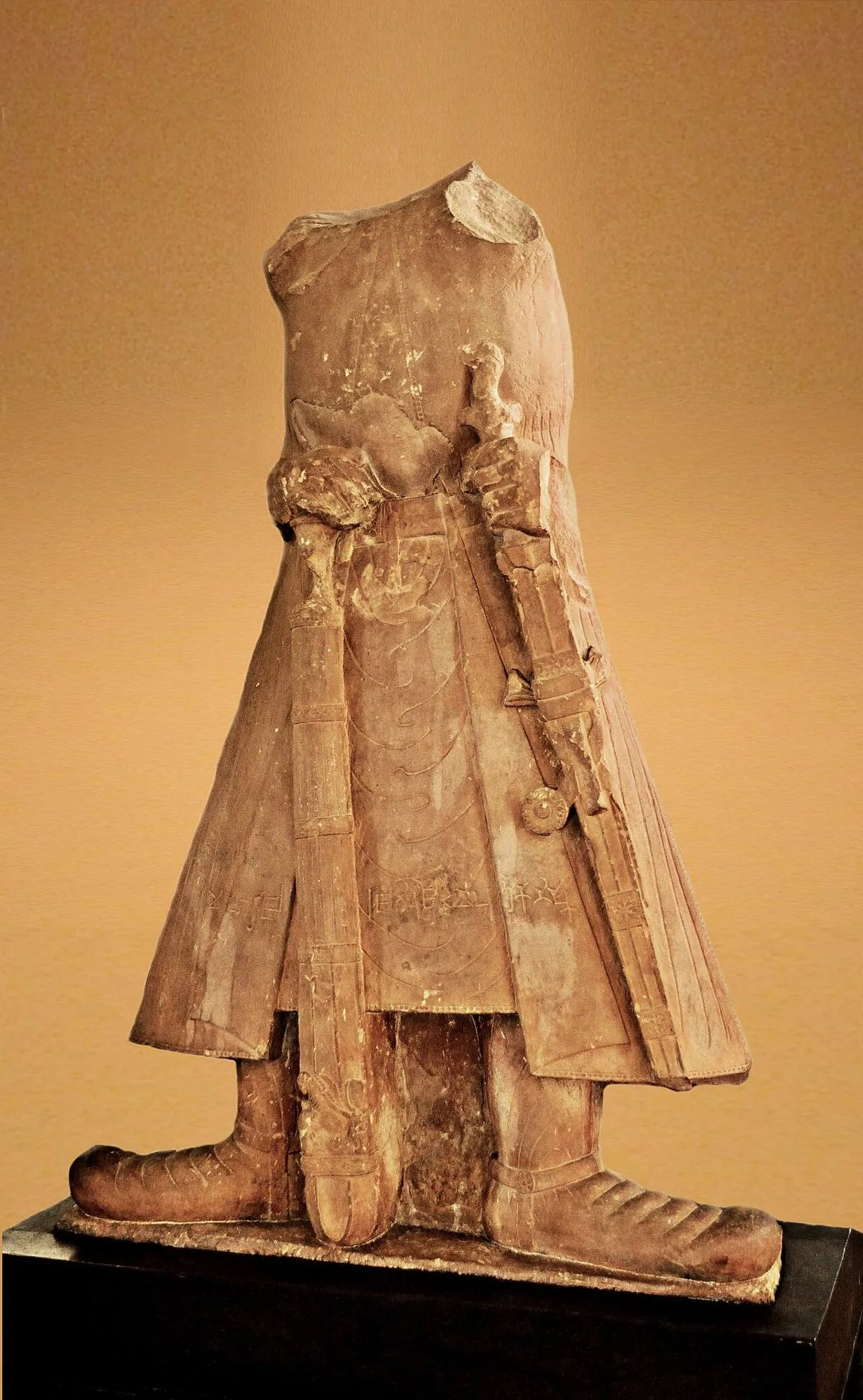
Image Source: Wikimedia
9.4 Fourth Buddhist Council and Mahayana
- Where: Kundalvana (Kashmir), the last of the four major Buddhist councils. → PYQ: WBCS Mains 2022
- Chief patron: Kanishka. → PYQ: WBCS Mains 2023
- President and vice-president: Vasumitra presided; Ashvaghosha was vice-president.
- Work done:
- The Sarvastivada commentaries, the Mahavibhasha, were compiled in Sanskrit.
- Buddhism split into Mahayana and Hinayana.
- Mahayana (“Great Vehicle”):
- The Buddha is worshipped as a god in image form.
- It follows the Bodhisattva ideal (Avalokiteshvara, Maitreya, Manjushri) and uses Sanskrit.
- It spread to Central Asia, China, Korea and Japan along the Silk Route.
- Hinayana (“Lesser Vehicle”, Theravada): the Buddha is a teacher, followers seek individual salvation, and texts are in Pali.
9.5 Scholars of the Kushana age
| Scholar | Known for |
|---|---|
| Ashvaghosha | Buddhacharita (life of the Buddha), Saundarananda, Sariputraprakarana; Kanishka’s court poet |
| Vasumitra | President of the 4th Council; Mahavibhasha |
| Nagarjuna | Mahayana philosopher; founder of the Madhyamika (Shunyavada) school; Mula-madhyamaka-karika; Nagarjunakonda is named after him |
| Charaka | Court physician of Kanishka; Charaka Samhita (medicine) |
| Sushruta | Sushruta Samhita (surgery) |
| Mathara | Kanishka’s minister |
| Agesilaus | Greek engineer of the Kanishka stupa |
- Ashvaghosha wrote the Buddhacharita. → PYQ: WBCS Prelims 2018, 2009 | PYQ: WBCS Mains 2023
- Ashvaghosha wrote the Sanskrit kavya Saundarananda. → PYQ: WBCS Mains 2020
- Charaka was the court physician of Kanishka. Do not confuse him with Jivaka, the physician of the Buddha’s time. → PYQ: WBCS Prelims 2000
- Later medicine: Vagbhata (Ashtanga Hridaya) is the great medical scholar of the Gupta age. → PYQ: WBCS Prelims 2001
9.6 Decline of the Kushanas
- Causes: after Vasudeva I (c. 230 CE), the Sasanians of Iran took Bactria and the north-west.
- Successors: in India, local powers such as the Nagas, Yaudheyas and later the Guptas took over.
10. Art of the Age: Gandhara, Mathura and Amaravati
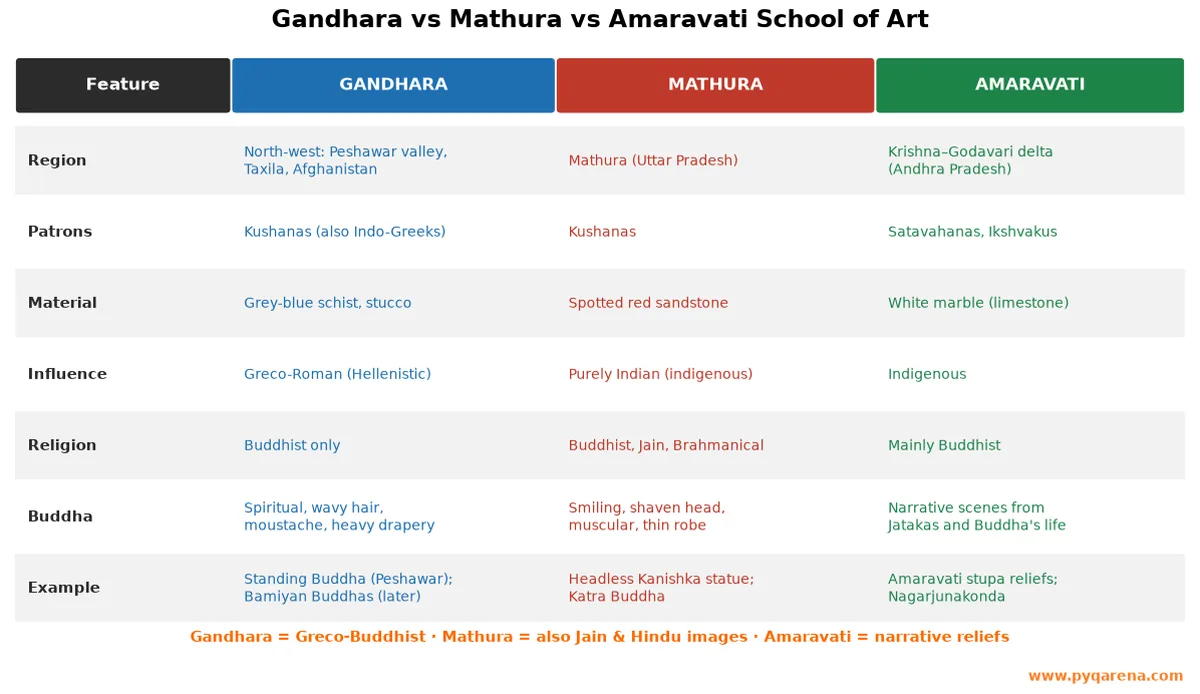
In simple words: For the first time, the Buddha was shown in human form. Earlier (at Bharhut and Sanchi) he was shown only by symbols. Three schools of sculpture grew up: Gandhara in the north-west (Greek influence), Mathura on the Yamuna (purely Indian) and Amaravati in Andhra (narrative marble reliefs).
10.1 Gandhara School
- When: it flourished under the Kushanas, beginning under the Indo-Greeks. → PYQ: WBCS Mains 2023 | PYQ: WBCS Prelims 2003
- Where: the Peshawar valley, Taxila and Afghanistan (Bamiyan, Begram). Taxila is a famous site of Gandhara art. → PYQ: WBCS Prelims 2014
- Other name: Greco-Buddhist (Indo-Greek) art, a blend of Hellenistic style and Buddhist themes.
- Firsts: the images of the Buddha were first made in human form here. → PYQ: WBCS Prelims 2001, 2002
- Material: grey-blue schist (stone) and stucco (lime plaster).
- Features:
- Wavy hair in a top-knot and sometimes a moustache.
- Heavy, pleated drapery like a Greek toga, and a spiritual expression.
- Religion: Buddhist themes only.
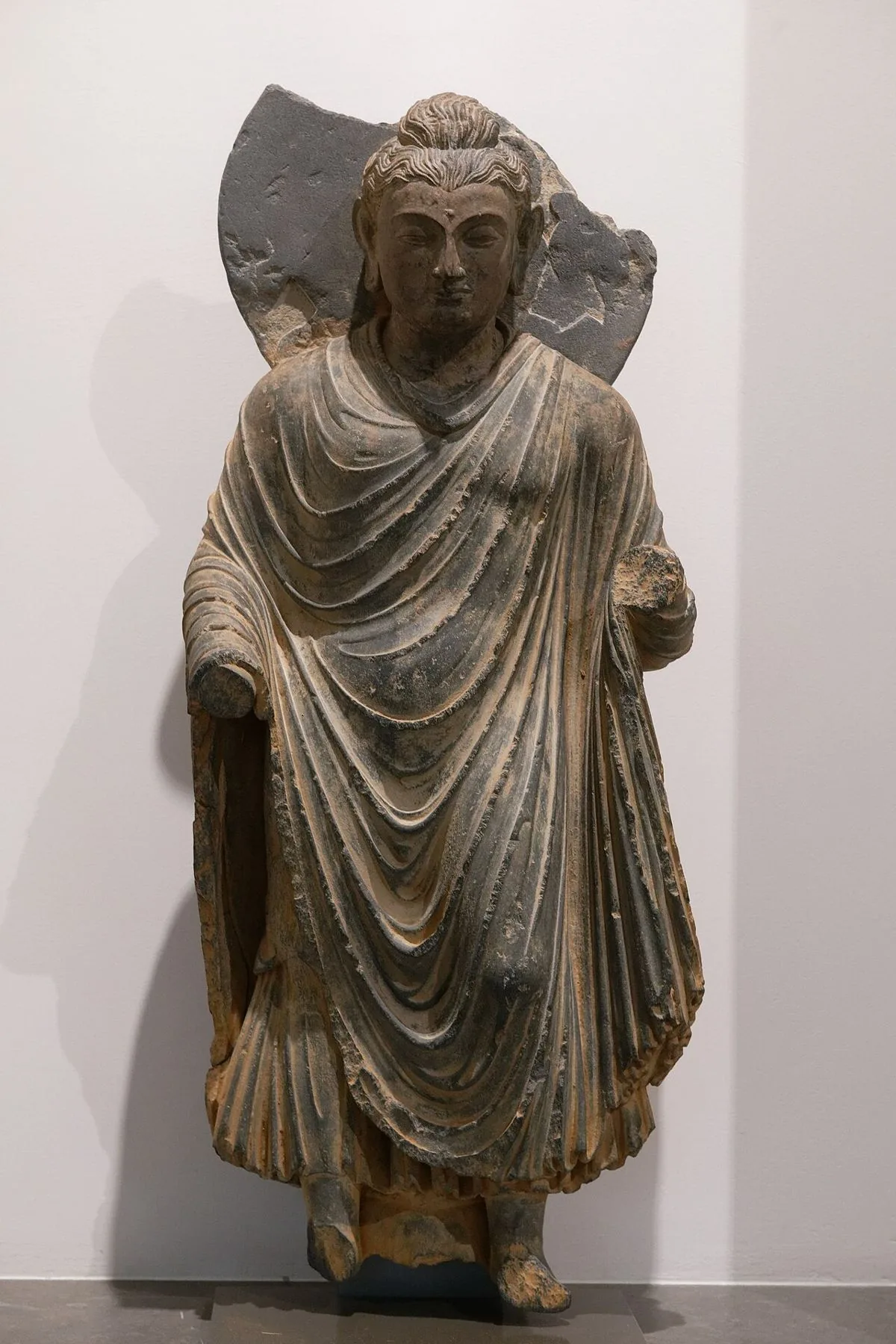
Image Source: Wikimedia
10.2 Mathura School
- When: it flourished in the Kushana period. → PYQ: WBCS Prelims 2009
- Material: spotted red sandstone from Sikri.
- Style: purely indigenous. It grew from the earlier Yaksha tradition.
- The Buddha looks smiling and fleshy, with a shaven head and a thin robe.
- Religion: it made images for Buddhists, Jains and Brahmanical (Hindu) cults alike, including early Vishnu, Shiva, Surya and Jain tirthankaras.
- Royal portraits: headless statues of Kanishka and Vima Kadphises (Mat shrine). The Katra Buddha is a famous Mathura image.
10.3 Amaravati School
- When and where: the lower Krishna–Godavari region, from the 2nd century BCE to the 3rd century CE. → PYQ: WBCS Mains 2016
- Patrons: the Satavahanas and later the Ikshvakus.
- Material: white marble (greenish-white limestone).
- Style: lively narrative reliefs of the Buddha’s life and Jataka stories, with many figures in motion.
- Sites: Amaravati, Nagarjunakonda, Jaggayyapeta and Ghantasala.
10.4 Rock-cut architecture
- Western Deccan: chaityas at Karle, Bhaja, Kondane, Nasik, Kanheri and Ajanta (caves 9 and 10).
- Odisha: Jain caves at Udayagiri–Khandagiri under Kharavela.
11. Economy, Trade and Guilds
In simple words: The post-Mauryan centuries were a golden age of trade. Roman ships came to Indian ports for pepper and cloth, and caravans carried goods along the Silk Route to China. Merchants and craftsmen organised themselves into guilds (shrenis), which even acted as banks.
11.1 Guilds (Shrenis)
- What they were: associations of merchants and artisans: weavers, potters, oil-pressers, bamboo workers, ivory carvers and others.
- Leadership: a jyeshthaka (head) or shreshthi led each guild.
- Powers: guilds had their own laws, seals, militia and funds.
- Banks: guilds accepted permanent deposits and paid interest.
- The Nasik inscription of Ushavadata (Nahapana’s son-in-law) records deposits with weavers’ guilds at Govardhana, at 12% and 9% interest.
- Donors: the ivory carvers of Vidisha donated a carving at Sanchi.
- Nigama: an association of merchants in a town.
11.2 Trade with Rome
- Augustus: sea trade with Rome got a great impetus under the Roman emperor Augustus (27 BCE – 14 CE). → PYQ: WBCS Mains 2016
- Hippalus: this Greek sailor found the use of the monsoon winds (c. 46 CE). Ships could then sail directly across the Arabian Sea.
- Sources:
- Periplus of the Erythraean Sea (1st century CE).
- Pliny’s Natural History, which complains of Rome’s gold drain to India.
- Ptolemy’s Geography.
- Exports:
- Pepper (called yavanapriya, “dear to the Greeks”), spices, muslin, ivory, pearls, gems and indigo.
- Silk re-exported from China.
- Imports: gold and silver coins, wine (in amphorae), red-glazed Arretine ware, glass, tin and lead.
- Arikamedu (near Puducherry): a Roman settlement and factory (trading station) has been found here. → PYQ: WBCS Mains 2016
- Ports:
- West coast: Barygaza (Bharuch), Sopara, Kalyan and Muziris (Kerala).
- East coast: Puhar (Kaveripattinam), Arikamedu and Tamralipti (Bengal).
- Ujjain: the nodal point where north–south and east–west trade routes met in the pre-Gupta and Gupta periods. → PYQ: WBCS Mains 2020
- Earlier history: Indian trade history begins much earlier, in the Harappan period (see Indus Valley Civilization Notes). → PYQ: WBCS Mains 2016
11.3 Silk Route
- Route: the Kushanas controlled the land route from China through Central Asia (Kashgar, Khotan) and Bactria to Persia and Rome.
- A branch came down to Taxila, Mathura and the western ports.
- Begram hoard: Chinese lacquer, Roman glass and Indian ivory found together, which shows this trade.
- Decline: Indian silk trade suffered after silkworms reached the Byzantine Empire from China in 551 CE. → PYQ: WBCS Mains 2015
11.4 Coins at a glance
- Indo-Greeks: portrait coins, bilingual (Greek and Kharosthi); first gold (few).
- Shakas: silver coins with portraits and dates, in the Shaka era.
- Satavahanas: lead, potin and copper; ship coins.
- Kushanas: large-scale gold (Roman-weight) and copper coins.
- Roman coins: found in large hoards in South India.
12. The Sangam Age Link (South India)
In simple words: While the north had Shungas and Kushanas, the far south (Tamil country) was ruled by three kingdoms: the Cheras, Cholas and Pandyas. Their history comes from Tamil poems composed in Sangams, assemblies of poets.
- Meaning of “Sangam”: an assembly (academy) of poets. → PYQ: WBCS Mains 2020
- Patrons: three Sangams were held. The Pandyas of Madurai were the centre and patrons of Sangam poets. → PYQ: WBCS Mains 2018
- Kingdoms:
| Kingdom | Capital | Port | Emblem / fact |
|---|---|---|---|
| Chera | Vanji (Karur) | Muziris, Tondi | Bow; Malabar coast, called Malaimandalam → PYQ: WBCS Mains 2017 |
| Chola | Uraiyur | Puhar (Kaveripattinam) | Tiger; Karikala built the Kallanai (Grand Anicut) on the Kaveri → PYQ: WBPSC Misc 2024 |
| Pandya | Madurai | Korkai (pearls) | Fish; patrons of the Sangams |
- Literature:
- Tolkappiyam (Tamil grammar).
- Ettuthogai and Pattuppattu (anthologies).
- Tirukkural (Tiruvalluvar).
- The epics Silappadikaram (Ilango Adigal) and Manimekalai (Sattanar).
- Administration: spies were called Orrars. → PYQ: WBCS Mains 2019
- Links with the north:
- Kharavela broke up a Tamil confederacy.
- Ashoka’s Rock Edict II names these kingdoms as lying outside his empire (see the Mauryan Empire chapter).
13. Master Comparison Table
| Dynasty | Founder | Greatest ruler | Capital | Key source | Remember for |
|---|---|---|---|---|---|
| Shunga | Pushyamitra | Pushyamitra | Pataliputra, Vidisha | Ayodhya inscription; Malavikagnimitram | Patanjali; Bharhut; Ashvamedha |
| Kanva | Vasudeva | — | Pataliputra | Puranas | 4 kings, 45 years |
| Chedi | Mahameghavahana | Kharavela | Kalinganagari | Hathigumpha | Jain king; Udayagiri caves |
| Satavahana | Simuka | Gautamiputra Satakarni | Pratishthana | Nasik, Naneghat | Land grants; lead coins; matronyms |
| Indo-Greek | Demetrius (in India) | Menander | Sakala | Coins; Milindapanha | Portrait coins; Gandhara beginnings |
| Shaka (W. Kshatrapa) | Bhumaka / Chashtana | Rudradaman I | Ujjain | Junagadh | First long Sanskrit inscription; Sudarshana lake |
| Parthian | — | Gondophares | Taxila | Takht-i-Bahi | St Thomas |
| Kushana | Kujula Kadphises | Kanishka | Purushapura | Rabatak; coins | Shaka era 78 CE; 4th Council; gold coins |
14. FAQ: Quick Questions
| Question | Answer |
|---|---|
| Dynasty after the Mauryas in Magadha? | Shunga |
| Patanjali was a contemporary of? | Pushyamitra Shunga |
| Who set up the Garuda pillar at Besnagar? | Heliodorus |
| Hathigumpha inscription is of? | Kharavela (Kalinga) |
| Founder of the Satavahana dynasty? | Simuka |
| Naneghat inscription describes? | Satakarni I (issued by Queen Naganika) |
| Nasik inscription is about? | Gautamiputra Satakarni (Satavahanas) |
| First rulers to grant land to Brahmanas? | Satavahanas |
| Important Satavahana port? | Sopara |
| Menander was? | An Indo-Greek (Bactrian Greek) king |
| Milindapanha was written by? | Nagasena |
| Bactrian Greeks are known mainly from? | Coins |
| Indo-Greek coins with Krishna and Balarama? | Agathocles |
| Bactrian king who invaded c. 182 BCE? | Demetrius |
| Junagadh inscription is of? | Rudradaman I (Shaka) |
| Shaka era began in? | 78 CE, by Kanishka |
| Kushanas came from? | Central Asia |
| Kanishka’s capital? | Purushapura (Peshawar) |
| Fourth Buddhist Council: where and patron? | Kundalvana, Kashmir; Kanishka |
| Author of Buddhacharita? | Ashvaghosha |
| Gold coins on the Roman pattern first? | Kushanas |
| Gandhara and Mathura art flourished under? | Kushanas |
| Art of the Krishna–Godavari valley? | Amaravati School |
| Roman factory found at? | Arikamedu |
| Gupta king who destroyed the Shakas? | Chandragupta II (“Shakari”) |
| Mihirakula was? | A Huna king (not Shaka, Kushana or Pahlava) → PYQ: WBCS Prelims 2023 |
15. Quick Revision Sheet
- Shungas (185–73 BCE):
- Pushyamitra killed Brihadratha; two Ashvamedhas; Patanjali (Mahabhashya).
- Agnimitra (Malavikagnimitram); Bhagabhadra.
- Heliodorus pillar (Besnagar, Bhagavata cult); Bharhut; Sanchi enlarged; last king Devabhuti.
- Kanvas (73–28 BCE): Vasudeva Kanva; 4 kings; ended by the Satavahanas.
- Kharavela: Chedi; Hathigumpha (Udayagiri, Prakrit, Brahmi); Jain; Nanda’s Jina image; Tamil confederacy.
- Satavahanas:
- Rulers: Simuka (founder); Satakarni I (Naneghat, Naganika); Hala (Gathasaptasati).
- Gautamiputra Satakarni: killed Nahapana; Nasik prashasti by Gautami Balashri; Ekabrahmana.
- Society and economy: matronyms; first land grants to Brahmanas; lead and potin coins; Sopara port.
- Art: Amaravati; Karle chaitya.
- Indo-Greeks:
- Demetrius (c. 182 BCE); Menander (Sakala; Milindapanha by Nagasena); Antialcidas.
- Coins: portrait coins; first gold (few); Agathocles‘ Krishna–Balarama coins.
- Shakas:
- Branches: Maues; Mathura satraps; Nahapana; Chashtana.
- Rudradaman I: Junagadh 150 CE (Sanskrit; Sudarshana lake).
- End: Chandragupta II (Shakari).
- Parthians: Gondophares; St Thomas; Takht-i-Bahi.
- Kushanas:
- Rulers: Yuezhi; Kujula Kadphises; Vima Kadphises (gold, Shiva).
- Kanishka: 78 CE Shaka era; Purushapura; 4th Council at Kundalvana (Vasumitra, Ashvaghosha); Mahayana; Rabatak; Devaputra.
- Scholars: Charaka, Nagarjuna.
- Art:
- Gandhara: Greco-Buddhist, schist, first Buddha images.
- Mathura: red sandstone, indigenous, Jain and Hindu too.
- Amaravati: white marble, narrative.
- Trade:
- Rome: Augustus, Hippalus’ monsoon, Periplus, Arikamedu, Muziris, pepper.
- Silk Route under the Kushanas.
- Guilds: shrenis acted as banks (Nasik, 12% interest).
- Sangam:
- Assembly of poets under the Pandyas of Madurai.
- Karikala Chola; Chera = Malaimandalam; spies = Orrars.
16. Summary
- Overall picture: the 500 years after the Mauryas were an age of regional kingdoms and foreign rulers, not of decline.
- Indian dynasties:
- In the north, the Shungas and Kanvas revived Brahmanism and Sanskrit.
- In Kalinga, Kharavela left the Hathigumpha record.
- In the Deccan, the Satavahanas began land grants, issued lead coins and patronised Buddhist caves and Amaravati art.
- Foreign rulers:Indo-Greeks, Shakas, Parthians and Kushanas came one after another from the north-west.
- They brought new coinage (portrait and gold coins), new ideas of kingship (Devaputra, Kshatrapa), and Greek and Central Asian art.
- All of them were absorbed into Indian society and religion.
- Kanishka’s age: the high point, with the Shaka era, the Fourth Buddhist Council, the rise of Mahayana, the Gandhara and Mathura schools, Charaka’s medicine and control of the Silk Route.
- Trade: commerce with Rome and China made the guilds rich, and the Sangam kingdoms of the south shared in this prosperity.
- What came next: the stage was set for the Gupta Empire.
17. Related PYQ Collections on PYQ Arena
- WBCS Mains: Post-Mauryan Empire PYQs
- WBCS Prelims: Ancient Indian History PYQs
- WBCS Mains: Buddhism and Jainism PYQs
- WBCS Mains: Gupta Empire PYQs
- WBCS Mains: South Indian Dynasties PYQs
- WBCS Mains: Pre-Mauryan & Mauryan Empire PYQs
- WBCS Mains: General Knowledge (History)
- WBCS Mains: General Knowledge (Art & Culture)
- WBPSC Miscellaneous: History PYQs
- WBPSC Clerkship: History PYQs
- WBP SI Prelims: History PYQs
Previous chapters: Prehistoric India · Indus Valley Civilization · Vedic Age · Mahajanapadas and Rise of Magadha · Buddhism and Jainism · Schools of Indian Philosophy · Mauryan Empire
Leave a Comment